Get in Touch with MACY-PAN Company

How to Choose a Portable Hyperbaric Chamber: 2026 Buyer Guide
Learn how to choose a portable hyperbaric chamber by pressure, chamber type, size, safety records, cost, and manufacturer support.

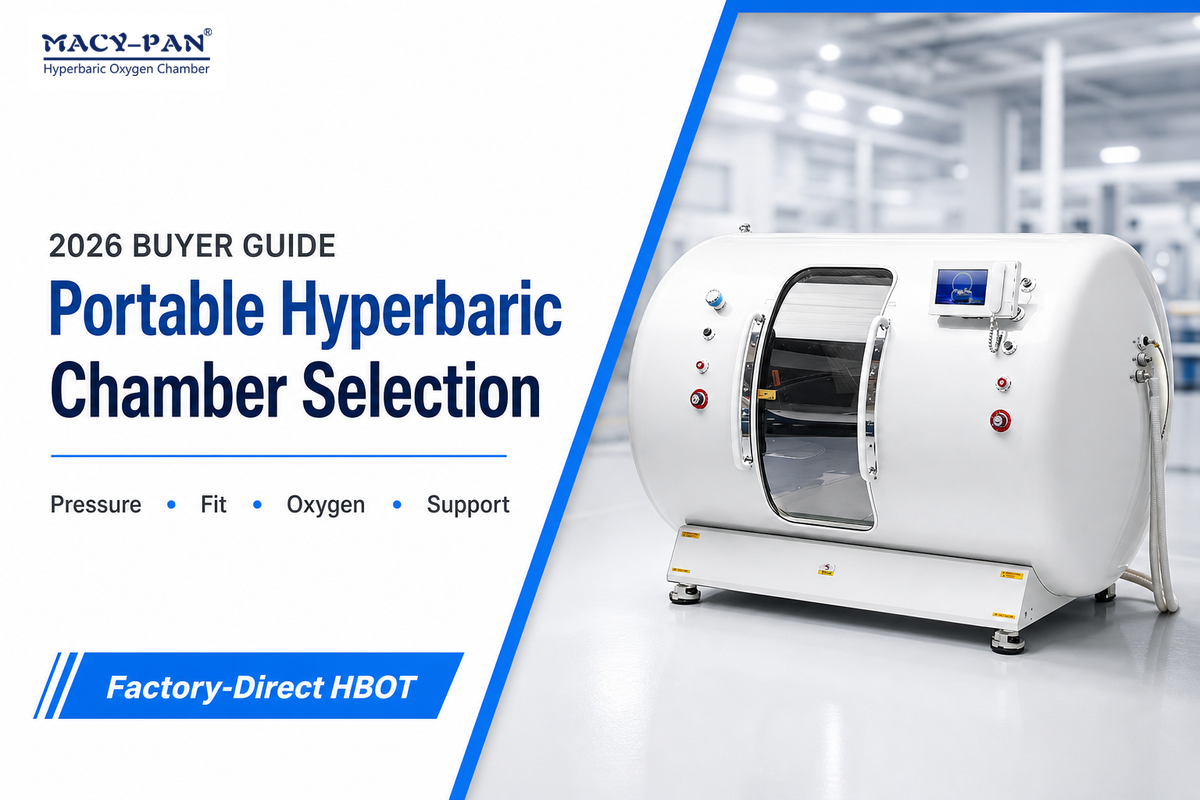
Learning how to choose a portable hyperbaric chamber starts with a harder question than price: what pressure, chamber type, fit, oxygen setup, documents, and supplier support match the way the chamber will actually be used?
Home buyers, service studios, recovery centers, and OEM distributors should not read the same quote in the same way. A soft portable chamber can be a practical choice for home routines, while a rigid system may fit a professional site or higher operating range better. Use case comes first; model choice comes second.
Quick specs before you compare
- Start with intended use: home routines, recovery room, facility workflow, or distributor/OEM supply.
- Compare ATA, not only PSI. Common soft portable options are often discussed around 1.3 to 1.5 ATA, while some rigid systems are positioned around 2.0 ATA.
- Ask how oxygen is delivered. Concentrator output purity is not the same as the oxygen percentage a person breathes inside the chamber.
- Request the document pack before deposit: quality-system certificate, market documents, pressure-vessel or test records where applicable, user manual, maintenance schedule, parts list, warranty, and training terms.
- Use supplier support as a deciding factor, especially if you are buying for repeated sessions, a paid service, or private-label resale.
Quick Answer: The Portable Hyperbaric Chamber Selection Sequence
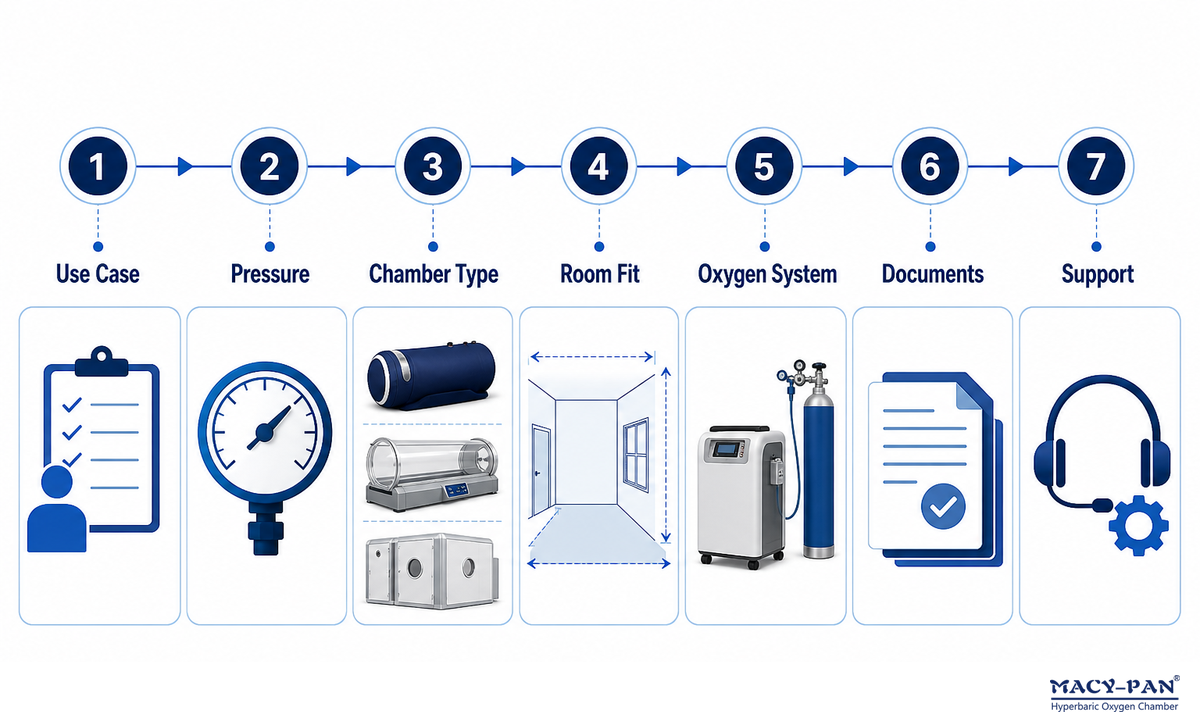
Keep this checklist handy: before you shop for brands or request a formal quote, address these issues first.
- Determine the primary use case and the operator’s experience.
- Select an operating range consistent with that use case without overstating clinical claims.
- Choose between soft shell, hard shell, horizontal, vertical, or a large-capacity facility style unit.
- Consider the fit: user size, ease of entry, room clearance requirements, flooring capacity and storage needs.
- Review oxygen concentrator, compressor, airflow, controls, noise, and cooling.
- Verify safety documents, certificates, manuals, and market-specific regulatory claims.
- Evaluate the total cost: This includes the chamber, shipping, warranty coverage, availability of spare parts, training, and after-sales responsiveness.
One common purchase error is focusing solely on the highest rating on the specification sheet.
That number matters, but it doesn’t fully explain whether the chamber is a suitable size for your room, or will accommodate your users, fulfill your documentation needs, or provide ongoing support.
Keep this buying guide separate from MACY-PAN’s portable hyperbaric chambers page. This article is the decision path; the product page is where model-level details belong.
Start With Pressure Range and Intended Use
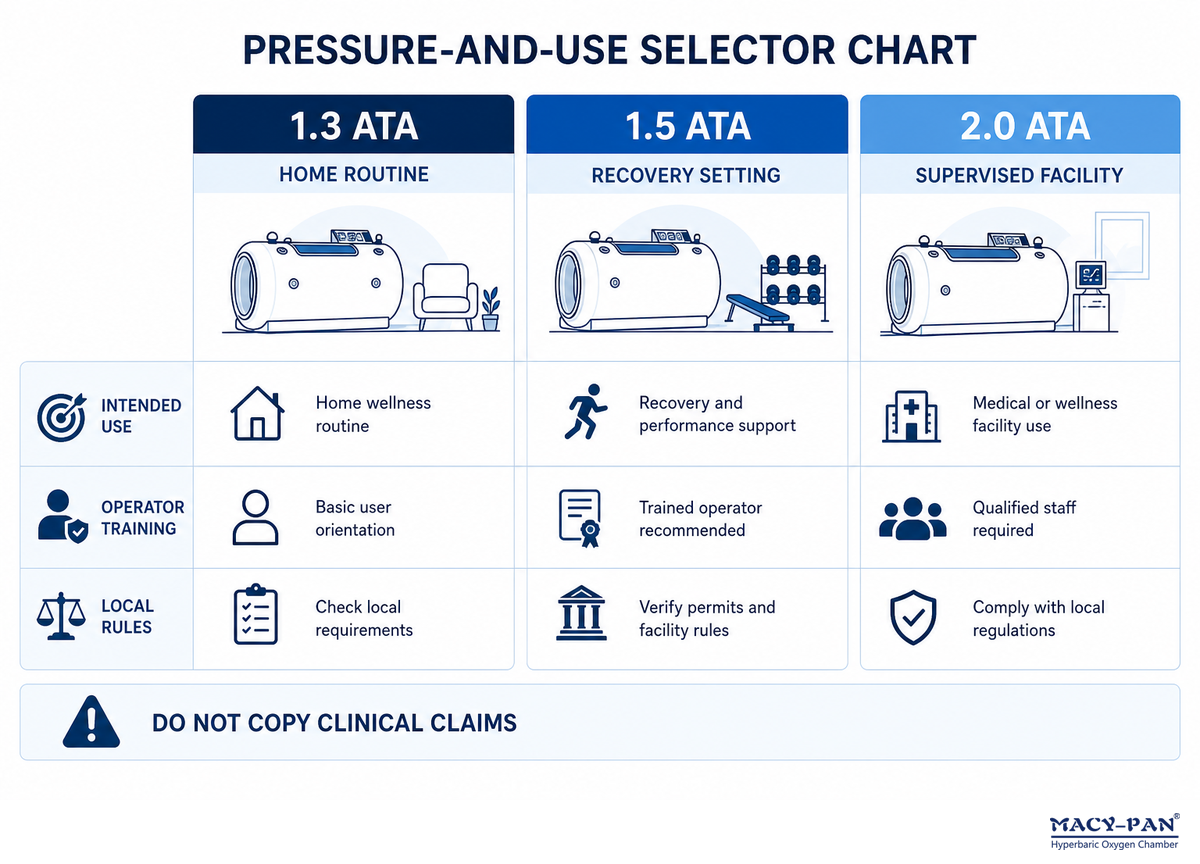
ATA means atmospheres absolute. In plain English, it describes pressure relative to normal air pressure at sea level. The chamber at 1.3 ATA is pressurized above normal atmospheric pressure; a 1.5 ATA chamber is higher; a 2.0 ATA chamber is higher again.
What is a mild hyperbaric chamber?
Mild hyperbaric chamber usually refers to a lower-range chamber used in non-clinical home or recovery contexts. Buyers should treat the term as a product category, not as medical clearance.
The operating range should be tied to intended use, setting, operator training, and local rules. Undersea and Hyperbaric Medical Society guidance describes clinical hyperbaric oxygen therapy in a much narrower way than many consumer pages do: clinical HBO2 involves a hard-sided chamber meeting recognized standards and prescribed oxygen in higher clinical settings. That matters because a mild portable hyperbaric chamber is not the same thing as a hospital or wound-care unit.
Compare pressure capabilities as product specifications, not as treatment promises; clinical wound healing protocols belong under medical supervision and should not be copied into home-use buying copy.
Pressure framing that keeps the decision honest
- Home-use and recovery buyers often compare soft portable chamber options around 1.3 to 1.5 ATA.
- Medical-facility buyers should ask whether the chamber, facility, operator training, oxygen system, and local regulatory path match the intended setting.
- If a seller uses specs to promise outcomes for medical conditions, ask for clinical context and a qualified medical source before relying on the claim.
MACY-PAN’s public portable chamber page positions soft 1.3-1.5 ATA recovery chambers and rigid 2.0 ATA systems as different product families. That distinction should stay visible in the buying process. If your goal is a home hyperbaric chamber for personal routines, your checklist will look different from a facility adding hyperbaric oxygen therapy as a paid service.
If you want a quick internal path, compare use goals with MACY-PAN’s pressure-to-goal chamber selector before asking for a quote.
Compare Soft Shell and Hard Shell Chamber Types
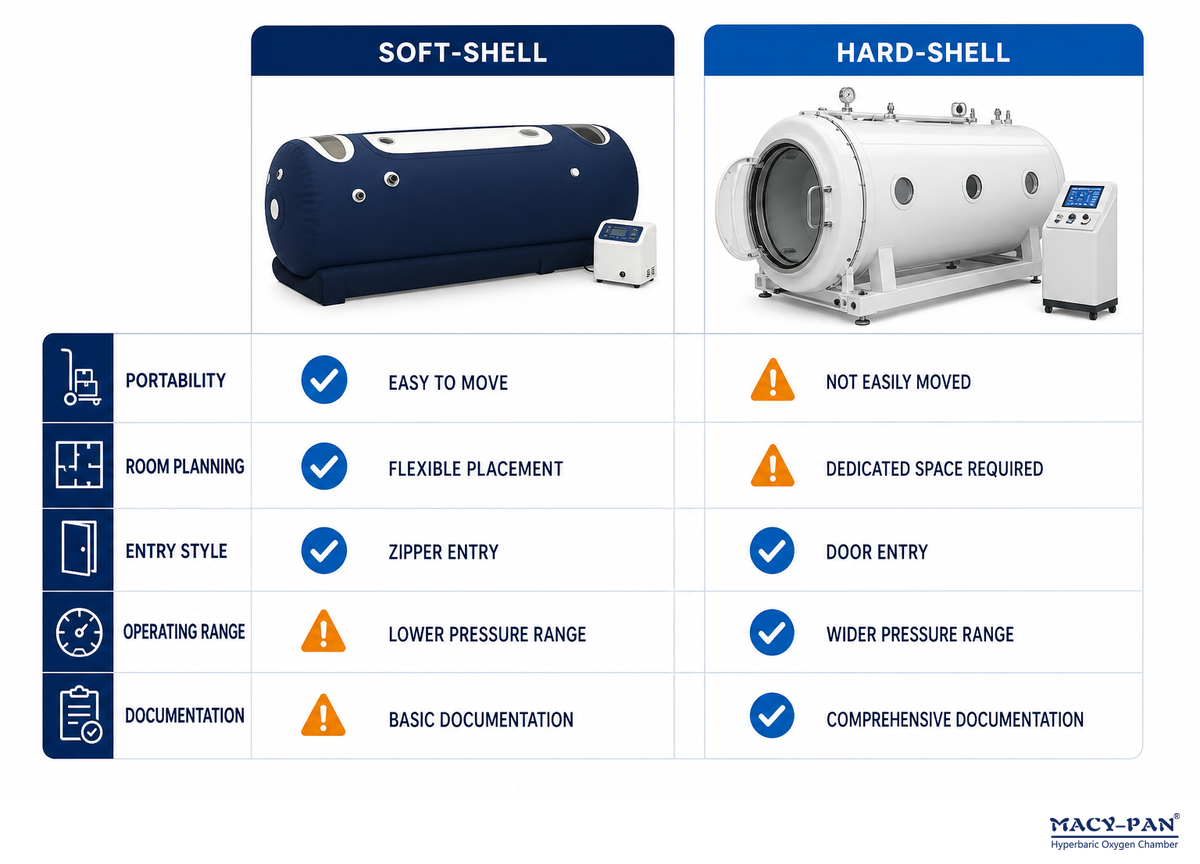
Next, decide on chamber type. Soft-sided chambers are often lighter, easier to move, and more practical for many home installations. Rigid chambers usually take more space and planning, but they may better fit facility environments, higher operating needs, and users who want a firmer structure.
| Factor | Soft portable chamber | Hard-shell chamber |
|---|---|---|
| Typical comparison point | Portability, home setup, storage, lower-pressure wellness routines | Rigid structure, facility workflow, higher operating range |
| Fit questions | Can the user enter comfortably? Can the unit be stored or moved? | Does the room allow delivery, placement, floor support, and service access? |
| Document review | Manual, operating pressure, fabric/material details, compressor and concentrator specs | Pressure-vessel records where applicable, service terms, installation and operator guidance |
You can’t assume that soft chambers are safe because they feel less industrial or that hard chambers are the right investment because they appear more medical. Try asking the question differently: which type of chamber matches the required operating range, user access, and supervisory and support requirements?
For a deeper side-by-side path, review MACY-PAN’s soft vs hard chamber comparison and soft-shell mild chambers pages.
Check Home Hyperbaric Chamber Size, Entry Style, and Room Fit
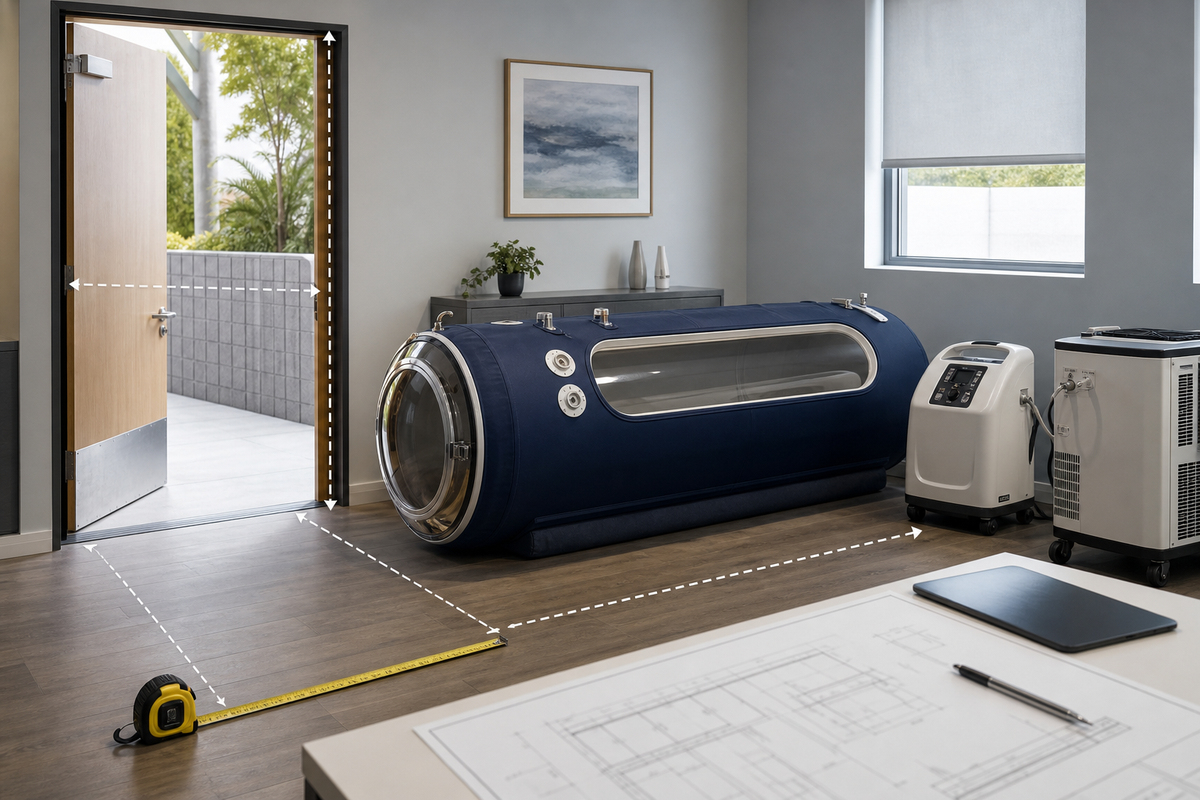
A chamber that looks right online can still fail in the room. Before choosing a model, ask for outside dimensions, inside dimensions, packed dimensions, entry orientation, zipper or door style, clearance needs, power requirements, floor-load notes, and the space needed for the concentrator and compressor.
Room-fit checklist
- Measure doorways, turns, stairs, elevators, and the final room path.
- Check whether the user enters lying down, sitting, or standing.
- Leave access space for zippers, doors, valves, hoses, controls, and service work.
- Ask how the chamber ships, what assembly is required, and whether local installation help is needed.
- Confirm storage needs if the chamber must be moved between sessions.
Home buyers should treat comfort and access as purchase criteria, not minor details. A chamber that feels cramped, loud, hard to enter, or hard to set up will be used less. Service providers face the same fit questions through staff time, scheduling, cleaning, and room turnover.
If you are deciding between a home unit and a business setup, compare the operational side with the home vs clinic break-even calculator and the broader hyperbaric chamber category.
Review the Oxygen System in a Hyperbaric Oxygen Chamber
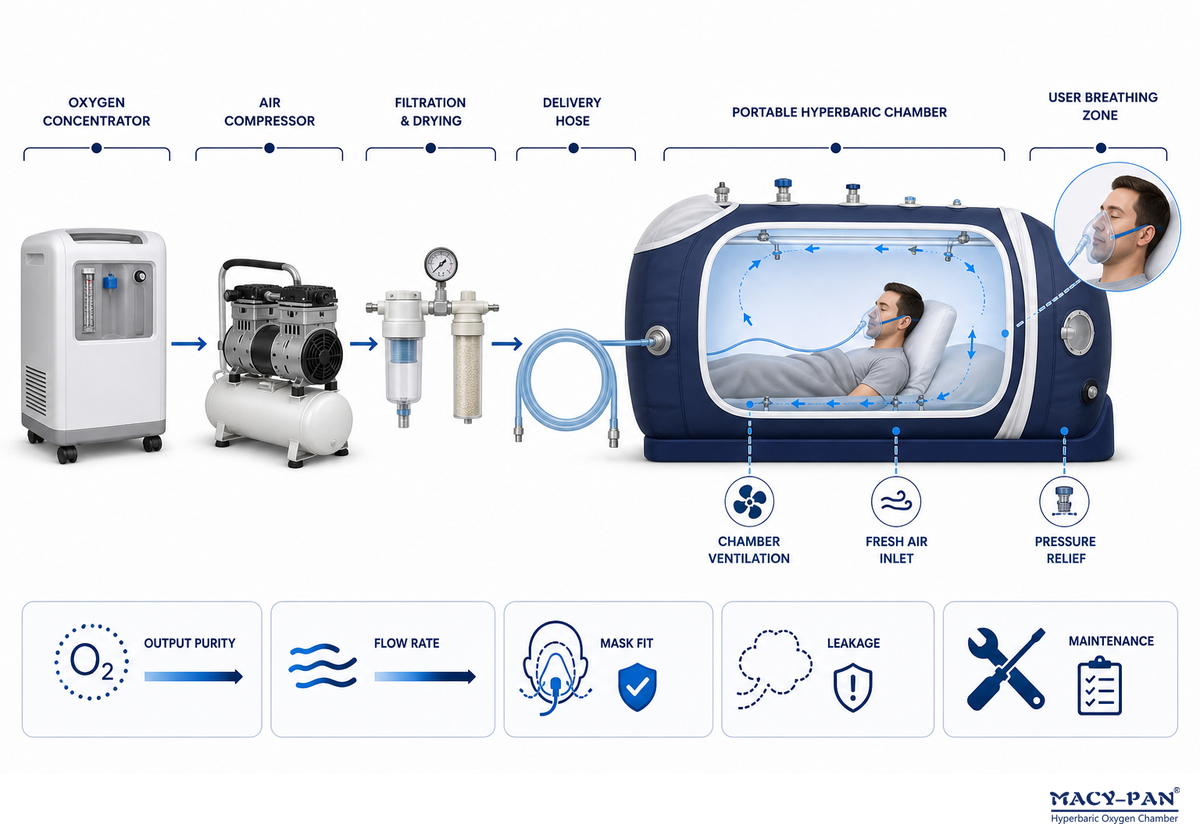
Portable HBOT chamber costs are more than just the chamber body. Your day will be defined by the oxygen concentrator, compressor, hoses, valves, filters, cooling, controls, mask or cannula, and service plan.
Technical note: concentrator output is not inspired oxygen
If a quote says the oxygen concentrator outputs about 93% oxygen, that number describes concentrator output purity. It does not mean the person inside the chamber is breathing 93% oxygen. Inspired oxygen depends on flow rate, pressure, ventilation, mask fit, leakage, and setup. This distinction is important when comparing portable hyperbaric oxygen chamber systems.
When shopping for systems, ask suppliers for a diagram that shows the complete delivery pathway, with an explanation of how it works for the specific configuration you are buying. You will want concentrator specs, expected flow rates, mask or delivery method details, compressor specifications, filters, replacement intervals, noise guidance, and maintenance recommendations. Don’t rely on a single oxygen percentage to assess the quality of oxygen delivery.
Oxygen also changes the safety conversation because it supports combustion. The NIOSH Pocket Guide entry for oxygen is a useful reminder that oxygen should be handled as an oxidizer, so the RFQ should ask about fire-control rules, cleaning instructions, grounding where applicable, and prohibited items.
Daily use factors also decide whether the chamber is workable: setup time, control access, user communication, temperature control, and cleaning responsibility. These details matter for home use, and they matter even more for paying clients in a service studio or facility.
Confirm Safety, Documentation, and Compliance
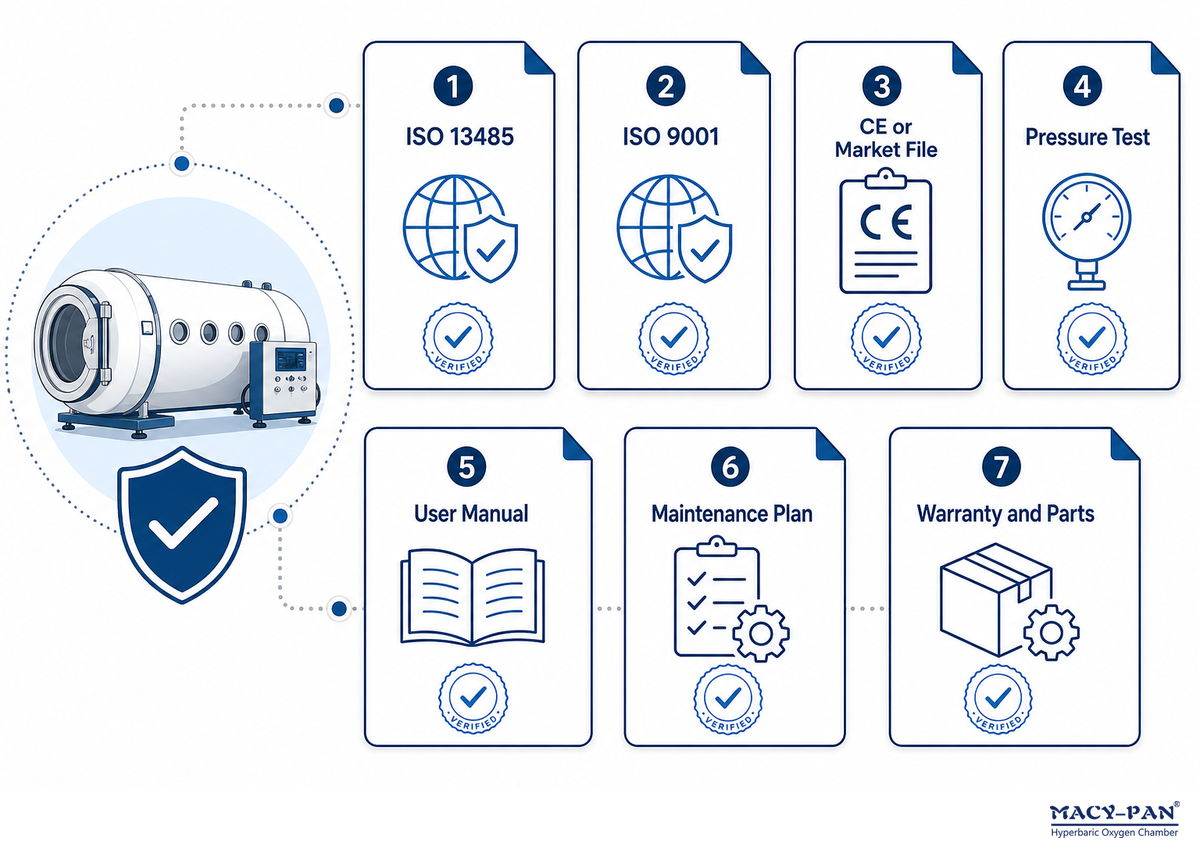
Safety documentation is where weak quotes usually reveal themselves. FDA’s 2025 safety letter reminded providers and facilities to follow manufacturer instructions for HBOT devices, with attention to fire prevention, training, supervision, maintenance, cleaning, and prohibited items. That advice belongs in buyer behavior, not only in clinical policy.
ISO 13485 should be read as a medical-device quality management system standard, while ISO 9001 is a broader quality management standard. CE marking should be read as a conformity signal for EU product rules when applicable. None of these documents proves that a chamber will produce a medical outcome for a specific person.
Supplier Document Pack Checklist
- Company name, factory identity, address, and responsible contact.
- certified quality management system and ISO 9001 certificates, including validity dates and scope of each certification.
- CE or relevant market-access documentation for the geographical area where the device will be sold or used.
- Relevant pressure testing, material specifications, and testing and inspection records.
- User manual, warnings and contraindications, procedures for emergencies, and a maintenance schedule.
- Warranty information, spare parts list, consumables list, training offered, and response time specifications.
- Packaging, labeling, languages offered, logo use, MOQ, lead time, and territory sales rights for resale or private-label configurations.
MACY-PAN states that Shanghai Baobang Medical Equipment Co., Ltd has over 19 years of HBOT manufacturing experience, certified quality management system, ISO 9001 and CE certification, patent registration, and exports to more than 126 countries. Those claims should sit in the supplier-evaluation section, where buyers can connect experience with document review.
A document-by-document view is available in the internal hyperbaric certification decoder before comparing final quotes.
Understand Cost, Warranty, Parts, and Service Support
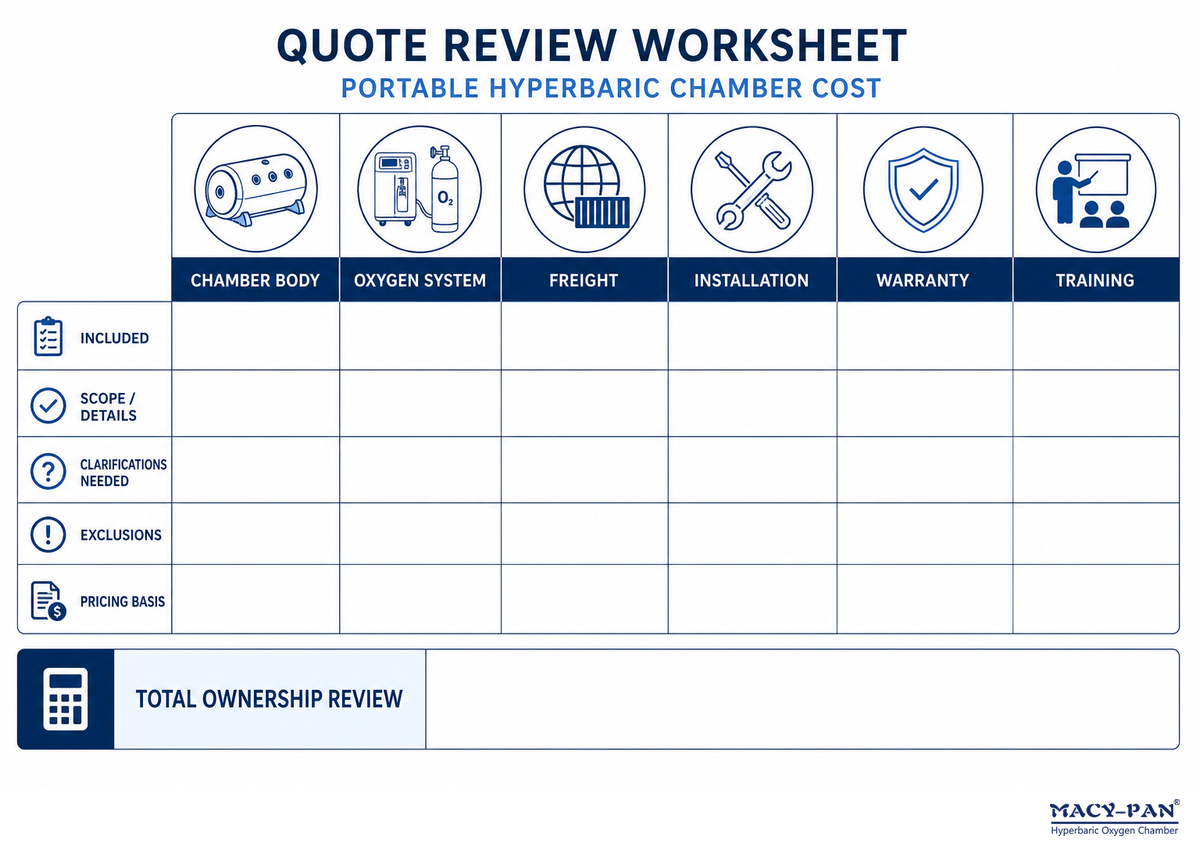
Portable hyperbaric chamber price pages change often, and many public ranges come from sellers. A single price range is less useful than a disciplined quote review. The real question is not “What is the cheapest chamber cost?” It is “What is included, what is excluded, and what happens after delivery?”
| Quote line item | Question to ask |
|---|---|
| Chamber body | Which exact model, pressure range, dimensions, and materials are included? |
| Oxygen and air system | Are concentrator, compressor, hoses, filters, masks, and spares included? |
| Freight and installation | Is shipping door-to-door, port-to-port, or buyer-arranged? Who handles customs? |
| Warranty and parts | Which parts are covered, for how long, and how quickly can replacements ship? |
| Training and support | Is operator training remote, written, video-based, or on-site? What is the response channel? |
Distributors and facilities should ask for landed cost, minimum order quantity, payment schedule, private-label fee, replacement-part terms, warranty handling, packaging options, and expected lead time. MACY-PAN’s OEM readiness checklist is useful when the purchase is tied to resale, private label, or multi-unit deployment.
Use the Pressure-Fit-Support Matrix
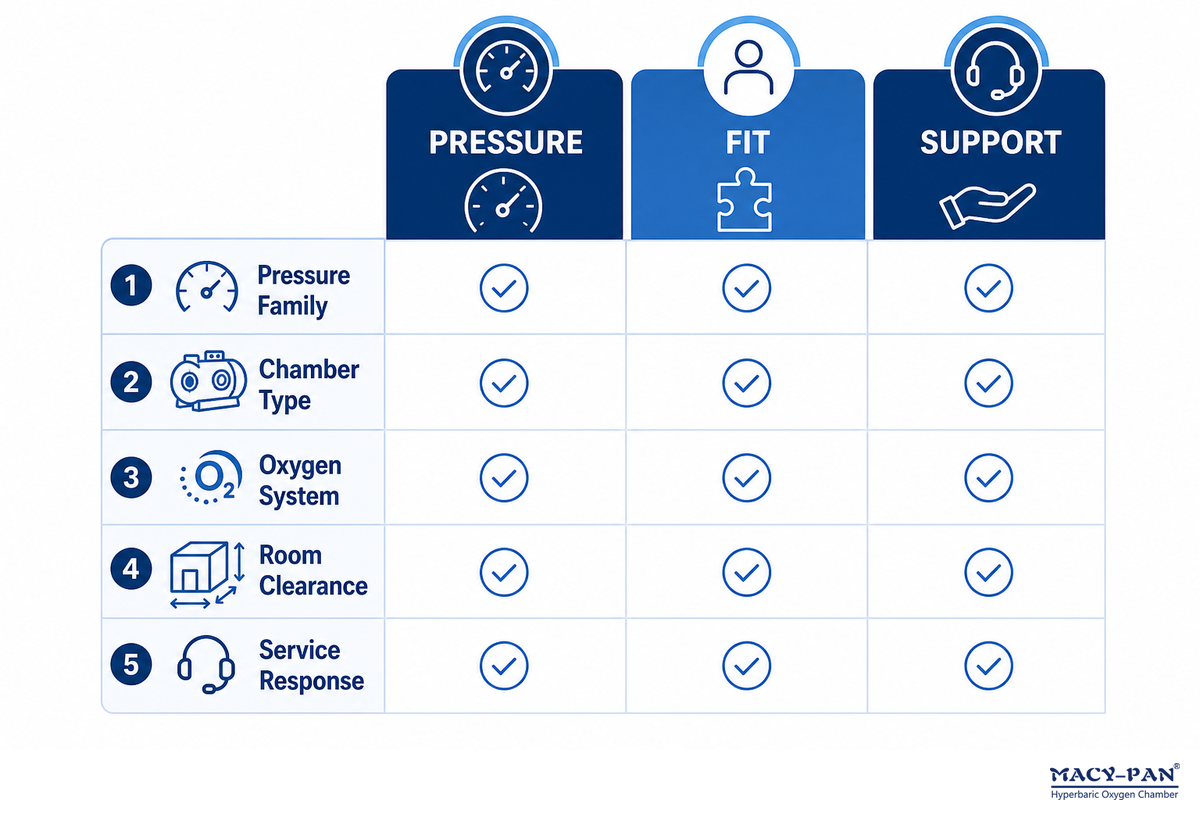
When selecting a hyperbaric chamber, the simplest selection criterion is to evaluate options across three areas: operating range, fit, and support. Range shows what conditions the chamber was designed for. Fit concerns the room and the user, while support relates to whether the seller will maintain the device after purchase.
5-Point Pressure-Fit-Support Matrix: Hidden Bottleneck Map
Use this table before comparing final quotes. The example numbers are planning placeholders or physics conversions, not universal model specifications; the supplier should replace each placeholder with model-specific data in the formal quote.
| Category | Quote field to verify | Decision risk if blank |
|---|---|---|
| Pressure family | Ask whether the model is positioned around 1.3 ATA, 1.5 ATA, or 2.0 ATA; as gauge pressure, those are about 4.4 PSI, 7.4 PSI, and 14.7 PSI above normal atmospheric pressure. | A buyer may compare unlike product families as if they were interchangeable. |
| Chamber type | Record soft shell, hard shell, entry style, model name, internal length, internal diameter, and door or zipper approach in in or cm. | The unit may fit the budget but fail the room, user access, or storage constraint. |
| Oxygen system | Separate concentrator output, such as 93% oxygen, from user-inspired oxygen; request the full delivery path, mask or cannula setup, and flow details. | A single purity number can hide differences in setup, leakage, ventilation, and maintenance. |
| Electrical load | Ask for compressor and concentrator electrical draw in W; use 600 W, 800 W, or 900 W only as worksheet placeholders until the supplier confirms the model. | A clinic or studio may plan the room before it knows the power, heat, or cable layout. |
| Room clearance | Record operating footprint, service side, and access clearance; a placeholder such as 24 in should be replaced by a factory drawing. | The chamber may arrive before the buyer has a workable access and service plan. |
| Daily schedule | Model daily use as 1 hour, 2 hours, 4 hours, or 8 hours only for planning; then confirm setup, cleaning, cooling, and supervision time. | Revenue or family-use assumptions may ignore turnover time and operator burden. |
| Consumables | Ask whether filters, masks, hoses, seals, and common spares follow a 3 months, 6 months, 9 months, or model-specific replacement interval. | A low unit price can become expensive if routine parts are unclear. |
| Warranty | Write warranty length in months; compare 12 months, 18 months, and 24 months only if the quote states those terms. | The buyer may assume support exists without knowing covered parts or exclusions. |
| Service response | Ask whether technical response is promised in 24 hours, 48 hours, or another written service window. | Facility downtime may have no practical support path. |
| OEM stock plan | For distributors, forecast 6 months or 12 months of spare parts and consumables before committing to private-label sales. | The sales channel may scale faster than its parts and service capacity. |
For a studio deployment, build one baseline day before signing: expected sessions, room turnover, operator coverage, cleaning time, and service response. A simple throughput baseline might compare 4 hours of use with 8 hours of staffing, then test whether installation, training, and parts support can keep that schedule realistic.
| Buyer type | Pressure | Fit | Support | Next step |
|---|---|---|---|---|
| Home user | Match wellness or recovery use without clinical claims. | Check comfort, entry, storage, noise, and help from another person. | Manuals, setup guidance, consumables, and warranty clarity. | Compare models and request setup guidance. |
| Service studio | Pick a range that fits non-clinical service positioning. | Plan room turnover, cleaning, client access, and staff workflow. | Training materials, spare parts, support hours, and clear warnings. | Ask for service and maintenance terms. |
| Recovery center | Coordinate operating range, oxygen supply, supervision, and local rules. | Assess room planning, patient access, emergency procedures, and cleaning. | Document pack, training, inspection path, and technical response plan. | Review documents before purchase approval. |
| Distributor or OEM buyer | Select product family by target market and channel claims. | Confirm packaging, labeling, model range, and after-sale workflow. | Factory records, Documentation Pack, private-label process, parts, and shipping. | Request an export shipping and supply review. |
This is where manufacturer fit matters. If you need a portable hyperbaric chamber export shipping and manufacturer support path, the supplier should be ready to discuss documents, product family, customization, logistics, and after-sales support, not only unit price.
Supplier Red Flags Before You Buy
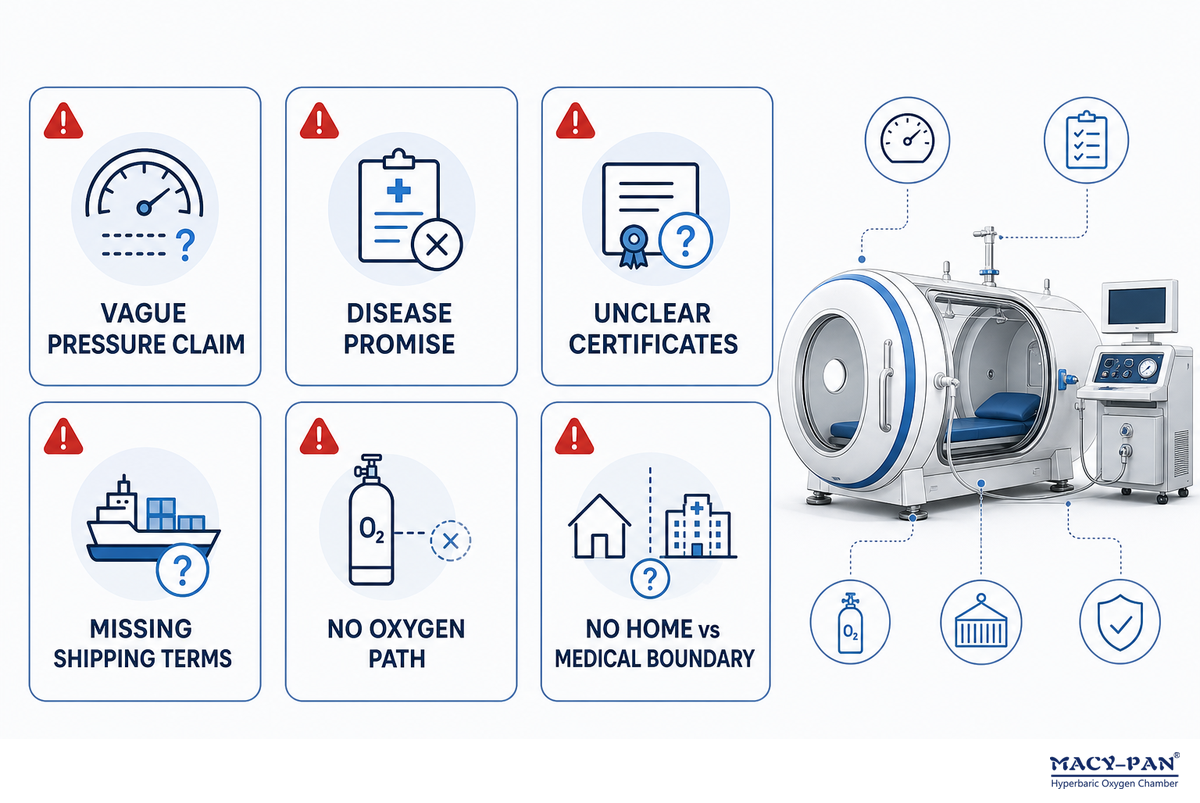
Having the biggest product line does not automatically confer supplier legitimacy. What is important is that a supplier answers the basic questions, and any of the following should raise red flags before sending payment:
- The stated rating is available, but it is not clear how that fits the specific type of chamber, oxygen delivery system, and setting.
- References to disease treatments are made for a mild chamber or a home unit without appropriate clinical framing.
- While the supplier references various certifications, they are not prepared to discuss their scope, relevance to the specific product model, or when they expire.
- Missing quote elements include shipping, customs clearance, consumables, accessories, spare parts, and warranty service.
- Oxygen chamber listings should state how oxygen is delivered, oxygen concentrator output rate, filter replacement, and maintenance requirements.
- The manufacturer does not distinguish clearly between home-use positioning and actual medical hyperbaric oxygen therapy.
B2B buyers can use MACY-PAN’s chamber selector, distributor program, and export shipping resources to stress-test the supplier conversation.
What’s Changing in Portable HBOT Buying in 2026
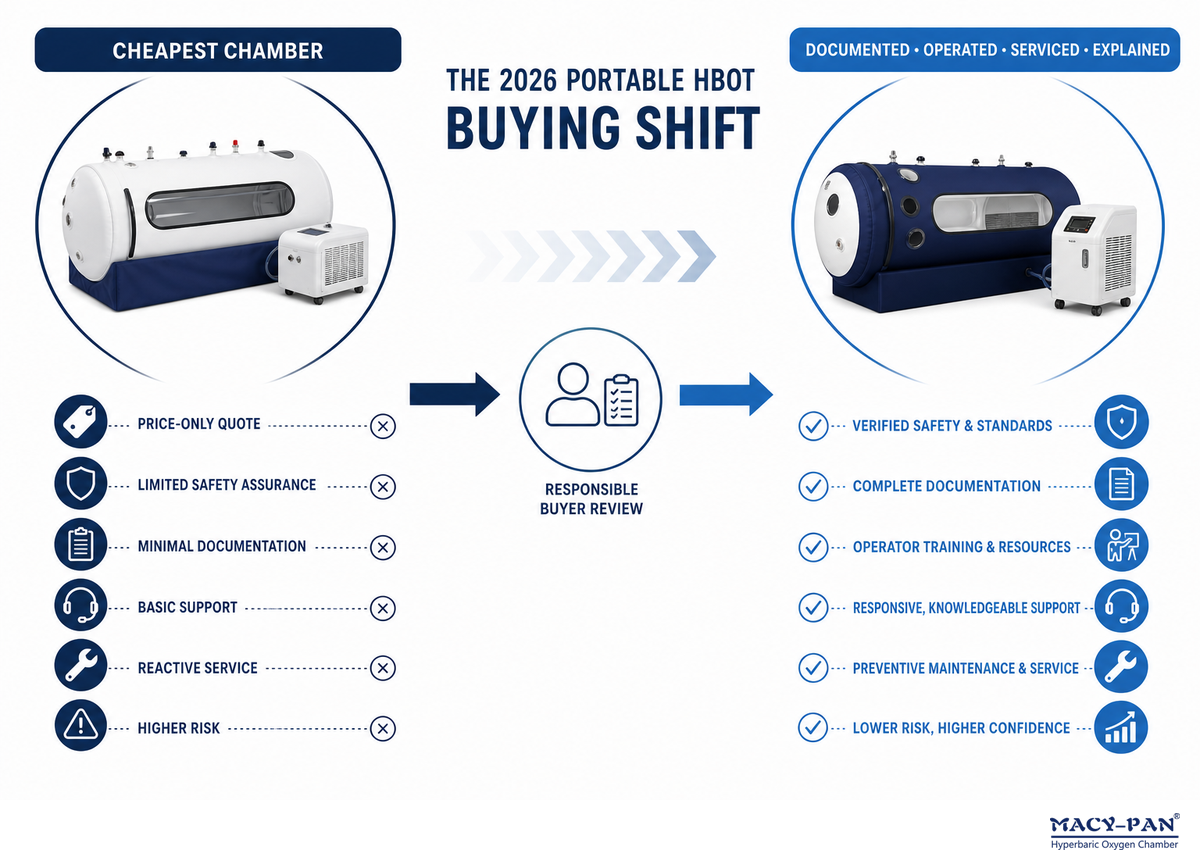
Buyer conversations are moving from “Which chamber is cheapest?” to “Which chamber can be documented, operated, serviced, and explained responsibly?” That shift is visible in search behavior around portable hyperbaric chamber cost and manufacturer queries, even though precise public price benchmarks remain seller-led.
Home buyers need more questions before the quote. Facilities need coordination across documents, staff, safety procedures, and service. Distributors need proof that the manufacturer can support labeling, private label, export documents, replacement parts, and training material at scale.
MACY-PAN positions itself as a 19-year hyperbaric chamber manufacturer serving family buyers and sales companies with tailored OEM products. If you are comparing manufacturer options, start at the broader hyperbaric chamber manufacturer page and then narrow the conversation to range, fit, documents, and support.
Need a portable HBOT chamber supply quote?
Ask MACY-PAN for model specs, document pack details, export terms, private-label options, and distributor pricing based on your use case.
Frequently Asked Questions
What pressure should I choose for a portable hyperbaric chamber?
View Answer
Consider first the purpose for which the chamber will be used, who will use it, and where it will be sited. Mild soft portable chambers typically operate between 1.3 and 1.5 ATA, while care sites may use higher ranges, different equipment standards, safety procedures, and staffing requirements. Never rely on a rating to guide a treatment protocol without consultation from a trained clinician.
Is a soft shell or hard shell chamber better?
View Answer
Better depends on the job. Soft shell chambers usually fit portability and home setup better. Hard shell chambers may fit facility workflows, higher operating product families, and buyers who want a rigid structure. Compare operating range, entry style, room fit, documentation, oxygen system, and support together.
Can I buy a mild hyperbaric chamber for personal use?
View Answer
Many buyers compare mild hyperbaric chamber options for personal or home wellness use. Before buying, check local rules, medical cautions, operating instructions, room fit, emergency guidance, and whether anyone using the chamber should first speak with a clinician.
Are portable hyperbaric chambers effective?
View Answer
Effectiveness depends on what outcome is being claimed, the chamber type, operating range, oxygen delivery, user condition, and supervision. FDA and Undersea and Hyperbaric Medical Society resources should guide medical claims. In home-use buying, focus on responsible use, documents, safety, and clear limits.
What documents should a supplier provide?
View Answer
Ask for quality-system certificates, market documents, model specs, user manual, warning and contraindication information, maintenance schedule, warranty, parts list, training materials, and shipping terms. OEM buyers should also add labeling, packaging, MOQ, territory, and private-label details.
Who should not use a hyperbaric chamber?
View Answer
Do not rely on a seller page for personal medical clearance. People with medical conditions, ear or sinus issues, lung concerns, pregnancy, recent surgery, implanted devices, or medication questions should ask a qualified clinician before use. Follow the manufacturer’s instructions and local safety requirements.
How much maintenance does a chamber need?
View Answer
Maintenance depends on the chamber type and oxygen system. Ask for cleaning steps, filter replacement intervals, zipper or seal care, compressor and concentrator maintenance, inspection routines, replacement-part availability, and what to do if range or oxygen flow does not match the manual.
References & Sources
External authority sources
- FDA: Follow Instructions for Safe Use of Hyperbaric Oxygen Therapy Devices
- Undersea and Hyperbaric Medical Society: HBO Indications
- UHMS: Consumer Warning on Soft-Sided Bag Chambers
- ISO: certified quality management system Medical Devices
- ISO: ISO 9001 Quality Management Systems
- CDC/NIOSH: Oxygen Pocket Guide
- Your Europe: CE Marking Requirements
MACY-PAN resources
Factory Selection Support
Need a hyperbaric chamber matched to your room, pressure target, and compliance documents?
MACY-PAN helps clinics, wellness centers, distributors, and home buyers compare soft-shell, hard-shell sitting, and professional-grade lying chambers before quotation. Send your intended use, available space, country, and preferred ATA range, and our team will recommend a practical model path.
2007HBOT manufacturing since
126+countries shipped to
1.3-2.0ATA chamber range