Get in Touch with MACY-PAN Company

Updated July 2026 Reviewer: MACY-PAN technical team.
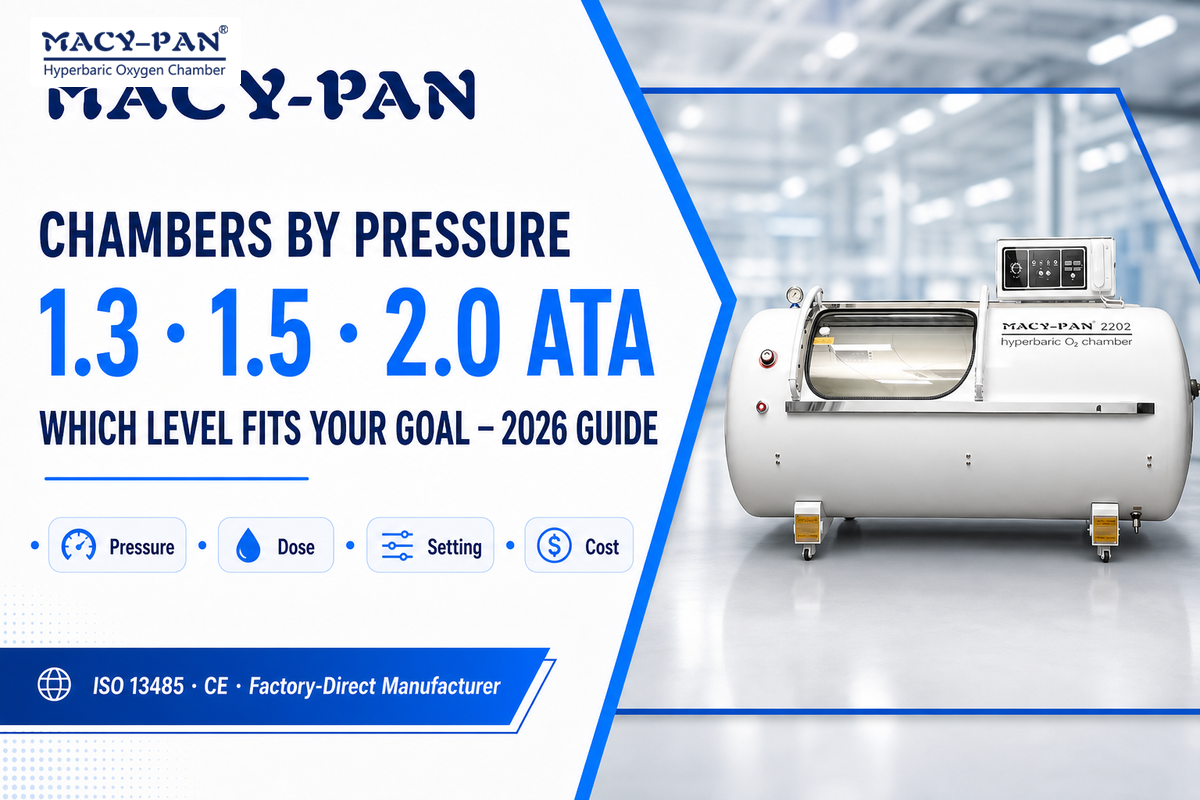
Hyperbaric chamber pressure is the above-normal air pressure inside the chamber, the single number that decides how much oxygen a session delivers, which conditions it suits, what the chamber has to be built from, and what it costs. It’s measured in ATA – atmospheres absolute – and the three tiers buyers actually compare are 1.3, 1.5, and 2.0 ATA. Get the pressure right and everything downstream falls into place; get it wrong and you either overpay for capability you never use or buy a unit that can’t reach your goal.
Direct answer: Hyperbaric chamber pressure runs from about 1.3 ATA (soft “mild” chambers) to 2.0 ATA (hard-shell clinical chambers). One ATA equals sea-level pressure (14.7 psi / 101.3 kPa), so a 2.0 ATA chamber holds 29.4 psi – roughly the pressure at 33 feet of seawater. The Undersea and Hyperbaric Medical Society treats 1.4 ATA as the floor for a session to even count as HBOT, but every UHMS-approved treatment indication specifically requires at least 2.0 ATA.
Key takeaways
- Higher ATA isn’t automatically better – a chamber you run daily at 1.5 ATA can outperform a 2.0 ATA unit used twice a month.
- Below 1.4 ATA breathing air, the UHMS says the exposure doesn’t meet the definition of therapeutic hyperbaric oxygen therapy.
- Reaching a verified 2.0 ATA requires a rigid steel build to ASME; soft chambers top out lower.
- Oxygen-toxicity seizure risk stays very low up to about 2.0 ATA and climbs with pressure above it.
- Price tracks pressure: soft 1.3-1.5 ATA units start near $4,495; 2.0 ATA multiplace systems exceed $100,000.
What “Pressure” Actually Means in a Hyperbaric Chamber
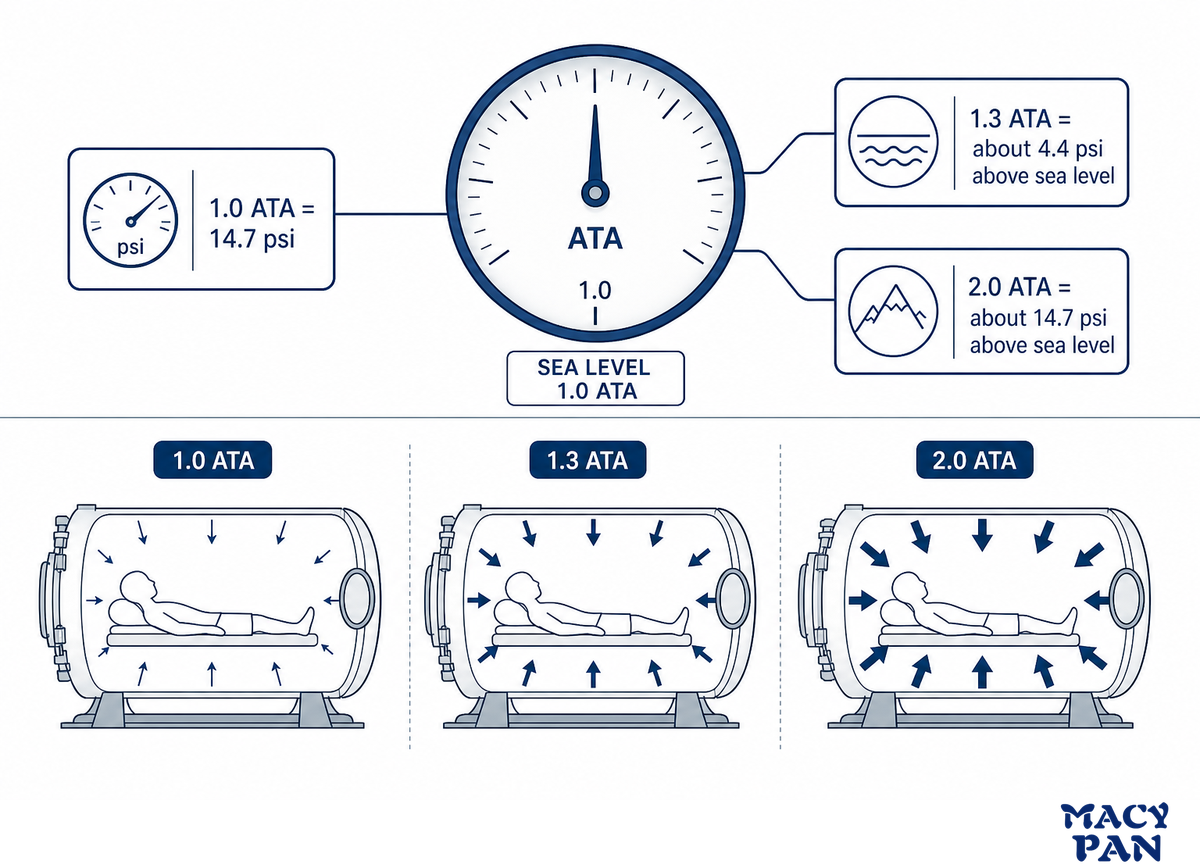
Pressure in a hyperbaric chamber is expressed in ATA, or atmospheres absolute, where 1 ATA is the pressure you feel at sea level. That figure, listed on every spec sheet, is the hyperbaric oxygen therapy pressure the chamber holds. That baseline equals 14.7 psi, 101.3 kPa, or 1.013 bar.
When a chamber pressurizes to 2.0 ATA, it doubles that baseline – the air inside sits at 29.4 psi and about 203 kPa, which is close to the pressure a diver feels at 33 feet of seawater. According to Mayo Clinic, therapeutic chambers raise air pressure to two to three times normal.
Here’s the arithmetic worked end to end so you can read any spec sheet. Start with 1 ATA = 14.7 psi. At 1.3 ATA the chamber adds 30% (14.7 × 1.3 = 19.1 psi).
Step up to 1.5 ATA and pressure reaches 14.7 × 1.5 = 22.1 psi; 2.0 ATA reaches 14.7 × 2.0 = 29.4 psi. Subtract the 14.7 psi you already live in and the gauge pressure – the extra squeeze – is 4.4, 7.4, and 14.7 psi respectively.
Why is the number important?
Due to Henry’s Law, the quantity of gas dissolved in liquid is proportional to its partial pressure. Increase pressure, and you increase oxygen dissolved directly in blood plasma, beyond capacity of red-blood cells. This is why the ATA level of a chamber-not its concentrator -determines its effective dose.
Running the same 93% concentrator at 1.3 ATA, then 2.0 ATA yields two different treatments.
💡 Pro Tip
Spec sheets mix units. If a listing quotes pressure in kPa or bar, divide kPa by 101.3 (or bar by 1.013) to get ATA.
A chamber advertised at “60 kPa” is a gauge figure – add atmospheric, and it’s about 1.6 ATA absolute, not 0.6.
The Pressure-to-Dose Map: 1.3, 1.5 & 2.0 ATA Side by Side
It’s easiest to compare the various pressure levels when they’re lined up against the various things each level affects simultaneously – equivalent depth, relative oxygen dose, build, capacity, and suitable users. We call this the Pressure-to-Dose Map, the most sought-after resource by shoppers who are in the know.
| Pressure (ATA) | Tier | psi / kPa (absolute) | Depth equiv | Relative plasma O₂ | Typical build | Best fit |
|---|---|---|---|---|---|---|
| 1.0 ATA | Baseline | 14.7 psi / 101 kPa | sea level | 1× (normal) | n/a | Ambient reference |
| 1.3 ATA | Wellness | 19.1 psi / 132 kPa | ~10 ft | ~3–4× | Soft TPU | Home wellness, travel |
| 1.4 ATA | Definitional floor | 20.6 psi / 142 kPa | ~13 ft | ~4–5× | Soft or hard | UHMS’s HBOT definition floor (not an approved-indication level) |
| 1.5 ATA | Wellness+ | 22.1 psi / 152 kPa | ~16 ft | ~5–7× | Soft or hard lying | Home sweet spot, recovery |
| 1.7 ATA | Transitional | 25.0 psi / 172 kPa | ~23 ft | ~8–10× | Hard shell | Brain-focused protocols |
| 1.75 ATA | Clinical | 25.7 psi / 177 kPa | ~25 ft | ~10× | Hard shell | Some clinical protocols |
| 2.0 ATA | Clinical | 29.4 psi / 203 kPa | ~33 ft | ~up to 15× | 304 stainless, PVHO | Most approved indications |
| 2.4 ATA | Clinical+ | 35.3 psi / 243 kPa | ~46 ft | higher | 304 stainless, PVHO | Wound / infection protocols |
| 3.0 ATA | Clinical max | 44.1 psi / 304 kPa | ~66 ft | highest | 304 stainless, PVHO | Supervised, upper limit |
| Limitations | Above ~2.0 ATA, chambers require rigid pressure-vessel construction and supervised 100% oxygen; soft TPU chambers are not suitable, and sub-1.4 ATA air-breathing is not therapeutic HBOT. | |||||
Reading only the top row is the classic mistake: a pressure rating means little if the build cannot hold it, so the pressure column and the build column have to be read together, a point our lineup of hyperbaric chambers organized by pressure is built around, and one the Undersea and Hyperbaric Medical Society reinforces by requiring at least 2.0 ATA for any of its approved clinical indications. Within MACY-PAN’s lineup, this map reflects three build tiers under a unified ISO 13485 quality system. The ST1700 and L1 series, for instance, use soft TPU for soft-sided chambers rated from 1.3 to 1.5 ATA. The HP1501, which can achieve 1.5 ATA, and the HE2202, validated at 2.0 ATA, are 304 stainless-steel lie-down chambers filling the mid-tier space.
Our clinical HE5000 series are designed for 2.0 ATA, serving between one and five occupants. Note the general principle here: Pressure and build level always correspond; they are inseparable factors for why there is no “which ATA?” without the accompanying “which chamber?”.
The Two UHMS Thresholds Buyers Confuse: 1.4 ATA vs 2.0 ATA
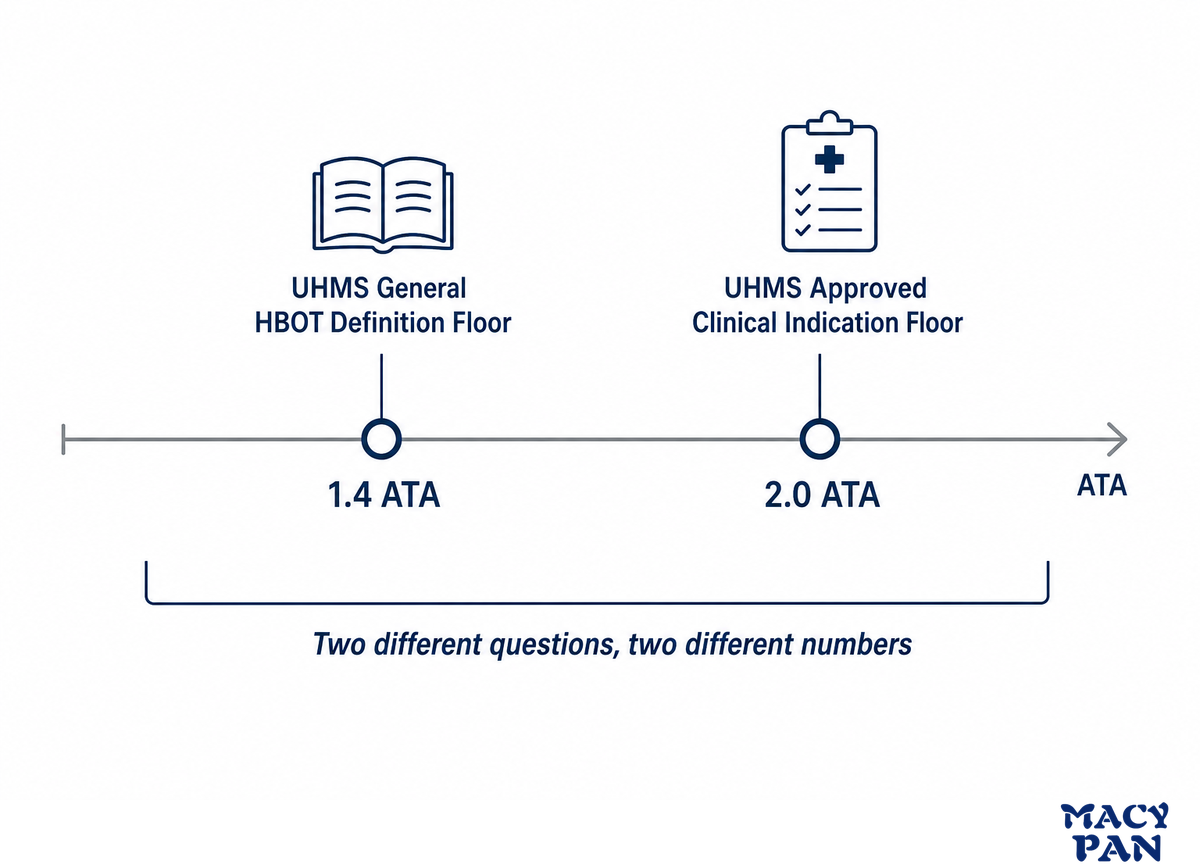
Out of all points on the pressure ladder, two numbers matter most: 1.4 and 2.0 ATA. Treating a 1.3 ATA session as clinical therapy is a common and costly mistake, because the extra dissolved oxygen at 1.3 ATA is a fraction of the dose a 2.0 ATA chamber delivers at 29.4 psi – the pressure the approved-indication evidence was actually built on; the NIH StatPearls hyperbaric physics review likewise places most therapy at 2 to 3 ATA.
The UHMS’s general definition treats 1.4 ATA as the floor for a session to count as hyperbaric oxygen therapy (HBOT) while breathing normal air at all. But every UHMS-approved clinical indication specifically requires a minimum of 2.0 ATA – that stricter number, not 1.4 ATA, is what actually separates an approved medical treatment from a wellness product.
Here’s where honest positioning becomes critical.
Our 1.3 ATA soft chamber, a genuine product used by actual customers, clearly fits the wellness-and-recovery sector. It isn’t medical therapy. Read a mild hyperbaric chamber this way: a low pressure hyperbaric chamber earns its place on daily consistency, not on matching a 2.0 ATA hyperbaric chamber. Studies and review articles support this, such as Ortega et al., who note in their summary that UHMS requires an ATA level of at least 1.4 for HBOT. An evidence-based guide published in 2025 by Samson et al. points out that treatment usually occurs at or above 2.0 ATA for clinical purposes.
If you’re looking for a chamber for the purpose of supporting a medical indication, this pressure is the foundation upon which evidence has been built.
What are the benefits of a low-pressure hyperbaric chamber?
1.3 to 1.5 ATA low-pressure chambers have the real edge: affordability, portability, installation simplicity, and comfort for day-to-day use, which is consistency. Many practitioners in r/HBOT believe the 1.4 to 1.5 ATA pressure range is a sweet spot for home support of healing if the frequency is high.
What these can’t claim is a comparable therapeutic effect at 2.0 ATA clinical levels, the basis of evidence for treating specific conditions at that pressure. Its real benefit is accessibility: a chamber you can actually use every day.
“We get asked ‘which ATA is best’ every week. An honest answer is there isn’t one. A home user who runs sessions daily at 1.5 ATA gets more benefit than someone who buys a 2.0 ATA clinical unit and uses it twice a month. We build both tiers so the pressure fits the routine, not the marketing.”
How Much Pressure Do You Actually Need?
Choose the pressure that fits the actual frequency of your usage, not the largest number advertised-what we’re calling the Use-Before-ATA Rule, which is why comparing 1.3 ata vs 1.5 ata matters more than chasing high pressure oxygen therapy, and why an occasional oxygen chamber treatment rarely justifies the top tier.
You’ll receive greater benefit using a 1.5 ATA device every day than you’ll from a 2.0 ATA unit used occasionally. We’ve included the 4-Zone Pressure Match to demonstrate how to apply a Use-Before-ATA choice to real circumstances.
| Your situation | Pressure zone | Build type | Why |
|---|---|---|---|
| Home wellness, recovery, travel | 1.3–1.5 ATA | Soft TPU | Light, portable, consistent daily use |
| Couple or parent-child at home | 1.3–1.5 ATA | Soft (2-person) | Shared sessions, low setup |
| Single-room clinic, rehab, spa | 1.5–2.0 ATA | Hard lying (304 SS) | Rigid shell, easy room install |
| Hospital, immobile patients | 1.0–1.5 ATA | Hard, stretcher entry | Side-entry sliding door |
| Premium clinic, VIP single | 2.0 ATA | Hard monoplace | Clinical pressure, comfortable interior |
| Multi-bay clinic, hospital, resort | 2.0 ATA multiplace | Hard, 4–5 users | Highest throughput per session |
| Not suitable | A soft 1.3 ATA chamber for a clinic billing recognized indications — it cannot reach the pressure the evidence and construction codes require. | ||
When a consumer bought a soft 1.3 ATA chamber for family use as if it were medical-grade, and then found it unable to accommodate family therapy requirements, that $4,000-plus purchase solved the wrong problem. (Similar is the clinic which spent six figures on an unused, occasional-use, multi-place 2.0 ATA unit for single clients). Both cases stem from not asking about the usage routine first. Clinics, to match patient throughput to equipment costs, may consult our pressure-to-goal chamber selector to connect use with model directly.
Soft vs Hard Shell: Why Pressure Decides the Build
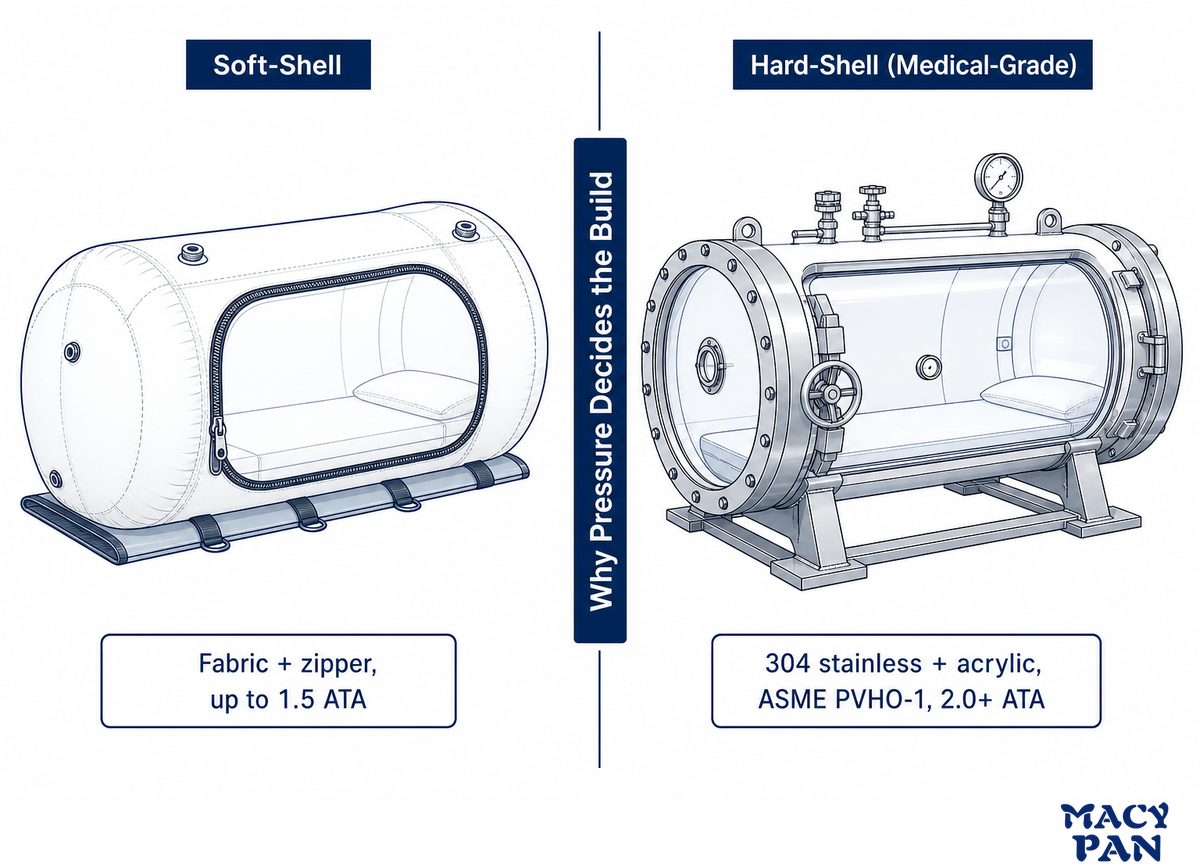
Construction and pressure are inextricable: it requires a rigid, verified pressure vessel to achieve 2.0 ATA; soft chambers simply stop earlier in the pressure range. Genuine 2.0 ATA, hard-shell chambers are fabricated from 304 stainless steel under the ASME safety code, for human occupancy pressure vessels. Soft TPU chambers, intended for portability and operating within the 1.3 to 1.5 ATA range, are designed to excel within their specific domain. One rehab clinic learned this the hard way: a unit sold as 2.0 ATA topped out near 1.5 ATA on the gauge, so its treatment protocols never reached the pressure they were written for, and the chamber had to be replaced inside a year.
A pitfall is the “hard-shell” claim by chambers that don’t truly exceed about 1.5 ATA. The tested maximum operating pressure of a “true” 2.0 ATA chamber is 100 kPa gauge pressure. For clinical builds, see our medical-grade 2.0 ATA chambers. Both MACY-PAN’s sitting 2.0 ATA HP2202 and the HE5000 line (medical grade) carry that verified 100 kPa (2.0 ATA), with redundant relief and safety systems in the clinical versions (redundancy is key at 2.0 ATA). Compare devices using certified tested maximum working pressure, not market language-refer to our soft vs. hard chamber comparison and medical-grade 2.0 ATA chamber page.
Pressure Safety: Limits, Oxygen Toxicity, and “Overdoing It”
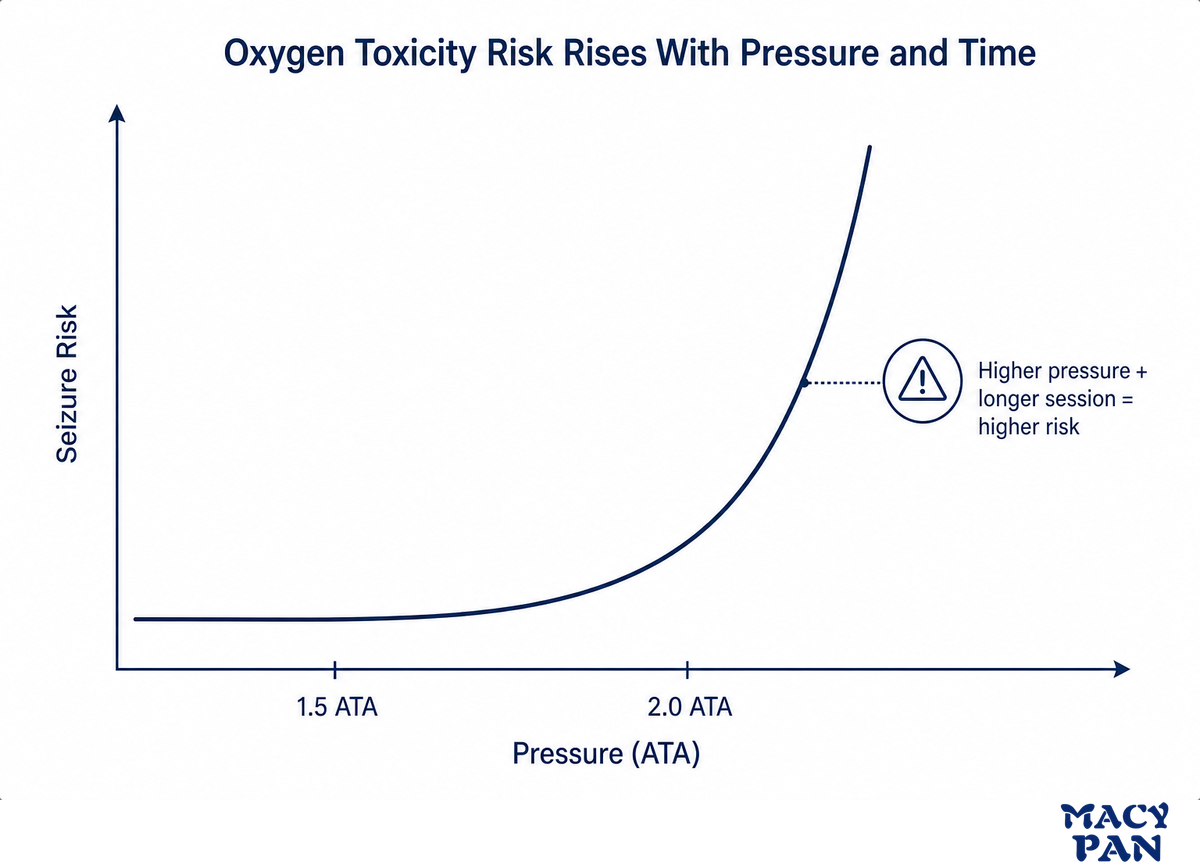
Yes, hyperbarics can be overdone, and pressure is the main axis of control. Pressuring yourself on 100% oxygen can induce central nervous system oxygen toxicity (seizure, albeit rarely; the chance escalates with pressure), which is why clinical protocols control 100% oxygen and off-the-shelf wellness chambers operate at lower pressure.
Evidence is reassuring within the normal therapeutic band and instructive above it. In a series reported by Hampson et al., incidence of seizure was on the order of 0.3% at 2.45 ATA and about 2.0% at 2.80 ATA across several hundred sequential patients per pressure – low, but definitely pressure-dependent. A systematic review of adverse effects of HBOT (2023; Zhang et al.) found treatment relatively safe below 2.0 ATA chamber pressure, and work by Harch (2024) frames roughly 3.0 ATA as a practical upper pressure limit for oxygen breathing. Simply put: below and up to 2.0 ATA the seizure risk is minimal; above it, supervision and pressure discipline have more weight.
⚠️ Important
A remedial, therapeutic hyperbaric dose should be medically ordered. This document explains pressure engineering and choices; this is not medical advice.
What Pressure Costs: The Price Range by ATA Level
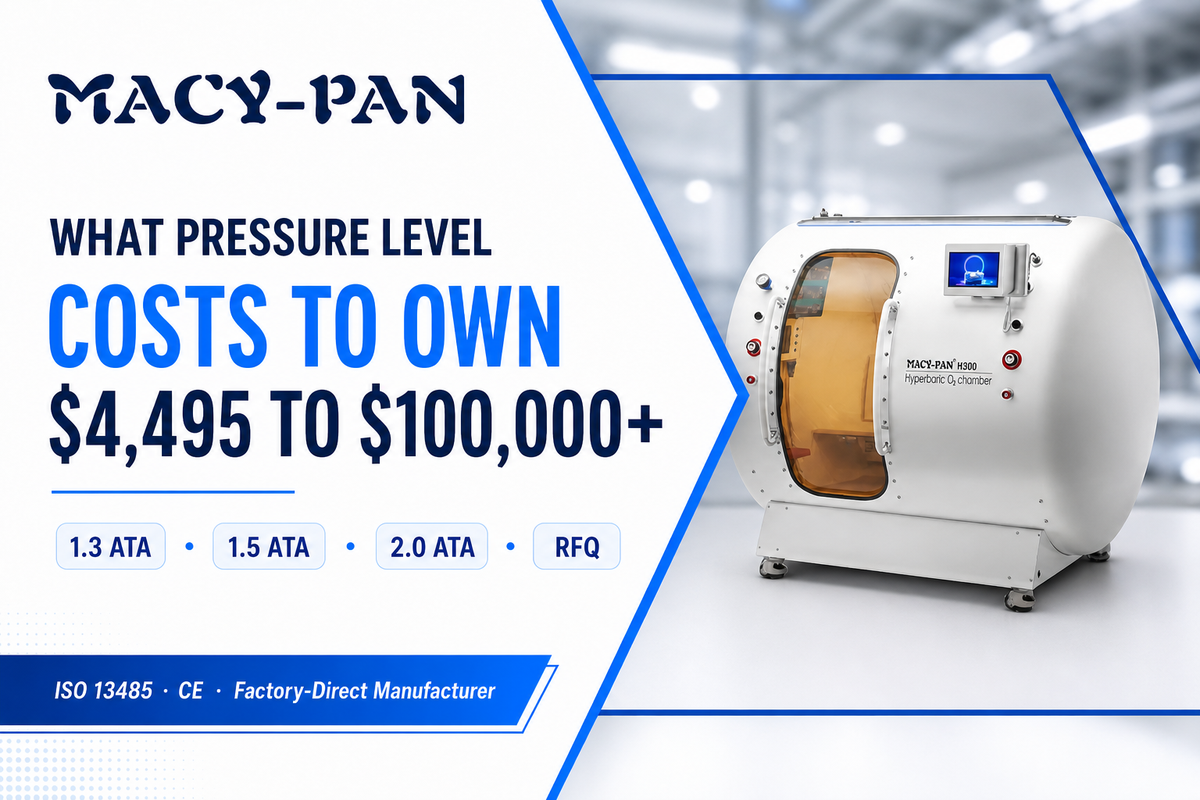
Price more than any other single factor correlates more to the pressure tier because higher pressure packs a heavier build, a more capable oxygen system, and formal compliance. As a market reference, soft 1.3-1.5 ATA chambers start near $4,495; moderate range hard-shell chambers approximate $24,000-$28,000; and 2.0 ATA multiplace chambers exceed $100,000 (approximate figures which vary by configuration and are subject to change).
Hidden cost is the vendor margin. That same clinical chamber a U.S. distributor shows near $78,650 can be shipped outright for considerably less because there’s no middle layer to support. Buyers must learn to differentiate the configuration you’ll use-pressure range, shell strength, capacity, oxygen delivery, etc.-from the price on the shelf. See our hyperbaric chamber cost guide for a full explanation.
Pressure-tier RFQ checklist (bring these to any quote)
- Starting pressure in ATA, and the worked maximum (not the marketing number)
- Shell material & thickness (soft TPU vs 304 stainless, mm)
- Capacity (single person to 4-5 persons) and monoplace versus multiplace
- Oxygen system: number of concentrators, flow rate (L/min), purity (%)
- Compliance documentation: ASME, certified quality management system, CE for the precise model
- Voltage (110 / 220 / 230 / 240 V) and shipping / lead-time conditions
Regulation Is Tightening Around Pressure Claims
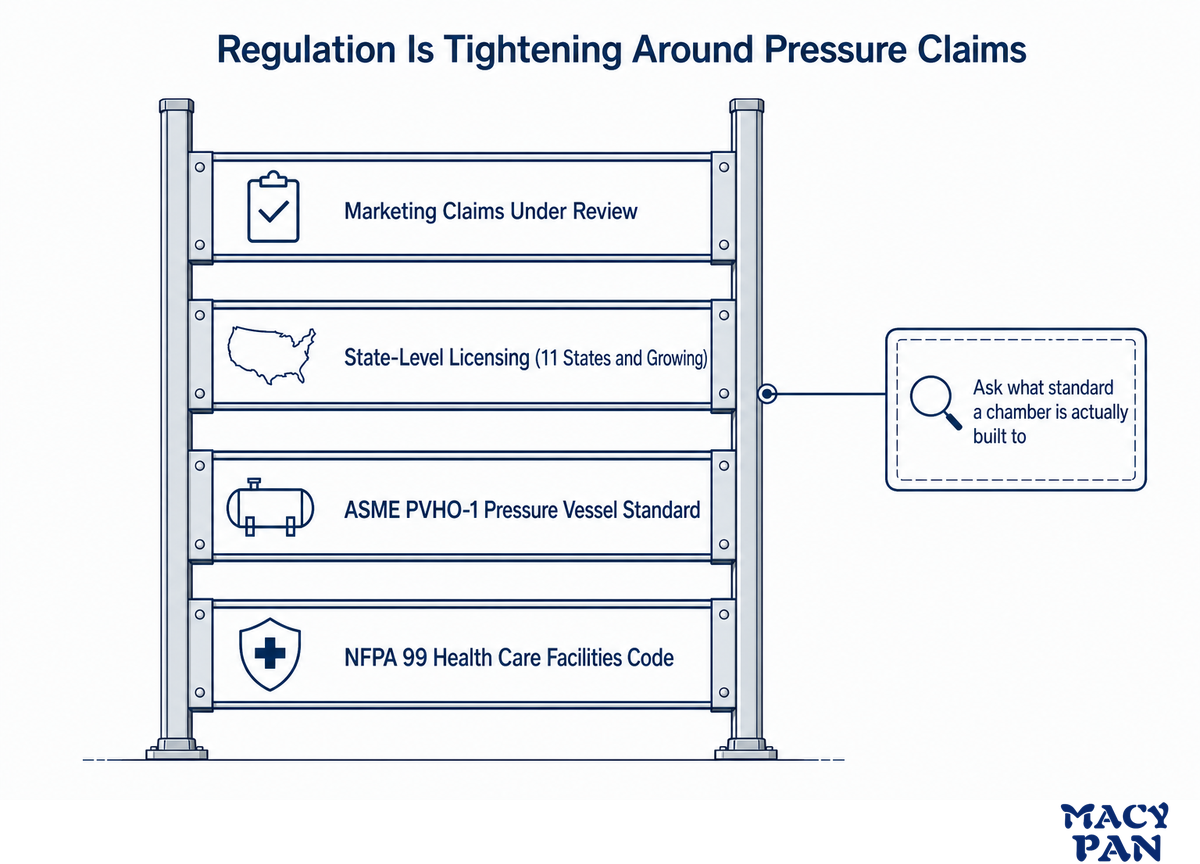
In 2026, buyers are faced with an architecture-standard discussion that is getting tighter, not looser, and that is the reality behind hyperbaric chamber pressure. NFPA 99 (2024 edition), Chapter 14, puts human-occupancy chambers under the scope that requires all chambers to be built from ASME standards, and PVHO compliance is policed in 11 states in the U.S. Meanwhile, medical associations are only becoming more firm in their assertion that non-1.4 ATA air-breathing is not therapeutic HBOT, and the FDA is still eyeing off-label marketing.
Pressure is on: U.S. search interest in hyperbaric chamber pressure is up nearly 30% over three years, drawing first-time and wellness buyers into a market that professional inspectors rank by pressure rating and build certification. If you plan to buy one in 2026 at or above 2.0 ATA, ensure the tested pressure rating and ASME paperwork are solid before you put down money; a non-compliant chamber might fail a facility inspection or even prove legally impossible to operate. See our guide to building medically sound equipment and documentation for more details.
Frequently Asked Questions
What psi should a hyperbaric chamber be?
Chamber pressure ranges from about 19.1 psi (1.3 ATA soft chambers) to 29.4 psi absolute (2.0 ATA clinical chambers), since 1 ATA equals 14.7 psi at sea level.
That varies by the class of chamber. At sea level, 1 ATA is equal to 14.7 psi, so a soft chamber rated for 1.3 ATA achieves approximately 19.1 psi absolute pressure (4.4 psi gauge pressure), while a 1.5 ATA chamber measures approximately 22.1 psi absolute pressure and a 2.0 ATA clinical chamber has a pressure of 29.4 psi absolute (14.7 psi gauge). Most home wellness chambers fall in the lower range, with most medical applications using a 2.0 ATA standard.
What is the maximum safe pressure for breathing 100% oxygen in a chamber?
Supervised 100% oxygen breathing tops out around 3.0 ATA, with most clinical therapy delivered between 2.0 and 2.4 ATA, where seizure risk stays low but rises with added pressure.
Clinically, supervised oxygen breathing usually tops out around 3.0 ATA, and most typical therapy treatments occur between 2.0 and 2.4 ATA. As pressure increases, the risk of central nervous system oxygen toxicity also increases, with recorded seizure incidence rate reported as approximately 0.3% at 2.45 ATA and around 2.0% at 2.80 ATA. Its use of higher pressures requires medical supervision.
Is 1.3 ATA enough, or do I need 2.0 ATA?
A 1.3 to 1.5 ATA soft chamber suits general home wellness and recovery use, while a 2.0 ATA hard-shell chamber is the standard for UHMS-qualifying medical therapy.
It depends on your specific purpose. If you are looking for general home wellness benefits, such as promoting recovery or convenience for travel, a 1.3 to 1.5 ATA soft chamber is engineered for regular daily use. For conditions that qualify for evidence-based medical therapy and meet UHMS criteria, a pressure of approximately 2.0 ATA is standard in a hard-shell chamber. For treatments directed by a medical professional, it is important to follow the pressure prescribed by your clinician.
Can you overdo a hyperbaric chamber?
Yes: pressures or session lengths that exceed manufacturer and clinician guidance raise the risk of central nervous system oxygen toxicity, including rare seizure events at higher pressure.
Yes, definitely. Pressures and session lengths that are too high or too long can raise the risk of oxygen toxicity. It is advisable to adhere to both the manufacturer’s guidelines and any instructions provided by your doctor.
Is chamber pressure measured in ATA, psi, or bar?
Hyperbaric chamber pressure appears in all three units – 1 ATA equals 14.7 psi, 1.013 bar, and 101.3 kPa – so buyers must check whether a spec is absolute or gauge.
All three measurements are listed on product specifications. 1 ATA equals 14.7 psi, 1.013 bar, and 101.3 kPa. Because ATA represents absolute pressure, it’s key to know if a particular measurement is reported as absolute or gauge pressure to make an accurate comparison.
Do home hyperbaric chambers reach clinical pressure?
Most soft home chambers top out at 1.3 to 1.5 ATA, while medical indications generally require 2.0 ATA – a level only hard-shell chambers are built to hold.
While most soft home units are designed for 1.3 to 1.5 ATA, medical indications generally require a 2.0 ATA pressure. Higher pressure capabilities are available in some hard-shell home chambers, though these are typically more expensive and require a sturdier construction. Consider how you will use your chamber to select the appropriate pressure level.
Not sure which pressure tier fits your routine?
Tell MACY-PAN how you intend to use the chamber (home, clinic, or facility with multiple users), and we’ll suggest a model and provide a factory-direct quote tailored to your target working pressure.
Why We Wrote This
MACY-PAN has built hyperbaric chambers across the full 1.3–2.0 ATA range for 19 years, shipping to 126 countries. The pressure-to-use mismatch, overbuying 2.0 ATA capability used twice a month, or a 1.3 ATA unit that can’t reach a clinical goal, is the single most common buying mistake we see, which is why this guide leads with matching pressure to routine rather than chasing the highest number.
References & Sources
- Position on Low-Pressure Hyperbaric Chambers — Undersea and Hyperbaric Medical Society (UHMS)
- A General Overview on Hyperbaric Oxygen Therapy (Ortega et al., 2021) — National Library of Medicine (PMC)
- Hyperbaric Oxygen Therapy: An Evidence-Based Primer (Samson et al., 2025) — ScienceDirect
- Hyperbaric Physics, StatPearls — National Center for Biotechnology Information (NIH)
- Adverse Effects of Hyperbaric Oxygen Therapy: A Systematic Review (Zhang et al., 2023) — Frontiers in Medicine
- Acute and Chronic CNS Oxygen Toxicity (Harch, 2024) — National Library of Medicine (PMC)
- Hyperbaric Oxygen Therapy — Mayo Clinic
- Hyperbaric Oxygen Therapy: Get the Facts — U.S. Food and Drug Administration
- ASME: Safety Standard for Pressure Vessels for Human Occupancy — ASME
- NFPA 99 Health Care Facilities Code (Chapter 14) — National Fire Protection Association
![Decision lenses: occupancy, gas path, access, staffing, facility interfaces, and exact-model evidence [article].](https://macypansolutions.com/wp-content/uploads/2026/10/monoplace-vs-multiplace-hyperbaric-chambers-featured-1-768x512.png)