Get in Touch with MACY-PAN Company

Monoplace vs Multiplace Hyperbaric Chambers: The Complete Comparison


Monoplace & multiplace chambers are the two core hyperbaric vessel types, and size is seldom the real dealbreaker between them. Their core differences lie in the pressurization strategy of each vessel and, consequently, in who inhales the pure oxygen. Monoplace chambers inflate the entire sealed vessel with oxygen-close to 100% pure, so that the lone patient breathes it in directly.
Multiplace chambers use air to pressurize a steel room; patients don on masks or hoods to receive a supply of oxygen while an attendant oversees them within the chamber. Everything else, including equipment expenses, staffing needs, fire controls, and patient suitability, is a function of that fundamental design distinction.
Quick Specs: Monoplace vs Multiplace at a Glance
- Monoplace: 1 patient · pressurized with ~100% oxygen · no mask · acrylic tube · ~2.0-3.0 ATA · outpatient / wound care
- Multiplace: 2-20+ patients · pressurized with air · oxygen by mask/hood · inside attendant · steel room · hospitals / critical / dive medicine
- Capital gap: a single 2.0 ATA hard monoplace lands near $47,995; a 2.0 ATA multiplace runs about $129,000
Monoplace vs Multiplace at a Glance
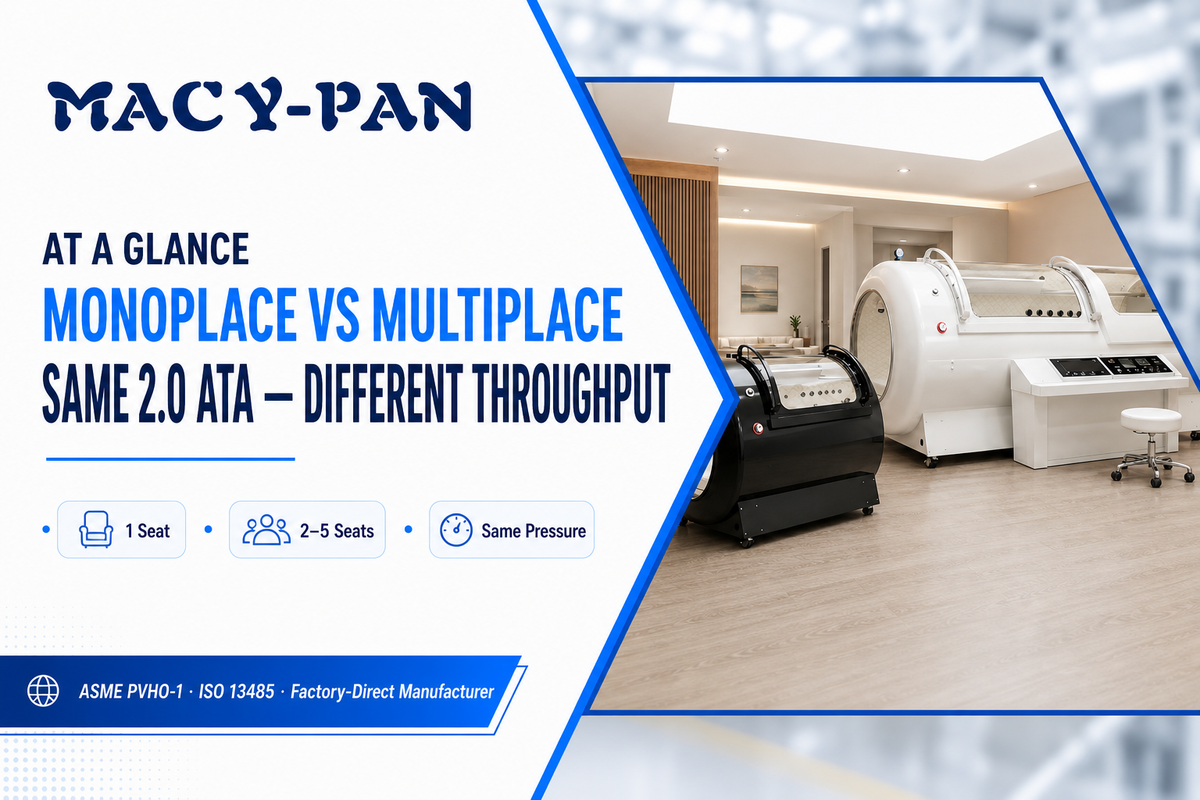
A monoplace chamber is designed for the treatment of a single patient in a tube pressurized by oxygen, where the patient is breathing the chamber atmosphere. Multiplace units treat multiple patients simultaneously in a room pressurized by air, where they all breathe oxygen by means of masks or hoods, with working pressure in both formats measured in atmospheres absolute (ATA). Sorting out the shell question first is the fastest way to tell whether you are actually weighing a hard or soft hyperbaric unit.
| Decision Point | Monoplace | Multiplace |
|---|---|---|
| Patients per session | 1 | 2 to 20+ |
| Pressurizing gas | ~100% oxygen | Air (21% oxygen) |
| How oxygen is delivered | Patient breathes chamber gas — no mask | Mask, hood, or endotracheal tube |
| Inside attendant | No (monitored from outside) | Yes (trained tender inside) |
| Typical pressure | 2.0–3.0 ATA | 2.0–2.8 ATA |
| Room footprint | Compact tube, fits most clinics | 800–1,200 sq ft suite |
| Typical capital cost | ~$47,995 (2.0 ATA hard) | ~$129,000 (2.0 ATA) |
| Staffing per session | 1 operator | Operator + inside attendant |
| Install lead time | Fast — drops into a clinic room | Longer — facility build to NFPA 99 |
| Best fit | Outpatient, wound care, sports, clinics | Hospitals, critical care, dive medicine |
These figures are the MACY-PAN estimate at the time this publication was released and may fluctuate according to configuration and options.
What Is a Monoplace Hyperbaric Chamber?
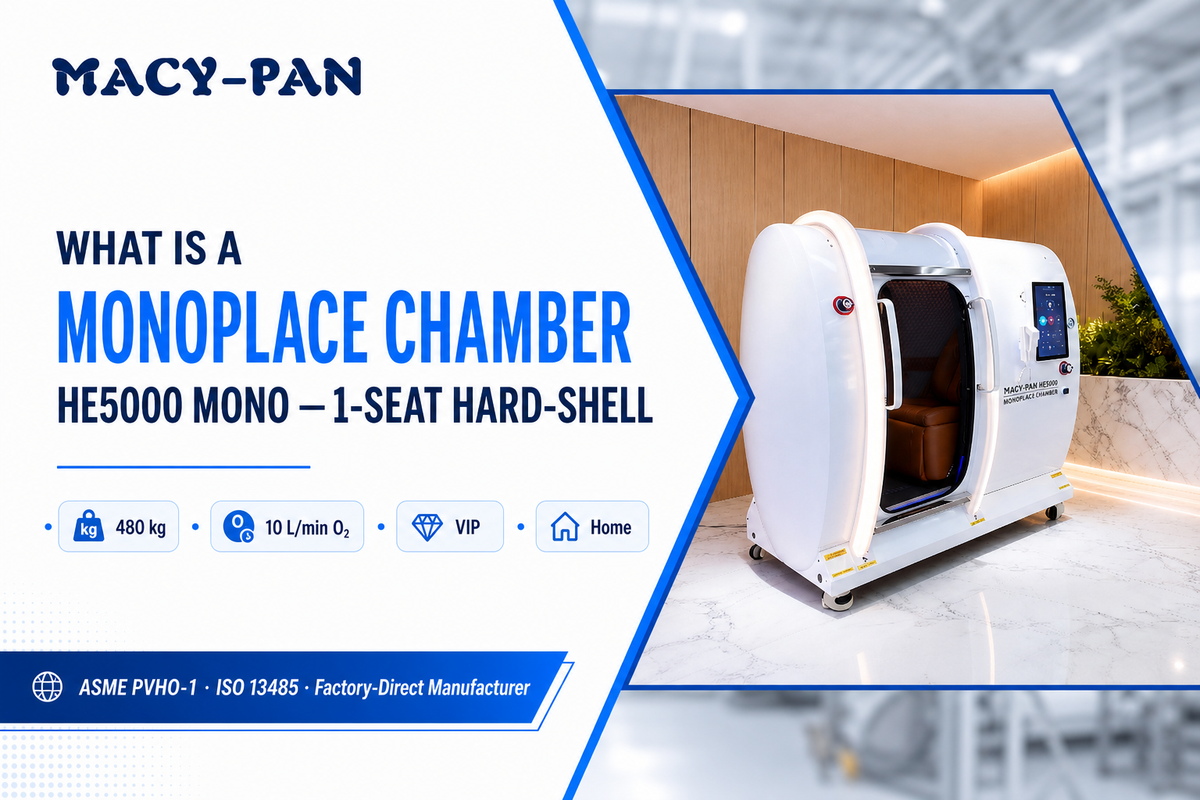
Defined simply, a monoplace hyperbaric chamber is a pressure vessel used to treat a single patient.
This vessel is typically filled with near 100% oxygen, so the patient can inhale it directly, as a mask is not needed. They typically take the form of clear, cylindrical acrylic tubes.
According to the U.S. FDA approvals, these monoplace systems can provide oxygen pressures that exceed atmospheric pressure by as much as 3ATA (equivalent to about 30 psi); many commercially available units offer treatments up to this ceiling, although the operating pressures of some systems will vary.
Because the patient lies supine on a padded tray within a transparent tube, he or she can maintain visual contact with the outside world, communicate with technicians via an intercom system, and forgo the mask, which keeps each session simple.
This operational simplicity makes the monoplace hyperbaric system ideal for the outpatient clinic and medical practice setting, where only one technician may be needed to run multiple treatments, and the chamber can readily fit into an existing room. One downside is that there’s no provision for clinicians to physically reach patients during their sessions.
Picture a busy wound-care clinic running back-to-back diabetic-foot wound healing sessions: a single technician can load one patient, start the treatment, and prep the next appointment while the first runs, because the low staffing model is the whole point. That efficiency is exactly why “hyperbaric chamber staffing” is a smaller line item for a monoplace program than for a multiplace one. The pain point shows up only when a patient becomes unstable mid-session, since no attendant is inside to intervene.
One clarification: while a single, fully sealed and pressurizing tank filled with pure oxygen (oxygen-fill) is the standard in monoplace chambers, this arrangement isn’t immutable. Some monoplace designs can operate at higher air pressure while simultaneously delivering a mask or built-in hood filled with pure oxygen-which works much like the multiplace setup. It’s a pattern found more commonly in hard-shell monoplace designs and influences some of the considerations and trade-offs in cost, staffing and safety detailed later in this article, but “monoplace” refers to capacity, not configuration.
What Is a Multiplace Hyperbaric Chamber?
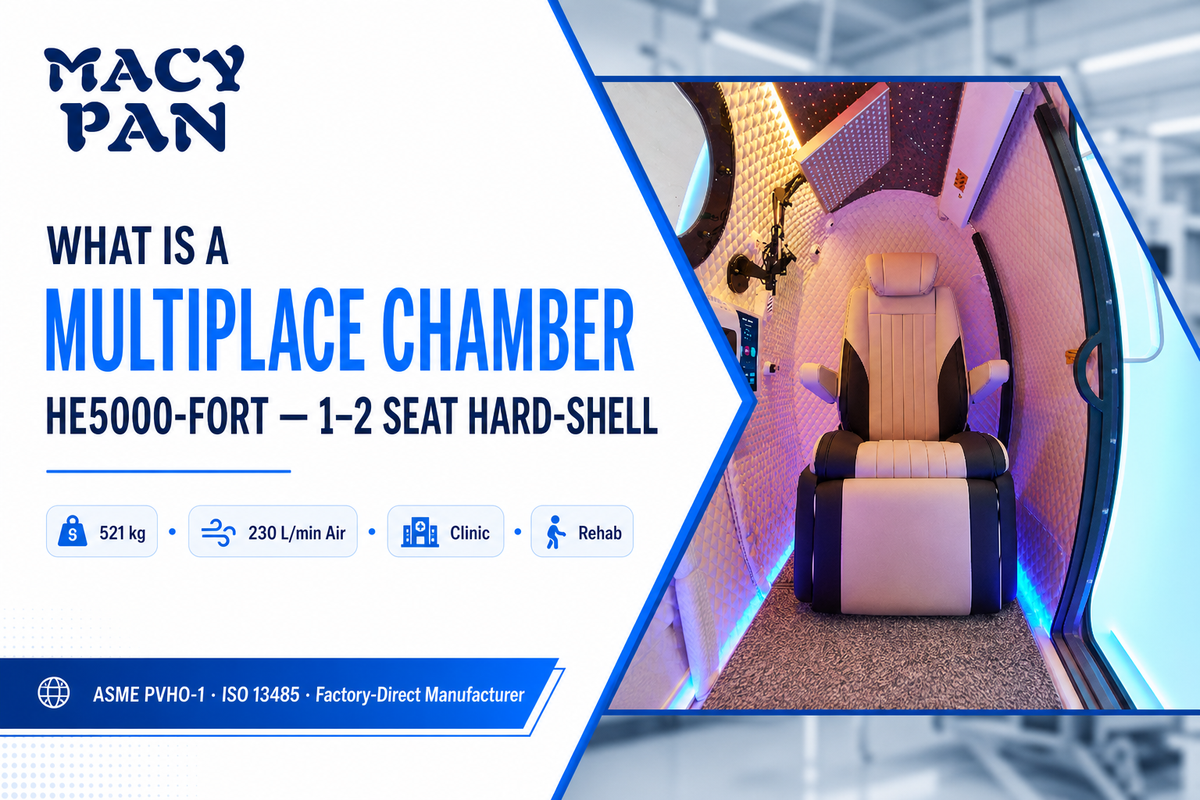
A multiplace hyperbaric chamber is a walk-in, room-size steel cylinder that holds two or more patients and is filled with ordinary air. Because it is walk-in, ambulatory patients can step inside on foot while an unstable patient is wheeled in on a gurney. Oxygen is delivered to each patient, who wears an individually sealed mask or hood, or-for patients on a ventilator-an endotracheal circuit.
Inside the chamber, a qualified person known as an attendant (or tender) monitors and assists the patients, offering hands-on treatment. “A chamber for two or more people is called a multiplace chamber,” says Mayo Clinic, and the oxygen is provided individually to everyone in the chamber.
Inside-attendant access is what makes the multiplace format a critical care tool: consider a hospital intensive care unit treating a ventilated patient with a gas embolism, where the tender manages the endotracheal circuit, adjusts intravenous lines, and responds to alarms without breaking pressure. That hands-on capability sits at the core of the mono vs multi trade-off, and it is why hospitals accept the higher footprint and staffing cost. This pain point is the reverse of a monoplace clinic’s: every session ties up an operator plus a trained attendant inside the vessel.
These chambers can accommodate anywhere from two individuals to more than 20 patients in large hospital settings. Multiplace units are used in dive medicine and research hospitals and provide the same basic technology-a sealed steel cylinder pressurized to a higher level than ambient-as MACY-PAN’s hard-shell medical chambers.
The Core Difference: How Each Chamber Is Pressurized
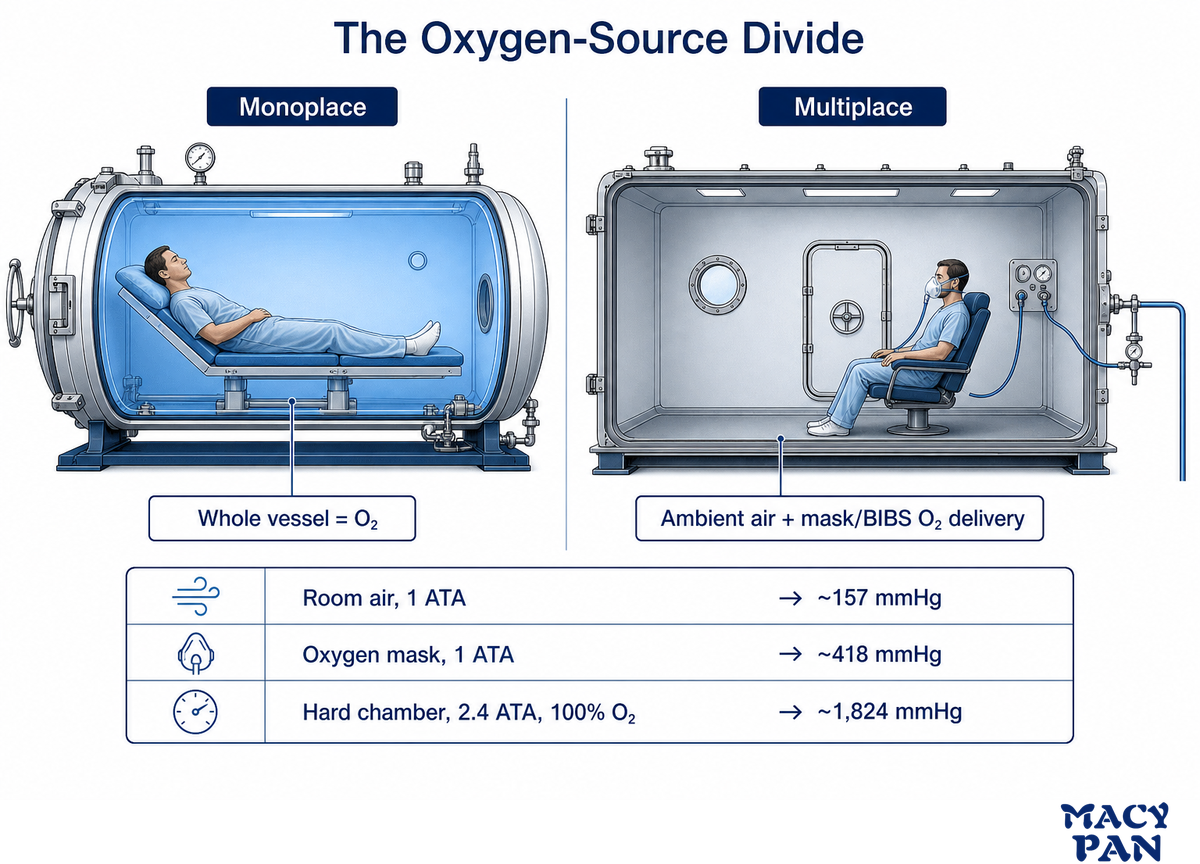
At its root, the fundamental difference between the two kinds of chambers is the following: in a monoplace, the entire vessel is pressurized with oxygen, so the patient is effectively receiving it directly. This is The Oxygen-Source Divide. A multiplace chamber instead raises ambient pressure using ordinary air and delivers oxygen through an attached mask, meaning the effective seal of that mask determines how much pure oxygen actually reaches the patient’s bloodstream.
Why is that clinically important? Adding pressure is useless unless it’s putting additional oxygen into the patient’s bloodstream. At 1 atm and breathing room air, the typical partial pressure of oxygen in arterial blood is 157 mm Hg. Add pressure and a pure oxygen breathing gas, and the value jumps quickly.
In studies of hyperoxia, breathing 100% O2 at about 1.5 ATA pushes the alveolar oxygen pressure to roughly 1,053 mmHg-considerably higher than the level achieved by simply breathing pure oxygen at sea level, which reaches about 663 mmHg. Cannellotto et al., 2024
| Setup | Inspired oxygen | Approx. arterial oxygen |
|---|---|---|
| Room air, 1 ATA | 21% | ~157 mmHg |
| Oxygen mask, 1 ATA | ~55% | ~418 mmHg |
| Hard chamber, 2.4 ATA, 100% O₂ | 100% | ~1,824 mmHg |
First-party oxygen delivery. Try it for your own protocol: at 2.4 atm, the monoplace patient hits the 1,053 mm Hg mark simply because the chamber environment is the 100% O2 breathing mix. However, for the multiplace patient to reach the same 1,053 mm Hg alveolar PO2 at 2.4 atm, a perfect seal around his or her mask or hood must be achieved. Any leaky mask at that pressure could result in an arterial PO2 that’s significantly lower than the one in a monoplace patient.
📐 Engineering Note
Because the ambient air within a multiplace is maintained at the standard ~21% O2 level, the filling process is considerably safer, as discussed in “The Fire Risk.” The entire dose of medical oxygen in a multiplace comes from the mask/hood breathing system. Air breaks must be administered regularly, and mask or hood fit is the main variable that must be managed in multiplace, in addition to protocol management.
Capacity, Attendant Access, and Clinical Use Cases
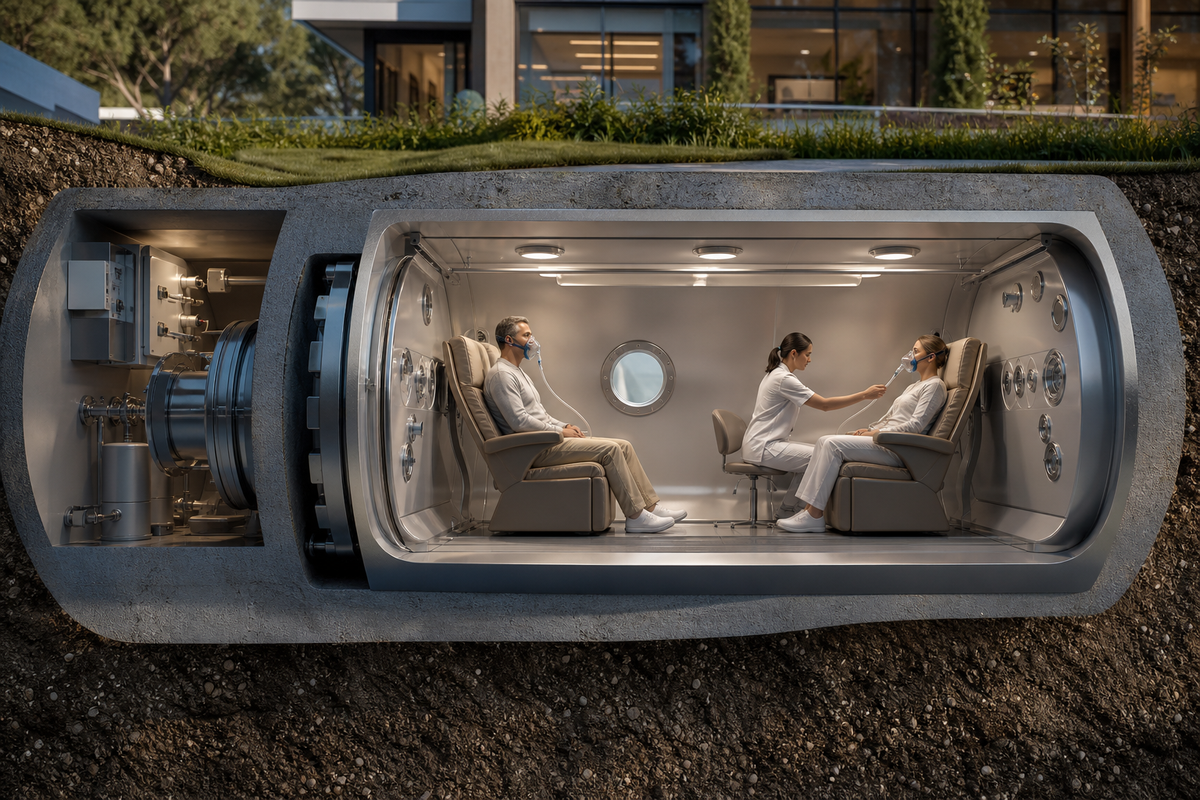
Match the technology to the clinical need, not to perceived prestige. According to one peer-reviewed comparison of monoplace and multiplace chambers, small acrylic monoplaces are “less staffing intensive and require no in-chamber attendant,” whereas “the multiplace chamber is more appropriate for treatment of the critically ill.” Lind, 2015
| Scenario | Better fit |
|---|---|
| Elective wound care, diabetic foot, radiation injury | Monoplace |
| Sports recovery, wellness, cash-pay | Monoplace |
| Ventilated or unstable critical-care patients | Multiplace (hands-on access) |
| Emergency carbon monoxide poisoning, gas embolism | Multiplace (or monoplace if first available) |
| Decompression sickness, remote/dive setting | Whichever gives faster recompression |
| High daily patient volume | Multiplace, or several monoplace units |
| Late radiation tissue injury, delayed wounds | Monoplace |
| Necrotizing infection, unstable vitals | Multiplace (hands-on access) |
| Pediatric elective HBOT | Monoplace (parent visibility) or multiplace |
Can a Monoplace Chamber Treat Critically Ill Patients?
Here’s where the assumption is faulty: many buyers think all critically ill patients require a multiplace chamber. In fact, it’s not always the case. Clinicians will treat ventilated and unstable patients in monoplace chambers with the use of special hyperbaric-rated ventilators and IVs – sometimes even positioning or wheeling the chamber directly into the ICU to accomplish this.
“In fact, a monoplace is moved to the ICU to accommodate such patients,” notes Wound Education Partners.
Moreover, with regard to decompression illness, a monoplace chamber may even be safer because “it provides victims immediate access to recompression in settings where traditional multiplace chambers aren’t available.” Clarke, 2020.
The true line: Critical patients in a monoplace program require the appropriate ventilator, qualified staff, and a well-thought-out set of protocols.
Otherwise, access to hands-on treatment really is compromised, and a multiplace chamber is the tidier choice.
Safety and Fire Risk Compared
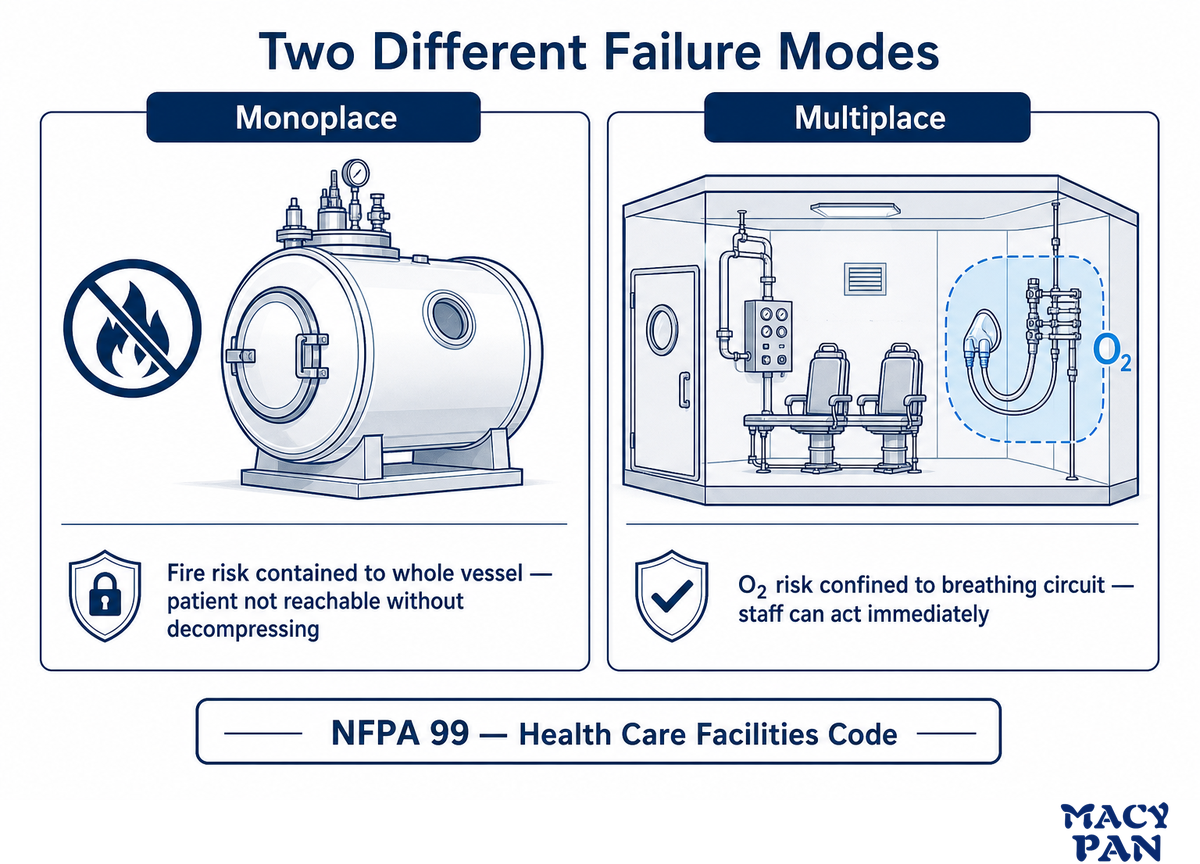
One isn’t necessarily safer than the other, intrinsically; they address different hazards.
Inside a monoplace, the 100 percent oxygen environment necessitates rigorous exclusion of ignition sources and non-approved materials. Because it contains air, a multiplace confines the 100 percent oxygen risk to the breathing circuit (rather than the entire room), but introduces the danger of people pressurized alongside equipment, requiring hands-on emergency procedures.
This is where the mono vs multi hyperbaric decision meets real bedside risk. A team choosing a hyperbaric chamber for critical care has to weigh two opposite failure modes: in a monoplace, a fire risk is contained but a deteriorating patient cannot be reached; in a multiplace, staff can act immediately, yet more people share the pressurized space. As a concrete example, if a ventilated patient dislodges a line at 2.4 ATA, a multiplace tender fixes it in seconds, while a monoplace program must decompress first. That single scenario, more than any spec sheet, is what pushes acute hospitals toward multiplace. Both formats share the same core clinical contraindications, so this decision is really about bedside access, not about which patients qualify for therapy.
⚠️ Important
NFPA 99 (the Health Care Facilities Code) guides hyperbaric medicine’s fire safety protocols. Two other hazards-oxygen toxicity and barotrauma-are managed similarly by both chamber types via alternating oxygen with “air breaks” and careful pressure changes. The purely oxygen atmosphere of a monoplace is why strict controls on ignition sources and other materials are required. The U.S. FDA likewise warns that fire risk rises with the oxygen concentration and pressure inside any hyperbaric chamber.
Cost and Investment: Sizing the Mono-to-Multi Capital Gap

The two chamber types differ greatly in price, and that cost isn’t directly proportionate to your patient volume. A single 2.0 ATA hard monoplace sits around $47,995 as a retail reference, while a 2.0 ATA multiplace runs about $129,000 – roughly 2.7 times more. A factory-direct MACY-PAN HE5000 multiplace has been reseller-listed near $65,100, which shows how much of a retail figure is markup.
| Configuration | Reference price | What drives it |
|---|---|---|
| Single 2.0 ATA hard monoplace | ~$47,995 | Steel shell, controls, single seat |
| Factory-direct multiplace (HE5000) | ~$65,100 listed | Reseller listing of a factory unit |
| 2.0 ATA multiplace, fully equipped | ~$129,000 | Larger steel, life support, redundancy |
Besides the sticker price, multiplace chambers also carry higher operating expenses, requiring both an on-site attendant and an operator per session, and their session length often runs longer once the compression and decompression of a larger vessel are counted (a monoplace needs just one operator per session).
And purchase price only accounts for half the picture; a center’s reimbursement landscape and treatment indications can often be more important to return on investment than the chamber’s cost alone, determining how many payable sessions are actually delivered. For a price guide across various chamber types, visit our guide to the cost of hyperbaric chambers. To explore by pressure rating, consult our hyperbaric chamber by ATA pressure table.
Standards, Certification, and Facility Requirements
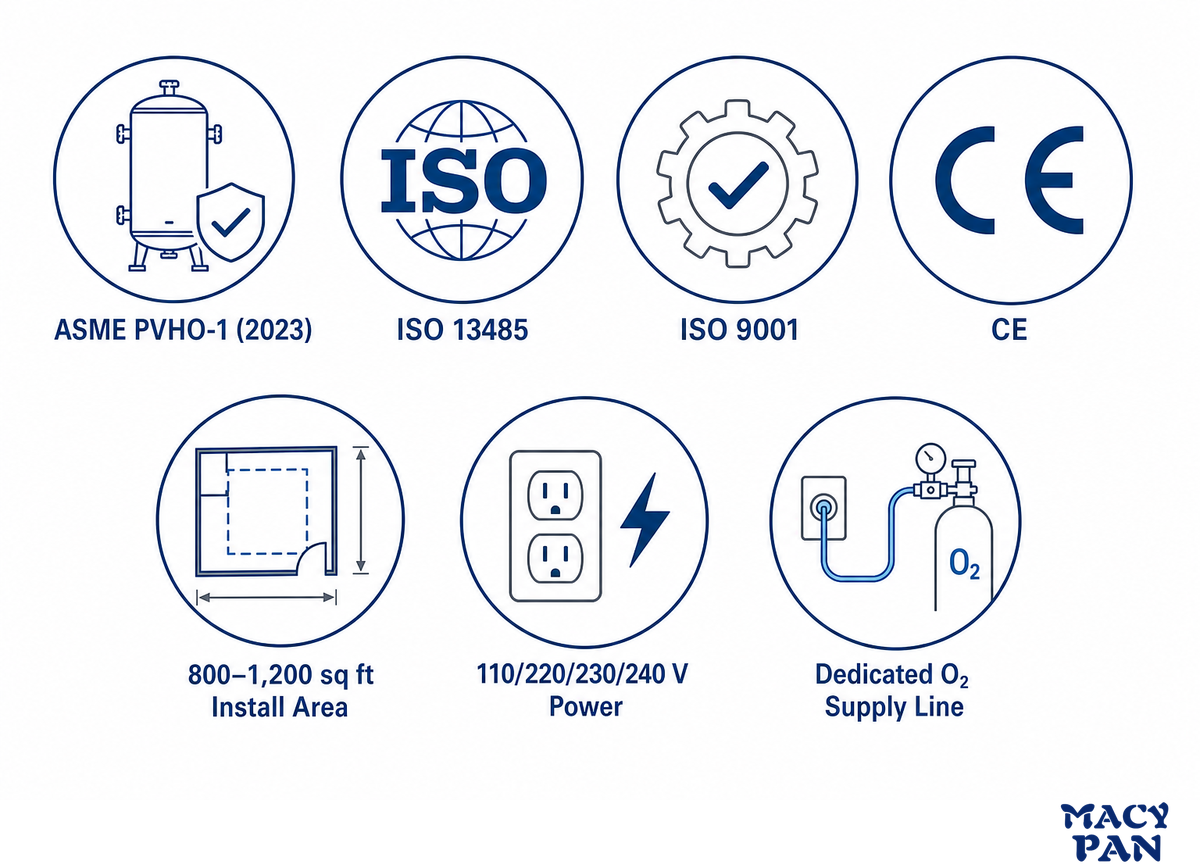
Both types of chambers are pressurized human occupancy devices. Any medical grade vessel sold in the US must be FDA cleared under 510(k) Class II and built to the ANSI/ASME (Pressure Vessels for Human Occupancy) safety standard, the same one referenced by NFPA 99. MACY-PAN chambers also come ISO 13485 quality management system and ISO 9001 certified with the CE Mark, with SGS tested 304 Stainless steel.
Facility-wise is where multiplace gets difficult. Most multiplace suites require 800-1,200 square feet, an oxygen supply of 10-15 LPM, and a package consisting of chamber plus concentrator plus compressor plus intercom, all built according to NFPA 99 code. Monoplace units fit into an existing clinical room with little site preparation.
💡 Pro Tip
Primary and secondary fire-suppression system requirement was newly included in NFPA 99 for 2024 on hyperbaric chambers. If you’re pricing out a multiplace now, budget that new fire suppression package as part of the build from the get-go instead of trying to retrofit later.
Which Should You Choose? The 5-Question Mono-vs-Multi Router
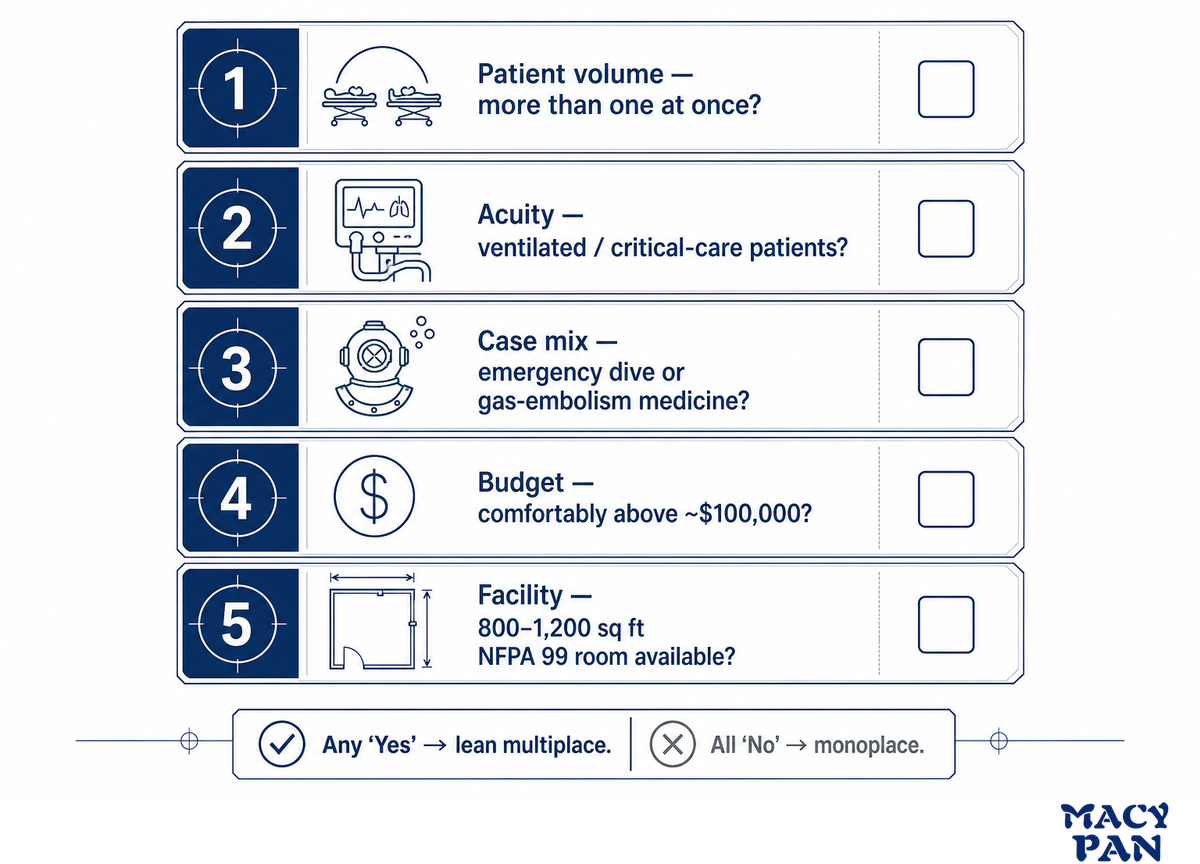
Take your situation through these five questions in order. Whichever is the first to produce a “multiplace” response is most likely your answer; if you don’t hit any of them, the less expensive monoplace is generally the quicker, lower-risk solution for most outpatient clinics.
The 5-Question Mono-vs-Multi Router
- Patient volume — do you need to treat more than one patient at the same time? Yes → lean multiplace. No → continue.
- Acuity — will you routinely treat ventilated or unstable critical-care patients without ICU-adapted monoplace protocols? Yes → multiplace. No → continue.
- Case mix — is your core caseload emergency dive or gas-embolism medicine needing hands-on care under pressure? Yes → multiplace. No → continue.
- Budget — is your capital budget comfortably above ~$100,000 with room for higher staffing? No → monoplace. Yes → continue.
- Facility — can your site meet an 800–1,200 sq ft NFPA 99 multiplace build? No → monoplace. Yes → multiplace is viable if the earlier answers pointed that way.
Outpatient clinics, wellness center, and one location practices often drop out at question 1 or 4 and hit monoplace (a portable or compact hard chamber). Hospitals and dive-medicine programs frequently go to question five and already have a definite multiplace need. If you haven’t already settled the issue of shell types as a whole, our soft vs hard chamber guide covers the underlying pressure question.
Walk a real case through it. A three-provider podiatry clinic treating diabetic-foot wounds answers “no” to questions one through three (one patient at a time, no ventilated patients, no dive emergencies), then hits question four: its capital budget is under $60,000. It stops there and buys a single 2.0 ATA monoplace near the $47,995 reference, avoiding the roughly $129,000 a multiplace would demand. A regional trauma center answers “yes” at question two, because it must treat ventilated carbon-monoxide and gas-embolism patients with an attendant inside, and commits to the 800–1,200 sq ft build. Same five questions, opposite outcome — and neither facility overspends on capacity it will not use.
“Small cost-efficient and easy-to-install acrylic monoplace chambers require less staffing and no inside attendant. The multiplace chamber is better suited for HBOT of critically ill patients.”
F. Lind, Undersea & Hyperbaric Medicine Society (UHMS) review, 2015
Industry Outlook: What Is Changing in Hyperbaric Equipment
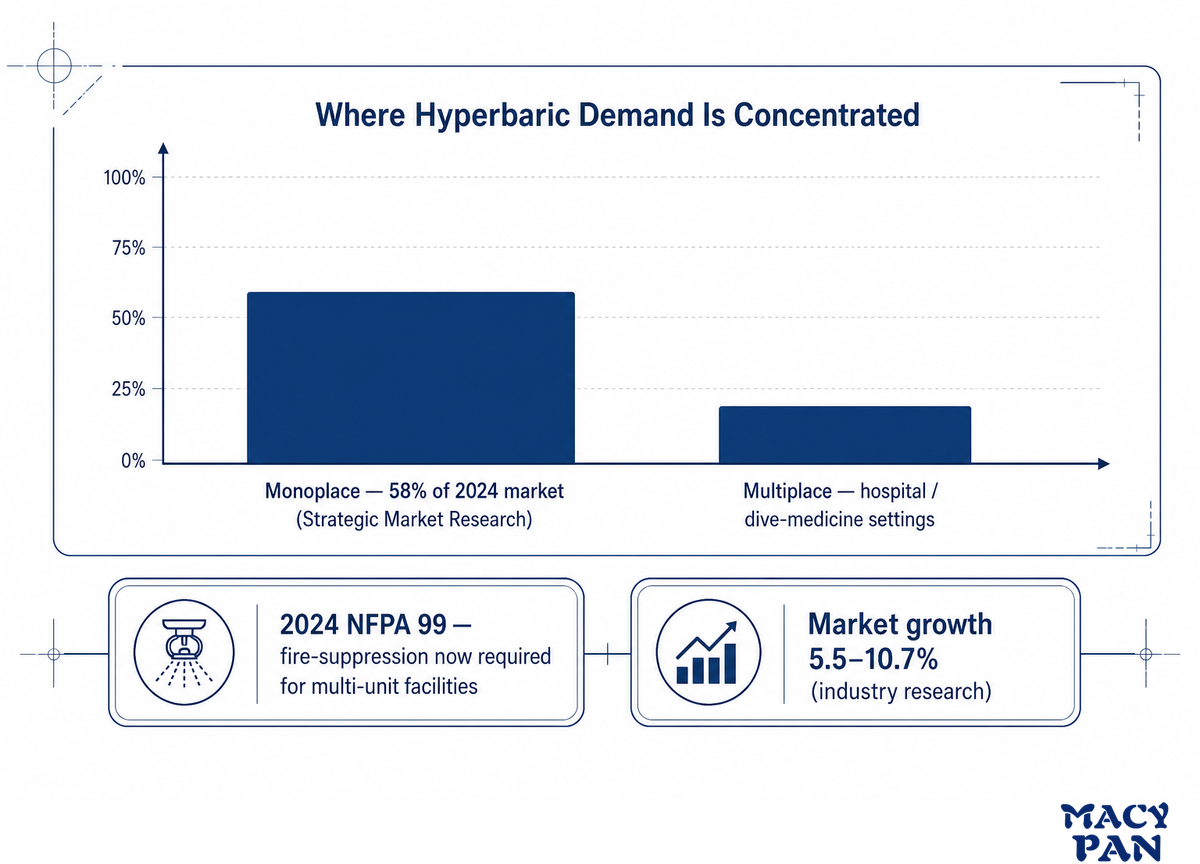
The best thing a buyer can do is understand where the demand is concentrated – not headline growth rate. Monoplace units accounted for an estimated 58% of the hyperbaric device market in 2024, according to Strategic Market Research. This represents widespread usage in outpatient wound-care centers and ambulatory care centers.
“Simply put, growth is occurring in locations that best suit monoplace and portable units, while multi-patient remain confined to hospital and diving medical environments. Budget according to your patient flow.”
Two concrete trends to anticipate are as follows: The regulatory standard for multi-unit facilities is increasing; primary and secondary fire-suppression is now a requirement under the latest 2024 NFPA 99 code. Beyond that, hyperbaric equipment overall has an average market growth of 5.5-10.7 percent according to market research; while the figure is broad, it highlights continuing equipment needs.
RFQ Checklist: What to Confirm Before You Order Either Chamber
- Working pressure (ATA) and if the unit has an FDA 510(k) for the proposed applications.
- ASME documentation for applicable hard-shell models and material (304 stainless, test for both).
- Oxygen supply in LPM, plus a NFPA 99 2024 fire suppression package (if applicable to a multiplace unit).
- Footprint, utility demand, and installation/training.
- Staffing requirements per session (inside attendants plus an operator or an operator only).
Comparing monoplace and multiplace models for your facility?
MACY-PAN manufactures and supplies both monoplace and multi-person systems-learn more about the monoplace and multiplace range.
Frequently Asked Questions
Is a monoplace or multiplace hyperbaric chamber better?
Neither type is inherently superior. Instead, factors like patient care needs, patient throughput, and your budget dictate which is the best fit.
Monoplace devices are the preferred choice for clinics in the areas of wound care and sports and for solo practitioners, thanks to lower staffing demands and a smaller physical size. Multiplace chambers are better suited for conditions that call for treating several patients at once, hands-on care for severely ill individuals, and dive medicine emergencies. Regardless of format, the success of an HBOT session relies on the treatment protocol.
Why is a monoplace chamber filled with oxygen but a multiplace filled with air?
Only the patient fits into a monoplace system, making pure oxygen the only efficient delivery method-a mask isn’t needed. As patients in multiplace systems can move around and interact, and because many can work with an inside attendant, pressurizing the chamber with pure oxygen would pose a fire risk.
To mitigate this, they use air, with oxygen delivered directly via a mask or hood.
Can a monoplace chamber treat critically ill or ventilated patients?
Yes, if adapted appropriately.
Patients who are intubated and in critical condition can receive treatment in monoplace chambers if special ventilators and adapted IV lines are used, with the chamber in or near the ICU. Limitations for these applications include restricted physical access for personnel to treat the patient. If those special adaptations are not in place, it’s safest to use a multiplace chamber and have an inside attendant to manage critically ill patients.
How many people fit inside a multiplace hyperbaric chamber?
The range in patient capacity is anywhere from 2 to 20+, plus one inside attendant. Larger installations are typically for hospitals and can handle many patients, while more compact multiplace units at a clinic may accommodate as few as 2 or 4.
Are monoplace hyperbaric chambers claustrophobic?
Although some find the tubes restrictive, the acrylic tube is transparent, so the patient can see out and communicate with their health care providers. The air can feel less constricting around their head compared to the mask worn with the hood.
Do home hyperbaric chambers count as monoplace or multiplace?
Many of the most readily available home units are built for one person – that is to say, they are monoplace in capacity, though a single person, low pressure soft chamber is a separate consideration from mono-and-multi chambers as detailed in this space.
Why We Can Compare These Fairly
MACY-PAN manufactures both monoplace and multiplace hyperbaric chambers-including the HE5000 multiplace line alongside single-patient hard chambers, so we aren’t guiding you toward the single class we produce. Our own numbers for cost, oxygen, and facilities, along with those in current directories and published standards are given below; the numbers for patient benefits and safety are supported by standards bodies and peer-reviewed publications.
References & Sources
- Hyperbaric Oxygen Therapy — U.S. Food & Drug Administration
- Hyperbaric oxygen therapy — Mayo Clinic
- Monoplace and multiplace hyperbaric chambers for critical care — Lind F., 2015 (PubMed)
- Monoplace chamber treatment of decompression illness — Clarke R., 2020 (PMC)
- Hyperoxia: mechanism of hyperbaric treatment — Cannellotto M. et al., 2024 (PMC)
- Key Health Care Changes in the 2024 Editions of NFPA 99 — National Fire Protection Association
- Pressure Vessels for Human Occupancy (ANSI/ASME) — The National Board of Boiler and Pressure Vessel Inspectors
Verified by MACY-PAN (Shanghai Baobang Medical Equipment) technical department. The quoted prices and technical parameters are reference values and will differ based on the product configuration. Please confirm the final details before placing an order.
Factory Selection Support
Need a hyperbaric chamber matched to your room, pressure target, and compliance documents?
MACY-PAN helps clinics, wellness centers, distributors, and home buyers compare soft-shell, hard-shell sitting, and professional-grade lying chambers before quotation. Send your intended use, available space, country, and preferred ATA range, and our team will recommend a practical model path.
2007HBOT manufacturing since
126+countries shipped to
1.3-2.0ATA chamber range
![Decision lenses: occupancy, gas path, access, staffing, facility interfaces, and exact-model evidence [article].](https://macypansolutions.com/wp-content/uploads/2026/10/monoplace-vs-multiplace-hyperbaric-chambers-featured-1-768x512.png)