Get in Touch with MACY-PAN Company

GLOBAL
certified quality management system
Export & Worldwide Shipping
Hyperbaric Chamber Manufacturer, Factory-Direct HBOT Systems, Shipped to 126 Countries
Sourcing a hyperbaric chamber manufacturer you can trust with a pressurized medical device is the hard part, not finding one. MACY-PAN (Shanghai Baobang Medical Equipment Co., Ltd) has built quality-system-controlled hyperbaric oxygen chambers for 19 years and shipped them, factory-direct, to clinics, wellness centers, and distributors across 126 countries.
- 1.3–2.0 ATA soft & hard range
- OEM / ODM white-label ready

19 yrs
HBOT-only specialist
126
export countries
10,000+
chambers delivered
certified quality management system
ISO 9001 · CE · SGS
Manufacture
Why Buy Hyperbaric Chambers Direct From the Manufacturer
A Hyperbaric Chamber Manufacturer carries a responsibility most equipment vendors never face: the product is a pressure vessel with a human sealed inside, breathing concentrated oxygen. That single fact reshapes how you should buy. The most expensive mistakes our distributor and clinic customers describe weren’t about price, they were about who they bought from. One buyer paid over $100,000 for a hard chamber that arrived with a burned-out circuit board, then learned the “brand” was a label invented by a reseller with no real factory behind it and no returns. Another found that once the warranty lapsed, every repair meant shipping the chamber back to China at their own cost.
A hyperbaric oxygen chamber, the medical equipment that delivers hyperbaric oxygen therapy by raising a sealed occupant to above-atmospheric pressure, is only as good as the factory standing behind it for the next decade. Buying direct from the manufacturer removes accountability disappearing layers: no relabeled OEM box, no pop-up dealer, no anonymous WhatsApp seller with recourse. You deal with the people who weld the vessel, run the aging test, and answer the service call in year five.
That’s the position MACY-PAN was built for. We manufacture the full pressure range in-house, soft 1.3–1.5 ATA portable units and hard 2.0 ATA clinical systems, monoplace through multiplace, and we sell them factory-direct to family buyers and to sales companies who resell under their own brand. The sections below give you the specifications, the certifications, the export logistics, and the real market price bands you need to make a defensible purchase, not a hopeful one.
Hyperbaric chambers are FDA-regulated Class II medical devices, which is why a real manufacturer’s accountability matters — source.
MACY-PAN Hyperbaric Chamber Range, Models, ATA & Sizing
Before the model list, one decision rule that saves buyers from over-paying: match chamber pressure to the clinical goal, not to the biggest number on the spec sheet. It’s a common assumption that more pressure is always better. Peer-reviewed work doesn’t support that, in dermal tissue studies, fibroblast proliferation and collagen production improved at 1.0 and 2.5 ATA but showed no added benefit at 3.0 ATA, and a diabetic-foot comparison found no significant healing difference between 1.5 and 2.0 ATA, with 1.5 ATA producing fewer ear-pressure side effects. Higher pressure is the right tool for clinical indications; it isn’t a universal upgrade. We build both ends of that range so you can specify the correct one.
Physics is why pressure tiers exist at all. At normal pressure, plasma carries only about 3 mL/L of dissolved oxygen; under hyperbaric oxygen therapy at 2.0 ATA the partial pressure of oxygen in blood plasma rises roughly ten-fold, and at 3.0 ATA on 100% oxygen plasma alone can meet resting tissue demand independent of hemoglobin. A 2.0 ATA hard chamber lifts arterial oxygen to roughly 1,800 mmHg versus about 157 mmHg breathing room air. That’s the gap between a wellness session and a clinical-grade hbot chamber.
How Hyperbaric Oxygen Therapy Works Across Chamber Types
Hyperbaric therapy works on a principle from hyperbaric medicine: inside a sealed therapy chamber, atmospheric pressure is raised and the occupant breathes pure oxygen, so oxygen dissolves into blood plasma at levels normal breathing never reaches. Raising the pressure levels increase the amount of oxygen the plasma carries, and that pure oxygen delivery reaches poorly vascularized tissue that ordinary circulation struggles to supply, the mechanism used to oxygenate stubborn wounds and to treat medical conditions such as carbon monoxide poisoning. Oxygen levels in a session depend on three variables you control: chamber pressure in ATA, oxygen purity, and time.
Hyperbaric chambers fall into two broad chamber types. A monoplace hyperbaric chamber holds one occupant breathing chamber oxygen directly, a monoplace chamber is the most common clinic format, sometimes called monoplace hyperbaric. A multiplace hyperbaric chamber pressurizes a room for several occupants breathing through masks; multiplace chambers and larger multiplace hyperbaric chambers suit multi-patient centers. We build across monoplace and multiplace formats, and a different chamber serves each use case. Each hyperbaric system pairs the vessel with matched support equipment, so the hyperbaric equipment and hyperbaric technology behind a 2.0 ATA unit ship as one integrated hyperbaric oxygen therapy system rather than mismatched parts. Every chamber is designed for medical and wellness settings with straightforward ease of operation, and our chambers accommodate single users through five-person groups.
In a hard chamber, materials like steel or acrylic let the vessel hold oxygen at pressures a fabric shell can’t; that’s why oxygen under pressure in a medical-grade unit feed the body’s oxygen delivery systems during a hyperbaric treatment more effectively than a soft chamber.
Chamber Selection Matrix, type × pressure × use case
| Series | Type | ATA | Sizes | Capacity | Best-fit buyer |
|---|---|---|---|---|---|
| ST701/801/901 | Soft lying (portable) | 1.5 | S / M / L | 1 person | Home wellness, mobile recovery |
| L1 / ST1700 / ST2200 | Soft sitting (portable) | 1.5 | S / M / L (to 220 cm) | 1–2 person | Wellness centers, gyms |
| MC4000 U / N | Sitting / wheelchair | 1.3–1.4 | L | 1 + wheelchair | Rehab, accessibility care |
| HP1501 | Hard lying | 1.5 | S–XL (HP1501-100) | 1–2 person | Recovery clinics |
| HP2202 | Hard lying (clinical) | 2.0 | S / M / L | 1–2 person | Hospitals, medical clinics |
| MC750 | Stretcher hard | 1.8 | L | 1 + stretcher | Hospital transfer |
| HE5000 series | Multiplace hard | 1.6–2.0 | Walk-in | 1–5 person | Multi-patient centers |
| HP600 / HP800 | Veterinary (vertical) | 1.4 | M / L | pets / animals | Veterinary clinics |
HP2202 — 2.0 ATA hard-shell clinical chamber.
High-grade stainless steel with reinforced acrylic viewing windows, internal/external dual pressure gauges, height-adjustable stretcher, integrated air-conditioning to manage pressurization heat, an in-out intercom, and interior lighting.
Engineered for 24/7 heavy-duty operation in hospitals and professional sports facilities. The clinical standard for severe wound healing, decompression sickness, and advanced athletic recovery.

ST-series — 1.5 ATA soft-shell portable.
Reinforced TPU over a rigid frame, zipper-sealed, with an integrated oxygen concentrator. The accessible entry point for home wellness and mobile recovery — a true portable hbot platform that ships and installs without a facility build-out.
Buyers searching for a hard shell hyperbaric chamber for sale should still read the comparison below before defaulting to soft.

Real performance at 2.0 ATA depends on more than the vessel rating: the supporting system has to hold pressure for a full session. MACY-PAN units pair the chamber with a matched compressor and a 10 L/min oxygen concentrator (the clinical standard, versus 5 L/min entry-level units that buyers on forums repeatedly warn are too weak), delivering 93%±3% oxygen purity. We explore hard-shell hyperbaric chamber and multiplace hyperbaric chamber options in dedicated specs.
Pressure-and-oxygen physics referenced from NIH hyperbaric physiology (StatPearls) — source.
Hard-Shell vs Soft-Shell Hyperbaric Chambers, Which to Order
This is the decision that cost buyers the most when they get it wrong, and the soft-versus-hard hyperbaric chamber debate dominates every buyer forum. An honest answer isn’t “buy the most expensive one” — it’s “buy the one your application is cleared and built for.” Here are the numbers, not adjectives.
Read more about the differences…
Here’s the honest version of the soft vs hard hyperbaric chamber question: physics won’t let a soft 1.3 ATA shell match a hard 2.0 ATA chamber, and we won’t claim it does. The trade-off is pressure ceiling versus portability and cost, not good versus bad.

| Factor | Soft-shell (mild) | Hard-shell (clinical) |
|---|---|---|
| Working pressure | 1.3–1.5 ATA | 2.0 ATA (to 3.0 in medical class) |
| Oxygen delivered | ~24% (compressed room air) | up to 100% medical oxygen |
| Arterial O₂ (typical) | ~230 mmHg | ~1,824 mmHg at 2.4 ATA |
| Shell material | reinforced TPU / nylon | stainless steel + acrylic |
| Bacteriostatic threshold (≥1.5 ATA) | below it at 1.3 ATA | above it |
| Best application | wellness, fatigue, recovery | clinical wound care, DCS, pro recovery |
| Typical market price | $5,000–$15,000 | $25,000–$65,000+ |
One trap buyers fall into is the “$1,000–$1,500 Alibaba special.” A chamber that merely holds pressure isn’t automatically equivalent to one that holds it safely for 1,000 sessions, the difference lives in seam construction, zipper redundancy, valve quality, and gas purity. When you weigh shipping, customs, and the risk of no after-sales recourse, buyers who looked closely concluded a cheap import “isn’t that much cheaper” than a properly certified chamber. That’s the calculus this page exists to make transparent.
Put plainly: a mild hyperbaric chamber, the soft 1.3–1.5 ATA class, also called mild hyperbaric, is the right instrument for wellness and recovery, while a hard chamber built from medical-grade, high-quality stainless steel and acrylic is the clinical one. Neither is “better”; they’re different tools, and a manufacturer that sell both has no reason to push you toward the wrong one.
Pressure-versus-outcome data drawn from a peer-reviewed HBOT review (NIH/PMC) — source.
Certifications, Quality Control & Export Compliance
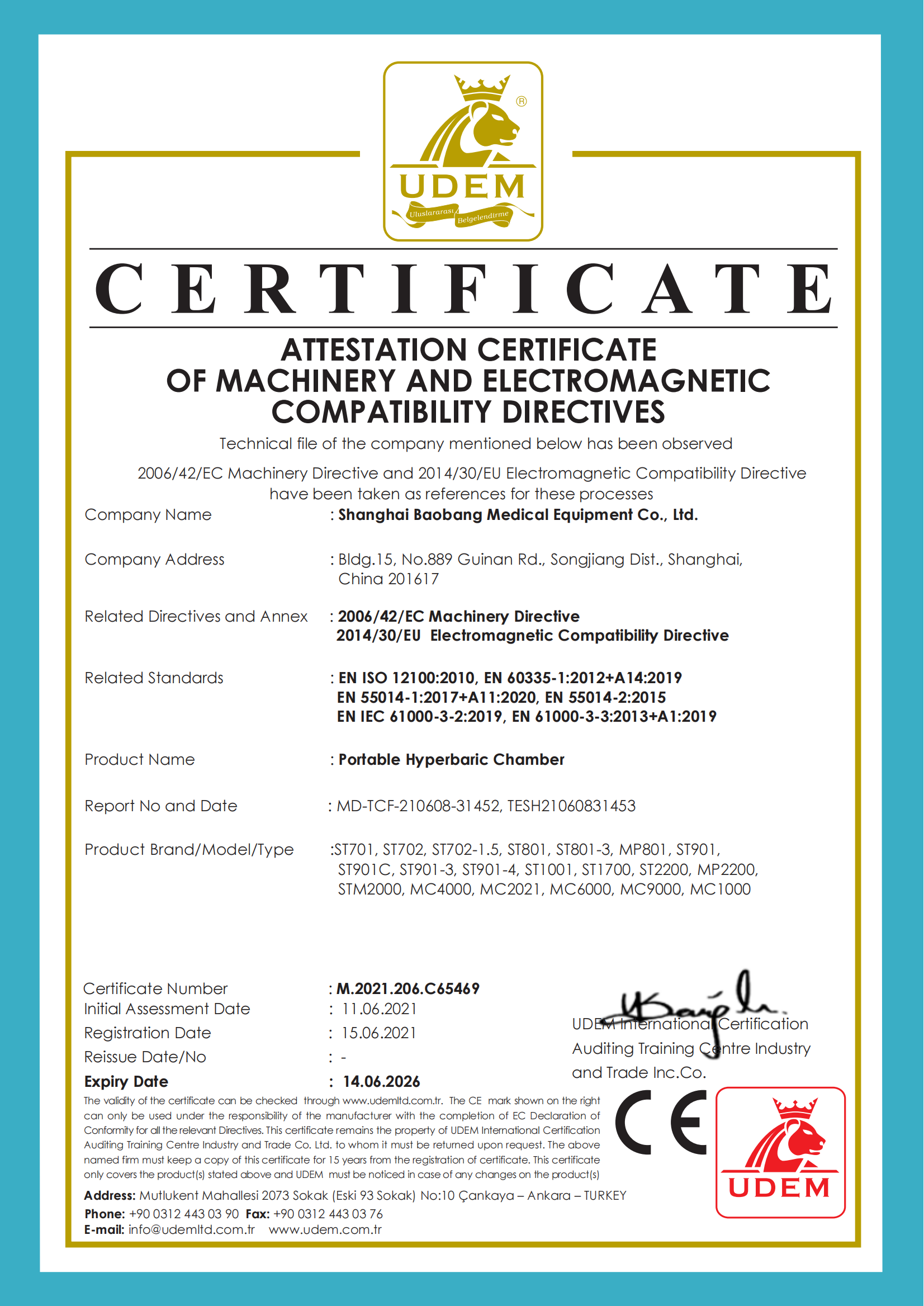
Buyers screen hyperbaric chamber suppliers on one question before any other: are they certified to sell this, and who carries the liability? It is the right question. A hyperbaric chamber is a regulated medical device, and the standards are not optional. Our chambers are manufactured under a certified quality management system (medical device quality management), ISO 9001, and CE, with non-toxic material safety verified by TÜV/SGS and our designs hold an invention patent on record.
certified quality management system
Medical device QMS
ISO 9001
Quality management
CE
Chamber + air compressor
SGS / TÜV
Non-toxic material tested
Patent
Invention patent on record
Engineering & Safety Standards
Why this matters at the engineering level: clinical hyperbaric chambers worldwide are built to the ASME Safety Standard for Pressure Vessels for Human Occupancy, the fabrication standard that the U.S. FDA recognizes when it clears hyperbaric chambers as Class II medical devices through the 510(k) process.
The discipline behind those codes is the reason a 73-year global survey found that of 35 chamber fires worldwide, none occurred in clinical chambers fabricated and operated to recognized pressure-vessel and fire codes.
We publish our applicable standards rather than hide behind a vague “highest safety rating” claim, because, per the Undersea and Hyperbaric Medical Society, clinical HBOT requires a hard-sided chamber operating at no less than 2.0 ATA on medical-grade oxygen of greater than 99% purity.
Structured Quality Control
Our quality control is structured as a six-stage inspection, raw-material inspection, assembly test, a 72-hour aging test, full-system testing, final inspection, and packing inspection.
Every chamber carries eight safety devices: a failure-safety system, door-close sensor lock, emergency relief valve, dual automatic pressure-relief valves, a manual pressure-relief valve, internal/external operation control, an in-out communication system, and carbon-dioxide removal.
Global Compliance Array
DOC 01
DOC 02
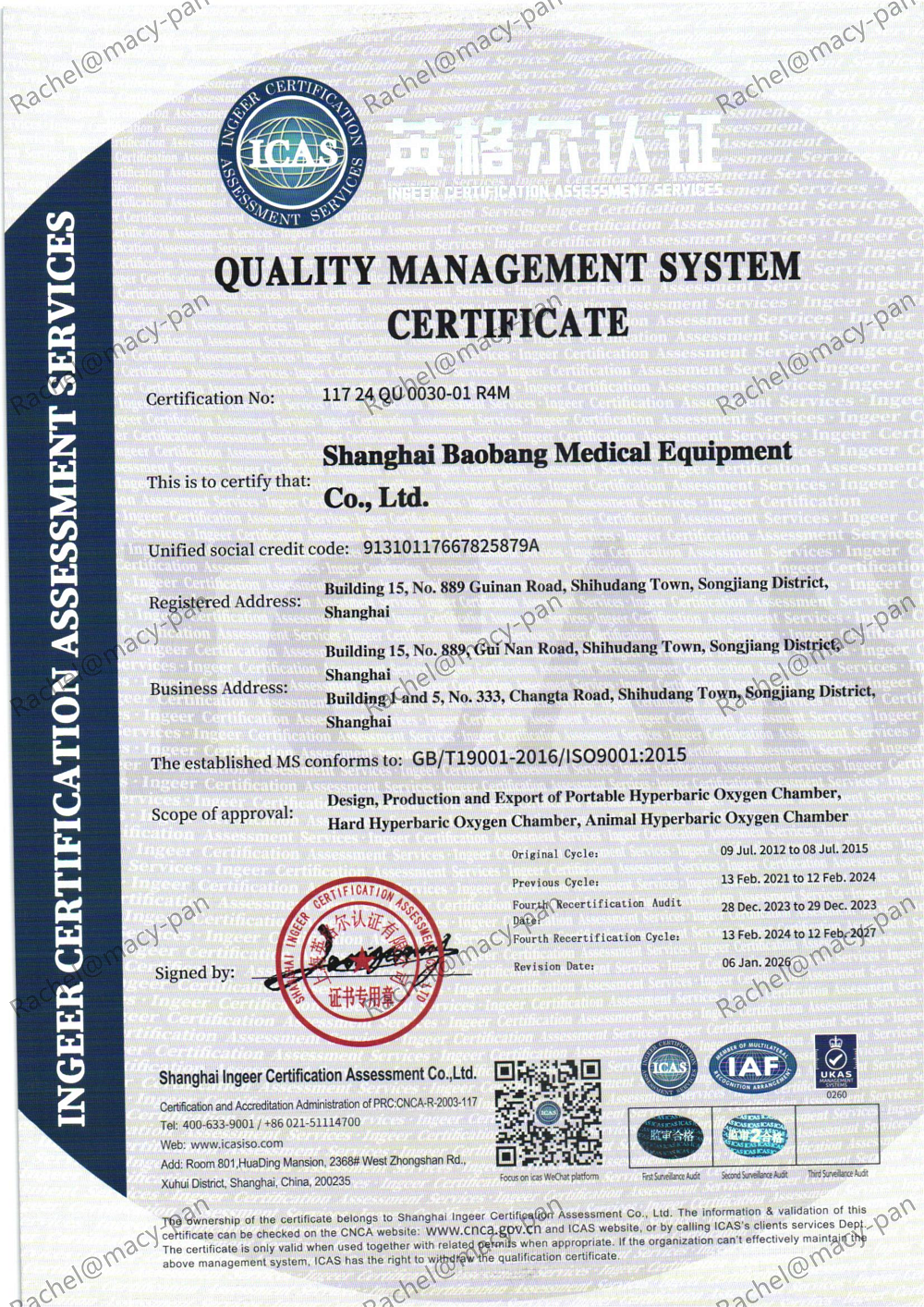
DOC 03
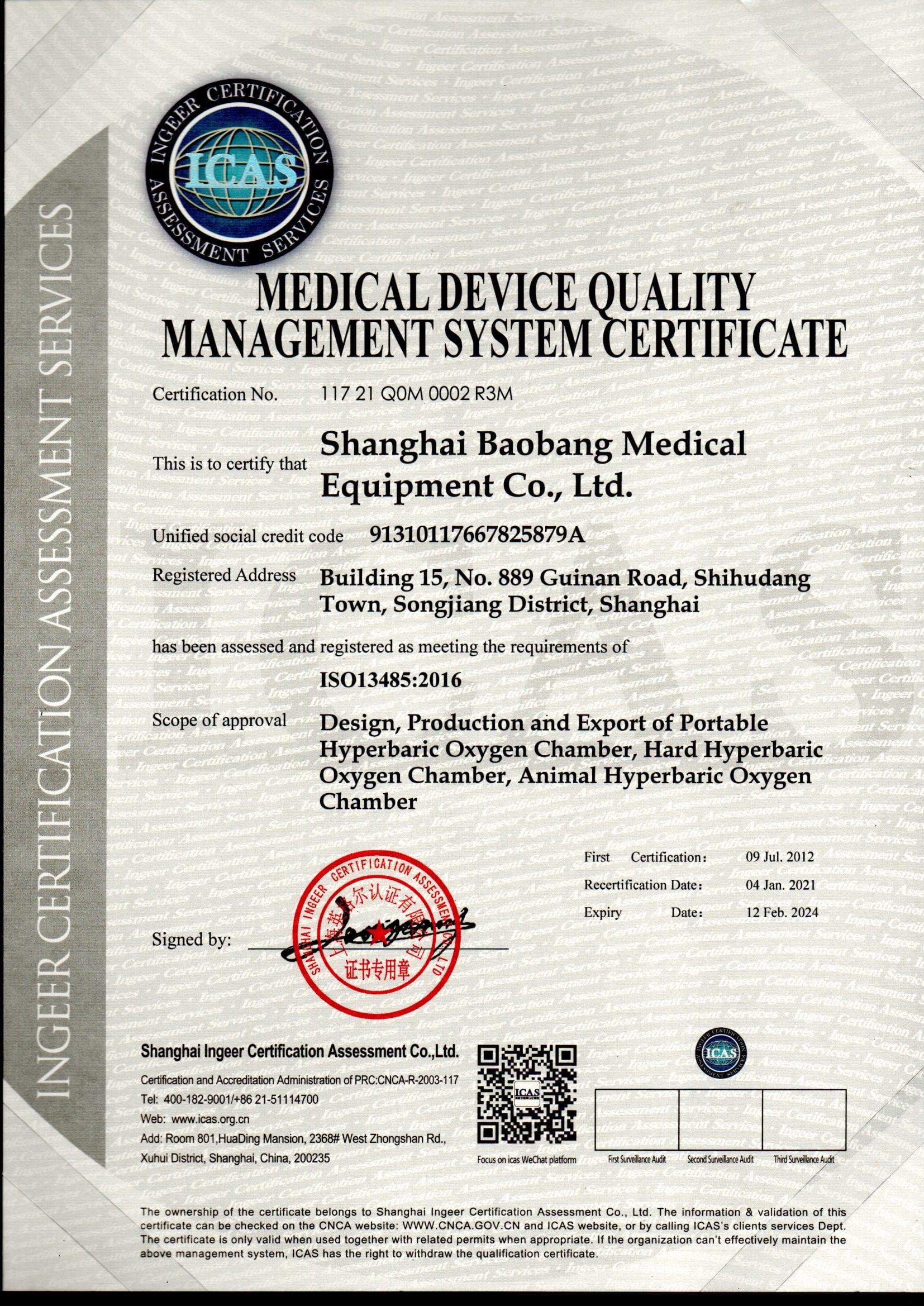
DOC 04

DOC 05
DOC 06
DOC 07
DOC 08
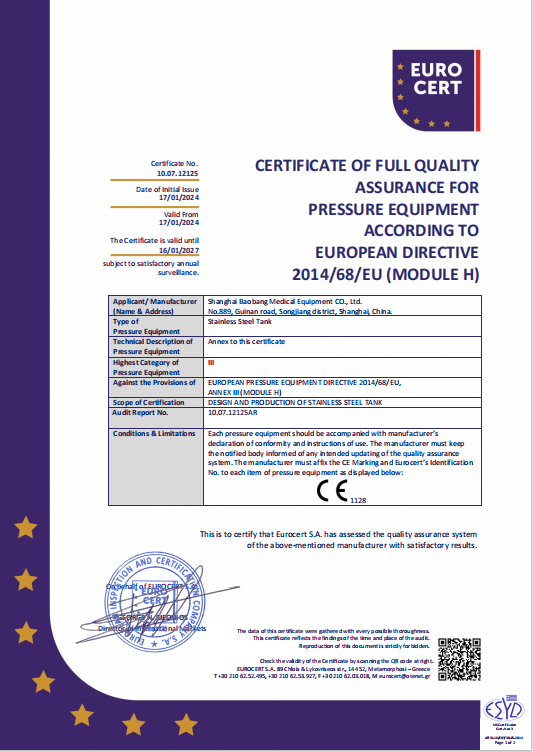
×
❮
❯
DOC 01
Worldwide Export & Shipping, 126 Countries, Supplier by Region
By far the biggest reason buyers hesitate to source from China isn’t price or specs, it’s what happens after the chamber lands. Forum threads are full of the same story: a “pop-up” dealer that disappears within two years, parts that can only be found in a foreign language, and warranty repairs that require shipping the unit back to China at the buyer’s expense. Export reliability is the differentiator, and it’s the one we built the company around.
Macy-Pan has export experience in 126 countries with more than 10,000 clients, and we structure delivery so a buyer in any region knows the path before they pay. China holds the world’s largest installed base of hyperbaric oxygen chambers more than 5,000 chambers, the highest of any country. which is the manufacturing depth behind that reach.
126-Country Export Footprint, What Ships With Every Order
Pre-Sale
Application-based selection guidance; spec match for your voltage, climate, and altitude.
[ VERIFIED ]Documentation
ISO/CE/patent records, commercial invoice, packing list for customs clearance.
[ VERIFIED ]Shipping Terms
FOB / CIF by region; export-grade crating tested for safe transport.
[ VERIFIED ]Installation
User manuals + installation videos; remote commissioning support.
[ VERIFIED ]After-Sales
Global online support plus local technical support in the USA; spare-parts supply.
[ VERIFIED ]High-elevation installs are a specific example of why region matters: a site at altitude needs an oversized oxygen concentrator to hit the same flow as one at sea level, and we size the support equipment to the destination rather than shipping a sea-level configuration everywhere. That’s the practical meaning of “supplier by country” — the chamber is specified for where it will actually run.
OEM & ODM, Custom & White-Label Hyperbaric Chambers
Distributors get burned when a factory treats OEM as an afterthought, a hidden risk that surfaces only when the first white-label order ships wrong, with no recourse. For sales companies and distributors, the manufacturer relationship is a product line, not a single purchase. MACY-PAN provides OEM and ODM service so you can sell hyperbaric chambers under your own brand: custom exterior color and finish, your logo and interface language, configurable pressure (1.3 ATA through 2.0 ATA), and chamber forms from soft sitting to hard multiplace. We support tailored configurations from a single unit, which lets a distributor validate a market before committing to volume.
Beyond the hardware, business customers receive market analysis, advertising assets, and sales-experience support, the difference between buying a box and onboarding a product line you can actually move. Our patented wheelchair-accessible entry (US20230201059A1) is one example of design IP we can build into a white-label program rather than asking you to compete on identical commodity units.
Design-IP example: our wheelchair-accessible entry is filed as US patent US20230201059A1 — source.
Proven Worldwide, Athletes, Clinics & Distributors
Perhaps the clearest signal that a chamber hold up is who keeps using it. MACY-PAN chambers are used by professional athletes including UFC champions, and trusted by physicians, wellness centers, and families across 126 countries. In the buyer communities where Chinese-made chambers are usually met with caution, MACY-PAN is repeatedly named as one of the reputable exceptions, the kind of earned reputation a relabeled OEM box can’t buy.
Across the communities comparing the best hyperbaric chambers, the real question is whether hyperbaric oxygen therapy chambers are proven in genuine medical settings and backed by a trusted hyperbaric brand, and whether advanced hyperbaric oxygen therapy from medical hyperbaric and medical chambers holds up across both portable hyperbaric and clinical use.
For a clinic or wellness center, the business case is concrete. Independent industry sources put HBOT session pricing at $150–$600, and a single chamber running four to six sessions a day generates roughly $150,000–$187,500 in gross revenue per year against operating costs of only a few thousand dollars annually. Adding hyperbaric oxygen therapy to an existing practice typically reaches payback fastest, often within 10–16 months.
10–16 months
typical payback when HBOT is added to an existing clinic or wellness practice, at $150–$250 per session
Source: industry ROI analyses (hyperbaricpro.com, oxygenhealthsystems.com, peakprimalwellness.com), 2025–2026. Figures are industry averages, not a MACY-PAN guarantee.
Demand is structural, not a fad: the global hyperbaric oxygen therapy device market was valued at roughly $3.3 billion in 2022 and is projected to approach $4.9–6.9 billion by 2030–2034, and 1,800–2,000 U.S. hospitals plus 500–700 non-hospital clinics already run hyperbaric programs.
That demand spans hyperbaric healthcare end to end. Our chambers run in medical clinics and hospital medical facilities, in wellness centers, and with home users, the same hyperbaric medical platform configured for various medical and wellness needs, from medical HBOT under clinical protocols to gentler setups for home use.
Clinical and athletic-recovery use is documented in the peer-reviewed literature (NIH/PMC) — source.
Interactive HBOT Export & Clinical Planning Tools
HBOT Chamber Selector
Match a MACY-PAN hyperbaric chamber to your application, pressure goal, and capacity. Factory-direct, certified quality management system.
Clinic HBOT ROI Calculator
Estimate annual revenue and payback for one hyperbaric chamber. Defaults reflect 2025–2026 industry figures.
Pressure & Oxygen Estimator
See the approximate arterial-oxygen tier for a chamber setup. Based on published HBOT ranges (NIH / clinical sources).
FAQ, Buying Hyperbaric Chambers From a Manufacturer
What certifications should a hyperbaric chamber manufacturer have?
At minimum, ISO 13485 (medical device quality management) and CE for clinical sale in Europe, plus material safety testing (SGS/TÜV). For the U.S. market, clinical chambers are designed to the ASME pressure-vessel standard and cleared by the FDA as Class II devices via the 510(k) process. Ask any supplier to publish their certificate numbers so your compliance team can verify them independently, a reputable manufacturer of hyperbaric chambers will provide them on request.
What is the difference between a soft and hard hyperbaric chamber?
Soft-shell (mild) chambers reach 1.3–1.5 ATA with reinforced fabric and deliver around 24% oxygen, suited to wellness and recovery. Hard-shell chambers are rigid stainless-steel-and-acrylic pressure vessels that sustain 2.0 ATA or more and can deliver up to 100% medical oxygen, which is the clinical standard. The right one depend on your application, not on price alone.
Can anyone buy a hyperbaric chamber?
Family buyers, wellness centers, clinics, and distributors all purchase chambers from us. In regulated markets, clinical hyperbaric oxygen therapy is a prescriptive medical device and operation should follow local rules and trained protocols. We provide selection guidance, user training, and documentation to support compliant deployment in your market.
Do inflatable / soft hyperbaric chambers actually work?
They work for what they’re cleared for. Soft 1.3 ATA chambers raise oxygen availability modestly and are appropriate for general wellness and fatigue recovery. For clinical indications, non-healing wounds, decompression sickness, the evidence base is built on the higher pressures only a hard chamber reach. Match the chamber to the goal.
How do I avoid the “pop-up dealer” and cross-border repair trap?
Buy from a manufacturer with a verifiable track record and a real after-sales structure, not a reseller reachable only by WhatsApp. MACY-PAN has 19 years of HBOT manufacturing, export to 126 countries, published certifications, an invention patent on record, global online support, and local technical support in the USA with spare-parts supply.
What does a hyperbaric chamber for home use cost to run?
Operating cost is modest, clinics report only a few thousand dollars a year per chamber in utilities, maintenance, and supplies. The larger variable is the upfront chamber configuration and oxygen system, which is what the Pricing Factors Framework above is for.
Are American-made hyperbaric chambers safer, and is it expensive to run?
Buyers often ask whether american made hyperbaric chambers are inherently safer than imports. Safety comes from the standard a chamber is built and certified to, ASME, certified quality management system, CE, not from the country label alone. And is it expensive to run a hyperbaric chamber day to day? No, operating cost is typically only a few thousand dollars a year per chamber in utilities, maintenance, and supplies.
Do you offer OEM / white-label and what is the MOQ?
Yes. We provide OEM and ODM service, your brand, color, interface language, and pressure configuration, and we support tailored orders from a single unit so distributors can validate a market before scaling.
Factory Selection Support
Need a hyperbaric chamber matched to your room, pressure target, and compliance documents?
MACY-PAN helps clinics, wellness centers, distributors, and home buyers compare soft-shell, hard-shell sitting, and professional-grade lying chambers before quotation. Send your intended use, available space, country, and preferred ATA range, and our team will recommend a practical model path.
2007HBOT manufacturing since
126+countries shipped to
1.3-2.0ATA chamber range