Get in Touch with MACY-PAN Company

Hyperbaric Chamber Cost and HBOT Pricing Guide 2026: Price Ranges by Type, ATA and Use Case

HBOT BUYING GUIDE
Hyperbaric chamber cost can mean three different things: buying equipment, paying per session, or calculating landed cost for a wholesale/OEM order. Start there before comparing any quote.
Quick Answer: What Does a Hyperbaric Chamber Cost?
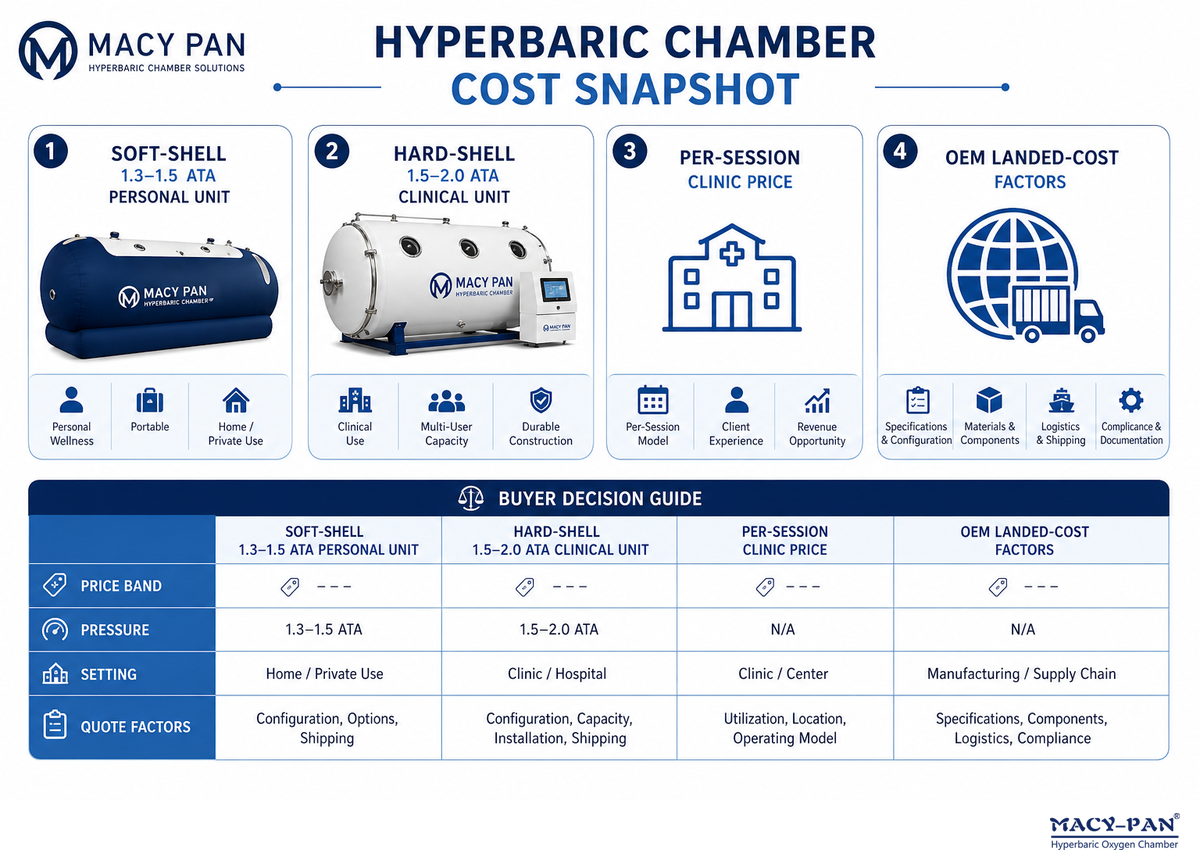
Home soft-shell chamber
Market-observed prices often sit around $5,000 to $25,000; ATA rating, chamber size, cooling, oxygen supply and accessories change the quote.
Hard-shell or clinical chamber
For individuals, retail prices start from the mid five figures and go up from there for hospital-grade and multiplace chambers with room design, as well as required life safety and system infrastructure.
HBOT cost per session
Clinics often price self-pay sessions by package. Chamber type, session length, location and medical supervision change the number.
OEM or wholesale order
For wholesale distributors and OEM clients, delivered cost is critical and accounts for chamber specification, volume, customization/branding, certification, freight, spares, and service agreements.
If you are sourcing for resale, clinic rollout or private label, use MACY-PAN’s hyperbaric chamber distributor program as the main quote path for reseller and dealer inquiries.
This pricing guide separates hyperbaric oxygen therapy cost from equipment ownership because chamber costs, cost per treatment, service scope and chamber type can point to very different buying decisions.
1. First Separate Purchase Price from Per-Session Price
A buyer looking for the answer to “How much does a hyperbaric chamber cost?” and a patient inquiring about the cost of one HBOT session are not asking the same thing. Online search engines merge results, leading to often confusing cost pages.
Use this split before you compare numbers:
| Cost question | Best answer format | Buyer risk |
|---|---|---|
| Buying a home chamber | Price band by shell type, ATA, size and included equipment. | Comparing low sticker prices without checking pressure rating, oxygen delivery and service. |
| Paying for therapy | Per-session or package cost after insurance and facility rules. | Assuming treatment coverage also means a home device is covered. |
| Buying wholesale | Landed quote by model, ATA, order volume, branding, destination and after-sales scope. | Leaving freight, certificates, parts and service out of the budget. |
For a quick product-family view, compare MACY-PAN’s hyperbaric chamber categories before asking for a final quote.
2. Hyperbaric Chamber Cost by Chamber Type: Hard Shell, Soft-Shell and ATA Range
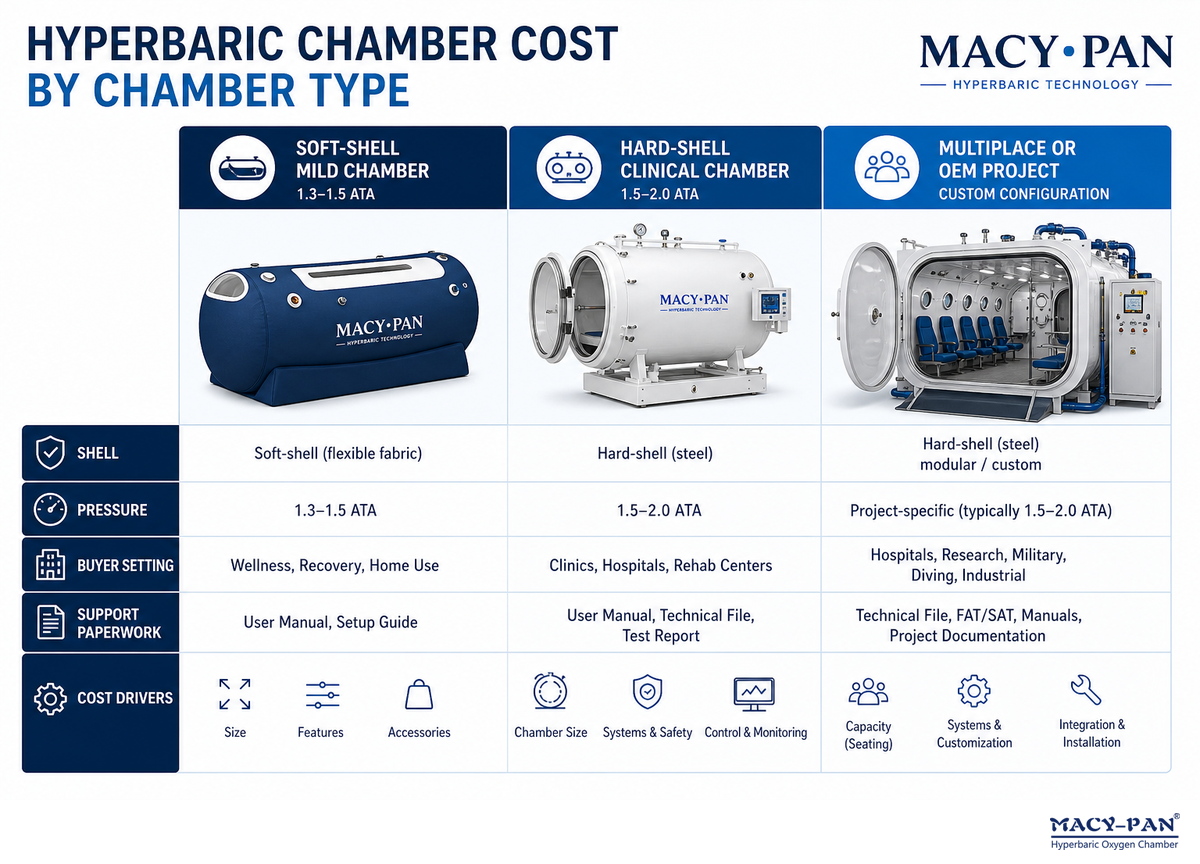
Chamber shell construction and pressure rating more greatly influence the bottom line than other components. Mild soft shell, 2.0 ATA hard shell and multiplace clinical systems require separate buy pathways.
| Chamber family | Common pressure lane | Market-observed price context | Best-fit buyer |
|---|---|---|---|
| Soft-shell mild chamber | Often 1.3 ATA to 1.5 ATA. | Often around $5,000 to $25,000, with many entry and mid-range models between $5,000 and $15,000. | Home wellness, recovery spaces and budget-sensitive first purchases. |
| Hard medical chamber | Often 1.5 ATA to 2.0 ATA and above, by model. | Retail examples can start near $28,000, while clinical-grade new units may sit far higher once certificate and site needs are added. | Clinics, wellness centers, professional buyers and high-use home buyers. |
| Monoplace or multiplace system | Model-specific; clinical projects need deeper review. | Large hospital-style multiplace systems can become six- or seven-figure projects after room, gas, fire and service needs. | Hospitals, large clinics and multi-user treatment settings. |
| Veterinary chamber | Built around animal size, access and care workflow. | Quote-led, because size and facility use change the build. | Veterinary clinics and animal rehabilitation centers. |
Pressure is not a minor label. Use a by-pressure ATA guide to match the chamber lane to the intended setting before treating any price as comparable.
Terminology also varies by seller: a portable hyperbaric unit may be described as a soft chamber, soft shell chambers, mild hyperbaric oxygen therapy equipment, a hyperbaric chamber for home, home chambers or a personal use system. Those labels should still be checked against pressure rating, oxygen source and documentation.
At first glance, a first-time buyer in the retail market may see a low-cost soft shell chamber and perceive it as a deal; however, such purchase could ultimately prove unsuccessful if the product lacks adequate support, doesn’t suit the intended use, or arrives with insufficient documentation required for local compliance.
3. Medical-Grade and Clinical-Level Safety Standards: Why ATA Rating, Shell Type and Safety Paperwork Change the Quote
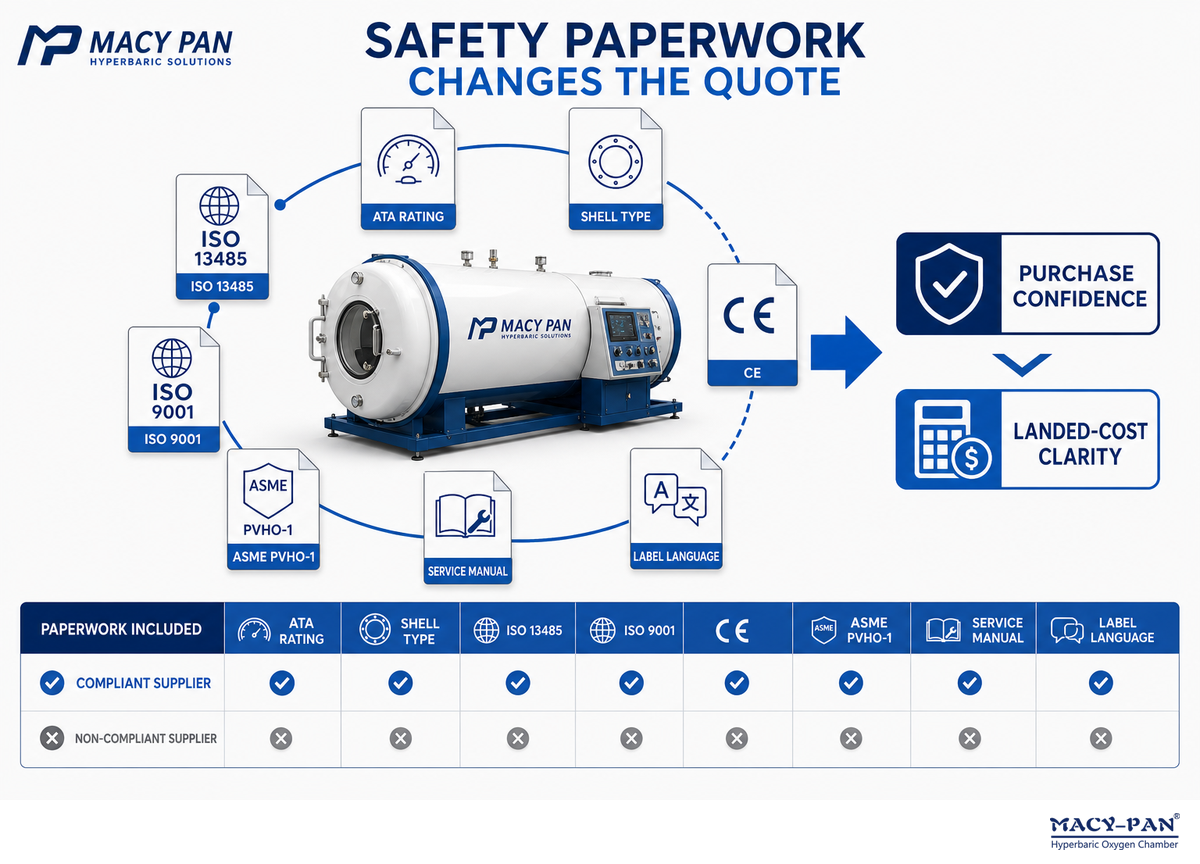
A chamber is a pressure environment. Higher pressure, rigid structure, oxygen handling, monitoring, service access and safety checks all add cost because they change the engineering job.
Engineering Note
The FDA reminds providers that HBOT devices require manufacturer instructions, fire prevention, grounding, staff training, patient monitoring, cleaning, maintenance and safety checks. That is why a credible quote should name more than chamber diameter and price.
UHMS links hyperbaric safety practice with NFPA 99 Chapter 14 and ASME. For clinical settings, the room and support plan matter alongside the chamber itself.
| Quote driver | Why it changes cost |
|---|---|
| ATA rating | Higher pressure demands stronger structure, controls and safety checks. |
| Shell type | Soft-shell and hard-shell chambers use different materials, seals, doors and service routines. |
| Oxygen delivery | Concentrated oxygen, pure oxygen systems, masks, hoods and connectors change scope. |
| Safety package | Fire prevention, grounding, staff training and service intervals become part of the real cost. |
| Destination market | Import rules, labels, voltage, language, certificates and freight path can change the landed price. |
The safer question is not “Which chamber is cheapest?” Ask, “Which chamber rating and support package match the job?” A model spec checklist can help buyers frame that discussion.
For clinical-grade or hard-shell hyperbaric purchases, confirm safety systems, strict safety paperwork, high-pressure component ratings, the method used to pressurize the chamber, and whether higher ATA operation changes installation or service requirements.
Before a clinic compares two 2.0 ATA offers, it should ask whether the quoted package includes the compressor or oxygen source, training materials, preventive service schedule, emergency procedure notes, replacement seals, shipping insurance and a named contact after installation.
4. Home, Clinic or Distributor: The Buyer Profile Changes the Math
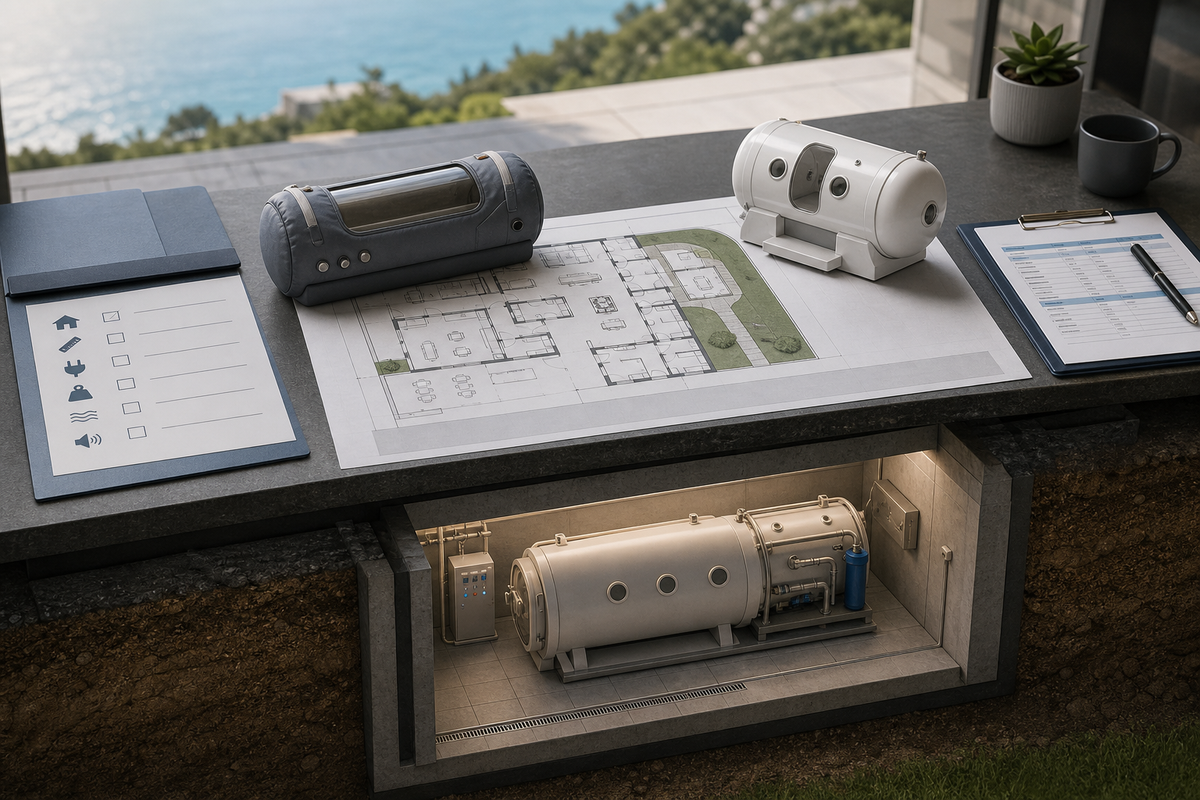
A single hyperbaric oxygen chamber will have different economic logic for three categories of buyers: homeowners consider ease and frequency of use; clinics focus on patient throughput, staff time, and support services; distributors must price inventory, brand fit, import risk, and servicing.
Home buyer
A home buyer should compare chamber cost with expected monthly use, space, caregiver support, maintenance, accessories and medical guidance before owning your own chamber. MACY-PAN separates this path under home hyperbaric chambers.
Clinic or medical practice
A clinic needs the chamber to fit staff workflow, patient scheduling, safety routines and service access. Start with the clinic and medical practice chamber path.
Wellness center
A wellness center should test fit around room size, session plan, cleaning routine, athletic recovery positioning, user comfort and staff training. See the wellness center chamber solution.
Distributors need a purchase order that extends beyond a low unit price to cover an ongoing supply of chamber models, replacement parts, documentation, labeling, and logistics.
5. Buy, Rent or Pay Per Session: HBOT Cost, Financing Options and Break-Even
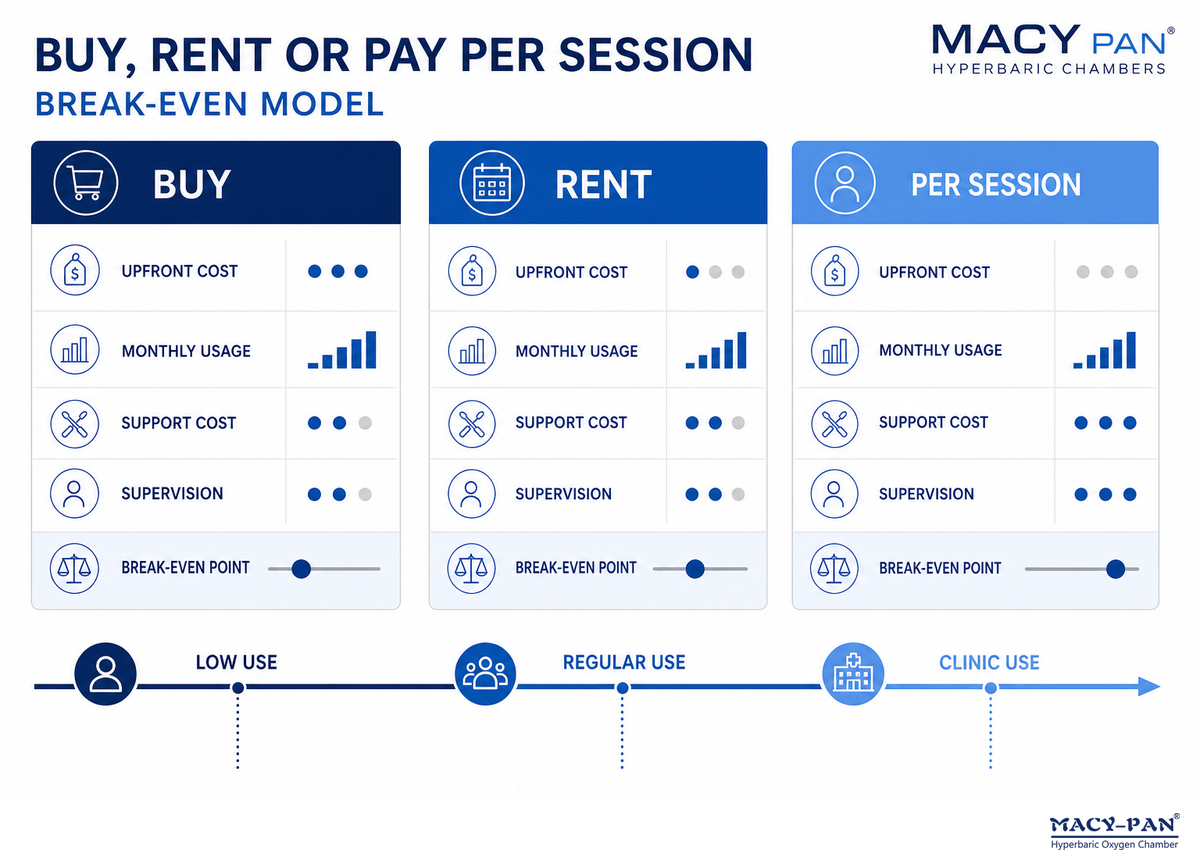
Serious shoppers want a clear price-buy the unit or continue paying for treatment. Better yet, model this out first.
Break-even formula
Cost of monthly sessions = session price x monthly sessions x number of users.
Compare that figure to the costs of ownership, service, parts, space, financing, delivery and not having to travel to a treatment center. Flexible financing options can help cash flow, but they do not remove maintenance, accessories or service risk. For a clinic performing multiple sessions daily, additional costs such as room turnover, patient registration, local code reviews, cleaning time, and staff availability also need inclusion.
Given that sellers often bury accessories in small print and charge for them as add-ons, a distributor must prepare a comparative spreadsheet with identical line items for each quoted unit, including: chamber pressure, diameter, listed accessories, warranty, parts lead time, shipping terms, packaging and the nearest port of arrival.
| Usage pattern | Likely first path to compare | Question to ask |
|---|---|---|
| Low or trial use | Clinic sessions or short rental. | Do I need access now, or am I ready to own and maintain a device? |
| Frequent home use | Ownership, if space and care support are realistic. | How many sessions per month will actually happen? |
| Clinic throughput | Hard-shell or higher-use commercial model. | What room, staffing, cleaning and booking limits affect daily capacity? |
| Distributor rollout | Wholesale source plan by SKU tier. | Which models can be sold, serviced and replenished reliably? |
To model ownership against treatment use, use the home vs clinic break-even calculator. Clinic buyers can also test room turnover, staff time and downtime risk in their own spreadsheet.
6. Insurance, Medicare and Off-Label Use: Hyperbaric Oxygen Therapy Cost Is Not Chamber Cost
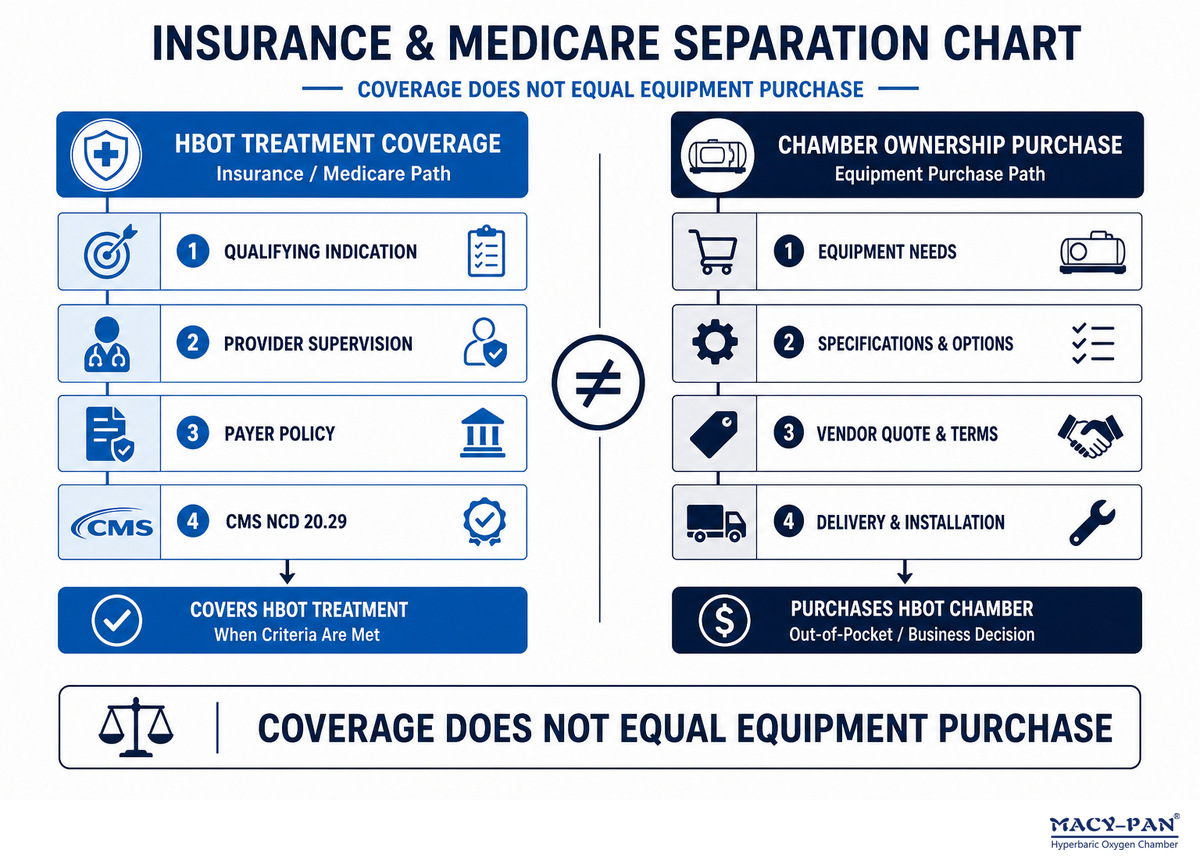
Payer coverage and device approval can vary.
Rules may apply to therapy treatments but not necessarily to all uses of a chamber.
Medicare.gov advises beneficiaries that coverage for hyperbaric oxygen therapy under Part B may apply if the patient meets specific criteria. Patients can expect to pay a coinsurance of 20% of the Medicare-approved amount plus any applicable deductible.
Medicare.gov also recommends asking a doctor or provider about potential costs.
CMS NCD 20.29 specifically lists the conditions under which Medicare covers therapy in a chamber. It is not a blanket approval for non-covered services or devices used at home.
Many consumers search for FDA-approved conditions, FDA-cleared devices or therapies but should distinguish device clearance, treatment indication and payer coverage. The common phrase “14 FDA-approved conditions” is not a substitute for checking the current CMS list, a payer policy, or a health care provider’s judgment.
Hyperbaric medicine includes hospital-based care for selected medical treatments such as decompression sickness and certain wound healing scenarios. A wellness buyer using HBOT for recovery should not assume the same coverage logic applies to off-label conditions or to buying equipment for home use. Some treatment plans may discuss a package such as 40 sessions, but the cost of hyperbaric oxygen therapy still depends on the facility, indication and payer rules.
Practical boundary
If it’s medical treatment, check with a licensed health-care professional and with payers regarding their guidelines. If it’s the purchase of a chamber, provide an estimate of the device cost and service agreement. Keep those numbers apart.
7. OEM and Wholesale Pricing: Use the ATA-Landed Cost Ladder
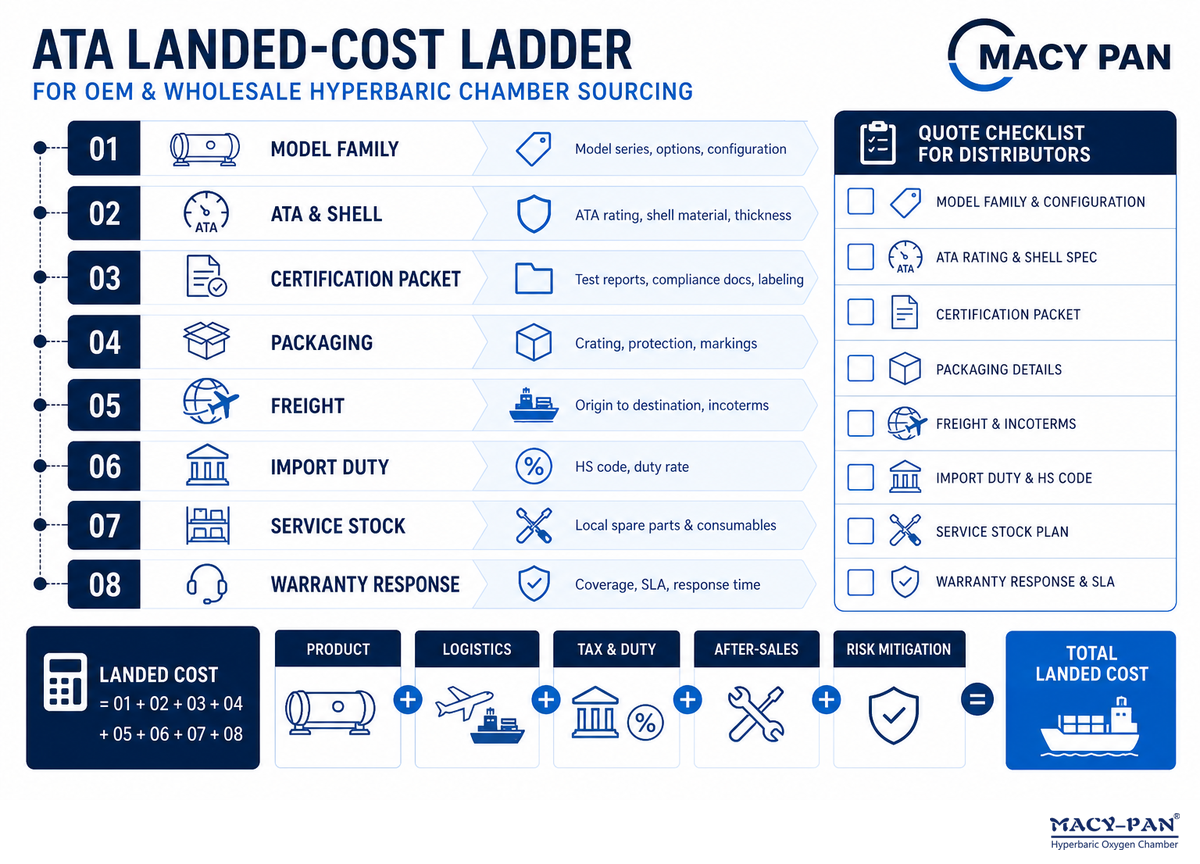
For the dealer, distributor, and private label customer, the chamber price is only a starting point. What you want is the usable figure: the landed cost to get, market, sell, support, and restock the product in the target market.
The ATA-Landed Cost Ladder
| Step 1 | Choose pressure lane: 1.3 ATA, 1.5 ATA, 2.0 ATA or other model-specific requirement. |
| Step 2 | Choose shell and use setting: home, wellness center, clinic, veterinary or distributor stock. |
| Step 3 | Define the certificate, label, language, plug, voltage, manual and packing needs for the destination market. |
| Step 4 | Add spare parts, warranty route, training content and after-sales support scope. |
| Step 5 | Calculate freight, customs path, delivery timing and inventory replacement plan. |
MACY-PAN, Shanghai Baobang Medical Equipment Co., Ltd, has specialized in HBOT chambers for more than 19 years. The company states certified quality management system, ISO 9001 and CE certification, patent registration, export to more than 126 countries, and OEM/private-label chamber design support.
The context is only useful if you’re looking for something specific. Good OEM quoting requests require buyer’s role, country, chamber type, ATA target, quantity required, branding preferences, required certificates, packaging, spare part requirements and post-sales support.
RFQ audit: what to ask before comparing unit price
A distributor quote is easier to compare when each supplier prices the same risk package. Ask for the base chamber, pressure lane, oxygen delivery setup, certificate packet, spare-part plan, warranty route, training file, installation notes and support response path in one sheet. A cheaper unit can become expensive if the 1 year warranty, 12 months spare package or 24 hours support response is handled by a different party.
| RFQ field | Why it changes landed cost |
|---|---|
| Pressure lane | A 1.3 ATA mild chamber, 1.5 ATA chamber and 2.0 ATA chamber do not have the same pressure, material or service discussion. In engineering shorthand, the pressure rise above atmosphere is about 4.4 psi, 7.4 psi and 14.7 psi respectively. |
| Pressure-vessel file | For hard-shell or clinical projects, ask whether the applicable design file references ASME or a destination-market rule. For operation and maintenance planning, ask how service notes relate to ASME PVHO-2 where PVHO rules apply. |
| Quality and labeling packet | Request the ISO 13485 quality-management-system scope, ISO 9001 scope, certificate holder name, current year validity, label language, plug and voltage before comparing 30 days, 60 days or 90 days quote validity. |
| Service stock | If you sell through clinics or dealers, price a 6 months or 12 months spare package, filters, seals, masks, hoses and a 48 hours response path. That is part of the real customer experience. |
For a cleaner distributor project, add three usage cases to the quote sheet: 10 hours per week, 20 hours per week and 40 hours per week. Then ask each supplier to price the same 95% uptime target, 98% uptime target or 99% uptime target, the same 3 months starter parts, 6 months replenishment plan, 12 months replenishment plan, 24 hours support path, 48 hours support path, 72 hours escalation path, 1 year warranty and 2 years warranty option. This is also where certified quality management system, ISO 9001 and ASME references should be tied to the actual model family, not left as brochure language.
Need distributor or dealer pricing?
Prepare model, ATA, destination market, expected order quantity and support needs before applying. It will reduce back-and-forth and produce a cleaner dealer quote.
8. 2026 Cost Outlook: Cheap Chambers Face More Scrutiny
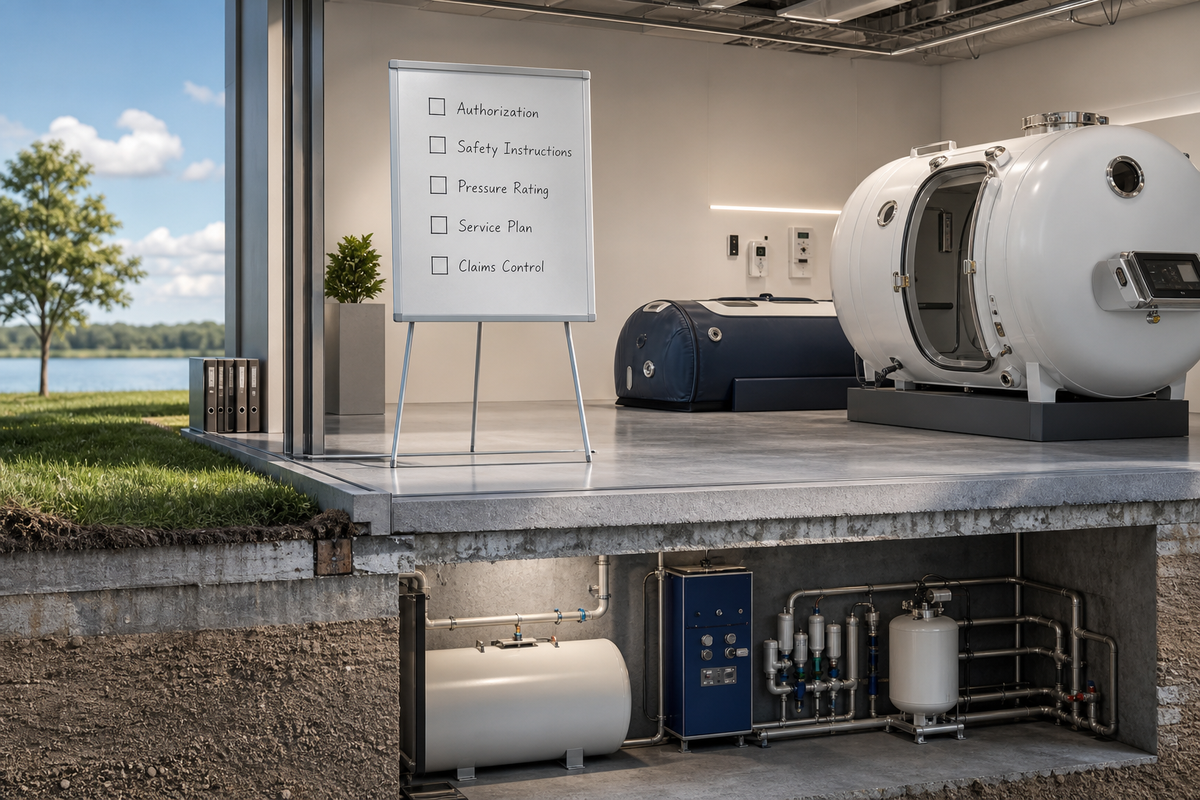
The 2026 buyer risk is not only inflation or freight. Safety scrutiny is rising around unauthorized or poorly supported devices, especially when soft-sided chambers are sold with broad wellness or medical claims.
Health Canada issued a public advisory on June 16, 2026, saying unauthorized soft-shelled hyperbaric chambers may pose serious health risks. It stated that these devices were increasingly found in wellness centers in Canada and that, as of the advisory, Health Canada had not authorized any soft-shelled hyperbaric chamber for sale in Canada. This is a Canada-specific notice, but the lesson travels: the lowest sticker price can carry hidden buyer risk.
The FDA’s 2025 safety communication points to a similar buying discipline: follow manufacturer instructions, fire-prevention steps, training, supervision and maintenance schedules. For buyers, those are not afterthoughts. They belong in the quote.
Distributors themselves can lower risk by receiving pressure rating, the limits of the intended-use, safety information, certificate packet, spare-part path, and service response prior to negotiating unit price. MACY-PAN’s hyperbaric chamber distributor program is the right next page for that conversation.
Frequently Asked Questions
How much does a hyperbaric chamber cost?
Personal soft-shell units are typically somewhere near $5,000 and $25,000 on the retail spectrum. Hard-shell, or clinical, machines can run to much higher prices. They are subject to project requirements relating to pressure ratings, design, oxygen systems, as well as room space and service needs.
Work from published prices, but obtain a quote for the actual machine model.
How much does a hyperbaric chamber cost per session?
Self-pay session fee depends on clinic, pressure, time, number of sessions bought and supervision. Medicare coverage, if accepted, is based on the payer regulations and not the retail price for the machine.
Will insurance pay for a hyperbaric chamber?
Insurance will potentially pay for qualifying clinical indications of HBOT, but that does not mean a payer will purchase a home chamber. Begin with the provider, the payer policy and the treatment indication. In terms of Medicare, CMS NCD 20.29 and the Medicare.gov coverage page are the better starting points.
Is a 2.0 ATA chamber always better than a 1.5 ATA chamber?
No. Higher pressure can raise capability and cost, but the right choice depends on intended use, setting, training, user needs and local rules. Even a 2.0 ATA chamber can be a poor purchase if the buyer lacks the room, support and service plan to use it correctly.
What extra costs should home HBOT buyers expect?
Ask if the oxygen concentrator, air compressor, cooling or dehumidifying system, masks or cannulas, filters, shipping, set up, service parts and warranties are all included in the price. Don’t forget to inquire about space requirements, temperature of the room, cleaning procedures, and if the device is suitable for medical supervision.
Can distributors buy hyperbaric chambers wholesale?
Yes. Treat a wholesale inquiry as a sourcing project, not a one-line price request. Share the target country, model family, ATA, order quantity, branding needs, certificate expectations, packaging, spare parts and support plan. MACY-PAN can design OEM products and private-label chamber programs for sales companies.
Related MACY-PAN Resources
References
- U.S. Food and Drug Administration safety communication, cited through the UHMS summary below because the direct FDA URL can route automated checks to an abuse-detection page.
- Medicare.gov. Hyperbaric Oxygen Therapy Coverage.
- Centers for Medicare & Medicaid Services. NCD 20.29: Hyperbaric Oxygen Therapy.
- Health Canada. Unauthorized Soft-Shelled Hyperbaric Chambers May Pose Serious Health Risks.
- Undersea & Hyperbaric Medical Society. FDA Safety Communication Summary.
- Undersea & Hyperbaric Medical Society. Consumer Warning: Soft-Sided Bag Chambers.
Factory Selection Support
Need a hyperbaric chamber matched to your room, pressure target, and compliance documents?
MACY-PAN helps clinics, wellness centers, distributors, and home buyers compare soft-shell, hard-shell sitting, and professional-grade lying chambers before quotation. Send your intended use, available space, country, and preferred ATA range, and our team will recommend a practical model path.
2007HBOT manufacturing since
126+countries shipped to
1.3-2.0ATA chamber range
![Decision lenses: occupancy, gas path, access, staffing, facility interfaces, and exact-model evidence [article].](https://macypansolutions.com/wp-content/uploads/2026/10/monoplace-vs-multiplace-hyperbaric-chambers-featured-1-768x512.png)