Get in Touch with MACY-PAN Company

A hyperbaric chamber distributor program is a manufacturer’s formalized plan for letting an independent company market and sell its hyperbaric oxygen therapy chambers under set territory, pricing, and service conditions, the kind of arrangement that lets a corporation with strong hyperbaric medicine expertise reach clinics, wellness centers, and home buyers it couldn’t reach alone. Anyone who searches this market today run into the same issue within minutes: four different manufacturers use four completely different names for arrangements that can represent wildly disparate commercial conditions. This guide is a brand-neutral walkthrough to help any equipment provider or buyer weigh a hyperbaric-chamber or medical-device distributor program before signing, not a pitch for one specific company’s terms.
Quick Facts
| Typical contract term | 1-3 years, often auto-renewing |
| Territory options | Exclusive, non-exclusive, or volume-gated semi-exclusive |
| Manufacturer-to-distributor markup | Commonly 15-20%, distributor resale margin often 20-40% on top (varies by category and volume — verify per quote, not by rule of thumb) |
| FDA registration trigger | Only if you import the device yourself (see H2 below) |
Provenance: industry-pattern ranges from public program pages and legal/market benchmark sources (Level 3), explicitly identified as *not* terms of a single manufacturer guaranteeing their products.
Hyperbaric chamber distributor programs dictate the geographic scope, price and service parameters a third-party will observe in selling a manufacturer’s oxygen therapy chambers. The strongest of these agreements put terms on paper prior to any commitment being signed; the weakest of them-according to our own research for this article-won’t share details about their commission arrangements until you’ve completed a qualification call.
What Is a Hyperbaric Chamber Distributor Program? (Distributor vs. Dealer vs. Reseller vs. Channel Partner)
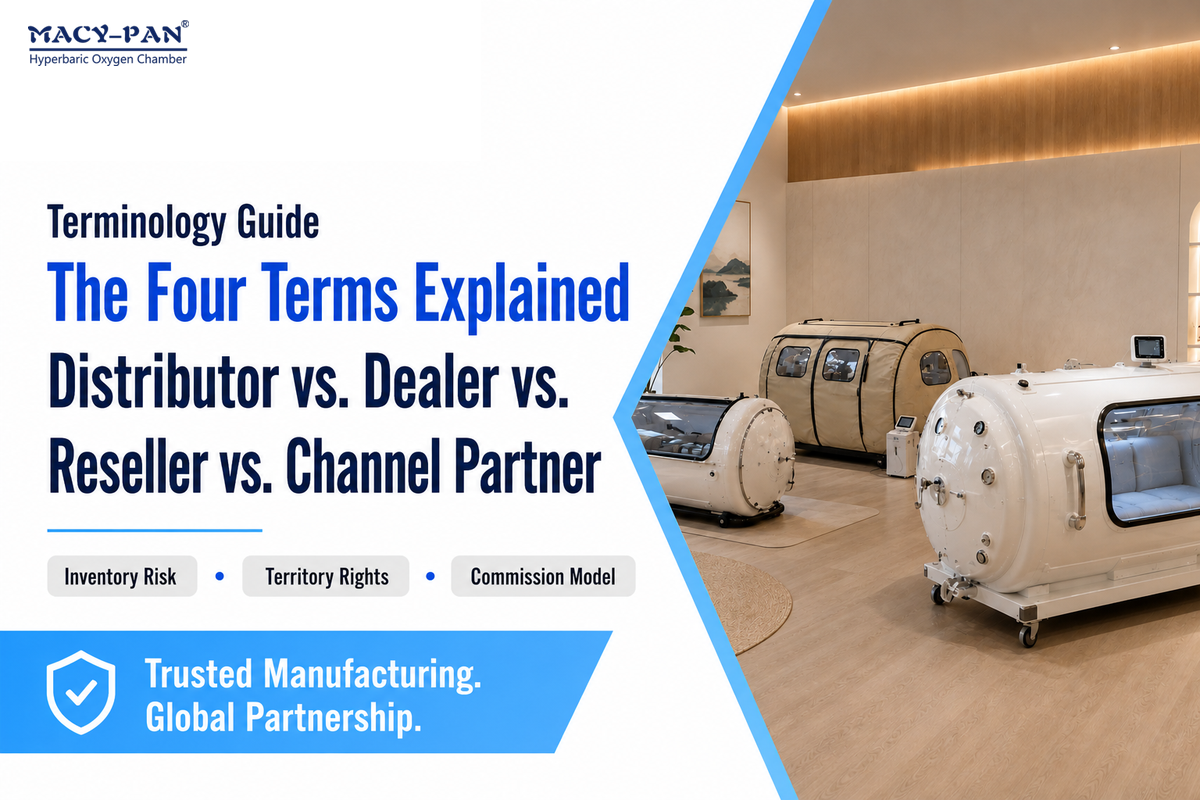
Distributor, dealer, reseller, and channel partner are nearly the same words on manufacturer websites, but not the same commercial arrangement. Distributors buy and hold stock under their own commercial terms, often with territory rights. Dealers run a similar model at a smaller, local scale. Resellers carry little or no inventory, working on commission instead. Channel partner is the umbrella term covering all of the above, plus non-transactional roles like referral partners.
Those differences become meaningful once a quality framework like ISO 13485 quality management system is involved, since its scope explicitly extends from manufacturing through distribution, and once territory and/or inventory obligations are on the table. Channel partner roles also extend to technology integrators serving healthcare providers, spas, recovery centers, and athlete training facilities. End-use range matters for a distributor too: some buyers want general health and wellness therapy sessions at home, while others are clinics running structured hyperbaric therapy protocols, dive medicine practices treating decompression cases, or veterinary and research settings that pressurize chambers under tighter controls, each with different service and training expectations.
Here’s an example of how this type of structure looks in practice. In a case of a real four tier plan, the page for a hyperbaric equipment manufacturer indicates four tiers under one “partner” banner: exclusive distributor (geographic exclusivity, territorial, national, or continental), reseller (earns a commission based on selling through existing trade networks), client referral (earns a commission for referring customers), and brand ambassador (incentive programme based on influencer performance) — there’s no information available at page level on the specific obligations associated with each tier.
| Term | Inventory ownership | Typical territory |
|---|---|---|
| Distributor | Buys and holds inventory | Often region- or country-defined |
| Dealer | Buys and holds, smaller volume | Local or single-location |
| Reseller | Light or none (drop-ship/commission) | Existing customer network, not geographic |
| Channel partner | Varies (umbrella term) | Varies |
What’s the Difference Between a Distributor and a Reseller?
Distributors carry the burden of inventory risk: they buy and hold chambers before they’ve actually found a customer, which is why distributor agreements more often include minimum order commitments and geographic protections. Resellers act on commission or referral instead, carrying little to no inventory, which lowers risk but usually means a smaller margin per unit.
Searches for “channel partner” and “reseller program” both register real, current buyer interest, which is one sign this terminology confusion is a live problem for buyers, not just semantic hair-splitting.
Program Types: Exclusive, Authorized, Master, and Independent Distributor Explained
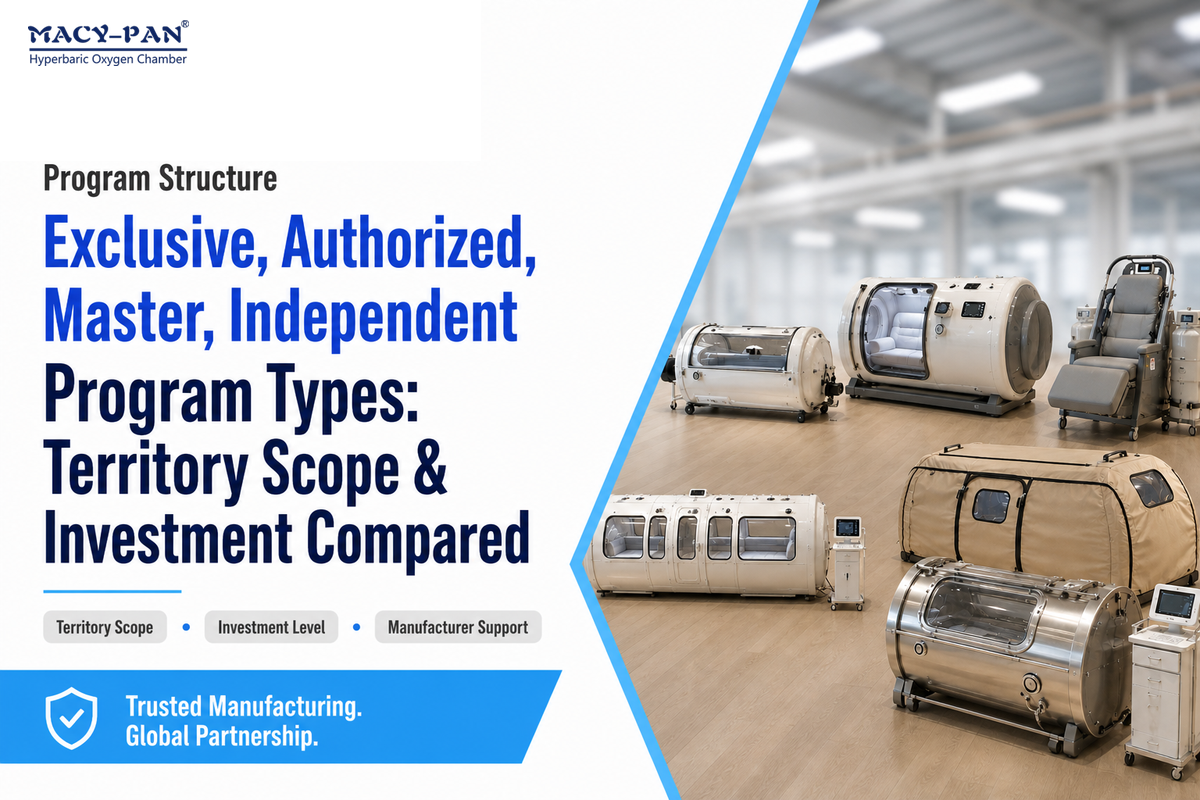
Having decided on the type of relationship you’re exploring, and whether HBOT (hyperbaric oxygen therapy) hardware is a sourcing solution that fits your business, the second question is which variety of that relationship type you’re actually being offered. ‘Exclusive,’ ‘authorised,’ ‘master’ and ‘independent’ have very different territorial and investment ramifications, and manufacturer’s don’t necessarily adhere strictly to terminology: a term which may be wider for one manufacturers Website, will be tighter for another. Hyperbaric chamber engineering itself has a long documented history across these different commercial structures, visible in decades of chamber-design patent filings spanning multiple manufacturers and countries.
| Program type | Territory scope | Typical investment level | Manufacturer support |
|---|---|---|---|
| Exclusive distributor | National, regional, or continental | Higher, often a 1-3 year volume commitment | Highest (dedicated territory backing) |
| Authorized distributor | Non-exclusive, defined region | Moderate, typically 15-20% off list price | Standard (price lists, marketing assets) |
| Master distributor | Country or multi-country, with sub-dealer rights | Highest, bulk inventory commitment | High, plus sub-dealer enablement |
| Independent distributor | Self-defined, non-exclusive | Lower barrier, no minimum territory | Lightest (self-directed sales) |
| Sub-dealer (under a master distributor) | Local or regional, assigned by the master distributor | Low, typically 1-5 unit starter orders | Indirect, routed through the master distributor |
| Reseller | Existing customer network, not geographic | Low, commission-based, little to no stocked inventory | Light (referral leads, no territory protection) |
| Client referral partner | None (transactional, per introduction) | None, commission per closed sale only | Minimal (introduction handoff only) |
| Brand ambassador | None (audience-based, not geographic) | None, performance-based rewards | Marketing assets and content support only |
| OEM/private-label partner | Defined by contract, often global | Highest, full production-run commitments | Full engineering and branding support |
💡 Pro Tip
Specify “type” of program in writing, and ask what technical support and ongoing training capability comes with it. Don’t settle for just “exclusive.” Without geography, and timeframe, “exclusive” isn’t a contract term; it’s a marketing adjective.
How to Become a Distributor: The Evaluation-to-Signature Process
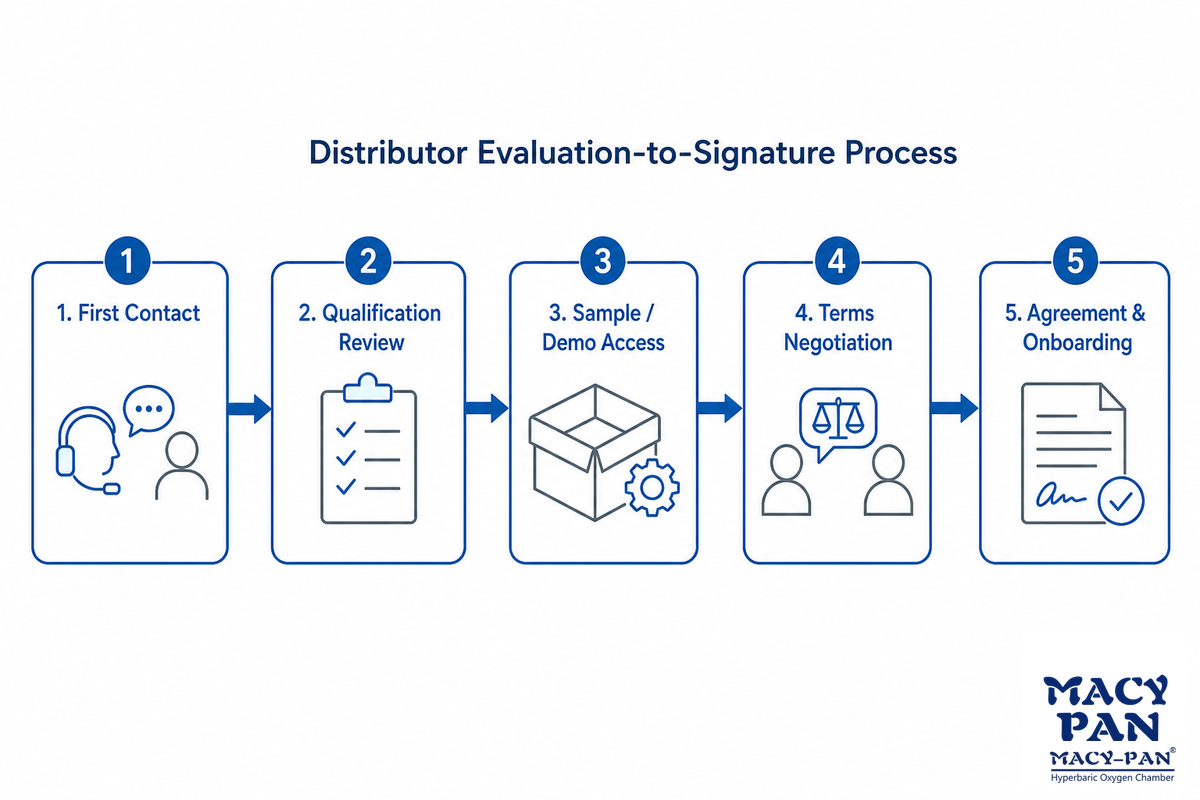
The hyperbaric chamber distributor program sales process looks like one, despite how instant the manufacturer’s marketing copy may make it sound. Expect five stages, in order: First Contact; Qualification review; Sample/Demo Access; Terms Negotiation; and, Agreement and Onboarding – and if importing is part of your role, a sixth step of confirming your own FDA registration status before the agreement is signed.
How Does the Partner Application Process Work After You Submit an Inquiry?
After a distributor inquiry is submitted, the manufacturer’s business development team reviews it against sector, territory, and sales-capacity fit, then follows up within a few business days to confirm interest and outline next steps. A timely response is itself a signal of how the relationship will operate day to day. Expect a qualification review before any numbers get shared, that pattern holds across this category.
If the qualification process for a given program continues to be murky after one inquiry — there’s no written program summary, timeline, or a designated contact person — press for that information in writing before agreeing to any call. Verbal terms at this stage represent the number one cause of diligence gaps that buyers experience (see checklist below), and the risk isn’t just wasted time – it’s the hidden problem of building sales projections around terms that were never actually confirmed in writing, a mistake that’s expensive to unwind once inventory has been ordered.
- Submit inquiry with your sector, territory and projected volume clear
- Request program summary before call
- Request sample or demo unit rather than spec sheets
- Negotiate terms around territory and minimums before signing
- Confirm on-boarding (training, marketing, leads, etc.) support in writing
Reading the Distributor Agreement: Contract Clauses That Matter
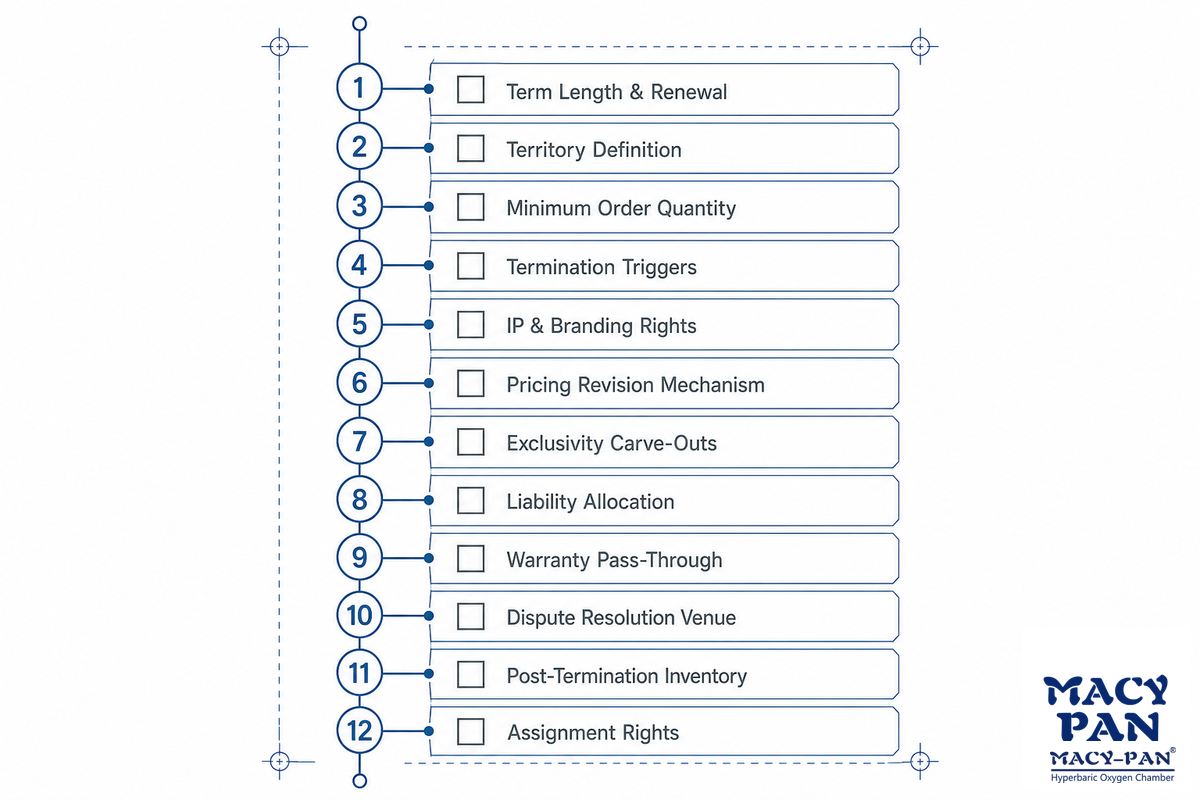
Distributor agreement and distribution contract both pull search results, but the searches bring up mostly generic contract language rather than specifics about what a hyperbaric or medical equipment distributor needs to check. That information gap in this category is huge. In fact, none of the competitor program pages analyzed for this article offered specific terms upfront, which makes a checklist that much more useful than a template.
The 12-Clause Distributor Agreement Checklist
Before you sign any hyperbaric chamber distributor agreement, make sure it covers these 12 clauses:
- Term length and renewal mechanism (auto-renew vs. manual)
- Territory definition (geographic boundary, exclusivity status)
- Minimum order quantity (MOQ) and review frequency
- Termination triggers and notice period
- IP and branding usage rights
- Pricing revision mechanism (who can change price, how often)
- Exclusivity carve-outs (existing accounts, online sales, marketplaces)
- Liability allocation (product defects, installation, misuse) – especially relevant given FDA’s medical device reporting rule covers manufacturers, importers, and device users differently
- Warranty pass-through terms to end customers, including maintenance obligations and replacement parts availability
- Dispute resolution venue and governing law
- Post-termination inventory and customer-transition terms
- Assignment rights (can either party transfer the agreement?)
“As a distributor, it is important to identify the viability of a product, not only in the market, but in the market being represented, the contract terms mean little if the territory and support don’t match the real sales conditions on the ground.”
Contract termination periods commonly extend based on the length of the agreement, with most legal commentary on termination indicating that contracts of one to three years carry three- to six-month termination notices, contracts of three to six years usually have six- to nine-month notice periods, and contracts over six years in some jurisdictions may allow for a statutory notice of at least six to twelve months, extendable by the contract. None of these apply specifically to hyperbaric contracts, they apply to general distribution agreements-but they’re numbers to ask for, along with who covers freight and shipping costs on returned or replacement chambers and how quickly the manufacturer can deliver a suitable replacement unit.
Exclusive vs. Non-Exclusive: How Territory Rights Actually Work
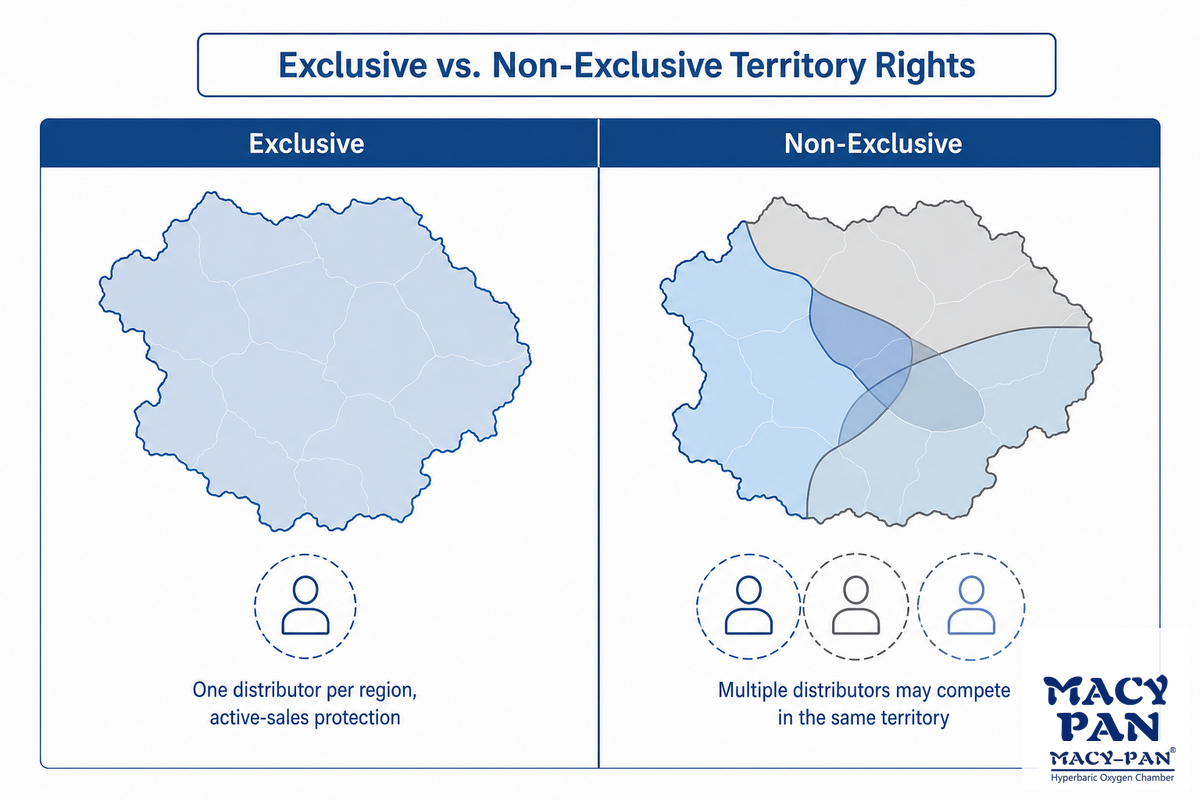
Exclusivity always feels like the win-win proposition from the outset. And it can be – but it’s by no means automatically the safest, or even the most profitable, move, and treating it that way is by far the most common simplification. Two things spoil this neat exclusive = better logic. Firstly, the level of exclusivity and how the exclusivity is structured varies a great deal from territory to territory and by how the exclusivity is drafted into the agreement. Secondly, exclusive distributors do benefit from a defined protection against active sales into their territory from EU competition law (vertical restraints guidelines under Regulation 2022/720), but this is competition law, not EU medical device legislation and has compliance implications. In the US, exclusive-dealing arrangements sit under a parallel but separate antitrust framework that the Federal Trade Commission oversees, which is a different set of compliance questions than the EU competition-law protections above.
✔ Advantages of Exclusive
- No direct competition from the same brand in your territory
- Stronger negotiating position for marketing co-investment
- In EU markets, formal active-sales protection under competition-law guidance
⚠ Limitations of Exclusive
- Usually requires a higher volume commitment to justify the grant
- Distributor and manufacturer incentives don’t always align – reported friction in cross-border medical device distribution over pricing and support priorities
- Harder to exit if the relationship underperforms, given the volume commitment already made
The Territory-Volume Exclusivity Test
If you can demonstrate that your projected annual volume exceeds the minimum volume that the manufacturer stated for exclusivity, and if the relevant territory isn’t currently served by competing distributors, it’s generally worth making the increased commitment for exclusivity. If either of those preconditions are missing – either the volumes are uncertain, or the territory is genuinely “open” – negotiate for an upgrade to exclusivity tied to your sales performance under an initial non-exclusive agreement.
Distributing Medical Devices: Extra Requirements for Regulated Equipment
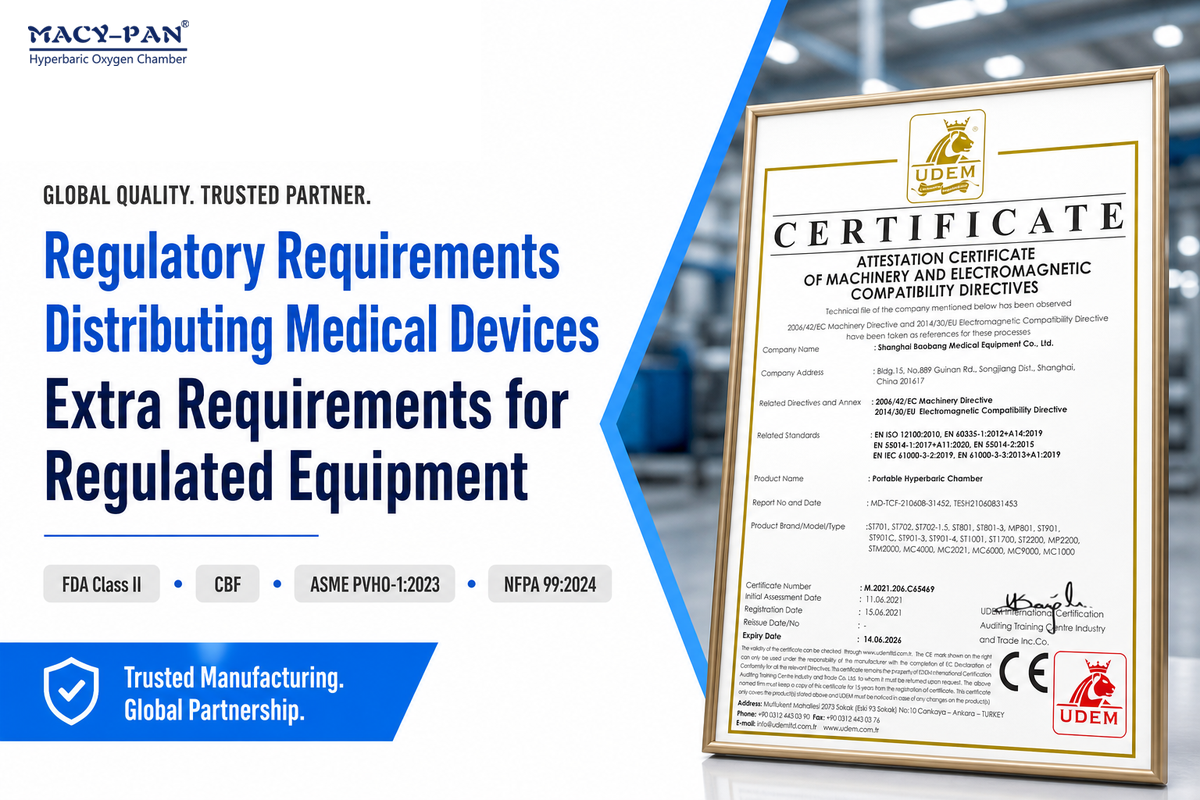
Hyperbaric chambers are regulated medical devices in the U.S. that may shift the distributor’s need to vet what they need to look at prior to agreeing to resell the product on behalf of a hyperbaric oxygen treatment manufacturer. The device is classified by FDA as product code CBF, which is a Class II device, requiring 510(k) clearance (it is not in a GMP-exempt class) and FDA recognized safety standards for hyperbaric chambers include the NFPA 99:2024 health care facilities code and ASME PVHO-1-2023 (pressure vessels for human occupancy), so this offers more specific detail regarding the device compliance story than a generic “medical device” description and the manufacturer’s paperwork should reflect this detail and certify current operational compliance for clinical settings.
Distributor regulations is more complicated than most expect, and the risk of getting the registration question wrong is a compliance gap that’s expensive to fix after the fact. A distributor in the U.S. who simply resells a device manufactured outside the U.S., without acting as the importer of record (IOR) for the device, is exempt from FDA establishment registration, listing and fees according to the agency’s own guidelines – the reason is that FDA’s rule is structured around who physically brings the device into the country, not who sells it. Pure domestic distributors also have no FDA establishment registration, listing or fees. You will only trigger these registration requirements if you plan to import on top of your domestic resale, and in that case, it is essential to clarify what specific role you are filling – not your job title – to determine your actual FDA registration obligations.
📐 Engineering Note
Pressure-vessel certification for the chamber series under ASME-2023 happens at the individual chamber model level (not for the entire company); make sure to ask for the specific test certificate for the particular model you’re contracted to resell, and not just a generic statement of the company’s overall compliance. NFPA 99:2024 will regulate the delivery and fire-safety requirements of your oxygen to the facility level where it’ll be used, but this is separate from the pressure-vessel certification for the chamber itself.
Outside the U.S., Article 14 of the EU Medical Device Regulation (MDR) imposes a series of concrete, distributor-specific obligations, regardless of whether the arrangement is exclusive or not: verifying the CE marking and declaration of conformity; ensuring the importer has fulfilled their obligations; implementing UDI (Unique Device Identification) requirements as applicable; maintaining storage and transportation conditions set forth by the manufacturer; forwarding any complaints or adverse event reports; and cooperating with competent authorities regarding recalls or field safety corrective actions. These duties exist regardless of whether the distributor territory is exclusive or non-exclusive.
Distributor Program Economics: How Margins and Minimum Orders Typically Work
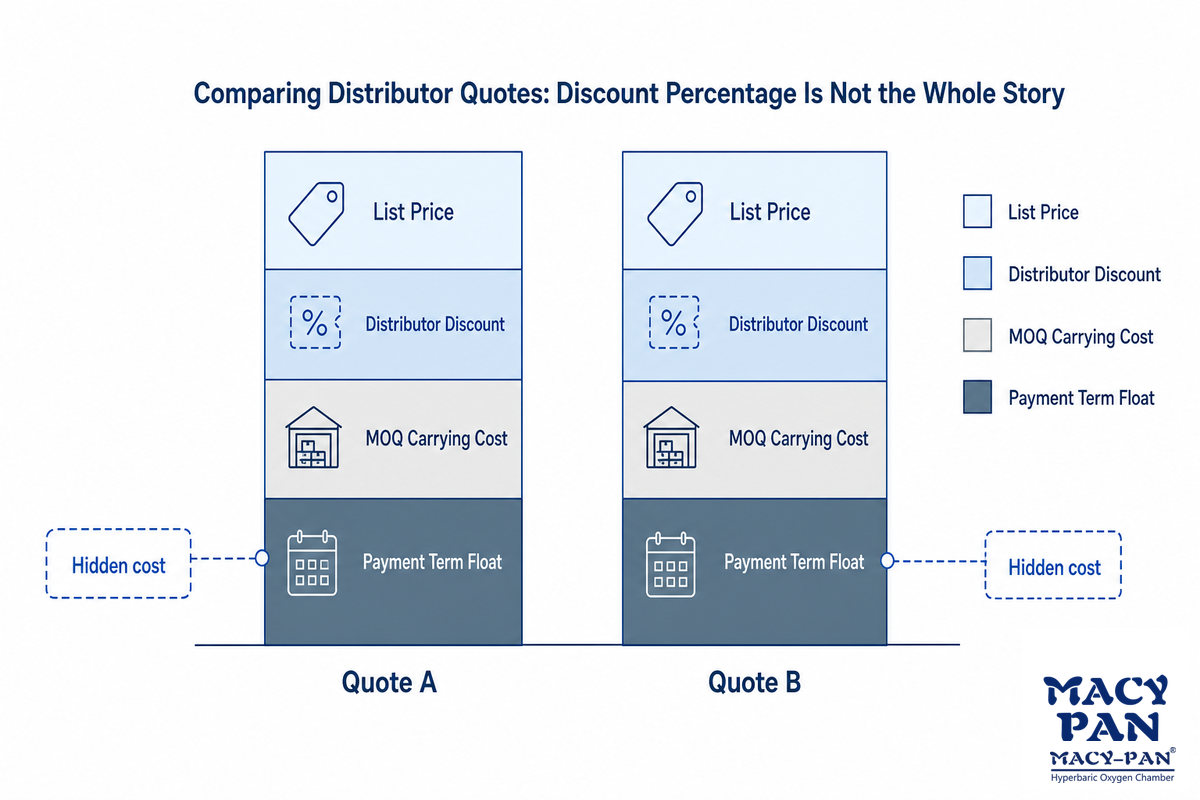
None of the competitor program pages found for this guide provide explicit numbers for markups-one explicitly states it negotiates commission rates on an individual basis and doesn’t share a standardized schedule. This lack of specifics is common enough in this space that it’s useful to operate under the assumption of norm rather than exception, making general industry figures helpful in absence of an actual quote.
In this space, two different numbers get used interchangeably, but they’re not the same. Industry commentary regarding distributor-supplier markups cites average manufacturer-to-distributor margins between 15-20% with an additional 20-40% added by the distributor to the sale price (this channel-markup number comes from a single commercial analysis, not a verified dataset of industry-wide margins, so it’s only a directional estimate). That figure represents the margin within the sales channel, not the device manufacturer’s company profitability, which, according to data such as MedPAC industry reports and NYU Stern’s sector margin datasets, can run considerably higher or lower based on company size and product mix. Ask any program for its own figures rather than trying to rely on either of these outside estimates-neither is a substitute for a formal quote.
Minimum order quantities (MOQs) often increase with increasing tiers, giving way to better pricing or exclusive terms at higher volumes. If a program’s economic advantages are emphasized via specific examples of dollar earnings or target account numbers, rather than wholesale prices, note that framing-programs built around earnings claims or prospective account volume can be subject to business-opportunity disclosure laws in some jurisdictions and may warrant additional due diligence.
A hidden risk shows up in practice when two quotes from different manufacturers look identical on the surface but hide different assumptions underneath. As a hypothetical illustration: say a distributor gets Quote A at roughly 18% off list with a 20-unit MOQ, and Quote B at roughly 22% off list with a 40-unit MOQ and a 90-day payment term instead of 30. Comparing only the discount percentage is the trap: the real gap is in working capital tied up in inventory and how long it sits before it converts to cash. Modeling both quotes against your actual sell-through rate, not just the headline markup, is the resolution, because the mistake of over-committing to MOQ tiers you can’t move is the single biggest reason well-documented, established programs still see distributor churn in year one.
Due Diligence: Red Flags Every Buyer Should Check Before Signing
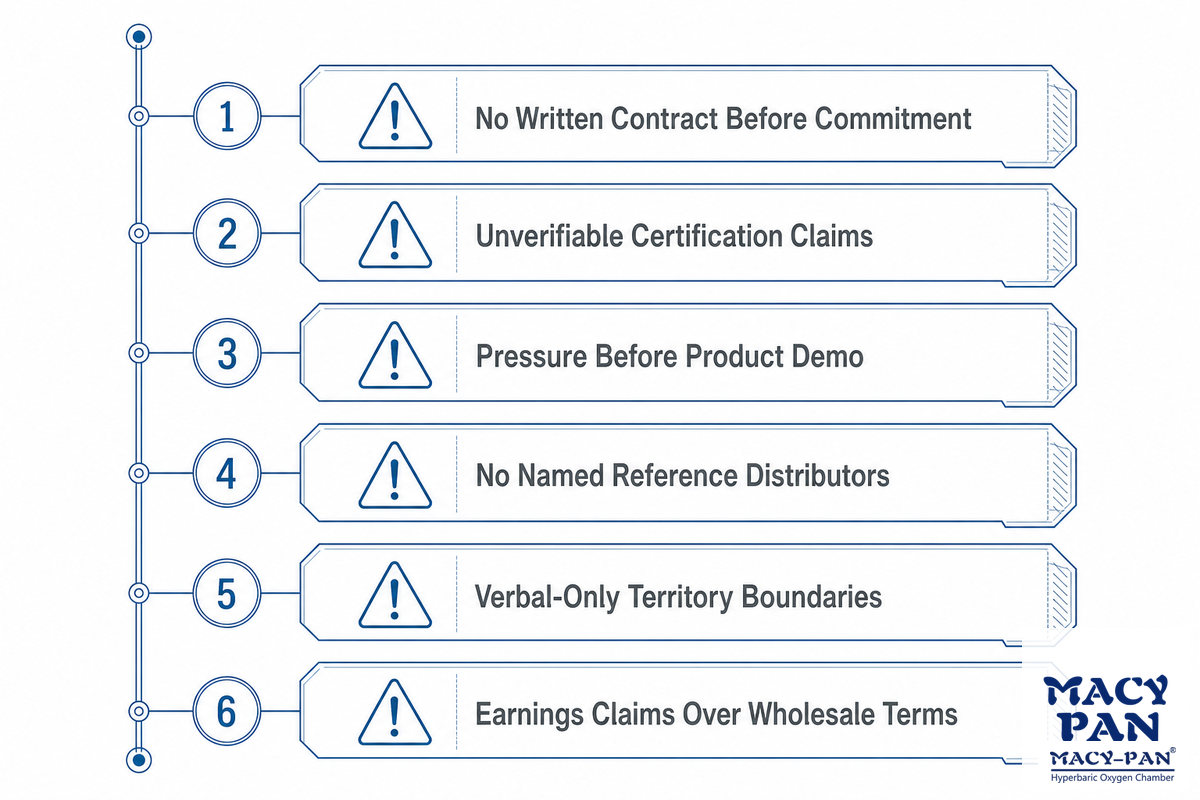
A small handful of recurring issues, many of which were directly highlighted in research for this guide, account for most of the friction that buyers experience in distributor programs.
- Failure to provide a written contract prior to asking for resources to be expended.
- Inaccurate or unverified certification claims (such as certified quality management system or CE marking), where official verification from the relevant standards body, or against the FDA device classification database, isn’t possible.
- Pressure to sign a contract before seeing the product or a demo unit.
- Lack of available, named current distributors who can act as references.
- Verbal descriptions of territory boundaries not in the written agreement
- Marketing materials lean on specific earnings numbers or promised customer volume rather than wholesale terms – ask whether the program’s disclosures meet business-opportunity requirements (in the US, 16 CFR Part 437) before treating those figures as commitments
None of this means a program is fraudulent if it doesn’t hand over full contract terms on the first call – the qualification-review pattern is standard across the category. The red flag is the combination: vague terms plus pressure to commit before those terms are in writing.
Industry Outlook: Why Program Structure Now Matters More Than Contract Templates
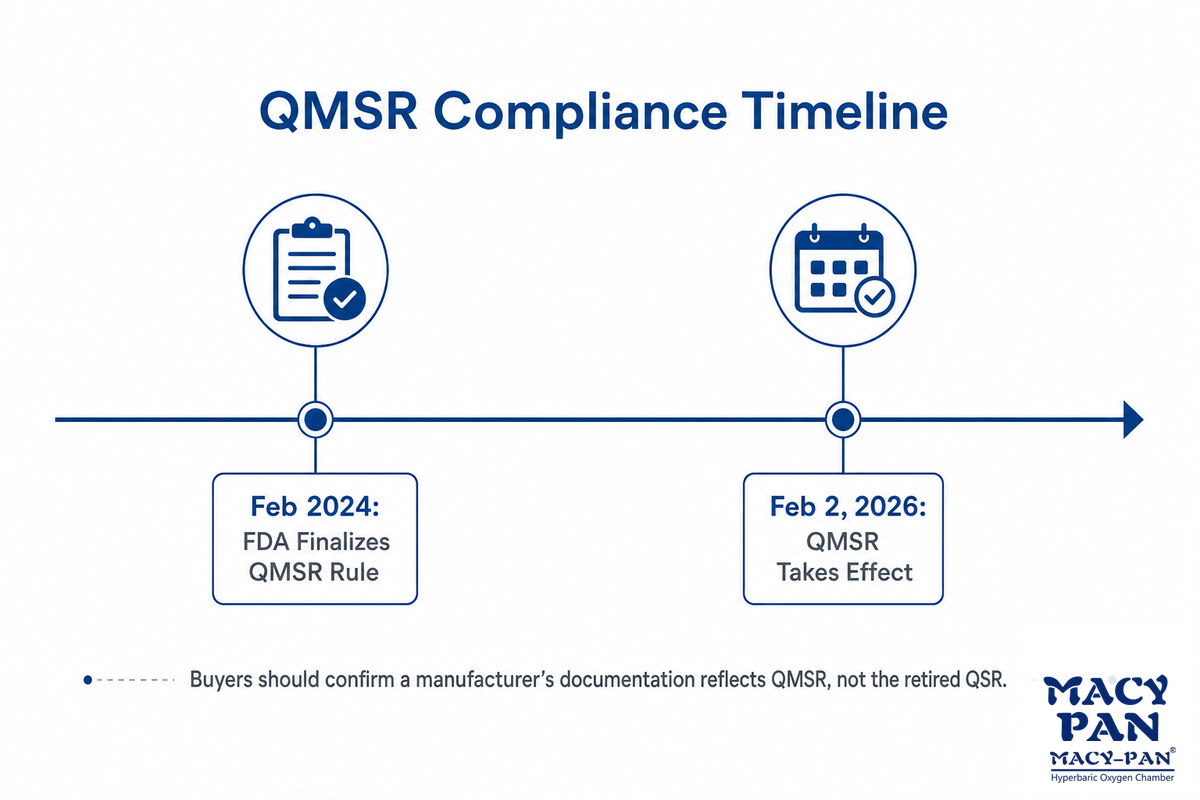
FDA finalized a rule incorporating certified quality management system into a new Quality Management System Regulation (QMSR) in early 2024, and that rule took effect February 2, 2026 – meaning the compliance framework distributors and manufacturers operate under changed just months ago, not years ago. That timing matters more than any market-size projection: a due-diligence checklist built on the old Quality System Regulation is already out of date, and buyers evaluating a program today should confirm the manufacturer’s documentation reflects QMSR, not the prior framework. The risk of skipping this check isn’t hypothetical – a manufacturer still citing the retired QSR is a structural gap in their compliance program, not a paperwork technicality, and it’s the kind of hidden problem that only surfaces during an audit, months after a distributor has already committed inventory.
Search behavior backs up a related shift. Terms tied to program structure – channel partner, channel distributors, master distributor, exclusive distributorship – show rising demand over the trailing 12 months, while terms tied to contract paperwork – distributor agreement, exclusive distribution agreement, medical device distributorship – show sharp year-over-year declines of roughly 60%. Read together with the QMSR timing, that points to buyers researching how a relationship should be structured before they get anywhere near a contract draft. Industry commentary on medical device channel expansion echoes the same pattern: going indirect through a channel partner is frequently described as the more practical route to expand rapidly into new markets and build a global network worldwide, ahead of any specific contract-term discussion, but that kind of integration only works if the manufacturer’s own quality assurance and monitoring systems are recognized worldwide, not just locally.
If you’re evaluating a program in 2026: confirm the manufacturer can speak to QMSR (not the legacy QSR) before you request a contract draft – that single question filters out programs running on outdated compliance documentation.
MACY-PAN’s Hyperbaric Chamber Distributor Program
Everything above applies to evaluating any manufacturer’s program – including MACY-PAN’s own. Shanghai Baobang Medical Equipment Co., Ltd. (MACY-PAN), a hyperbaric chamber manufacturer with 19 years of factory experience in the category, state-of-the-art innovation, certified quality management system certified and CE credentialed, and chambers engineered for reliability and durability, runs a structured hyperbaric chamber distributor program covering territory, tiered margins, and onboarding support – the resolution MACY-PAN built around this program is the same evaluation framework covered above, applied to its own terms. Run the 12-clause checklist and the Territory-Volume Exclusivity Test above against its actual terms – that is exactly what this guide is designed for.
Not sure whether a distributor arrangement fit your situation? Try the Dealer-Fit Quiz for a quick read before you request full program terms.
Apply to MACY-PAN’s Distributor Program →
FAQ
Q: What’s the difference between a distributor, a dealer, and a reseller?
View Answer
A distributor purchases and stocks product, frequently tied to a particular territory, so most distributor contracts require minimum purchase quantities (MOQs). A dealer operates a similar buy-and-resell model, but usually on a smaller scale. A reseller often does not stock products and operates on a commission basis or uses a drop-ship arrangement to lower entry costs but to a lesser profit per unit than stocking distributors.
Q: Is it better to start with an exclusive or non-exclusive distributor agreement?
View Answer
Whether exclusivity is worth it depends on projected volume and territory competition, not any inherent benefit of exclusivity itself. If expected volume clears the manufacturer’s stated threshold and the territory already has competing distributors active in it, exclusivity is usually worth the higher up-front commitment. If volume forecasts are uncertain, a non-exclusive agreement with a volume-triggered upgrade clause is the lower-risk starting point, and it still leaves room to negotiate exclusivity later once real sales data exists.
Q: What certifications should I ask a hyperbaric chamber manufacturer for before agreeing to distribute their products?
View Answer
Always request CE marking documentation, a certified quality management system certificate, and for hyperbaric chambers-pressure vessels that are used in human occupancy environments-the exact unit’s model-specific ASME-2023 test certificate, not a generalized company-wide compliance certificate. For products intended for use in the U.S., confirm the specific product has FDA 510(k) clearance under product code CBF. In addition, verify any certificate’s authenticity with the issuing body’s registry to prevent accepting falsified documentation.
Q: How long does the process take from first inquiry to a signed distributor agreement?
View Answer
Although many programs begin qualification in just a few business days after an initial inquiry, a completed agreement, including sample or demo review and terms negotiation, commonly takes several weeks rather than days. Programs that push for a signature faster than that timeline, without a written summary in hand, are worth extra scrutiny before committing.
Q: What’s a reasonable minimum order quantity (MOQ) to expect for a first order?
View Answer
MOQ terms for hyperbaric chamber distributor programs can vary widely, and claims of universal standards for MOQs should be approached with caution. Generally, hyperbaric chamber contracts feature tiered MOQs that scale based on purchase volume and associated benefits such as pricing improvements or territory rights as order volume grows. Rather than agreeing to a single first-order quantity, ask for the full tier schedule in writing to understand the expected commitments beyond the initial order.
Q: Can a distributor agreement be terminated early, and what should the contract say about that?
View Answer
Yes. Most distributor contracts allow for termination. Such agreements should specify notice periods and procedures for handling existing inventory and customer accounts. Notice periods generally correspond to the duration of the contract. Initial contracts commonly allow for a few months’ notice, and long-term agreements may require notification of a year or longer, depending on jurisdiction. Make certain to confirm this contractual provision explicitly, as it is often the source of disputes in distribution law.
Why We Write This
MACY-PAN has its own hyperbaric chamber distributor program, so this article is of course very interesting in this category. The above check-list and exclusivity-test were developed to apply to all manufacturers’ terms and conditions, not only our own; the research supporting it-including the FDA & ISO sourcing verification-comes from publicly available regulations, not sales literature. Reviewed by the Shanghai Baobang Medical Equipment Co., Ltd. technical team.
References & Sources
- Overview of Device Regulation — U.S. Food and Drug Administration
- Who Must Register, List, and Pay the Fee — U.S. Food and Drug Administration
- Medical Devices; Quality System Regulation Amendments — Federal Register
- certified quality management system, Medical devices Quality management systems — International Organization for Standardization
- Guidelines on Vertical Restraints (Regulation 2022/720) — European Commission Directorate-General for Competition
- An Overview of the Medical Device Industry — Medicare Payment Advisory Commission (MedPAC), background context only; see NYU Stern data cited in-text for current sector margins
- ASME — American Society of Mechanical Engineers, publisher of the PVHO-1 pressure vessel standard
- Federal Trade Commission — US antitrust oversight of exclusive-dealing arrangements
Related Articles
- Hyperbaric Chamber Manufacturer — MACY-PAN’s manufacturing credentials and full chamber range
- OEM & Wholesale Supply — private-label and bulk sourcing options if distributorship isn’t the right fit
- Monoplace vs. Multiplace Chambers — what a distributor would actually be reselling
- Hyperbaric Chambers for Wellness Centers — a common end-buyer segment for distributors in this category
- Hyperbaric Chambers for Clinics & Medical Practices — the higher-ATA end of the buyer spectrum
- About MACY-PAN — company background and credentials
![Decision lenses: occupancy, gas path, access, staffing, facility interfaces, and exact-model evidence [article].](https://macypansolutions.com/wp-content/uploads/2026/10/monoplace-vs-multiplace-hyperbaric-chambers-featured-1-768x512.png)