Get in Touch with MACY-PAN Company

If you’ve just received one factory quote marked “OEM” and another marked “ODM”, and both seem to promise a similar finished product, you’re not just being paranoid. OEM vs ODM is probably the most commonly misused pair of acronyms for a company that’s thinking about making the jump to outsource manufacturing. Between these two business models, you need to understand who owns the intellectual property in your product, who’s liable when things go wrong with regulations, and what timeline you can expect for delivering a finished new product. This guide takes you through each model and then tests how those models apply to a specific regulated product category: hyperbaric chambers.
Quick Specs: OEM / ODM / OBM / Private Label at a Glance
| OEM | You design it, a factory builds it to your spec. You own the IP. |
| ODM | The factory designed it and owns the base IP. You brand and sell it. |
| Private Label | A specific ODM arrangement: your name, address, and product identifier go on someone else’s device. |
| White Label | A private-label device sold near-identically to multiple brands, minimal customization, usually lower risk. |
| OBM | Original Brand Manufacturer — a factory that designs, builds, AND sells under its own brand. |
What Is OEM? What Is ODM? (And Why Buyers Confuse Them)
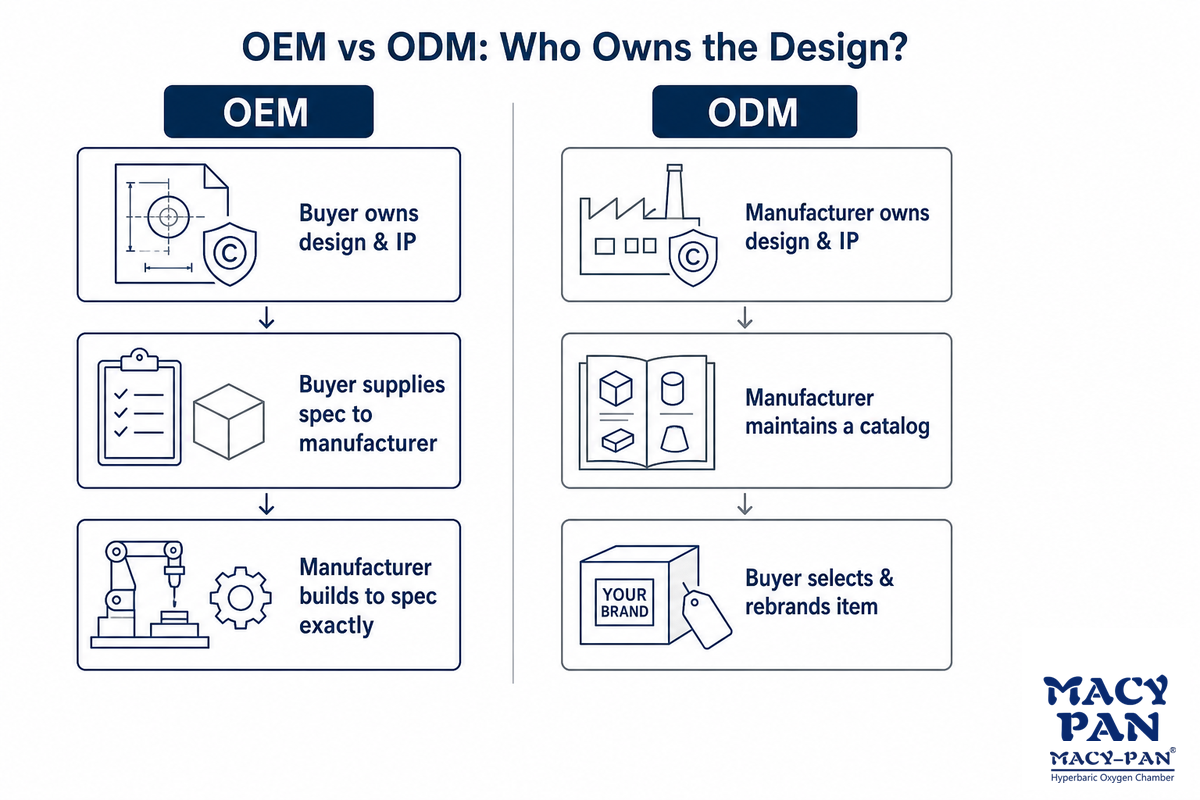
An original equipment manufacturer (OEM) builds a product to a specification the customer owns and supplies; an original design manufacturer (ODM) instead owns a pre-built design and validated tooling that customers select from a catalog and rebrand as their own.
It’s the customer who furnishes the design, the BOM, and performance targets in an OEM relationship – the OEM’s task is to construct something to that specification, period, without argument or variation. In an ODM relationship, the manufacturer owns a design and associated manufacturing tooling which it validates in the marketplace and presents as its catalog of available designs. The customer picks a product from the catalog, and has the ODM put its logo on it and assemble its packaging, usually with some minor cosmetic tweaks.
This typically breaks down in reality. As one founder summed it up on a startup forum, when they were in talks with factories, the sales team usually referred to both scenarios as OEM and ODM, but engineers in the factory only considered the ODM side to be the one that owns the design. That difference between what the commercial teams consider versus the engineers is how a company ends up signing what it thinks is a full IP ownership agreement and is actually getting an ODM arrangement on the back-end of the contract.
What Is OEM Manufacturing?
OEM manufacturing is a production partnership in which the buyer, not the factory, owns the product design, intellectual property, and technical specification, generally developing it internally before handing it to the manufacturer in finished spec form, with the manufacturer executing to that spec rather than contributing original design work.
Manufacturing itself is the manufacturer’s job, whether procuring parts, managing a production line or handling required tests, quality checks, and so on, while the buyer directs and approves the quality criteria. Since the design ownership belongs to the buyer, such relationships almost always necessitate in-house engineering capability (or use of a third party design house), the expense of tooling and certification costs usually borne by the buyer up front. This, in turn allows for greater design control, roadmap control and the theoretical right to shift manufacturing to a new provider without losing the design (the practical cost is real when tooling and process is unique to one manufacturer).
Apple and Foxconn are the classic worked example – Apple owns the iPhone design and architecture, and it also owns the intellectual property and the specifications to build it, and outsources the assembly to Foxconn. Foxconn is the OEM in this case (the contract manufacturer in this instance) – it doesn’t own the iPhone design and isn’t in a position to offer to sell a duplicate design under its own brand. That one distinction is the easiest litmus test for what sort of model you’re really in – try asking who’s legally able to offer to sell the same design to your competitor tomorrow. If the answer is the factory, you’re in a private label / ODM arrangement, regardless of what the sales presentation says – and that difference between OEM and ODM is the one that actually holds up in a contract dispute.
Literally the second word of the terms explains the difference between ODM and OEM: OEM stands for original equipment manufacturer, and ODM stands for original design manufacturer – one letter, opposite meaning. Ask a factory manager what’s the difference and the answer usually centres around who drew up the specs first, but in casual sourcing conversations these two terms get compressed fast: buyer representatives frequently take these two terms and use them interchangeably even when the factory’s own contract defines them differently, sometimes describing a design from the ODM’s own catalog as though it were based on another company’s original brief. A useful OEM example in a regulated field: OEM refers to the buyer-owned-design side of the relationship, while the ODM produces the catalog designs the buyer selects and resells under its own brand – and if you choose an ODM platform, you inherit whatever that base design already is. To discover the key differences between OEM and ODM on your next quote, rather than rely on the sales deck, ask who signs off on and holds the design history file – a term with a specific regulatory meaning under FDA’s design controls rule, not just internal paperwork.
OEM vs ODM vs Private Label vs OBM: At-a-Glance Comparison
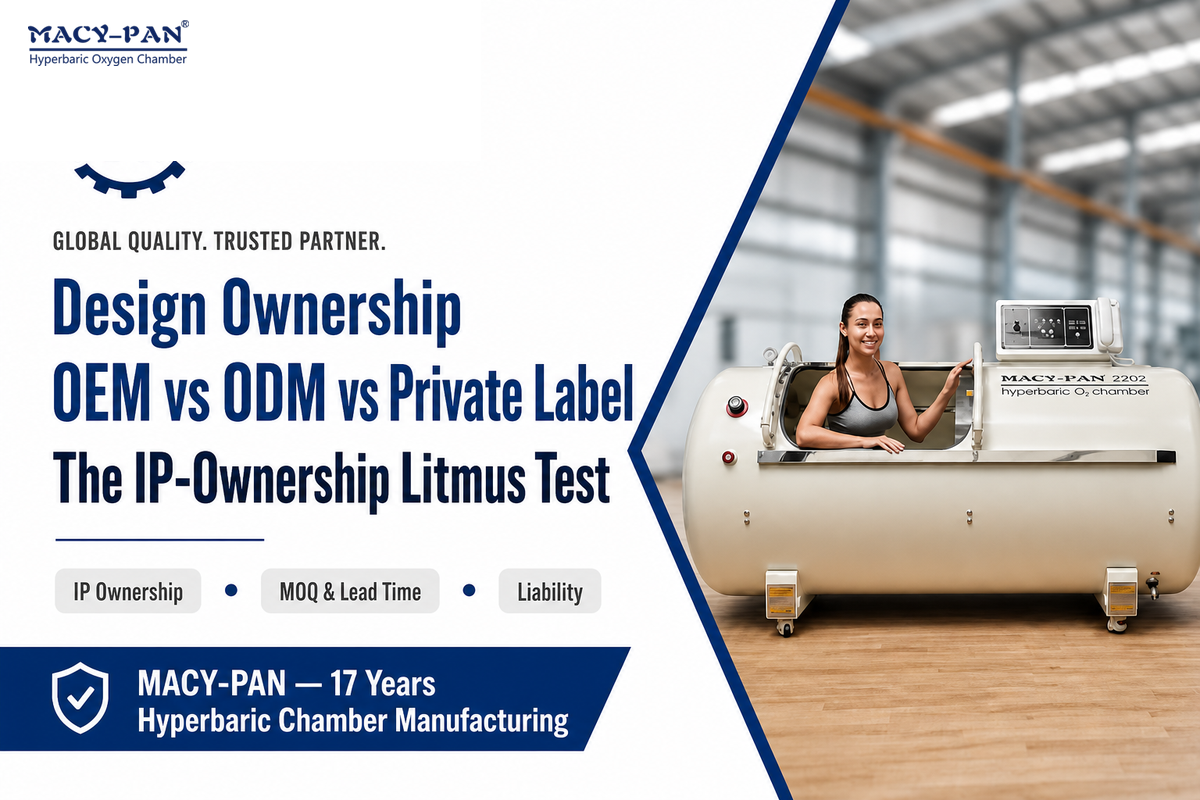
Every product based on one of these models starts with the same three key questions, and the IP-Ownership Litmus Test strips the label confusion down to exactly that: (1) Who has the ownership of the technical drawing and specification? (2) Would your contract manufacturer be legally entitled to make and sell an identical product to your direct competitor? and (3) Who bears financial liability in the event of an inherent defect in the design itself as opposed to the execution of the design? Your response will put you squarely in one of the following rows of the table – no other! The same design-ownership line is what U.S. regulators use to decide who is on the hook for a device’s design controls under 21 CFR 820.30, not just who negotiated the purchase order.
| Model Factor | OEM | ODM / Private Label |
|---|---|---|
| Design ownership | Buyer | Manufacturer |
| IP ownership | Buyer retains core IP | Manufacturer retains base-design IP |
| Customization depth | Full — any spec the buyer defines | Cosmetic to moderate (branding, color, packaging; White Label = least, Black Label = most) |
| Typical time to first shipment | Longer — full design, tooling, and validation cycle | Shorter — existing design and tooling already validated |
| Upfront tooling cost | Buyer-financed, dedicated tooling | Amortized across multiple clients sharing the same tooling |
| Exclusivity | Design is exclusive to buyer | Base design may be sold to competitors under different brands |
| Design-defect liability (typical contract default) | Buyer | Manufacturer, unless contract states otherwise |
| In-house engineering needed | Yes, or a hired design partner | Minimal — evaluation and QA capacity is enough |
| Worked example | Apple (OEM/brand owner) & Foxconn (contract manufacturer) for iPhone assembly | A distributor selecting an existing chamber design from a manufacturer’s catalog and adding its own brand name |
✔ Advantages
- OEM – full design freedom, no direct imitation risk for intellectual property (IP), no risk for exclusive products.
- ODM/Private Label : quicker time to market, less initial investment, no question of involving the in-house design team
⚠ Limitations
- OEM: increased initial cost, lengthy development process, the buyer owns the design development risk
- ODM/Private Label: Limited options on customization. The design you’re using probably won’t be unique. you’ll have very little transparency over how the manufacturer manages control.
When choosing the right model for your product, the most important thing to weigh isn’t which of the models sounds more prestigious but rather the cons of each model your business is willing to live with, and whether that trade-off is right for your business at this stage. An OEM model means that you’re paying for and will retain ownership of any and all design, a decision well-made if the raison d’être for your brand is a product unmatched in your space. An ODM model – often just one of several manufacturing models in a manufacturing and product lineup offered from the same factory line – requires you to accept a common core design in exchange for time savings and reduced risk, an excellent option if you need to validate a new product space before investing significant engineering resources. Buyers selecting an ODM model solely because of a reduced price, without having done the due diligence to ensure the shared base design is exclusive to them, are often surprised to see an competitor launching a replica product 18 months down the line. There isn’t one answer that’s best for all businesses regardless of their category – a consumer accessory and a regulated medical device can both differ dramatically in their comfort level with the “someone else has ownership of the IP” exchange.
How Private Label Manufacturing Actually Works (Sample to Shelf)
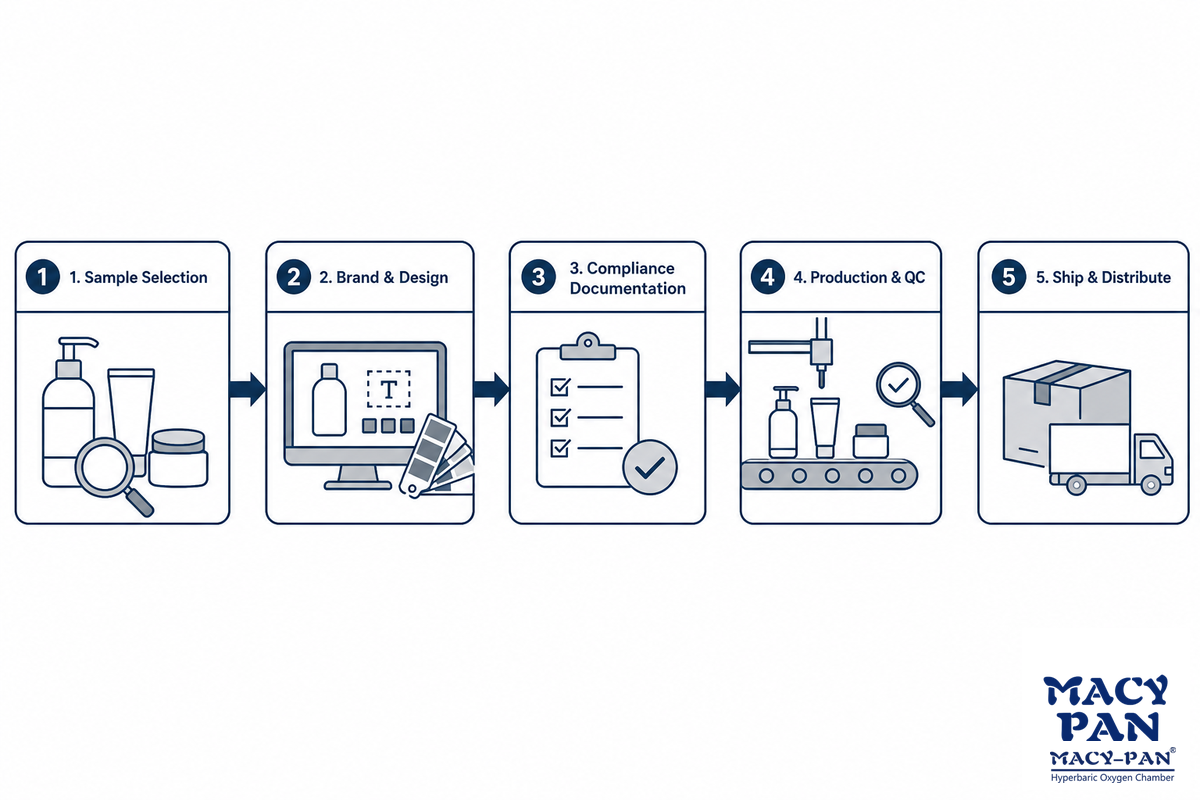
Private label medical devices fall into two operating categories – White Labeling and Black Labeling – and picking between them means choosing from products already validated by the manufacturer rather than starting a design process from the ground up, which skips the higher upfront design and tooling costs an OEM path requires.
That distinction is more important than most sourcing guides let on – guides borrowed from consumer electronics and general electronics manufacturing tend to omit it entirely, because a medical device’s regulatory filing raises the stakes considerably when things go wrong. This is the logic behind private labeling or white label programs across the entirety of manufacturing services, not merely medical devices: from the buyer’s side, it means skipping the higher upfront costs for design and tooling required to pay an OEM to manufacture a from-scratch product. Think of the OEM’s catalog as a menu: the OEM designs a particular product just one time, and companies can rebrand and sell copies of it repeatedly under different brand names, without so much as laying a finger on the original design. In essence: White Labeling is a case of the original equipment manufacturer designing one device that multiple private labels buy to sell-the device itself is fairly generic and may undergo little to no customization; this typically poses lower risk and lower upfront costs. Black Labeling is when the original equipment manufacturer creates a product specifically for one private labeling company, and it’s generally customized in some way to meet that company’s needs, and the company agrees that the device shall only be sold under its Private Label brand names.
Once type is settled, the actual manufacturing relationship is decided by four pragmatic questions the manufacturer and the private labeler must address in a written-not verbal-agreement: Who is responsible for owning and maintaining the design history file required under 21 CFR 820.30? Who owns the commercial rights to any customizations the labeler demands? Who controls the labeling and packaging design, and how do both sides keep it in documentation? And how will the companies manage change control as specifications or labeling requirements evolve? As one practitioner who has led this process from the brand-owner perspective explained, “The entire purpose of a private label agreement is to delegate responsibility for production, manufacturing expertise and design maintenance to the supplier-the buyer is effectively renting the design and manufacturing expertise that they do not possess to produce in-house. This works as long as the contract is crystal clear as to which documents each company retains within its respective quality system. Both parties are going to end up with multiple copies of labeling records and, if they go out of synchronization, an FDA inspector is going to find that inconsistency.”
💡 Pro Tip: Sample Approval Checklist
Before signing off on a private-label sample for any new product, document: (1) which party’s system houses the design history file; (2) whether your logo or brand mark becomes a distinct part number on the manufacturer’s bill of materials; (3) who is responsible for printing and packaging your instructions-for-use; and (4) the notification window if the manufacturer must change a specification that affects your branded configuration.
Vetting a Manufacturing Partner: MOQ, Lead Time, and Red Flags
Two engineers with experience on both sides of the OEM arrangement-as part of a buyer’s engineering department and as part of a manufacturer’s production floor-describe the tension similarly. “Working as an OEM’s production partner means designing internal tests that you know will pass the buyer’s acceptance criteria. Cooperation is ‘tight and at times agonizing’ because the buyer’s specification doesn’t always align perfectly with the realities of the production line from day one. That friction is perfectly normal; the failure mode isn’t the disagreement itself but rather that the disagreement become apparent after the tooling has already been built.”
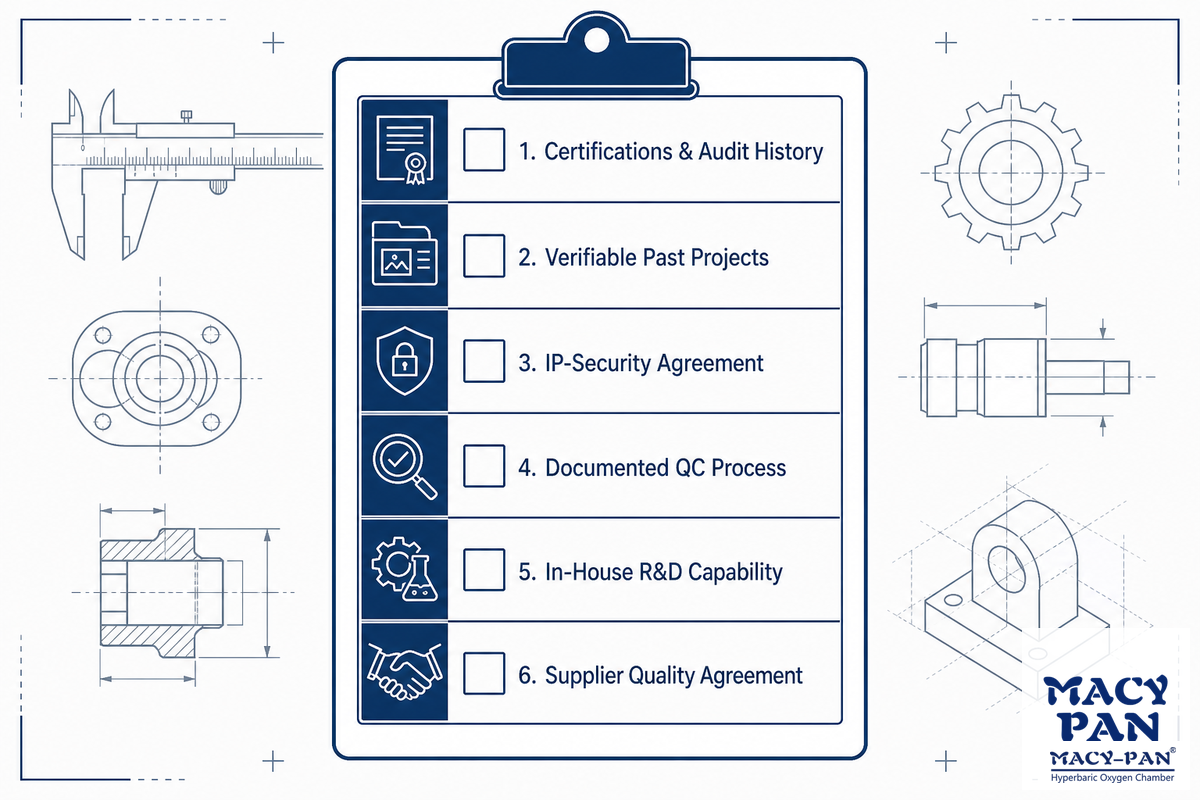
The six things you need to assess in a due-diligence review of a prospective OEM or ODM partner, before the contract is signed and before you even set foot on their factory floor – this needs to go beyond a walkthrough, since manufacturing capabilities on paper and the manufacturing processes actually followed on the line are not always the same thing:
The 6 Point Manufacturing Partner Framework
- Can they produce evidence of relevant certifications (for medical devices, ISO 13485 quality management system is standard, not a luxury) and a history of audits, not just a certificate?
- Can they cite specific past projects and provide contactable references (and not just the logos on their Web site)?
- Is there a separate confidentiality and IP-security agreement for your specifications?
- Do they’ve a quality-control process documented that describes their acceptance criteria? (Not simply, “We test everything.”)
- Does it do any in-house research and development (R&D) work, or does it outsource design work itself – is it a factory that can manufacture the product but cannot explain how they design and manufacture products in-house – meaning it’s really just relabeling someone else’s ODM product for you?
- What’s its actual minimum order quantity (MOQ) and lead time for *your* product configuration – not its advertised minimum for a simpler product.
- Who will sign the Supplier Quality Agreement (SQA), and is it explicit about ownership of the design-history file, responsibility for complaint investigation under the design controls rule, and notification to FDA in case of an inspection?
This last item, a well-drafted Supplier Quality Agreement (SQA), is the one least emphasized in typical sourcing guides but is critical once the product is out the door. This is not a template – this is the document that defines who’s on the hook when a customer complains or FDA knocks on the door. A workable SQA obligates the contract manufacturer to forward customer complaints to the private labeler within 5 business days and report a potential adverse event within 24 hours, because fda’s own medical device reporting rules require very fast turnaround on reportable events once they’re reported. Factories also receiveFDA inspections based on the risk of their devices, not a schedule; the furls registration also needs annual renewal each October 1 to December 31-and can easily fall through the cracks if both the factory and the private labeler think the other company is responsible for it.
Wholesale Medical Equipment Economics: MOQ, Landed Cost, and Margin
Minimum order quantities for ODM and private-label production run lower than for OEM products for a purely practical, economic reason. A true OEM requires dedicated, custom tooling designed exclusively for one customer’s specifications, and that tool has to be amortized over the sales to that single customer. The cost of an ODM manufacturer’s tools is already being spread out over many customers purchasing variants of the same basic platform, so the company can accept smaller orders.
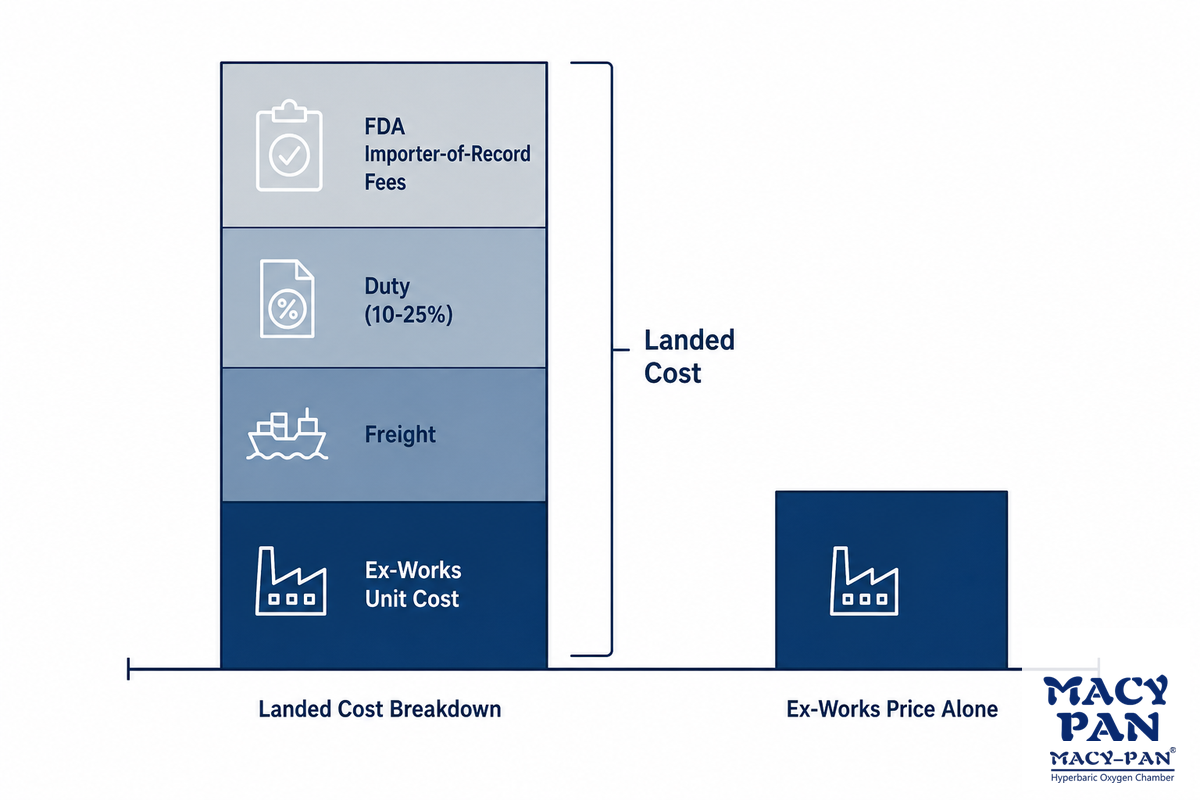
The average OEM/ODM electronics sourcing benchmarks for medical and related industries often cite 100s of units per order for full custom, and 100s to low 100s for hybrid OEM/ODM and private label on a shared platform, for full lead times – all subject to a large variety of variables and always needing direct discussion with the factory for your specific product, type of device, and current factory capacity. And beyond the unit price you pay, remember to factor in the landed costs – duty and freight alone will often add 10% to 25% to the ex-works cost of the device from an offshore source (based on Harmonized System code and country of origin, among other things); if the private labeler imports it from a foreign contract manufacturer, it will be the designated “initial importer” of record with the FDA, which has its own operational overhead.
Here, the hidden risk isn’t the unit price – it’s the landed-cost gap that only becomes visible after the shipment clears customs. A distributor who builds a margin model on ex-works cost alone risks a costly mistake, because the real delivered cost only becomes clear once the first shipment has already cleared customs, by which point the retail price is already quoted downstream to their own buyers. Ask MACY-PAN, or any prospective OEM or ODM partner, for a landed-cost worksheet before comparing unit prices – one that separately itemizes ex-works cost, freight, duty, and any FDA importer-of-record fees – built around whatever track record of in-house exporting experience that manufacturer can actually document; MACY-PAN’s own answer is 19 years of exports to 126+ countries.
How to Become a Distributor: Medical Equipment vs. General Wholesale
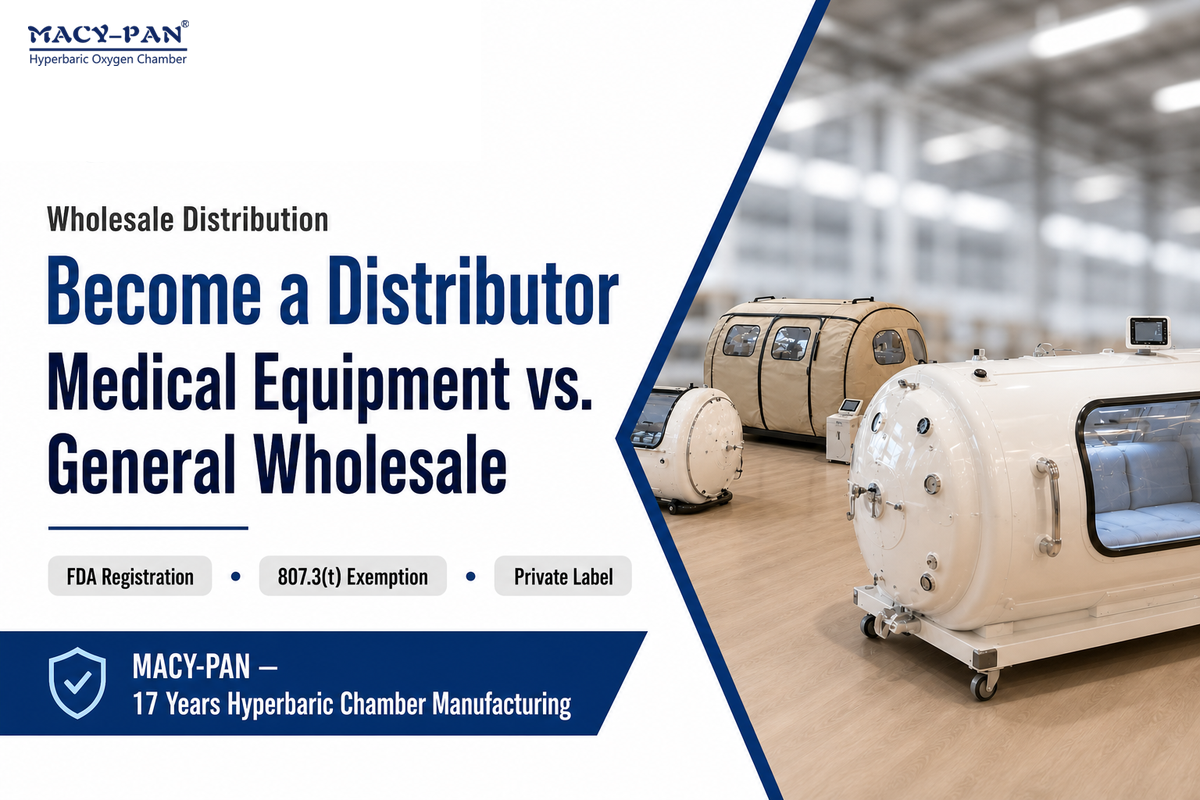
General wholesale distribution needs only a supplier agreement and logistics; medical device distribution adds an FDA registration layer that kicks in the moment repackaging, relabeling, or private branding is involved, and skipping that check is the single most common compliance mistake new distributors make.
How Do You Become a Medical Device Distributor?
Becoming a general wholesale distributor just takes a supplier agreement, capital, and logistics; medical device distribution adds one extra layer most buyers skip at their own risk – whether or not the device gets repacked, relabeled, or altered before resale.
If you distribute devices without repacking, relabeling, or altering them, you usually won’t need to register as a manufacturer or a listed establishment under the FDA’s device rules. That’s the exemption FDA defines for a wholesale distributor, specifically. But if your company name (or identifier, or brand name, or brand, whatever you want to call it) appears anywhere on the device, that takes you into private label territory, with corresponding registration and listing requirements. That one fact alone-whether or not you repackage or relabel-is the fork in the road that defines the difference between “I sell medical devices” and “I distribute private-label medical devices,” and it warrants getting legal confirmation in writing before a contract is signed, not after.
In practice, a distributor evaluating a medical device product line should inquire directly from the supplier about the nature of the arrangement: Is it intended to be a pure distribution deal or a private-label one? The compliance obligations, paperwork, and timelines diverge substantially between the two, even though from a sales and logistics perspective, they can look similar.
Over the long haul, distributors that forge manufacturing partnerships, rather than simply placing individual orders with factories, will likely receive more favorable terms: Repeat business offers the manufacturer a strong incentive to nurture the relationship, rather than treating each order as a one-off transaction. Still, a distributor’s investment in its branding and marketing budget will matter more than the factory’s product manufacturing scale in the initial phases: a smaller facility with rigorous quality control can deliver products to consumers with just as much reliability as a larger one, and the costly mistake of purchasing idle manufacturing capacity is a common one for beginners. Buyers without the in-house expertise to design a chamber from the ground up aren’t at a disadvantage in this scenario, since the ODM model is designed precisely to let them achieve this goal – it allows them to create and sell under their own brand without first assembling a dedicated engineering team.
FDA Rules for Private-Label and OEM Medical Devices (21 CFR 807.20)
“There is no one-size-fits-all approach to defining responsibilities in private label medical device relationships… The key is to establish a well-defined Supplier Quality Agreement.”
Sarah Lacey Robbins, RAC, Senior Quality Manager, Rook Quality Systems
Does FDA Regulate Private-Label Medical Devices?
FDA regulates private-label medical devices indirectly, through establishment registration and device listing, rather than by approving the private-labeling arrangement or contract itself; the agency stays out of the commercial terms between the two companies entirely and focuses only on who must register and list the device.
FDA does not get involved in the specific contractual terms between an original equipment manufacturer (OEM) and a private-labeling company. What the FDA regulates is establishment registration and device listing.
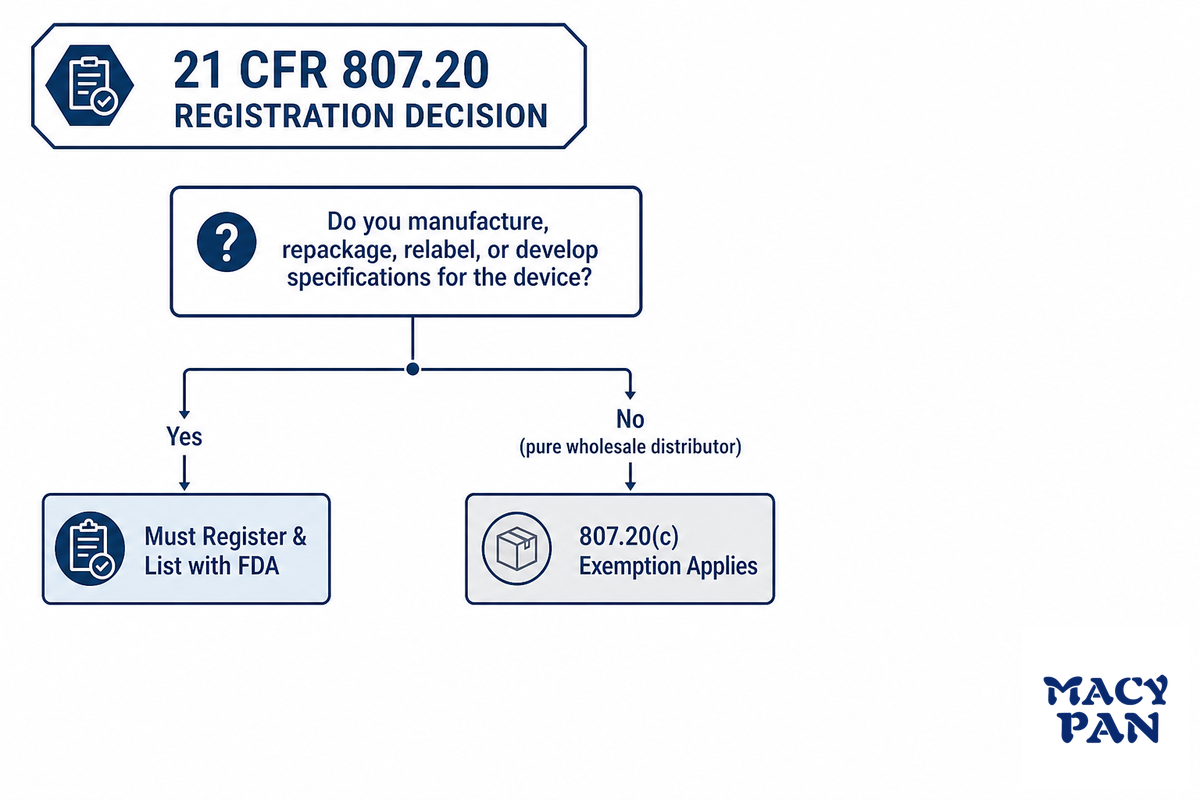
Specifically, 21 CFR 807.20 stipulates that anyone who initiates or develops specifications for a device to be manufactured by another company or repacks or relabels a device must register their establishment with the FDA and list the devices they are distributing. 21 CFR 807.20(c) exempts a “wholesale distributor that does not manufacture, repackage, process, or relabel” the device from registration requirements. Whether you’re a pure wholesale distributor or a private labeler turns solely on whether your name is on the label.
When a private labeler does need to register and list, they will generally not start from a new premarket notification filing. Rather, they “piggyback” on the existing 510(k) clearance from the original manufacturer in their listing, referencing that 510(k) – this is only possible if they obtain written authorization from the original manufacturer as FDA does not allow the same device to be listed under two separate 510(k) filings. A new 510(k) filing is only required if the private-label version involves modifications to its performance, function, or intended use.
Labeling itself is a separate and distinct requirement – 21 CFR 801.1(c) dictates that when the label does not identify the actual manufacturer, the label must be qualified with “Manufactured for _____” or “Distributed by _____.” Omission of that qualifying phrase (or listing a private labeler without registering them) is one of the most common ways a private-label device ends up mislabeled by mistake on either party’s part. Should the original manufacturer be located outside the United States, as is almost always the case for China-based sources, the manufacturer will also need to register as a foreign establishment and appoint a U.S. Agent; the private labeler will need to be identified as the “Importer” on the shipping documentation.
📐 Compliance Note
21 CFR 807.20(a)(1) and (a)(3) apply registration to those who “develop device specifications” for a second-party manufacturer and anyone who repackages or relabels a device, whereas 21 CFR 807.20(c) exempts purely wholesale distributors. 21 CFR 801.1(c) applies the “Manufactured for” or “Distributed by” qualifying requirement. UDI compliance falls on whoever “owns the label,” per 21 CFR Part 830 and 801.20, which isn’t always the manufacturer, and isn’t always the private labeler either, but rather who has control over final label content.
OEM & Wholesale Supply for Hyperbaric Chambers
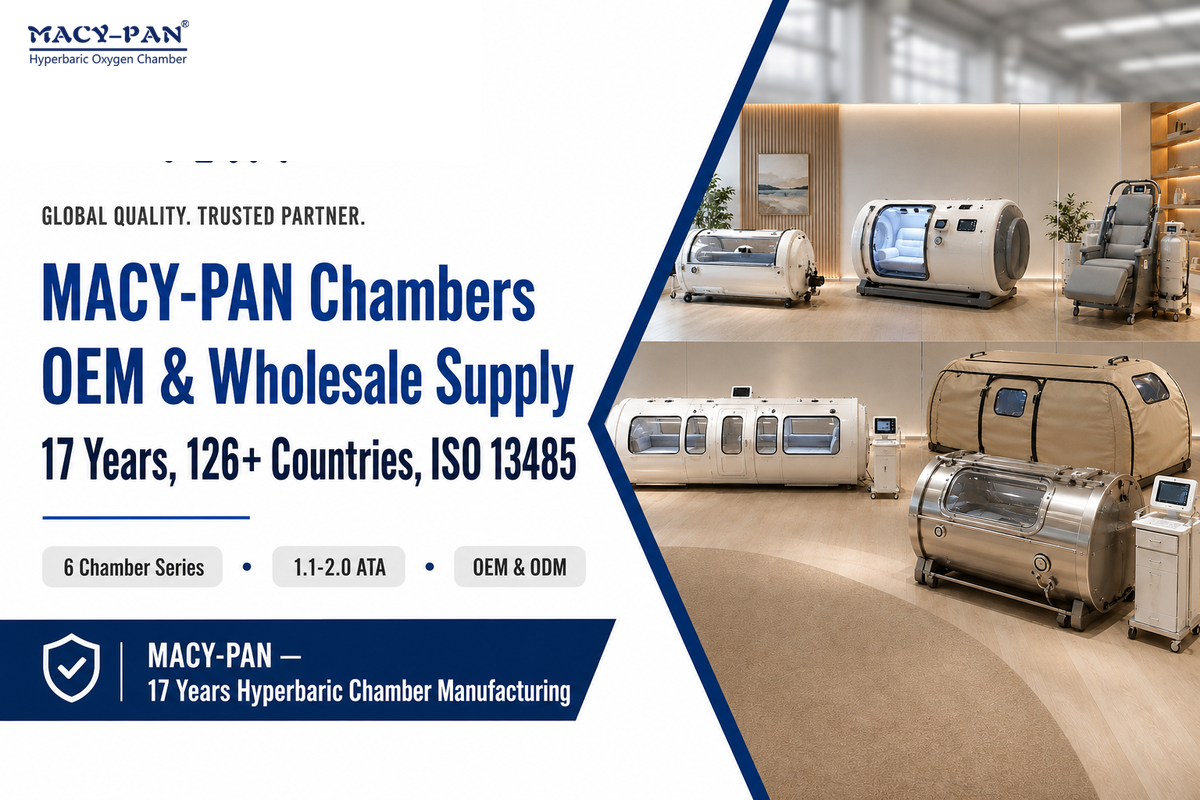
The above points all hold generally true for medical devices, but to specifically discuss hyperbaric chambers, the OEM vs. wholesale supply looks a bit different when you’re dealing with a genuine manufacturer. MACY-PAN (Shanghai Baobang Medical Equipment Co., Ltd) has been manufacturing hyperbaric chambers for 19 years, possesses certified quality management system, ISO 9001 certifications and CE marking, and has exported to 126+ countries (so the checklist in the above section of what certifications you need are in place and not just theoretical aspirations). Additionally, MACY-PAN holds a granted U.S. design patent (USD1084341S1, application date: June 2024, grant date: July 2025) for a hyperbaric oxygen-chamber ornamental design, indicating true in-house design capabilities rather than just assembly lines; this is especially important for a buyer considering either OEM or private label arrangements, as it affects their ability to have unique specifications implemented (OEM) versus leveraging the existing validated design work (private label/ODM).
MACY-PAN participates in the hyperbaric-chamber manufacturing sector both as an OEM and ODM production partner, instead of one that produces a single, iconic chamber that any private-label distributor will take with little-to-no alteration. Should your distributor require a company that designs to your specific drawings, MACY-PAN’s engineers can manufacture products based on buyer requirements; if full custom-designing is premature for your distributor, the available catalog from the 6-series provides a company that sells validated chamber platforms ready for your branding. Both strategies provide protection to the buyer’s intellectual property rights over their brand assets, even though the underlying chamber may not exclusively belong to that buyer.
MACY-PAN’s chamber lineup comprises both soft- and hard-shell designs within its 6-series group (ST, HP, HE, MC, and large-capacity HP600-800 models), offering pressure ranges from 1.1 to 2.0 ATA ( approximately 14.7 to 29.4 PSI) according to the model, and catering to single-user and multi-user (as well as veterinary) applications – the variety necessary to support both OEM projects (in which a distributor requires a distributor’s own customized specifications for an existing chamber platform) and private label/white label efforts (in which a reseller can simply select a chamber from the current catalog, to add to their own branding). Here are two examples from the wider medical device private label market of how that can play out commercially: A licensing deal, such as the Bone Solutions/Onkos Surgical pact for OsteoCrete technology or the Vision-Sciences and Stryker agreement for a private-labeled endoscopic device, would look similar in structure to what was mentioned for the FDA; one company possesses the base design and regulatory authorization, and the other company offers distribution power and a market-facing brand.
The common mistake is skipping this OEM-vs-private-label decision entirely and simply asking a manufacturer to “send a quote” – a risk that leads distributors to compare chambers that are not actually interchangeable, because a soft-shell single-occupant unit priced against a hard-shell multiplace model looks like a bargain until the specifications are lined up side by side. MACY-PAN resolves that gap directly: it engineers to a distributor’s own specification under an OEM program, or delivers a pre-validated platform under private label, backed by 19 years of hyperbaric chamber manufacturing and quality-management-system certification. If a distributor or reseller has to decide between pursuing a hyperbaric chamber OEM program ( buyer’s custom chamber designs) or a private label program ( existing chamber platforms from MACY-PAN) , the chamber selection, MOQ’s, and lead-times can be found on the OEM & Wholesale Supply program page with clearer, decision-making information than is contained in a general sourcing guide. Get to know more about the manufacturer whose credentials stand behind those certifications on the MACY-PAN company page.
Start an OEM or Wholesale Inquiry →
Industry Outlook: Where OEM/ODM Medical-Device Sourcing Is Headed in 2026
When considering your partner to go with heading into 2026, don’t be surprised when supply-chain resilience – and not price alone – dictates what type of manufacturing partners you’re looking for. This year’s released engineering guidance on selecting manufacturing models points to global supply-chain resilience alongside digital process optimization as a primary consideration for buyers evaluating partners. That means they’re examining supplier diversity – geographic and beyond – rather than just per-unit price. Regulatory ground shifted under this exact question on February 2, 2026, when FDA’s Quality Management System Regulation (QMSR) became effective, folding the old Part 820 Quality System Regulation into certified quality management system by reference – the design-controls and design-history-file obligations discussed earlier now sit inside a rule that is explicitly harmonized with the same certified quality management system standard buyers should already be checking for in an OEM or ODM partner. And it shows: In the U.S., searches for “what’s oem manufacturing” increased by 51% year-over-year and for “medical device distributor” rose 50% year-over-year (according to DataForSEO search volume data), demonstrating that buyers are investigating fundamental supply-chain details prior to committing to a manufacturing partner in an increasingly cautious environment. For some perspective on the market’s size: Estimates for the global medical device contract-manufacturing market place it at approximately $84.6 billion in 2025 and $93.5 billion in 2026, with additional reports placing the figure at upwards of $153.13 billion by 2034 – but consider these only for context, as different market researchers vary the estimates by tens of billions.
So what does that mean for the buyer looking to partner with an OEM or private label partner today? Go beyond price and MOQ and start asking questions about geographical risk and capacity redundancy. It’s a trend that was a nice-to-have a couple of years ago but is a supplier-scorecard staple in 2026 – the buyers who skip this step are the ones who find out about a manufacturer’s single-region concentration risk only after a shipment gets stuck, not before signing the contract. Ask any prospective OEM or ODM partner directly whether they operate more than one production site and how they’d handle a facility disruption; a candid answer to that one question tells you more about long-term supply reliability than another round of unit-price negotiation ever will – and it matters just as much for the FDA registration obligations covered earlier, since a facility disruption at an unregistered second site can stall a shipment as fast as a quality problem can. MACY-PAN’s own answer is 19 years of continuous in-house production under a certified quality management system – the kind of track record that is harder to find than a low quote.
FAQ
Q: What is better, OEM or ODM?
View Answer
Neither OEM nor private label is universally better – the right choice depends on whether design exclusivity or speed to market matters more for your product and budget, and on who needs to hold intellectual-property ownership at the end of the deal.
If you’re prioritizing exclusivity over speed to market and have a budget that allows, an OEM approach may be your best bet. If it’s more important to launch quickly with less initial risk and a lower cost, either ODM or private label is the ideal strategy. Always ask: who is the owner of the intellectual property? If legal ownership is a non-negotiable and time is on your side, opt for OEM; if speed is the most pressing concern, ODM or private label should be the pick.
Q: Is Apple an OEM or ODM?
View Answer
Foxconn is the OEM: it manufactures and assembles Apple’s design, while Apple owns all the intellectual property, trademarks, and design authority, and Foxconn cannot sell an equivalent product under its own brand – making it a textbook OEM relationship, not an ODM one.
Most guides to product development will point to this as a definitive example of OEM versus other manufacturing options due to the clear delineation of intellectual property ownership. In this specific scenario, Apple Inc. is the design and ownership authority, and Foxconn, the OEM manufacturer responsible for executing that design and specifications, with no overlap between roles. It’s the antithesis of an ODM model, in which a single manufacturer may supply several OEMs with a similar base design for use by numerous brands (including Samsung Electronics, in certain component markets).
Q: What are the disadvantages of ODM?
View Answer
Limited customization and limited exclusivity are the chief drawbacks of ODM: the baseline design belongs to the manufacturer, buyers are restricted to cosmetic or minor changes, and that same design can typically be resold to competing brands unless the contract forbids it.
Since the manufacturer owns the IP underlying the design, buyers will also have limited bargaining power should they ever wish to change suppliers without re-doing the design work from scratch.These compromises may be acceptable to buyers whose primary concern is speed and lower initial cost over differentiation in the brand market.
Q: Can OEM and ODM manufacturers collaborate?
View Answer
Yes – most factories support both and can offer hybrid options (sometimes referred to as joint design manufacturing or JDM), which incorporate elements of the buyer’s design on the manufacturer’s base design and vice versa on the same line.
Q: What are the benefits of quality-management-system certification for a contract manufacturer?
View Answer
quality-management-system certification confirms that a manufacturer’s quality management system has passed independent third-party review against the international standard for producing medical devices, covering design, documentation, CAPA, and traceability controls that a generic ISO 9001 certificate does not require or verify.
That review runs on an ongoing basis, with a 3-year cycle of initial certification and annual follow-up reviews. For an OEM or private label customer, this is a material consideration, as eventually the FDA will conduct inspections, or the customer may conduct audits, looking for a well-established design history file, thorough complaint-handling system, and a clearly defined process for change control. quality-management-system certification assures that such a system is in place and has already undergone rigorous third-party inspection rather than having to be established on a crash basis after the device is already on the market.
References & Sources
- 21 CFR 807.20, Who Must Register and Submit a Device List — U.S. Food and Drug Administration, eCFR
- 21 CFR 801.1, Device Labeling Requirements — U.S. Food and Drug Administration, eCFR
- US Design Patent USD1084341S1, Oxygen Chamber — Shanghai Baobang Medical Equipment Co., Ltd, USPTO/Google Patents
- Making Private Labeling Work — David Warburton, MDDI (Medical Device and Diagnostic Industry)
- Bone Solutions, Onkos Ink Private Label Deal — MassDevice
- Medical Device Contract Manufacturing Market Report, 2026–2033 — Grand View Research
Related Articles
- Hyperbaric Chamber Manufacturer: OEM & Wholesale Supply — chamber selection, MOQ tiers, and lead-time details for hyperbaric chamber OEM and wholesale programs
- About MACY-PAN — 19 years of hyperbaric chamber manufacturing, certifications, and export history
- MACY-PAN Home — full hyperbaric chamber product range
Why We Write This
MACY-PAN fields OEM and private-label inquiries for hyperbaric chambers from distributors who are frequently new to medical-device sourcing rules, not just new to hyperbaric chambers specifically. This guide reflects the questions those buyers actually ask before a first quote – starting with “what does OEM even mean here” and ending with FDA registration mechanics – rather than a generic manufacturing-model comparison written for a different industry.
Reviewed by the Shanghai Baobang Medical Equipment Co., Ltd technical team. Updated July 2026.
![Decision lenses: occupancy, gas path, access, staffing, facility interfaces, and exact-model evidence [article].](https://macypansolutions.com/wp-content/uploads/2026/10/monoplace-vs-multiplace-hyperbaric-chambers-featured-1-768x512.png)