Get in Touch with MACY-PAN Company

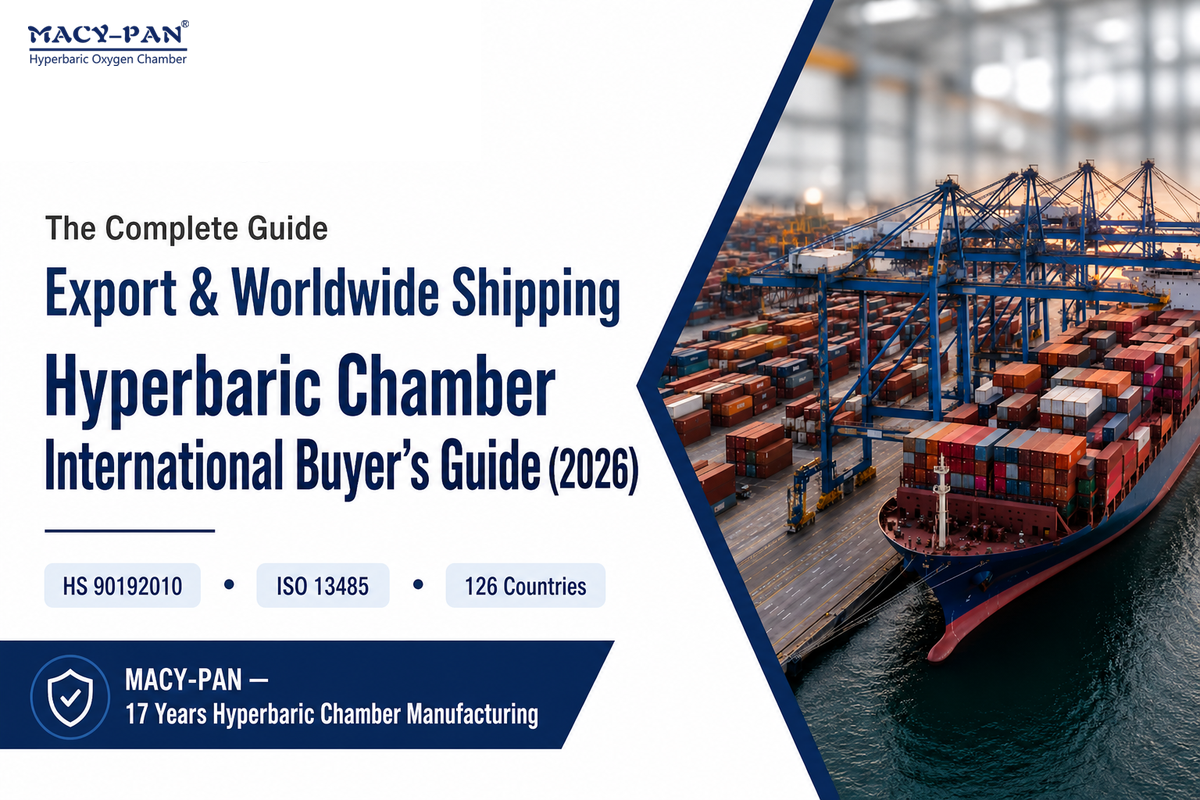
Quick Specs
| HS Code (commonly cited) | 90192010 — verify against your country’s official tariff schedule |
| Certifications | certified quality management system, ISO 9001, CE |
| Export footprint | 126+ countries, 19 years |
| Freight modes | Air, ocean (FCL/LCL), express courier |
| Standard export documents | 5 (see below) |
Export & worldwide shipping is the real test for any Chinese hyperbaric chamber purchase, it isn’t decided at the factory, but at customs. For a chamber shipped from Shanghai to a Toronto clinic, a Vienna, Austria wellness center, or a Dubai home, there are five sets of documents to clear, one or two regulatory checkpoints to survive, and a freight mode decision that almost all buyers make with a poor understanding of the cost trade-offs. With 19 years of experience exporting hyperbaric oxygen therapy chambers to more than 126 countries, MACY-PAN (Shanghai Baobang Medical equipment Co., Ltd.) outlines the real process.
Export & worldwide shipping of hyperbaric chambers from China involves five documents, one or two customs and health-authority review checkpoints, and a freight-mode (air vs. ocean) choice that impacts landed cost more than import duty often does.
Key Facts
- For a several hundred-kilogram chamber, the choice of air versus ocean freight mode is generally a bigger factor for landed cost than import duty.
- The process is more than just customs approval; a shipment can be cleared by customs, yet be held back by a health-authority review within the destination country.
- hyperbaric chambers carry U.S. FDA classification 21 CFR 868.5470 (Class II).
- Additional items shipped along with the chamber (e.g., concentrators, chemical oxygen generators, or cylinders) may require separate hazardous materials shipping classification.
- MACY-PAN’s patent-pending wheelchair-accessible soft chamber design (US20230201059A1, application pending) can only be provided by a direct manufacturer; a trading company reselling another’s chamber can’t match this capability.
What “Worldwide Shipping” Actually Means When You Buy From a Chinese Manufacturer
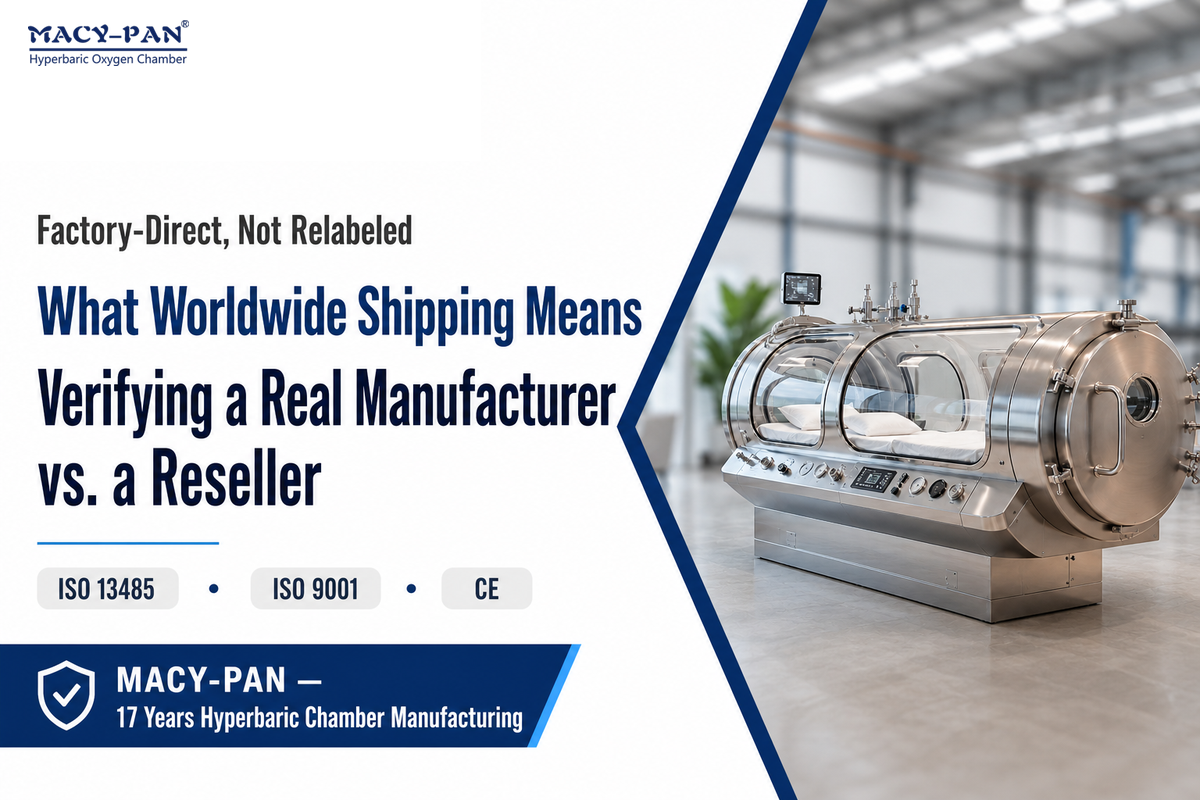
While nearly every hyperbaric chamber manufacturer will boast “We ship worldwide” on their websites, it’s rarely informative on its own. Reviewing three manufacturer websites for this article revealed sweeping claims about quality (100% inspection, one-year warranty) and partnerships, but no concrete evidence such as third-party verifications, document examples, or country-specific details. This isn’t necessarily deceitful; it’s just marketing rhetoric instead of procedural specifics.
A genuine export operation will differ from generic claims in three ways: It can list specific documents needed for shipping (not just “we manage paperwork”). It can explain the customs and safety review classifications in your specific country (not just “we ship to 190+ countries”). It holds internationally recognized, independently verifiable certifications like certified quality management system, ISO 9001, CE, and even a U.S. patent application for its design, checkable on Google Patents. With 19 years of experience shipping to over 126 countries, MACY-PAN offers insight into what worldwide shipping entails: documentation, customs math, freight decisions, and the post-delivery reality.
Buyers researching this topic often search using the acronym HBOT: HBOT equipment, HBOT systems, HBOT therapy, safe HBOT solutions, and exporting HBOT chambers all describe the same underlying hyperbaric oxygen chamber category this guide covers. Hyperbaric medicine chambers trace back to dive-decompression treatment and now serve tissue-oxygenation, wound-care, surgical-recovery, and non-invasive therapy applications across clinical and wellness settings spanning a wide range, from single-patient home units to multi-bed hospital installations.
Not every hyperbaric chamber maker serves the same sector: some focus on non-medical wellness chambers built for workout recovery, spa, and relaxation use, a legitimate but different category from certified quality management system medical-grade hyperbaric solutions built for hospitals, clinics, and sports recovery centers. MACY-PAN, a certified hyperbaric equipment provider, manufactures across that full range: hard-shell multiplace chambers, monoplace units, and portable soft-shell models rated to different atmospheric pressure levels.
The 5-Document Export Paper Trail
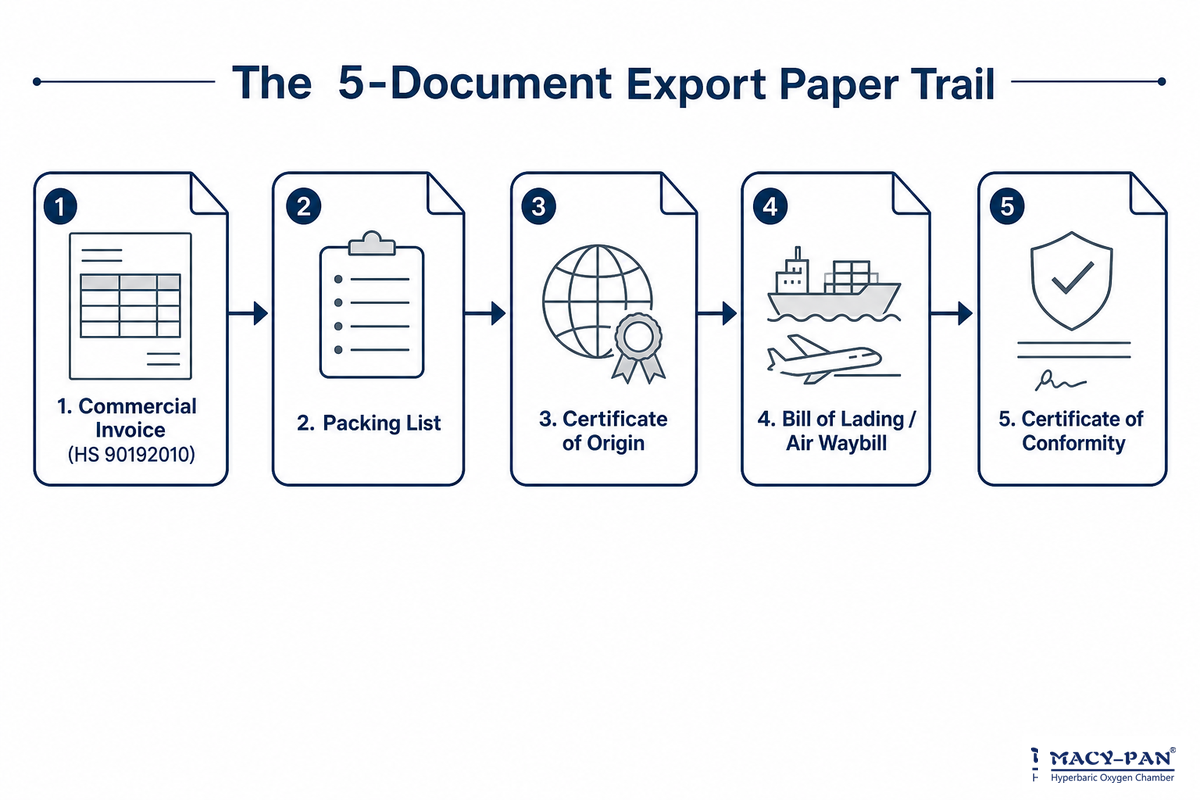
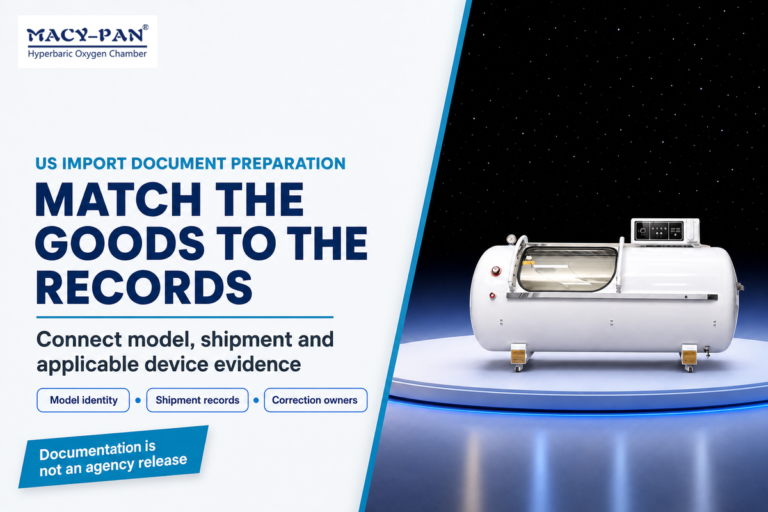
Five documents must be aligned before a hyperbaric chamber leave the factory floor. Discrepancies, such as a product description mismatch between the invoice and the packing list, are frequent cause for customs delays on medical equipment freight, according to logistics experts (Zarach Logistics).
- Commercial Invoice – must contain the correct Harmonized System code. (Trade-data aggregators commonly list hyperbaric chambers under HS 90192010 but this should never be taken as a substitute for looking up the code for your own country via your national tariff-schedule – even H.S. codes will vary somewhat depending on national authorities and what exactly is dutyable). – – Consult with a customs broker about the correct HS code and rate.
- Packing List – – gross and net weight, dimensions, crate count, must exactly match commercial invoice –
- Certificate of Origin – – indicates that the chamber was manufactured in China (a certificate your destination country may require for duty or to secure an import permit).
- Bill of Lading (ocean) or Air Waybill (air) – the shipping carrier’s bill of sale and shipping contract. Your broker uses this document to retrieve your cargo from the carrier upon arrival at destination.
- Certificate of Conformity – – copy of the chamber’s certified quality management system, ISO 9001 and CE certification – Sometimes requested in addition to a U.S. Certificate to Foreign Government (CFG). The FDA will issue a CFG to a device that is legally marketed in the U.S. and is in compliance with 21 CFR 820 (quality-system) regulations for two years (FDA).
📐 Engineering Note
A missing or mismatched Certificate of Conformity is the most common reason that a chamber waits in a bonded warehouse while its buyers broker go through a bureaucratic labyrinth chasing the paperwork that the exporter ought to have prepared before the crate even left the dock. – Get the CofC and Certificate of Origin from your supplier when getting your shipment quote – NOT when you’re ready to book.
| Document / Checkpoint | Type | Issued / Enforced By | Purpose |
|---|---|---|---|
| Commercial Invoice | Trade document | Exporter | States commonly-cited HS code (90192010, verify nationally), value, and terms — the customs valuation baseline |
| Packing List | Trade document | Exporter | Dimensions, weight, and crate count — must match the invoice exactly |
| Certificate of Origin | Trade document | Exporter / Chamber of Commerce | Confirms China manufacture for duty or import-licensing purposes |
| Bill of Lading | Trade document | Ocean carrier | Legal ocean-transport contract and cargo-release document |
| Air Waybill | Trade document | Air carrier | Legal air-transport contract and cargo-release document |
| Certificate of Conformity | Regulatory document | Manufacturer (certified quality management system / ISO 9001 / CE) | Evidences quality-system and product-safety compliance |
| FDA Certificate to Foreign Government | Regulatory document | U.S. FDA | For devices legally marketed in the U.S.; valid two years |
| China NMPA Export Sales Certificate | Regulatory document | China NMPA | Required under provisions effective May 1, 2026 |
| Destination Customs Entry | Regulatory checkpoint | Destination customs authority | Duty assessment and HS-classification verification |
| Destination Health-Authority Review | Regulatory checkpoint | Destination health / medical-device regulator | Separate from customs — can hold a shipment independently |
What trading-company product listings typically fail to disclose for a hyperbaric chamber is any mention of the chamber’s manufacturer’s design IP. The one distinguishing feature that sets a real factory from a reselling outfit like most of those seen online is that the former has demonstrable design work that the latter simply doesn’t: MACY-PAN is now patent-pending on its own design for an accessible wheelchair soft chamber featuring double zippers and automatic pressure-relief valves. It’s the sort of specific and checkable detail that a savvy buyer need in order to confidently assess whether he is getting an actual chamber manufacturer or a broker reselling somebody else’s inventory. That patent reflects in-house R&D, design and engineering work, not just assembly — the kind of innovation a customizable, unique-needs OEM order draws on. MACY-PAN offers a private-label OEM and wholesale option for chambers manufactured using its intellectual property.
Customs Clearance and Import Duties: The Landed-Cost Stack
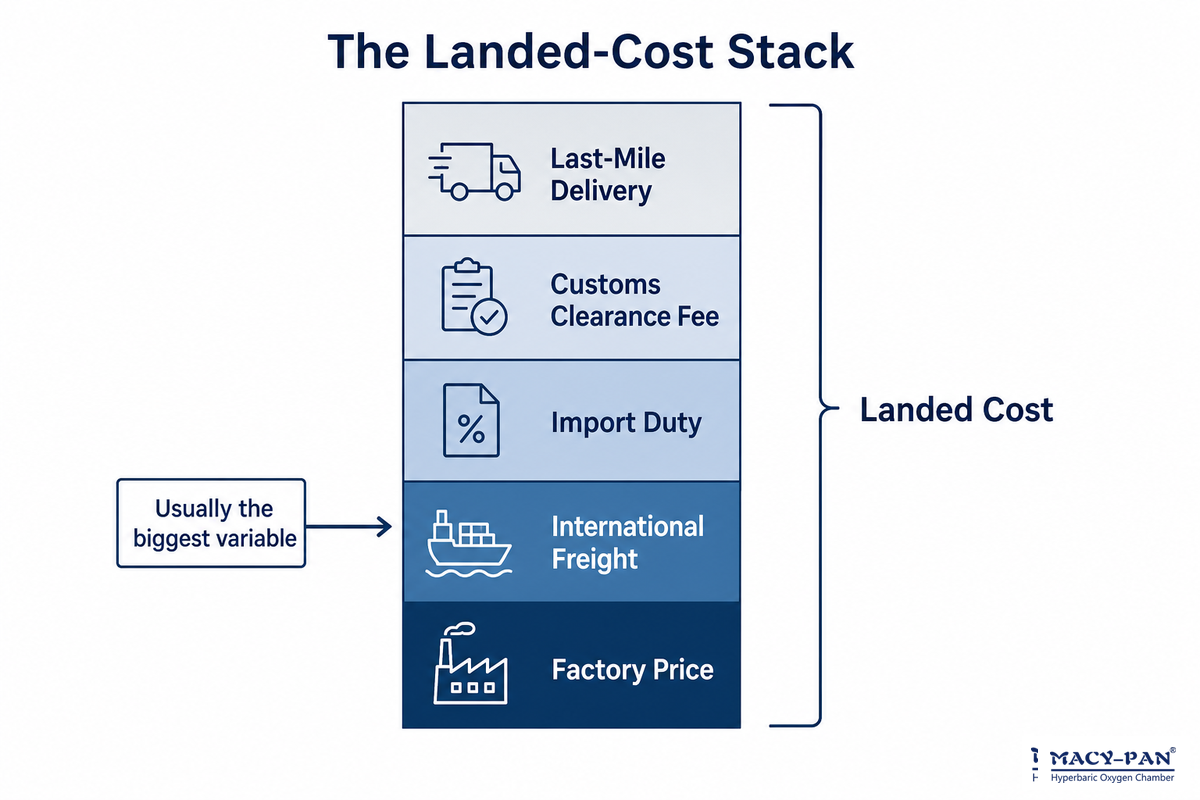
Most people wrongly assume that the duty imposed on importations is the single largest and most opaque expense in getting from a factory’s quote price to what the product actually cost. For several hundred kilograms of hyperbaric chambers, this assumption generally isn’t even close to true. Medical equipment in HS Chapter 90 is often eligible for significantly reduced duty (even free duty, depending on trade agreement between trading partners). This isn’t universally true for all of China, nor for every country. Two factors drive what you actually pay for the shipment more than duty does: which mode of transport you chose (see next section) and if your shipment requires clearance at a second government regulatory checkpoint after the primary customs inspection.
That second point often surprises buyers; a shipment could sail through customs and still be held pending the receiving country’s health or medical-device regulatory authority for clearance and registration details. A related sourcing guide describes the same pattern for medical equipment generally: FDA product classification determines the regulatory review route, and time-sensitive factors such as sterilization windows or cold-chain and cooling-life limits add pressure that generic freight guidance ignores, a hyperbaric chamber doesn’t carry those specific cold-chain constraints, but the underlying lesson still applies: classification drives clearance speed, not paperwork alone.
| Layer | What Drives It | Typical Weight in Total Cost |
|---|---|---|
| Factory price | Chamber type, ATA rating, materials | Baseline |
| International freight | Air vs. ocean, weight, volume | Largest variable — often bigger than duty |
| Import duty | HS classification, trade agreements | Often low/zero for HS Chapter 90 medical items — verify per country |
| Customs clearance fee | Broker fees, inspection risk | Fixed-ish, rises sharply if flagged |
| Last-mile delivery | Distance from port, equipment size | Varies by destination infrastructure |
⚠️ Common Mistake
Compare factory-direct price to landed cost of a US distributor’s order, and you will usually discover that the former is far from cheap after all. After all of the shipping, duty and custom’s clearance fees, as well as local delivery charges, the gap is closed considerably, but still, it’s still there; factory-direct should still work out to be cheaper.
Use MACY-PAN’s export & worldwide shipping program to get an estimate for the country-specific landed cost of your configuration chamber; it will factor in estimated freight costs, exposure to duty, and clearance fees based on the region into which you’ll be shipping.
Air Freight vs. Sea Freight vs. Courier: Choosing How Your Chamber Travels
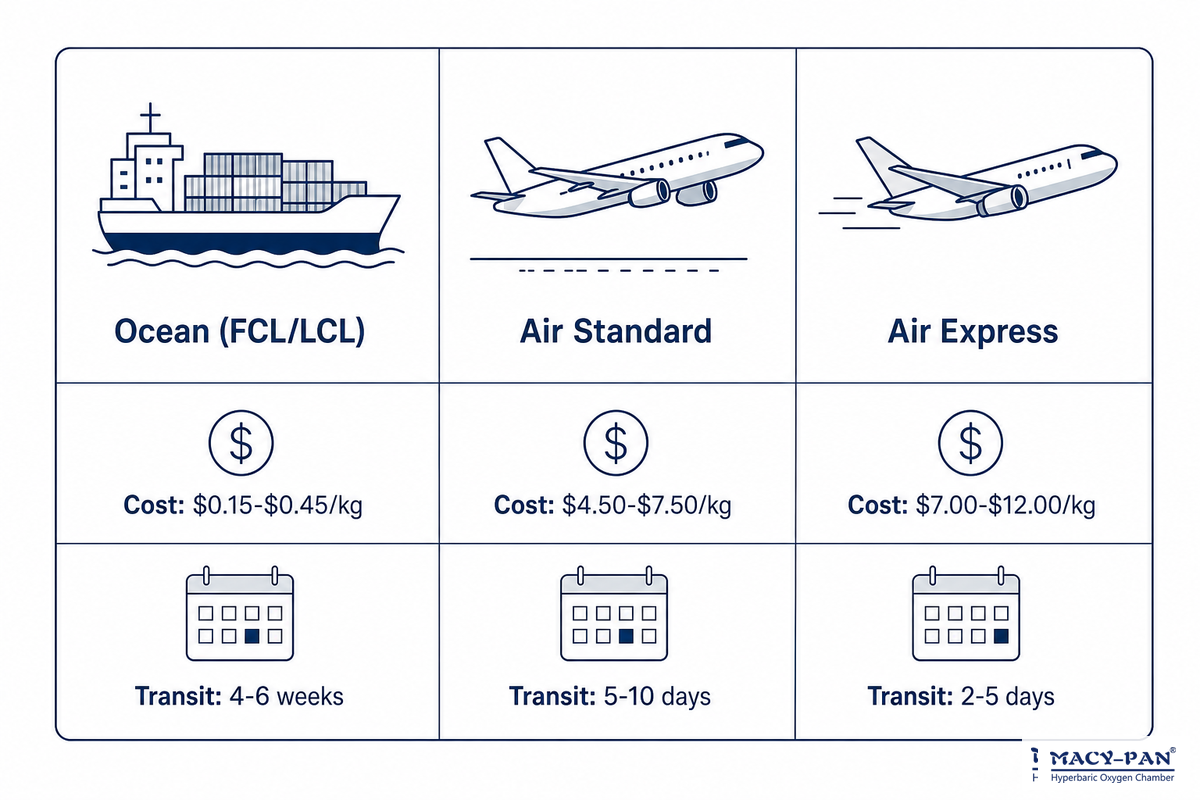
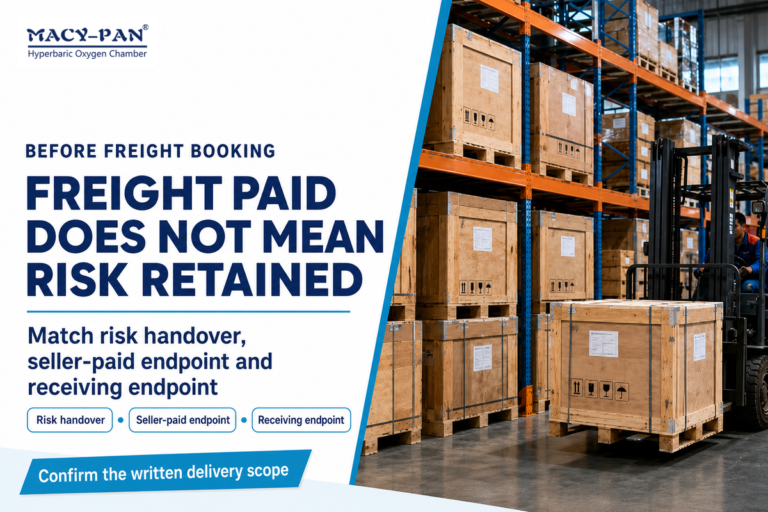
Shipping via ocean will lower shipping cost on multi-hundred kg chambers 80-90% compared to air cargo, assuming heavy, non-perishable goods for both methods (ExFreight). Typical air freight for such goods costs $4.50-$7.50/kg, or $7-$12/kg express; meanwhile, container-based ocean freight equivalent per kg is roughly $0.15-$0.45/kg, based on today’s rates (FreightAmigo), which vary due to fuel surcharge and port congestion. Treat these figures as planning ranges rather than fixed quotes, actual rates shift with carrier capacity and booking timing, so confirm current pricing with your freight forwarder before budgeting a shipment.
| Mode | Typical Cost | Transit Time | Best For |
|---|---|---|---|
| Ocean (FCL/LCL) | ~$0.15-$0.45/kg equivalent | 4-6 weeks port-to-port | Standard clinic/distributor orders, no rush |
| Air (standard) | $4.50-$7.50/kg | 5-10 days | Time-sensitive single-unit orders |
| Air (express) | $7.00-$12.00/kg | 2-5 days | Emergency replacement units |
📐 Engineering Note
Order it along with some compressed-oxygen cylinders, or a chemical-oxygen generator? Then you’ll want to know the shipment’s freight classification: compressed oxygen (49 CFR 172.101 UN1072, Class 2.2) has a passenger-aircraft limit of 75 kg and a cargo-aircraft limit of 150 kg, whereas chemical-oxygen generators (UN3356, Class 5.1) usually are limited to cargo aircraft only (eCFR). Chamber shells themselves aren’t hazmat, but the accessories could be, potentially restricting which carriers will take your shipment.
This is becoming especially relevant for medical-device shipments, which have been pushing in 2026 for priority port handling amid congestion in the face of clinical equipment losses on delays that generic freight doesn’t suffer (FreightWaves). Ocean shipping remains the choice for the typical distributor/clinic on a replacement or growth cycle; air is a cost-justifiable luxury for a replacing chamber. Comparative pressure chamber ratings, chamber shell type, etc. are summarized on MACY-PAN’s chamber classification page.
Packaging and Crating: How a Pressurized Steel Vessel Survives a 30-Day Ocean Voyage
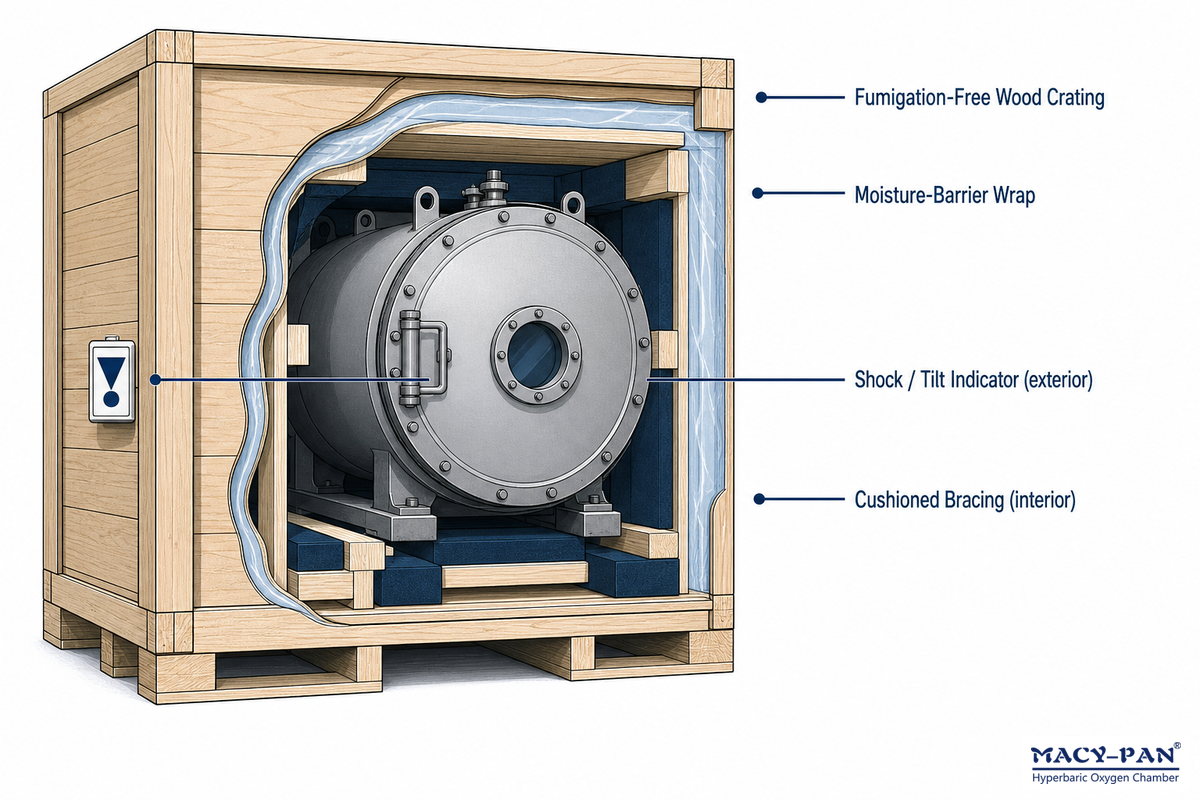
The 4-6 weeks a hyperbaric chamber might spend at sea means humidity, vibration, and a constant re-handling between forklifts, cranes and truck beds. Export-grade equipment crating typically addresses this by adhering to a few basic principles across most manufacturers: Fumigation-free (heat-treated or engineered) wood crating so that it will clear customs without an additional certificate of fumigation. A moisture-barrier wrap that covers all exposed metal and electronics components. And, the presence of shock/tilt indicators on the outside of the crate so you’ll know the moment it arrived damaged, not after it’s been installed.
Crating details such as wall thickness, amount of desiccant, cushioning materials, vary greatly with chamber size and shell type and there isn’t one, single standard published somewhere for export crating hyperbaric chambers the way there’s for the ASME standard that regulates the pressure vessel itself. Always ask your supplier for their crate specification sheet prior to shipment, rather than assuming some universal standard applies. That’s where this becomes a “depends on the exact unit” issue.
💡 Pro Tip — What to Check the Moment the Crate Opens
- Take photographs of the shock/tilt indicators prior to removing them and, if any of them have triggered, document them prior to signing the delivery receipt.
- Ensure the crate’s moisture-barrier wrap extends around electronic and control components specifically, not just the crate walls.
- Match the packing list to the crate contents prior to the carrier leaving. You’ll find it far easier to resolve discrepancies before the truck drive away.
Will It Be Legal to Install? Certification Recognition by Destination Country
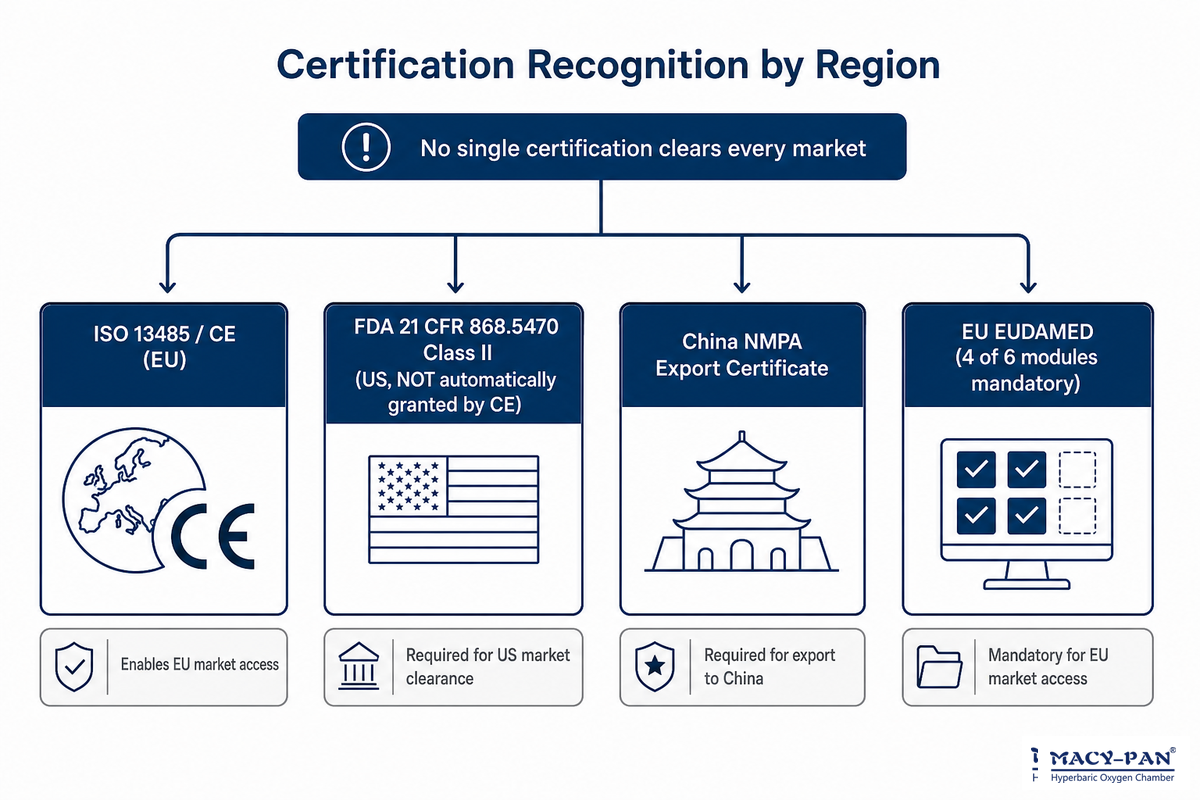
A CE marking or an quality-management-system certification is not an all-access pass. It signals that a manufacturer has implemented a recognized quality-management system and that a product has been assessed as compliant with the requirements of the EU, but its acceptability at the border is always contingent upon the regulatory system of your destination country – and that system is going to be even more complex by 2026.
This applies whether the buyer runs a hospital, a medical and wellness clinic, or a distributor sourcing hyperbaric medicine equipment for resale.
Is It Legal to Own a Hyperbaric Chamber?
Legal status depends on your jurisdiction and chamber type. In the US, hyperbaric chambers are classified under 21 CFR 868.5470 as Class II medical devices, a specific classification rather than a generic “medical device” catchall. Many jurisdictions treat mild, soft chambers under about 1.5 ATA differently from multiplace, clinical-grade, hard-shell units. Given that country and chamber-class variability, check with the destination country’s health or medical-device regulator before ordering.
Three upcoming changes make this even more critical than it was a year ago: FDA Quality Management System Regulation (QMSR) technical amendments, which take effect on February 2, 2026, will formalize certified quality management system within the US regulatory structure. In the EU, four EUDAMED modules are scheduled to go live as of May 28, 2026, with another two still under development; the remaining modules will follow in subsequent years. China’s National Medical Products Administration issued new Administrative Provisions for Medical Device Export Sales Certificates that become effective May 1, 2026.
MACY-PAN’s certified quality management system, ISO 9001, and CE certification (plus an in-process U.S. patent, not FDA clearance). It’s a distinction that matters because the European CE process and the U.S. FDA certification process are distinct pathways; European certification does not automatically imply FDA clearance for your market. U.S. importers should consult with the FDA directly to verify classification and export-certificate requirements before ordering. (MACY-PAN’s certification decoder tool breaks down which certifications apply to specific uses and countries.)
What Happens After It Lands: Installation, Commissioning, and Cross-Border After-Sales
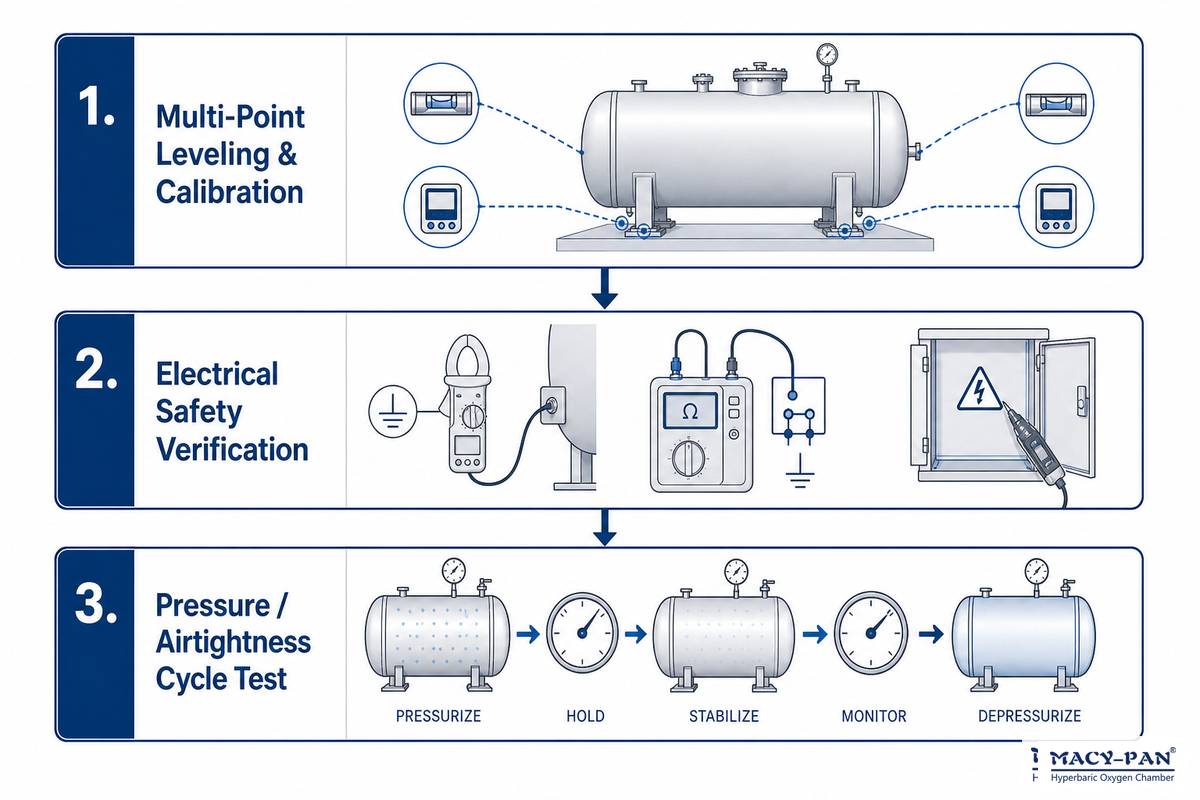
The fear behind the “will you actually support this after I buy it” hesitation isn’t unfounded. What’s one concern most potential cross-border hyperbaric chamber buyers raise? “What if something breaks on it and the factory is on the other side of the world?” It’s a valid question that any serious exporter should be prepared to answer with specifics.
Typical commissioning for a hyperbaric chamber include a multi-point level check and calibration, electrical-safety verification and an airtightness test, just as with an in-country install-though it’s handled remotely or with a local partner coordinated by the exporter. After delivery, your practical questions should include: who’s going to commission the equipment (a technician trained at the factory, the local agent, or the buyer’s own team with support from the exporter?), what are lead times for spare parts for your region, and what hours is tech support available?
“Most installation problems we see after export aren’t chamber defects, they’re commissioning steps skipped because nobody planned for who does the leveling, the electrical check, and the pressure test on the receiving end before the crate ships.”
MACY-PAN engineering team
MACY-PAN details its after-sales service plan on its about us page, where the company also notes its 19 years in export manufacturing and its ISO 13485/9001 quality system.
Real Shipments, Real Routes: What Exporting to 126+ Countries Actually Looks Like
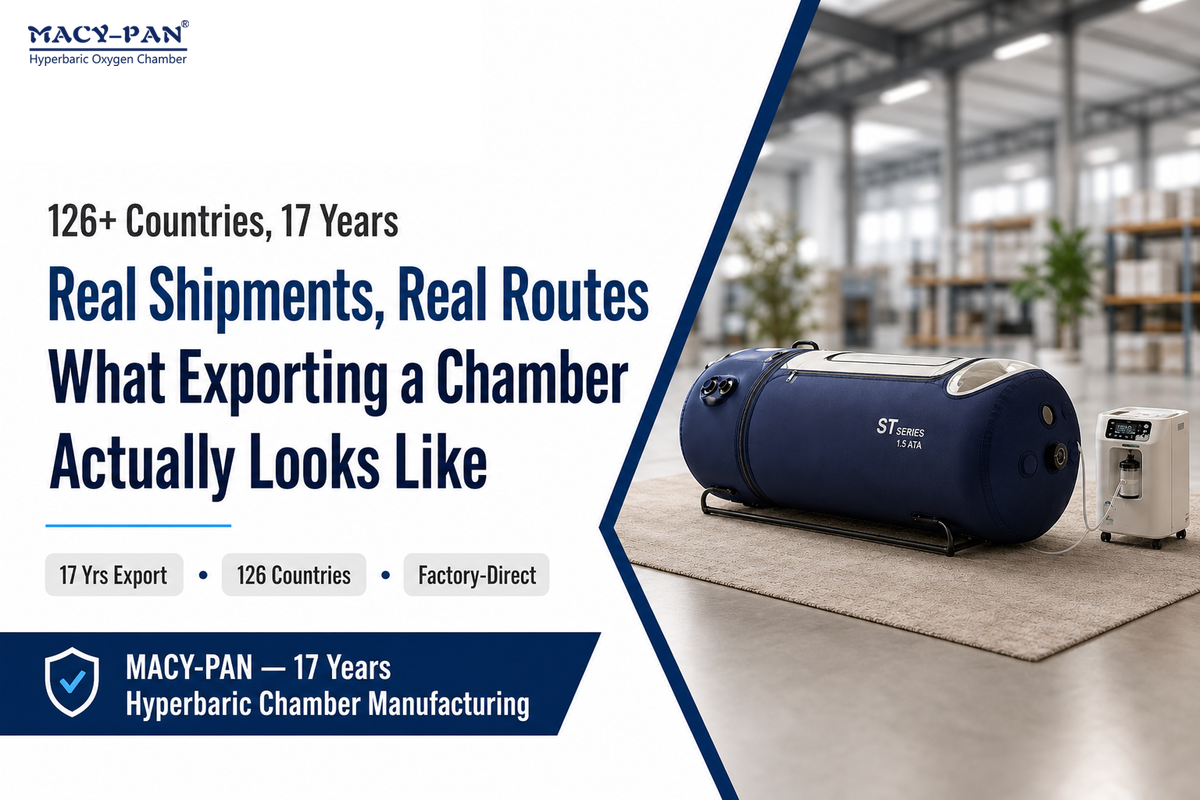
Shipment updates for this class of manufacturer typically name the destination country and sometimes the chamber configuration or distance shipped. One competing manufacturer, for example, publicly documented delivering and commissioning a hyperbaric chamber in Thailand in April 2026 — including onsite multi-point leveling calibration, electrical-safety verification, and a pressure/airtightness cycle test before handover. That level of specificity is exactly what’s worth asking any supplier for, rather than accepting a generic country list as proof of export capability.
The verified, if broad, starting point for MACY-PAN’s claims is its own figures: 126+ countries serviced across 19 years of export operations. Instead of a single manufactured success story, consider MACY-PAN’s export & worldwide shipping page; you can ask the company directly for a shipment reference in your own region, or a comparable one, as a concrete check on export capability before committing to an order.
2026 Outlook: Tightening Export Compliance and What It Means for International Buyers
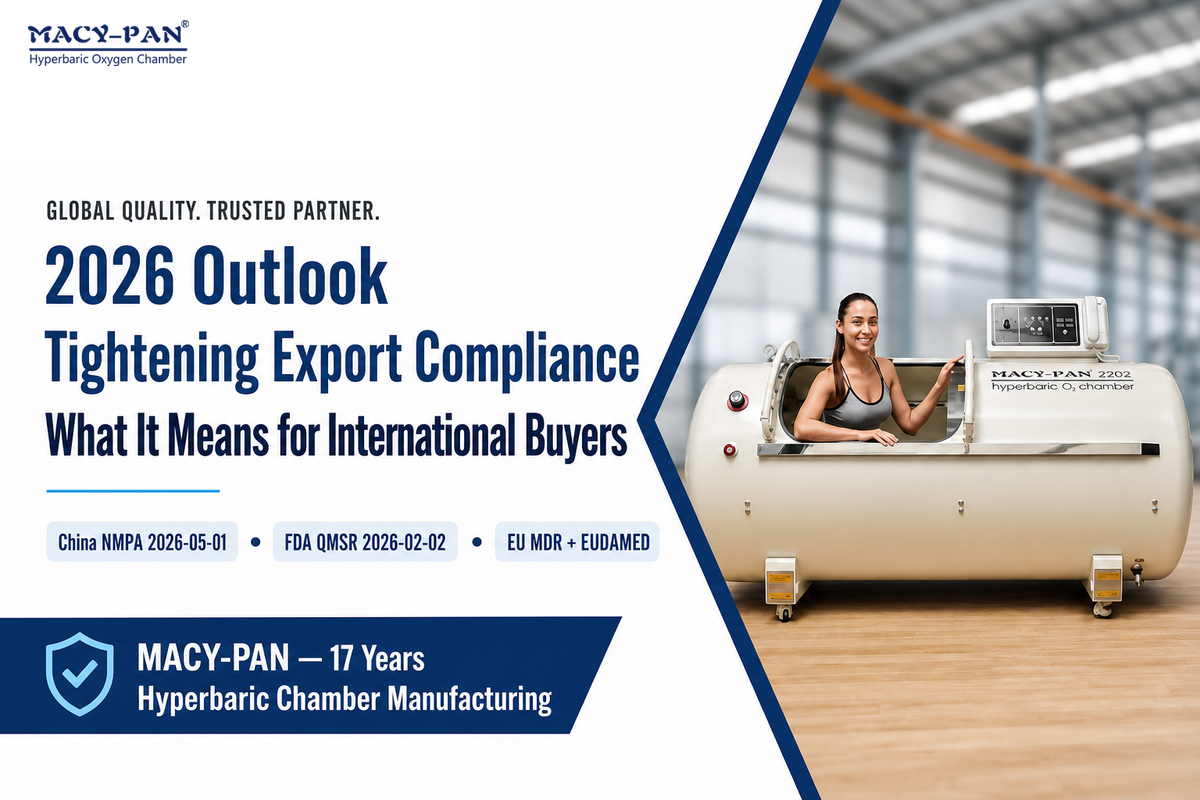
What can international buyers do about this? Keep things simple: always double-check your suppliers’ certificate of compliance is up to date before placing an order rather than only after your shipment gets hung up at the border. Your supplier’s certificate was fine in 2024, but it won’t be enough for your importing country’s customs office or health regulators come 2026.
Specifically, China’s NMPA has swapped its 10-year-old export-certificate regulation for new Administrative Provisions taking effect May 1, 2026. FDA’s QMSR technical amendments – which take effect Feb. 2, 2026 – officially weave certified quality management system into the U.S. quality-system regulations against which exporters are reviewed. In the EU, four of EUDAMED’s modules are mandated starting May 28, 2026 – with other modules still being developed and thus continue to move the EU’s documentation requirements over the rest of 2026.
EU regulators have also introduced a supply-disruption notification mechanism (Regulation 2024/1860) which manufacturers need to incorporate into compliance planning, among many others pieces of the tightening puzzle.
Market-size context: The global market for medical devices is estimated to have been $572.31B in 2025 and will grow toward $1,032.66B in 2034 according to market research (helpful as a data point for total market direction, though not why buyers should act differently this year.) Global medical device trade is also shifting toward emerging markets, where demand for high-quality, highly efficient hyperbaric chamber systems worldwide is rising alongside stricter documentation expectations — exporters with strict quality processes already in place are positioned to capture that demand. The tighter regulations discussed earlier are a more specific warning – they add cost to engaging with a non-compliant supplier, and subtract it from buyers who ensure their vendor’s credentials are in order upfront.
FAQ, Hyperbaric Chamber Export & Worldwide Shipping
Q: What is the HS code for a hyperbaric chamber?
View Answer
Trade-data databases commonly list hyperbaric chambers under HS 90192010, though this isn’t confirmed against every country’s own tariff schedule — treat it as a starting point, not a filed classification. The UK’s tariff service confirms the broader 6-digit heading but assigns ventilator-specific codes rather than a chamber-specific one, proof the digits shift by country. Much of HS Chapter 90 qualifies for reduced duty, though not universally. Confirm both the code and rate with a customs broker first.
Q: Is it legal to own a hyperbaric chamber in my country?
View Answer
Chamber type and jurisdiction both shape the answer. In the US, hyperbaric chambers are a Class II medical device under 21 CFR 868.5470; mild, soft chambers under 1.5 ATA often face different rules than clinical hard-shell units. Check your destination country’s health authority — CE or certified quality management system doesn’t guarantee legal ownership everywhere.
Q: How long does international shipping take for a hyperbaric chamber?
View Answer
Ocean freight, the default for standard orders, typically takes 4-6 weeks port-to-port, on top of production lead time and customs clearance. Air freight cuts transit to 5-10 days standard or 2-5 days express, at a premium usually worth paying only for urgent replacement units. Customs clearance is the least predictable variable — a shipment can clear general customs quickly and still wait days for a separate health-authority review at the dock.
Q: Do I need a customs broker to import a hyperbaric chamber?
View Answer
Not always a legal requirement, but strongly recommended. Medical equipment shipments commonly face a two-checkpoint clearance risk — customs plus a separate health-authority review — and a broker catches documentation gaps before they become a hold at the dock.
Q: What’s included in the landed cost of an imported chamber?
View Answer
Landed cost stacks five layers: factory price, international freight (usually the biggest, most volatile line item), import duty (country-specific), customs clearance fees, and last-mile delivery to your facility. Freight mode — air versus ocean — swings the total more than duty does for a chamber-sized shipment.
Q: Can MACY-PAN ship to my country?
View Answer
MACY-PAN (Shanghai Baobang Medical Equipment Co., Ltd.) has shipped hyperbaric chambers to 126+ countries over 19 years, backed by certified quality management system, ISO 9001, and CE certification. Request a regional shipment reference and a landed-cost quote through the export & worldwide shipping program.
Our Perspective
“We ship worldwide” hardly tells a buyer what actually has to happen — five documents, up to two clearance stops, and a transport-mode decision — before a hyperbaric chamber reaches their hands. We built this guide from our own 19 years exporting to 126+ countries, cross-checked against current FDA, EU, and China regulatory sources rather than generic freight-guide language. Reviewed by the Shanghai Baobang Medical Equipment Co., Ltd. technical team.
References & Sources
- Types of Export Certificates — U.S. Food and Drug Administration
- Exporting Medical Devices, FAQs — U.S. Food and Drug Administration
- 21 CFR 868.5470, Hyperbaric Chamber Classification — Cornell Legal Information Institute
- Commodity 9019.20 — Oxygen Therapy and Respiration Apparatus — UK Integrated Online Tariff, GOV.UK
- 49 CFR 172.101, Hazardous Materials Table — Electronic Code of Federal Regulations
- Medical Devices Quality Management System Regulation, Technical Amendments — U.S. Federal Register
- EUDAMED Overview — European Commission
- US20230201059A1 Patent Application — Google Patents / USPTO
- Medical Device Industry Wants Priority at Crowded Ports — FreightWaves
- FDA’s New Approach to Export Regulation — MD+DI
- FDA Looks to Expedite Importing Medical Devices — MassDevice
Related Articles
- Export & Worldwide Shipping Program — country-specific freight and landed-cost quotes
- Hyperbaric Chamber Manufacturer — full model range, OEM/ODM, and factory-direct pricing
- Hyperbaric Certification Decoder — which certifications apply to which use case and country
![Decision lenses: occupancy, gas path, access, staffing, facility interfaces, and exact-model evidence [article].](https://macypansolutions.com/wp-content/uploads/2026/10/monoplace-vs-multiplace-hyperbaric-chambers-featured-1-768x512.png)