Get in Touch with MACY-PAN Company


A hyperbaric chamber RFQ checklist is a controlled buyer input pack used to define a quote before price comparison. In MACY-PAN’s intake method, the factory receives 24 inputs covering the project, chamber configuration, site, utilities, documentation, delivery, commissioning, support, and commercial terms. You can still request a budgetary estimate with gaps, but the supplier should label every assumption. For a firm offer, attach the completed checklist and require the quotation to identify what is included, excluded, optional, buyer-supplied, or still awaiting confirmation.
Important boundary
The 24-input count is MACY-PAN’s factory-intake method. It measures whether the supplier has enough information to price a defined scope. It is not a regulatory, safety, conformity, clearance, accreditation, or facility-approval checklist.
The distinction matters because hyperbaric equipment sits at several overlapping interfaces. A chamber may connect to building power, medical gas, controls, alarms, ventilation, fire protection, and owner procedures. The factory, installer, design professional, facility operator, and destination authority may each own part of the answer. Your RFQ should assign those interfaces instead of assuming one party covers them all.
“Ensure fire prevention and safety measures are followed.” U.S. Food and Drug Administration, updated August 25, 2025
The FDA communication also points to grounding, staff training, monitoring, cleaning, maintenance intervals, safety checks, compatible materials, and prohibited electrical or static items. These are not reasons to turn an RFQ into an operating manual. They are reasons to ask which party supplies the instructions, training, checks, interfaces, and acceptance evidence for the quoted device.
For a hyperbaric oxygen therapy (HBOT) project, the documentation requirements for hyperbaric facilities should also identify the chamber safety standards being claimed, any breathing air or oxygen purity specification set by the project team, the fire suppression interface, the controls for pressurization and depressurization, any separate decompression requirement, and the risk management records to be delivered. Each item still needs a named owner and model-specific evidence.
The 24-Input RFQ Scope Ledger in One View

Use the following pack as the controlled attachment to your inquiry. Complete each row, write “to be proposed” where you want the factory to recommend an option, and write “unknown” where a local party still needs to decide. Do not leave a blank that can silently become a vendor assumption. This commercial intake complements, but does not replace, the exact model instructions and the FDA’s published safety measures.
24-Input Quote Pack — copy these fields into the RFQ attachment:
| # | Buyer input | What to send | Quotation uncertainty removed |
|---|---|---|---|
| 1 | Setting and intended use | Home wellness, clinic, hospital, sports, veterinary, distributor, research, or another stated setting; describe the intended role without inventing a treatment claim. | Product family and market pathway |
| 2 | Working pressure and oxygen method | Requested operating range in ATA or gauge pressure, plus oxygen delivery method to be proposed or supplied. | Pressure platform and gas configuration |
| 3 | Throughput and occupancy | People per session, planned sessions per day, and expected operating days. | Monoplace, multiplace, size, and duty assumptions |
| 4 | Patient and operator access profile | Entry needs, mobility constraints, attendant needs, transfer approach, and operator position. | Door, seating, access, and communication options |
| 5 | Chamber class and type | Soft or rigid shell, horizontal or seated, single- or multi-occupant, and any buyer-mandated class. | Basic construction and quote family |
| 6 | Rated pressure and control range | Required rating, normal set points, indication units, and who controls pressurization. | Controls, gauges, valves, and test basis |
| 7 | Physical envelope and interfaces | Maximum assembled dimensions, preferred orientation, service clearance, ports, pass-throughs, and floor-load information requested. | Model footprint and interface layout |
| 8 | Included safety and communication systems | Intercom, monitoring view, alarms, emergency release, grounding provisions, and any buyer-required controls. | Base scope versus options |
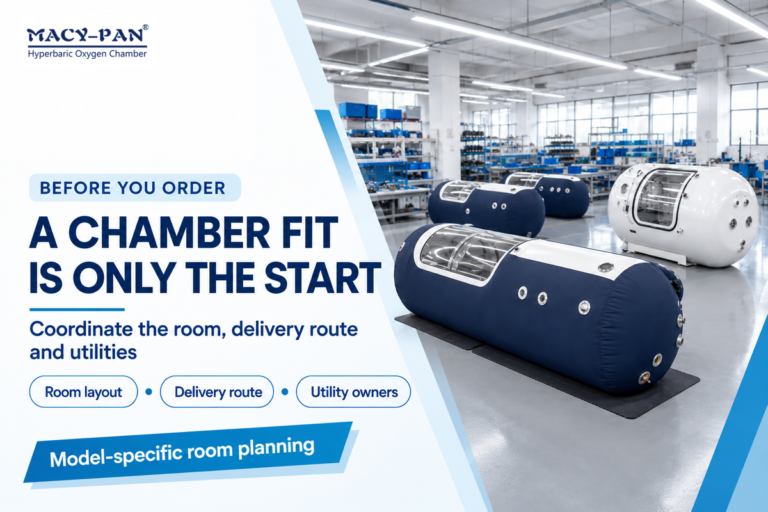
| 9 | Room and delivery route | Dimensioned room plan, doorways, corridors, turns, stairs, elevator, dock, final position, floor loading, and photographs with scale. | Pack size, rigging, assembly, and access risk |
| 10 | Electrical service | Voltage, phase, frequency, available circuit, outlet or hardwire requirement, grounding system, and backup-power expectations. | Electrical build and site work |
| 11 | Gas and air services | Source, pressure, quality, capacity, connection point, storage or concentrator plan, and ownership of regulators and piping. | Compressor, concentrator, manifold, piping, and connection scope |
| 12 | HVAC and environmental conditions | Room temperature, humidity, ventilation, heat rejection, altitude, dust, corrosive exposure, and local environmental limits. | Cooling, ventilation, material, and derating assumptions |
| 13 | Destination regulatory pathway | Country, intended market role, legal importer, device or wellness classification expected, and local authority or notified-body questions. | Which evidence can be offered for the exact market and use |
| 14 | Pressure-vessel basis | Requested code or standard, edition, jurisdictional adoption, design conditions, stamping or marking requirement, and exact vessel/piping boundary. | Applicable construction and inspection package |
| 15 | Fire and life-safety package | Locally adopted code edition, authority having jurisdiction, facility class, required interfaces, alarms, suppression, egress, materials, and owner procedures. | Factory deliverables versus facility work |
| 16 | Technical file | Exact model data sheet, drawings, instructions for use, test reports, declarations, certificates, serial traceability, manuals, and language needs. | Document availability and model match |
| 17 | Delivery basis and packaging | Incoterm with named place, shipment mode, target date, package limits, export packing, insurance, customs, taxes, and unloading owner. | Landed-scope comparison |
| 18 | Installation scope | Rigging, movement to room, assembly, anchoring, utility connection, piping, permits, inspection support, and site cleanup. | Labor, travel, tools, and owner prerequisites |
| 19 | Commissioning and acceptance criteria | Factory and site tests, witness points, calibration records, punch-list rules, acceptance sign-off, and documents required before handover. | When delivery becomes accepted performance |
| 20 | Operator training and governance | Audience, language, format, duration, competency record, refresher need, and who owns local clinical or operating protocols. | Training deliverable without shifting local governance |
| 21 | Warranty | Start date, duration, covered parts and labor, exclusions, travel, freight, consumables, response process, and remedy. | Real warranty value |
| 22 | After-sales service | Remote and onsite support, response target, service geography, preventive-maintenance plan, spare-parts list, lead time, and escalation route. | Lifecycle support and downtime exposure |
| 23 | Price and payment structure | Currency, taxes, payment milestones, quote validity, option pricing, recurring items, bank fees, and price-adjustment conditions. | Commercial comparability and cash timing |
| 24 | Model-specific verification schedule | List each claim to verify, the document or test that proves it, responsible reviewer, due date, and hold point before shipment. | Stops brochure-level claims from becoming order assumptions |
Four fields deserve to come first in your email: destination country, intended setting, pressure target, and room/delivery-route drawing. They determine which product family can even be discussed. The rest turn a possible match into a quote your engineering, compliance, operations, and finance teams can evaluate during a factory quotation and manufacturer review.
How to format measurable inputs
The figures below are fictional formatting examples, not MACY-PAN specifications, safety limits, selection values, or site-acceptance criteria. Replace every number with project data confirmed by the responsible party.
| Category | Example field A | Example field B |
|---|---|---|
| Assembled envelope | Length: 2100 mm | Width: 900 mm |
| Packed envelope | Length: 2200 mm | Width: 1000 mm |
| Shipping mass | Net: 300 kg | Packed: 450 kg |
| Room access | Door clear width: 950 mm | Door clear height: 2100 mm |
| Travel route | Corridor: 1200 mm | Turning space: 1500 mm |
| Elevator access | Door: 1000 mm | Rated load: 1000 kg |
| Electrical service | Supply: 230 V, 50 Hz | Circuit: 16 A, 3 kW |
| Room environment | Temperature: 20 °C | Relative humidity: 60% |
| Service planning | Remote response: 24 hr | Onsite response: 48 hr |
| Commercial timing | Quote validity: 30 days | Warranty example: 12 months |
Other project-only fields might be written as 6 bar, 90 psi, 120 V, or 60 Hz. These are also fictional format examples and should be used only when the responsible engineer confirms the actual project values.
Inputs 1–4: Define the Project and Use Case

Start with the setting and intended use because the same chamber description can sit in very different commercial and regulatory contexts. A home-wellness buyer, a hospital, a veterinary facility, a distributor, and a research group do not need the same documents, access arrangement, training, service plan, or market pathway. Do not ask a supplier to invent your medical protocol. State the setting, buyer role, and intended function, then ask which quoted models are offered for that context.
For the United States, intended function is not a cosmetic label: 21 CFR 868.5470 identifies a hyperbaric chamber by its intended medical function and classifies that device type as Class II. This does not mean every product branded “hyperbaric” has the same status. Ask for the exact model, legal manufacturer, intended use, and the applicable model-specific listing, clearance, declaration, or test evidence for the destination market.
Pressure and occupancy come next. Record the requested range and units, but let the quotation state the rated pressure, control method, indication reference, and available options. Add sessions per day, people per session, transfer needs, and operator position. A compact chamber quoted for occasional single-person use cannot be compared with a multi-occupant system expected to run a long daily schedule.
Pressure notation also needs a stated reference. ASME’s public PVHO-1 scope uses a differential-pressure threshold above 2 psi. For conversion context at standard atmosphere, 1 ATA is about 101.3 kPa absolute or 14.7 psi absolute, while 2 psi differential is about 13.8 kPa differential. A 0 psi gauge reading corresponds to about 1 ATA absolute under that same assumption. For another unit check, 1 bar equals 100 kPa. These conversions are not model ratings or operating recommendations. A supplier’s product page may use ATA, kPa, bar, or psi without stating the same pressure reference used in another document. Do not infer a model rating from a family-level range. The quotation must bind each value to the exact model, pressure reference, rated conditions, and source document.
Inputs 5–8: Lock the Chamber Configuration

A product name is not a configuration. Require the offer to state the exact model identifier, shell type, orientation, occupancy, rated pressure, control range, dimensions, packaged dimensions, mass, access arrangement, included accessories, and all selected options. If the supplier recommends an alternative, require a separate line so the substitute does not overwrite your base request.
Safety and communication systems need the same discipline. “Includes intercom and alarms” is too broad for approval. Request the model, function, location, power source, interface drawing, test record, and whether each item is standard, optional, or supplied by others. Apply that rule to grounding provisions, pressure indication, emergency release, monitoring view, communications, and alarm interfaces. The FDA safety communication specifically highlights grounding, monitoring, maintenance, training, and compatible materials, so each quoted claim needs a named item and evidence.
1. Name the function
Describe what the buyer needs the feature to do.
2. Name the item
Require the exact component or system in the offered configuration.
3. Name the evidence
Tie the claim to a drawing, manual, test, declaration, or certificate.
4. Name the boundary
Mark whether factory, installer, facility, or buyer owns the interface.
Inputs 9–12: Measure the Site and Utilities

The delivery route can reject an otherwise suitable model. Measure the dock, outside access, every doorway, corridor width, ceiling restriction, corner, stair, elevator door, elevator car, floor loading, and final service clearance. Provide a dimensioned plan and photographs with a scale reference. Ask the factory to compare both packaged and assembled dimensions against that route and to flag any unverified turn or lifting point.
Site needs extend beyond room length and width. Massachusetts’ public IP24 hyperbaric-suite checklist, for example, calls for manufacturer technical specifications in plan review and addresses chamber/support-equipment space, oxygen service, room arrangement, utilities, and inspections. It is one jurisdictional example, not a universal design code, but it shows why the factory’s equipment drawing and the facility design cannot be developed in isolation.
For electrical service, state voltage, phase, frequency, circuit availability, grounding, connection style, and backup-power expectations. For gas and air, identify the source, capacity, connection, ownership of regulators and piping, and any quality requirements set by the project team. For HVAC, supply temperature, humidity, ventilation, heat-rejection assumptions, altitude, dust, and corrosive exposure. A supplier can then price its equipment boundary and clearly list the building work it has not priced.
Inputs 13–16: Name the Exact Documentation and Market Pathway

This section only defines the evidence fields a buyer should put in the RFQ. Full conformity, registration, clearance, code, and facility-acceptance reviews belong in separate model- and jurisdiction-specific work.
Ask for evidence in four layers: the manufacturer’s quality system, the quoted model, the destination facility, and the transaction. Keeping the layers separate prevents a valid document in one layer from being used to answer a different question.
| Evidence layer | Examples to request | What it does not prove by itself |
|---|---|---|
| Company / quality system | Legal manufacturer identity, certificate scope, issuing body, validity dates | Approval or clearance of every chamber model |
| Quoted model | Model data sheet, drawing, instructions, test reports, declaration, listing or clearance record where applicable | Approval of the installation site or operating program |
| Facility / local authority | Adopted code edition, plan-review criteria, permits, inspection and accreditation requirements | What the factory includes in its commercial offer |
| Transaction | Final configuration, serial traceability, included documents, acceptance records, warranty and signed deviations | Compliance outside the stated model, market, use, or project scope |
ISO 13485:2016 is titled “Medical devices — Quality management systems — Requirements for regulatory purposes.” That is valuable organizational evidence, but the ISO page does not present it as approval of a particular chamber. In your RFQ, record the certificate holder, scope, issuer, dates, and relationship to the legal manufacturer. Then request separate model-level evidence.
ASME PVHO-1-2023 publicly describes requirements for design, fabrication, inspection, testing, marking, and stamping of pressure vessels for human occupancy and names hyperbaric chambers in its scope. It also covers PVHO piping systems. Ask which vessel and piping boundaries the supplier claims, which edition applies, which records will be delivered, and whether the destination authority adopts or requires that basis.
Do not confuse FDA recognition with the facility’s adopted code
FDA recognized-consensus-standard records allow declarations of conformity to the superseded NFPA 99:2021 and ASME PVHO-1-2019 records through December 26, 2026. Record 1-181 identifies ASME PVHO-1-2023 as the replacement for the 2019 record. These dates describe the medical-device premarket transition; they do not declare a facility code “out of date” for every other purpose.
Those recognition dates do not mandate the edition enforced at a facility. For example, CMS currently identifies the 2012 editions of the Life Safety Code and Health Care Facilities Code for covered Medicare and Medicaid provider types. A destination authority may use another adopted edition. Ask two separate questions: “Which evidence supports this model’s market submission?” and “Which edition governs this facility?”
CMS currently identifies the 2012 editions of NFPA 101 and NFPA 99 for covered provider facility compliance. A state, local authority, contract, or accreditation program may impose different requirements. The buyer should therefore record the exact title, edition, purpose, and authority for each requirement rather than asking a factory to choose one universal “current code.”
Inputs 17–20: Fix Delivery, Installation, Commissioning, and Training

The terms of delivery should specify the Incoterm and place; that, however, is only step one. Identify who pays freight, insurance, customs, duties, taxes, unloading, rigging, movement to the final room, assembly, anchoring, connection, permits, inspection support, and cleanup. Ask for packaged dimensions and weights before approving a route or crane plan.
Commissioning should end in an agreed acceptance record. List factory tests, site tests, calibration documents, witness points, utility prerequisites, punch-list handling, and the person authorized to sign acceptance. If performance depends on owner-supplied gas, power, ventilation, network, or building controls, name the input and acceptance limit rather than letting it remain an oral assumption.
Training must identify audience, language, delivery mode, duration, materials, and competency record. The supplier can train users on its equipment and instructions. The facility still owns local staffing, emergency response, clinical governance, and authority requirements. The FDA’s safety communication underscores training and monitoring. Where responsibilities overlap, create an interface row rather than forcing the issue into “factory” or “facility.”
Inputs 21–24: Fix Service and Commercial Terms

A warranty length without scope is not comparable. Define when coverage starts, what parts and labor are covered, what travel or freight is excluded, how consumables are treated, which maintenance records are required, and what remedy applies. Then request remote and onsite response targets, service geography, spare-part lead times, a recommended starter set, preventive-maintenance responsibilities, and an escalation route.
Lifecycle evidence may involve a different standard from construction. ASME’s public PVHO-2 page identifies a 2025 post-construction edition for operation and maintenance of PVHO systems built to PVHO-1, including in-service topics for acrylic windows. Ask which maintenance instructions, inspection records, replacement criteria, and service documents apply to the exact quoted system. Don’t infer them from a PVHO-1 statement alone.
Finally, require a model-specific verification schedule. Every material claim should have a proof item, reviewer, due date, and hold point. Examples include a drawing match before deposit, the document package before shipment, serial and packing verification before dispatch, and site acceptance before final payment. This turns “we have that certificate” into a checkable transaction.
Use the Quote Normalization Board

Do not compare totals until both offers use the same scope categories. Copy each supplier’s response into the matrix, preserve deviations, and calculate a normalized total only after the missing boundaries have prices or explicit owner allowances.
| Scope line | Included | Excluded | Optional | Buyer-supplied | Vendor assumption |
|---|---|---|---|---|---|
| Exact chamber configuration | Model and base accessories | List omissions | Price each option | Owner equipment | Pressure, duty, occupancy |
| Documents and verification | Named deliverables | Unavailable records | Witness or extra test | Local approvals | Market and edition |
| Delivery and site movement | Named place and tasks | Customs, unloading, rigging | Insurance or special packing | Dock, crane, route | Access and schedule |
| Installation and commissioning | Labor, travel, tests | Building connections | Extra site days | Utilities, permits, trades | Readiness date |
| Training and lifecycle support | Audience and service level | Travel, labor, consumables | Spares or extended service | Local protocols and staffing | Language and location |
| Commercial terms | Currency and payment plan | Taxes and bank fees | Alternates | Local costs | Validity and timing |
For each line, ask the supplier to cite the quotation page, drawing, or document that controls the answer. A blank cell is not “included.” It is unresolved. If the commissioning was offered by one vendor and not by another, place an owner’s allowance prior to comparing the totals. Regulatory rows should identify the exact model evidence and purpose; the FDA’s consensus-standards guidance explains why a declaration of conformity belongs to a defined submission context, not to a vague brand-level claim.
Apply the RFQ Completeness Score

Give 1 point for each input that contains an applicable answer, a controlled “to be proposed” instruction, or an explicit “unknown” assigned to an owner for confirmation by the stated date. Do not award a point for an input with a blank response, a vague “standard” response, or an unattached verbal note.
24 / 24
Quote-ready input pack. The factory can still raise model or jurisdiction questions.
20–23
Conditional quote. Require the supplier to list assumptions for every missing input.
Below 20
Clarification required. Treat pricing as an early budget signal, not a comparable firm offer.
This score tells you whether the input pack is complete. It does not tell you whether a chamber is safe, approved, cleared, compliant, suitable for a patient, accepted by an authority, or correctly installed. Those decisions need the applicable evidence and qualified reviewers. For example, 21 CFR 868.5470 defines and classifies the U.S. medical device type; an internally assigned RFQ score cannot substitute for that regulatory framework.
What the Factory Can Estimate and What It Cannot

A factory can propose a product family, flag dimensional conflicts, state utility needs, itemize its equipment and services, provide available documents, and price options against written assumptions. It cannot determine a medical protocol, issue a local permit, select the enforced facility-code edition in every jurisdiction, act as the authority having jurisdiction, or guarantee acceptance outside the quoted model and scope. The Massachusetts IP24 checklist shows facility-level plan review and inspection questions beyond a generic factory quotation.
The practical response is not to push every decision back to one party. Create an interface register. For all open items log the factory deliverable, facility deliverable, installer deliverable, design-professional decision required, authority decision required, due date, and proof. The overlap at piping, electrical, ventilation, alarms, fire protection, commissioning, and maintenance then becomes visible before the purchase order.
The buying rule
Compare scope before price, model evidence before brand claims, and locally adopted requirements before the newest edition number. A complete RFQ makes gaps visible; it does not erase them.
Frequently Asked Questions
Can I request a hyperbaric chamber quote without all 24 inputs?
Yes, but require written assumptions.
You can request a budgetary estimate before every field is known. Mark each gap “unknown” or “to be proposed,” give an owner and due date, and require the factory to list the assumption it used. Don’t compare that estimate with a firm offer as if both have the same scope. A quote below 24 points can still help early planning, but its uncertainty should stay visible through every revision. Ask the supplier to identify which missing inputs could change the model, accessories, shipping method, installation scope, schedule, price, or evidence package. Before a purchase order, close each material gap or turn it into a signed deviation with a responsible owner.
How should ISO 13485 be recorded in the RFQ?
Record it as quality-system evidence about the manufacturer, not as approval of the quoted chamber. Capture the certificate holder, the certified scope, the issuing body, and the validity dates, then ask separately for model-level evidence covering the exact model, legal manufacturer, intended use, and destination market.
The official ISO title describes quality-management-system requirements for medical devices. Ask whose quality system is certified, the scope, issuer, and dates. Then request separate evidence for the exact quoted model, legal manufacturer, intended use, destination market, and any applicable declaration, listing, clearance, test, or pressure-vessel record. One valid company document does not automatically answer every product-level question.
How should NFPA 99 and ASME PVHO-1 editions be recorded in the RFQ?
Ask for the supplier’s claimed edition and the locally governing edition, because FDA recognition and facility enforcement answer different questions and may follow different transition dates.
The newest published or FDA-recognized edition may not be the edition enforced at the destination facility. FDA transition records concern declarations of conformity in premarket submissions, while CMS currently identifies 2012 editions for covered provider facility compliance. State, local, contractual, or accreditation requirements may differ. Record the edition, its purpose, the authority that requires it, and any transition date.
What should a hyperbaric chamber quotation include?
Require a controlled response that names the exact model, scope, evidence, delivery basis, installation responsibilities, warranty, payment terms, exclusions, deviations, buyer-supplied items, and revision status.
Name the exact model and options, documents, delivery basis, installation scope, warranty, payment terms, exclusions, deviations, and buyer-supplied items. Add a revision number and clarification log.
How do I start an RFQ with MACY-PAN?
Send the 24-input pack and room route drawing.
Start with the destination, intended setting, pressure target, occupancy, room route, utilities, required documents, and target date. MACY-PAN can flag gaps and state its quotation assumptions. Browse the chamber solutions hub, then review the chamber selection guide, pricing guide, and clinic regulatory-readiness page before submitting the final pack.
Ready to request a scope-controlled quote?

Send your completed 24-input pack, room drawing, destination market, and target schedule. Ask MACY-PAN for a model-specific quotation that identifies open assumptions and clearly lists included, excluded, optional, and buyer-supplied items. Request one revision that records any scope changes made during clarification.
References & Sources
- U.S. Food and Drug Administration — Follow Instructions for Safe Use of Hyperbaric Oxygen Therapy Devices
- Electronic Code of Federal Regulations — 21 CFR 868.5470, Hyperbaric chamber
- International Organization for Standardization — ISO 13485:2016
- ASME — PVHO-1-2023 public scope
- ASME — PVHO-2-2025 public scope
- National Fire Protection Association — NFPA 99, 2024 edition
- FDA recognized consensus standard record 1-153 — NFPA 99 transition
- FDA recognized consensus standard record 1-181 — ASME PVHO-1 transition
- FDA — Appropriate Use of Voluntary Consensus Standards in Premarket Submissions
- Centers for Medicare & Medicaid Services — Life Safety Code and Health Care Facilities Code Requirements
- Massachusetts Department of Public Health — IP24 Hyperbaric Suite checklist
- Undersea and Hyperbaric Medical Society — Hyperbaric Facility Accreditation Program
Prepared by the MACY-PAN product content team. Public-source statements were checked on September 2, 2026. Buyers must confirm model-specific evidence and destination requirements with the responsible authorities and qualified professionals.
![Decision lenses: occupancy, gas path, access, staffing, facility interfaces, and exact-model evidence [article].](https://macypansolutions.com/wp-content/uploads/2026/10/monoplace-vs-multiplace-hyperbaric-chambers-featured-1-768x512.png)