Get in Touch with MACY-PAN Company

Updated July 2026 · Reviewed by the MACY-PAN technical team.
Hyperbaric chamber cost is the all-in price to buy or use a pressurized oxygen chamber, and the honest answer is a range, not a number: a personal soft-shell unit starts near $4,000, while a 2.0 ATA multiplace clinic system can pass $129,000. That 30-fold spread isn’t arbitrary. It tracks four things a price tag hides, shell type, pressure rating, capacity, and certification. This guide breaks the market into a simple price ladder, explains what actually drives each figure, and shows where paying per session at a clinic beats buying your own.
Quick Specs: Hyperbaric Chamber Pricing (2026, US)
| Soft-shell home (1.3–1.5 ATA) | $4,000 – $20,000 |
| Hard-shell home / entry-clinical (1.5–2.0 ATA) | $20,000 – $60,000 |
| Clinical monoplace (2.0–3.0 ATA) | $90,000 – $200,000 |
| Multiplace clinic / hospital | $100,000 – $4,000,000 |
| Clinic session (per visit) | $150 – $600 |
Hyperbaric Chamber Cost at a Glance: The 4-Tier Price Ladder (2026)
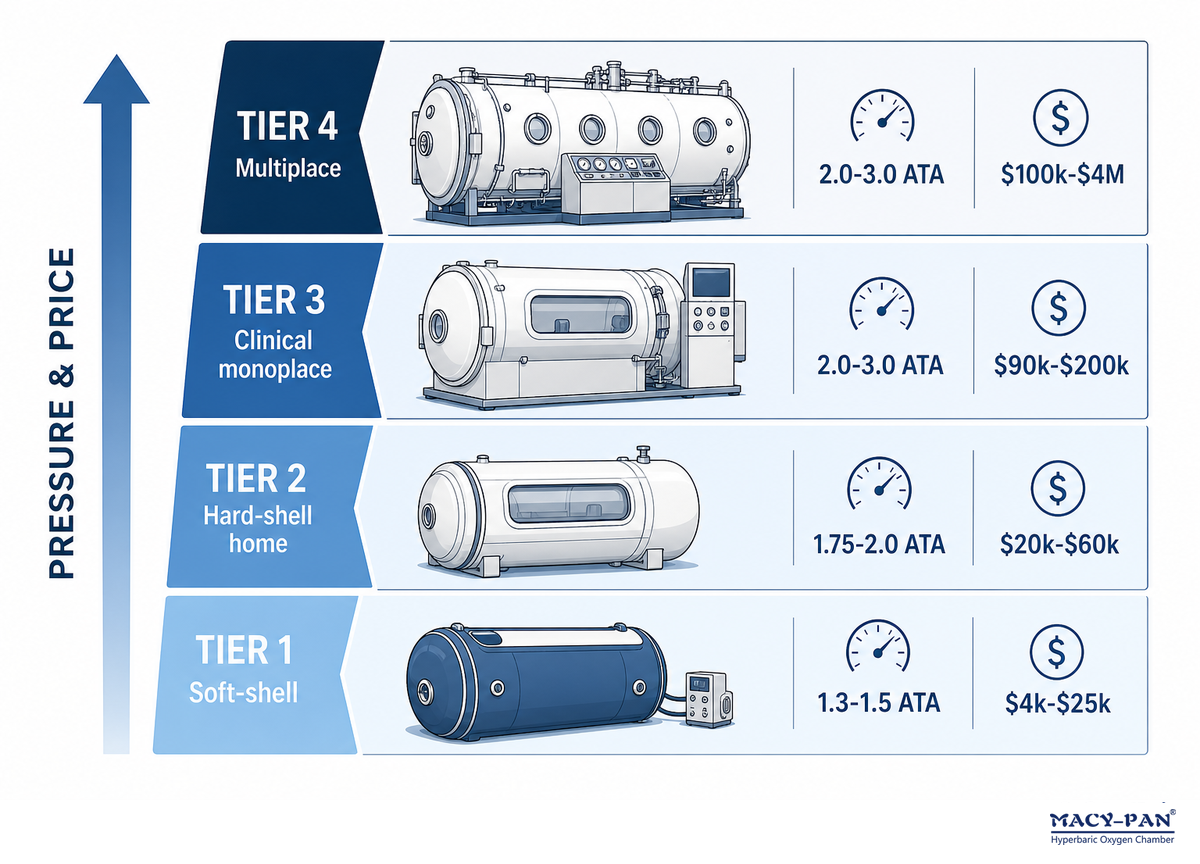
Hyperbaric chamber prices run anywhere from about $4,000 to $129,000 for the units most buyers actually consider, depending on shell type and pressure, measured in atmospheres absolute, or ATA. Sorting the market into four tiers makes the number make sense, each tier answers a different job, from home recovery to hospital-grade therapy, and each carries a different treatment role.
$4,000+
Entry soft-shell home
30×
Spread, soft home to multiplace
$150–600
Per clinic session
| Tier | Configuration | Pressure | Price band | Best fit |
|---|---|---|---|---|
| 1 · Soft | Portable soft-shell | 1.3 ATA | $4,000–$8,000 | Travel, athletic recovery |
| 1 · Soft | Sitting soft-shell | 1.3–1.5 ATA | $8,000–$15,000 | Home wellness, sleep |
| 1 · Soft | Lying / wide soft-shell | 1.5 ATA | $10,000–$20,000 | Daily home recovery |
| 1 · Soft | Soft multiplace (2-person) | 1.5 ATA | $15,000–$25,000 | Couples, small studios |
| 2 · Hard home | Entry hard-shell | 1.75 ATA | $20,000–$40,000 | Serious home users |
| 2 · Hard home | Full-pressure hard-shell | 2.0 ATA | $40,000–$60,000 | Home + small practice |
| 3 · Clinical | Clinical monoplace | 2.0–2.4 ATA | $90,000–$150,000 | Clinics, single patient |
| 3 · Clinical | High-pressure monoplace | 3.0 ATA | $150,000–$200,000 | Advanced wound care |
| 4 · Multiplace | Walk-in multiplace | 2.0 ATA | $100,000–$250,000 | High-volume centers |
| 4 · Multiplace | Hospital multiplace | 2.0–3.0 ATA | $250,000–$4,000,000 | Hospitals |
Price bands reflect 2026 US market ranges across multiple vendors; specific quotes vary by configuration and freight.
Where does the head-turning multiplace figure come from? Those are engineered rooms, several occupants, full life-support, fire suppression, closer to a construction project than an appliance. For everyone shopping for one person, the first two tiers are the real decision. Compare the soft and hard options side by side on our soft-shell chambers and hard-shell medical chambers pages, or step up to monoplace and multiplace chambers for clinic volume.
What Drives the Price? The 5-Factor Price Stack
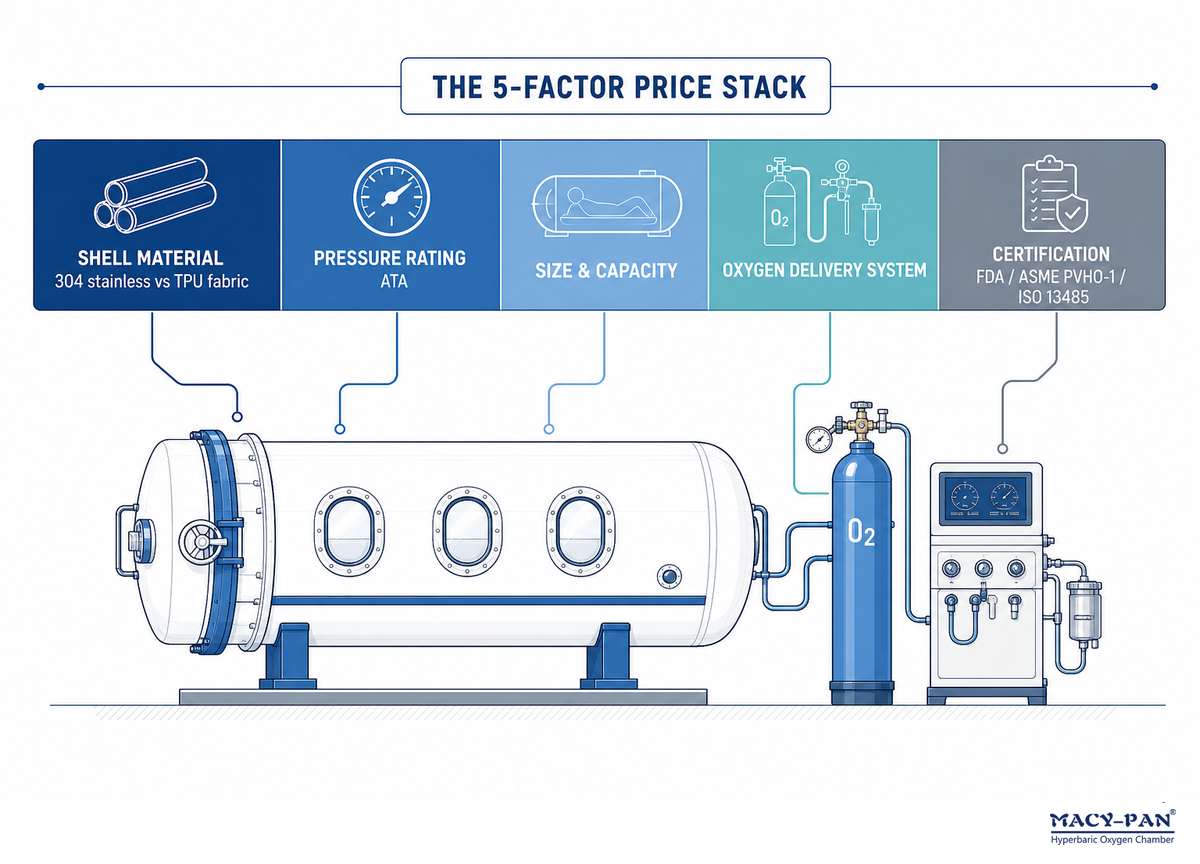
Five variables explain almost every dollar of difference between a $7,000 chamber and a $120,000 one: shell material, pressure rating, size and capacity, the oxygen delivery system, and certification. Read a quote against this stack and you can predict where the number should land, and spot padding.
- Shell material is the biggest swing, a zipper-sealed urethane/TPU soft shell costs a fraction of a welded 304 stainless-steel pressure vessel. Rigid steel built to ASME PVHO-1 is the single biggest line item on a hard chamber.
- Chamber pressure rating compounds fast: each step up, 1.3, 1.5, 1.75, 2.0 ATA, demands stronger walls, tighter seals, and certified valves. Higher pressure is where engineering and safety testing costs climb fastest.
- Size and capacity multiply everything, one single-occupant monoplace is manageable, while a multi-patient walk-in multiplace multiplies the cost of life support, monitoring, and fire safety.
- Oxygen delivery system. Every working chamber needs a 10–15 LPM oxygen concentrator, an air compressor rated for the pressure, controls, and an intercom. These are often quoted separately, a favorite way to make a chamber look cheaper than the delivered system.
- Certification. FDA 510(k) clearance, ASME PVHO-1 fabrication, ISO 13485, and CE all cost money to earn and maintain, and they separate a medical device from a wellness gadget.
📐 Engineering Note
Oxygen becomes bacteriostatic at roughly 1.5 ATA, which is why serious soft chambers target that pressure rather than 1.3 ATA. Below it, a soft chamber sits closer to oxygen-enriched room air than to therapy. Clinical work at 2.0 ATA with 100% oxygen only happens safely inside a rigid, PVHO-1 hard shell, a physical reason the two shell types are priced worlds apart.
Notice that two of these five factors, controls and certification, are engineering, not raw steel. Pressure regulation, sensing, and ventilation are patented territory (see US patents US8251057B2 and US7360539B2), which is part of why the hard-shell premium is real rather than a markup.
Soft-Shell vs Hard-Shell: Price vs Performance
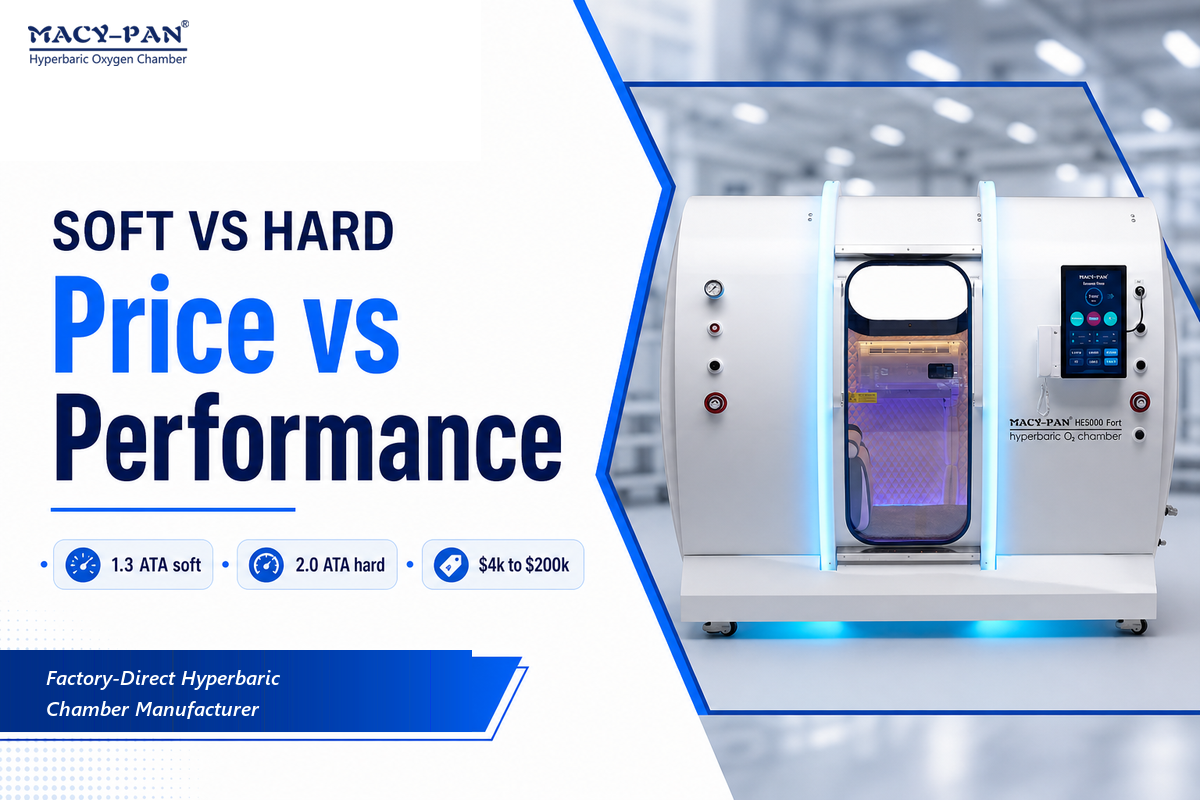
Soft-shell savings look obvious until you price the outcome, not the box. Put the hard shell vs soft shell question in dollar-per-result terms and the gap narrows fast. Framed as a soft shell vs hard shell hyperbaric chamber decision, the cheaper unit is not a discount on the same therapy but a different product entirely. A 1.3 ATA soft chamber and a 2.0 ATA hard chamber are two different products for two different buyers, and the gap between them is a clinical-dose gap, not just a build-quality one.
| Dimension | Soft-shell (mild) | Hard-shell (clinical) |
|---|---|---|
| Typical price | $4,000–$20,000 | $40,000–$200,000 |
| Pressure | 1.3–1.5 ATA | 1.75–3.0 ATA |
| Oxygen environment | ~24% via concentrator | 100% at pressure |
| Arterial O₂ (approx.) | ~230 mmHg at 1.3 ATA | ~1,824 mmHg at 2.4 ATA |
| Regulatory standing | Wellness; portable soft chambers are commonly FDA-cleared for acute mountain sickness (Rx) | Class II medical device for on-label conditions |
| Not suitable for | Treating FDA on-label medical conditions | Plug-and-play home budgets |
Arterial oxygen figures are illustrative of the pressure, oxygen relationship, not a treatment claim.
The 1.3 ATA controversy worth knowing before you pay
Here’s the counterintuitive part. For years, a 1.3 ATA mild hyperbaric setup was considered to add little therapeutic value, low enough that researchers used it as the sham “placebo” pressure in blinded trials.
“Using a lower pressure than the hyperbaric oxygen group while breathing 21% oxygen best matches the inertness of the placebo.”
Lansdorp et al., Double-blind trials in hyperbaric medicine (2018)
In a 2026 review, Sci similarly notes that pressures of 1.2–1.49 ATA are marketed as “mild” or “wellness” pressurization and aren’t indicated for the recognized medical conditions. None of this makes soft chambers useless, many home users value them for recovery and sleep, but the cheaper price buys a different job, so spend for the outcome you actually want.
Home Hyperbaric Chamber Cost (and the Used-Chamber Trap)
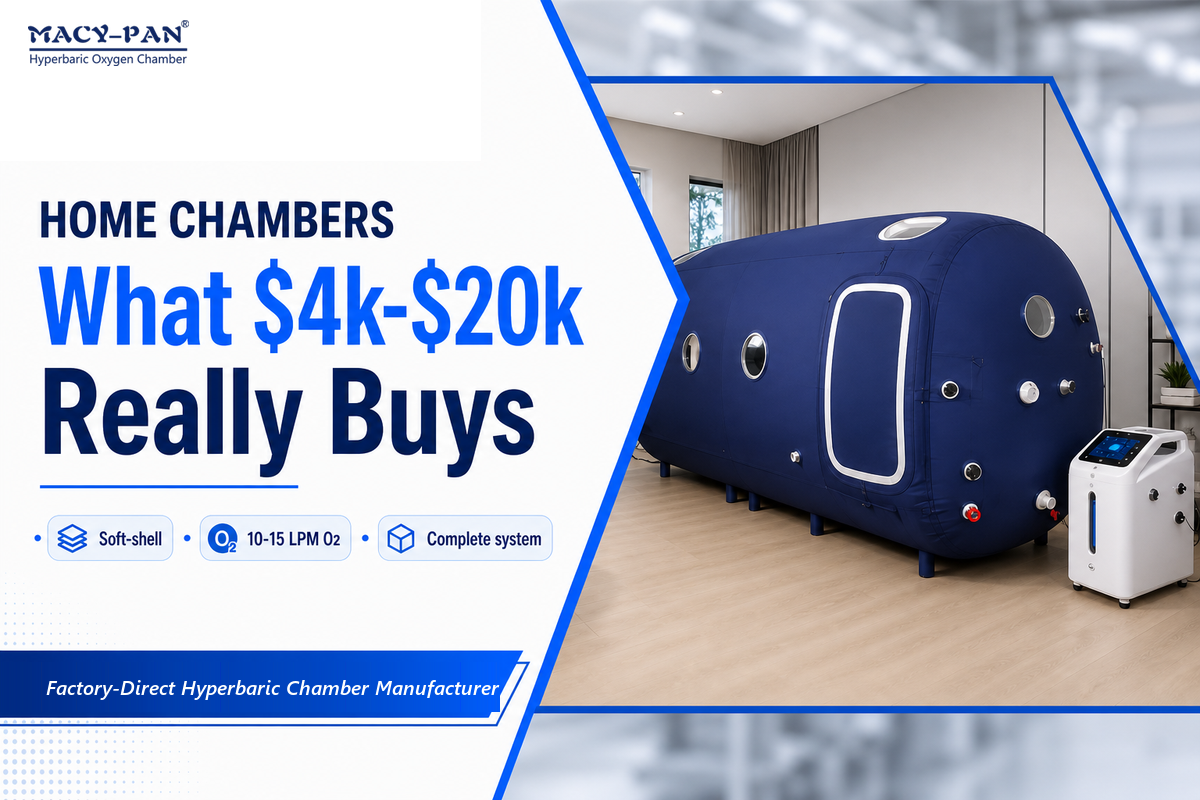
Home hyperbaric chamber cost lands mostly in the $4,000–$20,000 soft-shell band, with a newer wave of home-appropriate hard-shell units running $40,000–$105,000. Whatever the tier, budget for the complete system, not the shell alone: a functioning setup includes the chamber, a 10–15 LPM oxygen concentrator, and a compressor and accessories such as controls and an intercom. Shoppers hunting the best hyperbaric chamber for home use often anchor on the sticker hyperbaric oxygen chamber price they see online, which rarely includes the concentrator or freight, so a $9,000 listing can land closer to $12,000 delivered.
Two buying notes save real money. First, a prescription is required to buy a chamber for home use in the US, so factor a physician visit into the timeline. Second, be wary of “used hyperbaric chamber for sale” listings that look 40–60% cheaper. A pressure vessel that has drifted out of certification, lost its parts pipeline, or carries no transferable warranty can cost more to bring back to spec than the discount saved. Lapsed warranty and certification are the two costs that bite hardest, and hard-shell recertification isn’t a home-garage job. If you’re weighing a portable option, our portable hyperbaric chambers and home hyperbaric chambers pages list what a complete system includes.
Clinic Cost Per Session vs Buying Your Own
Paying per session makes sense until you use a chamber often enough that ownership wins. The clinic vs buying your own question turns on how often you go: clinic HBOT sessions run about $150–$600 each depending on facility and pressure, and most protocols call for 20–40 sessions, so the hyperbaric oxygen therapy cost for a single course of off-label therapy can reach $10,000–$12,000 out of pocket.
How much is one hour in a hyperbaric chamber?
Expect roughly $100–$300 per hour at a wellness center using a soft chamber, and $150–$600 for a clinical hard-shell session at higher pressure. Package deals lower the per-session figure: one biohacker forum thread cited ten 90-minute sessions for $1,770, about $177 each.
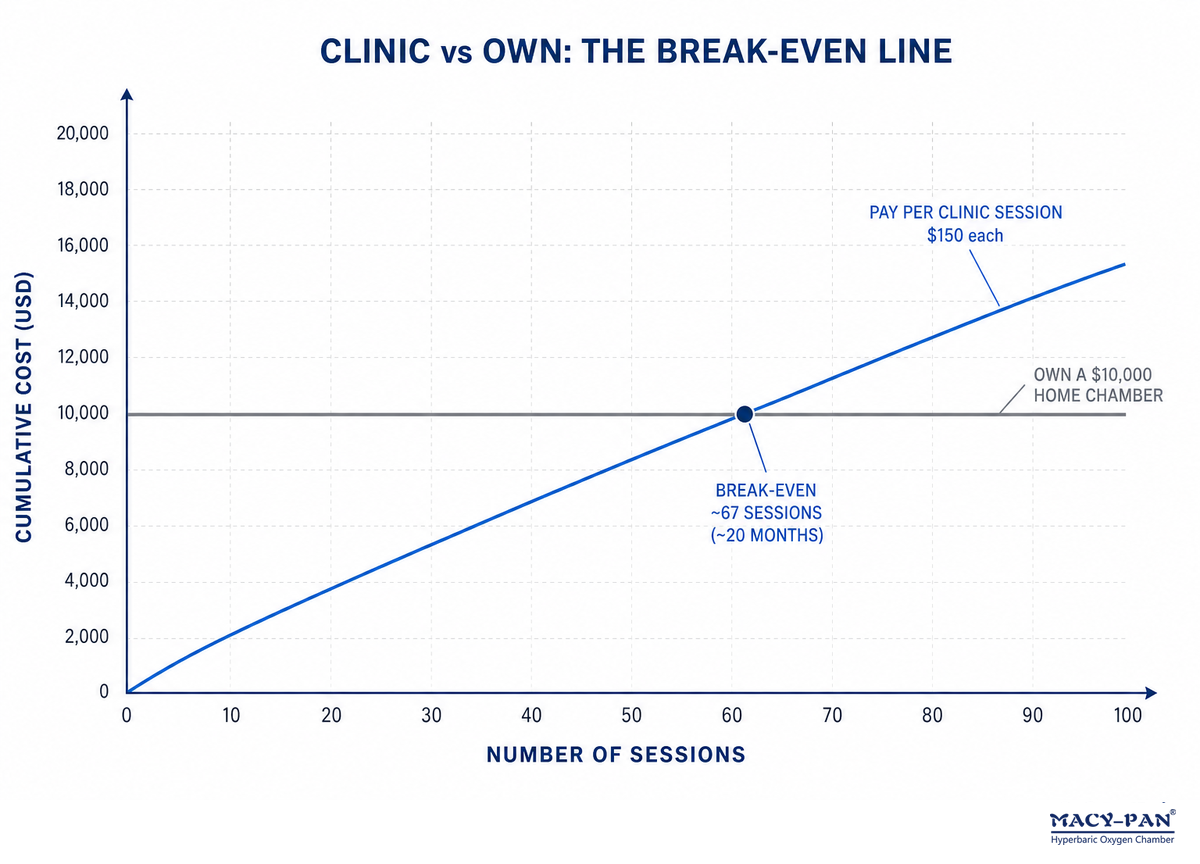
The Clinic-vs-Own Break-Even Line (worked example)
Say a home soft-shell chamber costs $10,000 and a comparable mild session at a wellness center costs $150.
Break-even sessions = $10,000 ÷ $150 ≈ 67 sessions.
At a realistic 40 sessions per year, ownership pays for itself in about 20 months, squarely inside the 12–24 month range owners typically report. Beyond that point, each session is effectively free, and you also save the travel and scheduling. Run your own numbers with the home vs clinic break-even calculator.
As a rule of thumb, occasional therapy favors the clinic while regular, ongoing use favors owning, frequency, not sticker price, is the deciding variable.
Total Cost of Ownership: The 3-Layer Cost Stack
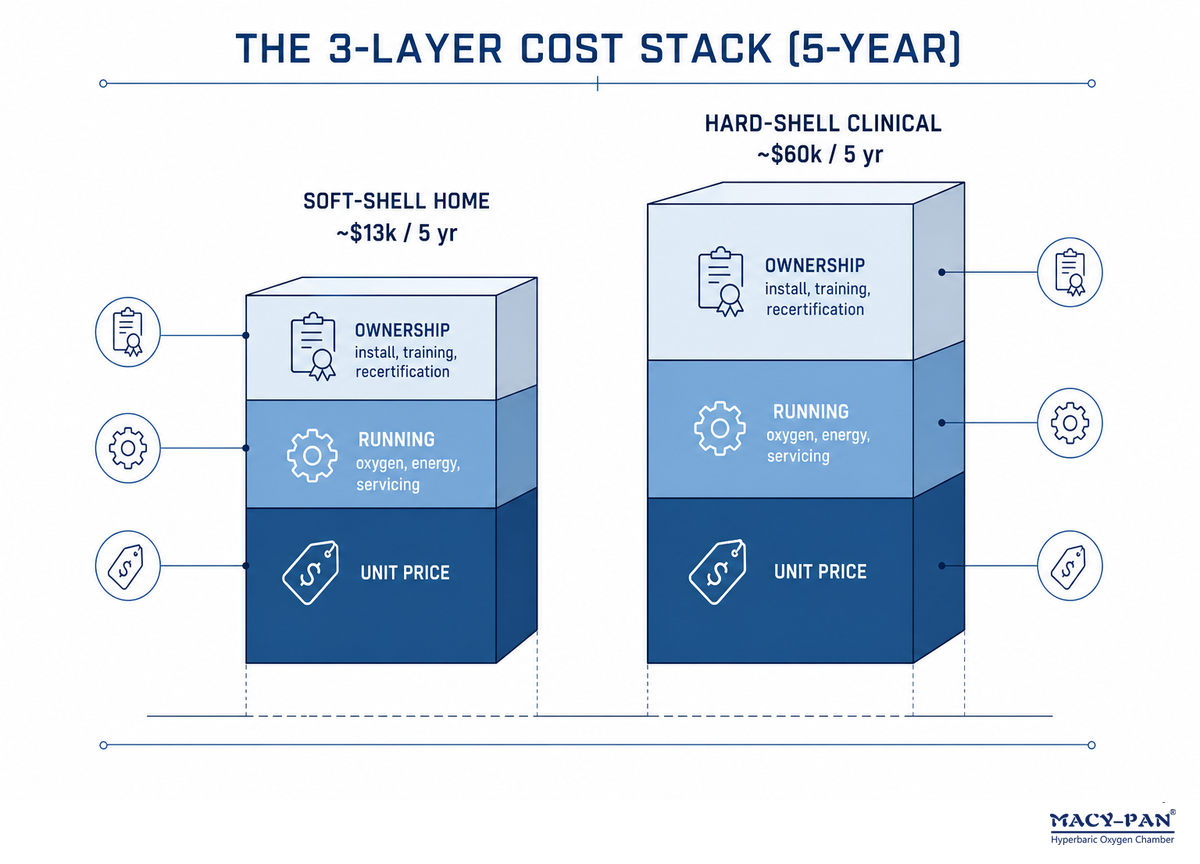
Purchase price is only the first of three layers. The 3-Layer Cost Stack, unit, running, and ownership, is where a “cheap” chamber can quietly become expensive, and where a well-specced one earns its keep.
5-year total cost of ownership (illustrative):
| Cost item | Soft-shell home | Hard-shell clinical |
|---|---|---|
| Purchase price | $10,000 | $45,000 |
| Install & commissioning | ~$0 (plug-in) | $2,000–$10,000 |
| Energy (5-yr) | ~$500 | ~$2,500 |
| Maintenance & spares (5-yr) | ~$1,500 | $5,000–$10,000 |
| Oxygen & consumables (5-yr) | ~$1,000 | ~$2,000 |
Payback example: a $10,000 soft-shell with ~$3,000 of five-year running cost totals ~$13,000, or ~$2,600/year. Against $150 wellness sessions, that is the cost of about 17 sessions a year — so anyone doing more than roughly one session every three weeks comes out ahead by owning.
Running costs tell the real story: the cost of oxygen and servicing is where the two shells diverge. Hard-shell chambers carry the heavier running load: certified-technician servicing once or twice a year runs $1,000–$2,000, and a clinical installation may need 800–1,200 sq ft of code-compliant space under NFPA 99 and ASME pressure-vessel standards. The mistake buyers make is judging on purchase price alone: a clinic that spent $45,000 on a hard-shell and skipped the $8,000 five-year service budget can find the chamber idle and out of certification the week a technician visit finally comes due. Clinical setups add costs the sticker price never shows, operator training, fire-safety and accreditation, local permitting, and, in the 11 states that mandate ASME PVHO-1, inspection to that standard. Those costs are predictable, as long as you ask for them up front.
Does Insurance or Medicare Cover It?
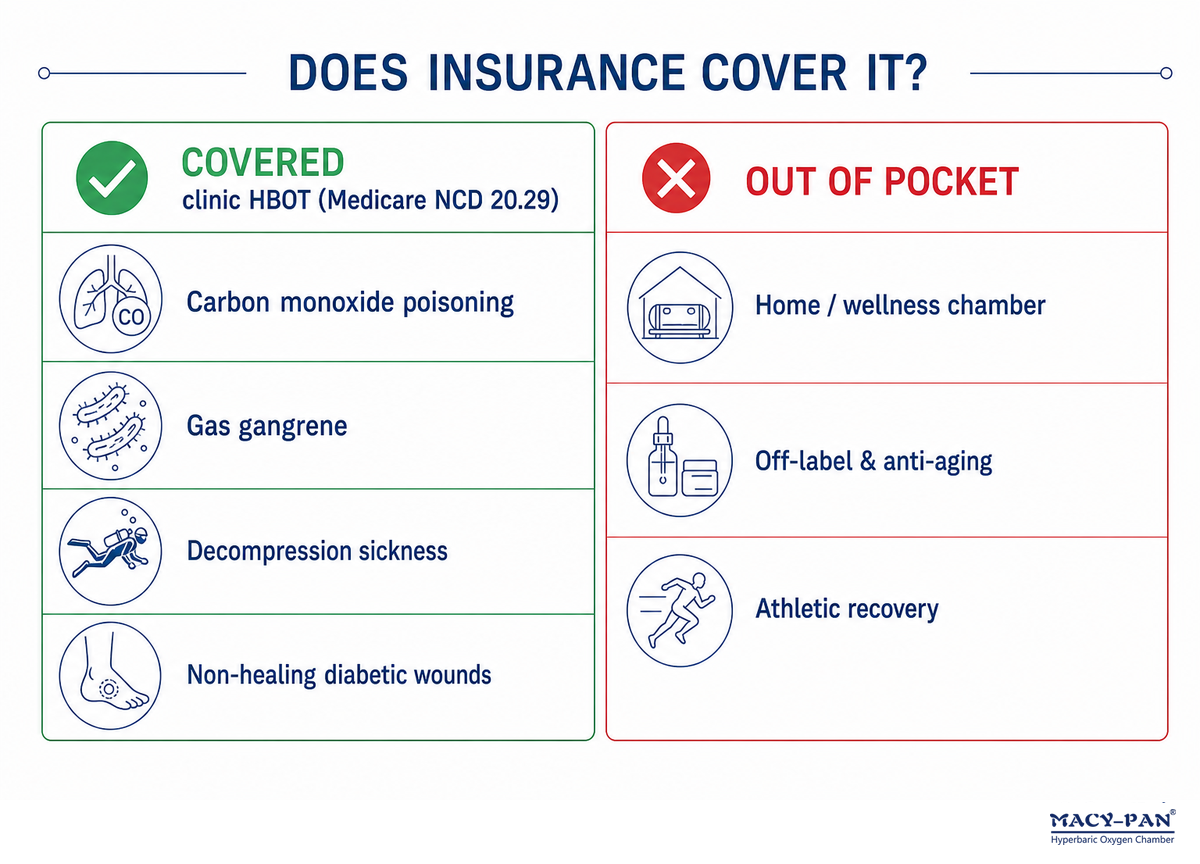
Insurance covers the therapy in a clinic for approved conditions, not the chamber in your living room. Medicare reimbursement follows the diagnosis, not the hardware: under Medicare NCD 20.29, HBOT is reimbursed as adjunctive therapy only when it is delivered in a qualifying facility, often a UHMS-accredited hyperbaric program.
Covered conditions include carbon monoxide poisoning, gas gangrene, decompression sickness, crush injuries, and diabetic wounds where standard wound healing has stalled after 30 days of care, among others. Coverage rests on the diagnosis, not on owning a chamber.
Will insurance pay for a hyperbaric chamber?
For a home or wellness chamber, almost never. Off-label uses, general wellness, athletic recovery, anti-aging, are paid out of pocket, and buying a personal unit is treated as a consumer purchase rather than a covered device. Most home buyers use cash or financing, which is why the break-even math above matters so much. The FDA’s consumer guidance is worth reading before you commit.
Factory-Direct vs Distributor: The Markup Multiplier
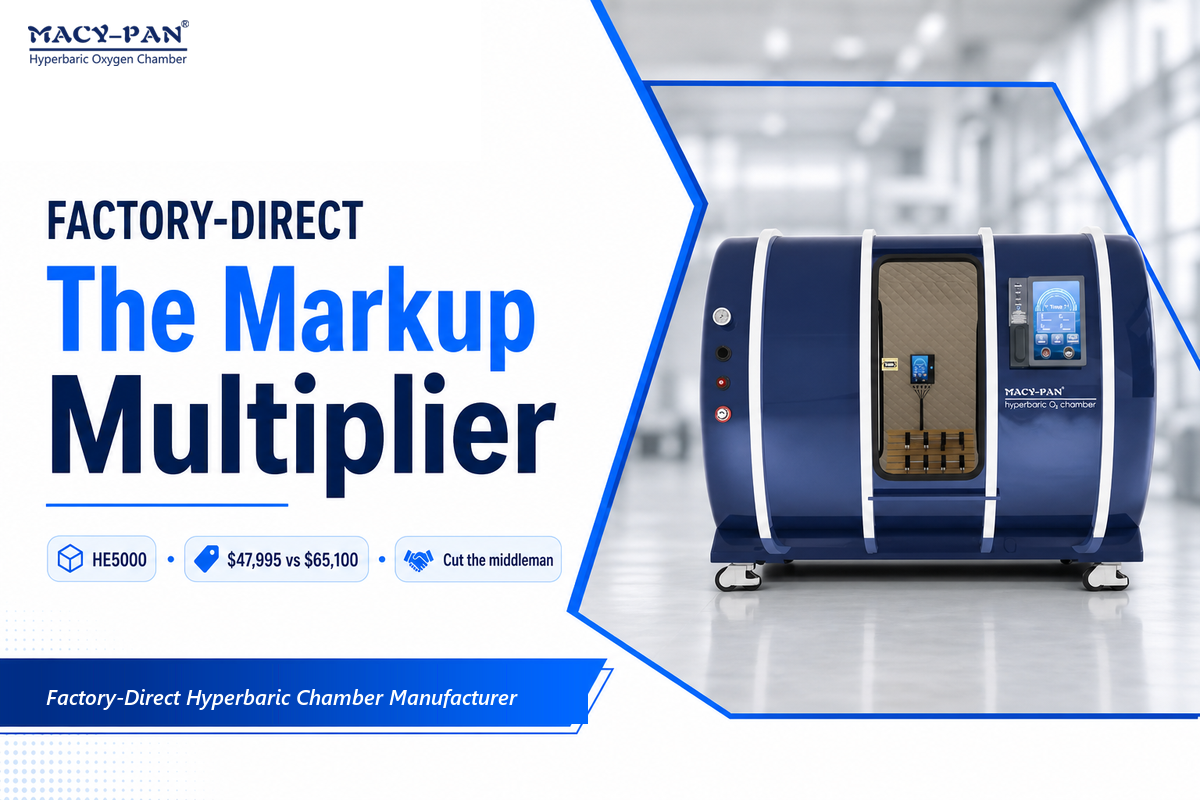
Two identical chambers can carry very different prices for one reason: how many hands they pass through. Many US listings are factory hardware that a reseller rebrands and marks up. As a manufacturer, we’ve watched the same MACY-PAN HE5000 appear on a reseller’s site at $65,100 against a roughly $47,995 retail reference for the same unit, the Factory-Direct Markup Multiplier in plain numbers. That premium usually pays for a sales layer and a warehouse, not stronger steel or a higher ATA rating. When you compare quotes, compare landed cost, freight and customs included, and ask who controls parts and warranty after the sale. You can see the direct pricing model on our factory-direct hyperbaric chambers page, or explore volume terms through the OEM / wholesale program.
Is a Hyperbaric Chamber Worth the Cost? A Buyer’s Checklist
Worth it depends on frequency, goal, and honesty about which shell type your goal requires. If you will use a chamber several times a week for recovery or wellness, ownership usually beats clinic fees within two years. If you need therapy for an FDA on-label condition, you need a 2.0 ATA medical grade hard-shell chamber cleared as an FDA Class II device and physician supervision, a soft shell will not do the job at any price. Picture a home user doing three recovery sessions a week: at a $150 wellness clinic that is $1,800 a year, so a $10,000 soft-shell pays for itself well inside two years, while a weekend athlete who trains six weeks a year is better served paying per visit. Before you pay a deposit, copy the checklist below into your quote request.
RFQ checklist — copy these into your quote request:
| Parameter | Recommended range | Why it matters | How to verify |
|---|---|---|---|
| Working pressure | 1.3–1.5 ATA soft; 2.0 ATA hard | Determines wellness vs medical use | Spec sheet + FDA clearance |
| Shell & standard | 304 SS to ASME PVHO-1 (hard) | Safety + resale value | PVHO-1 nameplate / certificate |
| Oxygen system | 10–15 LPM concentrator included | Avoids hidden add-on cost | Itemized quote |
| Delivered price | Landed, not ex-works | Freight/customs can add thousands | Written landed quote |
| Warranty & parts | Factory-backed, transferable | Who fixes it when it breaks | Warranty document |
Outlook: Why Home HBOT Prices Are Bifurcating in 2026
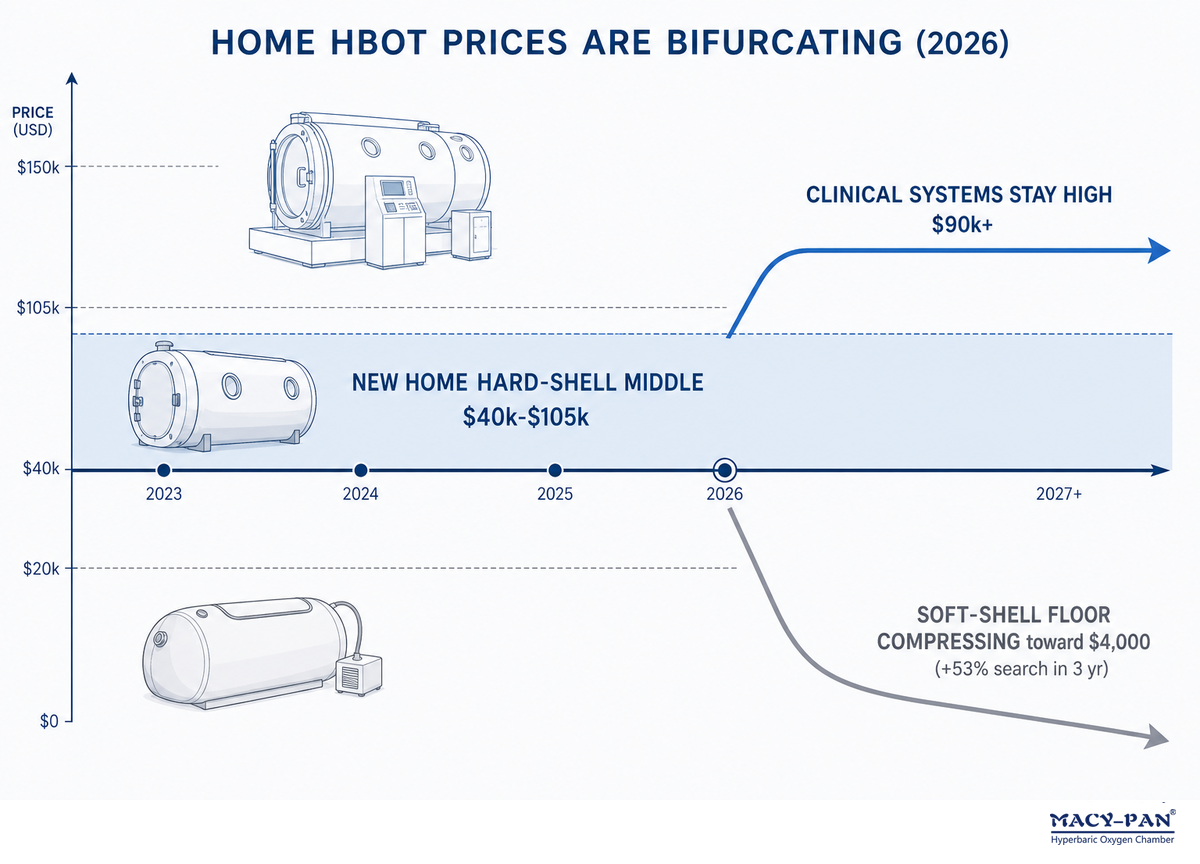
Demand for home hyperbaric chambers is climbing, and it’s pulling prices in two directions at once. Search interest in what a chamber costs has risen about 53% over three years, and that consumer pull has drawn a wave of soft-shell supply into the entry tier, pressing the floor down toward $4,000. At the same time, a new class of home-appropriate hard-shell units ($40,000–$105,000) has appeared, sitting between cheap wellness chambers and six-figure clinical systems, even as clinical evidence for new indications keeps accumulating.
Key takeaway
The market is bifurcating: soft-shell entry prices are compressing while genuine clinical capability stays expensive. For buyers, that means a wider middle — more real choice between a $10,000 wellness unit and a $45,000 hard-shell — but it also means the “cheap chamber, clinical results” promise is more misleading than ever. Match the tier to the job.
Zoom out, and the device market sits near $4 billion in 2026, projected to grow at roughly 5.5% a year, but that headline matters less to a single buyer than the shape of the shift: the choices in the $10,000–$60,000 middle are the ones expanding fastest.
Frequently Asked Questions
Q: How much does a hyperbaric chamber cost per session?
A single HBOT session costs about $150–$600 at a clinical facility and $100–$300 at a wellness center using a soft chamber, and most protocols call for 20–40 sessions in total.
A single HBOT session costs about $150–$600 at a clinical facility and $100–$300 per hour at a wellness center using a soft chamber. Because most protocols call for 20–40 sessions, a full off-label course commonly reaches $10,000–$12,000 out of pocket. Package pricing lowers the per-session rate, and clinics often discount blocks of ten or more sessions.
Q: Are hyperbaric chambers worth it?
Hyperbaric chambers are worth it when you use them often enough to beat clinic fees — most owners break even in 12–24 months of regular use.
They are worth it when you use them often enough to beat clinic fees. A home soft-shell chamber around $10,000 breaks even against $150 wellness sessions in roughly 20 months at 40 sessions a year, after which each session is effectively free. For occasional use, a clinic is cheaper; for an FDA on-label medical condition, only a hard-shell chamber under physician supervision is appropriate, whatever the budget.
Q: Will insurance pay for a hyperbaric chamber?
Insurance and Medicare cover clinic-delivered HBOT for approved medical conditions, but rarely a home or wellness chamber purchase, which is treated as an out-of-pocket consumer cost.
Insurance and Medicare cover clinic-delivered HBOT for approved conditions under Medicare NCD 20.29 — such as carbon monoxide poisoning, gas gangrene, and non-healing diabetic wounds — but rarely a home or wellness chamber purchase. Off-label and consumer uses are paid out of pocket, so most home buyers rely on cash or financing rather than a claim.
Q: What are the two types of hyperbaric chambers?
Soft-shell chambers (mild, 1.3–1.5 ATA) serve wellness and recovery, while hard-shell chambers (up to 2.0+ ATA with 100% oxygen) serve clinical medical therapy under physician supervision.
Soft-shell chambers are flexible, 1.3–1.5 ATA units for wellness and recovery. Hard-shell chambers are rigid steel vessels reaching 2.0 ATA or more with 100% oxygen for medical therapy.
Q: How much does a home hyperbaric chamber cost?
Home soft-shell chambers run $4,000–$20,000, while newer home-appropriate hard-shell units run $40,000–$105,000 before the oxygen concentrator, compressor, and freight are added to the sticker price.
Home soft-shell chambers run $4,000–$20,000, and a newer class of home-appropriate hard-shell units runs $40,000–$105,000. Budget for the complete system — chamber, 10–15 LPM oxygen concentrator, compressor, and controls — rather than the shell alone, and remember a prescription is required to buy one for home use in the US.
Q: Can HBOT help with long COVID?
HBOT is not FDA-cleared for long COVID; it remains under investigation, is not an approved indication, and is not covered by insurance for that use.
HBOT is not FDA-cleared for long COVID. Some early studies are exploring it, but it is not an approved indication and is not covered by insurance for that use. Anyone considering it should consult a physician and treat it as experimental.
Why We Wrote This
The price figures here draw on our vantage point as a hyperbaric oxygen chamber manufacturer, including the factory-direct versus reseller comparison on the MACY-PAN HE5000, cross-checked against FDA, CMS, and UHMS sources. We build both soft-shell and hard-shell chambers, so we have no reason to push a 2.0 ATA vessel on a buyer who needs a wellness unit. Reviewed by the MACY-PAN technical team.
References & Sources
- Hyperbaric Oxygen Therapy: Get the FactsU.S. Food and Drug Administration
- Safe Use of Hyperbaric Oxygen Therapy DevicesU.S. Food and Drug Administration
- NCD 20.29, Hyperbaric Oxygen TherapyCenters for Medicare & Medicaid Services
- Hyperbaric Oxygen Therapy CoverageMedicare.gov
- HBO IndicationsUndersea & Hyperbaric Medical Society
- Pressure Vessels for Human Occupancy (ASME PVHO-1)The National Board of Boiler and Pressure Vessel Inspectors
- Double-blind trials in hyperbaric medicine (Lansdorp, 2018)PMC, National Library of Medicine
- Emerging Indications for Hyperbaric Oxygen TreatmentPMC, National Library of Medicine