Get in Touch with MACY-PAN Company

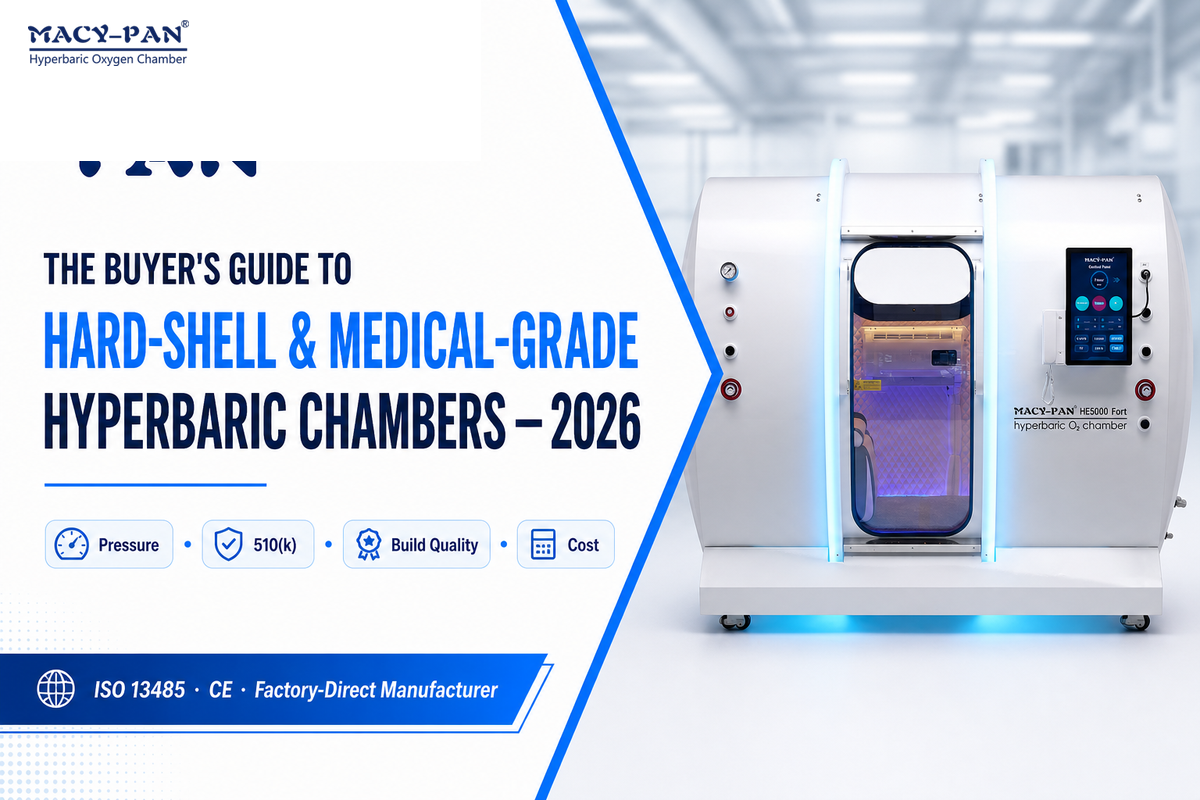
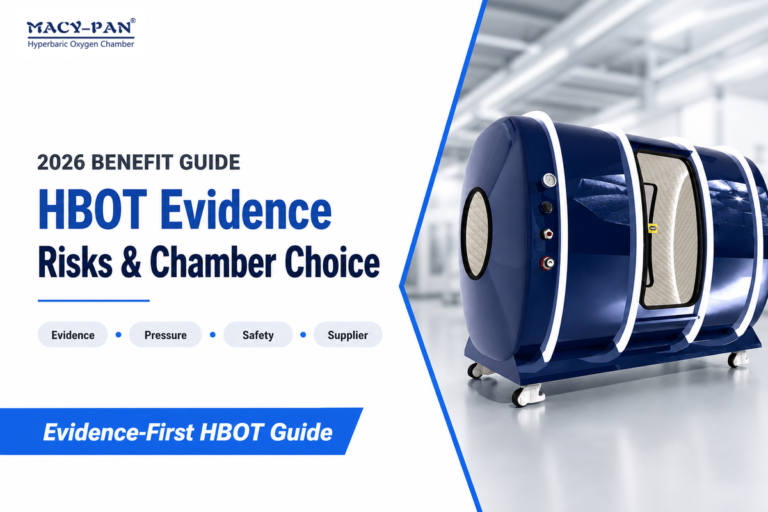
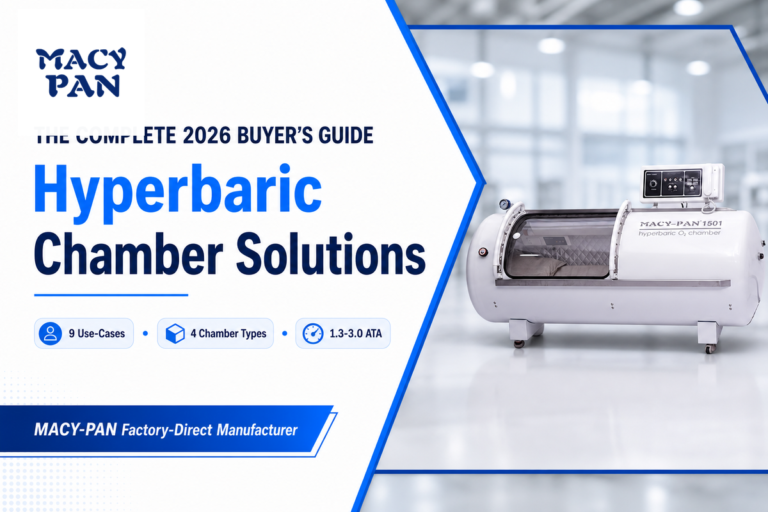
A hard shell hyperbaric chamber is a rigid steel or acrylic pressure vessel that delivers up to 100% oxygen at pressures above 2.0 ATA — yet not every hard shell is truly medical-grade. Being hard shelled in hyperbaric chambers does not a medical-grade chamber make and a soft shelled hyperbaric chamber does not a medical grade chamber make either. In essence, what differentiates a medical grade hyperbaric chamber from all the rest comes down to pressure and in particular, our ‘1.4 ATA line,’ or what’s sometimes termed the boundary that’s a divide between a wellness machine and an FDA cleared medical treatment device. When comparing to purchasing a hyperbaric chamber to equip your clinic, wellness studio, or home use, this guide outlines a spec based, certification focused method to distinguish between genuine medical hardware and some flashy branding.
Quick answer: A hard shell hyperbaric chamber is a rigid steel or acrylic pressure vessel that delivers up to 100% oxygen at pressures above 2.0 ATA. It becomes “medical-grade” only when it is cleared by the U.S. Food and Drug Administration as a Class II device through the 510(k) process — a bar soft-sided chambers do not meet for general therapy.
What Is a Hard-Shell Hyperbaric Chamber?
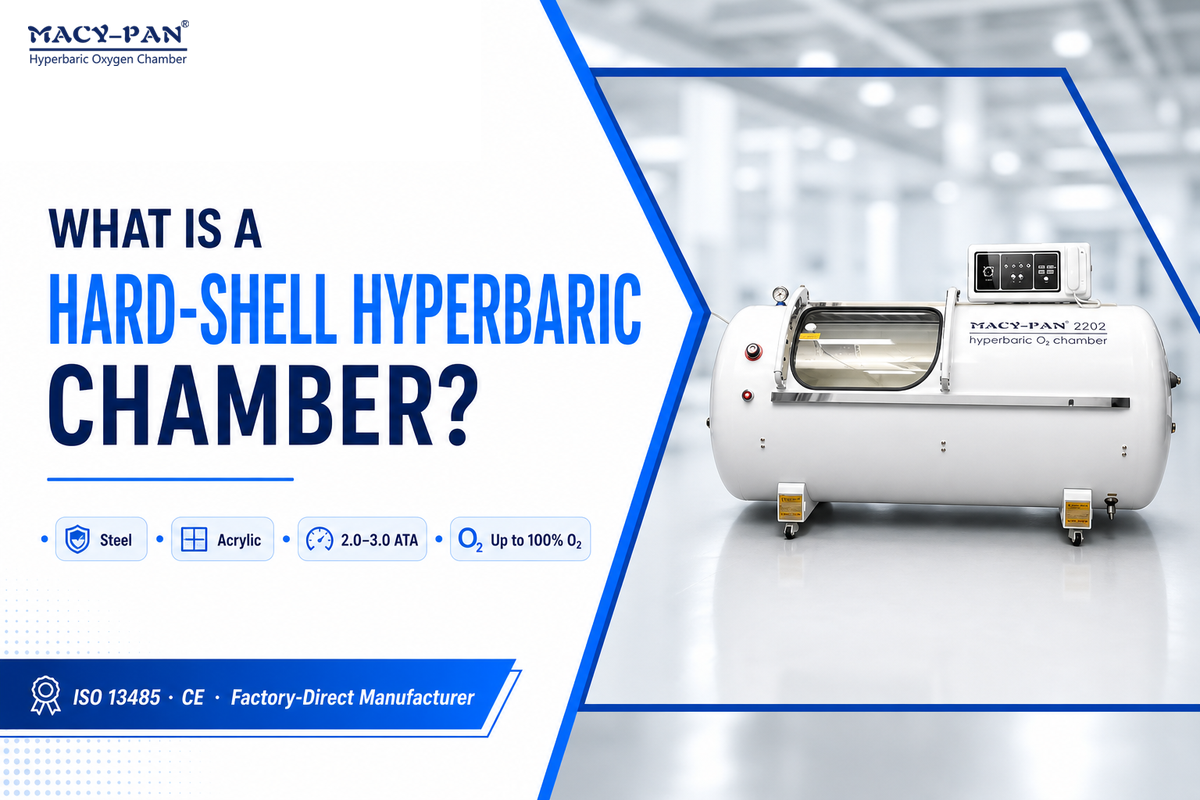
A chamber in this category is an air-tight steel tube capable of resisting pressure just like a tank of scuba diving air, or an acrylic one with machined walls capable of holding more than twice what fabric can sustain. The term “hard-shell chamber” includes steel-welded ones as well as ones manufactured with machining processes using an array of materials capable of handling pressure, such as acrylic.
The device description filed with an FDA 510(k) filing indicates that they “are manufactured of steel, acrylic, or any suitable material, in an order approved for such use to resist working pressures above those that may be sustained by any fabric,” and states therapeutic pressure is controlled within safe limits.
That solid construction allows chambers to achieve the pressure needed for authentic hyperbaric oxygen therapy. While in the chamber, patients inhale as much as 100% oxygen while being subjected to pressures two to three times higher than atmospheric, pushing oxygen into the plasma of the blood to reach tissue deprived of oxygen. There’s one number to keep in mind: the 1.4-ATA line.
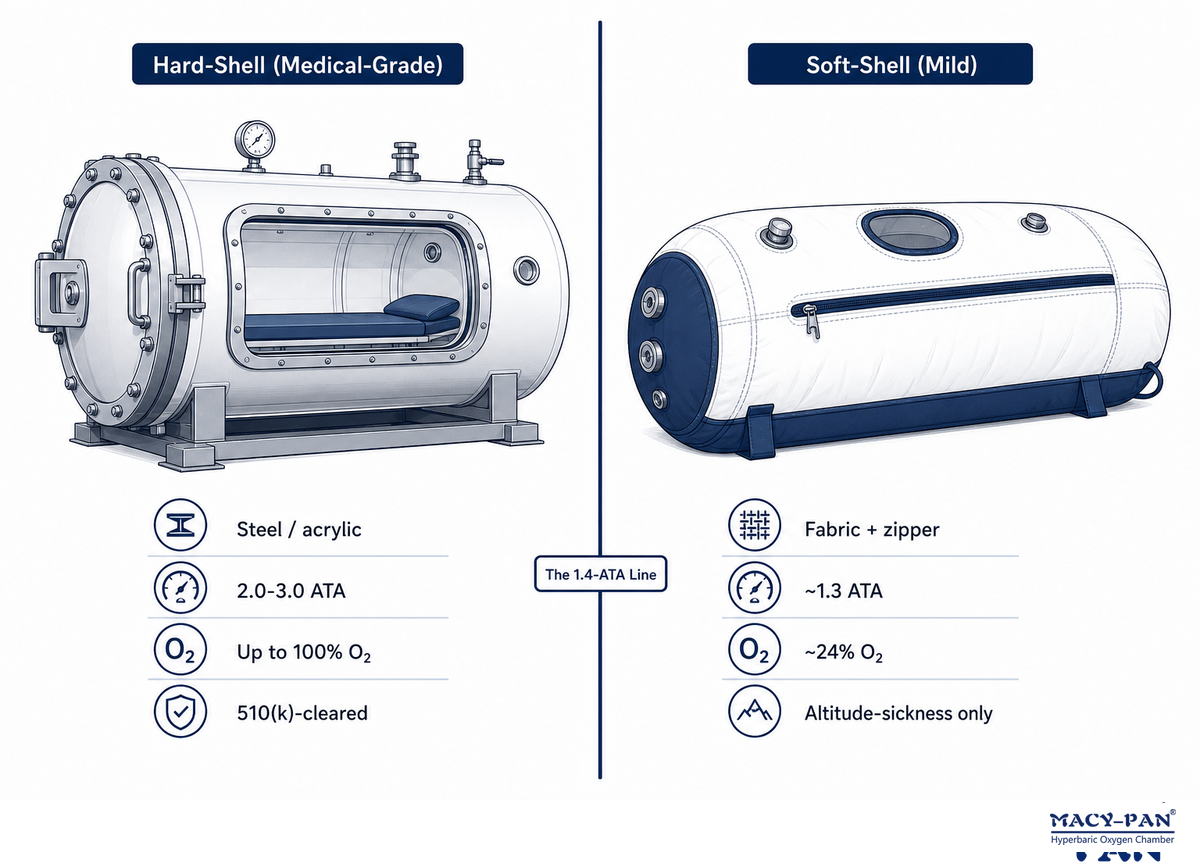
Hyperbaric oxygen therapy is defined by generally applying pressures at 1.4 ATA or higher, and a soft-sided chamber near 1.3 ATA isn’t even at that threshold. Established practice starts higher, with the UHMS defining therapeutic HBOT as that done inside a hard-sided chamber at no less than 2.0 ATA – typically 1.9 to 3.0 ATA. That requires a chamber built from steel or acrylic.
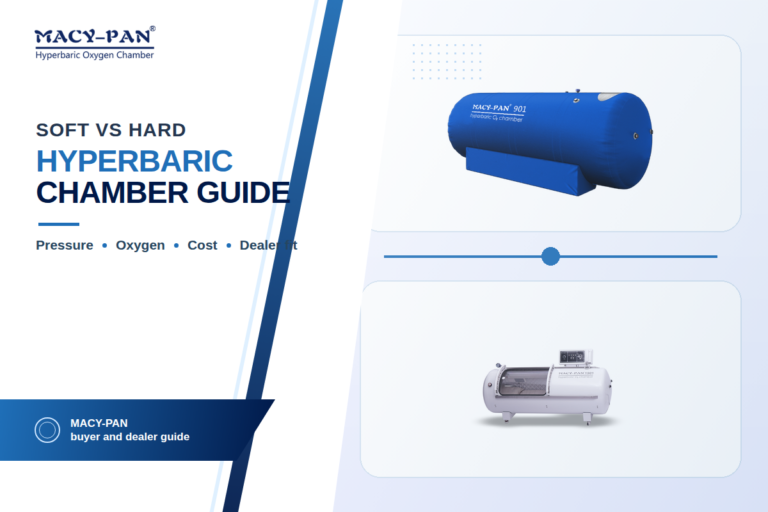
Hard-Shell vs Soft-Shell: The Pressure Line That Divides Them
There’s usually only one question most purchasers have at first: Is a hard shell worth the cost versus a soft shell that costs far less?
The short answer is “it depends on your goals, but not on the physics,” and hard shells actually are what they claim to be while soft chambers often under deliver, or at best meet the lowest standards for the “mild” therapy that some people claim to be helpful. Soft-sided chambers, which are sometimes called mild hyperbaric or mHBOT chambers and are popular with athletes chasing recovery, close with a zipper, may be around 1.3 ATA, circulate low levels of mildly increased oxygen (some quote around 24%), while a hard-shell chamber can operate between 2.0 to 3.0 ATA with high-concentration (close to 100%) oxygen delivered under pressure via a mask or head tent. Below is the full comparison:
| Specification | Hard-Shell (Medical-Grade) | Soft-Shell (Mild / mHBOT) |
|---|---|---|
| Working pressure | 2.0–3.0 ATA | ~1.3–1.4 ATA |
| Shell material | Steel or cast acrylic | Urethane/TPU fabric + zipper |
| Oxygen delivered | Up to 100% | ~24% (ambient enriched) |
| FDA status | 510(k)-cleared for HBOT | Cleared for altitude sickness only |
| Arterial O₂ (illustrative) | ~1,824 mmHg at 2.4 ATA | ~230 mmHg at 1.3 ATA |
| Typical setting | Hospital, clinic, advanced home | Home, wellness studio |
| Install requirements | NFPA 99 fire/safety compliance | Minimal |
| Portability | Fixed / semi-fixed | Packs down, portable |
| Viewport | Acrylic window / full acrylic body | Small clear panel |
| Price band (reference) | ~$20,000–$150,000+ | ~$7,500–$15,000 |
Arterial oxygen numbers serve to reflect the gap in pressure/concentration, and aren’t guarantees of a treatment outcome. Price ranges are references within the industry.
Which is better, a hard-shell or soft-shell hyperbaric chamber?
For an actual medical application with FDA approval, it really comes down to physics: only a hard shell will safely hit the 2.0-3.0 ATA and near 100% oxygen of medical standards. As folks in the HBOT forums r/HBOT state quite plainly, 2.0 ATA allows deeper oxygenation whereas 1.5 ATA can be used safely at home but has nowhere near the effect.
A soft chamber will suffice for an economical “general wellness” setup, but is simply in a different category of device.
What “Medical-Grade” Actually Means: FDA Clearance and the 510(k) Standard
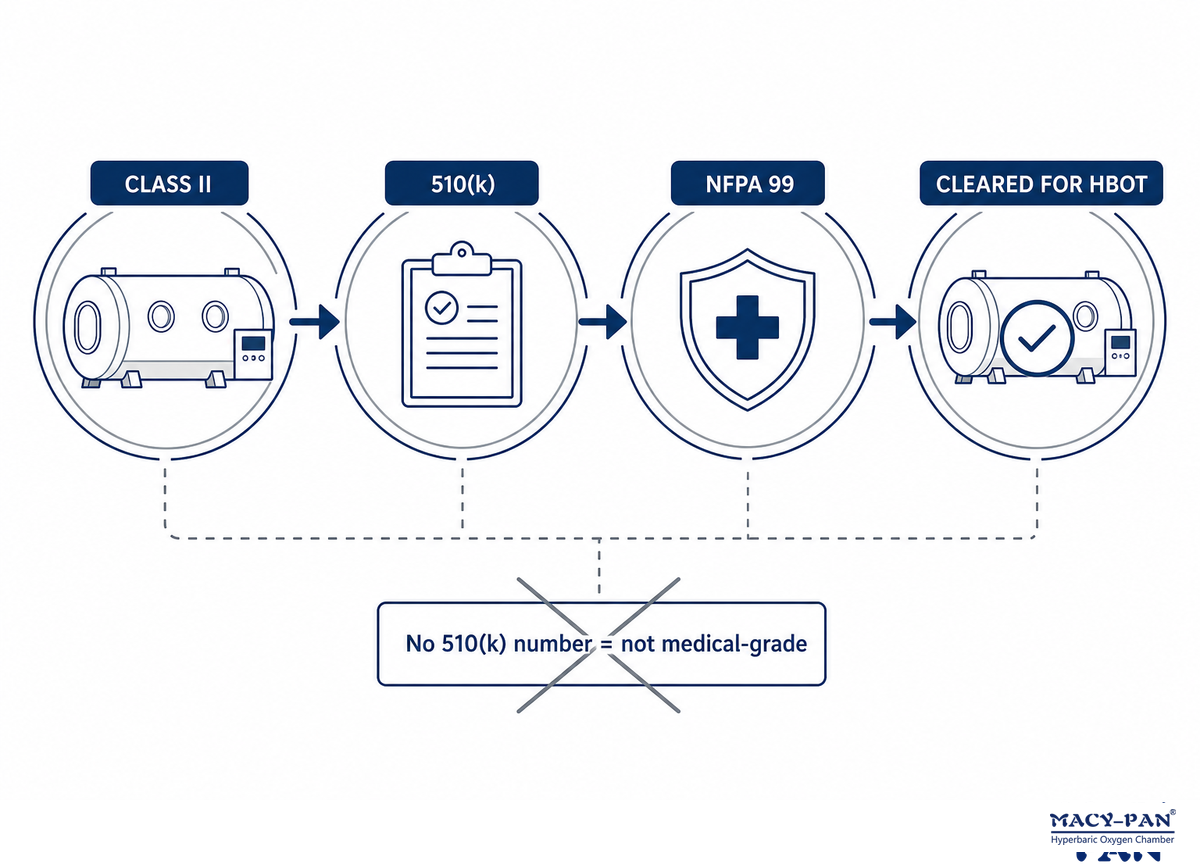
“Medical-grade” is arguably the most abused buzzword in the hyperbaric market place; so pin it to something tangible. In the U.S., hyperbaric chambers are considered a Class II medical device, meaning the FDA approves them using a process called a 510(k). Devices that haven’t navigated this pathway, by definition, aren’t cleared for hyperbaric oxygen therapy.
What makes a hyperbaric chamber medical grade?
Medical institutions recognize hyperbaric oxygen therapy as a treatment for a narrow list of specific conditions, commonly cited as 13 to 14 – including CO poisoning, decompression sickness, gas gangrene, crush injuries, radiation injury, sudden vision and hearing loss, skin graft compromise, and non-healing diabetic wounds. In hyperbaric medicine, these cleared uses center on wound healing, and every genuine medical-grade unit lists the contraindications a buyer should read.
One clarification to remember before quoting numbers to sellers: The exact count is in the eye of the beholder. The Medicare coverage database and the Undersea and Hyperbaric Medical Society both report closer to 15 conditions, with other countries differing. Soft-shell chambers don’t factor into this list: The FDA has stated their only clearance is for altitude sickness, and the UHMS definition of hyperbaric oxygen therapy is based on the use of high-pressure pure oxygen in a sealed, hard-shell unit.
Legitimate medical-grade equipment is also backed by a regulatory paper trail. If you look in the FDA’s device classification database, the product code for hyperbaric chambers is linked to a 510(k) submission and references the NFPA 99 Health Care Facilities Code. This regulatory foundation is conspicuously missing from wellness-box systems.
Understanding ATA: How Pressure Determines Therapeutic Value
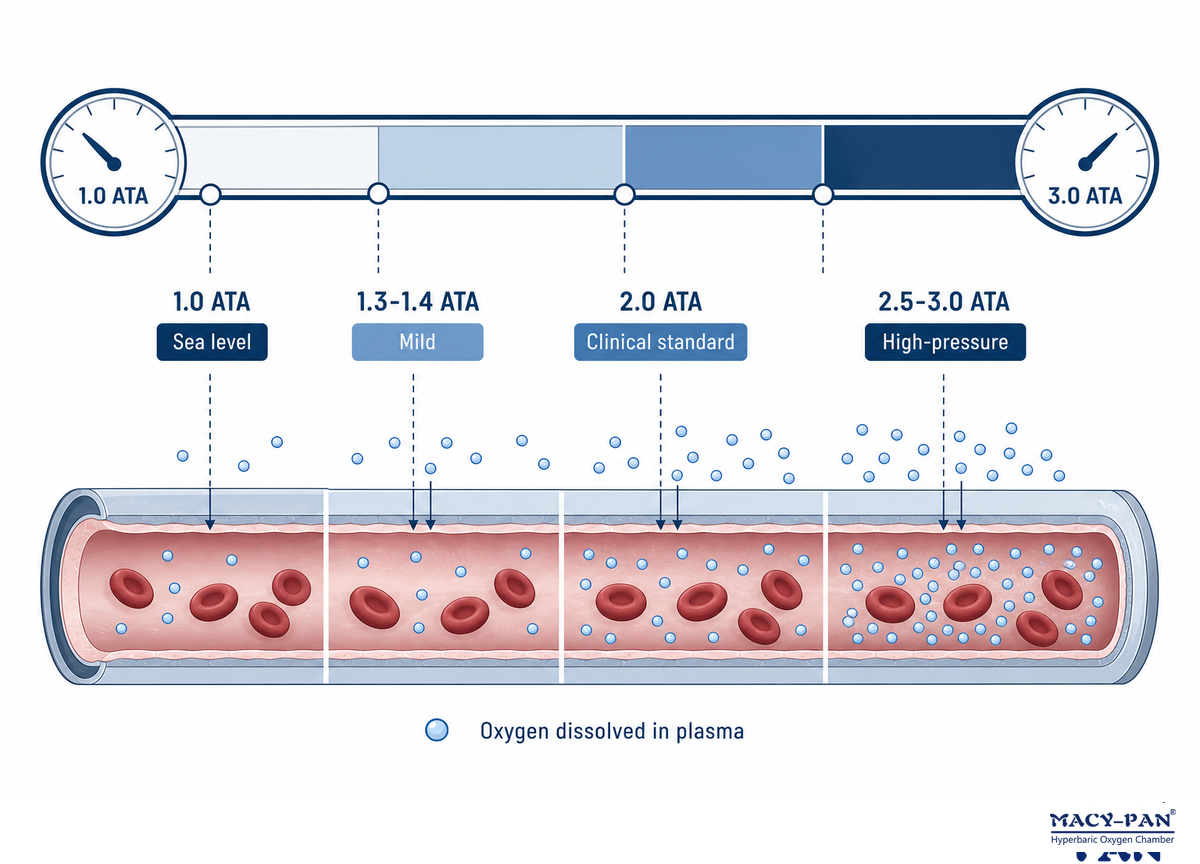
ATA refers to “atmospheres absolute,” a measurement of the overall atmospheric pressure in a space where 1.0 ATA is equivalent to sea-level pressure. Double that to 2.0 ATA, and your body’s experienced pressure will be twice normal. Pressure is critical here because it forces oxygen to dissolve directly into blood plasma – as opposed to attaching only to the red blood cells – enabling it to penetrate tissues that the body can’t normally reach by breathing. Here’s an important detail the marketing materials omit: While the definition of hyperbaric oxygen therapy, or HBOT, starts at roughly 1.4 ATA, the UHMS clinical definition stipulates a treatment in a hard-sided chamber at a pressure of no less than 2.0 ATA. Pressures between 1.4 ATA and 2.0 ATA can be regarded as lower-intensity therapy rather than an alternative modality. This matrix will help match the pressure band with the intended purpose.
| Pressure band | Typical use | Chamber class |
|---|---|---|
| 1.3–1.4 ATA | General wellness, recovery routines | Soft / mild |
| 1.4–2.0 ATA | Above the HBOT floor, below the ≥2.0 ATA clinical standard | Hard-shell (lower rating) |
| 2.0–2.5 ATA | Standard wound care, infection support | Medical-grade hard-shell |
| 2.5–3.0 ATA | Decompression sickness, gas embolism | Multiplace / high-pressure hard-shell |
⚠️ More pressure is not always better
However, excessive pressure does have its limits. Peer-reviewed literature, such as that available on the National Library of Medicine, details cases of central nervous system oxygen toxicity at pressures even lower than 2.0 ATA. That’s why high-pressure, hard-sided systems come with stringent safety controls and why increasing the pressure isn’t always the right answer.
Configurations: Monoplace, Multiplace, and Sizing
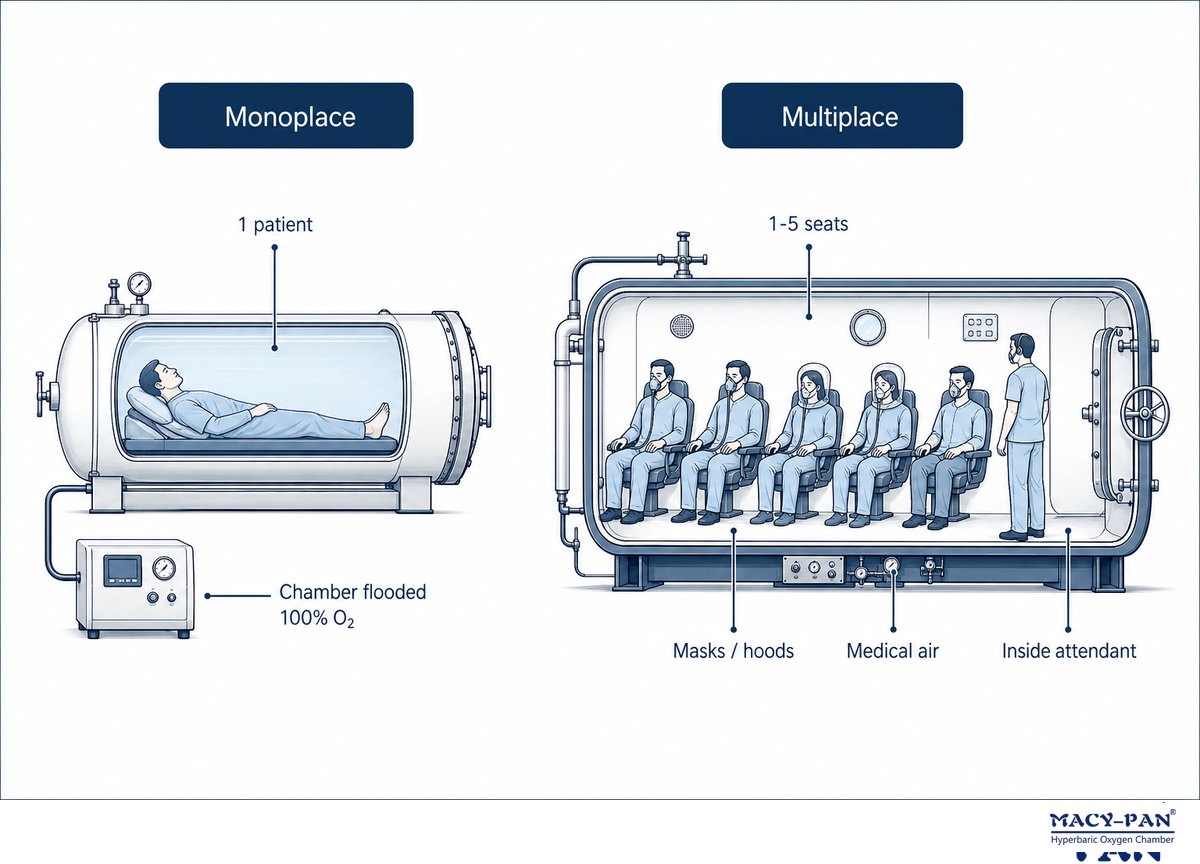
Hard-sided chambers split into two designs, and the gap matters more than first-time buyers expect. A monoplace chamber holds one patient and floods the whole shell with 100% oxygen — MACY-PAN’s rigid HP2202 and MC750 units, for instance, run pure oxygen to a full clinical 2.0 ATA inside a 304-stainless shell certified to ASME PVHO-1. That setup fits solo therapy, advanced home installs, and small clinics. A multiplace chamber is a room-sized vessel pressurized with medical air while each occupant breathes oxygen through a mask or hood; MACY-PAN’s HE5000 line spans 1 to 5 seats, which is why hospitals and high-volume clinics lean on it.
What really decides it is patient volume against running cost, not just floor space. Picture a wound-care clinic booking six patients a day: a single-seat monoplace would cycle load-pressurize-treat-decompress six times, tying up a technician for most of the shift, while a 3-to-5-seat multiplace treats several of them in one pressurization and spreads the oxygen, staffing, and NFPA 99-compliant room cost across every seat. The trade-off is that multiplace units need a trained inside attendant and a much larger install envelope. Internal diameter, whether patients sit or recline, viewport size, and door type all follow from that seat count. Full-acrylic monoplace systems give up a little pressure ceiling for a more open, less claustrophobic ride — a genuine factor for patients who tense up in a narrow steel tube.
One spec buyers overlook is the oxygen supply behind the shell. Monoplace units flood the chamber directly from an oxygen concentrator or compressor, while a multiplace pipes oxygen to masks. Either way, the flow rate and delivered oxygen concentration have to match the chamber size and seat capacity, or pressurization stalls. Ask any manufacturer to state the concentrator output and flow rate a model needs before you compare price.
Home vs Clinic: Matching a Chamber to Your Setting
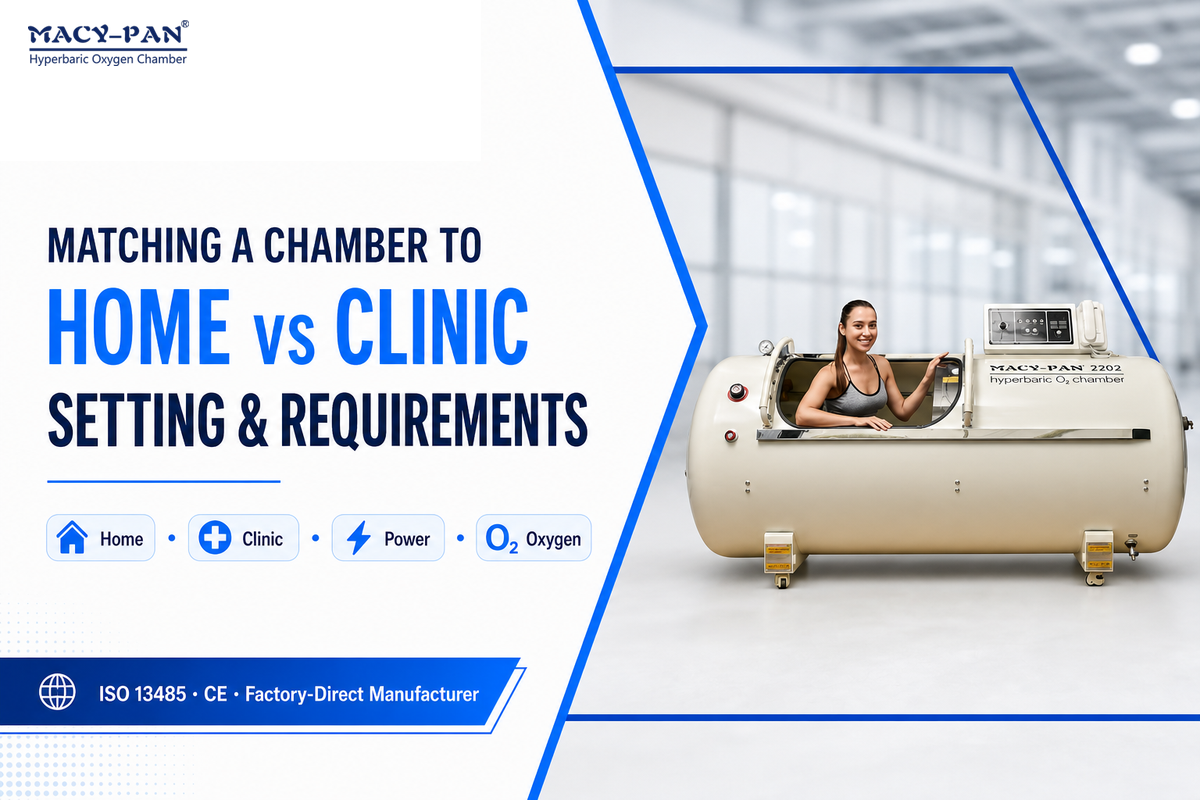
Location changes the whole spec. Clinicians and physicians’ offices require an FDA cleared unit, that works with an oxygen source that’s sized for your day, meets all of the fire codes like NFPA 99 (unapproved electronics need to be OUT), etc. Home buyers need to consider floor space, standard power, noise levels, is someone qualified to operate it?
What many don’t realize, there’s a sort of ‘happy medium’. A less expensive 1.5-2.0 ATA (ATA=atmospheres of absolute pressure) hard-shell unit, can offer many of the medical-grade construction benefits to the home without the expense of all of the associated plumbing and support infrastructure of a hospital multiplace chamber. Remember though, the chamber itself is only one half of the equation for safety – trained operation, medical oversight, the proper emergency protocol, and appropriate installation are as critical as the vessel itself – which is why clinical societies view operations and prescription as an integrated part of the whole treatment.
💡 Pro Tip
Before comparing systems, get a certification checklist (ISO 13485 / CE / 510(k)) so you are holding every quote up to the same standard. You can see our full line of hard shell & medical-grade chambers by pressure rating (spec sheets available).
Hard-Shell Medical-Grade Chamber Cost, and What Drives It
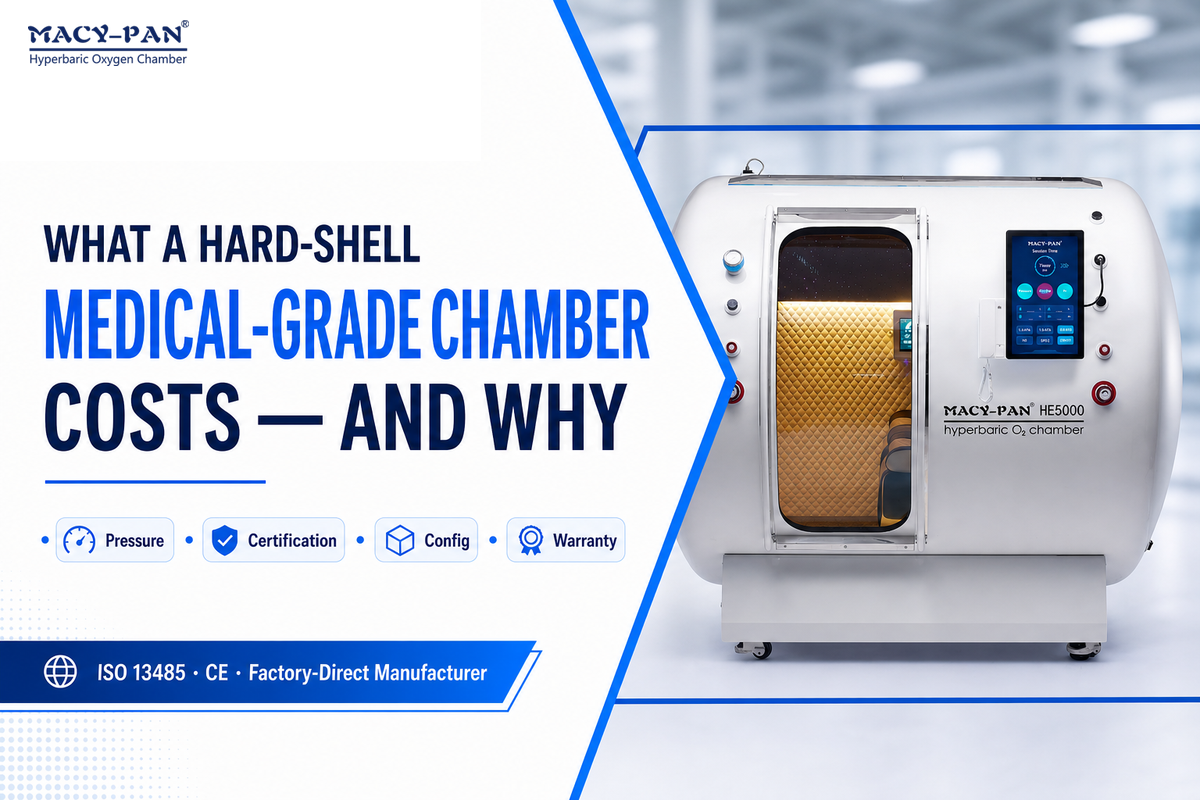
A price band can vary dramatically as “hard-shell” can range from small, single person chambers to those used in hospital settings accommodating multiple patients. Using standard industry reference bands, hard-sided chambers range from just about $20,000 for low pressure single persons up to more than $150,000 for high pressure multi-place. On the other hand soft-sided chambers cost near $7,500-$15,000.
In regards to treatment, an HBOT session on a hard shell chamber for a clinic is generally from several hundred dollars up to over $2,000.
Where the money goes
- 3.0 ATA Pressure -A 3.0 ATA system, by nature, requires more material – heavier steel, a thicker acrylic dome and more rigorous design and engineering than its 1.5 ATA counterparts.
- Certification – 510(k) plus ISO 13485 and CE is a tangible benefit that translates into real reassurance, real costs.
- Oxygen supply- integrated oxygen supply or supply from line, valve and regulator
- Configuration – multiplace room-scale building is orders of magnitude more expensive than the monoplace.
- Warranty and service – support and parts availability over 10-15 years service life
Low- or unclear-volume facilities can fill the gap on a rental basis or using a less costly monoplace before committing to a multiseat purchase. Do the per-session economics against realistic utilization levels before ordering a multiseat.
How to Vet a Manufacturer: Certifications, Specs, and Red Flags
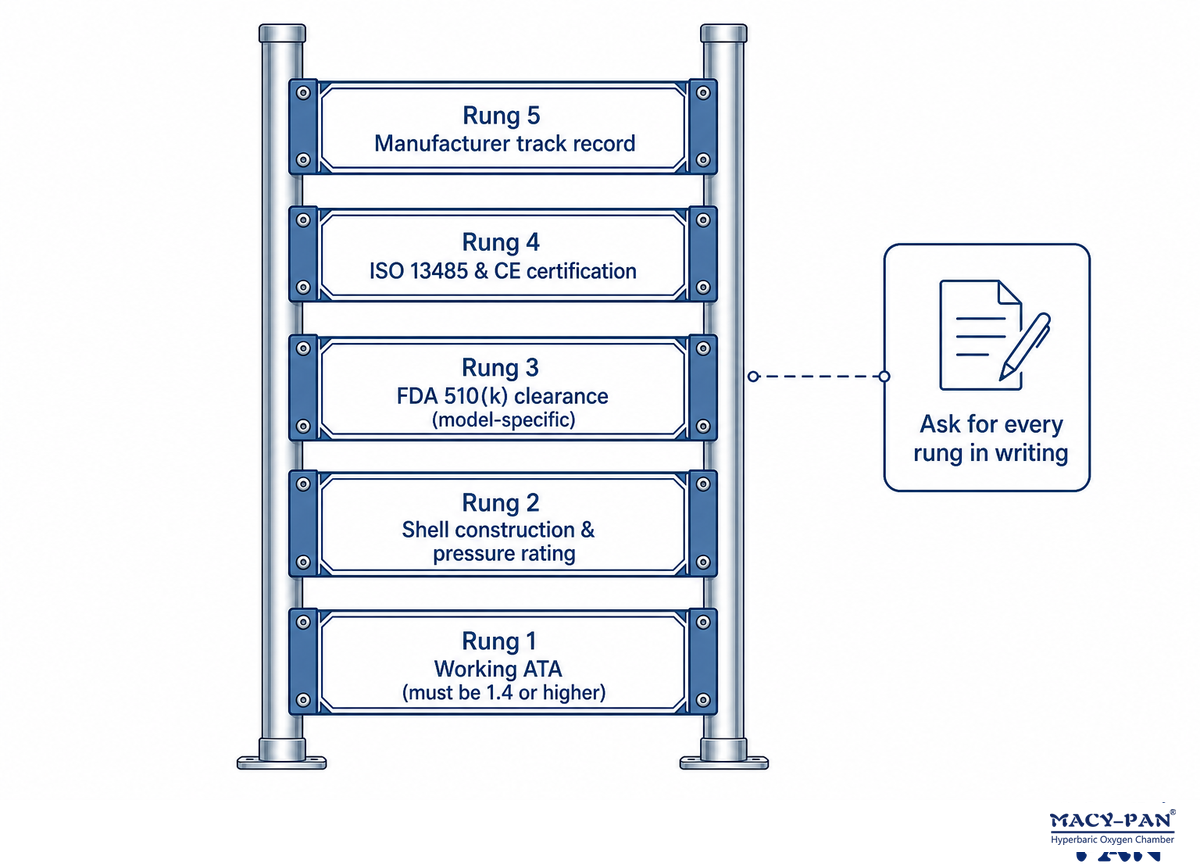
This is where people usually get burned, so use this like a to-do list instead of a vibe guide. We manufacture hyperbaric chambers, and after 17 years shipping them to buyers in 126 countries, we’ve seen the same preventable mistakes over and over again. Use what we call the Medical-Grade Verification Ladder: five rungs, top to bottom.
- Level 1 – Working ATA: request written working ATA in writing. If the working ATA is below 1.4, it’s a wellness device, no matter the shell.
- Rung 2 – Construction: Check rating and wall thickness, not just “hard”
- Level 3 – Regulatory clearance with a U.S. market 510(k) number or its equivalent regional clearance with the identical model designation.
- rung 4 – Quality certifications – ISO 13485 for medical device manufacturing, and CE for Europe. Understand that correctly – ISO 13485 is a quality system certification and a CE mark is a manufacturer’s declaration – not a replacement for FDA clearance or EU safety approval. They answer a different question than rung 3 – so ask for the certificate scope and the notified body, not just a logo.
- rung 5 – Track record – years in production, patent ownership, export experience, and warranty terms.
To offer an example, MACY-PAN (Shanghai Baobang Medical Equipment) has been manufacturing hyperbaric chambers for more than 17 years, holds ISO 13485, ISO 9001, and CE certification, and has a patent on our chamber design and exports to more than 126 countries with both OEM and ODM custom builds. We mention those specs not to make our product seem special, but to illustrate what you should be looking for when considering any manufacturer on your shortlist.
“The single biggest red flag is a ‘medical’ claim with no pressure rating and no clearance number. If a seller cannot give you both in writing, you are not looking at a medical-grade chamber.”
MACY-PAN technical team
Where Medical-Grade HBOT Is Heading in 2026 and Beyond
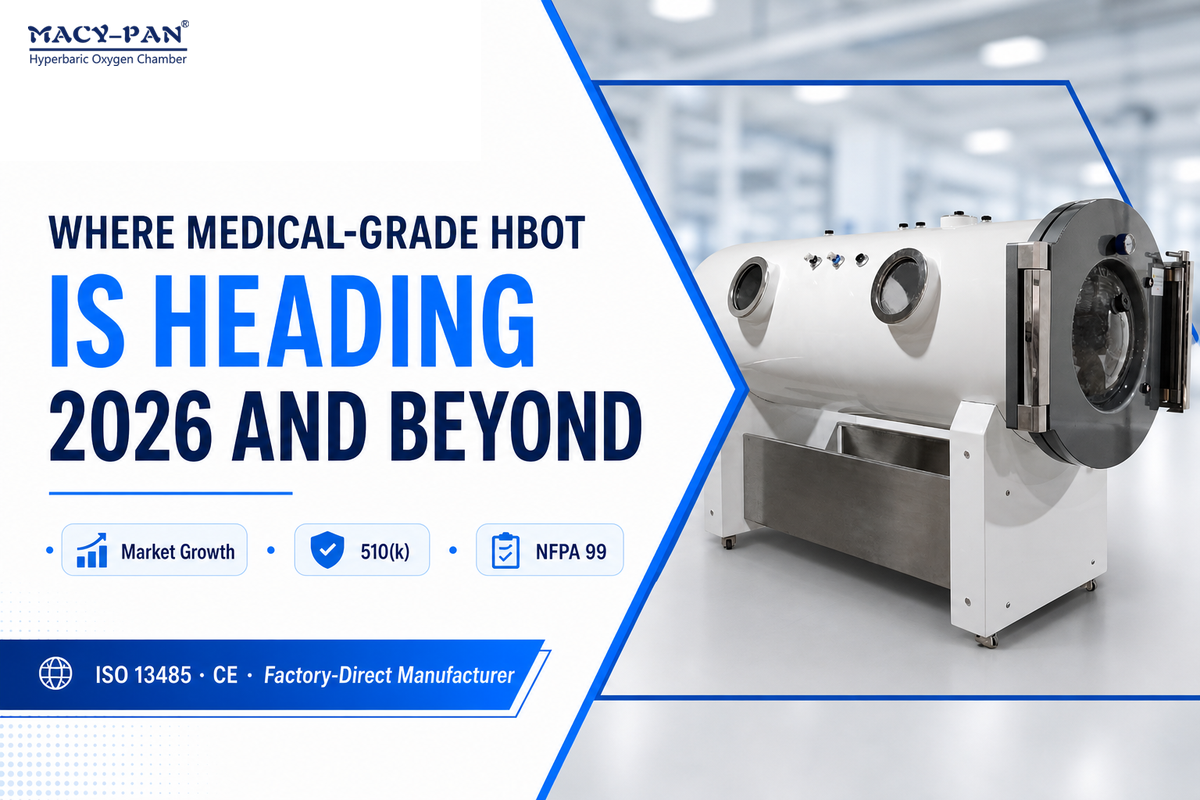
The demand for these devices is rising at a steady pace, not a meteoric spike. Market analysts are expecting the hyperbaric oxygen therapy device sector to reach about $4 billion in the U.S. by 2026, growing in the mid-single digits. One estimate suggests the sector could grow to $6.9 billion by 2034 at around 6.8% per year.
U.S. market share for hyperbaric chambers alone is projected to grow from about $1.0 billion in 2025 to $1.7 billion by 2034. This level of growth is luring new manufacturers to the space, and many of them are seeking FDA 510(k) clearance as their primary credential.
Regulation is following suit. The FDA has already adopted the 2024 edition of NFPA 99 (the Health Care Facilities Code), which resets the safety baseline for any new medical-grade chamber installation. That matters at the point of purchase: a chamber engineered only to the older 2021 code can stall a facility inspection, so ask a manufacturer which NFPA 99 edition the specific model certifies to before you sign — MACY-PAN builds its hard-shell HP and HE5000 lines to current ASME PVHO-1 pressure-vessel standards. In other words, for the consumer, everything above continues to be true – as this field continues to grow, verified clearance and up-to-date compliance, not marketing-hype, will always be the indicators of value.
Frequently Asked Questions
Are hard-shell hyperbaric chambers FDA cleared?
View Answer
Yes, but only if that specific model has successfully completed the FDA 510(k) process and is classified as a Class II medical device. A 510(k) clearance is model-specific, so be sure to get the 510(k) number for the specific chamber you are considering and don’t accept general company clearance. Note that FDA-cleared soft-sided hyperbaric chambers are only approved for altitude sickness, not for any of the 14 conditions for which HBOT is approved to be used.
How much does a hard-shell hyperbaric chamber cost?
View Answer
By way of general industry price comparison, most hard-sided chambers fall between approximately $20,000 (lower-pressure, single-place models) and more than $150,000 (high-pressure, multi-place units), whereas soft chambers can range from about $7,500 to $15,000. Other factors such as pressure rating, certification, oxygen delivery system, configuration, and warranty significantly influence price. A typical HBOT session using a hard-shell chamber typically costs several hundred dollars to more than $2,000.
What pressure (ATA) does a hard-shell chamber reach?
View Answer
Hard-shell medical chambers usually run at 2.0 – 3.0 ATA vs. approx. 1.3 ATA in a soft chamber. HBOT in general is typically defined starting from ~1.4 ATA while the UHMS clinical standard defines therapy treatment in a hard-sided chamber at a pressure no less than 2.0 ATA. Higher pressure helps dissolve more oxygen in the blood plasma, but isn’t necessarily “better” – oxygen toxicity creates a limit, which is why all medical grade chambers pair pressure with intelligent control systems.
Can you use a hard-shell hyperbaric chamber at home?
View Answer
Yes, lower-rated (approx 1.5-2.0 ATA) monoplace hard-shell chambers are intended for use in the home, offering hospital-grade construction without hospital-grade facilities. Focus first on power, footprint, oxygen supply and operator training needs.
Is a soft-shell chamber ever a safe choice?
View Answer
If a strict budget restricts options for “general wellness,” a soft chamber can work, if from a quality manufacturer, properly maintained, and carefully operated. Given the risks cited by UHMS in several tragic cases including a home asphyxia, they are not a toy.
Comparing medical-grade chambers?
Collect spec sheets, pressure ratings, and certifications from all manufacturers; evaluate every quote based on the same criteria from the Verification Ladder below.
Related Articles
- Soft-Shell Hyperbaric Chamber Guide — how mild mHBOT units compare and where they fit
- Top Hyperbaric Chamber Manufacturers — how to compare suppliers before you buy
- Hyperbaric Chamber OEM & Wholesale Guide — private-label and bulk sourcing options
- Hyperbaric Chamber Distributor Guide — becoming a regional reseller
Why We Wrote This
MACY-PAN has designed and manufactured hard-shell, soft-shell, monoplace, and multiplace hyperbaric chambers for over 17 years, exporting to more than 126 countries. The certification and pressure-rating checks in this guide are the exact ones we ask buyers to apply, to our chambers and to everyone else’s.
References & Sources
- Safe Use of Hyperbaric Oxygen Therapy DevicesU.S. Food and Drug Administration
- Product Classification: Chamber, Hyperbaric (510(k))U.S. FDA CDRH Database
- Indications for Hyperbaric Oxygen TherapyUndersea and Hyperbaric Medical Society
- The Dangers of Soft-Sided Bag ChambersUndersea and Hyperbaric Medical Society
- Central Nervous System Oxygen Toxicity in HBOTNational Library of Medicine (PMC)
- Hyperbaric Oxygen Therapy (History and Physiology)StatPearls, National Library of Medicine