Get in Touch with MACY-PAN Company

Reviewed by the MACY-PAN technical team · Updated July 2026
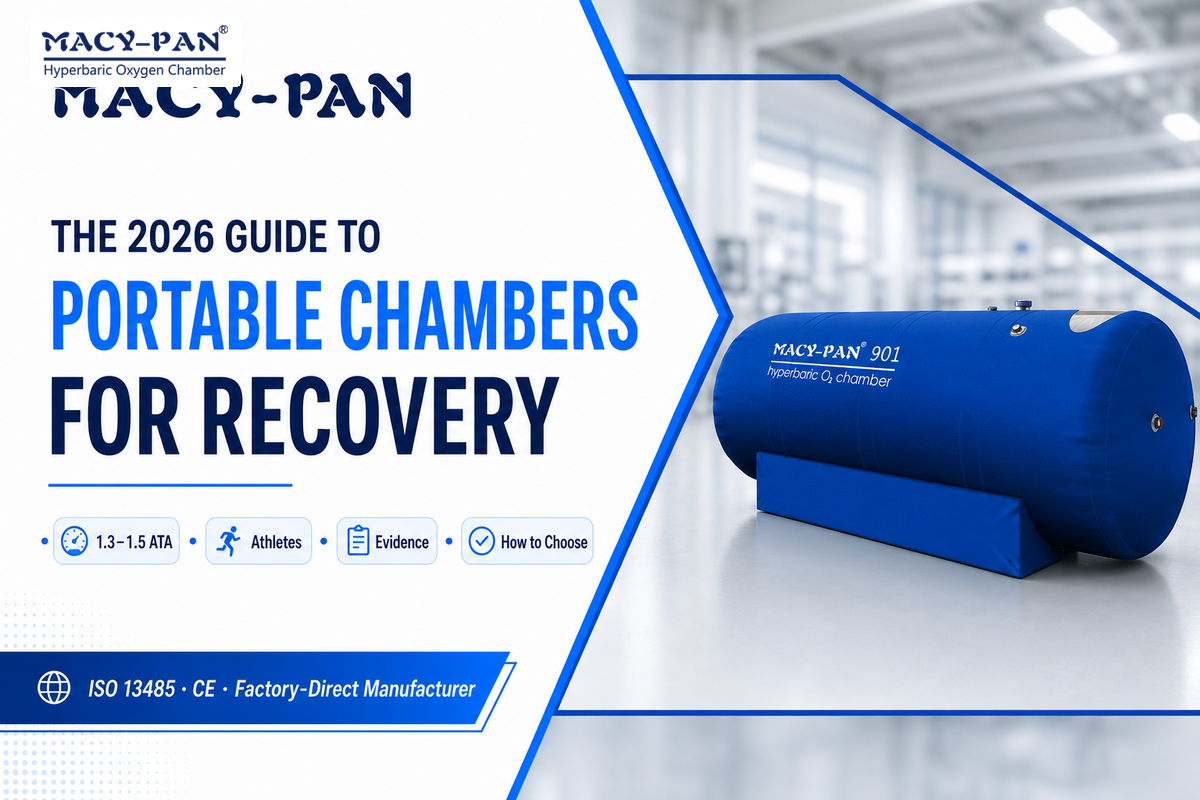
Portable chambers for recovery have moved out of clinics and into spare bedrooms, garage gyms, and hotel rooms. A portable hyperbaric chamber for recovery is a soft-shell, mild-pressure unit, usually 1.3 to 1.5 ATA, that you can set up at home to raise the oxygen carried in your blood plasma and support tissue repair. This guide explains what the evidence actually shows, what pressure to run for muscle recovery, how athletes use these chambers, and how to choose one without overpaying or buying a knock-off. Think of it as HBOT at home, minus the clinic schedule.
Quick Specs: Portable Recovery Chambers (Soft-Shell / Mild)
- Working pressure: 1.3–1.5 ATA (4.3–7 psi above ambient)
- Oxygen: 93% (±3%) via included concentrator + mask; ~24% ambient without the mask
- Weight: 18–40 kg; setup 5–8 min; fits a 32-inch doorway
- Power: standard 110–240 V wall outlet
- Typical recovery session: 60–90 min, 3–5×/week
- Certifications to look for: ISO 13485, CE, SGS-verified TPU
What a Portable Hyperbaric Chamber Does for Recovery
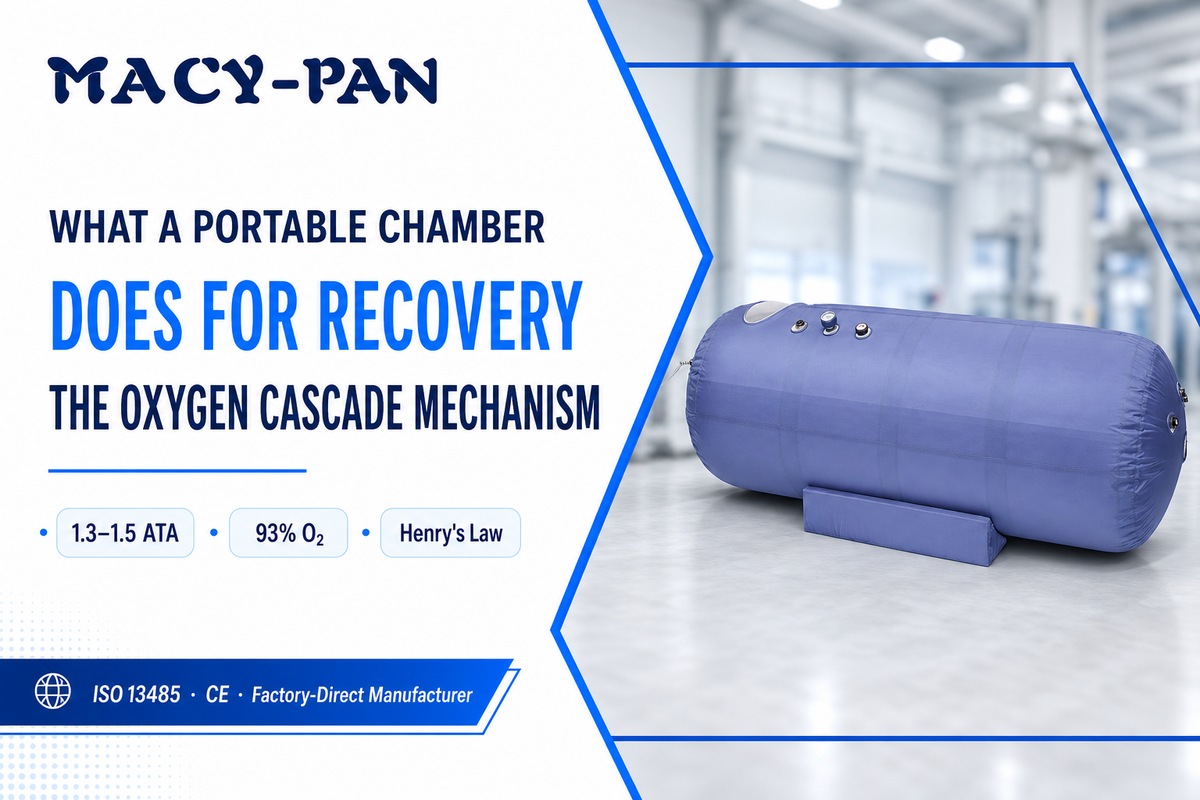
Portable hyperbaric chambers speed recovery by raising the atmospheric pressure around you so more oxygen dissolves directly into your blood plasma and reaches tissue that circulation alone struggles to supply. At mild pressures of 1.3–1.5 ATA with supplemental oxygen, that extra dissolved oxygen is the mechanism behind reduced inflammation, faster tissue repair, and healing, not the pressure by itself.
This works because of physics, and it’s worth walking through once. Normally, almost all the oxygen you carry is bound to hemoglobin in red blood cells, which sit near saturation at sea level. Raising the pressure follows Henry’s Law: the amount of a gas that dissolves into a liquid rises with the partial pressure of that gas. So when you breathe ~93% oxygen at 1.4 ATA, far more oxygen dissolves into the watery plasma, the part of blood that can seep into swollen, poorly perfused tissue. That mechanism is exactly what researchers measured in a 2023 mild-HBOT study (1.4 ATA, ~40% oxygen). That’s the “so what”: oxygen reaches strained muscle and connective tissue that red cells can’t easily get to after hard training or injury.
We call this chain the Recovery Oxygen Cascade — pressure → Henry’s Law → dissolved plasma oxygen → tissue perfusion → recovery. Each stage depends on the one before it, which is exactly why a chamber run on ambient air alone (no concentrator) does little: without the extra oxygen at stage two, the cascade never starts.
💡 Pro Tip
By far the most important accessory is the oxygen concentrator. A soft chamber pressurized with plain air raises pressure but not inspired oxygen. For recovery, the concentrator delivering 90%+ oxygen is what actually drives the cascade.
The Evidence: What Mild HBOT Actually Does for Recovery
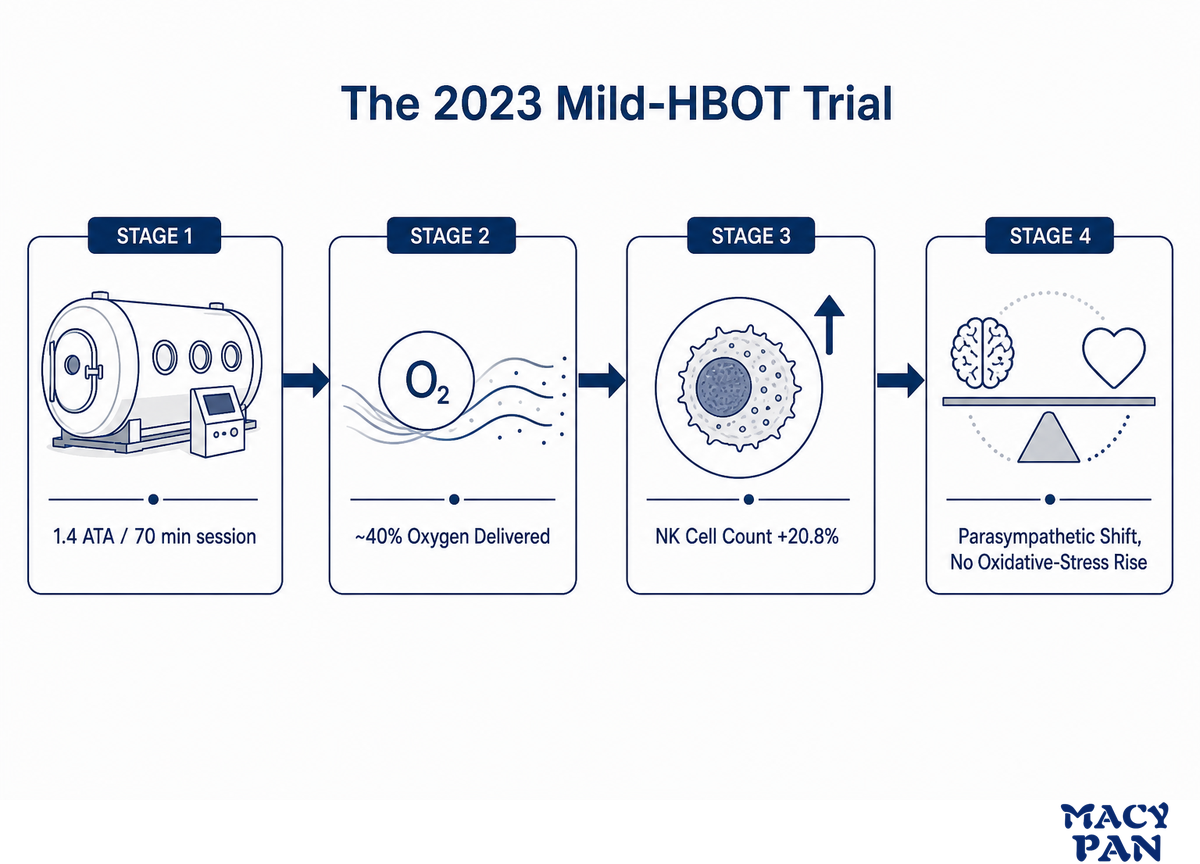
Honestly, the mild hyperbaric oxygen therapy benefits people chase for recovery are real but narrower than the marketing: mild HBOT has measured effects on immune and nervous-system markers, yet the popular “30–50% faster recovery” claims are stronger than the published evidence. Treat the mechanism as supported and the exact recovery-speed numbers as marketing until your own results say otherwise.
Here’s what peer-reviewed work shows. A 2023 study indexed in PMC (Nisa et al.) found that mild hyperbaric oxygen at 1.4 ATA for 70 minutes at ~40% oxygen increased peripheral natural killer (NK) cell counts by about 20.8% by shifting the body toward parasympathetic (“rest and repair”) activity, with no rise in oxidative stress. Separately, a 2024 paper in Frontiers in Physiology (Gušić et al.) measured recovery and performance after a football match in elite youth players following a single one-hour HBOT session.
| Claim you’ll see marketed | What the evidence shows | Strength |
|---|---|---|
| Raises immune / recovery markers | NK cells +20.8%, parasympathetic shift at 1.4 ATA/70 min (PMC 2023) | Peer-reviewed |
| Helps athletic recovery | Measurable effects after a match in elite youth players (Frontiers 2024) | Emerging |
| “Cuts DOMS recovery to 24–48h” | A Cochrane review (Bennett 2005) found insufficient evidence, and some sign HBOT may increase interim soreness | Not established |
| Air-only soft chamber “delivers oxygen therapy” | Per UHMS, fabric chambers with air deliver no extra tissue oxygen; a concentrator is required | Regulatory position |
“The mistake most first-time buyers make is judging a chamber by its ATA rating alone. At mild pressure, the oxygen concentrator does the therapeutic work, a 1.5 ATA shell run on room air is a very expensive way to sit in slightly compressed air.”
In our own factory testing across soft-shell builds, the difference readers feel between “a chamber” and “a recovery chamber” is almost always the concentrator flow (5 vs 10 L/min) and mask fit, not another 0.1 ATA of pressure.
Recovery Pressure: 1.3 vs 1.5 vs 2.0 ATA
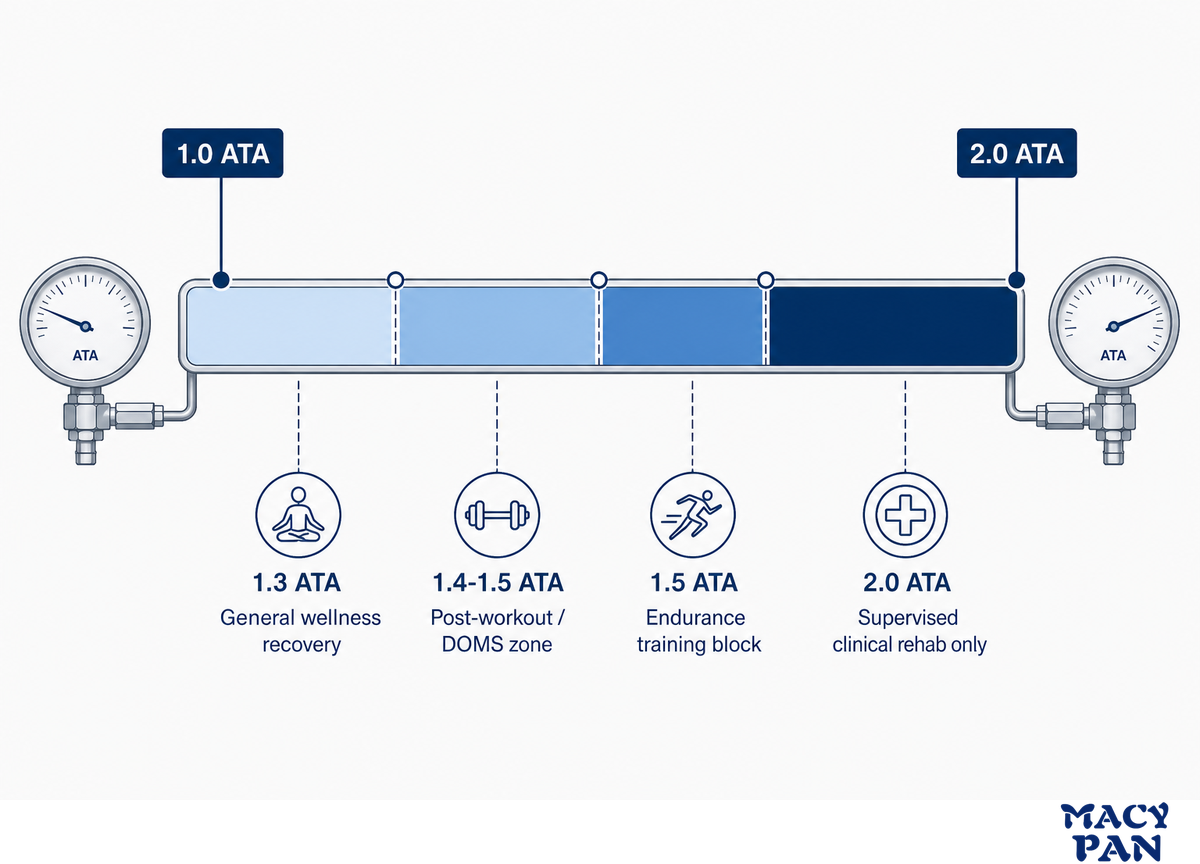
Most home and athletic recovery sits at 1.3–1.5 ATA with an oxygen concentrator; 2.0 ATA is a clinical setting reserved for supervised rehab, not everyday soreness. Higher pressure isn’t automatically better, it changes the risk profile and the equipment class more than it changes recovery outcomes.
What ATA pressure is best for muscle recovery?
For muscle recovery, 1.4–1.5 ATA is the practical target. That range matches the pressure used in the study that showed NK-cell and parasympathetic gains, it stays within soft-shell equipment limits, and it keeps sessions comfortable enough to actually repeat 3–5 times a week, which is what drives results. Framed as 1.5 ata vs 2.0 ata: going to 2.0 ATA means a hard-shell chamber, tighter ear-equalization demands, and usually clinical oversight, without a clear recovery advantage for healthy trainees.
Use the 3-Zone Recovery Pressure Map below to match a goal to a pressure and protocol.
| Recovery goal | ATA zone | Session | Frequency | Chamber type | Supervision |
|---|---|---|---|---|---|
| General wellness recovery | 1.3 ATA | 60–90 min | 3–5×/wk | Soft-shell | Self |
| Post-workout muscle recovery | 1.4–1.5 ATA | 60–90 min | 3–5×/wk | Soft-shell + concentrator | Self |
| Acute DOMS after an event | 1.5 ATA | 60–90 min | Daily short block | Soft-shell | Self |
| Endurance training block | 1.5 ATA | 60 min | 4–6×/wk | Soft-shell | Self / coach |
| Sleep & parasympathetic reset | 1.3 ATA | 60 min | Most nights | Soft-shell | Self |
| Travel / competition recovery | 1.4 ATA | 60 min | Daily during event | Portable 18 kg | Self |
| Couples / shared household | 1.3–1.5 ATA | 60–90 min | 3–5×/wk | 2-person soft | Self |
| Skin & wellness maintenance | 1.3 ATA | 60 min | 3×/wk | Soft-shell | Self |
| Supervised clinical rehab | 2.0 ATA | 60–90 min | Per clinician | Hard-shell | Clinician |
Worked example. Say you’re a weekend runner who finished a half-marathon and your legs are wrecked with DOMS. Read down the map to “Acute DOMS after an event”: that points you to 1.5 ATA, 60–90 minutes, run as a daily short block for the next two to three days, in a soft-shell chamber, self-administered. You wouldn’t jump to 2.0 ATA, that’s the supervised-rehab row, a different (hard-shell) machine and a different risk profile that buys you nothing extra for ordinary soreness. Prefer to browse by pressure first? See MACY-PAN’s chambers organized by ATA pressure.
Athletes and Sports Recovery: Protocols That Work
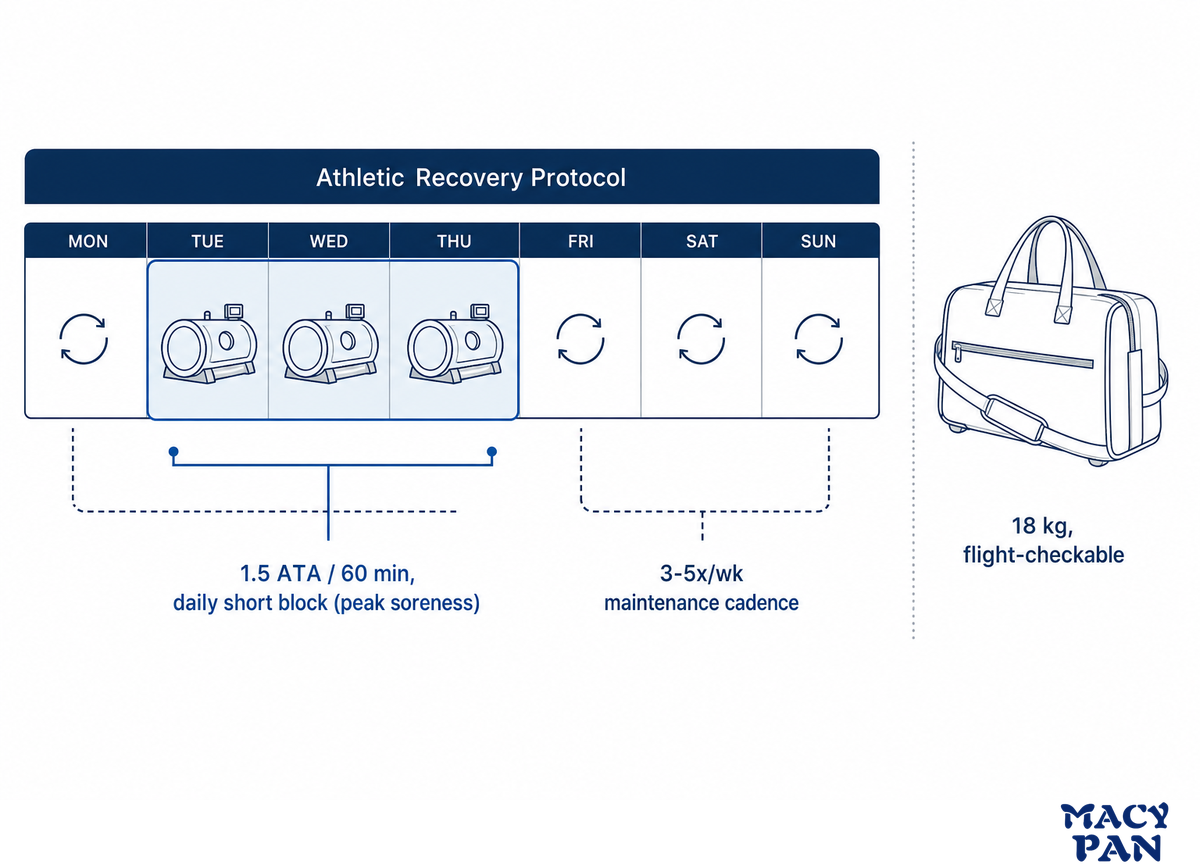
Hyperbaric chamber sports recovery has become a standard tool for athletes who want to compress downtime between hard sessions, running 1.4–1.5 ATA for 60 minutes on a daily or near-daily block around competition. Its appeal is simple: a chamber you can wheel into a training room or check onto a flight let you recover on your schedule instead of a clinic’s.
Do NBA and NFL athletes use hyperbaric chambers for recovery?
Yes, high-profile endorsement is real, though it isn’t the same as proof of a specific recovery percentage. Media coverage has documented pro athletes across the NBA, NFL, and pro cycling using chambers as part of rehab. Outside/Velo reported that four-time Tour de France winner Chris Froome called a hyperbaric chamber a “big part” of his recovery after his 2019 crash. Endorsements tell you the tool is credible and tolerated; the protocol below is what makes it useful.
One common athletic pattern is a short daily block: 1.5 ATA for 60 minutes, once a day for the two to three days of peak soreness after an event, then back to a maintenance cadence of three to five sessions a week. One caution worth keeping honest: the Cochrane evidence on DOMS specifically is mixed, so treat the chamber as one recovery input alongside sleep, protein, and load management, not a magic reset.
⚠️ Field note
One masters triathlete training for a spring race set up an 18 kg travel chamber in a hotel during a training camp, running 60-minute 1.4 ATA sessions each evening after brick workouts. The practical win was not a lab number — it was doing structured recovery every night on the road, which a clinic 40 minutes away would have made impossible. Portability, in other words, is itself a recovery feature.
For team, gym, or performance-facility setups, MACY-PAN keeps a dedicated lineup of hyperbaric chambers for athletes, and a US athletic-performance retailer stocks 21 of our models.
Soft-Shell vs Hard-Shell for Home Recovery
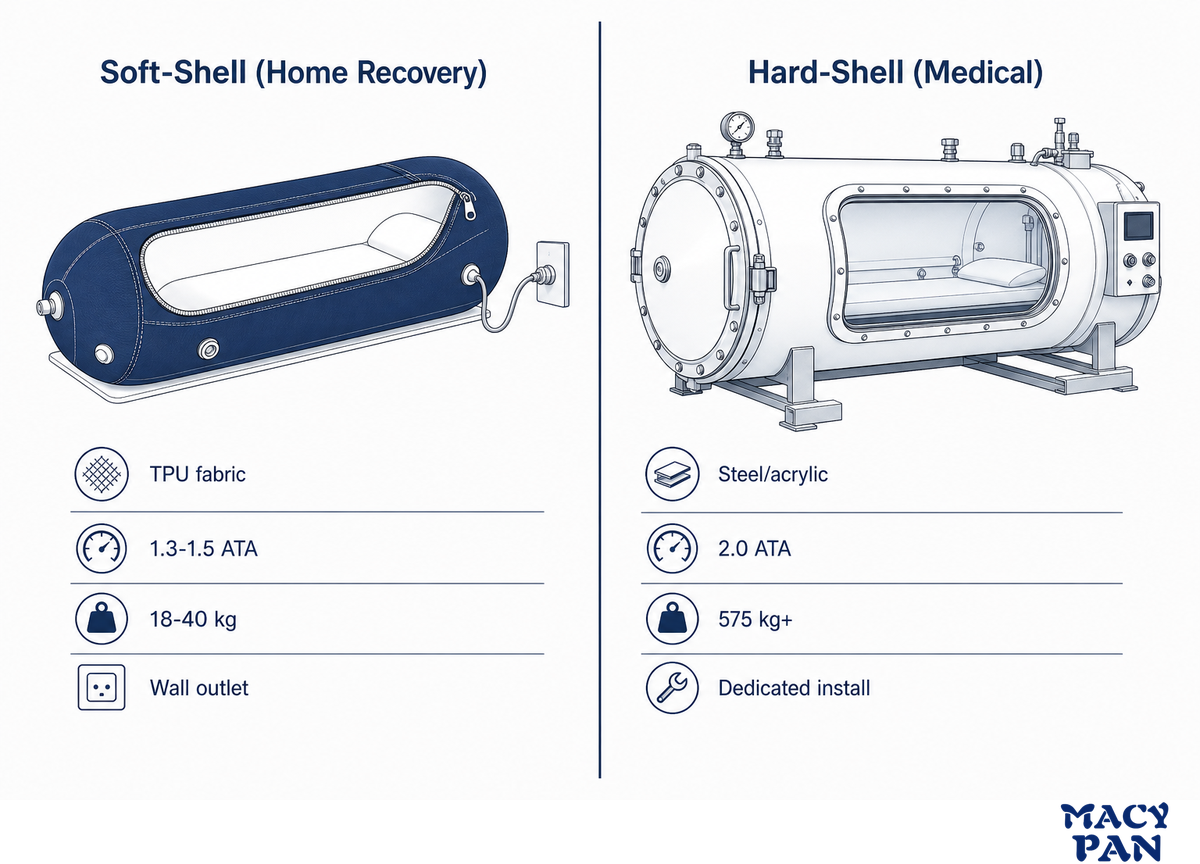
At home, a soft-shell mild chamber (1.3–1.5 ATA) is the right tool for the large majority of users; a hard-shell chamber (2.0 ATA) only makes sense if a clinician has prescribed higher-pressure therapy. That choice is less about “which is better” and more about which pressure your recovery goal actually needs, the 3-Zone map above answers that first.
One common and expensive mistake is buying a hard-shell chamber for home recovery because “more pressure must be better,” then discovering it needs a dedicated room, a heavier power feed, and clinical oversight. For a hyperbaric chamber for muscle recovery, the recovery-relevant comparison is what matters:
| Factor | Soft-shell (mild) | Hard-shell (medical) |
|---|---|---|
| Working pressure | 1.3–1.5 ATA | 2.0 ATA |
| Oxygen delivery | 93% via concentrator | 93–100% |
| Weight | 18–40 kg | 575 kg+ |
| Power | 110–240 V wall outlet | Dedicated install |
| Home recovery fit | Yes | Clinic / team only |
| Typical price | $7,500–18,000 | $30,000–48,000+ |
Practically, soft-shell units use SGS-verified medical-grade TPU, weigh 18–40 kg, and run off a normal wall outlet, so they belong in a home. Hard-shell medical chambers use steel or reinforced acrylic, can exceed 575 kg, and are built for clinics and pro teams. If you want the full teardown of each type, we keep separate deep-dives, the soft-shell mild chamber guide and the hard-shell medical-grade chambers guideso this section stays focused on the recovery decision.
Portability and Setup: Weight, Space, and Travel
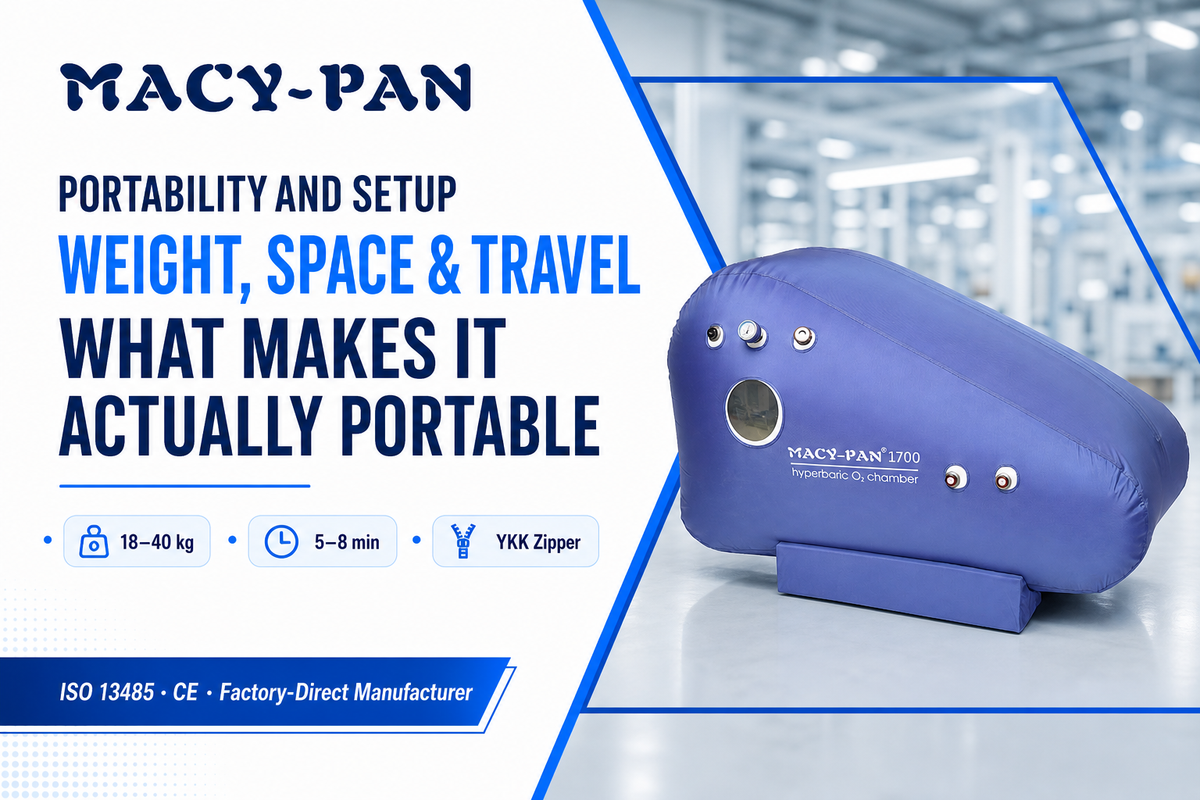
A genuinely portable recovery chamber weighs 18–40 kg, sets up in 5–8 minutes without tools, and fits through a standard 32-inch doorway, the specs that decide whether it actually gets used or ends up folded in a closet. The most common mistake when picking a hyperbaric chamber for home use is buying one that technically deflates but weighs 40 kg; nobody moves it twice, so it never travels. “Portable” should mean one person can move and pitch it, not just that it technically deflates.
Three details separate a chamber you’ll keep using from one you won’t. First, the zipper: a triple-layer YKK zipper where each layer holds pressure independently is a safety and longevity feature, not a luxury. Second, the gauges: dual mechanical gauges need no batteries, so pressure is always readable. Third, the frame: an internal metal frame holds the chamber’s shape even unpressurized, which prevents the collapse-and-crease wear that shortens the life of frameless bags. The design idea of pairing a soft-sided chamber with a rigid support structure is well established, it appears in US Patent 8,025,056 for a foldable hyperbaric chamber with a removable external frame.
On the road, the lightest sitting model checks in around 18 kg, flight-checkable, while lie-down clinic models run 28–40 kg. One physics footnote buyers ask about: after roughly 45 minutes of continuous use the interior warms slightly (that’s Charles’s Law, gas warming under pressure), which is why an air cooler is included rather than sold as an upsell. To match a chamber to a home layout, MACY-PAN groups options as home hyperbaric chambers.
How to Choose a Portable Chamber for Recovery
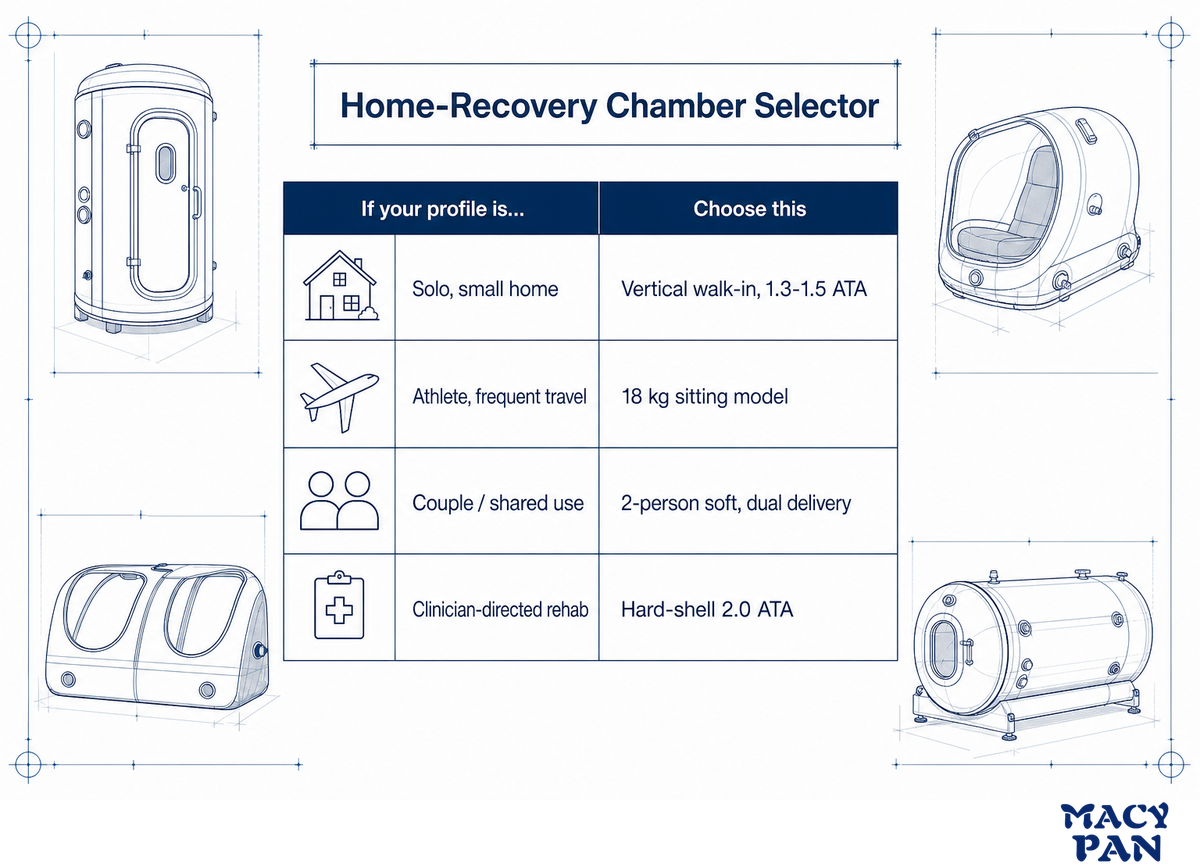
Choose a portable recovery chamber by matching your recovery goal to a pressure, then confirming the chamber includes a real oxygen concentrator, holds recognized certifications, and physically fits your space. There’s no single best hyperbaric chamber for home use, get those four right and the brand-by-brand details matter far less than the marketing implies.
Run your profile through the Home-Recovery Chamber Selector to land on a configuration.
| If your profile is… | Choose this configuration | Why |
|---|---|---|
| Solo general recovery, small home | Vertical walk-in, 1.3–1.5 ATA | Smallest footprint, easy entry |
| Athlete, frequent travel | 18 kg sitting model, 1.4–1.5 ATA | Flight-checkable, fast setup |
| Lie-down comfort, daily use | Lying soft chamber, 1.5 ATA | Comfort drives adherence |
| Couple / parent-child | 2-person soft, dual delivery | Two users, one concentrator |
| Claustrophobia concern | Wide walk-in or 40-inch soft | More interior room |
| Heavy training load | 1.5 ATA soft + 10 L/min concentrator | Higher oxygen flow |
| Budget-first, wellness only | 1.3 ATA soft, 5 L/min | Lowest entry cost |
| Clinic / gym service | Lying 1.5 ATA, ≤55 dB | Quiet, session-ready |
| Clinician-directed rehab | Hard-shell 2.0 ATA | Only with supervision |
Worked example. One busy parent who trains three times a week and shares recovery with a partner reads to the “Couple / parent-child” row: a two-person soft chamber with dual oxygen delivery from a single concentrator, run at 1.3–1.5 ATA. That one line rules out the 18 kg travel model (too small for two) and the hard-shell (overkill and immovable), and it tells the buyer to check concentrator delivery for two masks before ordering. To pressure-test a shortlist, MACY-PAN offers a pressure-to-goal chamber selector.
RFQ checklist — what to confirm before you buy
- ✔ Working pressure (state 1.3 / 1.4 / 1.5 / 2.0 ATA)
- ✔ Oxygen concentrator included? Flow rate (5 vs 10 L/min)?
- ✔ Interior size + form (walk-in / sitting / lying / 2-person)
- ✔ Certifications: ISO 13485, CE, SGS material report
- ✔ Zipper layers, gauge type, internal frame
- ✔ Warranty term + parts/repair support
- ✔ OEM/custom options and lead time
Buying Safely: Prescription, Cost, and Avoiding Knock-offs
In the United States you do not need a prescription to buy a soft-shell mild chamber for personal wellness, but that freedom is exactly why buyers get burned, uncertified units and inflated claims are common. Protect yourself by verifying certification, understanding what “FDA-cleared” really means, and treating any medical claim with skepticism.
Do you need a prescription to own a home hyperbaric chamber?
For a mild soft-shell chamber used for general wellness and recovery, no prescription is required in the US, and no professional supervision is legally mandated. One nuance is regulatory: HBOT devices are Class II devices cleared by the FDA through the 510(k) process, and soft fabric chambers are specifically cleared only for acute mountain sickness, everything else is “off-label.” That does not make home recovery use illegal; it means you should ignore any seller promising a “treatment” or cure for medical conditions, and consult a physician if you have ear, sinus, or lung issues or are pregnant.
On cost, portable soft chambers with proper certification and a bundled concentrator generally run about $7,500–$18,000, and one thing to price in is that resellers often charge $500–$1,500 for the concentrator that a factory-direct bundle may include. For a full price breakdown by type and pressure, see our dedicated portable hyperbaric chamber cost guide rather than duplicating the numbers here.
5 Portable-Recovery Buying Traps
- No concentrator in the quote. A pressure-only “air” chamber can’t drive the Recovery Oxygen Cascade, confirm 90%+ oxygen delivery is included.
- ATA hype. A higher number isn’t better for recovery and may push you into hard-shell territory you don’t need.
- Missing certifications. No ISO 13485 / CE / SGS material report is a red flag on a pressure vessel you’ll sit inside.
- Medical “cure” claims. Soft chambers are cleared for acute mountain sickness only; anything else is off-label, walk away from disease claims.
- No parts or repair path. Zippers and concentrators are wear items; buy from a maker with warranty and replacement parts.
When you are ready to compare certified units, MACY-PAN lists its factory-direct portable hyperbaric chambers with ISO 13485 and CE documentation.
Where Home Recovery HBOT Is Heading
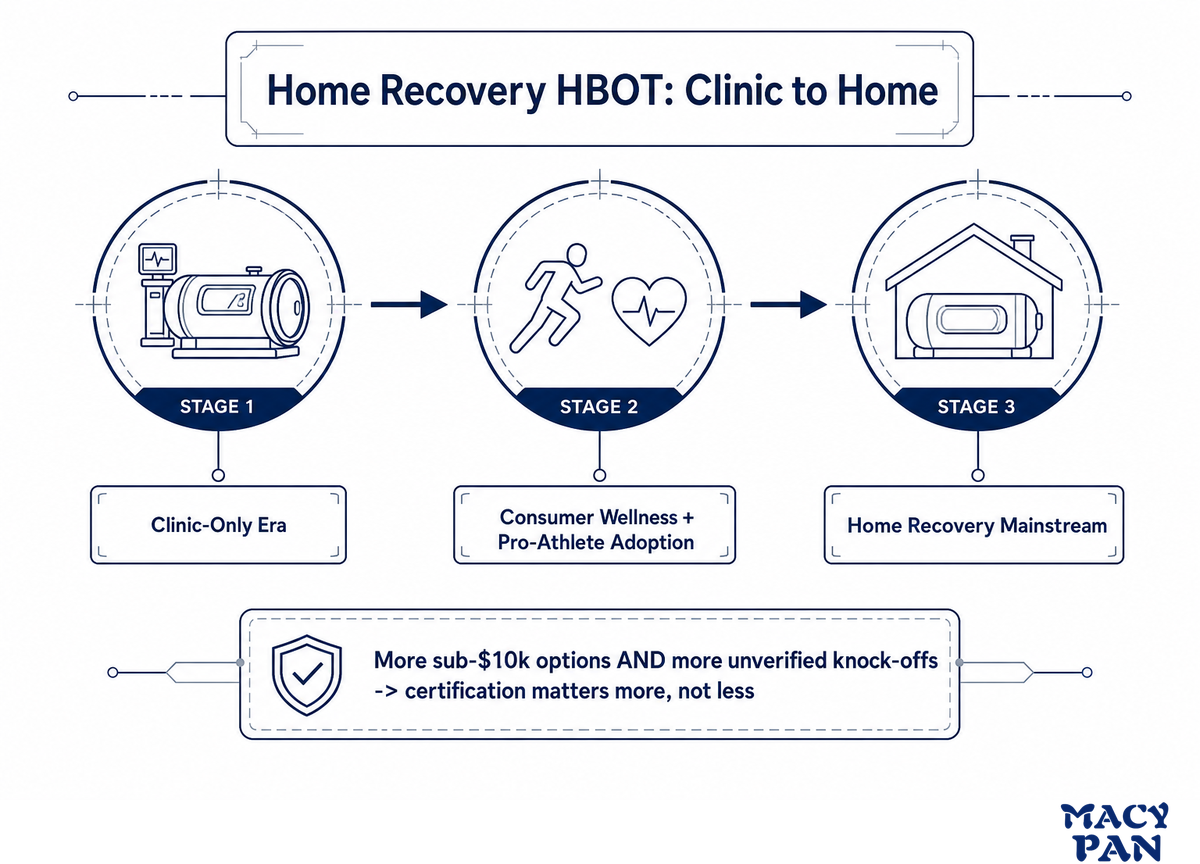
Mild HBOT is decisively moving out of clinics and into homes, pulled by consumer wellness demand and pro-athlete visibility, and for buyers that cuts both ways: more affordable sub-$10,000 options are arriving, but so are more unverified knock-offs, which makes certification and factory provenance more important, not less. That’s the practical judgment to act on before any market chart.
Underneath it runs a quieter trend, standardization: bundled concentrators, triple-layer pressure zippers, and anti-collapse frames are becoming baseline rather than premium features, which is good news for first-time buyers who no longer have to assemble a system from parts. As background only, market trackers put HBOT devices near USD 4.01 billion in 2026 growing around 5.5% a year, and US demand for “portable hyperbaric chamber” has risen roughly 140% over three years, directional signals, not precise forecasts.
As a manufacturer, the change we see most is buyers arriving better-informed and certification-first: the question has shifted from “does it work?” to “is this specific unit certified and properly equipped?” If you’re planning a 2026 purchase, that’s the right instinct, lead with the certification and concentrator questions, and let pressure follow your actual recovery goal.
Frequently Asked Questions
Do portable hyperbaric chambers actually work for recovery?
They can support recovery through a measured mechanism, but honest expectations matter. At 1.3–1.5 ATA with an oxygen concentrator, more oxygen dissolves into blood plasma, and peer-reviewed work shows real immune and parasympathetic effects (NK cells rose ~20.8% at 1.4 ATA). The blanket “recover 50% faster” claims, however, are stronger than the published evidence — treat the chamber as one useful recovery input, not a guaranteed shortcut.
Air-only chambers with no concentrator do far less, because the oxygen step of the mechanism never happens. If a seller cannot tell you the oxygen concentration delivered at the mask, or quotes a chamber without a concentrator at all, that is your signal the “recovery” claim rests on pressure alone — which the evidence does not support.
How long is a recovery session and how often should you use it?
A typical recovery session runs 60–90 minutes, three to five times per week for general recovery. For acute soreness after an event, athletes often shift to a daily short block for two to three days, then return to a maintenance cadence. Consistency over weeks matters more than any single long session, so pick a schedule you can actually keep.
Supervised clinical protocols at 2.0 ATA follow a clinician’s dosing schedule, not the self-directed cadence above, so do not copy a rehab protocol at home. As a rough anchor, many recovery users settle on 60-minute sessions four times a week during heavy training blocks, then drop to two or three sessions when their load is light, adjusting by how their body responds rather than by a fixed number.
Is a portable hyperbaric chamber safe to use at home?
Mild soft-shell chambers are generally safe for home use when built and operated correctly, which is why certification matters. Look for a triple-layer pressure zipper, dual mechanical gauges, an internal anti-collapse frame, and ISO 13485 / CE certification. Consult a physician first if you have ear or sinus problems, lung conditions, or are pregnant, and never exceed the manufacturer’s pressure rating.
The most common safety shortcut to avoid is an uncertified unit with no documented material testing. A pressure vessel you climb inside deserves the same scrutiny you would give a car seat: ask for the ISO 13485 certificate, the CE mark, and an SGS material report in writing, and confirm the zipper is a multi-layer design where each layer independently holds pressure before you ever pressurize it at home.
How is a soft-shell chamber different from a hard-shell chamber?
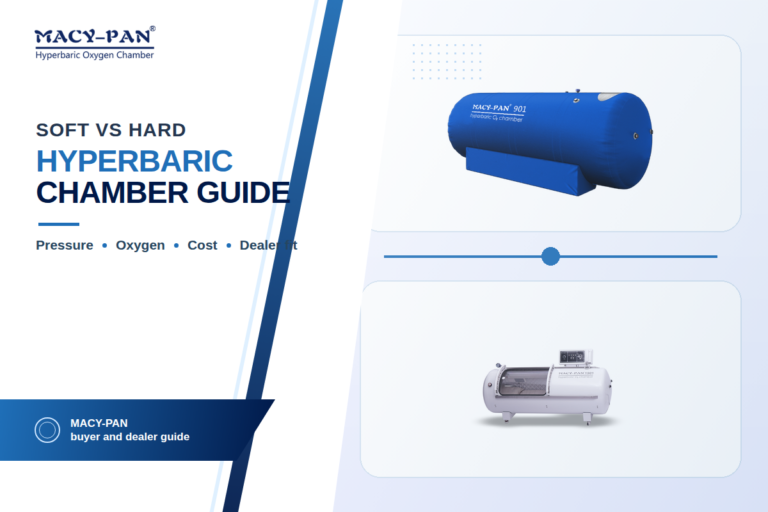
Soft-shell chambers run 1.3–1.5 ATA, use TPU fabric, and suit home recovery; hard-shell chambers reach 2.0 ATA, use steel or acrylic, and are built for clinics. See our soft-shell and hard-shell guides for the full comparison.
Most home recovery buyers want soft-shell.
How much does a portable hyperbaric chamber cost?
Certified portable soft chambers with a bundled concentrator typically run about $7,500–$18,000. See our dedicated cost guide for a full breakdown by type and pressure.
Watch the concentrator line item.
Who should not use a hyperbaric chamber?
Anyone with untreated pneumothorax should avoid HBOT, and people with ear or sinus congestion, certain lung conditions, recent ear surgery, or who are pregnant should consult a physician before starting. Because responses vary, a quick medical check-in before your first session is the safe default.
Stop and seek advice if you experience ear pain that will not equalize during pressurization.
Match a portable recovery chamber to your goal
Factory-direct, ISO 13485 & CE certified, concentrator included, with OEM options.
References & Sources
- Mild Hyperbaric Oxygen Exposure Enhances Peripheral NK Cells (Nisa et al., 2023)PubMed Central / NIH
- Effects of HBOT on Recovery After a Football Match in Elite Youth Players (Gušić et al., 2024)Frontiers in Physiology
- Hyperbaric Oxygen Therapy for Delayed Onset Muscle Soreness (Bennett et al., Cochrane Review)PubMed Central / NIH
- Follow Instructions for Safe Use of Hyperbaric Oxygen Therapy DevicesU.S. Food & Drug Administration
- Position Statement: Low-Pressure Fabric Hyperbaric ChambersUndersea & Hyperbaric Medical Society (UHMS)
- US Patent 8,025,056 B2, Portable Soft-Sided Hyperbaric Chamber with External SupportUSPTO / Google Patents
- Chris Froome on Hyperbaric Chamber RecoveryOutside / Velo
Why We Wrote This
MACY-PAN has manufactured portable soft-shell and hard-shell hyperbaric chambers for over 17 years under ISO 13485, ISO 9001, and CE certification, exporting to more than 126 countries. The recovery pressure and protocol figures here come from our own product and clinical-configuration data; where the science is unsettled, as with DOMS, we have said so plainly rather than inflate it. Our aim is a buying decision you can defend, not a bigger claim.