Get in Touch with MACY-PAN Company

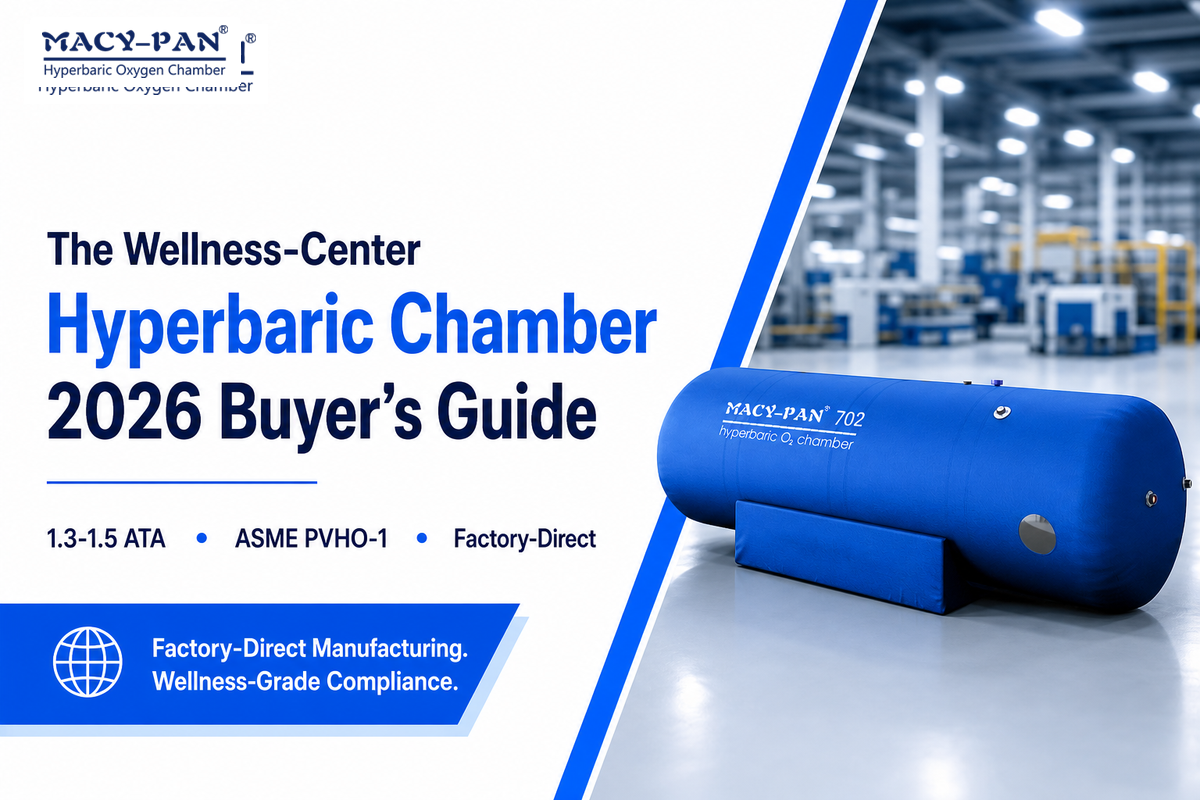
A hyperbaric chamber for wellness center use is a pressurized unit – often a soft shell, 1.3-1.5 ATA – that the spa, recovery center or integrative health practice buys to offer as a cash-pay service rather than to provide as clinical treatment. Spa-like businesses contemplating purchasing one have a different set of questions to consider than medical facilities do, including physician involvement requirements for this gentle pressure category, as well as legitimate licensing, certification and marketing-compliance considerations absent on many of these companies’ product pages.
Quick Specs
| Wellness pressure class | 1.3–1.5 ATA (soft shell) |
| Clinical pressure threshold | ≥2.0 ATA, per UHMS |
| FDA device category | Class II, 21 CFR 868.5470 |
| Engineering standard | ASME |
| Single-chamber commercial startup cost | $80,000–$150,000 (reported) |
| Typical wellness session price | $75–$500 per session |
A wellness-level hyperbaric chamber operates from 1.3 to 1.5 ATA and usually needs no medical licensing to operate, but a clinical-level chamber operate at 2.0 ATA and up, by UHMS’ definition of hyperbaric oxygen therapy. When looking into either level for wellness facilities, always confirm the applicable regulatory documentation and model-specific ASME files are on the paperwork and approach all marketing with extreme caution, as much as regulators have to approach product information.
Key takeaways
- I’ve heard that single-chamber commercial start-up cost ($80,000-$150,000) is way above the price they sell the new units for, it’s just for compliance and building/training cost
- Trade publications not aligned with a chamber seller have referred to operators of spa, and wellness as a high-growing segment of equipment purchasers.
- US, Canadian, and Australian regulators have actually brought regulatory enforcement action in the past 2 years versus devices being advertised without a license, or unapproved hbot marketing cases.
What Counts as a Hyperbaric Chamber for Wellness Center Use? (Types & Pressure Classes)
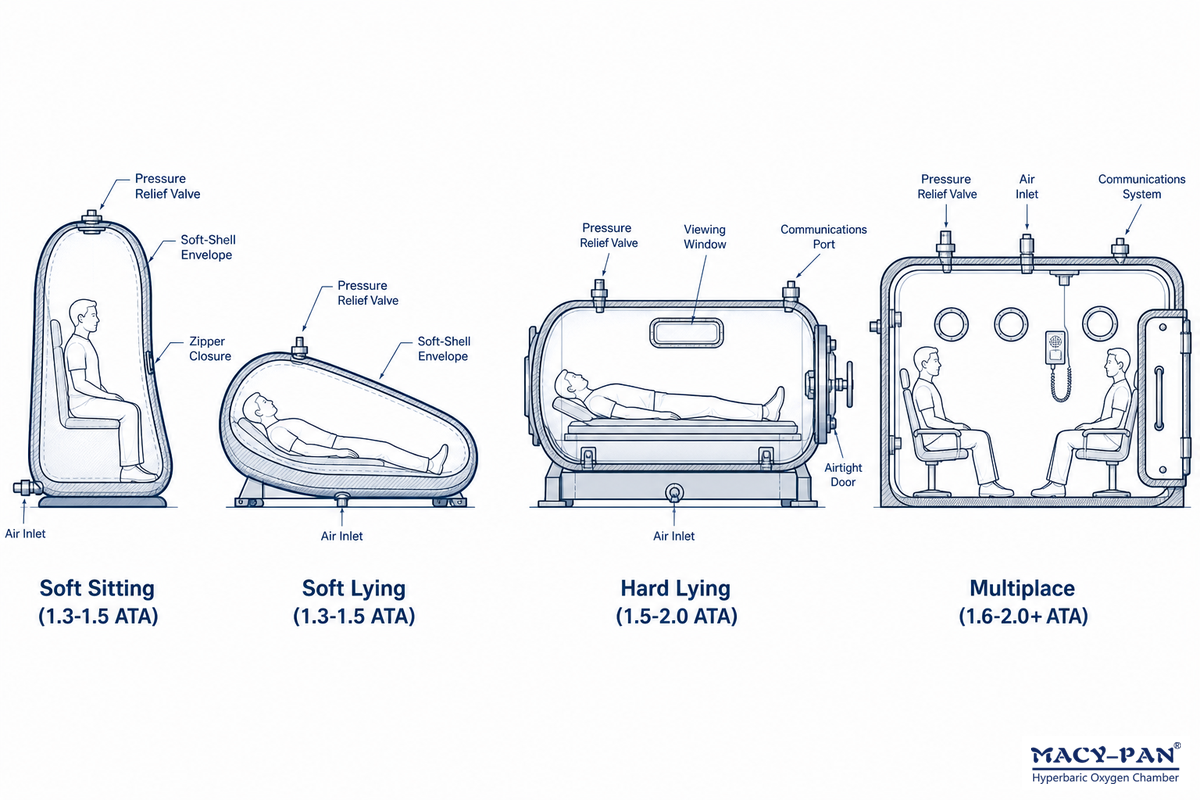
Hyperbaric medicine, where this gear originates, uses five chamber types in broad terms, and only two kinds — soft-shell monoplace and hard-shell single or multi-occupant — show up often in a wellness context. A pressurized hyperbaric oxygen chamber (also called a hyperbaric oxygen therapy chamber, or just a therapy chamber) is any sealed enclosure that raises air pressure above atmospheric levels so the body absorbs more oxygen; wellness centers use the lower-pressure soft-shell and entry hard-shell classes.
Here’s the physiological breakdown before the buying choices: raising the pressure lets the body absorb a greater amount of oxygen directly into the blood plasma instead of relying only on the oxygen attached to hemoglobin. That extra oxygen and the higher resulting oxygen levels reach tissue and blood vessels through ordinary blood flow, aiding the cellular repair tied to wound healing and recovery — including formation of new blood vessels around damaged tissue — and white blood cell and blood cell activity involved in fighting infection. As a non-invasive therapy, hyperbaric therapy’s main job across every setting is simply increasing the oxygen supply available to cells faster than normal breathing alone can.
That same mechanism, at clinical pressures, is why hospitals use hard-shell chambers to treat decompression sickness – the diving injury tied to scuba diving pressure changes, which is also where the ATA pressure unit gets its name – and carbon monoxide poisoning, conditions well outside what a wellness-tier chamber addresses. Patients breathe pure oxygen through a mask or hood inside the chamber in both settings, and, as with any oxygen treatment delivered at pressure, a wellness operator should be able to describe the potential side effects (mild ear pressure, temporary sinus discomfort) to a first-time client before their session.
Hard shell is absolutely not needed in wellness applications of these devices – it occurs with the wellness level pressure also, just not to as great an extent.
Realistic wellness choices would involve the soft-seated (or reclined) monoplace chamber 1.3 – 1.5 ATA, one or two-seater, TPU shell, or a hard lying chamber (1.5 – 2.0 ATA) made of acrylic and steel. While a multiplace chamber offers hospital grade, walk-in style hard chambers at 1.6-2.0+ ATA, it’s very unlikely to be economically justifiable outside a busy clinic — most hbot chambers sold into the wellness-center channel are single-occupant monoplace units rather than multiplace designs.
| Chamber class | Pressure (ATA) | Build | Best-fit wellness facility |
|---|---|---|---|
| Soft sitting, entry tier | 1.3 | Soft TPU shell | Entry-level relaxation/recovery add-on |
| Soft sitting, standard tier | 1.4–1.5 | Soft TPU shell | Recovery studio, spa, home-style suite |
| Soft lying, light-use tier | 1.3–1.4 | Soft TPU shell | Gym-adjacent recovery studio, low volume |
| Soft lying, frequent-use tier | 1.4–1.5 | Soft TPU shell | Gym-adjacent recovery studio, daily bookings |
| Hard lying, single-occupant | 1.5–1.75 | Steel/acrylic | Premium wellness studio |
| Hard lying, upper wellness tier | 1.75–2.0 | Steel/acrylic | Integrative clinic, medically-adjacent wellness |
| Hard lying, dual-occupant | 1.5–2.0 | Steel/acrylic | Couples/family wellness suite |
| Multiplace, small (2–4 seats) | 1.6–2.0+ | Hard, walk-in | High-throughput recovery center |
| Multiplace, large (5–12 seats) | 1.6–2.0+ | Hard, walk-in | Hospital-adjacent or franchise-scale center |
📐 Engineering Note
A hyperbaric chamber is regulated as a pressure vessel with a person inside it, not as an ordinary consumer product. Even a soft-shell wellness unit is built to ASME, the standard covering design, fabrication, inspection, testing, and stamping of pressure vessels for human occupancy — a different, stricter bar than general product-safety rules.
Most importantly: if you receive a chamber quote that’s missing one of the classes from the table, clarify which class they’ve assumed it to be before getting too deep into pricing.
The 2.0-ATA Line Is a Clinical Marker Not a Legal Shortcut
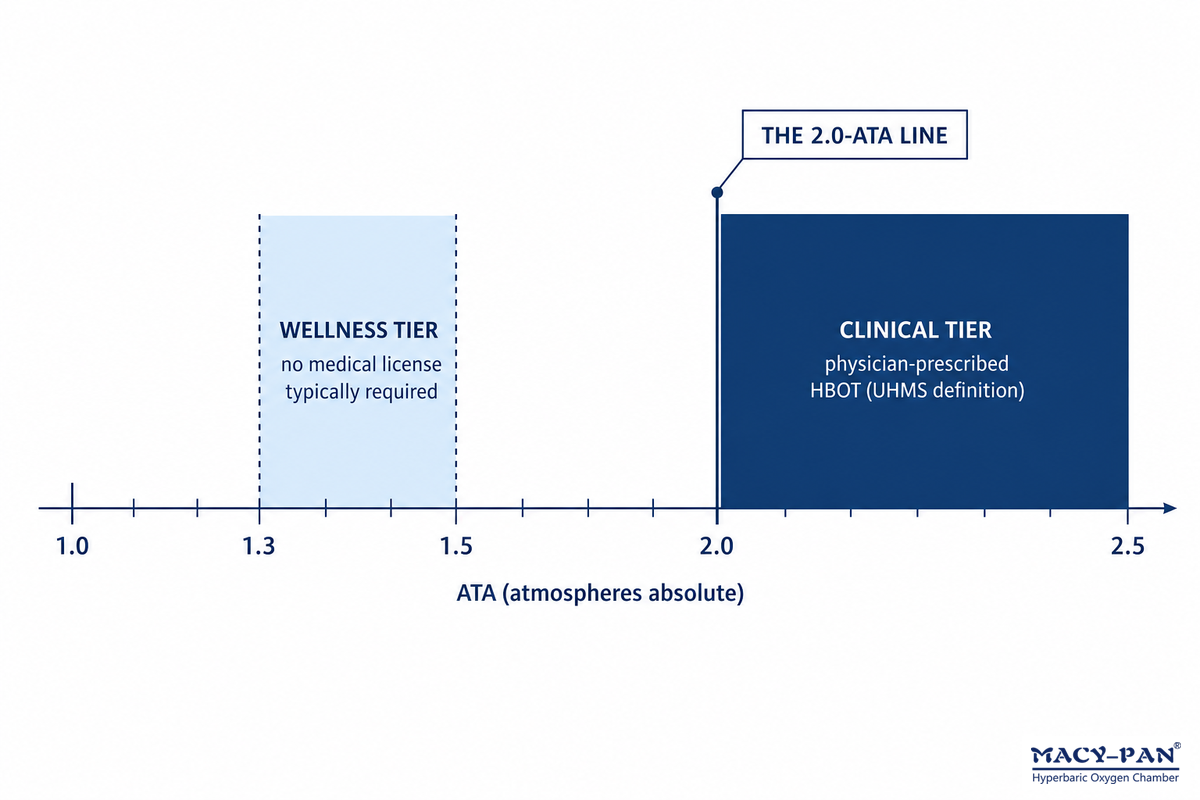
Multiple Undersea and Hyperbaric Medical Society resources converge on the same pressure floor: hyperbaric oxygen therapy is physician-prescribed medical-grade oxygen administered at a pressure not lower than 2.0 ATA. Exact wording on session duration and scope varies across UHMS’s own indications pages and position statements, so treat the pressure threshold — not any single document’s phrasing — as the load-bearing number here. Everything at 2.0 ATA or above counts as clinical HBOT by that threshold; everything below it is a wellness or mild-pressure exposure.
⚠️ Important
2.0-ATA Line is a clinical definition marker not a legal safe-harbor. Even the FDA’s device classification page for hyperbaric chambers doesn’t appear to consider 2.0 ATA as the legal threshold, rather it looks at device classification, use and intended use, ASME, NFPA 99 etc. An appropriately marketed soft-shell chamber as wellness is in a different compliance position than a soft-shell chamber being sold with medical claims for a patient with wellness despite the 2.0 ATA classification.
What that really means in practice is there are actually two questions you as a buyer from a wellness-center are trying to answer: Which pressure level is appropriate for the service that you’re trying to sell and, then, how can you actually advertise that service to potential customers. Deciding whether or not to purchase a hyperbaric chamber actually is a combined question: It’s not simply looking at the ATA number that’s printed on a spec sheet. It is 2.0 ATA under 21 CFR 868.5470 that would likely require the supervision of a physician under FDA regulations if it’s marketed as having a medical application, and that’s a separate question from FDA’s own classification tiers; some individual 510(k) applications submitted to the FDA for specific chamber models do delineate between single-occupant and multi-occupant versions, but that’s an engineering distinction within one filing, not a second FDA-wide classification.
1.3–1.5 ATA Wellness Tier
- Below UHMS clinical threshold
- Typically no medical license required for wellness/recovery marketing
- Cash-pay business model
2.0+ ATA Clinical Tier
- Meets UHMS clinical HBOT definition
- Physician oversight expected for medical-indication marketing
- Insurance-billable only for FDA-recognized indications
Key takeaway: the ATA number informs physiology, it doesn’t alone tell you what you can claim. Be aware of both.
Which Chamber Class Actually Fits Your Business? (The Session-Turnover Capacity Formula)
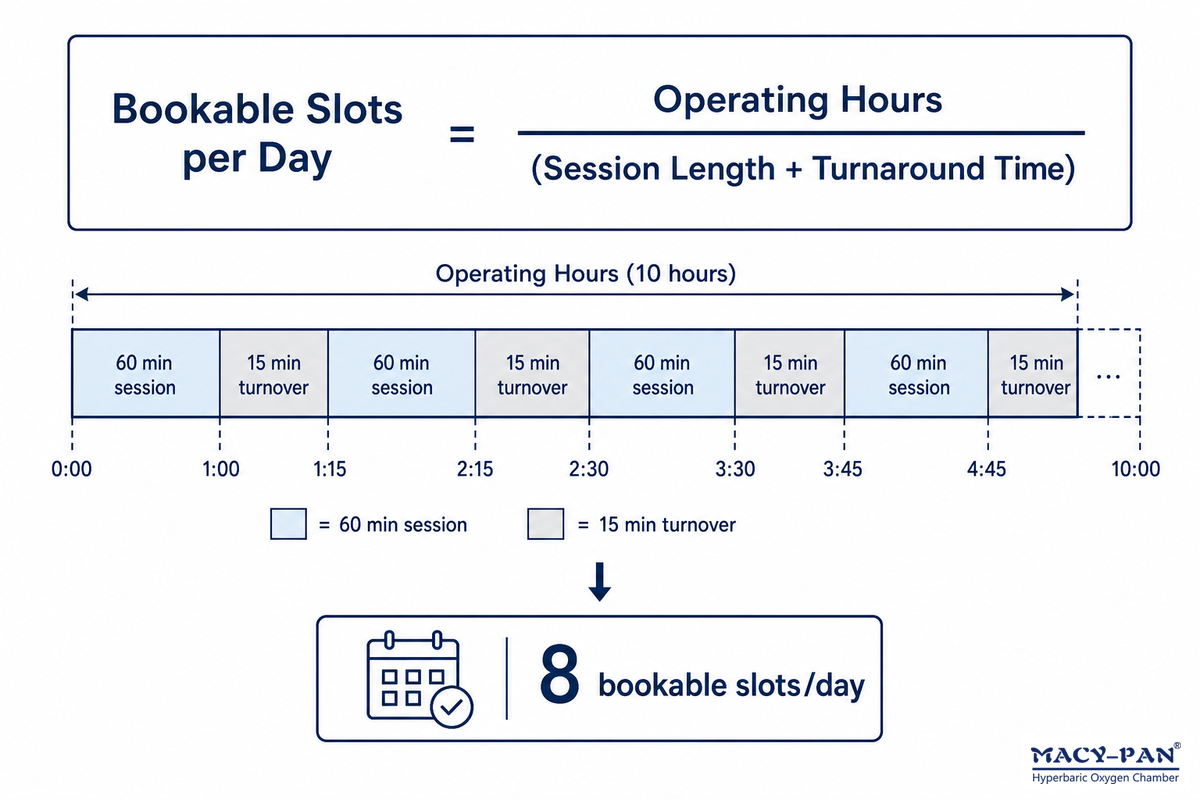
The right chamber class depends less on price and more on how many paying sessions it can realistically support in your operating day. Before comparing quotes, run your own hours and session length through a simple capacity formula, since a cheaper chamber that can’t hit your target session volume is not actually the cheaper option once you account for lost bookings. Use this formula:
The Session-Turnover Capacity Formula
Bookable Slots per Day = Operating Hours (Session Length + Turnaround Time)
Worked example: a studio operating 10 hours a day, which is providing 60-minute wellness sessions and turning them over every 15 minutes (for cleaning/ admin), will offer 10 hours / 1.25 hours = 8 bookable sessions a day. A studio that provides 45 minute sessions and turn-around of 10 minutes will offer 10 hours / 0.92 hours = 10.9 bookable sessions per day, and so, offer 10 bookable slots.
That 8-slot number matches what one of the commercial multiplace suppliers is willing to share for a similar 60-minute-session, 15-minute-turnover schedule (they quote 7-8 slots per day). So, there’s a useful reality check to that formula spits out something plausible, rather than just a theoretical calculation. Stick your own hours and session lengths into the calculation, then go ask chamber for their quote. Keep the turnaround-time input honest, too: the pressure-vessel inspection and maintenance intervals a chamber must follow under ASME eat into bookable hours on top of routine cleaning, so a capacity plan built only on marketing turnover numbers tends to run optimistic.
| Target daily sessions | Floor space available | Recommended class |
|---|---|---|
| 1–8 sessions/day | ~10×12 ft | Soft sitting or lying, single-occupant |
| 8–15 sessions/day | ~12×16 ft | Hard lying, single or dual-occupant |
| 15+ sessions/day, multiple staff | 500+ sq ft | Multiplace, walk-in |
Conclusion: Run the capacity formula through your actual working hours prior to comparing a single dollar amount between two chamber’s – if a chamber is less expensive but doesn’t have the operating hours to handle your session count, it’s not less expensive.
Certification Vetting: ASME, FDA Class II, CE & certified quality management system
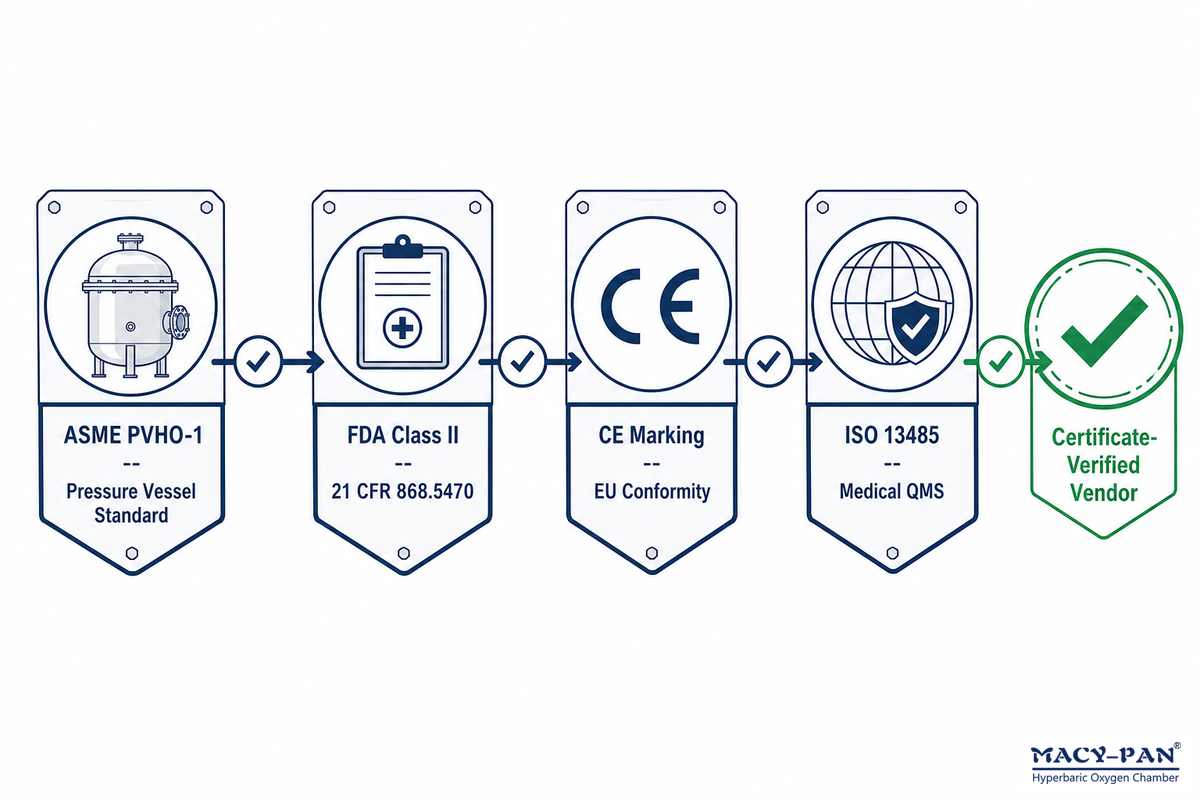
This is the single most consequential checklist on this page. This equipment is an oxygen-enriched pressure vessel with a human occupant. In the interest of cutting costs and bypassing regulatory hassle, many imported models bypass any certification process entirely.
⚠️ Important
Uncertified chambers are not a hypothetical danger. There was a hyperbaric chamber fire in Troy, Michigan in January 2025 which resulted in the death of a 5-year-old child. Another hyperbaric chamber fire killed a 43-year-old clinic owner in Lake Havasu City, Arizona in July 2025. In the Michigan case, the owner had reportedly made claims about the chamber being able to treat conditions such as autism and ADHD without any basis or validation from the FDA. certification and truthful marketing are not bureaucratic requirements; they mean the difference between having a business and having a liability.
This concern has also been officially addressed by Health Canada, which has formally warned that unlicensed soft-shelled hyperbaric chambers “may cause serious injury or death” and has made importing or selling unlicensed models illegal, confirming this isn’t simply a US-centric issue for wellness centers importing from abroad or considering expanding.
- Request the ASME certificate number that corresponds to your exact model, and ensure the scope of your ISO 13485 quality-management-system certification explicitly includes design and manufacturing of the hyperbaric chamber – not just the logo on the website.
- Request SGS or other similar material test reports for the shell fabric, window, and cover. Confirm import and licensing status in your country – Health Canada’s advisory shows this isn’t a given even with a well-established-looking vendor.
- Obtain a written warranty for the pressure vessel (at least 2 years from reputable suppliers) and get specifications on the pressure control and relief valves before installation.
MACY-PAN documents ASME, CE, and quality-management-system certification for its chamber lines and maintains records of certificate numbers and SGS material reports for individual units, see the certification vetting checklist tool for model-by-model details.
“Every MACY-PAN chamber is built and documented to ASME before it ships. We keep the certificate numbers, the SGS material reports, and the relief-valve test records on file for every unit, because a wellness operator should be able to audit a chamber the same way a hospital audits ours.”
Bottom line: make every item on this checklist non-negotiable; a vendor unable to provide a certificate number for your specific model has already demonstrated their lack of transparency.
Licensing Reality: Does a Wellness Center Need a Medical License to Run HBOT?
Generally, no. A wellness-tier chamber run below the 2.0 ATA clinical threshold and marketed as a cash-pay recovery service typically needs no medical license or physician oversight in most US states. That changes once a center operates at or above 2.0 ATA or markets using medical-treatment language, where state medical-practice rules usually apply. Always verify with your own state’s licensing board before opening.
Do you need a license to operate a hyperbaric chamber?
In the United States, there’s no “hyperbaric operator license” as such on the federal level. A wellness-grade chamber, used solely as a cash-based recovery or relaxation service and not promoted as a medical treatment under 2.0 ATA, generally doesn’t require a medical license or the oversight of a physician in most states, separate from the chamber’s own FDA Class II status covered earlier.
A chamber operating at 2.0 ATA or higher for medical purposes will likely require medical supervision, often from certified staff like a Hyperbaric Technologist. Local regulations concerning non-medical wellness facilities vary, and operating a medical condition facility without appropriate licensing can be a violation of medical practice laws at the state level — the risk isn’t the chamber itself, it’s marketing language that outruns what your license actually covers.
There’s a real content gap right now in the equipment-manufacturer space: If you search manufacturer and reseller sites for this exact question, you’ll find almost nothing specific to wellness-center licensing; most answers you find will come from legal-information sites, not from chamber sellers. And since that gap is the very reason this page exists-to give a wellness-center buyer an answer rather than a marketing page dodging the question-we’ll try to fill it.
💡 Pro Tip
Note that state and local licensing rules will vary and can change. Always confirm with your state’s medical board or business licensing office before you open-this page offers the federal framework, not a substitute for legal advice.
In practice: what actually matters for licensing is a combination of pressure tier and marketing language-not just one or the other. Get both of these right before opening.
Space, Installation & Staffing: What Actually Happens Before Your First Paying Session
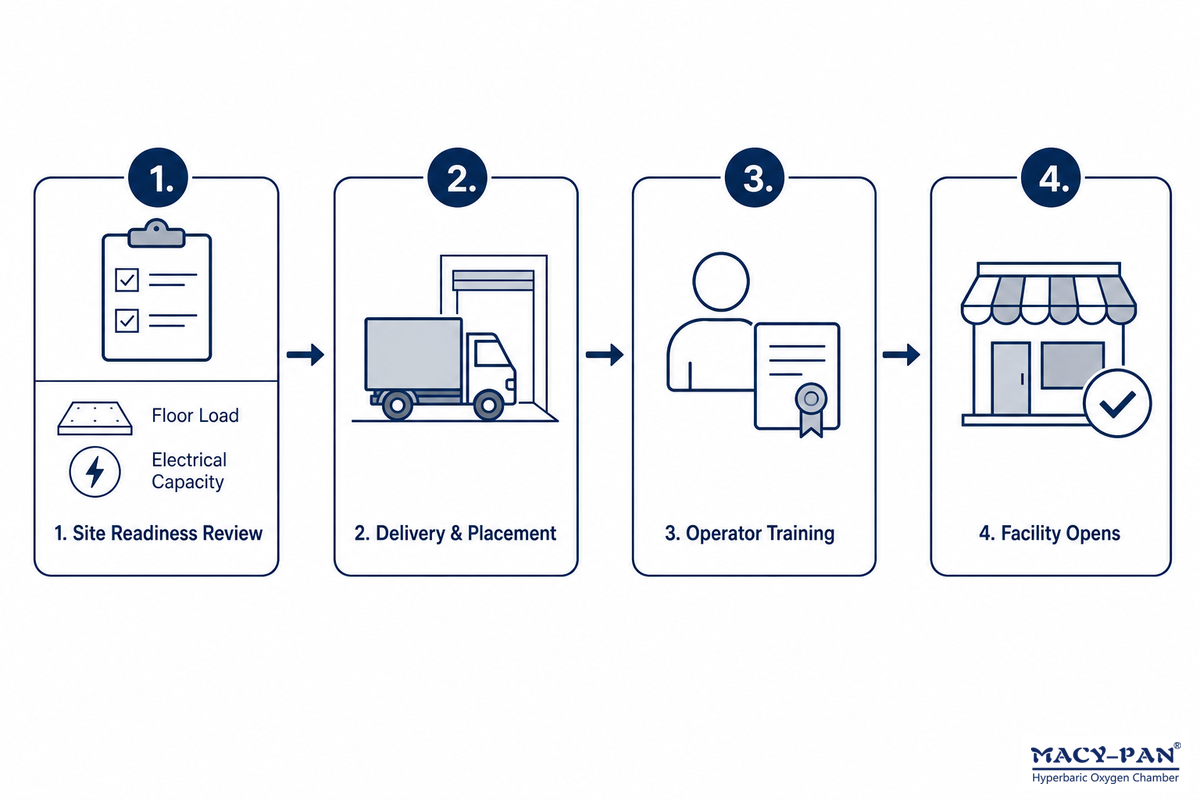
A general flow for installing a wellness-tier chamber in an existing space follows these steps: The facility receives a site readiness review covering delivery access, floor load and electrical capacity. chamber delivery and placement is scheduled. Staff receive operator training, and the facility opens. It’s designed to fit into an existing building, not a new construction project.
- Check the floor’s load capacity for the fully weighted chamber. Most soft-shell and entry hard-shell units plug into a standard 110V outlet, but confirm your model’s compressor and control-panel draw before you assume a standard circuit is enough. Size the internal oxygen concentrator to match the volume of the specific model you install, not a generic size.
- Plan for equipment delivery-hard shell and multiplace units usually require wider doorways (roughly 81-91 cm clearance for typical soft-shell and entry hard-shell models), if not crane access. A typical soft-shell wellness unit weighs in the 90-150 kg range once fully assembled, light enough for a 2-person delivery team on a level entry but still worth confirming against your floor-load number above.
Operator training for wellness-tier chambers is generally structured for spa and hospitality staff rather than clinicians. At least one manufacturer offers training advertised as requiring “no clinical background.” Their training includes basic chamber operation, management of pressure profiles, and safety protocols. However, because any hyperbaric chamber is designated by the FDA as life-sustaining or -supporting technology rather than a consumer wellness product, your emergency preparedness and training plan should align with industry standards such as those outlined in NFPA 99, rather than a basic product-maintenance checklist. This is a significantly different level of responsibility.
Bottom line: “No clinical background required” isn’t a substitute for real, in-depth safety protocol certification. Budget for a program, not a 20-minute walk-through.
Is It Worth It? Pricing Models & the Break-Even Math
Before you put prices on your services, be clear on the difference between your hyperbaric oxygen therapy (the cost of the chamber itself, install and training) and your client’s visit fee. Wellness use of hbot doesn’t fall under CMS or most private insurance; Medicare’s coverage policy only pays for medical conditions on its designated list and doesn’t cover any condition not on that list. Consequently, it’s a cash-pay business from the outset. wellness centers already operating this business model usually set their rates between $115-$149 per month for a two-session membership tier and $290-$500+ per month for more frequent access, with individual sessions commonly costing between $75 and $500 depending on facility type.
| Model | Typical price | Best fit |
|---|---|---|
| Standalone session | $75–$500 | New clients, trial visitors |
| Membership bundle (2–4 sessions/mo) | $115–$500+/mo | Retention, predictable revenue |
The total, out-the-door startup cost for a single-chamber business, per the people who have actually opened one, runs $80,000-$150,000 once you throw in the chamber, oxygen system, buildout, and training — far higher than the retail price listed for just the chamber from the manufacturer, which is exactly why sourcing direct (covered next) matters to the real math. Since it’s based on a single, unverified account by an operator, and not industry benchmarks, just use it to guide you while you develop your own estimate based on actual bids for your facility and market. The common mistake here is pricing off the chamber’s sticker price alone: the real risk to your break-even timeline is underestimating the buildout and training gap between what a chamber costs and what it takes to actually open the doors.
Practically: market sessions and memberships on a cash-pay wellness from the beginning- don’t create a business model expecting to get insurance reimbursed for that purpose, as it usually doesn’t.
Sourcing: Factory-Direct vs Reseller vs Distributor
Wellness Centers typically buy in one of three ways: From the factory directly, from a multi-brand wellness-equipment dealer, or from a local distributor. Each has its own trade-offs in price and support.
✔ Factory-direct
- No reseller markup
- Direct access to certificate records
- OEM/white-label options available
⚠ Reseller / distributor
- Local stock, faster delivery
- Markup built into price
- Verify they still provide manufacturer certificate records
Good sanity check for any reseller: get their name of their manufacturer, and their manufacturer’s certificate numbers-if a reseller can’t (or won’t), don’t use them, no matter how low the price. A few multi-brand US wellness resellers also happen to carry factory-direct chamber lines of Chinese manufacturing, mixed in with their other gear lines; a reseller status isn’t inherently an inferior position. Whichever channel you buy through, cross-check the model against the FDA’s own device classification listing before you sign anything — a reseller repeating a manufacturer’s claims is not the same as that clearance actually existing under the model name on the invoice.
Bottom line: the channel isn’t as important as the persistence of the certificate trail – always check records no matter who your seller is.
Positioning HBOT in Your Wellness Portfolio (Athletic Recovery, Beauty/Anti-Aging, General Wellness)
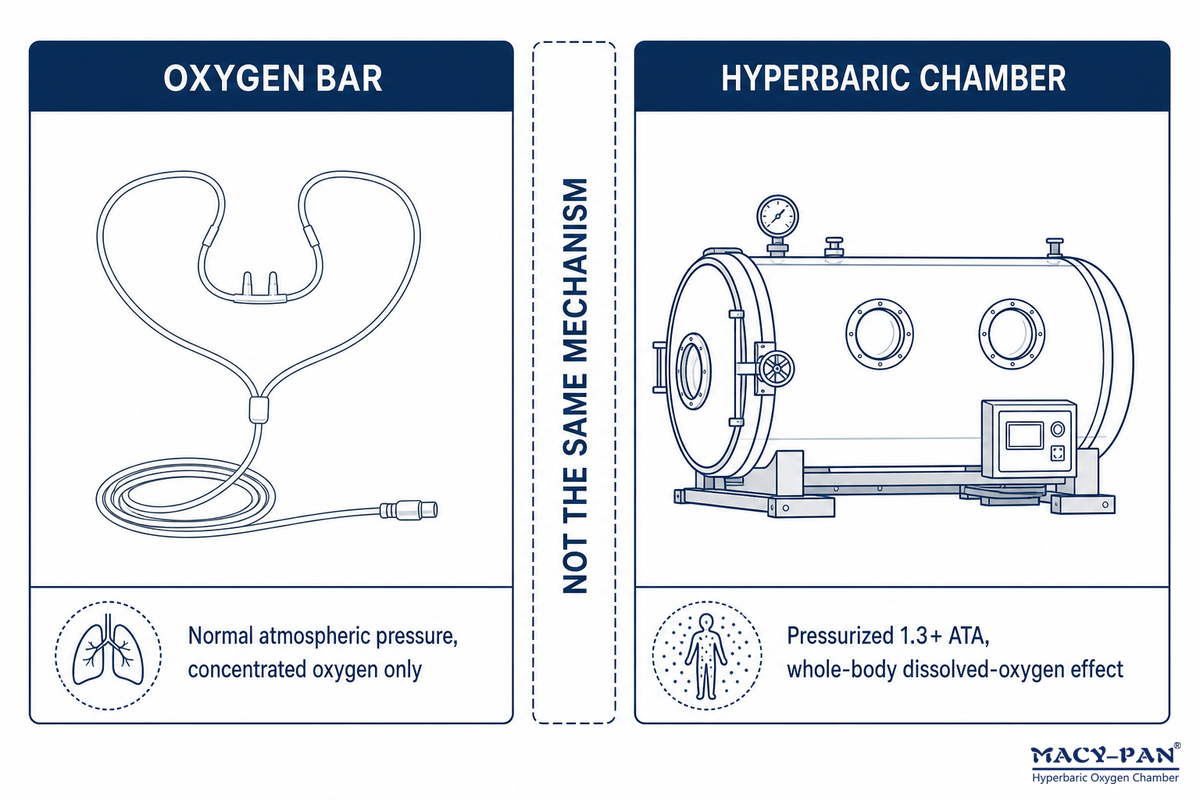
What’s the difference between HBOT and oxygen bars?
An oxygen bar is a different thing entirely: it delivers concentrated oxygen through a nasal cannula at normal atmospheric pressure, with no pressurized chamber and no added dissolved-oxygen effect. A wellness-tier hyperbaric chamber pressurizes the whole body, which is the actual mechanism behind the tissue-oxygenation and recovery effects wellness centers market. The two aren’t interchangeable, and calling an oxygen bar “hyperbaric” is a common marketing shortcut worth avoiding.
Three client segments consistently make wellness level demand for chambers: Athletic Recovery, Beauty/Antiaging, and Generic wellness. Fresh, anecdotal evidence for athleticism include the recent application of chamber therapy for an NFL player in injury rehabilitation and recovery, on top of long-time applications for other elite athletes across several disciplines. With regards to Beauty/Antiaging, the market demand is substantial enough that a published patent (US9919162B2) actually claims the application of a micro-hyperbaric chamber for the use of anti-aging on the skin, which provides evidence that patent inventors are actively exploring this specific application but doesn’t necessarily mean that the underlying wellness patent claims have been validated clinically. Wellness centers commonly position a chamber as one recovery modality among several — alongside red light therapy, cryotherapy, and compression — rather than a stand-alone medical device, which is also the honest framing for the general wellness segment: a way to help clients improve overall wellness, not treat a diagnosed illness. That framing matters because on the clinical side, hospitals use hard-shell chambers built on the identical pressure physics for genuine medical indications such as late tissue injury from prior radiation therapy, where getting enough oxygen to tissues that are starved of it is the actual treatment goal — a different intent, audience, and regulatory bar than a wellness add-on service.
⚠️ Important
In the case of this marketing language is at least as important as the device itself. Australia’s regulatory authority imposed a penalty of AU$3 million on an Australian hbot operator and one of its directors for claims about hyperbaric oxygen therapy that the company could not substantiate. Marketing of wellness as being to aid recovery or a “wellness for health” instead of a cure for illness reduces market risk greatly.
Bottom line: position the service as recovery & wellness assistance in all three of those categories; align the language around the service to what that pressure tier actually enables; and evaluate those unsubstantiated medical-benefit claims as a true regulatory risk, rather than merely an ethical consideration.
Industry Outlook: Where Wellness-Center HBOT Is Headed
Hyperbaric oxygen therapy have been in use well outside of clinics for a long time, and today spa and wellness centers represent the fastest-growing segment of purchasers for the devices, based on reports by independent spa-industry trade presses reporting on the space in 2026 – not on claims made by a chamber manufacturer, but by a third party to identify the centers of actual purchasing demand. That shift comes with increasing scrutiny over safety; reported chamber fires in 2025 in Michigan and Arizona have brought scrutiny to the devices’ certification and marketing claims with an unprecedented public profile, and governments in multiple countries have demonstrated they’re willing to act on unlicensed equipment and unsubstantiated claims alike.
For a wellness center considering a purchase between 2026-2027, the take-home is that this is a great time to buy – from a legitimate, certified provider – while the sector is still under-differentiated from a compliance perspective; centers that can document ASME and certified quality management system compliance will do so more easily over time rather than less so. The real risk sits with operators who wait: as scrutiny rises, the compliance gap between documented and undocumented sellers only gets more expensive to close later. The global market for hbot devices is predicted to see growth at a compound annual rate of roughly 5.5% over the next several years; that’s helpful context for the category in general but offers less clarity for an individual center’s buying decision than the certification and demand segment data.
Bottom line: the category demand growth is significant and is backed by third-party industry data; the centers that are going to best positioned to capitalize on that growth are the ones treating certification and honest marketing as a non-negotiable first step rather than a mere footnote.
FAQ
Q: How does HBOT support overall wellness?
View Answer
A wellness-tier hbot increases blood oxygen content by exposing the patient to higher-than-normal concentrations of air pressure. That increased supply is delivered throughout the bloodstream to help power the cellular processes that aid recovery, inflammation reduction, and that general feeling of well-being associated with a good wellness session. That said, wellness-tier devices offer general support for wellness and recovery, rather than treatment for a diagnosed medical condition at wellness pressures.
Q: How does HBOT improve athletic performance?
View Answer
When athletes use hyperbaric chambers for sessions, they’re generally seeking recovery rather than a direct boost in physical performance; faster tissue repair is aided by additional oxygen delivery and can help decrease the amount of time between high-intensity training sessions, which explains its adoption among pro athletes recently. chamber sessions have become part of the injury-recovery plans of several professional athletes, most recently even in the NFL. The devices help improve capacity for recovery rather than direct output within the session itself.
Q: What are the risks or complications of hyperbaric oxygen therapy?
View Answer
At wellness pressures, users can expect relatively minor effects, mostly pressure on the ears and sinuses similar to flying; this is easily managed by swallowing or yawning. Most serious risks, of course, involve equipment malfunctions leading to fire hazards in the oxygen-rich environment, which is why certification (ASME and certified quality management system compliance) and adherence to manufacturer protocols aren’t just recommended-they are essential preventative measures.
Q: Who is HBOT good for in a wellness-center setting?
View Answer
chamber devices at wellness pressures are appropriate for patients seeking general health recovery, athlete recovery support, or anti-aging and general wellness services, not for those patients requiring treatment for a diagnosed medical condition, which is appropriate only in a clinical setting at 2.0 ATA and above, with the oversight of a medical professional.
Q: Can a wellness center operate a hyperbaric chamber without a medical license?
View Answer
Generally yes if it’s wellness level (below 2.0 ATA) and advertised without any health benefits claims. Some states may require a license so always check with your local licensing board first.
Q: How much floor space does a commercial hyperbaric chamber need?
View Answer
About 10×12 ft for a soft single-occupant unit, up to 500+ sq ft for a multiplace walk-in system – see the facility-fit table above for the full breakdown by class.
Want to Compare wellness-level chamber models to factory-direct costs with full certification records?
About This Analysis
This guide compiles data from FDA device-classification records, UHMS clinical definitions, ASME’s PVHO-1 standard, published wellness-center pricing pages, and regulator enforcement actions in the US, Canada, and Australia. Chamber capacity and pricing figures for our own Soft, Hard, and Multiplace lines reflect MACY-PAN’s model-specific ASME files and manufacturing under a certified quality management system; third-party figures are cited to their original source and labeled where they come from a single, unverified report rather than a cross-checked benchmark.
References & Sources
- Hyperbaric Oxygen Therapy IndicationsUndersea and Hyperbaric Medical Society
- Hyperbaric Chamber Device Classification, 21 CFR 868.5470U.S. Food and Drug Administration
- Safety Standard for Pressure Vessels for Human Occupancy (PVHO-1)ASME
- Unlicensed Soft-Shelled Hyperbaric Chambers May Pose Serious Health RisksHealth Canada
- National Coverage Determination: Hyperbaric Oxygen Therapy (20.29)Centers for Medicare & Medicaid Services
- Oxymed Australia Ordered to Pay $3 Million for Unlawful AdvertisingTherapeutic Goods Administration, Australia
- 4 Charged in Death of 5-Year-Old Boy in Hyperbaric Chamber ExplosionAssociated Press
- Man Dies After Flash Fire in Hyperbaric Chamber in ArizonaThe Washington Post
- US9919162B2, Apparatus for Providing Light Therapy (Skin Anti-Aging Micro-Hyperbaric Chamber)USPTO / Google Patents
- HPO Tech Brings Design-Led Hyperbaric Systems to the Spa FloorSpa Business Magazine
Related Articles
- Hard-Shell & Medical-Grade Hyperbaric Chambers: How Pressure, Certification, and Build Quality Separate Clinical Devices from Wellness Boxes
- Soft Shell Hyperbaric Chambers: What They Really Do and How to Buy One Safely
- OEM vs ODM vs Private Label for Medical Devices
- Hyperbaric Oxygen Therapy and Anti-Aging: The Evidence, Explained
![Decision lenses: occupancy, gas path, access, staffing, facility interfaces, and exact-model evidence [article].](https://macypansolutions.com/wp-content/uploads/2026/10/monoplace-vs-multiplace-hyperbaric-chambers-featured-1-768x512.png)