Get in Touch with MACY-PAN Company


Hyperbaric Chamber Benefits: What You’re Actually Buying When You Own One
Hyperbaric chamber benefits is a phrase that generally means two different things depending on who’s asking: the clinical case for HBOT treatment, or the practical case for owning a chamber at home.
Quick Specs, Soft-Shell (Mild) Chambers
| Pressure range | 1.3–1.5 ATA (4–7 psi) |
| Oxygen delivery | Ambient air compressed, paired with an included oxygen concentrator (up to ~93% via mask/headset) |
| Typical U.S. price band | $5,000–$20,000 (most home units $5,000–$10,000); entry pricing varies by manufacturer |
| FDA status | Full-body hyperbaric chambers are a Class II device (product code CBF); most wellness-marketed soft-shell units carry no medical-treatment clearance, and only specific individual models hold a prescription-only clearance for acute mountain sickness — verify the exact model, not the category |
| Typical session length | 45–90 minutes (roughly 0.75–1.5 hrs) per wellness session |
| Power draw | Compressor and concentrator draw varies by model — confirm the combined rated amperage with MACY-PAN before an electrician sizes the circuit |
| Who it’s realistically for | Wellness, sports recovery, and daily oxygen-enrichment users — not a replacement for physician-supervised clinical HBOT |
Hyperbaric chamber benefits, hyperbaric oxygen benefits, hbot benefits, whichever phrase brought you here, get discussed almost entirely in clinical terms, what the therapy does inside a hospital-grade chamber under a doctor’s supervision. That conversation matters, and our companion article covers it in full. This one answers a different question, the one most people actually researching hyperbaric chamber uses for a home purchase need answered: what changes once you’re the one who owns the chamber, not just the one who books a session in it.
In short:
- Owning a chamber buys you access and control over your own schedule, not a different clinical outcome than a supervised session delivers.
- A soft-shell (1.3–1.5 ATA) home chamber and a 2.0+ ATA clinical hard chamber are different product categories with different FDA status, this article keeps that line explicit throughout.
- Total ownership cost runs well beyond the sticker price once installation, oxygen supply, and maintenance are counted.
- Medicare and most insurance cover hyperbaric oxygen therapy sessions for a defined list of conditions, not the purchase of a personal chamber.
- Verifying a seller’s compliance paperwork before you pay is the single most protective step in this whole decision.
What a Hyperbaric Chamber Actually Does (and Doesn’t Do)
A hyperbaric chamber is an enclosure that raises air pressure above normal atmospheric pressure so the body absorbs more oxygen into its tissues than it would breathing room air. That’s the entire mechanism, everything else is a question of degree. A clinical hyperbaric oxygen therapy (HBOT) chamber runs at 2.0 ATA or higher, delivers near-100% medical-grade oxygen, and operates under physician supervision for a defined list of medical conditions.
FDA classifies that device as Class II under product code CBF, per its product classification database. A soft-shell “mild” chamber, the type most people are shopping for when they search for a home unit, runs at 1.3–1.5 ATA, pressurizes ordinary ambient air, and typically pairs that mild pressure with an included oxygen concentrator to boost the oxygen level a user breathes through a mask. These aren’t two strengths of the same product; they’re two different regulatory categories, and this article is careful to say which one it’s talking about at every step. The mistake many buyers make is assuming the marketing phrase “hyperbaric chamber benefits” means the same product regardless of price. In reality, that pricing gap traces back to FDA classification: a 2.0+ ATA hard chamber must carry FDA 510(k) clearance as a Class II medical device, while soft-shell mild chambers are typically sold without a medical-treatment clearance claim at all. That regulatory gap is the reason a $4,495 soft-shell unit and an $80,000 hard chamber can both legally use the word “hyperbaric” in their marketing.
At 1.3 ATA breathing only compressed ambient air, the gas mixture itself is still ~21% oxygen, but the added pressure raises oxygen’s partial pressure to a sea-level-equivalent of roughly 27%, a real but modest change, not the actual percentage of oxygen molecules in the air. The oxygen concentrator a soft-shell chamber ships with is what does the heavier lifting, typically rated in the low-90s percent range, pushing inhaled oxygen concentration up through a mask independent of the mild pressure itself. Buyers evaluating “hyperbaric chamber benefits” for a home purchase are functionally evaluating that combination, mild pressure plus a concentrator, not the near-100%-pure-oxygen, high-pressure protocol used in a hospital HBOT unit.
Clinical HBOT, historically, grew out of treating conditions where getting more dissolved oxygen into the bloodstream quickly matters most: decompression sickness in scuba divers who surface too fast from undersea depths, carbon monoxide poisoning, and severe wounds where local blood supply has been compromised. At 2.0+ ATA while breathing pure oxygen, that increased pressure pushes more oxygen into the blood plasma itself rather than relying only on red blood cells to carry it, enough of a shift that researchers have documented downstream effects on new blood vessels forming, blood flow to injured tissue, and collagen production tied to wound healing. None of that’s what a 1.3–1.5 ATA soft chamber running on compressed air and a concentrator is designed to reproduce; it’s mentioned here only so the two products aren’t confused with each other. One practical mechanical note that applies to both categories: pressurizing and depressurizing changes the air pressure in your middle ear the same way a flight does, which is why chamber instructions always include ear-clearing guidance regardless of which type you’re using.
If you’ve read elsewhere that hyperbaric oxygen therapy helps the body heal by increasing the amount of oxygen in the blood, that description is accurate for clinical HBOT, not a claim about a home soft-shell chamber. At clinical pressure, extra oxygen dissolves directly into blood plasma at a much higher concentration of oxygen than normal air pressure delivers, and pressure alone increases the amount of oxygen physically available to tissue. That is why hospitals that offer hyperbaric oxygen therapy use it to help heal chronic wounds, other non-healing wounds, and radiation therapy tissue damage, one of the documented effects of radiation that clinical HBOT is used to treat, conditions where the body’s natural healing process has stalled because local blood supply and the delivery of oxygen are compromised. The field of hyperbaric medicine, whose professional body is the Undersea and Hyperbaric Medical Society, is also why hyperbaric oxygen therapy treats several infection-related conditions, like gas gangrene and progressive necrotizing infections, that appear on Medicare’s approved list. None of that describes what happens inside a soft-shell chamber at home; our companion guide on the benefits of hyperbaric oxygen therapy covers exactly which effects of hyperbaric oxygen therapy are proven at 2.0+ ATA.
A physician can legally direct hyperbaric oxygen therapy for a condition off that approved list, using individual clinical judgment; hyperbaric oxygen therapy is generally reserved for the conditions on that list, though, and the point isn’t that off-label use is improper, it’s that the evidence backing it is a different, generally thinner, bar than the approved list, and a clinic that offers the therapy is expected to be upfront about that distinction: hyperbaric oxygen therapy must be prescribed and dosed by a physician, not self-selected. Some marketing pages claim oxygen helps enough to meaningfully treat a traumatic brain injury or general brain injury at any pressure; the evidence base there is far thinner than for the Medicare-approved conditions covered later in this article, and it’s a claim our companion guide addresses directly rather than one this article repeats. For the conditions that are approved, though, the therapy increases dissolved oxygen enough that hbot helps measurably; patients who get hyperbaric oxygen therapy or undergo hyperbaric treatment for those specific diagnoses are relying on a real, if narrow, ability to heal, one where extra oxygen plays a defined clinical role rather than a general wellness one. Doctors use hyperbaric oxygen therapy to help a specific diagnosed problem when the body can’t deliver enough oxygen on its own, whether patients are treated with hyperbaric oxygen therapy at a hospital-based medical center or a standalone oxygen treatment center; either way, the benefits of HBOT in that setting are well documented for the approved conditions, which is the whole reason that list exists.
The Real Benefit of Owning vs. Renting Access
Owning a chamber changes what you’re buying: access and control on your own schedule, not a different physiological outcome than a comparable session elsewhere delivers. That framing matters because most of what gets written under “hyperbaric chamber benefits” is really about what hyperbaric oxygen therapy does clinically, cellular oxygenation, wound-healing support, the specific conditions where evidence is strongest. Our companion guide, Hyperbaric Oxygen Therapy Benefits: What Actually Happens Under Pressure, walks through that evidence tier by tier. This article assumes you’ve either already read that or already know you want the wellness/recovery use case, and instead answers the practical question: if your search started as “hyperbaric oxygen therapy near me,” what does ownership itself change versus renting access by the session at a local clinic?
The honest answer is: mostly logistics and cost structure, not physiology. A soft-shell chamber you own delivers the same mild pressure and concentrator-boosted oxygen whether you use it once a month or daily, the “benefit” of ownership is removing the friction of booking, traveling to, and paying per visit for that same experience. It doesn’t upgrade a 1.3 ATA wellness session into 2.0 ATA clinical therapy, and no legitimate seller should imply that it does — the FDA’s own guidance to health care providers draws exactly this line between wellness marketing and FDA-cleared medical claims.
Who Actually Buys a Chamber, The 9-Scenario Buyer Field Guide
Anyone shopping for a hyperbaric oxygen chamber for home use falls into a handful of recognizable buyer scenarios, and each one is optimizing for something different. Matching yourself to one of these before comparing models saves the most common early mistake: shopping on price before shopping on fit.
| Buyer type | Primary goal | What they check first | Where to go deeper |
|---|---|---|---|
| Athlete — solo recovery routine | Faster turnaround between training sessions | Entry size, session frequency tolerance, portability | hyperbaric chamber for athletes guide |
| Athlete — shared team/training-facility use | Higher throughput across multiple athletes | Multi-user durability, cleaning turnaround between users | See the small clinic / multi-room facility row below |
| Family — single-adult home wellness | Daily oxygen-enrichment routine at home | Room fit, noise, ease of setup | what a hyperbaric chamber is guide |
| Family — multi-person household sharing one unit | Cost-effective access for more than one user | Chamber size, whether an adult can accompany a child | The home hyperbaric chambers lineup covers multi-user sizing |
| Wound-care support — physician-directed supplement | Supplementing (never replacing) an existing treatment plan | Physician sign-off before purchase | Discuss with the treating physician first |
| Wound-care support — mobility-limited user | Safe, assisted entry and exit | Wheelchair-accessible entry, caregiver assistance space | Discuss with the treating physician first |
| Small clinic / wellness-studio — solo practitioner | Adding one cash-pay recovery service | Warranty terms, realistic booking throughput | See the reseller/distributor row below |
| Small clinic / wellness-studio — multi-room facility | Higher client throughput across multiple units | Multi-unit maintenance contracts, staff training | See the reseller/distributor row below |
| Reseller / distributor | Sourcing for resale, not personal use | OEM/private-label terms, minimum order quantities, factory QC documentation | OEM / private-label sourcing guide |
Q: Who cannot go in a hyperbaric chamber?
Anyone with an untreated collapsed lung (pneumothorax), certain ear or sinus conditions, or specific medication and medical-history contraindications should not use a hyperbaric chamber, soft or hard, without a physician’s clearance first.
This isn’t a full contraindication list, and it isn’t meant to replace a physician conversation. It’s meant to flag the single most common reason a buyer profile gets ruled out before purchase: an untreated pneumothorax is a recognized absolute contraindication for pressurized environments generally. If you have a chronic respiratory, cardiac, ear, or sinus condition, or you’re on medication your doctor hasn’t cleared for pressure changes, get that conversation done before you spend money on a chamber, not after.
Soft-Shell vs. Hard-Shell, Which Category You’re Actually Choosing Between
Before comparing specific models, you’re choosing between two structurally different products. Soft-shell (mild) chambers are flexible, usually TPU-shelled, zip-sealed enclosures running 1.3–1.5 ATA (roughly 4–7 psi above ambient) on compressed ambient air plus a concentrator, the category almost every home buyer actually needs. Hard-shell chambers are rigid steel or acrylic pressure vessels running 2.0 ATA or higher (about 15 psi and up above ambient) on near-100% medical-grade oxygen, built for physician-supervised clinical therapy. Reaching for a hard-shell “because higher pressure sounds better” is the second most common buying mistake after skipping the compliance check in the next section, higher pressure isn’t a home-wellness upgrade, it’s a different, physician-directed medical device category with a different price tier entirely (commonly $40,000–$150,000+ versus $4,495–$20,000 for soft-shell).
✔ Soft-shell fits you if…
- Your goal is general wellness, recovery, or daily oxygen-enrichment, not treating a diagnosed medical condition
- You want cash-pay, no-prescription-required operation in most states
- Budget realistically sits under $20,000
⚠ Hard-shell is the honest answer if…
- Your physician has prescribed clinical HBOT for a diagnosed condition
- You need near-100% oxygen at 2.0+ ATA under medical supervision
- You’re building a clinic, not a home routine
Within “soft-shell” itself, posture and entry style split the category further, a distinction most buying guides skip past. The table below lines up real chamber classes and models by type, from small sitting units to full clinical multiplace chambers, so you can see where a given product actually sits before comparing prices.
| Model / class | Type | Pressure | Best for |
|---|---|---|---|
| L1 | Soft, sitting, single-user | 1.3–1.5 ATA (≈4–7 psi) | Smallest footprint, tight spaces |
| ST1700 | Soft, sitting, single-user | 1.3–1.5 ATA (≈4–7 psi) | Everyday home use, folding-chair comfort |
| ST2200 | Soft, sitting, single-user | 1.3–1.5 ATA (≈4–7 psi) | Larger users, adult-plus-child sessions |
| ST801 | Soft, lying, single-user | 1.3–1.5 ATA (≈4–7 psi) | Full-length lying sessions, higher oxygen flow option |
| MC4000 U/N | Soft, wheelchair-accessible | 1.3–1.4 ATA (≈4–6 psi) | Limited-mobility users, two-occupant sessions |
| Generic soft multiplace | Soft, multiplace (2+ users) | ~1.3–1.5 ATA | Small studios running back-to-back clients |
| Hard-shell monoplace | Hard, single-user, clinical | 2.0–3.0 ATA (≈15–29 psi) | Physician-supervised clinical HBOT, one patient |
| Hard-shell multiplace | Hard, multi-user, clinical | 2.0–6.0 ATA (≈15–74 psi) | Hospitals, high-acuity or emergency cases |
| Topical oxygen chamber (extremities) | Different device class entirely | Slightly above atmospheric | Local limb wound care only — not a full-body chamber, separate FDA classification (21 CFR 878.5650) |
Our full soft-shell mild chamber lineup lists per-model pressure ceilings, oxygen flow rates, and entry styles side by side if you’ve already narrowed to this category; our soft-vs-hard chamber comparison page covers the full decision tree in more depth than this section does, and the home hyperbaric chambers guide covers room-prep and electrical planning specific to home use.
What Owning a Chamber Actually Costs, The True Ownership Cost Formula
Most hyperbaric chamber cost estimates only quote the listed purchase price, which is just one line in the real cost of owning a chamber. Installation, the oxygen concentrator and compressor system, ongoing maintenance, and, for higher-pressure setups, training all add to the number a buyer should budget against, not just the checkout total.
5-year total cost of ownership — soft-shell (mild) chamber:
| Cost item | Typical range |
|---|---|
| Purchase price (chamber + included concentrator/compressor) | $4,495–$20,000 |
| Installation / setup | $200–$1,000 |
| Maintenance (5-yr total, soft-shell) | ~$1,500–$4,000 (roughly $300–$800/yr) |
| Consumables (filters, concentrator servicing) | Included in most manufacturer maintenance plans; verify before buying |
| Training | Usually $0 for soft-shell personal use (manufacturer walkthrough); required and separately budgeted for any clinical hard-shell setup |
Worked example: a $9,000 soft-shell unit, $500 installation, and $500/year maintenance runs to roughly $9,000 + $500 + ($500 × 5) = $12,000 over five years — a real total that’s about 33% above the sticker price alone. Hard-shell clinical setups scale very differently: purchase in the $40,000–$150,000+ range, plus $1,500–$6,000 a year in maintenance versus a soft-shell’s $300–$800, because they involve more complex pressure-vessel systems and medical-grade oxygen supply.
Not-suitable-for note: this formula assumes single-user personal or small-studio use. It doesn’t capture staffing costs, insurance-billing infrastructure, or facility build-out, real added line items for anyone planning a multi-room clinical operation rather than a personal or small-studio setup. Cost estimates like these can shift a great deal by case volume and setup, a pattern a state health-technology cost-effectiveness review of HBOT has also documented for clinical settings.
Clinic Sessions vs. Home Ownership, Why It Isn’t One Number
There’s no single breakeven number between paying per clinic session and owning a chamber, because the variable that drives the math, how many sessions you’d actually use, varies by condition, protocol, and individual response, and no authority publishes one universal session count. A rough per-session comparison can still be useful as a starting point, but treat any “you’ll break even in X months” claim you see elsewhere as a simplification, not a guarantee; for the fuller math with your own numbers, use the price and session-rate ranges above.
Clinic per-session rates vary widely by region and provider, and neither MACY-PAN nor any clinic partner publishes a fixed number this project could independently verify — treat any specific per-visit price you’re quoted locally as one data point, not an industry average. What’s more durable than a specific number is the shape of the comparison: a soft-shell purchase (see the worked example above) is a fixed cost with no per-use fee, while clinic sessions are a recurring cost — how many sessions you’d realistically use in year one is what actually determines which is cheaper, not the sticker price alone. A Canadian health-technology assessment on HBOT economics found that clinics can’t always fill every session slot to capacity, which changes the real per-session cost clinics need to charge to stay viable — a reminder that a quoted clinic price is a starting point for a phone call, not a number you can compare against on your own.
⚠️ Important, insurance doesn’t change this math the way people assume
Per Medicare.gov’s coverage page, Part B may cover hyperbaric oxygen therapy sessions delivered in a chamber, including a one-person unit, for a defined list of covered conditions, with the patient typically paying 20% of the Medicare-approved amount plus any applicable deductible; that clinical service runs at 2.0+ ATA under a physician’s care. It does not extend to purchasing a personal soft-shell wellness chamber, which is a cash-pay product in nearly every case. If a seller implies insurance will offset your home-chamber purchase, ask them to point to the specific coverage policy, in most cases it doesn’t exist for that use.
Before You Buy, The 4-Layer Compliance Verification Framework
Verifying a chamber and its seller are legitimate comes down to four checkable layers, all tied to the same FDA device classification for full-body hyperbaric chambers (product code CBF, 21 CFR 868.5470, Device Class 2, 510(k) submission pathway): premarket clearance status, manufacturing quality system, the physical build standard, and accurate labeling. FDA lists NFPA 99 (2024 edition) and ASME PVHO-1 (2023 edition) — the Health Care Facilities Code and the pressure-vessel-for-human-occupancy safety standard, respectively, as its recognized consensus standards for this device category. Recognized consensus standards aren’t automatically a legal mandate on every seller (FDA treats conformity as voluntary unless a standard is specifically incorporated by reference), but a manufacturer building to them, and willing to show you the paperwork proving it, is doing more than the regulatory floor requires.
Buyer verification checklist — ask any seller for these before you pay:
| What to ask for | Why it matters | How to verify |
|---|---|---|
| Pressure-vessel engineering standard (ASME PVHO or equivalent) | Confirms the vessel is built to a recognized safety spec, not just marketed as one | Ask for the specific standard and edition year in writing, for the exact model |
| Material safety/fire test report (e.g. SGS or equivalent) | Shell material fire-safety relevant in an oxygen-enriched environment | Request the lab report, not just a logo on the website |
| Quality management system scope (e.g. ISO 13485) | Confirms the certification actually covers hyperbaric chamber design and manufacturing, not an unrelated product line | Confirm the certificate’s stated scope explicitly names hyperbaric chambers |
| FDA clearance status for the specific claimed use | Wellness marketing claims and FDA-cleared medical claims are legally different things | Search the FDA 510(k) database by product code CBF; a wellness-marketed soft chamber legitimately may show no clearance at all if it makes no medical claims |
| Number and type of built-in safety devices | Redundant relief valves and monitoring are what keep a rare fault from becoming an incident | Ask for a written list — pressure gauges (internal + external), automatic and manual relief valves, and door-close sensor lock are reasonable items to ask any seller to confirm in writing |
| Factory inspection / aging-test process | Confirms every unit is checked before shipping, not just the design | Ask whether each unit goes through a documented pre-shipment inspection and burn-in test |
| Warranty length and coverage scope | A short or vague warranty is a signal of low confidence in the build | Get warranty terms and what’s excluded in writing, not a verbal promise |
| Post-sale maintenance and parts availability | Compressors and concentrators are wear components with finite service life | Ask directly whether replacement parts and service are available after the sale, and for how long |
| Oxygen concentrator specification (flow rate, purity) | This component, not the chamber shell, does most of the oxygenation work in a soft-shell unit | Ask for the concentrator’s rated output percentage and flow rate (L/min), not just “included” |
| Real, checkable customer or clinical references | A manufacturer with nothing to show after years in business is a red flag on its own | Ask for a reference you can actually contact, not just a testimonial page |
A real cautionary example: in early 2020, Health Canada seized six unlicensed soft-shelled hyperbaric chamber units from distributors in Quebec, a documented case of exactly the scenario this checklist is designed to prevent. Most legal exposure in this category doesn’t come from ownership itself; it comes from a seller making unsupported medical claims or skipping the paperwork a legitimate buyer should have asked to see.
Who Shouldn’t Buy One, Risks, Red Flags, and the Purchase Red-Flag List
On August 25, 2025, the FDA issued a letter to health care providers reminding them of real reports of serious injuries and deaths linked to hyperbaric chamber fires, with the root cause of those specific incidents still under review. The underlying risk is well understood even without knowing the specific case details: oxygen-enriched environments carry a heightened fire risk.
FDA’s recommendations cover trained staff, continuous supervision during sessions, manufacturer-specified maintenance intervals, and patients wearing hyperbaric-compatible clothing such as cotton; though addressed to health care facilities, the same fire-prevention logic applies to any hyperbaric chamber, soft-shell included, not only hospital-grade units.
“The FDA is aware of recent reports of fires that occurred with HBOT devices that resulted in serious injuries and deaths. Currently, the root cause of these events is not known.” — FDA, Letter to Health Care Providers, August 25, 2025
The Purchase Red-Flag List
⚠ Walk away if a seller…
- Claims the chamber treats or cures a specific diagnosed disease
- Uses unverifiable “before and after” photos as proof of a medical outcome
- Can’t produce a written pressure-vessel standard for the exact model
- Implies insurance will cover your personal purchase without pointing to an actual policy
- Pressures same-day payment with no documentation review window
✔ Reasonable to proceed if a seller…
- Frames the product honestly as wellness/recovery, not disease treatment
- Provides engineering standard, material test report, and QMS scope on request
- Discloses which conditions (if any) hold FDA clearance and which don’t
On the buyer side: anyone with an untreated pneumothorax, certain cardiac, respiratory, ear, or sinus conditions, or specific medications should get physician clearance before using any pressurized chamber, soft or hard. That’s not a full contraindication list, it’s a prompt to have the conversation before you spend money, not a substitute for one.
What You Need in Place Before Day One (Integration & Ownership Requirements)
Most soft-shell chambers ship as a complete, plug-in-ready kit, the enclosure, oxygen concentrator, oil-free compressor, and internal/external pressure gauges included as one package, with the chamber itself falling under the same FDA device classification described earlier (the concentrator and compressor are separately regulated components sold alongside it), which is what keeps most installation timelines to a day or two rather than several weeks of separate equipment sourcing.
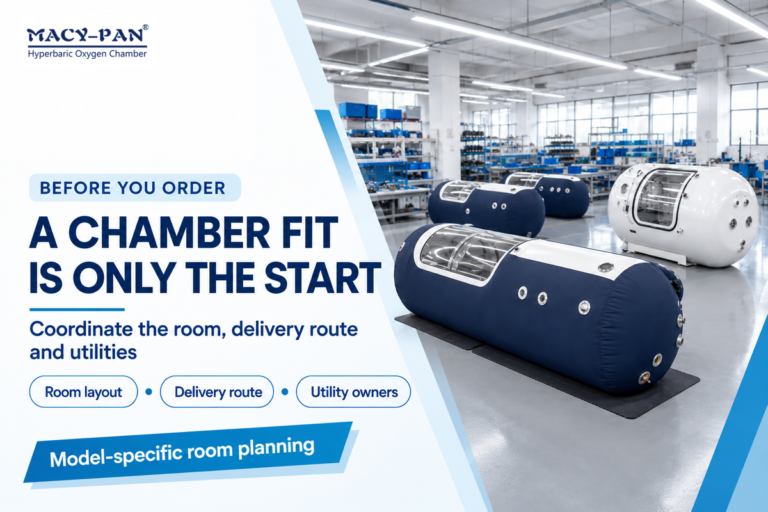
What buyers still need to plan for is straightforward but easy to skip: a household electrical circuit sized to the compressor’s and concentrator’s combined rated amperage (confirm this with MACY-PAN before an electrician sizes it), enough floor space for the chamber footprint plus clearance to enter and exit comfortably (footprint and shipping weight vary by model — MACY-PAN publishes per-model specs, confirm directly), and a room where the compressor’s operating noise won’t be disruptive during use.
Two questions are worth asking any manufacturer directly before you buy: what does the standard warranty cover, and is ongoing maintenance support (not just a one-time sale) actually available after the unit ships. Component parts like compressors and concentrators have finite service lives, get the maintenance-interval and parts-availability answer in writing, not as a verbal assurance. Skipping that step carries a real risk: the reason it matters is that a compressor is a wear part, not a lifetime component, and a buyer who accepts a verbal promise instead of a written service agreement can face a hidden $300–$600 out-of-pocket repair bill the first time it fails, often after the sales team has stopped responding to calls.
Frequently Asked Questions
Who cannot go in a hyperbaric chamber?
Anyone with an untreated pneumothorax (collapsed lung) should not enter a hyperbaric chamber, soft or hard, and it’s one of the most consistently cited absolute contraindications for pressurized environments.
Certain ear, sinus, and respiratory conditions, some cardiac conditions, and specific medications are also reasons a physician may advise against use, since pressure changes can aggravate any of these regardless of whether the chamber is a mild soft-shell unit or a clinical hard-shell chamber. This isn’t an exhaustive list; if you have any chronic medical condition, get a physician’s sign-off before buying or using a chamber, home or clinical.
What are the cons of a hyperbaric chamber?
Weighing hyperbaric chamber benefits and risks together, the main downsides of owning one are the upfront and ongoing cost, the dedicated space and electrical setup it requires, the recurring maintenance responsibility, and the real, if generally rare, fire risk inherent to any oxygen-enriched enclosed environment, all of which fall on the owner rather than a clinic staff.
FDA’s August 2025 safety communication specifically flagged reports of serious injuries and deaths linked to hyperbaric device fires and recommended fire-prevention measures, trained supervision, proper grounding, manufacturer-specified maintenance intervals, and avoiding static-prone fabrics like wool or synthetics in favor of cotton clothing. None of that makes ownership unreasonable for the wellness use case this article covers, but it does mean a chamber isn’t a “set it and forget it” purchase, it comes with an ongoing safety and maintenance responsibility, not just a one-time buying decision, for as long as you own the unit.
Does insurance or Medicare cover buying a personal hyperbaric chamber?
Generally no, Medicare Part B may cover hyperbaric oxygen therapy sessions for a defined list of medical conditions, but that coverage is for the clinical service, not for purchasing your own chamber.
If you’re weighing a purchase specifically because you expect insurance to offset the cost, confirm the actual policy with your insurer in writing before you buy, don’t rely on a seller’s representation of what your plan covers.
How often should a person use a hyperbaric chamber?
There’s no single recommended frequency, session frequency and count for clinical HBOT vary by condition and protocol, and for wellness/recovery use, it depends on your specific goal.
Manufacturer usage guidance and, for anyone with a medical condition, physician input are the two references to follow rather than a generic number.
Why does Justin Bieber sleep in a hyperbaric chamber?
According to public reporting, celebrity use of home hyperbaric chambers is real, and it’s usually framed around recovery and wellness routines rather than treating a diagnosed condition, the same wellness use case this article covers for any buyer.
It’s a useful entry point into the “who actually buys one” question above: athletes and public figures who buy soft-shell chambers are typically the athlete/recovery persona from the 9-Scenario Buyer Field Guide — one of several real athlete-recovery use cases for chamber ownership, not people substituting a home unit for clinical treatment.
How long is too long in a hyperbaric chamber?
Follow the manufacturer’s stated session-length guidance for your specific model rather than a generic time limit; typical wellness sessions run under two hours, and running longer than the manufacturer specifies isn’t shown to improve results.
Exceeding manufacturer-specified session length or pressure settings is one of the documented risk factors in hyperbaric chamber safety guidance, alongside unsupervised or unattended use.
What are the risks and side effects of hyperbaric oxygen therapy?
Reported side effects include ear and sinus barotrauma from the pressure change, temporary vision changes, and claustrophobia; at clinical pressures and pure-oxygen levels there’s also a small risk of oxygen poisoning if a session runs longer or higher than a physician has calibrated for.
Serious side effects are uncommon at the mild 1.3–1.5 ATA pressure a soft-shell chamber uses, but the FDA fire-safety guidance covered above still applies to that category too. Anyone with a specific health condition should discuss their personal potential risks with a physician before use, whether they breathe in pure oxygen through a mask at home or undergo a clinical session, rather than relying on a seller’s summary of side effects of hyperbaric oxygen therapy.
What actually happens inside a hyperbaric chamber?
Entering the chamber, you’ll lie or sit while the air pressure is increased gradually by the operator, similar to the ear-popping feeling of a plane descending during takeoff.
In a soft-shell (mild) chamber, the chamber itself runs on compressed ambient air; the special chamber environment on its own doesn’t deliver much more oxygen than normal room air until you add the included concentrator’s mask. A hard-shell hyperbaric oxygen therapy chamber, sometimes called a monoplace chamber when built for one person, instead floods the entire sealed space with high levels of oxygen, so anyone entering wears hyperbaric-compatible clothing and skips anything flammable, per the FDA guidance above. Either way, the pressure in the chamber is released gradually at the end of the session, not all at once.
Why We Write This
MACY-PAN has manufactured hyperbaric chambers for 17-plus years and ships to over 120 countries, which means we field the same buyer questions, cost, compliance, and “which category do I actually need” — on a near-daily basis. This article is built to answer those questions honestly, including pointing readers toward our clinical-benefits companion article when that’s actually what they’re looking for, rather than blending two different products into one sales pitch.
References & Sources
- FDA Product Classification, Chamber, Hyperbaric (Product Code CBF) U.S. Food and Drug Administration
- Follow Instructions for Safe Use of Hyperbaric Oxygen Therapy Devices (August 25, 2025) U.S. Food and Drug Administration
- Hyperbaric Oxygen Therapy Coverage Medicare.gov
- Unlicensed Soft-Shelled Hyperbaric Chambers May Pose Serious Health Risks Health Canada
- Hyperbaric Oxygen Therapy: Health Technology Assessment Washington State Health Care Authority
- Adjunctive Hyperbaric Oxygen Therapy for Diabetic Foot Ulcer: An Economic Analysis Canadian Agency for Drugs and Technologies in Health
- 1910.146, Permit-Required Confined Spaces (oxygen-enriched atmosphere definition) Occupational Safety and Health Administration
Related Articles
- Hyperbaric Oxygen Therapy Benefits: What Actually Happens Under Pressure the full clinical evidence review
- Hyperbaric Chamber Cost and HBOT Pricing Guide full price breakdown by type and use case
- Soft-Shell & Mild Hyperbaric Chambers full model lineup and specs
- Home Hyperbaric Chambers the room-prep and setup guide for home buyers
- OEM Hyperbaric Chamber sourcing guide for resellers and clinics
![Decision lenses: occupancy, gas path, access, staffing, facility interfaces, and exact-model evidence [article].](https://macypansolutions.com/wp-content/uploads/2026/10/monoplace-vs-multiplace-hyperbaric-chambers-featured-1-768x512.png)