Get in Touch with MACY-PAN Company

How Does an Oxygen Concentrator Work? PSA Sieve Beds, Flow, Purity and Limits

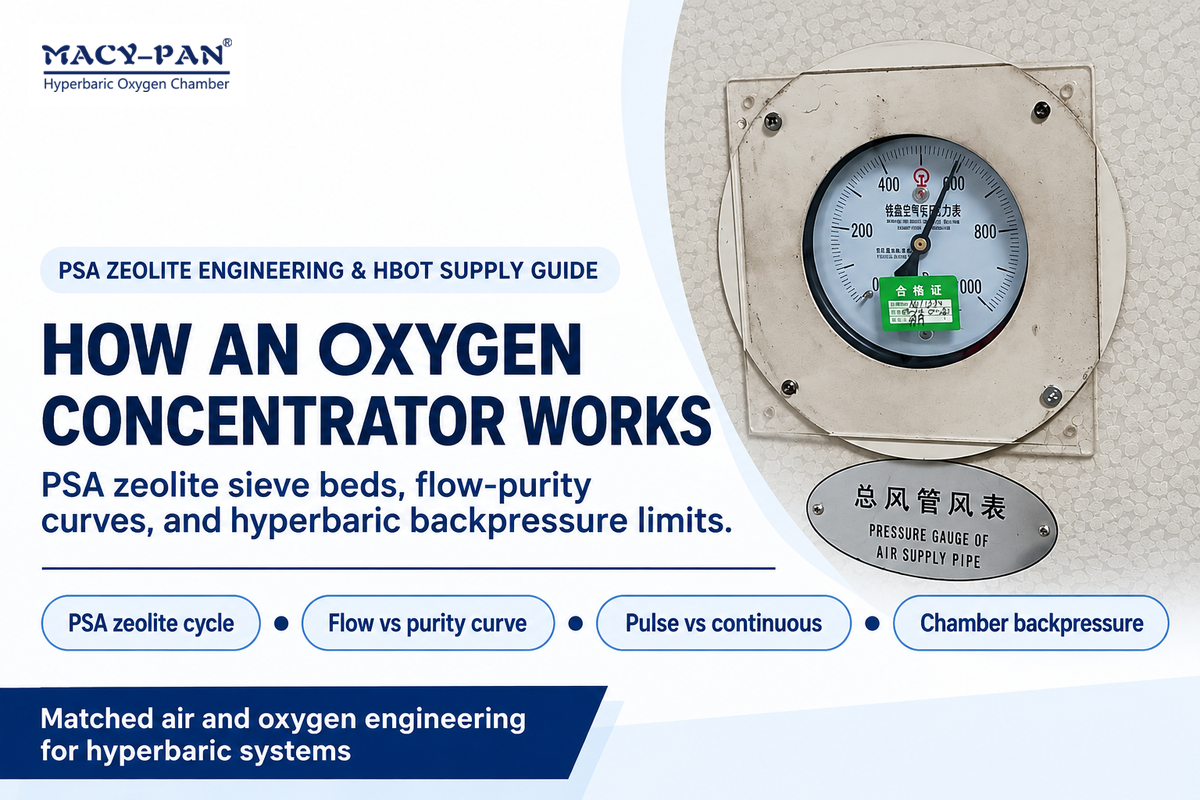
An oxygen concentrator works through the process of drawing in ambient air from the room, compressing it through porous zeolite molecular sieve beds which selectively trap nitrogen molecules under pressure, and releasing a stream of 90% to 95% pure oxygen. Dry atmospheric air consists of approximately 78% nitrogen and 21% oxygen, thus removing the nitrogen component from the air enriches the product gas. This process doesn’t require any chemical reactions or the need to replenish the tank. As long as there’s an uninterrupted electrical supply or a charged battery, the Pressure Swing Adsorption (PSA) process continuously repeats to provide concentrated oxygen through a breathing mask or nasal cannula.
While a home oxygen concentrator for sea-level respiratory care and an oxygen supply subsystem paired with a hyperbaric chamber share the same zeolite nitrogen separation physics, their flow rate and outlet pressure requirements are greatly different. At flow rates up to 5 or 10 liters per minute (L/min), gas residence time inside the sieve beds determines whether purity holds near 93% or drops toward the 80% low-purity alarm threshold. However, if the flow rate is set below 10 L/min, the purity of the oxygen stream may drop to 80% and sounds the low-purity alarm. We analyze the four-step PSA process, the filter and compressor hardware, the decay of purity at 5 and 10 L/min, the limits of continuous flow, and how MACY-PAN pairs backpressure-matched 10 L/min oxygen systems with 1.3 to 1.5 ATA (4 to 7 psi) hyperbaric chambers.
What Is an Oxygen Concentrator and How Does an Oxygen Concentrator Work?
To explain a oxygen concentrator work cycle, consider the gas mixture in a standard room. As noted in Cleveland Clinic’s clinical overview of oxygen concentrators, the air people breathe every day contains about 20% to 21% oxygen, and the rest is made up of nitrogen and other trace gases. In a healthy lung at sea level, 21% inspired oxygen keeps normal saturation of hemoglobin in the arteries. However, in the case of hypoxemia, a prescribed medical oxygen stream is given. Breathing a higher oxygen percentage helps compensate for impaired gas diffusion across the pulmonary membrane.
In medicine, an oxygen concentrator is a medical device prescribed to raise inspired oxygen concentration for patients who need constant oxygen support. Clincally, a oxygen concentrator is a device that separates nitrogen from the air around the unit so that the user receives purified oxygen rather than raw room air. In respiratory care, oxygen concentrators are medical devices regulated for home and hospital delivery. In hyperbaric engineering, a dedicated high-flow concentrator paired breathing-gas subsystem serves with a pressurized chamber. In both situations, oxygen concentrators provide an on-demand enriched stream without depending on pre-filled high-pressure cylinders.
“Unlike a compressed or liquid oxygen tank that you must replace or refill when you run out of oxygen, an oxygen concentrator continuously purifies the air around you (atmospheric air) to deliver 90% to 95% pure oxygen.”
The core separation mechanism inside every stationary and portable unit is Pressure Swing Adsorption (PSA) across synthetic aluminosilicate zeolite crystals. As peer-reviewed research on nanozeolite concentrators by Yadav et al. (PMC10174459) and Pan et al. (PMC5575677) explains, synthetic zeolite pellets contain a uniform lattice of micropores (pore diameter less than 2 nm, with calcium aluminosilicate at 0.5 nm and sodium aluminosilicate 13X at 1 nm). Because a diatomic nitrogen molecule possesses a stronger electrostatic quadrupole moment than an oxygen molecule, the positively charged cations inside the zeolite cage attract and bind nitrogen under elevated pressure while allowing oxygen to pass straight through into a product tank.
Buyers often ask why PSA oxygen concentrators take surrounding air and concentrate it to 90% to 95% purity rather than 100%. According to Yadav et al. (PMC10174459), when feed air (78% nitrogen and 21% oxygen) passes through the zeolite columns, it’s converted into 90% to 95% pure oxygen with 5% to 10% residual nitrogen and trace atmospheric argon. Because argon is a non-polar noble gas with a kinetic diameter almost identical to oxygen, zeolite crystals don’t adsorb argon, leaving roughly 95% as the natural physical ceiling of single-stage PSA separation.
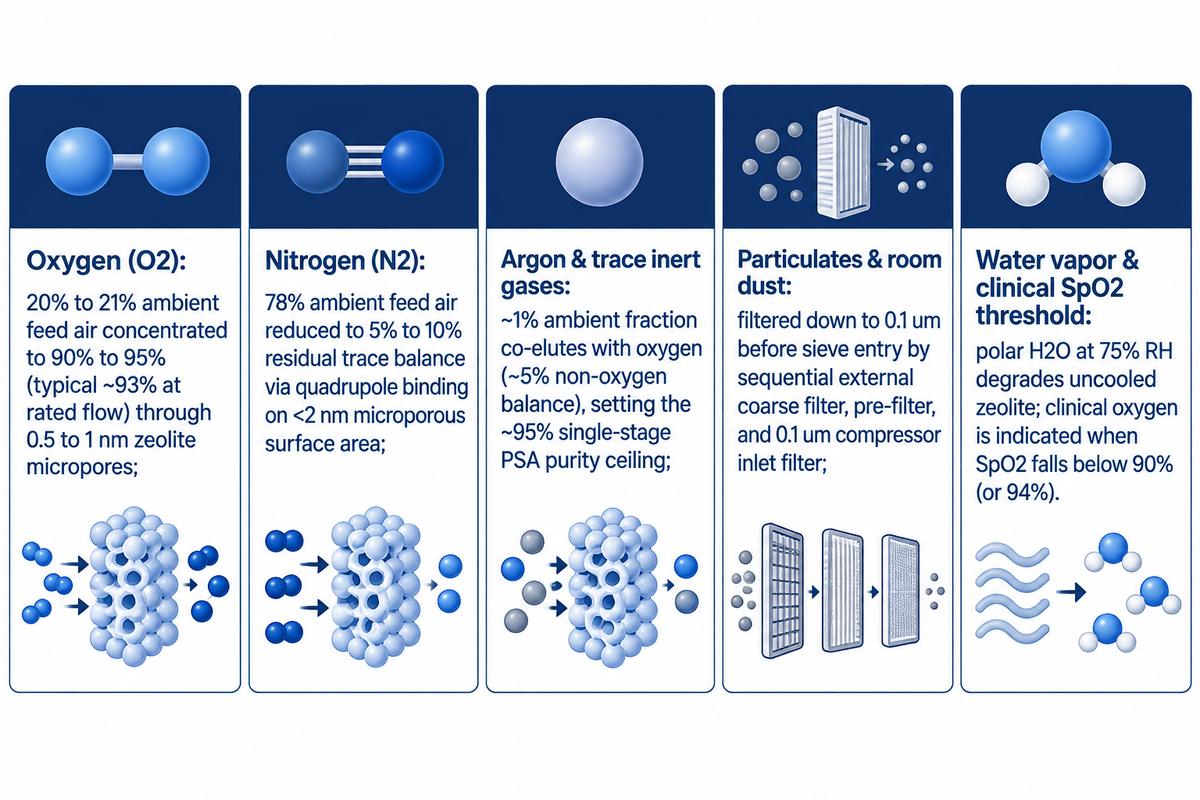
| Gas Component Type | Ambient Feed Air Fraction | PSA Concentrator Product Stream | Zeolite Sieve Interaction Mechanism | Primary Source Reference |
|---|---|---|---|---|
| Oxygen (O2) | 20% to 21% by volume | 90% to 95% (typical ~93% at rated flow) | Low quadrupole moment; passes through 0.5 to 1 nm zeolite micropores into the surge tank | Cleveland Clinic (2023) & Yadav et al. (PMC10174459) |
| Nitrogen (N2) | 78% by volume | 5% to 10% residual trace balance | Strong quadrupole interaction binds N2 to Li+ or Na+ cations on <2 nm microporous surface area under pressure | Yadav et al. (PMC10174459) & Pan et al. (PMC5575677) |
| Argon & Trace Inert Gases | Small remaining fraction (~1%) | Included within the non-oxygen balance (~5%) | Non-polar inert gas co-elutes with oxygen, setting the ~95% single-stage PSA purity ceiling | Yadav et al. (PMC10174459) |
| Particulates & Dust | Variable room dust and lint | Filtered down to 0.1 μm before sieve entry | Captured by sequential external coarse filter, pre-filter, and 0.1 μm compressor inlet filter | Yadav et al. (PMC10174459) |
| Water Vapor (Relative Humidity) | Ambient room humidity (tested up to 75% RH) | Dry gas stream (optional post-flowmeter humidification) | Polar H2O binds strongly to zeolite; excess feed humidity at 75% RH degrades purity over time if uncooled | USPTO Patent US8894751B2 (Galbraith et al.) |
Does using oxygen make your lungs stronger?
Using supplemental oxygen doesn’t improve the physical strength of the lungs. As stated by many scientists in the field, an oxygen concentrator raises the partial pressure of oxygen in the alveoli, thus increasing the diffusion of oxygen across the alveolar capillary membrane and helping to restore low oxygen levels, therefore, lessening the workload of the heart and brain. Patients needing extra support to help meet the body’s basic metabolic needs rely on an oxygen concentrator for help.
As clinical guidelines summarized in PMC10174459 note, supplemental oxygen is recommended when a patient’s blood oxygen levels (SpO2) fall below 90% on a pulse oximeter, or below 94% in specific acute conditions, while avoiding excessive hyperoxia or untreated hypoxemia (SpO2 below 80% to 85%). Clinical pulse oximetry is used to assess how effective pulmonary oxygen absorption is in supporting peripheral tissues. Patients should consult a healthcare provider to determine if oxygen therapy and to adjust the liter flow is indicated.
Inside the Oxygen Machine: Filter Stages, Compressor, Sieve Beds, and Crossover Valves
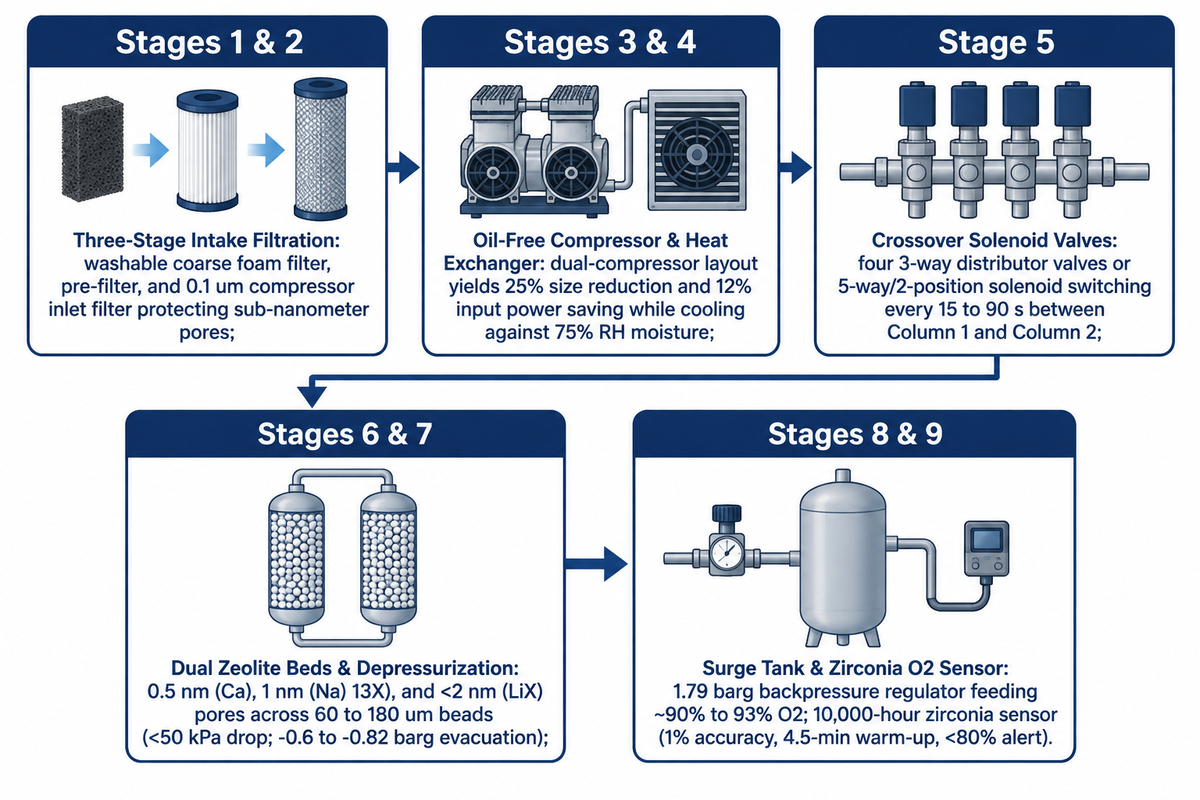
The interior of a oxygen machine demonstrates a closed-loop pneumatic train engineered to filter, compress, cool, separate, and regulate room air without the introduction of oil vapor. Because zeolite crystals are sensitive to airborne dust and moisture, ambient air passes through a multi-stage filtration and heat exchange pathway, prior to coming in contact with the sieve cylinders. Every modern oxygen unit depends on dry, oil-free compress to keep the sieve pores uncontaminated.
As Yadav et al. (PMC10174459) document, a series of filters are arranged in order inside the cabinet: an external coarse filter (gross particle filter) traps room lint and hair, a pre-filter captures finer dust, and a compressor inlet filter rated at 0.1 μm blocks sub-micron particles and bacteria before the gas enters the pump head. Keeping this intake filter train clean protects both the compressor cup seals and the sub-nanometer pores of the zeolite beds.
Once filtered, the air enters an oil-free piston or diaphragm compressor that generates the pressure swing required for nitrogen adsorption. In the pressure/vacuum swing adsorption (PVSA) concentrator prototype evaluated by Pan et al. (PMC5575677), using an integrated dual-compressor assembly instead of two separate diaphragm compressors achieved a 25% size reduction and a 12% input power saving. Depending on the sieve design, column working pressure reaches 1.79 barg (~179 kPa gauge) in a 90-second continuous cycle (PMC5575677), whereas high-pressure rapid-cycle bench evaluations by Ullah et al. (MDPI, 2024) demonstrated that pressurizing air at 0.8 MPa for 15 seconds per cycle delivered 93% pure oxygen. Those 1.79 barg and 0.8 MPa operating pressures and 15 to 90 second cycle times reflect specific experimental PVSA and PSA test rigs; commercial 5 L/min and 10 L/min concentrators calibrate their exact valve timing and cylinder pressure to match their installed sieve mass.
| Internal Subsystem / PSA Stage | Pneumatic & Chemical Function | Verified Engineering Specification | Fault Symptom if Degraded | Primary Source Basis |
|---|---|---|---|---|
| 1. External Coarse Cabinet Filter | Screens room lint, pet hair, and gross dust at the cabinet air intake louver | Washable open-cell foam gross particle filter (first stage in filter train) | Restricted intake airflow, elevated cabinet heat, and premature flow drop | Yadav et al. (PMC10174459) |
| 2. Pre-Filter & Compressor Inlet Filter | Strips fine particulates and microbial aerosols before air enters the compressor cylinders | Sequential pre-filter plus 0.1 μm compressor inlet filter rating | Internal pressure drop across filter causes compressor strain and low output | Yadav et al. (PMC10174459) |
| 3. Oil-Free Air Compressor | Compresses filtered ambient air (78% N2, 21% O2) to drive nitrogen into zeolite pores | Dual-compressor layout yields 25% size reduction and 12% input power saving | Worn piston cup seals fail to reach target column working pressure | Pan et al. (PMC5575677) |
| 4. Heat Exchanger & Moisture Condenser | Cools hot compressed air so water vapor condenses before reaching hydrophilic zeolite | Aluminum cylinder housing promotes heat dissipation and moisture control (tested vs. 75% RH) | Warm humid air enters sieve bed, causing rapid water poisoning and purity loss | USPTO Patent US8894751B2 |
| 5. 3-Way / 5-Way Crossover Solenoid Valves | Alternates compressed air feed and countercurrent nitrogen exhaust between Column 1 and Column 2 | Four 3-way distributor valves (PMC5575677) or 5-way/2-position solenoid switching every 15 to 90 s | Stuck valve freezes pressure swing, causing immediate low-purity alarm | Pan et al. (PMC5575677) & MDPI (2024) |
| 6. Dual Zeolite Molecular Sieve Beds | Adsorbs quadrupole nitrogen in micropores while letting oxygen flow to the product end | 0.5 nm (Ca) to 1 nm (Na 13X) and <2 nm (LiX) pores; 60 to 180 μm (80 to 120 μm) spherical beads; <50 kPa bed drop | Moisture saturation or mechanical bead dusting drops oxygen concentration below 80% | PMC10174459, PMC5575677 & US8894751B2 |
| 7. Depressurization & Vacuum/Purge Exhaust | Releases trapped nitrogen from the regenerating bed back into the room muffler | Atmospheric blowdown or intermediate/deep evacuation (−0.6 to −0.82 barg in PVSA) | Incomplete nitrogen desorption leaves the bed saturated on the next cycle | Pan et al. (PMC5575677) |
| 8. Product Surge Tank & Backpressure Regulator | Buffers alternating column pulses into a smooth, continuous enriched oxygen stream | Backpressure regulator set at 1.79 barg feeding the product surge tank at ~90% to 93% O2 | Pressure fluctuation at the oxygen outlet or backflow during bed switchover | Pan et al. (PMC5575677) & MDPI (2024) |
| 9. Oxygen Concentration Sensor & Flowmeter | Monitors real-time oxygen percentage and meters liters per minute to the outlet barb | Zirconia O2 sensor with 10,000-hour lifetime, 1% accuracy, 4.5-min warm-up; alert below 80% purity | Yellow/red low-oxygen indicator illuminates when purity falls below 80% threshold | US8894751B2 & Cleveland Clinic (2023) |
Why must an oxygen generator use two sieve beds instead of one? A single zeolite column can only adsorb nitrogen until its microporous surface area (pore diameter under 2 nm) reaches saturation; at that point, compressed air would break through unseparated unless the bed is depressurized to release the trapped nitrogen. By pairing two matched adsorption columns (for example, 3 cm in diameter and 20 cm in length in the PMC5575677 LiX 13X column study), the crossover valves execute a continuous four-step loop: while Column 1 is pressurized to its 1.79 barg working pressure to collect pure oxygen for you to breathe, Column 2 vents its adsorbed nitrogen to the atmosphere (or down to −0.6 to −0.82 barg evacuation pressure), and then the two columns reverse roles so the product tank never loses pressure.
How Oxygen Concentrators Deliver Oxygen: Flow Rate (5 vs. 10 L/min) and the 90%–96% Purity Decay Curve
Understanding oxygen concentrators deliver oxygen across the different dial settings requires understanding the relationship between gas flow rate and sieve-bed contact time. According to Lincare’s clinical equipment guide, oxygen output is the volume of gas the machine delivers per minute, measured in liters per minute (L/min or LPM), and oxygen purity is the percentage of oxygen in the gas stream (typically 90% or higher, within the rated capacity). The actual amount of oxygen reaching the mask or cannula is dependent on both the liter flow setting and the active purity percentage.
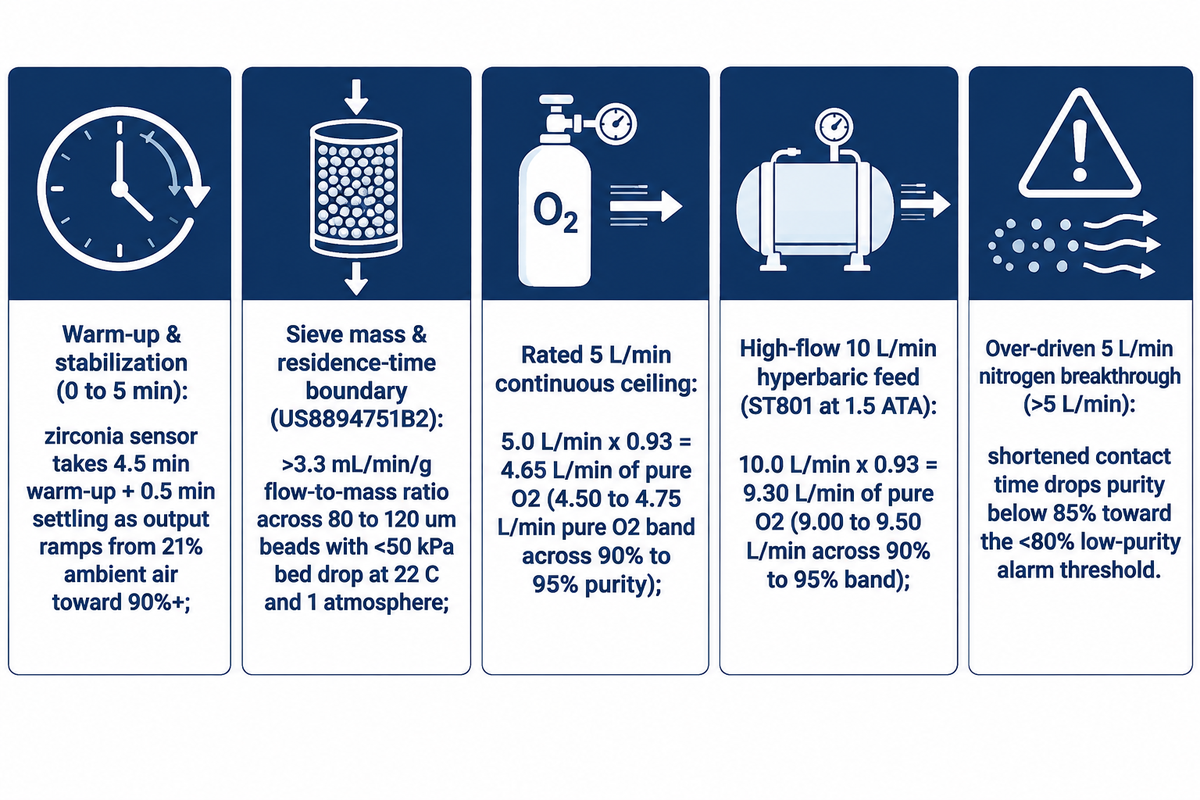
Counter-intuitively, turning a concentrator’s flowmeter knob above its rated L/min ceiling doesn’t give the user more oxygen. Inside a fixed mass of molecular sieve material, nitrogen separation depends on gas residence time. As disclosed in USPTO Patent US8894751B2, an adsorbent bed is engineered for a specific product flow-rate-to-sieve-mass ratio (such as greater than 3.3 mL/min/g across 80 to 120 μm spherical zeolite beads with a bed pressure drop under 50 kPa, producing up to 3 to 5 liters of oxygen per minute at 22 °C and 1 atmosphere). If a user forces 7 or 8 L/min through a 5 L/min sieve bed, compressed air rushes through the zeolite pores faster than nitrogen can diffuse and bind. Consequently, unseparated nitrogen breaks through into the oxygen outlet, and the concentration of oxygen drops below the 80% alarm threshold noted by Cleveland Clinic. These flow-purity relationships assume 22 °C sea-level operation with dry intake air; high altitude or feed air at 75% relative humidity reduces inlet oxygen density and accelerates purity decay.
Worked Effective Pure Oxygen Delivery Calculation (5 L/min Unit vs. 10 L/min Hyperbaric-Paired Unit): Multiply the total gas flow rate (L/min) by the verified oxygen purity fraction (90% to 95%, or ~93% nominal) to compare actual pure O2 molecules delivered per minute:
- At a standard 5 L/min continuous flow setting operating at 93% oxygen purity (MDPI, 2024; MACY-PAN spec), effective pure oxygen delivery equals 5.0 L/min × 0.93 = 4.65 L/min of pure O2 (within a 4.50 to 4.75 L/min pure O2 band across the 90% to 95% purity range).
- At a high-flow 10 L/min continuous setting on a heavy-duty dual-bed unit (such as the 10 L/min concentrator paired with the MACY-PAN ST801 at 1.5 ATA) holding 93% purity, effective pure oxygen delivery doubles to 10.0 L/min × 0.93 = 9.30 L/min of pure O2 (or 9.00 to 9.50 L/min across the 90% to 95% band).
- If a 5 L/min concentrator is over-driven above its 5 L/min design ceiling so that nitrogen breakthrough pushes purity below the 80% low-purity alert threshold (Cleveland Clinic), the machine triggers an equipment warning and fails medical concentration requirements, confirming why high-demand masks and protocols governed by hyperbaric oxygen partial pressure and oxygen toxicity limits require a true 10 L/min sieve assembly rather than an over-dialed 5 L/min home unit.
| Operating Regime & Flow Tier | 5 L/min Concentrator Purity | 10 L/min Concentrator Purity | Effective Pure O2 Volume Delivered | Sensor & Alarm State (<80% Alert) | Primary Application Suitability |
|---|---|---|---|---|---|
| 1. Warm-Up & Stabilization (0 to 5 min) | Ramping from 21% ambient air toward 90%+ | Ramping from 21% ambient air toward 90%+ | Transitional purge phase before steady delivery | Zirconia sensor takes 4.5 min warm-up + 0.5 min settling (US8894751B2) | Allow 5 minutes of run time before connecting mask or checking purity |
| 2. Low Continuous Flow (1 to 2 L/min) | 93% to 95% O2 (maximum residence time) | 93% to 95% O2 (maximum residence time) | 0.93 to 1.90 L/min pure O2 | Normal green status (1% sensor accuracy) | Low-flow resting ambient nasal cannula oxygen therapy |
| 3. Moderate Continuous Flow (3 L/min) | 90% to 95% O2 (~93% nominal) | 93% to 95% O2 | 2.70 to 2.85 L/min pure O2 | Normal green status (above 85% & 90% benchmarks) | Standard home nasal cannula or compact 3 L/min rapid-cycle unit (US8894751B2) |
| 4. Rated 5 L/min Ceiling (5 L/min) | 90% to 95% O2 (~93% at 1 atm, 22 °C) | 93% to 95% O2 (50% sieve load) | 4.50 to 4.75 L/min pure O2 (4.65 L/min @ 93%) | Normal green status (<50 kPa bed pressure drop) | Maximum rated ceiling for 5 L/min stationary home concentrators and standard 1.3–1.5 ATA masks |
| 5. Over-Driven 5 L/min Unit (>5 L/min) | Drops below 85% toward <80% N2 breakthrough | 90% to 95% O2 (within 10 L/min sieve rating) | 5 L/min unit loses purity; 10 L/min unit holds 90%–95% | 5 L/min unit triggers <80% low-purity alert (Cleveland Clinic) | Do not over-dial a 5 L/min unit; upgrade to a 10 L/min twin-sieve system |
| 6. High-Flow Hyperbaric Feed (10 L/min) | Not capable (exceeds 5 L/min bed mass) | 90% to 95% O2 (~93% nominal at 1.5 ATA on ST801) | 9.00 to 9.50 L/min pure O2 (9.30 L/min @ 93%) | Normal green status on 10 L/min hyperbaric-paired unit | High-flow reservoir mask/headset supply inside 1.5 ATA hyperbaric chambers (MACY-PAN ST801) |
| 7. High-Humidity Feed Air (75% RH Uncooled) | Gradual purity decay over operating hours | Gradual purity decay if air cooler/dryer is omitted | Declining O2 percentage as H2O blocks LiX/13X sites | Triggers <80% purity alert once moisture saturates sieve | Requires pre-sieve condensation cooling and dehumidification (US8894751B2 Fig. 13) |
| 8. Clogged 0.1 μm Inlet Filter / Cup Seal Wear | Drop below 80% due to low column pressure (<1.79 barg) | Drop below 80% due to low column pressure | Reduced liter output and sub-80% oxygen concentration | Low-purity alert (<80%) + low pressure / thermal fault | Wash coarse filter weekly; replace 0.1 μm inlet filter and service compressor seals |
| 9. End-of-Life Sensor / Sieve (≥10,000 Hours) | Requires ultrasonic analyzer audit vs. 80% floor | Requires ultrasonic analyzer audit vs. 80% floor | Verified via calibrated analyzer at rated L/min | Zirconia O2 sensor rated for 10,000 hours actual operation | Scheduled sieve-bed regeneration/replacement and compressor rebuild |
How long should you be on an oxygen concentrator?
How long you should be using use an oxygen concentrator depends on whether the unit is prescribed for chronic medical respiratory support or paired with a hyperbaric chamber for scheduled support. As (Cleveland Clinic) states most patients prescribed supplemental oxygen for chronic lung or heart conditions need to use it for at least 15 hours a day and some may need to use it for 24 hours a day under a physician’s orders. Your prescribing clinician will adjust duration based on your body’s functioning during rest and activity (oxygen requirements).
While a paired oxygen concentrator typically offers ~93% oxygen to a mask or headset within a 1.3 to 1.5 ATA mild hyperbaric chamber ( MACY-PAN soft-shell specification), the concentrator operates for the duration of the individual hyperbaric session after a 5-minute warm-up and stabilization.
Types of Oxygen Concentrators: Stationary Home Oxygen Concentrator vs. Portable Oxygen Concentrator
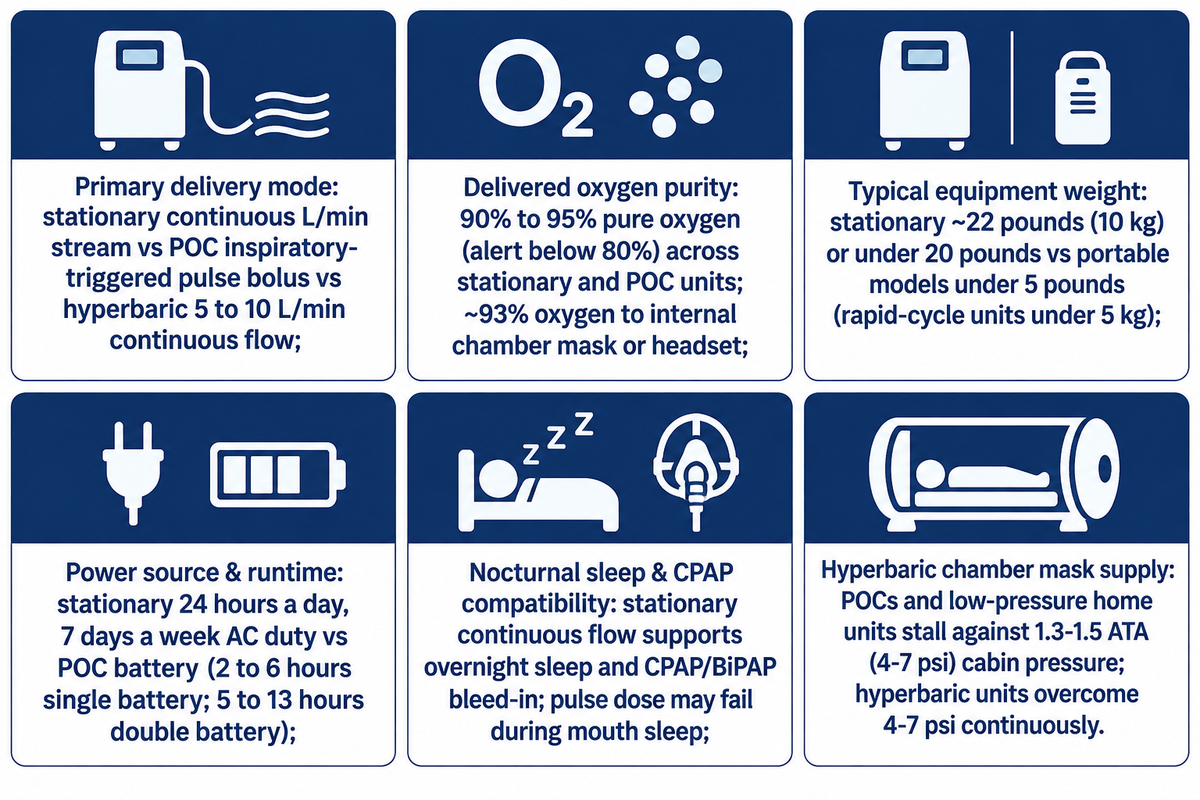
When evaluating different types of oxygen concentrators, engineers and clinicians generally classify systems into two hardware categories, depending on how they meter gas to the user; namely, stationary continuous-flow systems and portable pulse-dose systems. A stationary home oxygen concentrator is built for continuous flow (measured in full liters per minute), whereas a portable oxygen concentrator (POC) prioritizes compact weight and battery life for travel and ambulation. A stationary oxygen concentrators are designed is designed for uninterrupted bedside or clinic operation, and a portable system is geared toward mobility.
According to Cleveland Clinic, a typical stationary oxygen concentrator weighs about 22 pounds (10 kilograms) and plugs into a grounded wall outlet, while Inogen’s equipment overview and US8894751B2 note that compact home concentrators can weigh under 20 pounds and portable oxygen concentrator models often weigh less than 5 pounds (or under 5 kg for higher-capacity portable units). Clinical documentation on Inogen oxygen systems notes that both home and portable models are validated for 24 hours a day, 7 days a week delivery. On battery power, Cleveland Clinic reports that a single-battery portable concentrator lasts from 2 to 6 hours on average, whereas a double-battery configuration lasts between 5 and 13 hours. High-capacity lithium packs allow portable oxygen users to stay active away from AC outlets.
Many first-time buyers of a portable concentrator make the operational mistake of assuming that the setting number for a pulse dose equals liters per minute of continuous oxygen flow. In continuous flow mode, purified oxygen streams out of nasal cannula or mask, and sets the flow rate at L/min whether the user is inhaling, exhaling, or neither. In pulse dose, an electronic pressure transducer waits for a slight negative pressure of a nasal inhalation, and upon detection, fires a millisecond bolus of oxygen. Because a pulse dose valve delivers no continuous background stream, a pulse dose portable unit can’t be used to drive a hyperbaric chamber or a positive pressure CPAP circuit that masks inspiratory trigger signals.
| Comparison Dimension | Stationary Home Oxygen Concentrator | Portable Oxygen Concentrator (POC) | Hyperbaric-Paired Oxygen Concentrator |
|---|---|---|---|
| Primary Delivery Mode | Continuous flow (constant L/min stream) | Pulse dose (inspiratory-triggered bolus; select models offer low continuous flow) | Continuous flow at elevated outlet pressure (5 to 10 L/min continuous) |
| Delivered Oxygen Purity | 90% to 95% pure oxygen (alert below 80%) | 90% to 95% pure oxygen inside each pulse bolus | ~93% oxygen (90% to 95% PSA range) delivered to internal chamber mask or headset |
| Typical Equipment Weight | About 22 pounds (10 kg); compact home models under 20 pounds | Many portable models weigh less than 5 pounds (rapid-cycle units under 5 kg) | Heavy-duty stationary console or integrated all-in-one hyperbaric cabinet |
| Power Source & Runtime | AC wall outlet; engineered for 24 hours a day, 7 days a week continuous duty | Rechargeable battery (2 to 6 hours single battery; 5 to 13 hours double battery) + AC/DC adapter | AC mains power matching facility voltage for continuous hyperbaric session duty |
| Nocturnal Sleep & CPAP Compatibility | Suitable for overnight sleep and CPAP/BiPAP bleed-in as directed by a provider | Pulse dose may fail to trigger during shallow or open-mouth sleep; not for CPAP positive pressure | Not applicable (engineered specifically for occupied hyperbaric chamber sessions) |
| Hyperbaric Chamber Mask Supply | Unsuitable if low outlet pressure stalls against 1.3–1.5 ATA (4–7 psi) cabin pressure | Strictly unsuitable (pulse trigger fails inside pressurized cabin and lacks continuous volume) | Purpose-built to overcome 1.3–1.5 ATA (4–7 psi) chamber backpressure continuously |
Can we sleep with an oxygen concentrator?
It’s safe to use a oxygen concentrator for sleep as prescribed by your healthcare provider. Stationary continuous-flow home concentrators are designed to operate continuously for 24 hours a day, 7 days a week. A stationary, continuous-flow unit will maintain a constant L/min stream even if a patient’s breathing becomes very shallow and/or shifts to mouth breathing during the night. A continuous-flow unit can also be used to set up a CPAP or BiPAP circuit to treat cases of extreme mouth breathing or continuous oxygen.
If a patient wishes to use a portable oxygen concentrator while sleeping, he or she must adjust the sensitivity settings of the nocturnal trigger to rule out apnea, and set the apnea alarm to the prescribing clinician. A nasal cannula is less likely to detect inhalation if the patient is mouth breathing while deeply asleep.
Ambient Home Oxygen vs. Hyperbaric Chamber Oxygen Concentrators: Output Pressure (kPa/PSI) and Backpressure Limits
The most frequently asked engineering question from clinic directors and home wellness buyers is whether a standard home oxygen concentrator can be connected to a hyperbaric chamber. The answer comes down to fluid mechanics: an ambient home concentrator is designed to discharge into a sea-level nasal cannula at 1.0 atmosphere absolute (1.0 ATA, or 0 psi gauge pressure), whereas a pressurized hyperbaric cabin exerts continuous opposing backpressure against the oxygen feed line. Therefore, the two can’t be connected.
Refer to MACY-PAN’s page for soft-shell mild hyperbaric chambers (1.3-1.5 ATA) paired with 10 L/min oxygen systems for details on mild hyperbaric chambers. They range from 1.3 to 1.5 ATA. As documented on MACY-PAN’s technical specification page for soft-shell mild hyperbaric chambers (1.3–1.5 ATA) paired with 10 L/min oxygen systems , mild hyperbaric enclosures operate at 1.3 to 1.5 ATA, which corresponds to 4 to 7 psi of positive cabin gauge pressure above ambient room air (specifically, the ST1700, ST2200, ST801, and L1 models reach 1.5 ATA [7 psi], while the larger wheelchair-accessible MC4000 cabin operates at 1.4 ATA [6 psi]).
When comparing 1.3, 1.5, and 2.0 ATA hyperbaric pressure tiers, the oxygen concentrator must regulate its outlet pressure above the 4 to 7 psi cabin backpressure to allow an adequate flow of enriched oxygen to the occupant’s mask. It’s also necessary to account for the <50 kPa pressure drop that’s documented in US8894751B2 (see figure below).
Worked Hyperbaric Backpressure & Dual-Stream Supply Calculation (1.4 ATA [6 psi] and 1.5 ATA [7 psi] Soft Chambers): Consider the pressure gradient between the PSA concentrator’s internal product regulator and the pressurized hyperbaric cabin:
- Inside the PSA adsorption column and backpressure regulator (Pan et al., PMC5575677), the working pressure is 1.79 barg (~26 psi gauge) during the adsorption process and is then stepped down to a lower pressure to become product.
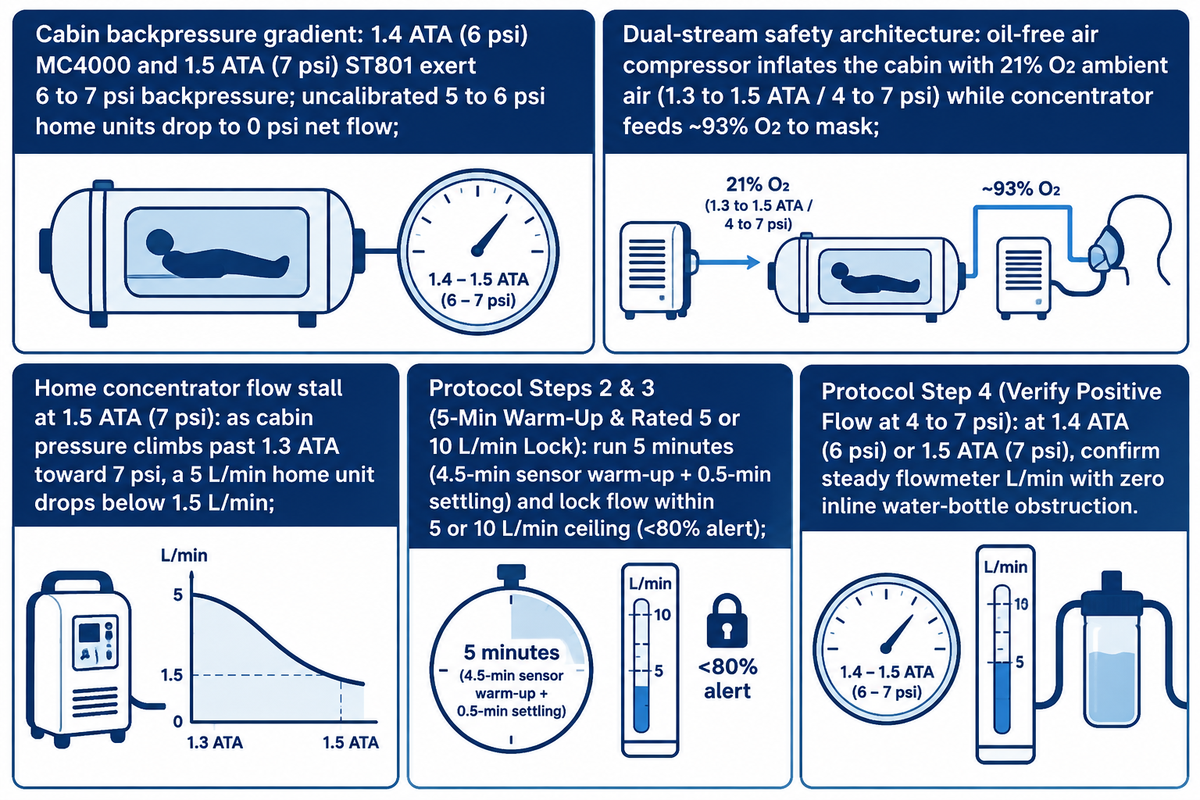
- In a 1.4 ATA (6 psi) MC4000 chamber or a 1.5 ATA (7 psi) ST801 chamber (MACY-PAN spec), the cabin air exerts a continuous backpressure of 6 to 7 psi against the oxygen bulkhead fitting.
- If a user attaches an uncalibrated low-pressure home respiratory concentrator whose outlet regulator is capped near 5 to 6 psi for sea-level cannulas, net driving pressure (Delta P = P_outlet − P_cabin) drops to 0 psi or negative once the chamber reaches 6 to 7 psi (1.4 to 1.5 ATA), causing the flowmeter ball to sink and oxygen flow to stall. By contrast, a factory-matched hyperbaric oxygen concentrator steps outlet pressure above the 7 psi cabin ceiling to deliver a full 10 L/min of ~93% oxygen at 1.5 ATA (as verified on the MACY-PAN ST801). This 1.3 to 1.5 ATA (4 to 7 psi) backpressure analysis applies to dual-stream soft and sitting chambers where ~93% oxygen is breathed via an internal mask or headset; clinical 2.0 ATA rigid medical chambers require physician oversight and hospital-grade high-pressure oxygen systems.
Equally important, an oxygen concentrator is never used by itself to inflate the main volume of a soft-shell or sitting hyperbaric chamber. Instead, a matched hyperbaric system always separates two gas streams: (1) a dedicated oil-free air compressor pumps filtered ambient air (21% O2) into the chamber enclosure to build and maintain the 1.3 to 1.5 ATA (4 to 7 psi) structural pressure, and (2) the paired oxygen concentrator feeds ~93% purified oxygen through a dedicated pass-through tube directly to the occupant’s breathing mask or headset. This dual-stream design keeps bulk cabin air near normal atmospheric oxygen percentage for fire safety while giving the occupant ~93% inspired oxygen at 1.3 to 1.5 ATA.
To avoid backpressure mismatches and nitrogen breakthrough, our 4-Phase PSA Cycle & Backpressure Matching Protocol is used by engineers and facility operators when pairing an oxygen system to a chamber:
- Before connecting any feed tube, execute Step 1 (Verify Three-Stage Intake Filtration to 0.1 μm): Confirm that the exterior gross particle foam filter, pre-filter, and 0.1 μm compressor inlet filter (PMC10174459) are clean and dry so bed pressure drop stays below 50 kPa (US8894751B2).
- During startup, execute Step 2 (Complete the 5-Minute PSA & Sensor Warm-Up): Run the concentrator for at least 5 minutes (4.5-minute zirconia sensor warm-up plus 0.5-minute settling time per US8894751B2) so alternating model-calibrated (such as 1.79 barg in the Pan et al. experimental PVSA test rig) column swings stabilize the product tank at 90% to 95% (~93%) oxygen purity.
- When setting flow, execute Step 3 (Lock Continuous Flow Within Rated Sieve Mass of 5 or 10 L/min): Set the flowmeter strictly within the unit’s rated continuous flow ceiling (such as 10 L/min on the MACY-PAN ST801 paired concentrator) and never over-dial the flowmeter ball into nitrogen breakthrough (<80% purity alert).
- Under full cabin pressure, execute Step 4 (Verify Positive Flow at Target Chamber ATA of 4 to 7 psi): Once the separate air compressor brings the chamber to 1.4 ATA (6 psi) or 1.5 ATA (7 psi), confirm that the flowmeter ball holds steady at the target L/min setting with zero inline water-bottle obstruction.
Scenario 1 (Resolving a Flow Drop When Retrofitting a Home Concentrator to a 1.5 ATA Chamber): A wellness studio attempts to connect an older standalone 5 L/min home respiratory concentrator to a 1.5 ATA (7 psi) soft chamber instead of using the factory-matched hyperbaric oxygen unit. As cabin pressure climbs past 1.3 ATA toward 7 psi, the attendant notices the flowmeter ball on the home machine dropping from 5 L/min down to less than 1.5 L/min because the home regulator lacks sufficient outlet pressure to push past the 7 psi cabin backpressure. Replacing the mismatched home machine with the factory-paired 10 L/min hyperbaric oxygen concentrator restores full 10 L/min continuous flow at ~93% oxygen purity throughout the 1.5 ATA session.
Comparing Oxygen Concentrators, Compressed Oxygen Tanks, and Liquid Oxygen Systems
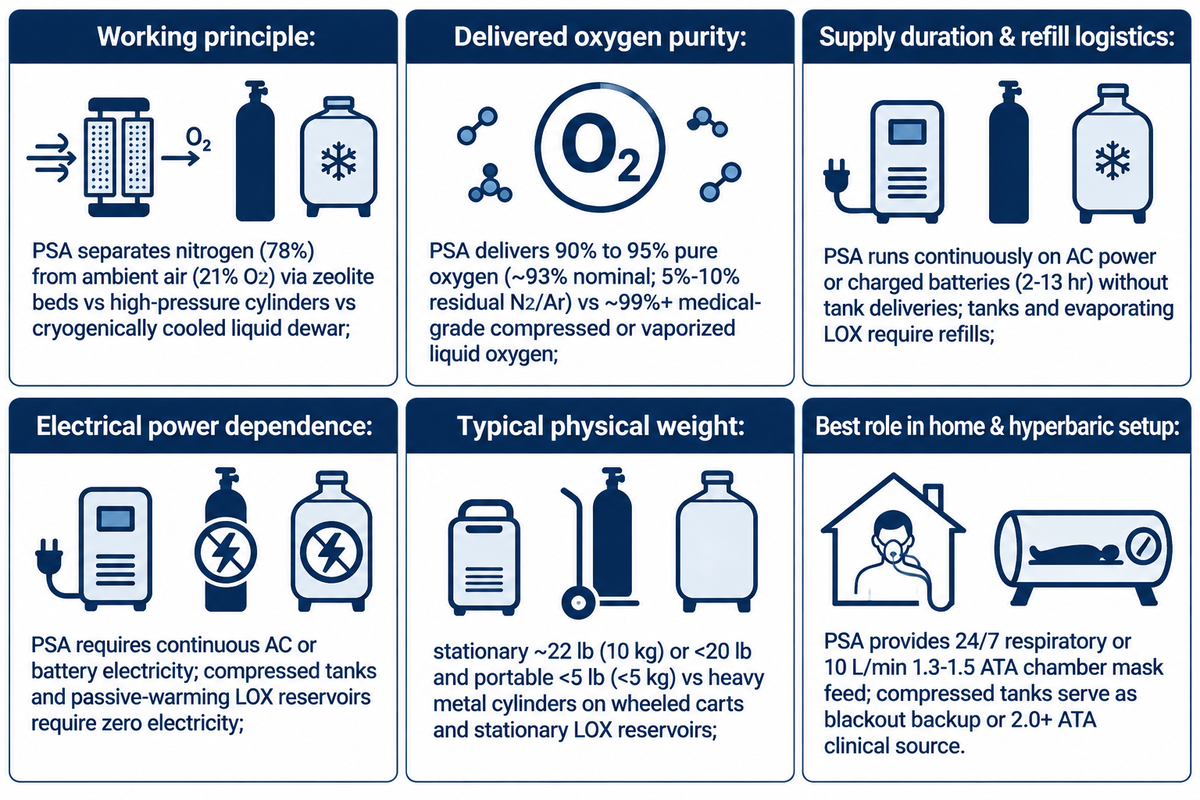
What are the differences between oxygen machine, oxygen tanks, or cryogenic liquid oxygen containers? The main difference is between on-site separation and pre-filled storage. The Compressed or liquid oxygen systems store an oxygen volume produced at an industrial air-separation plant; once the cylinder or dewar is empty, an oxygen supplier must deliver a replacement or refill the vessel. An electric PSA oxygen concentrator manufactures its own oxygen stream of 90% to 95% on-demand from room air; therefore, it provides an unlimited oxygen supply as long as electrical power is available. With this on-site generation model, supplemental oxygen to individuals is provided without waiting for the next cylinder truck delivery.
Critical care environments in hospitals, including emergency departments, operating rooms, ICUs, NICUs, etc., Yadav et al. (PMC10174459) write that facilities may need to have a 24/7 uninterrupted supply of oxygen supply, which can be provided by central supplies and/or cylinders in combination with PSA (Progressive Suction) systems. Public Education Materials from the American Lung Association explain these trade-offs for patients and caregivers. Specifically, materials from the American Lung Association on using oxygen at home and the Cleveland Clinic discuss the three options (oxygen equipment) of home oxygen, safety, purity, and logistics.
| Evaluation Criterion | PSA Oxygen Concentrator | Compressed Oxygen Tanks (Cylinders) | Liquid Oxygen (LOX) Reservoir |
|---|---|---|---|
| Working Principle | Separates nitrogen (78%) from ambient air (21% O2) via zeolite molecular sieve beds | Stores pre-compressed oxygen gas under high pressure in aluminum or steel cylinders | Stores cryogenically cooled liquid oxygen in an insulated thermos-like dewar |
| Delivered Oxygen Purity | 90% to 95% pure oxygen (~93% nominal; 5%–10% residual N2/Ar) | Medical-grade compressed oxygen (~99%+ purity from industrial plant) | Medical-grade vaporized liquid oxygen (~99%+ purity) |
| Supply Duration & Refill Logistics | Continuous unlimited supply while connected to AC power or charged batteries (2–13 hr) | Finite capacity; requires recurring cylinder delivery or exchange when pressure drops | Finite capacity; evaporates passively over time even if unused and requires supplier refills |
| Electrical Power Dependence | Requires continuous AC electricity or battery power to drive compressor and valves | Zero electricity required (mechanical pressure regulator and flowmeter) | Zero electricity required (passive warming vaporizes liquid into breathable gas) |
| Typical Physical Weight | Stationary ~22 lb (10 kg) or <20 lb; portable models <5 lb (<5 kg) | Heavy metal cylinders requiring wheeled carts for large stationary tanks | Heavy stationary base reservoir plus refillable portable canister |
| Best Role in Home / Hyperbaric Setup | Primary daily 24/7 respiratory supply or matched 10 L/min 1.3–1.5 ATA chamber mask feed | Mandatory non-electric emergency backup for power outages or 2.0+ ATA clinical HBOT | High-flow ambulatory respiratory patients with active local LOX delivery service |
What are the downsides of using an oxygen concentrator?
The four primary downsides of using an oxygen concentrator are that it’s 100% dependent on electrical power (meaning a backup compressed oxygen cylinder or charged batteries is required for power outages), an operating hum from the air compressor and a cyclic nitrogen purge exhaust, warm air discharge into the room, and zeolite sieve bed gradual degradation if exposed to humid air and dusty intake filters.
In addition, because single-stage PSA zeolite adsorption leaves 5% to 10% nitrogen and trace argon in the product stream (90% to 95% oxygen purity per PMC10174459), a standard low-pressure concentrator can’t replace hospital liquid oxygen pipelines or high-pressure 2.0+ ATA clinical hyperbaric oxygen banks that require ~99%+ medical-grade oxygen at high pipeline pressures.
Zeolite Sieve Bed Lifespan, Moisture Dusting, and Preventive Filter Maintenance Schedules
Understanding oxygen concentrator uses over a multi-year lifecycle involves protecting the internal zeolite crystals from their biggest enemy, water vapor. Synthetic calcium (0.5 nm), sodium (13X, 1 nm) and microporous lithium (LiX) aluminosilicate zeolites possess strong ionic charges in their pores (See PMC10174459), and highly polar water molecules (H2O) bind to zeolite cations much more strongly than nitrogen molecules do. When humid room air enters the sieve towers without adequate condensation cooling, water molecules take up the active adsorption sites and don’t desorb during the short atmospheric blowdown step.
This is quantified in USPTO Patent US8894751B2 (Figures 13 through 16) as the percentage of oxygen purity vs. hours of operation with inlet air at 75% relative humidity, and shows how untreated moisture slowly decreases the nitrogen separation capacity across the adsorbent beds (tested at 0.95 g and 10 g micro-beds and up to 50 g modules). While in the 60 to 180 μm (or 80 to 120 μm) size range, the spherical zeolite beads can experience pressure surges above the 50 kPa bed pressure drop limit or lose their spring preload, resulting in mechanical friction which breaks the beads down to a fine powder (“zeolite dusting”) and clogs downstream valves.
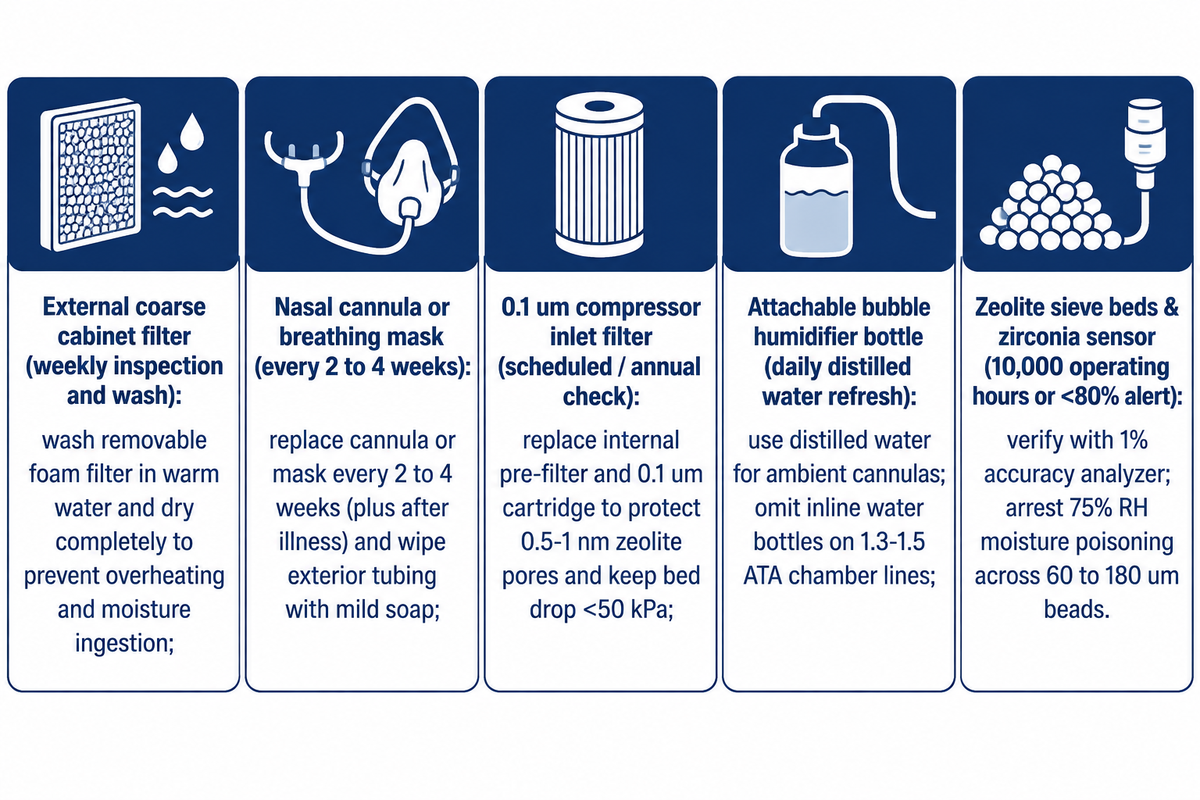
To verify long-term purity, modern concentrators integrate a solid-state oxygen concentration sensor, such as the zirconium (zirconia) sensor detailed in US8894751B2, which delivers a 10,000-hour actual operating lifetime at 1% accuracy (drawing 1.5+ watts with a 4.5-minute warm-up and 0.5-minute settling time) without needing recalibration, and trigger an audible/visual alert if purity drops below 80% (Cleveland Clinic). Once the 5-minute warm-up concludes, you can attach your nasal cannula or chamber mask tubing to the outlet fitting. Combining sensor monitoring with the American Lung Association’s maintenance guidelines gives operators a clear five-point schedule:
| Component / Subsystem | Maintenance Interval | Required Maintenance Action | Failure Prevented | Verified Source Basis |
|---|---|---|---|---|
| External Coarse Cabinet Filter | Weekly inspection and wash | Wash removable gross particle foam filter in warm water and dry completely before reinstalling | Prevents lint buildup, cabinet overheating, and wet-filter moisture ingestion | Yadav et al. (PMC10174459) & Cleveland Clinic |
| Nasal Cannula or Breathing Mask | Every 2 to 4 weeks (plus after any illness) | Replace external nasal cannula or mask and wipe exterior tubing with mild soap and water | Prevents microbial biofilm, cracked prongs, and restricted delivery flow | American Lung Association (Using Oxygen at Home) |
| 0.1 μm Compressor Inlet Filter | Scheduled service / annual cabinet check | Replace internal pre-filter and 0.1 μm compressor inlet filter cartridge (never wash internal paper/HEPA elements) | Keeps sub-micron dust out of 0.5–1 nm zeolite pores and keeps bed drop <50 kPa | Yadav et al. (PMC10174459) & US8894751B2 |
| Attachable Bubble Humidifier Bottle | Daily water refresh (when used on ambient cannula) | Fill strictly with distilled water; omit inline water bottles on pressurized 1.3–1.5 ATA chamber lines | Prevents tap-water mineral scale blocking the diffuser and prevents backpressure water backflow | Cleveland Clinic & hyperbaric pneumatic safety |
| Zeolite Sieve Beds & Zirconia Sensor | 10,000 operating hours (or if <80% alert sounds) | Verify output with calibrated O2 analyzer (1% accuracy); replace moisture-degraded sieve modules or worn cup seals | Arrests 75% RH moisture poisoning and restores 90%–95% nitrogen separation | US8894751B2 (10,000-hr sensor life) & Cleveland Clinic (<80% alert) |
Do you need electricity for an oxygen concentrator?
Yes, every oxygen concentrator requires electrical energy to power its air compressor, cooling fan, electronic circuit board, and crossover solenoid valves. Stationary home and clinic concentrators must be plugged directly into a grounded AC wall outlet to run 24 hours a day, whereas portable oxygen concentrators can run on rechargeable lithium-ion batteries for 2 to 6 hours on a single battery or 5 to 13 hours on a double battery (Cleveland Clinic).
Since a grid blackout will immediately stop a mains-powered stationary concentrator, patients who depend on continuous life-support respiratory therapy must always maintain an available backup compressed oxygen tank.
Scenario 2 (Diagnosing a Low-Purity Alert After Running a Concentrator in a Humid Room): After operating a stationary concentrator inside an unventilated room during a humid summer week (ambient relative humidity near 75%), an operator sees the yellow low-oxygen indicator light illuminate, signaling that output purity has dipped below the 80% threshold. Inspection reveals that the exterior coarse foam filter was caked with dust and reinstalled while still damp after washing, starving cooling airflow and feeding warm moisture into the zeolite beds. Drying the intake path, installing a fresh 0.1 μm compressor inlet filter, and servicing the moisture-saturated sieve module restores output purity to 93%.
How MACY-PAN Engineers Matched Oxygen Concentrator and Air Compressor Systems for Hyperbaric Chambers
At MACY-PAN, we manufacture the full 1.0 to 2.0 ATA hyperbaric chamber range under a certified ISO 13485:2016 medical-device quality management system. To keep our scope transparent for buyers: MACY-PAN supplies oxygen concentrators exclusively as matched, backpressure-calibrated subsystems (or integrated all-in-one compressor-concentrator-cooler consoles) paired with our hyperbaric chambers; we do not retail standalone home respiratory concentrators for unpressurized domestic COPD care. Also, ISO 13485:2016 certification verifies our quality management system across hyperbaric chamber design and manufacturing, while buyers in specific countries verify local clinical device registrations separately.
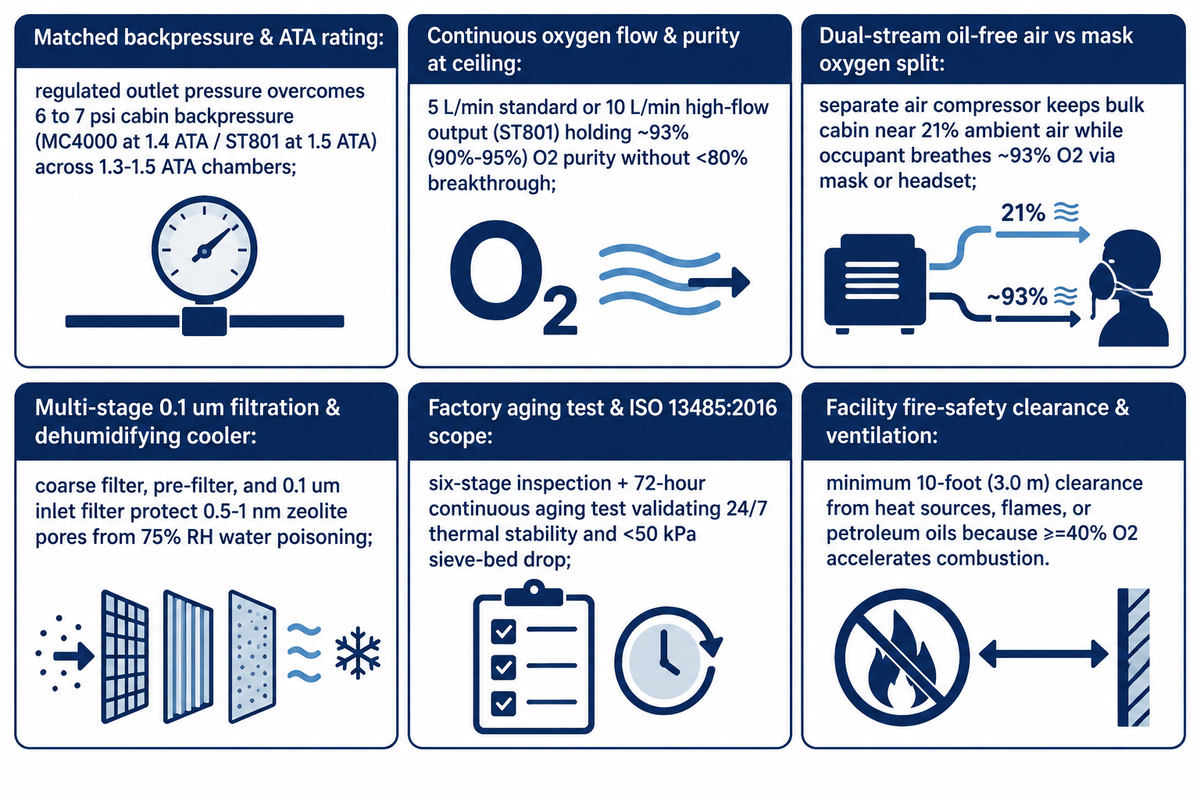
Whether a facility selects our soft-shell mild hyperbaric chambers (1.3–1.5 ATA), our ergonomic sitting hyperbaric chambers with integrated compressor-concentrator consoles, or our rigid hard-shell hyperbaric chambers with all-in-one air and oxygen support units, every paired oxygen subsystem is engineered to solve three physical challenges of pressurized operation: overcoming 4 to 7 psi (1.3 to 1.5 ATA) cabin backpressure, delivering up to 10 L/min of ~93% oxygen to the internal mask or headset (as configured on the lying ST801 at 1.5 ATA), and removing compressor heat and moisture before gas enters the zeolite sieve towers or the occupant cabin. Before commissioning any new oxygen device alongside a hyperbaric chamber, technicians verify both regulated backpressure and gas purity. Before shipment, every MACY-PAN unit passes a six-stage inspection and a 72-hour aging test.
| Specification Checkpoint Type | Target Engineering Requirement | Why It Matters Under 1.3–1.5 ATA Pressure | Buyer RFQ & Acceptance Test Check |
|---|---|---|---|
| 1. Matched Backpressure & Chamber ATA Rating | Regulated outlet pressure matched to 1.3–1.5 ATA (4–7 psi) soft/sitting or 1.5+ ATA hard chambers | Prevents the 6 to 7 psi cabin backpressure (MC4000 at 1.4 ATA / ST801 at 1.5 ATA) from stalling mask flow | Verify full L/min flow on the flowmeter while the chamber is pressurized at 1.5 ATA (7 psi) |
| 2. Continuous Oxygen Flow & Purity at Rated Ceiling | 5 L/min standard or 10 L/min high-flow continuous output holding ~93% (90%–95%) O2 purity | Ensures adequate reservoir mask replenishment without nitrogen breakthrough (<80% purity alert) | Confirm whether your model uses a 5 L/min or 10 L/min (ST801) concentrator and verify analyzer reading |
| 3. Dual-Stream Oil-Free Air vs. Mask Oxygen Split | Separate oil-free air compressor for cabin inflation + dedicated PSA oxygen line to internal mask/headset | Keeps bulk chamber cabin gas near 21% ambient air while the occupant breathes ~93% O2 via mask | Inspect separate bulkhead ports for cabin air supply, oxygen mask feed, and dual relief valves |
| 4. Multi-Stage 0.1 μm Filtration & Air Cooling | Sequential coarse filter, pre-filter, 0.1 μm compressor inlet filter (PMC10174459), and dehumidifying cooler | Protects hydrophilic 0.5–1 nm zeolite pores from 75% RH water poisoning (US8894751B2) and cools cabin air | Request filter replacement intervals and verify integrated air cooler/moisture trap drainage |
| 5. Factory Aging Test & ISO 13485 Quality Scope | Six-stage inspection + 72-hour continuous aging test under ISO 13485:2016 quality management | Validates 24/7 thermal stability, crossover valve timing, and <50 kPa sieve-bed pressure drop before crating | Confirm ISO 13485 scope covers hyperbaric chamber design and manufacturing plus 72-hour test report |
| 6. Facility Fire-Safety Clearance & Ventilation | Minimum 10-foot (3.0 m) clearance from heat sources/flames (Cleveland Clinic) + open cabinet airflow | Concentrated oxygen accelerates combustion rate; room ventilation prevents heat and exhaust buildup | Plan floor layout with ≥10 ft flame clearance and unobstructed intake/exhaust louvers |
Is an oxygen concentrator safe?
Yes, an oxygen concentrator is safe for home and clinic usage; however, it does create a high-pressure rupture danger for compressed gas cylinders because it generates low-pressure oxygen on demand. Strict fire safety rules must be followed. As the Cleveland Clinic and lung health experts at the American Lung Association explain, pure oxygen isn’t flammable, but the presence of excess oxygen (i.e. a concentration of 40 percent or higher) will immediately increase the combustion rate and cause fires to burn hotter and faster.
As the Cleveland Clinic’s safety guidelines explain, you must keep your oxygen concentrator at least 10 feet away from any source of high temperatures, open flames, or flammable materials, including cigarettes, gas stoves, candles, fireplaces, electric or gas heaters, petroleum-based lotions, rubbing alcohol, or oil lubricants.
Scenario 3 (Commissioning an All-in-One Air & 10 L/min Oxygen System for a 1.5 ATA Chamber): A sports recovery clinic installs a MACY-PAN ST801 lying soft chamber (rated to 1.5 ATA / 7 psi) paired with its 10 L/min oxygen concentrator system. During room setup, the technician positions the console on a hard floor more than 10 feet away from any heating appliance, verifies that the exterior coarse filter and 0.1 μm inlet filter are seated, runs the concentrator through its 5-minute warm-up until the zirconia sensor stabilizes at 93% oxygen, and pressurizes the chamber to 1.5 ATA (7 psi). Inside the cabin, the athlete wears the soft headset mask receiving a steady 10 L/min of ~93% oxygen while dual automatic relief valves regulate cabin air turnover.
If you’re specifying a soft-shell, sitting or hard-shell hyperbaric chamber for a clinic, wellness center or distributor portfolio, contact the engineering team at MACY-PAN to review matched 5 L/min and 10 L/min oxygen concentrator consoles, voltage configurations and factory-direct shipping.
Frequently Asked Questions About How Oxygen Concentrators Work
Which is better, an oxygen tank or an oxygen concentrator?
An oxygen concentrator is appropriate for constant daily home oxygen therapy or 1.3 to 1.5 ATA hyperbaric chamber mask supply because it separates nitrogen (78%) from ambient room air (21% O2) and continues to deliver 90% to 95% pure oxygen without needing to change cylinders. However, a compressed oxygen tank remains essential as a non-electric emergency backup during power outages and for 2.0+ ATA clinical hyperbaric protocols requiring 100% medical-grade oxygen.
What is the biggest mistake when using oxygen?
The most dangerous safety mistake is operating an oxygen concentrator within 10 feet of open flames, smoking, gas stoves, heaters, or flammable petroleum-based lotions and oils, because concentrated oxygen dramatically accelerates the combustion rate. From an equipment standpoint, the most common operational mistake is dialing the flowmeter above the sieve bed’s rated L/min ceiling or neglecting filter cleaning, which drops oxygen purity below the 80% alarm threshold.
Can You Use an Oxygen Machine 24 Hours Per Day Safely?
Yes, stationary and clinically validated oxygen concentrators are engineered with oil-free compressors, cooling fans, and thermal safeguards to deliver 90% to 95% pure oxygen 24 hours a day, 7 days a week when prescribed for continuous 15-to-24-hour daily therapy. In order to operate reliably 24 hours a day, wash the exterior coarse filter weekly, replace your nasal cannula or mask every 2-4 weeks, and make sure the air vents are clear.
How many watts does an oxygen concentrator use?
Power consumption is directly related to the size of the compressor and the sensor. Power draw depends on compressor and sensor size: internal zirconia oxygen sensors draw 1.5+ watts (US8894751B2), while integrated dual-compressor PVSA assemblies reduce input power consumption by 12% compared with dual separate diaphragm compressors (Pan et al., PMC5575677).
How does oxygen concentrator work with water?
An oxygen concentrator doesn’t use water in its PSA zeolite molecular sieve beds; in fact, high feed-air moisture (like 75% relative humidity in US8894751B2 testing) poisons hydrophilic zeolite pores and lowers oxygen purity. Water is only used downstream of the oxygen outlet in an external bubble humidifier bottle filled with distilled water to moisten dry gas for ambient nasal cannulas, while inline water bottles are removed from 1.3 to 1.5 ATA hyperbaric chamber feed lines.
How should the concentrator be positioned on the floor?
oxygen concentrator
Place the device upright on a level surface, leave space for it to draw in air through the intake vents and keep it 10 feet from any heat sources, flames or flammable materials.
References & Sources
- Cleveland Clinic: Oxygen Concentrators – Function, Stationary vs. Portable Settings, Purity Alerts & Fire Safety
- National Center for Biotechnology Information (PMC10174459 / Yadav et al., 2023): Recent Trends in Nanozeolites-Based Oxygen Concentrators and PSA Filtration
- National Center for Biotechnology Information (PMC5575677 / Pan et al.): Portable Oxygen Concentrator Design Using Li+ Exchanged 13X Zeolite PVSA/PSA Cycles
- MDPI Engineering Proceedings (Ullah et al., 2024): Experimental Evaluation of a Portable Oxygen Concentrator Based on Pressure Swing Adsorption
- United States Patent and Trademark Office (US8894751B2 / Galbraith et al.): Rapid-Cycle Molecular Sieve Oxygen Concentrator, Bed Pressure Drop, and Zirconia Sensor Specifications
- American Lung Association: Using Oxygen at Home, Equipment Care, Cannula Replacement, Safety
- Inogen Learning Resources: How Do Oxygen Concentrator Work? Filtration, Sieve Beds, Weight and Benchmarks
- Lincare Learning Center: Get To Know Your Equipment, Oxygen Output (LPM), Purity, and Delivery Modes
- International Organization for Standardization (ISO 13485:2016): Medical Devices, Quality Management Systems Requirements for Regulatory Purposes
Factory Selection Support
Need a hyperbaric chamber matched to your room, pressure target, and compliance documents?
MACY-PAN helps clinics, wellness centers, distributors, and home buyers compare soft-shell, hard-shell sitting, and professional-grade lying chambers before quotation. Send your intended use, available space, country, and preferred ATA range, and our team will recommend a practical model path.
2007HBOT manufacturing since
126+countries shipped to
1.3-2.0ATA chamber range
Related Posts
Trending now