
Get in Touch with MACY-PAN Company

To convert atm to psi, multiply by approximately 14.6959. Do not confuse atm with the technical atmosphere (at): 1 at equals about 0.968 atm, so the two labels give different psi results. One atmosphere, the standard pressure unit, equals exactly 101,325 Pa, or about 14.6959 pounds per square inch. Keep the pressure reference with the result: an absolute input gives an absolute output; a gauge input stays gauge pressure.
The distinction is relevant when a worksheet combines an atmospheric reading with an equipment specification. Converting the unit changes the number used to describe a physical pressure. Changing between absolute and gauge pressure also requires the applicable ambient pressure. Begin with the multiplication step below; use the reference examples if the labels vary.
ATM to PSI Formula: Multiply by 14.6959
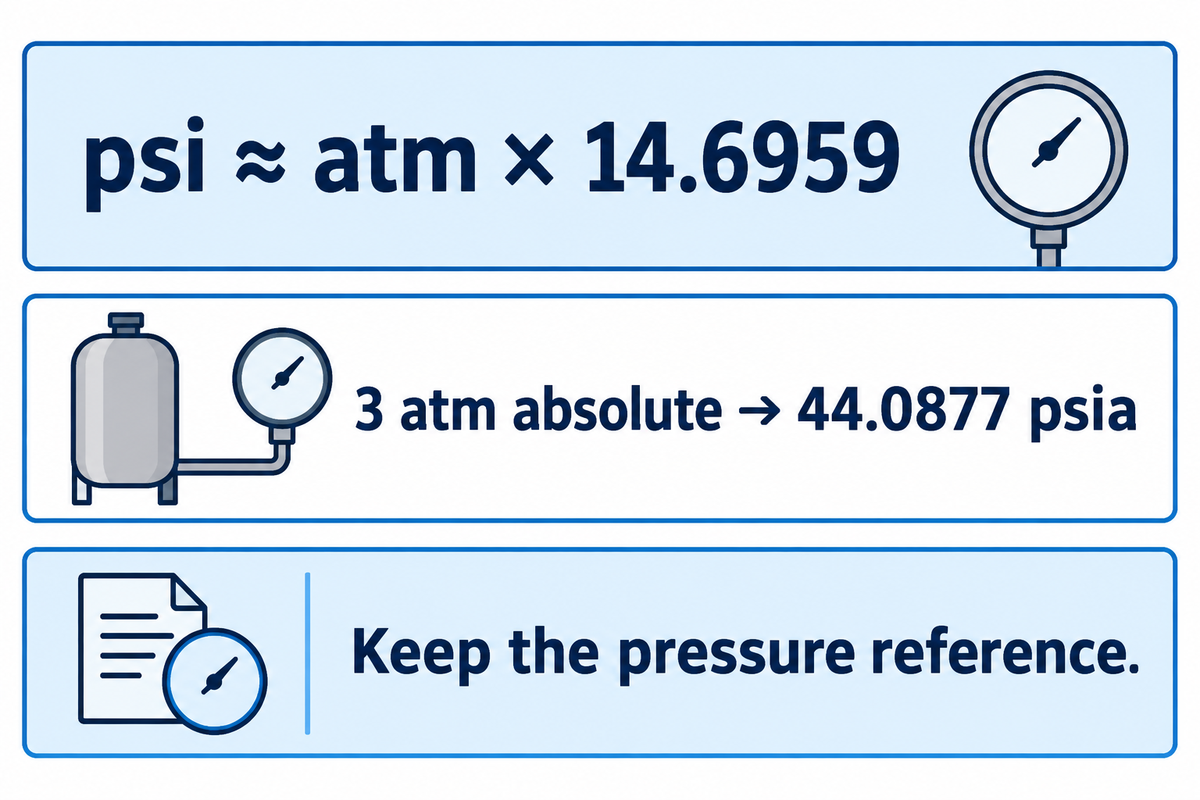
The formula for a standard atmosphere to psi calculation is pressure in psi ≈ pressure in atm × 14.6959. This conversion factor comes from the NIST pressure conversion table. The standard atmosphere has an exact pascal definition; 14.6959 is a rounded display factor suitable for the worked arithmetic here.
psi ≈ atm × 14.6959.
Example: 3 atm × 14.6959 psi/atm = 44.0877 psi.
For example, suppose an industrial engineering worksheet records an absolute pressure of 3 atm. Write the input as “3 atm, absolute” before doing the calculation. Multiplying by 14.6959 psi per atm cancels atm and produces 44.0877 psi, absolute. A display rounded to two decimal places would show 44.09 psia. Place the original value, the multiplication factor and the displayed value in adjacent columns. A reviewer can then trace the output without having to reconstruct the calculation from a separate note. Keep the unrounded calculation in the worksheet so another person can reproduce the result. The reference label belongs next to the number rather than in a separate note that may be overlooked.
For an absolute atmosphere input, the free online absolute-pressure ATA-to-PSI conversion calculator gives the related tool and chamber notations.
Does 1 atm equal 14.7 psi?
Yes, to one decimal place: 1 atm is approximately 14.7 psi. The factor used in this guide is 14.6959 psi per standard atmosphere, so 14.7 is a convenient rounded equivalent. Use the full factor for repeated calculations and then round the final result to suit the purpose of the measurement.
Retyping 14.7 into every row introduces the same proportional rounding difference each time. The rounding difference is shown directly in the table below.
ATM to PSI Conversion Chart
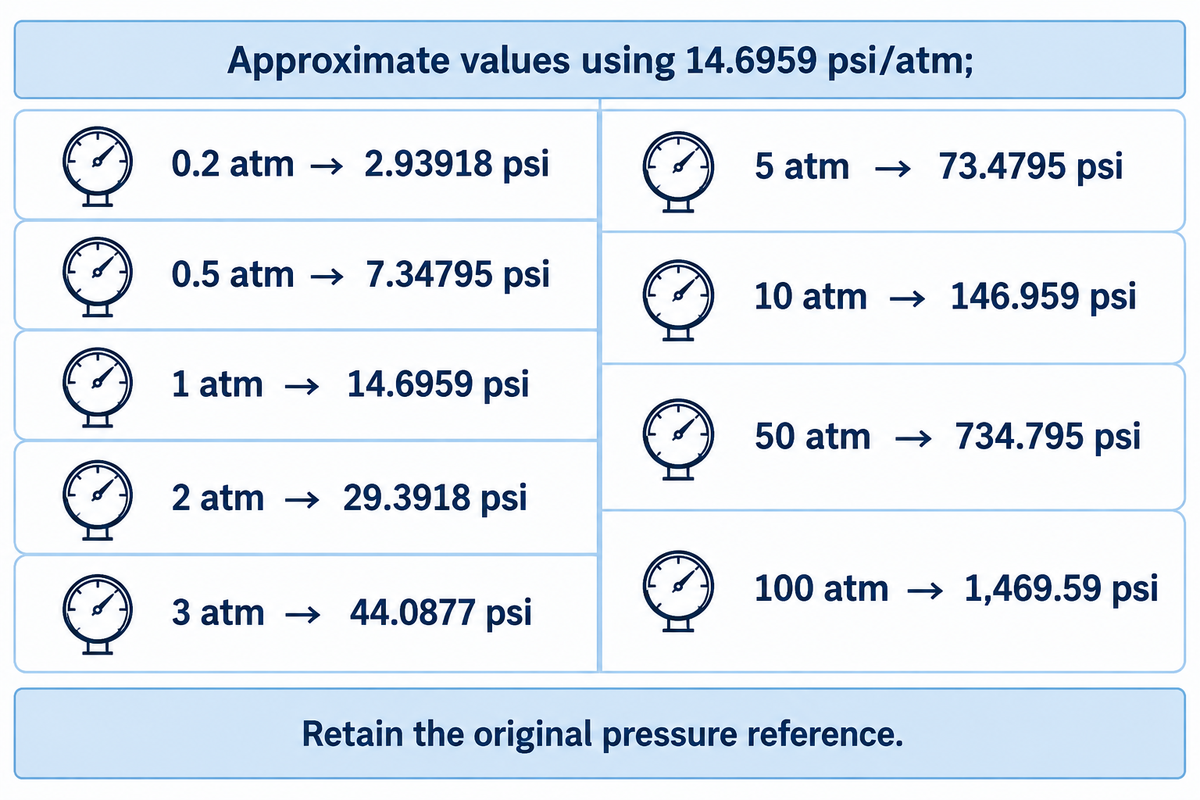
To convert standard atmospheres to pounds per square inch, multiply each value in the first column by the factor above. For example, 2 atm converts to approximately 29.3918 psi.
| Pressure in atm | Pressure in pounds per square inch (psi), approximately |
|---|---|
| 0.2 atm | 2.93918 psi |
| 0.5 atm | 7.34795 psi |
| 1 atm | 14.6959 psi |
| 2 atm | 29.3918 psi |
| 3 atm | 44.0877 psi |
| 5 atm | 73.4795 psi |
| 10 atm | 146.959 psi |
| 50 atm | 734.795 psi |
| 100 atm | 1,469.59 psi |
To read the chart, find the original value and keep its reference in your record. An absolute 2 atm input gives 29.3918 psia. A 2 atm pressure difference gives approximately 29.3918 psi of differential pressure. The arithmetic is identical because each uses the same unit ratio.
PSI to ATM: Divide to Convert Back
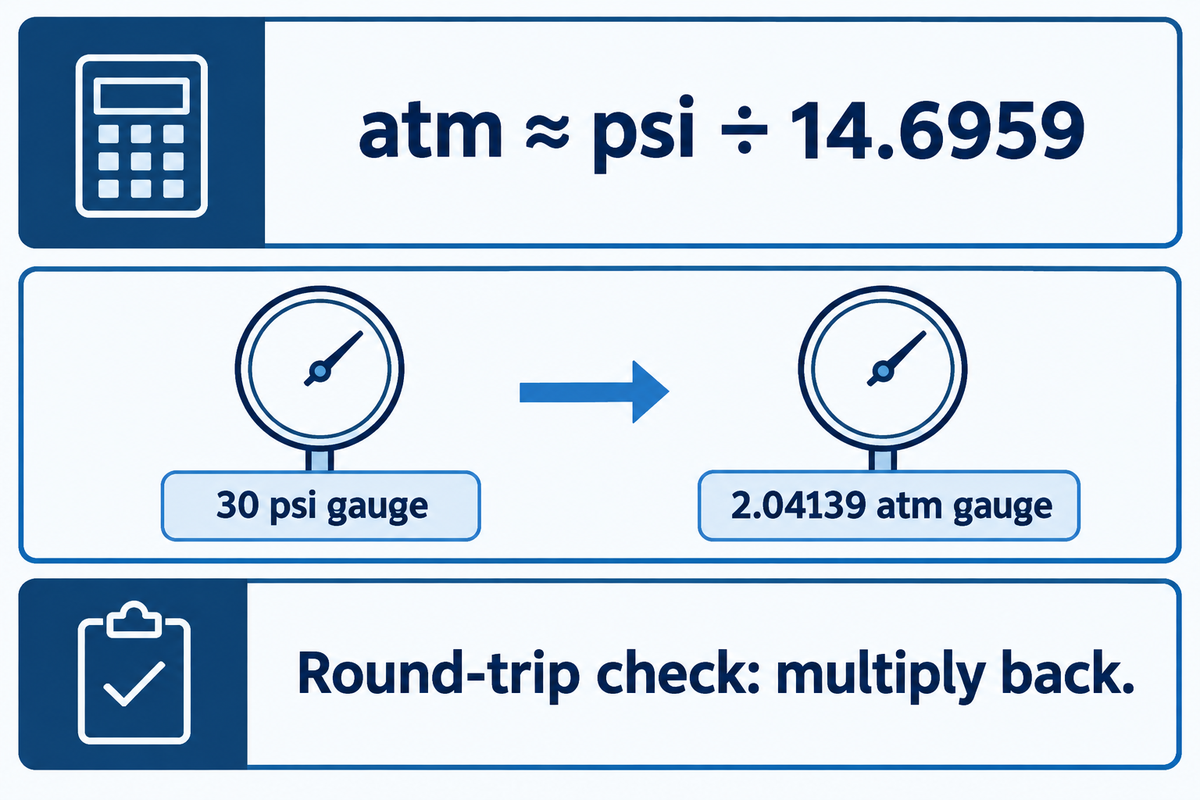
To convert psi to atm, divide by approximately 14.6959. Thus, 30 psi ÷ 14.6959 psi/atm ≈ 2.04139 atm. The NIST conversion instructions describe division for reversing a tabulated conversion factor.
atm ≈ psi ÷ 14.6959
To convert psi to atm, divide by the conversion factor. For quick hand checks, dividing psi by the rounded factor 14.696 gives practically the same result as the full factor. Suppose a lab note gives a gauge reading of 30 psi and a report requires that value in atm. Enter 30 as the psi input, divide by 14.6959, and record approximately 2.04139 atm, gauge. Multiplying the unrounded result by the same factor should return the original 30 psi, apart from ordinary numerical rounding. That round trip checks worksheet consistency and helps catch a reversed operator, misplaced decimal or a reference to the wrong cell. NIST specifies dividing by the forward conversion factor for a reverse conversion; keep this instruction beside the constant cell.
A useful psi to atm conversion record therefore retains the input, unit, reference and final display precision. You can convert psi values in bulk with one formula while keeping the original readings for comparison. Multiplying by the forward factor a second time changes the magnitude in the wrong direction. In a chemistry worksheet, record pressure separately from fluid density and temperature. Changing the pressure unit leaves those separately stated quantities unchanged.
ATM, Bar, kPa and Technical Atmosphere
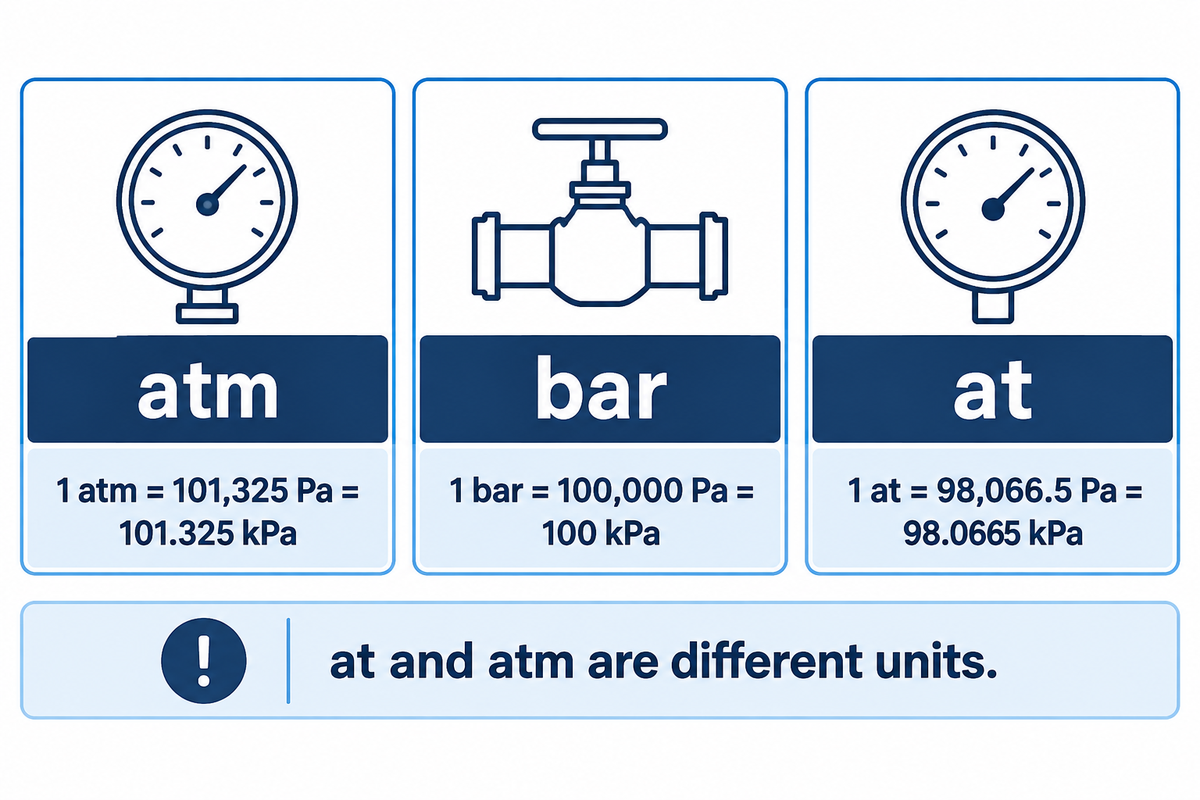
1 atm = 1.01325 bar = 101.325 kPa. These units are different. The technical atmosphere, symbol at, is also distinct: 1 at equals 98.0665 kPa. The NIST Appendix B.8 table gives the pascal factors used for this comparison.
| Unit | Value in Pa | Value in kPa |
|---|---|---|
| 1 standard atmosphere, atm | 101,325 Pa | 101.325 kPa |
| 1 bar | 100,000 Pa | 100 kPa |
| 1 technical atmosphere, at | 98,066.5 Pa | 98.0665 kPa |
SI means the International System of Units. The pascal is its unit of pressure: one newton of force per square meter. Using Pa as the common basis allows you to calculate a conversion between units without treating similar abbreviations as equivalent. For technical atmosphere to standard atmosphere, 98,066.5 ÷ 101,325 ≈ 0.967841. An engineering drawing marked “at” therefore needs a different factor from one marked “atm.”
For comparison with a mercury barometer, NIST’s pressure table lists 1 atm as approximately 760.000 mmHg (millimeters of mercury).
Is 1 bar 14.7 psi?
No. One bar is approximately 14.504 psi, and one standard atmosphere is approximately 14.6959 psi. Bar is defined as 100,000 Pa, and atm as 101,325 Pa. Their values are close enough to create confusion, and replacing one label with the other alters the pressure being specified.
To reproduce the bar result with this guide’s factor, calculate (100,000 ÷ 101,325) × 14.6959 and round to three decimal places. It also helps readers learn the relationship instead of memorizing two unrelated factors. For absolute chamber paperwork already labeled ATA, use the other guide to convert an ATA specification into bar.
A Pressure Unit Does Not Choose the Zero Point
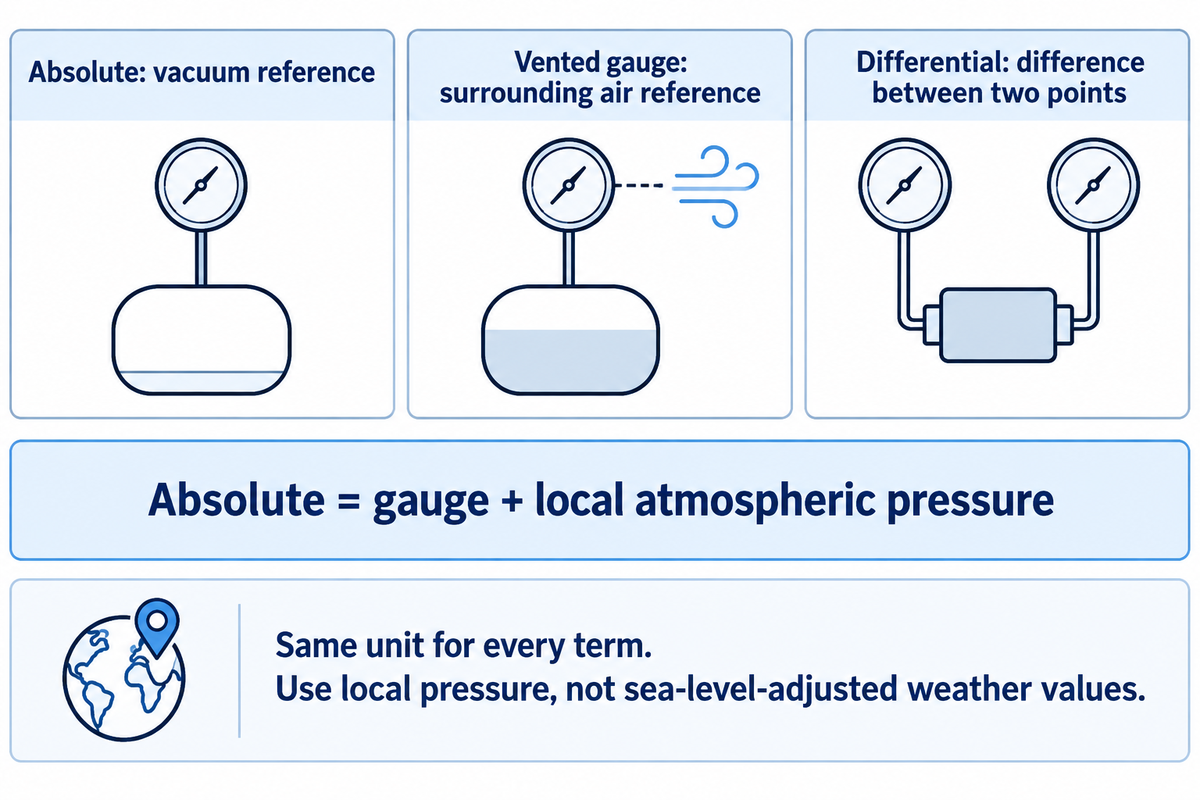
A pressure unit describes magnitude; absolute, gauge and differential describe the reference. Absolute pressure = gauge pressure + local atmospheric pressure, with every term in the same unit. The relationship is explained in more detail in this OpenStax page. Calculate the reference and unit conversion separately.
The vacuum used as a reference for absolute pressure sets its zero. A vented gauge uses the surrounding air pressure, and therefore its zero follows that ambient reference. Differential pressure describes the difference between two pressure points. A sealed gauge reads against a sealed reference pressure, so converting its reading to an absolute value requires that reference value.
| Input and stated condition | Quantity being converted | Result, approximately |
|---|---|---|
| 1 atm absolute | 1 atm absolute | 14.6959 psia |
| 2 atm absolute | 2 atm absolute | 29.3918 psia |
| 1 atm gauge; ambient 1 atm | Gauge: 1 atm | 14.6959 psig |
| 1 atm gauge; ambient 1 atm | Absolute: 1 + 1 = 2 atm | 29.3918 psia |
| 0 atm gauge; ambient 0.8 atm | Absolute: 0 + 0.8 = 0.8 atm | 11.75672 psia |
| −0.2 atm gauge; ambient 1 atm | Absolute: −0.2 + 1 = 0.8 atm | 11.75672 psia |
| Pressure difference of 0.2 atm | Differential: 0.2 atm | 2.93918 psi differential |
| Pressure difference of 1 atm | Differential: 1 atm | 14.6959 psi differential |
| 1 atm; reference unspecified | Magnitude only: 1 atm | 14.6959 psi; reference still unspecified |
When you need local ambient pressure, use a local measurement. The U.S. National Weather Service distinguishes station pressure at an observing site’s elevation from altimeter settings and mean sea level pressure, which are reduced to sea level. An adjusted sea level weather value is a different input from the actual pressure surrounding the gauge.
Is atm pressure 0 PSIG?
Not always: 1 atm absolute reads 0 psig only under one condition. One atm absolute corresponds to zero gauge pressure only when the local ambient pressure is also 1 atm. The computation is gauge pressure = absolute pressure – ambient pressure. When that condition is satisfied, 1 atm absolute – 1 atm absolute = 0 atm gauge, which converts to 0 psig.
If ambient pressure is 0.8 atm instead, a vented gauge at zero is exposed to 0.8 atm absolute. The unit definition has stayed fixed; the local reference has changed. Therefore, an unlabeled “atmospheric pressure” value needs its context prior to use in an absolute to gauge calculation.
Rounding and Spreadsheet Examples
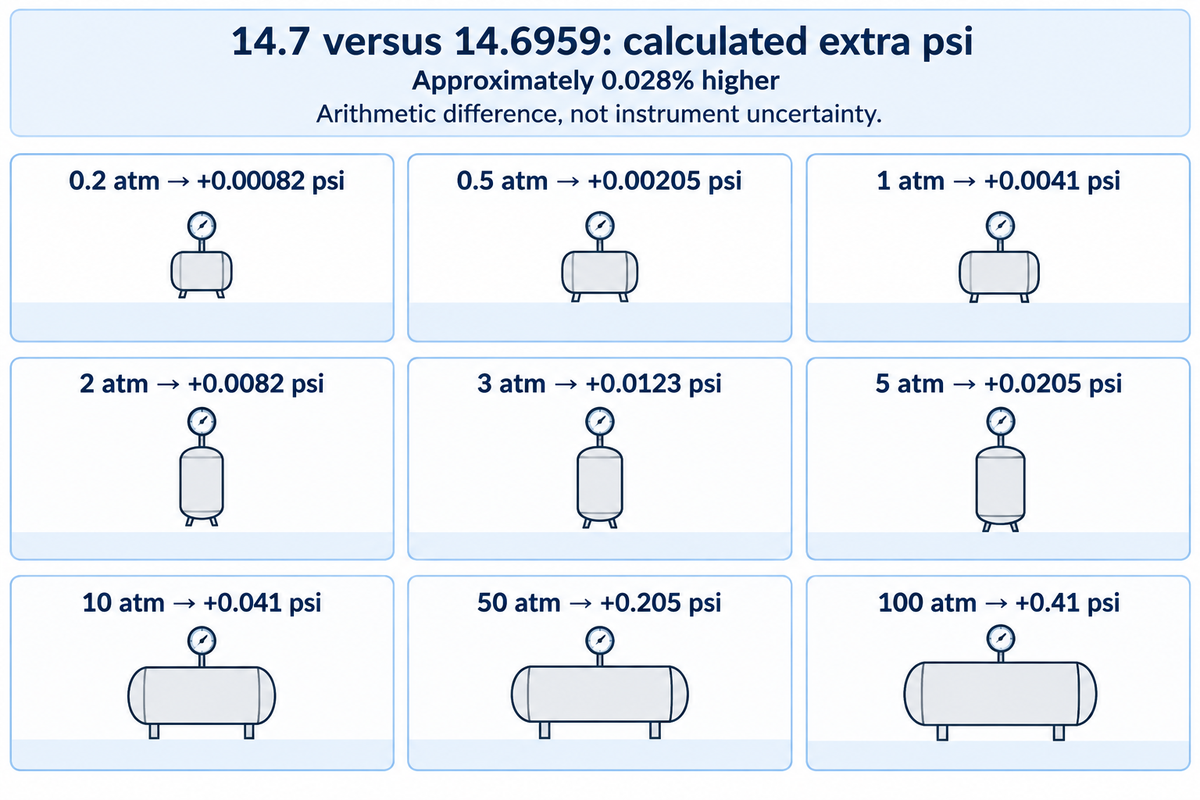
Using 14.7 instead of 14.6959 gives a calculated result approximately 0.028% higher, relative to the displayed 14.6959 factor. The percentage stays constant; the difference in psi grows with the atm input. Each row below is calculated as input atm × multiplier; extra psi = input atm × (14.7 − 14.6959). For 10 atm, 10 × 14.7 psi/atm = 147 psi; this is a calculated value. Keep the fuller factor in a constant cell and round the displayed answer at the end.
| Input | Using 14.6959 | Using 14.7 | Extra psi |
|---|---|---|---|
| 0.2 atm | 2.93918 psi | 2.94 psi | +0.00082 psi |
| 0.5 atm | 7.34795 psi | 7.35 psi | +0.00205 psi |
| 1 atm | 14.6959 psi | 14.7 psi | +0.0041 psi |
| 2 atm | 29.3918 psi | 29.4 psi | +0.0082 psi |
| 3 atm | 44.0877 psi | 44.1 psi | +0.0123 psi |
| 5 atm | 73.4795 psi | 73.5 psi | +0.0205 psi |
| 10 atm | 146.959 psi | 147 psi | +0.041 psi |
| 50 atm | 734.795 psi | 735 psi | +0.205 psi |
| 100 atm | 1,469.59 psi | 1,470 psi | +0.41 psi |
For example, suppose you are comparing spreadsheet outputs for an input of 100 atm. Put 14.6959 in cell B1, name that cell ATM_TO_PSI, and put the atm value in A2. The formula =A2*ATM_TO_PSI returns 1,469.59 psi. Using 14.7 instead returns 1,470 psi, a difference of 0.41 psi. Calculate that difference before rounding both displayed results, or the presentation may hide it. Keep a separate column for the pressure reference and label B1 as the chosen approximate conversion factor. This simple layout helps you convert a whole column consistently and makes later changes to the display precision easy to trace. Unlike a converter that returns only a number, the worksheet exposes each input field and its formula.
NIST formats approximate factors differently from exact factors in Appendix B tables.
“A factor in boldface is exact.”
NIST separately explains how rounding should reflect the original value and its intended use. The case in point above shows an example of a choice of multiplier. It does not pertain to instrument uncertainty. More decimal places in a conversion do not improve the accuracy of the original measurement.
ATM vs ATA on a Chamber Specification
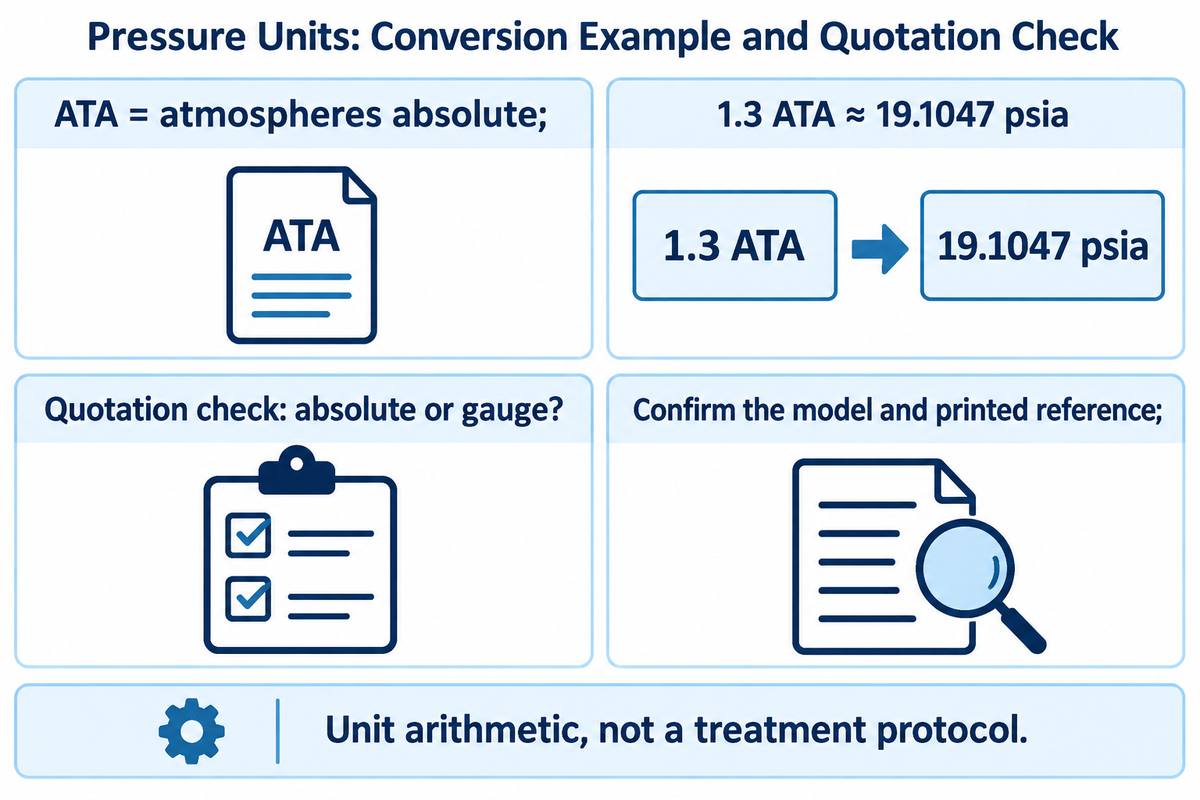
ATA indicates atmospheres absolute in hyperbaric chamber notations. The Undersea and Hyperbaric Medical Society’s terminology adopts that expansion. For an absolute specification of 1.3 ATA, the magnitude conversion is 1.3 × 14.6959 ≈ 19.1047 psia.
MACY-PAN groups its chamber pressure categories by ATA. On the absolute scale, a chamber at 1.5 ATA is about 50% above sea-level pressure, and 2.0 ATA is roughly double it. Compare the model-specific pressure specifications using the reference printed on the paperwork. If a quotation says only “psi,” ask whether it means absolute or gauge pressure and which model the value applies to.
For context regarding the use of chamber ATA labeling, see how chamber ATA labels are used. This unit tutorial provides arithmetic and is not a treatment protocol or operating setting.
Frequently Asked Questions
Is atm a unit of pressure?
Yes. The symbol atm denotes the standard atmosphere, a pressure unit defined as exactly 101,325 pascals. It is a unit of magnitude, while absolute, gauge and differential describe the reference used for a pressure quantity. Unlike the weather-dependent pressure of surrounding air, this unit stays fixed. A standard unit makes values recorded at different locations comparable on the same numerical scale.
What is pounds per square inch (psi)?
Psi means pound-force per square inch: force divided by area. The familiar phrase “pounds per square inch” refers to force here, rather than a mass measurement by itself. The suffixes psia and psig add reference information: absolute pressure uses vacuum, whereas a vented gauge uses surrounding atmospheric pressure. The denominator is an area, measured in square inches.
Is atmospheric pressure always 14.7 psi?
No. About 14.7 psi is the rounded value of one standard atmosphere, a fixed unit defined through pascals. Actual local atmospheric pressure changes with elevation and weather. As WIKA explains, weather causes atmospheric pressure to fluctuate, so atmospheric pressure at sea level also varies. Use standard atmospheric pressure as a stated reference in science and engineering, and a local air-pressure measurement for conditions at a particular place and time.
What is 2 atm in psi?
Two standard atmospheres convert to approximately 29.3918 psi. For an absolute input, write the result as 29.3918 psia.
How do I convert psi to atm?
Divide the pressure in psi by approximately 14.6959. For example, 30 psi divided by that factor is about 2.04139 atm. Retain the original reading beside the result so another person can reproduce the calculation and see where you rounded. In a spreadsheet, store the factor in one labeled constant cell and refer to it in each row. If C2 holds the psi input and the named constant ATM_TO_PSI holds 14.6959, use =C2/ATM_TO_PSI. This is the inverse of the forward atm formula, using the same approximate factor.
References & Sources
- Pressure and Gas Flow Unit Conversions — National Institute of Standards and Technology.
- Guide to the SI, Appendix B: Conversion Factors — National Institute of Standards and Technology.
- Guide to the SI, Appendix B.8 — National Institute of Standards and Technology.
- University Physics, Volume 1: Measuring Pressure — OpenStax, Rice University.
- Pressure Definitions — U.S. National Weather Service.
- Treatment Protocol: Technical Terminology — Undersea and Hyperbaric Medical Society.