Get in Touch with MACY-PAN Company

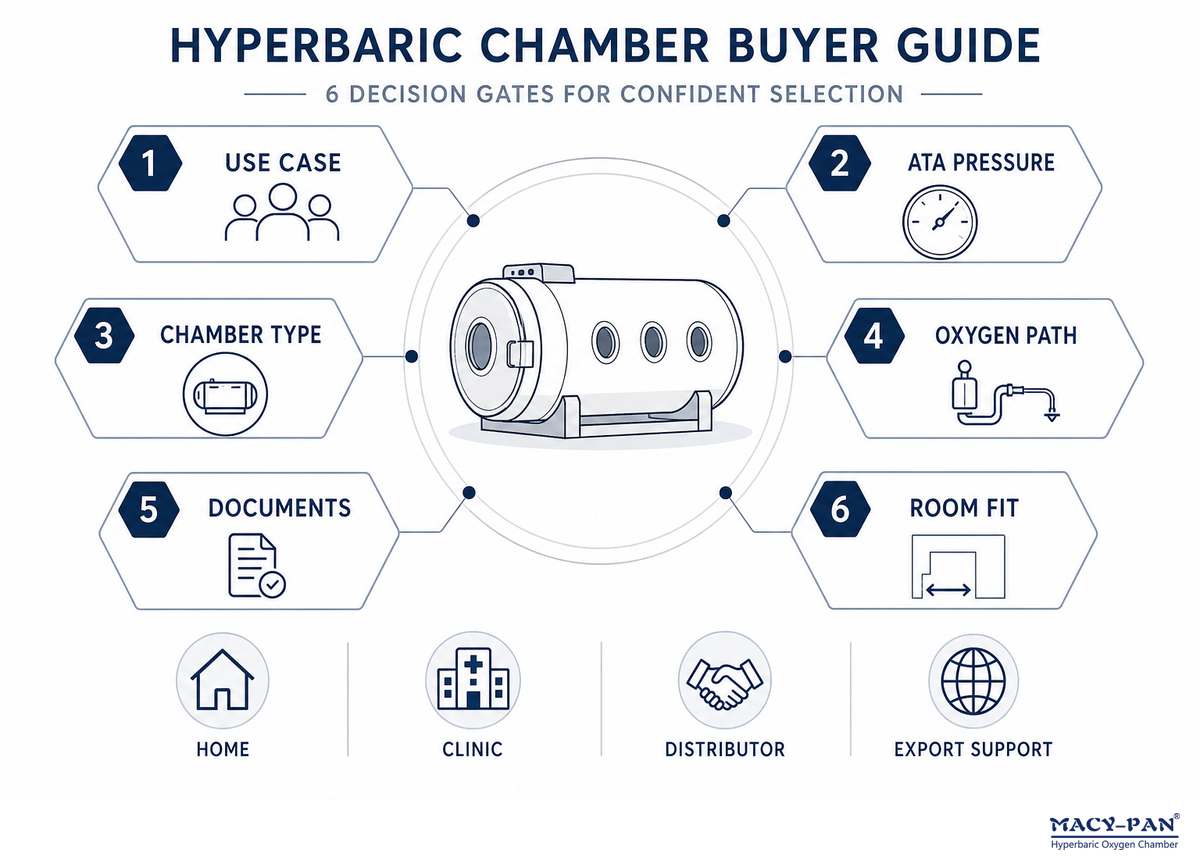
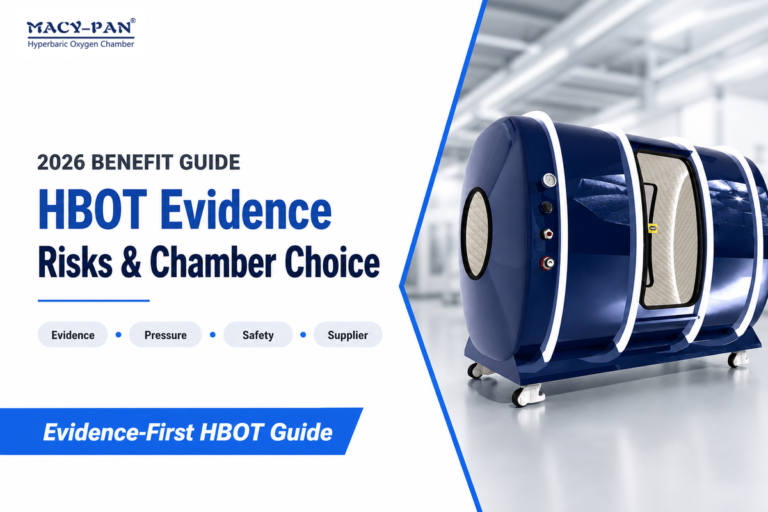
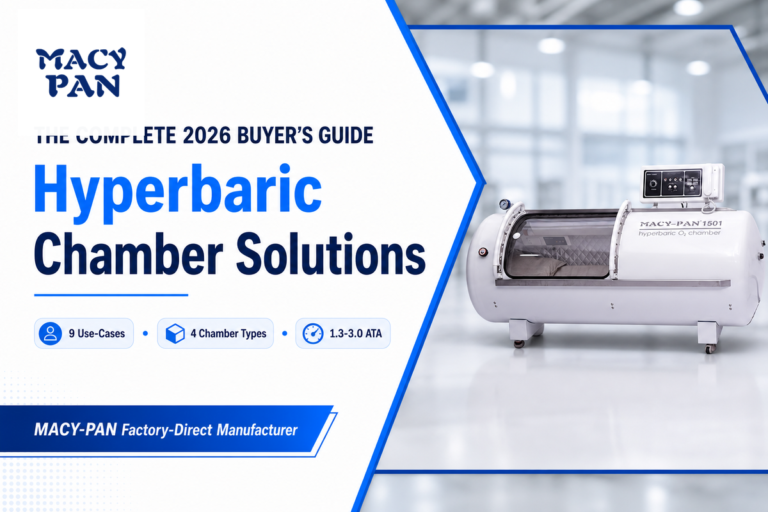
When choosing a hyperbaric chamber, do not start with the model name. Start with what the system has to do for the application: home wellness support, clinic workflow, athlete recovery support, dealer resale, or OEM procurement. Right-fit begins with the application, range, access, delivery of O2, safety validation, room conditions, and provider path.
The order of those items is important, because HBOT straddles a complex space between wellness and medicine, between safety in a pressurized chamber and vessel engineering. The U.S. FDA sent a new notification to health providers on August 25, 2025 reminding them of the critical manufacturer instructions for all HBOT systems: Fire prevention, grounding, staff certification and training, routine patient monitoring, frequency of inspections, no unauthorized objects and hyperbaric attire are among those required for HBOT equipment, and all of them should be among the initial checks a buyer makes, not post-deposit concerns.
Quick Specs: Decisions to Make Before You Request a Quote
| Buyer setting | Home, clinic, wellness center, distributor, or OEM program |
| Pressure range | Common buyer comparisons include 1.3 ATA, 1.5 ATA, 2.0 ATA, and clinical systems that may reach higher pressures |
| Chamber type | Soft shell, hard shell, monoplace, multiplace, sitting, lying, or accessible entry |
| Oxygen path | Oxygen concentrator, mask, cannula, hood, or chamber-based delivery depending on model and setting |
| Safety documents | IFU, maintenance schedule, safety checks, certificate copies, model specs, and prohibited-item rules |
| Import support | Export documents, packing, voltage, spare parts, training, and service contact path |
Start with the use case: home, clinic, wellness center, or distributor program
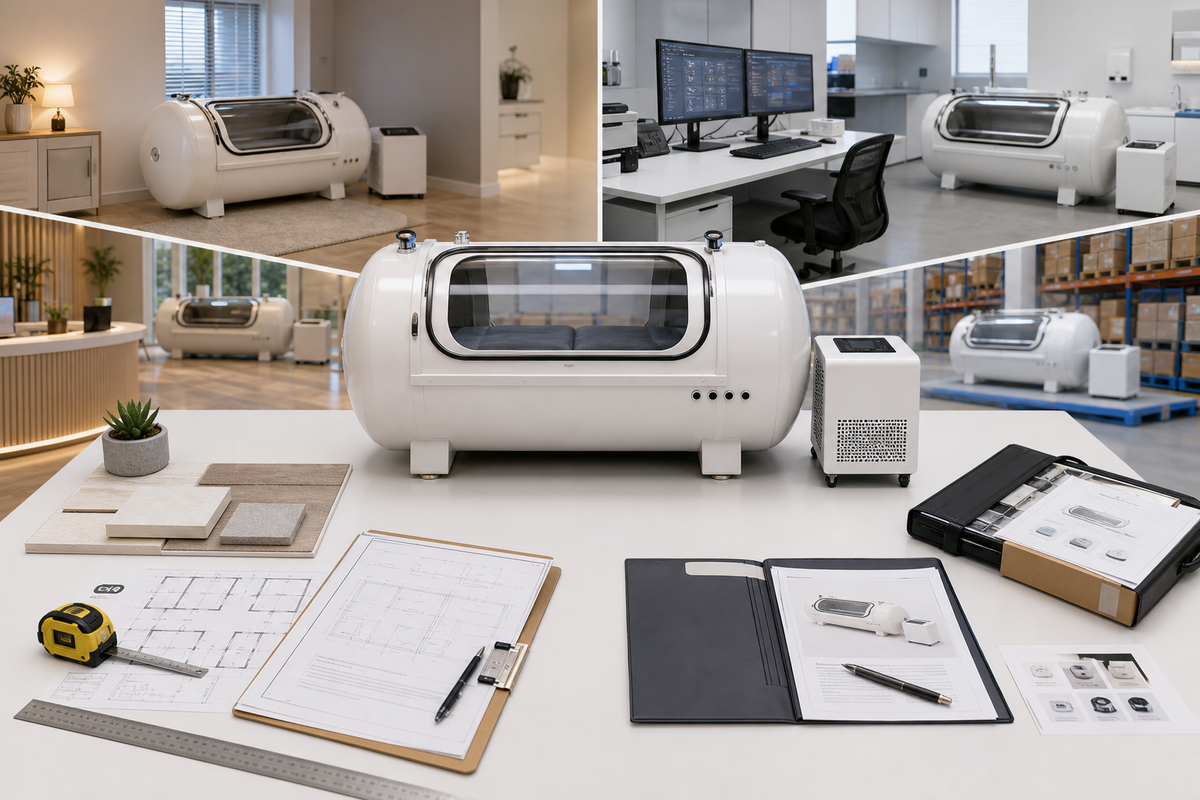
Homeowners are asking, “Does it fit my lifestyle and my house?” Clinic owners are asking, “Can my staff run and maintain it properly?” Distributors are asking, “Can I record, import, service and sustain repeat buyers?” These are distinctly separate purchase problems despite chamber appearance being identical in a brochure.
If the need is for medical HBOT, follow the medical directions: UCLA Health recommends following guidelines from the Undersea and Hyperbaric Medical Society, lists indications like air or gas embolism, carbon monoxide poisoning, decompression sickness, problem wounds (certain types), refractory osteomyelitis, delayed radiation injury, compromised grafts and flaps and acute thermal burns. Home sellers and product providers can’t turn that list into a promise of good things to all home buyers.
For your personal use: After you identify your goals, then take time to review MACY-PAN’s guide on the use of a hyperbaric chamber at home. If your plan is to resell the product to your customers, or sell as a clinic network, then view the chamber as a product combined with documents and a warranty.
Imagine two potential customers who are looking for the exact same 1.5 ATA home hyperbaric chamber. Buyer A is receiving the unit and will use it in a ground floor treatment room, attended by a qualified professional. Buyer B is receiving the same chamber in a third-floor apartment with tight elevator doors and a relative acting as monitor.
Identical pressure – but dramatically different risk. Buyer A needs confidence in how the workflow will run and clarity around screening questions. Buyer B needs to know the doorway size, packing size and whether the delivery team will help with setup – and have a plan in place for the oxygen alarm. That is why the buying process must always establish the environment prior to determining the product.
Advantages of starting with use case
- This does not allow a home buyer to be like a hospital buyer.
- This will allow clinics to remain focused on their workflow, oversight, and staff development.
- This feature allows dealers to verify documentation and parts prior to model pricing.
Limits of use-case sorting
- It does not replace medical screening.
- It does not validate that a space is appropriate for any specific health care claim.
- It still needs model-level confirmation from the supplier.
Choose ATA pressure before choosing a chamber shape
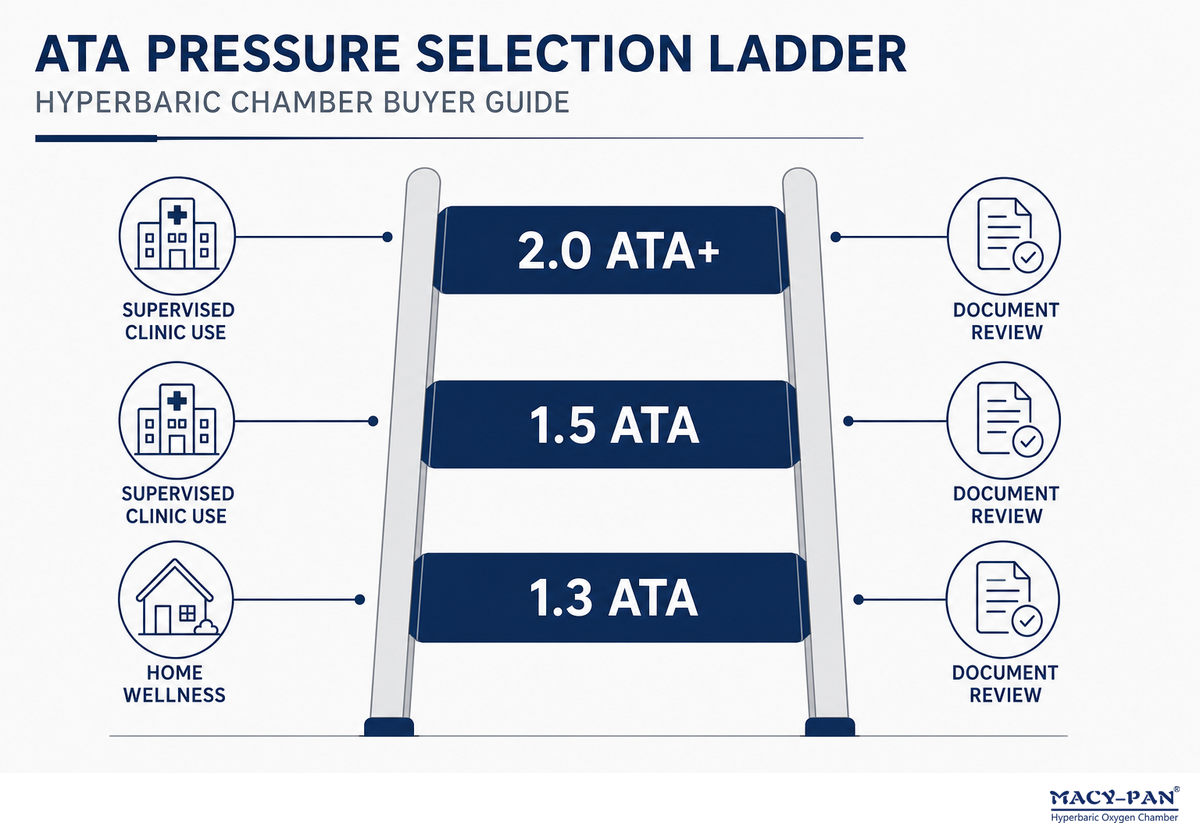
ATA refers to Atmospheres absolute. The higher this number, the greater the pressure in the chamber above that of normal atmospheric pressure. Although a doctor’s definition for HBOT might refer to exposure to no less than 1.4 ATA with a person breathing pure oxygen, this varies wildly with the categories buyers face when purchasing.
This is why it should be a qualifier rather than the campaign slogan.
For mild HBOT, home and wellness purchasers often consider 1.3 ATA and 1.5 ATA hyperbaric chambers, whereas clinics may consider systems over 2.0 ATA according to indications for use, supervision plan, device clearance, and state legal guidelines. Johns Hopkins’ explanation of HBOT says treatment normally uses pressures between 1.5 and 3 atmospheres greater than normal air, while emphasizing patient-specific risk and dosage management.
What is ATA in a hyperbaric chamber?
The ATA represents the pressurized atmosphere; not the grade. For example, a 1.3 ATA, a 1.5 ATA and a 2.0 ATA chamber can accommodate different consumer requirements. The higher ATA will alter: user screening, documentation, the chambers’ physical makeup, the exposure to oxygen, as well as the maintenance standards.
Narrow your selection before examining costs or material considerations of your chamber with MACY-PAN’s ATA hyperbaric pressure and model guide.
Engineering Note
Pressure Vessels for Human Occupancy (PVHO), as defined by ASME PVHO-1-2023, apply to those with a differential pressure greater than 2 psi both externally and internally, and applies to hyperbaric and medical hyperbaric oxygen facilities. That can translate to pressure considerations being not only about patient comfort but about document review and question content during inspections for purchasers.
Match chamber type to user count, mobility, and supervision
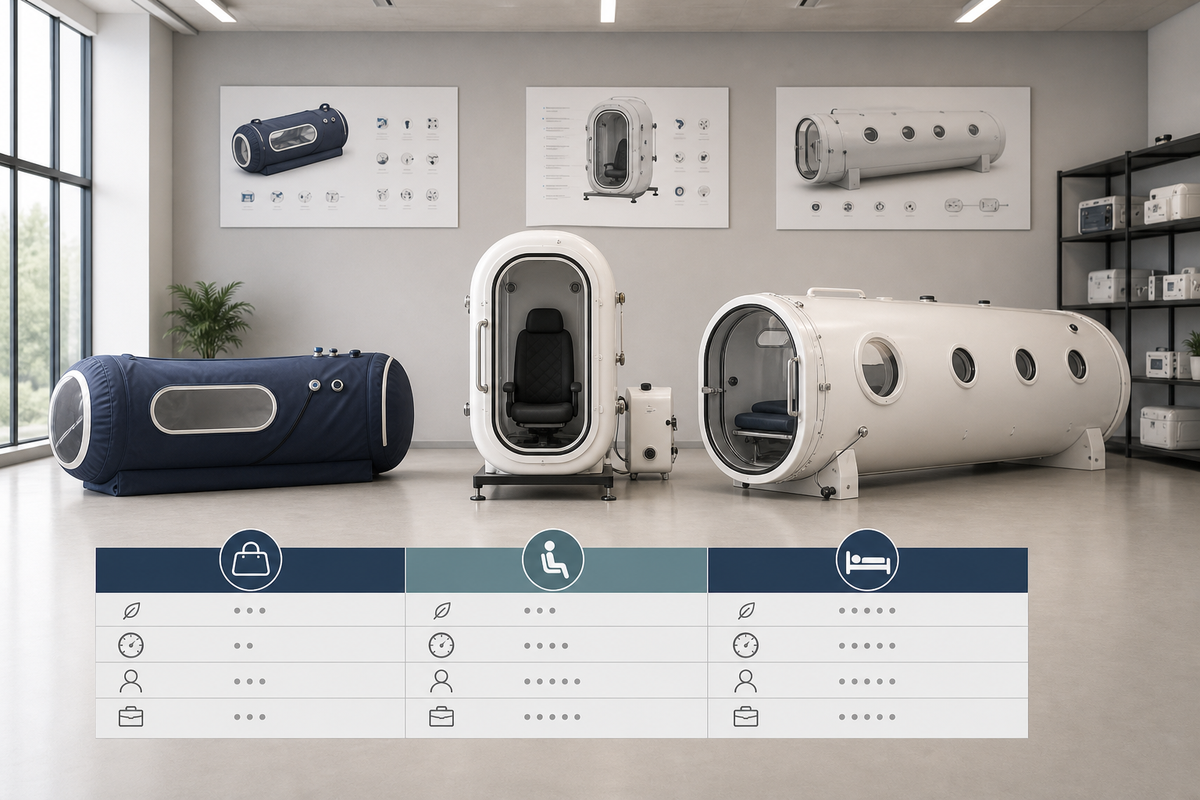
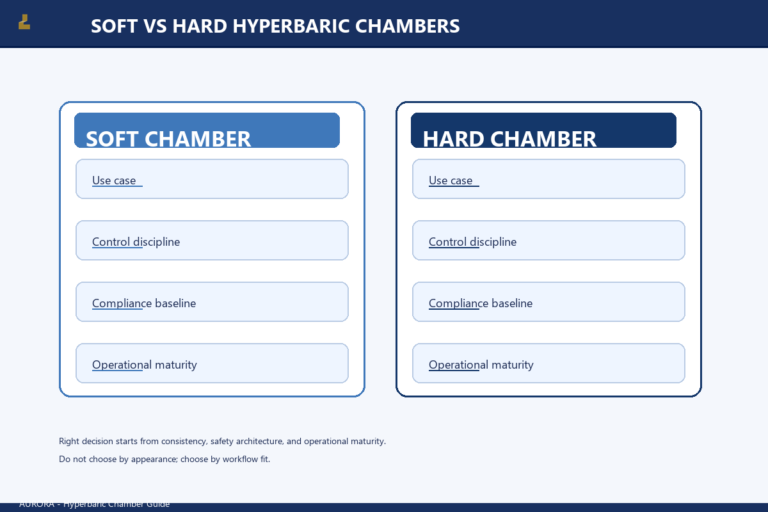
Chamber type follows pressure gate: A soft chamber might be ideal if mobility and moderate pressure are key; a hard-shell chamber if the user wants another pressure range, more of a stationary install, or clinic-style setup; and a monoplace if the user plans on using the chamber solo and a multiplace if the user anticipates accommodating more than one patient or if a clinical team will enter the chamber with the patient, according to UCLA, adding that a multiplace can be easier for people who feel claustrophobic.
What is the difference between monoplace and multiplace chambers?
Monoplace hyperbaric chambers are for one user only. Multiplace hyperbaric chambers are for more than one user, or a user and support person working in an oxygen rich environment. Selection will determine space, staff, oxygen supply, comms, emergency protocols, throughput.
For the home user the comparison boils down to: soft shell vs hard shell; sitting vs lying; ease of entry and exit.
To get a better idea on chamber type comparisons, check out MACY-PAN’s soft vs hard chamber comparison guide, monoplace vs multiplace chamber guide, and portable hyperbaric chamber guide.
| Type question | Why it changes the shortlist | What to ask before buying |
|---|---|---|
| Soft or hard shell? | Pressure range, portability, installation space, and support expectations differ. | Rated pressure, material, zipper/door system, oxygen setup, and maintenance schedule. |
| Sitting or lying? | Comfort, claustrophobia, ceiling height, and user mobility all change. | Internal height, entry width, chair position, and emergency exit process. |
| Monoplace or multiplace? | One-user vs multi-user operation changes staffing, room, and oxygen delivery. | User count, supervision method, communication system, and service requirements. |
Check oxygen delivery, monitoring, and fire-safety controls
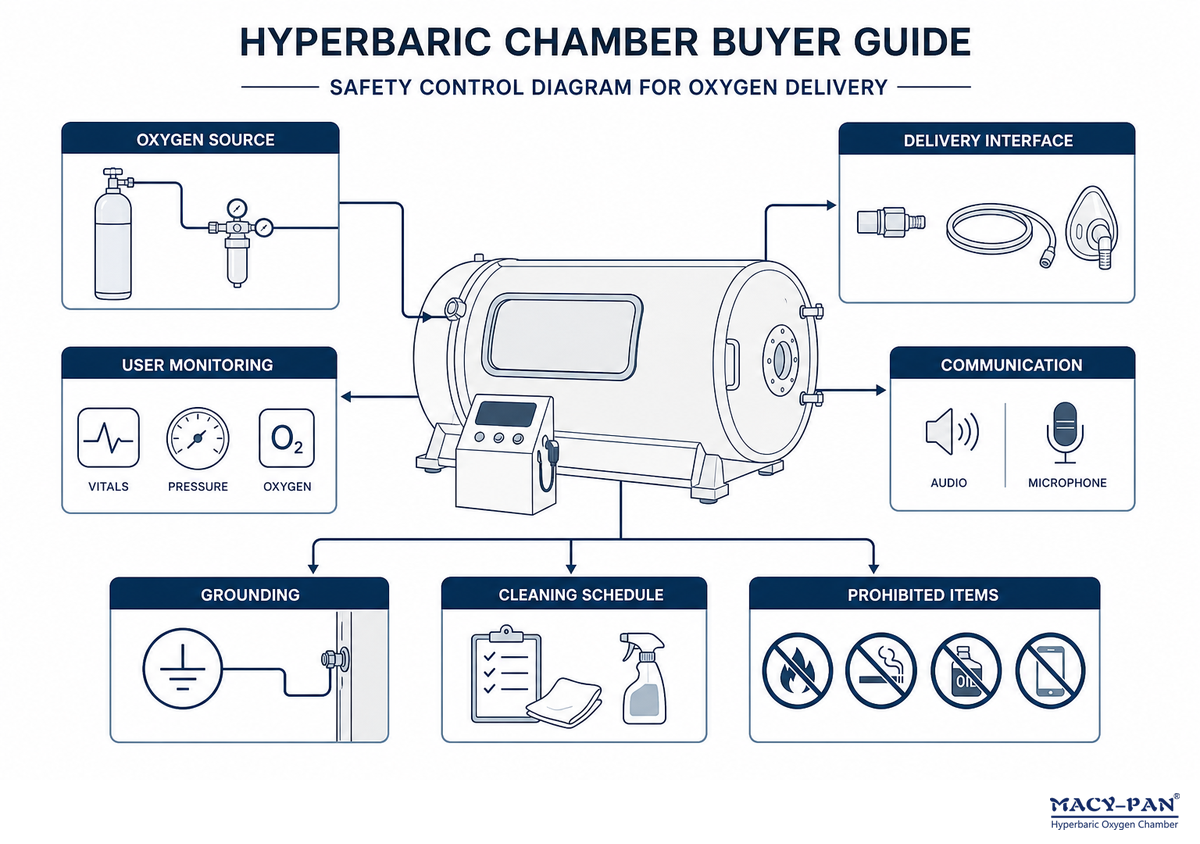
Oxygen delivery is not just an accessory issue. The delivery method has an impact on patient safety, patient exposure, the required fire safety procedures, training needs, and the maintenance schedule. The 2025 FDA letter notes the higher fire risk associated with high-concentration oxygen therapy and outlines the necessary checks, staff training, and equipment safety precautions including grounding, monitoring, cleaning and the required frequency of maintenance.
Inquire about the oxygen source, how the model supplies it, and what type of oxygen concentrator is necessary. Ask about communication with the user during sessions and how the chamber is supervised. You’ll also need to find out which objects are not allowed in the chamber. Certain electrical items, static-generating substances, oils, lotions, and inappropriate clothing can pose risks, depending on the chamber and the type of oxygen used. Adhere to the manufacturer’s recommendations, not those found online.
Who should not get in a hyperbaric chamber?
Start with medical screening. As part of its guide to safe hyperbaric chamber use, StatPearls outlines absolute and relative contraindications to HBOT, such as untreated pneumothorax, a number of lung disorders, certain medications, trouble with ear and sinus equalization, high fever, claustrophobia, and other conditions specific to the individual. Johns Hopkins advises against HBOT for people who have collapsed lung, some lung diseases, an ear injury or recent surgery, a fever or cold, or who suffer from severe claustrophobia.
Safety check before purchase
- Ask for the model-specific instructions for use.
- What are the prohibited materials or items inside the chamber?
- Confirm cleaning, maintenance, and safety-check intervals.
- What method will be used to monitor the user, and how will you communicate with him or her?
- Ask what training is required before the first session.
Verify documentation before comparing chamber cost
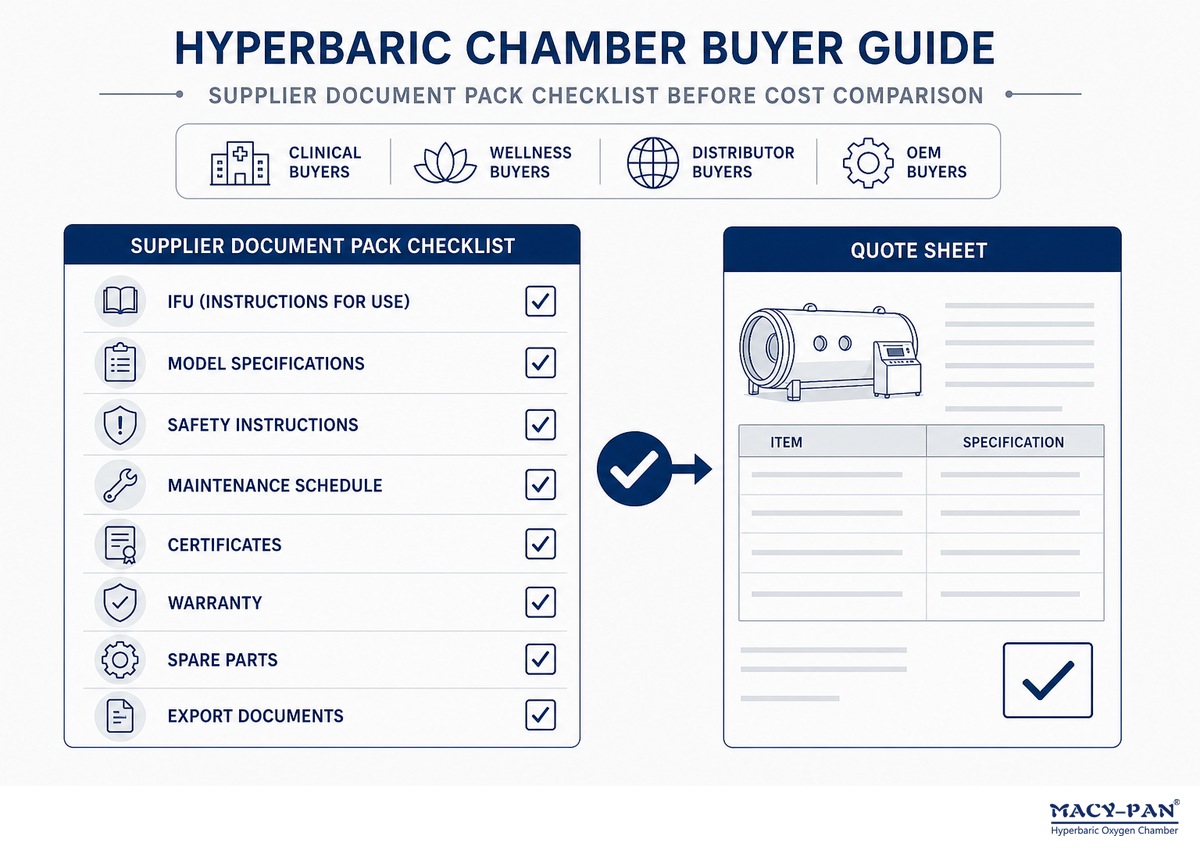
Room fit is part of the real price because it affects the delivery pathway, installation requirements, and usable space around the chamber. Even if you purchase a chamber with a low price quote, it can be expensive if the offer doesn’t include necessary spare parts, delivery, setup, or any user training. Get all of the necessary documentation from each supplier. They should provide the user manual, instructions for use, model specification sheet, safety instructions, maintenance schedule, certificate copies, warranty, list of spare parts, and export documents (if the chamber will be shipped outside the U.S.) before you begin making a comparison.
As a reference in the United States context for medical devices, “chamber, hyperbaric” has a FDA Product Code of CBF, with a Submission Type of 510(k), and falls under Device Class 2, regulation number 868.5470, and it has a Life-Sustain/Support Device status of “yes.” That particular page on the FDA Web site was last updated July 13, 2026. Please note that just because it exists as a classification does not imply that every single device marketed online is FDA-cleared for every medical claim made by a seller or user of a chamber. You as the purchaser will want to understand how to check that a particular device has the applicable regulatory path for your intended application and market.
Under FDA’s recognized consensus standards, the page for this regulatory area lists ASME PVHO-1-2023 as a complete recognized standard and notes that for premarket submission declarations, recognition of ASME PVHO-1-2019 will be transitioned to PVHO-1-2023 after December 26, 2026. According to the ASME Web site, PVHO-1-2023 is a 2023 standard for the design, fabrication, inspection, testing, marking, and stamping of pressure vessels for human occupancy.
Use MACY-PAN’s Manufacturer Verification Checklist and Hyperbaric Certification Decoder to outline what should be included in your document requests. Then, use our Hyperbaric Chamber Cost Guide once you are clear on what a particular vendor or manufacturer quote is expected to cover.
Confirm room fit, doorway access, floor load, and service clearance
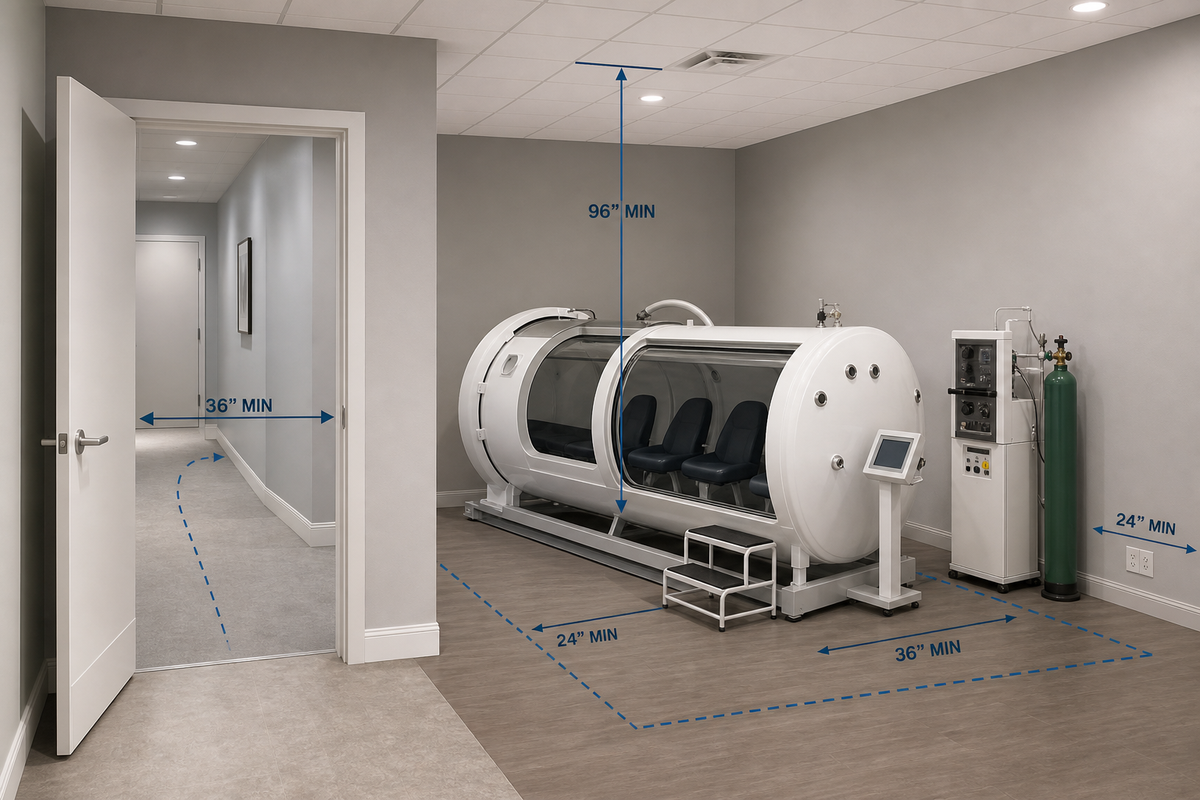
Don’t limit yourself to the chamber’s width and length dimensions. Delivery routes are important, and the space requirements should cover building entrances, elevator size, corridors that require a turn, door widths, ceiling heights, and room for a concentrator or compressor. If you buy a seated model for easier entry, you may need to consider more ceiling height than for a bed-style chamber.
Before you put down any money for a deposit, do a careful walkthrough from the delivery entrance all the way to your intended room location. Measure and note the tightest turn, smallest door frame width, highest ceiling, clearance from walls, where outlets are, and where your oxygen system and equipment will go. After that, you can get into a dialogue with the supplier about packaged size, fully assembled size, operating space minimum, service access, and any specific requirements for floor and ventilation.
For the home or personal buyer, a simple doorway fit calculator by MACY-PAN can use those dimensions to shorten the process of screening models.
Measure Before Quote
- Map every doorway and turn from the arrival point to your oxygen therapy room.
- Check ceiling height for sitting and vertical chamber designs.
- Show the supplier exactly where you’ll put oxygen equipment, power supplies and all accessories.
- Keep clear space behind the chamber so you can access service easily-don’t push it tight against walls.
- Ask for packed dimensions as well as operating dimensions.
Plan after-sales support, spare parts, and export shipping
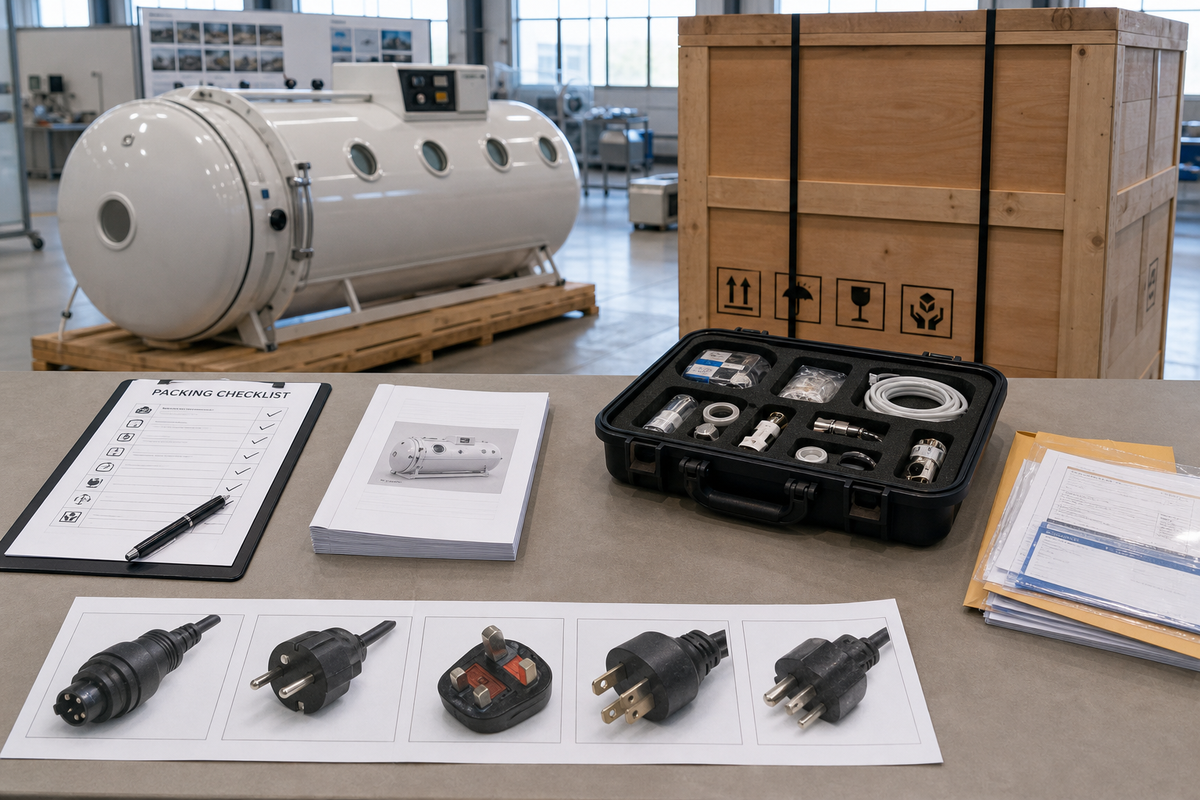
If you are purchasing a hyperbaric oxygen chamber as a shipped system, and not a pre-installed unit, then the order for international sales should explicitly include detailed packing specifications, export documents, confirmation of voltage and plug configuration, spare parts list, instructional training manuals, maintenance documentation and clear contact information and support after delivery.
According to MACY-PAN, Shanghai Baobang Medical Equipment Co., Ltd. is an established player with over 17 years of specialization in hyperbaric oxygen chamber systems.
They serve more than 126 countries, catering to both individual and commercial buyers, with the capability to customize OEM products. The company has a record of certifications including ISO13485, ISO90001, and CE marks, along with patent registrations (though certificate label checks against originals are necessary for official use).
When importing a chamber, first consider MACY-PAN’s documentation and global shipping support to inform your final model selection. Discussion with the supplier should include the chamber, the oxygen system, spare parts, packing, documentation and support personnel you’ll communicate with during installation.
Demand a pre-delivery checklist in writing that outlines contents, accessory list, power specifications, unpack steps, first power-on sequence, and your primary service contact. If the unit is for resale, ask which documents and training can be passed along to the end user and how best to escalate any technical issues. A reseller who can’t explain installation procedures, safety guidelines, and the process for getting post-sales help will quickly be overwhelmed by a flood of calls from frustrated clients.
The 6-Gate Chamber Choice Filter
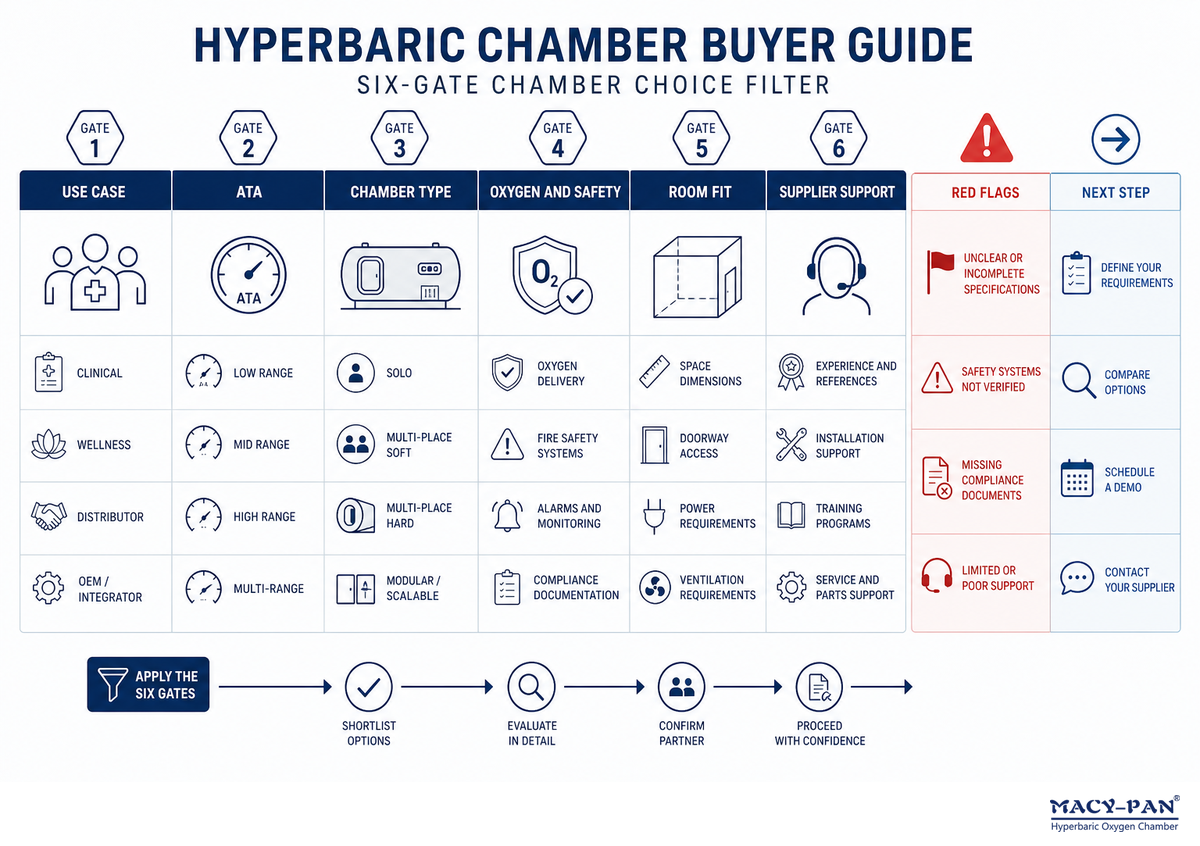
Use this filter when you’ve narrowed down choices between two vendors whose quotes appear similar. This method requires both suppliers to respond to identical questions, preventing a lower price from masking overlooked or missing documentation, training or after-sales service.
| Gate | Decision | Red flag | Next step |
|---|---|---|---|
| 1. Use case | Home, clinic, wellness center, distributor, or OEM | Same model pitched for every buyer | Write the buyer setting in the quote request |
| 2. ATA pressure | 1.3 ATA, 1.5 ATA, 2.0 ATA, or clinical path | “Higher is always better” | Ask why that pressure matches the use case |
| 3. Chamber type | Soft, hard, sitting, lying, monoplace, or multiplace | No entry/exit or mobility discussion | Match type to user access and supervision |
| 4. Oxygen and safety | Delivery method, monitoring, grounding, prohibited items | No model-specific safety instructions | Request IFU and safety-check schedule |
| 5. Room fit | Door path, ceiling, floor, service clearance | Only external product dimensions provided | Send room and doorway measurements |
| 6. Supplier support | Documents, packing, spare parts, export, training, service | No named support process after delivery | Ask for the document pack before payment |
Need a model shortlist?
Send your intended pressure, client-desired setup, the dimensions of your installation room and your destination country. MACY-PAN can guide you in choosing the right type of chamber, oxygen setup, packing configuration and the necessary documentation.
What is changing in 2026 hyperbaric chamber buying?
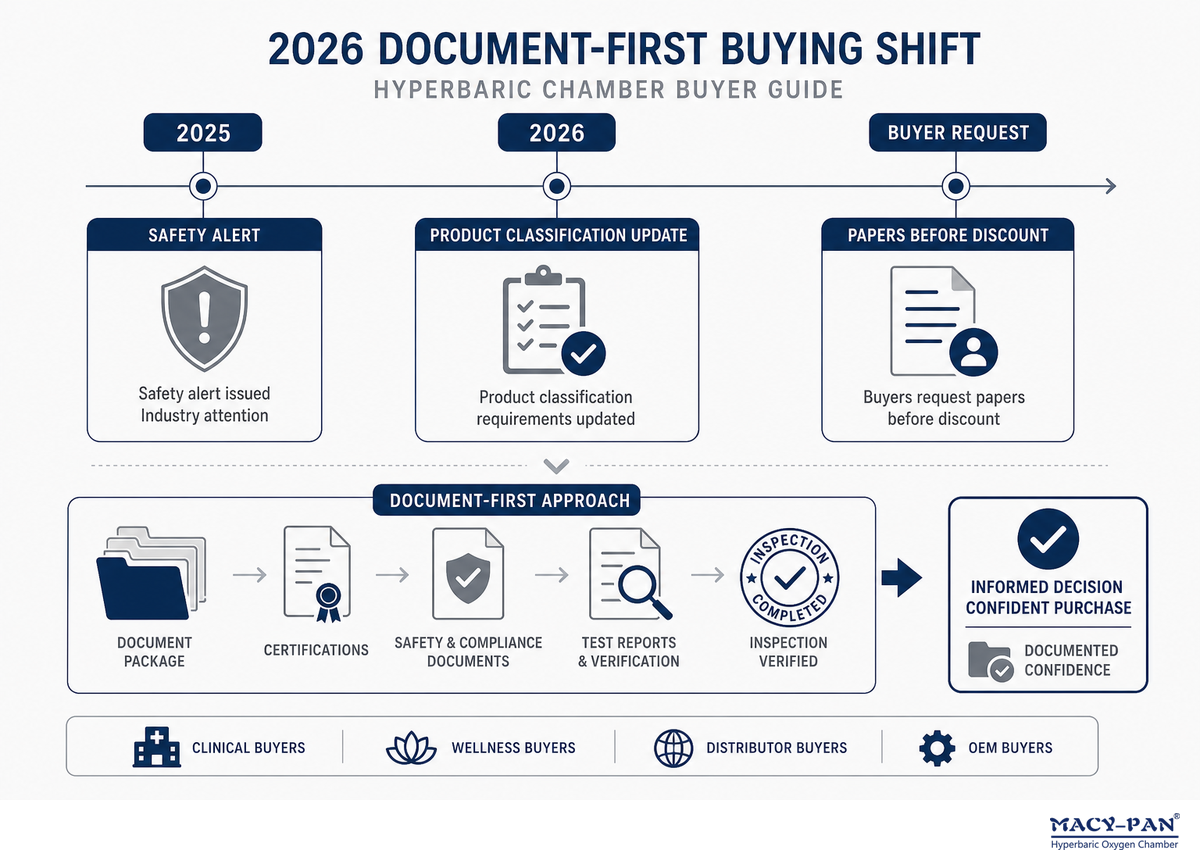
In 2026, the purchase shift is not merely jargon. It is a document-first buying process.
FDA’s August 25, 2025 safety alert highlighted the significance of manufacturer instructions, fire safety, electrical grounding, operator training, performance monitoring, equipment maintenance, and prohibitions on specific materials. Their Product Classification page for Product Code CBF was updated on July 13, 2026, and the ASME PVHO-1-2023 section was revised on May 25, 2026.
As the buyer, your response is easy – “Let me see the papers first. If your rep can walk me through pressure, how the oxygen is supplied, how to maintain it, do safety checks, talk about spares and export documents before discussing discounts, we are off to a better start. If they can only offer “best price”, I’m not done yet.”
FAQ
Q: Which hyperbaric chamber is best?
View Answer
Best means fit for purpose, not the same model for every buyer.
Q: Can I buy my own hyperbaric chamber?
View Answer
In many markets, buyers can purchase home-use hyperbaric chambers. A better question is whether the chamber’s pressure range, oxygen setup, papers, training, and local rules match the intended use. Medical treatment decisions should involve a qualified clinician, especially when the buyer wants HBOT for a diagnosed condition rather than general wellness support.
Q: Who should not use a hyperbaric chamber?
View Answer
People with untreated pneumothorax should not undergo HBOT according to medical references. Other issues, including certain lung conditions, fever, ear or sinus problems, medications, pregnancy, severe claustrophobia, or implanted devices, need clinician screening before use. Do not use a chamber to work around medical uncertainty. Use screening to decide whether treatment is suitable, which pressure and oxygen exposure are appropriate, and what monitoring is needed.
Q: Is 1.3 ATA or 1.5 ATA better for home use?
View Answer
Neither is automatically better. Ask why that pressure range fits your intended use.
Q: What documents should I ask a chamber manufacturer for?
View Answer
Ask for the instructions for use, safety rules, prohibited-item list, maintenance schedule, product specification sheet, certificate copies, warranty terms, spare parts list, packing details, and export documents. For regulated medical use, ask how the model maps to the rules in your market.
Q: Will a hyperbaric chamber fit in a home or clinic room?
View Answer
Measure more than the final floor space. Check the delivery path, door width, corridor turns, ceiling height, floor surface, outlet location, service clearance, and the oxygen equipment position. Send those measurements to the supplier before selecting the final model.
Related Articles
- Home Hyperbaric Chamber Guide – home-use fit, comfort, and setup questions.
- Hyperbaric Chamber ATA Pressure Guide – how pressure range changes model choice.
- Soft vs Hard Chamber Comparison – shell type tradeoffs before purchase.
- Portable Hyperbaric Chamber Guide – mobility, space, and home setup checks.
- Export and Shipping Support – document and delivery planning for international buyers.
References & Sources
- Follow Instructions for Safe Use of Hyperbaric Oxygen Therapy Devices – U.S. FDA
- Product Classification: Chamber, Hyperbaric – U.S. FDA
- Recognized Consensus Standard: ASME PVHO-1-2023 – U.S. FDA
- PVHO-1 Safety Standard for Pressure Vessels for Human Occupancy – ASME
- Hyperbaric Medicine Indications – UCLA Health
- Hyperbaric Oxygen Therapy Contraindications – StatPearls, NCBI Bookshelf
- Complications of Hyperbaric Oxygen Treatment – Johns Hopkins Medicine