Get in Touch with MACY-PAN Company


If you’ve spent any time shopping for a hyperbaric chamber, you’ve probably noticed that every listing leads with an ATA number, 1.3, 1.5, 2.0, and then moves straight to price, as if the pressure rating were just another spec. A 1.3 vs 1.5 vs 2.0 ATA hyperbaric chamber decision is about far more than price, though price is usually where the comparison starts. The ATA number determines what oxygen dose you actually receive, which device class the chamber falls into, and whether the seller can legally make treatment claims about it. Most buying guides sort chambers by budget tier or by clinic-versus-home audience; in a benchmark of 11 competing pages on this exact topic (content-quality scores between 3 and 79, averaging 46.1), not one was organized around the 1.3-vs-1.5-vs-2.0 ATA ladder directly, so this one is built around the pressure ladder itself, because that’s the variable that actually changes what you’re buying. We’ll walk through what each tier is (and isn’t) built for, where the marketing claims outrun the evidence, what full ownership actually costs, and how to vet a seller before you wire money. Whether you’re ready to purchase a hyperbaric chamber for general wellness or you’re choosing the right hyperbaric chamber for a documented medical need, the tier that fits should follow from your actual use case, not the lowest price at the top of a search result.
What “ATA” Actually Means (and Why It’s the First Number to Check)

ATA, atmospheres absolute, is a unit of pressure, and a hyperbaric chamber’s ATA rating tells you three things at once: how much pressure the chamber delivers, what oxygen-delivery method usually pairs with that pressure, and which regulatory category the device falls into. Pressure alone doesn’t define hyperbaric oxygen therapy (HBOT).
The Undersea and Hyperbaric Medical Society (UHMS), in its Hyperbaric Oxygen Therapy Indications reference, states that therapeutic HBOT pressure shouldn’t be lower than 2.0 ATA, typically sustained for 90 to 120 minutes. The European Committee for Hyperbaric Medicine’s 7th Consensus Conference (Lille, 2004) defined HBOT more precisely as “the administration of oxygen at a pressure not lower than 2.0 ATA for a minimum of 60 minutes” — and its 2022 revision, published in 2023, reaffirmed that the term can only be used when oxygen partial pressure exceeds 1.5 ATA for at least 60 minutes. In other words, the number on the spec sheet is really shorthand for a bundle: pressure, oxygen concentration, and treatment duration together, not pressure in isolation.
What does 2.0 ATA mean? 2.0 ATA means the chamber pressurizes to twice normal atmospheric (sea-level) pressure, roughly equivalent to the pressure at 33 feet of seawater, the same feet-of-seawater convention used for commercial diving chamber depth ratings. At that pressure, breathing 100% oxygen, the gas hard-shell chambers are built to run on, drives substantially more dissolved oxygen into blood plasma than breathing enriched air at a lower pressure. This is the pressure floor UHMS and the original 2004 ECHM consensus both use to define “true” HBOT, which is why 2.0 ATA hard-shell chambers are the reference point every lower tier gets compared against. That same pressurized, pure oxygen environment is why more dissolved oxygen reaches blood plasma and other body fluids, including cerebrospinal fluid, than at normal air pressure — oxygen flow into tissue rises accordingly, though we’re not putting an exact figure on it here.
Quick Specs, ATA / PSI / Depth Equivalents
| 1.3 ATA | ≈ 4.4 psi over ambient · ≈ 10 feet of seawater equivalent |
| 1.5 ATA | ≈ 7.4 psi over ambient · ≈ 16.5 feet of seawater equivalent |
| 2.0 ATA | ≈ 14.7 psi over ambient · ≈ 33 feet of seawater equivalent |
Physician and wound-care specialist Dr. Caroline Fife has published a worked explainer of exactly this pressure math for clinicians new to hyperbaric medicine. The underlying arithmetic (atmospheres, feet of seawater, and the relationship to gauge pressure) is standard across the field, which is why every legitimate chamber spec sheet expresses pressure the same way regardless of manufacturer. If you want the fuller mechanics of how pressure and oxygen dose interact before comparing tiers, see our full ATA pressure explainer.
The 1.3 vs 1.5 vs 2.0 ATA Comparison Table (At a Glance)

Here’s the side-by-side most buying guides skip, because most of them sort by price tier or by clinic-versus-home audience, folding 1.5 and 2.0 ATA into one “mid-to-high” bucket. Treated as three distinct tiers, the pattern is clearer. You can also browse chambers by pressure class directly once you know which tier fits.
| Feature | 1.3 ATA | 1.5 ATA | 2.0 ATA |
|---|---|---|---|
| Typical shell | Soft-shell, portable | Soft-shell or semi-rigid | Hard-shell (metal/acrylic) |
| Typical oxygen delivery | Oxygen concentrator, ~24-40% O2 | Concentrator or mask-delivered O2 | 100% medical-grade O2 |
| Regulatory framing | General-wellness OR narrow prescription indication — see below | Same as 1.3, plus a thin, less-standardized product category | FDA Class II, 510(k)-cleared, ASME PVHO-1 + NFPA 99 compliance stack |
| Meets UHMS/ECHM “true HBOT” definition? | No (see The Evidence Transfer Line, below) | Borderline — meets the 2022 ECHM >1.5 ATA revision, not the original UHMS 2.0 ATA threshold | Yes, by both definitions |
| Entry purchase price (soft-shell home unit examples) | ~$4,500-$8,000 | Similar to 1.3, fewer models to compare | Well into five or six figures for facility-grade units |
| Portability | Folds down, home-portable | Usually portable, some semi-rigid designs | Fixed installation, not portable |
| ASME PVHO-1 pressure-vessel standard applies? | Can apply, depending on design (2 psi differential threshold) | Can apply, depending on design | Applies and must be documented most extensively |
| Typical buyer | Home wellness user, budget-conscious | Niche — smallest of the three product categories | Clinic, wellness center, or documented-need home buyer |
| Prescription required to purchase? | Generally no for general-wellness units; yes for the narrow FDA-cleared subset | Same split as 1.3 ATA | Depends on the specific device’s FDA clearance and indication |
A note on the oxygen-dose figures above: independent partial-pressure math published by a hard-shell chamber provider estimates arterial oxygen delivery near 230 mmHg for a 1.3 ATA/24% oxygen setup versus roughly 1,824 mmHg for a 2.4 ATA/100% oxygen setup, against a room-air baseline of about 157 mmHg, directionally consistent with basic physics, though we treat the exact figures as a single commercial source rather than an independently verified benchmark. See The Evidence Transfer Line for why the gap between 1.3 ATA and 2.0 ATA matters more than it looks on a spec sheet.
1.3 ATA Soft-Shell Chambers: Who They’re Actually For

A soft shell hyperbaric chamber at 1.3 ATA is the entry point of the category, and it’s where the regulatory picture is most often oversimplified, in both directions. There are genuinely two distinct situations here, not one. One is a general-wellness device with no FDA clearance to treat disease; the other is a narrow, prescription-only clinical device requiring physician supervision.
Consumer wellness chambers. The large majority of 1.3 ATA soft-shell units, often marketed as a “mild hyperbaric chamber” or simply “mild hyperbaric,” sold as a hyperbaric chamber for home use, are positioned as general-wellness devices rather than a clinical hyperbaric therapy platform. They are not FDA-cleared to treat any disease, and a seller who implies otherwise is overstating what the device is authorized to do. These units typically run on an oxygen concentrator delivering somewhere in the 24-40% oxygen range, well below the 100% medical-grade oxygen a hard-shell 2.0 ATA chamber uses. In marketing copy, this same category is often labeled mild hyperbaric oxygen therapy, or abbreviated mHBOT, terminology that shows up on the same listings as home oxygen equipment even though the chamber itself isn’t a standalone medical treatment platform. Some users also find the small, fully zipped enclosure claustrophobic — worth testing before buying. Marketing sometimes claims to reduce chronic fatigue or deliver general therapeutic benefits, claims that go well beyond the oxygen levels a hard-shell clinical chamber actually delivers; myalgic encephalomyelitis/chronic fatigue syndrome (ME/CFS) is not among the FDA-cleared indications for any HBOT device at any pressure tier.
Prescription-only devices, a separate category. Here’s the nuance most buying guides miss entirely: a narrow subset of 1.3-1.5 ATA devices are FDA-cleared, just not for the broad “general HBOT” claims wellness marketing implies. FDA 510(k) clearance K220290, for the Revitalair 430+ (a semi-rigid chamber operating at 1.3-1.5 ATA), lists its intended use as treating acute mountain sickness “under the prescription of a health professional,” and is designed for use at health institutions and physician offices, not unsupervised home use. This tracks with a broader pattern: the FDA authorizes low-pressure hyperbaric bags at all only for altitude sickness and emergency evacuation, the same category as a Gamow bag. So when you see “FDA-cleared” attached to a 1.3-1.5 ATA product, the correct question isn’t “is that true or false” — it’s “cleared for what, and under whose supervision,” because a consumer wellness chamber and a prescription-only clinical device can share a pressure rating and still be two entirely different regulatory animals.
✔ Advantages
- Lowest entry price point in the category
- Portable, can fold down for storage or travel
- No 100%-oxygen fire-risk profile of hard-shell units
- Reasonable fit for general wellness/relaxation use cases
- See MACY-PAN’s soft-shell chamber lineup for current 1.3 ATA models
⚠ Limitations
- Not FDA-cleared for disease treatment (consumer-wellness units)
- Lower oxygen concentration than clinical HBOT
- Doesn’t meet UHMS/ECHM’s formal definition of HBOT
- Not suitable for someone expecting clinical-trial-grade outcomes
1.5 ATA: The Middle Tier Most Buyers Skip Past

The 1.5 ATA tier sits in an awkward middle, and the search data reflects it: among the three pressure levels, “1.5 ata hyperbaric chamber” carries the smallest monthly search volume of the group. That’s not a data gap we’re papering over; it’s a genuine signal that fewer buyers specifically shop this tier compared to 1.3 or 2.0 ATA, and product listings at 1.5 ATA are correspondingly thinner and less standardized than at either neighboring tier — consistent with industry segment data that names no distinct 1.5 ATA product category at all, only monoplace, multiplace, portable, and hybrid low-pressure groupings.
What does 1.5 ATA actually change versus 1.3? Under the ECHM’s 2022 revision, 1.5 ATA is the threshold above which the term “hyperbaric oxygen therapy” becomes technically applicable, a bar the 1.3 ATA tier doesn’t clear. In practice, that regulatory distinction matters more to how the device can legally be marketed than to what a buyer will physically feel; the oxygen-delivery hardware at 1.5 ATA is frequently similar to 1.3 ATA (concentrator-based, not 100% medical oxygen), so the tier is best understood as a modest pressure step with an important compliance implication, not a meaningfully different product category from 1.3 ATA on the hardware side. If you’re deciding between 1.3 and 1.5 specifically, the honest answer is that the gap is smaller than the gap between either of them and 2.0 ATA. Buyers who do shop this tier tend to be wellness users and professional athletes wanting a modest step up from entry-level pressure — sports medicine framing shows up in these listings more than at either neighboring tier, even though the underlying hardware, as noted above, is often no different from 1.3 ATA.
2.0 ATA Hard-Shell Chambers: What You’re Really Paying For

2.0 ATA hard-shell chambers cost more than soft-shell units for a specific, documentable reason: they carry a compliance stack that soft-shell wellness chambers don’t. The FDA’s own Product Classification database lists hyperbaric chambers (product code CBF, a Class II device cleared via a 510(k) premarket notification under the Federal Food, Drug, and Cosmetic Act) against a set of Recognized Consensus Standards that currently includes both NFPA 99:2024 (Health Care Facilities Code) and ASME PVHO-1-2023 (Safety Standard for Pressure Vessels for Human Occupancy).
NFPA 99’s 2024 edition, Chapter 14.2.1.1.7, requires hyperbaric chamber rooms to be used exclusively for hyperbaric purposes; the FDA formally recognized this 2024 edition in April 2025. Layer on ISO 13485 quality-management-system certification for manufacturing, and a hard-shell chamber’s price reflects real, auditable regulatory overhead that a soft-shell wellness unit simply doesn’t carry. That overhead exists because a 100%-oxygen, high-pressure environment, driven by a dedicated compressor and gas-delivery system, carries real fire-safety and structural stakes a low-pressure soft-shell unit doesn’t — the same distinction the Engineering Note below unpacks further.
📐 Engineering Note
ASME PVHO-1 is often assumed to be a “2.0 ATA hard-shell” standard specifically. It isn’t, by ASME’s own published scope:
“[PVHO-1 covers] pressure vessels for human occupancy, having an internal or external pressure differential exceeding 2 psi… PVHOs include, but are not limited to… hyperbaric chambers, high altitude chambers, and medical hyperbaric oxygenation facilities.” — ASME, PVHO-1 Scope
That 2 psi differential is a low bar, well below what a 2.0 ATA chamber reaches, and one that some 1.3-1.5 ATA semi-rigid designs cross too. The FDA’s own K220290 clearance file for a 1.3-1.5 ATA device confirms this in practice: it states the chamber’s operational design pressure “falls within the scope of the American Society of Mechanical Engineers Pressure Vessels Human Occupancy 1 (ASME PVHO 1-2012),” and its pressure testing was performed against ASME PVHO-1-2007 sections. So the accurate framing isn’t “ASME PVHO-1 is a 2.0 ATA requirement” — it’s that hard-shell manufacturers building for the 2.0 ATA tier have to document PVHO-1 compliance most extensively, because their higher pressure differential and 100%-oxygen environment carry materially higher engineering and fire-safety stakes, not because the standard itself stops applying below 2.0 ATA.
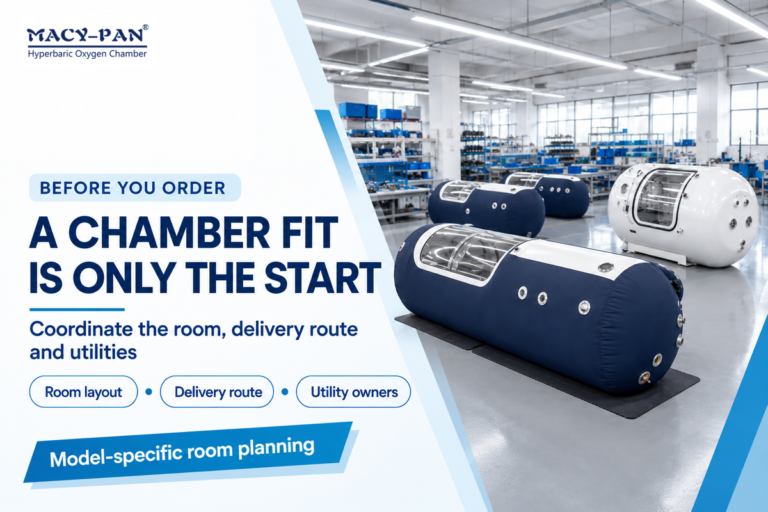
Monoplace or Multiplace?
Hard-shell chambers split further into monoplace and multiplace configurations, and the distinction affects both cost and how a treatment session runs. A federal technology assessment on conventional HBOT (typically delivered at roughly 2.0-2.5 ATA using 100% oxygen) defines monoplace chambers as holding one patient at a time, while multiplace chambers hold multiple patients and/or medical personnel simultaneously, a distinction the FDA/NLM device registry also reflects.
One listed prescription monoplace chamber, rated to 3 ATA and using 100% oxygen as both pressurization and treatment gas, is built as a hard-shelled metal/acrylic vessel for single-occupant use. Multiplace units are more common in medical-spa and wellness-center settings that need to run more than one treatment session per hour without adding chambers, while monoplace units dominate individual clinical and home ownership because they’re smaller, less expensive to install, and don’t require staff to be pressurized alongside the patient. A monoplace hyperbaric chamber and a multiplace hyperbaric chamber can carry the same 2.0 ATA rating and still be very different purchases once installation footprint and staffing are factored in.
✔ Advantages
- Meets UHMS/ECHM’s formal HBOT definition
- 100% medical-grade oxygen delivery
- Documented compliance stack (FDA + ASME PVHO-1 + NFPA 99 + ISO 13485)
- The reference tier most published clinical outcomes are actually studied at
⚠ Limitations
- Highest purchase price of the three tiers
- 100%-oxygen environment carries a real fire-safety profile requiring facility-grade precautions
- Installation and facility requirements are non-trivial for home buyers
- Not portable — hard-shell construction is fixed-location
Explore MACY-PAN’s hard-shell medical-grade chamber lineup if this tier fits your use case, or continue to the tier-fit framework below before deciding. If you’re weighing whether investing in a hyperbaric chamber at this tier makes sense, or buying the hyperbaric chamber outright versus leasing time at a local clinic is the better call, the cost-of-ownership math two sections below is where to run those numbers.
The Evidence Transfer Line, Why Clinical Results Don’t Automatically Apply to Your Chamber

A clinical result documented at one pressure, oxygen concentration, and chamber setting can’t be assumed to transfer to a different chamber tier, even one with a similar-sounding ATA number. This is the single most important thing to understand before a marketing page cites a “hyperbaric oxygen study” to sell you a soft-shell chamber.
ECHM, UHMS, and the Canadian Undersea and Hyperbaric Medical Association (CUHMA) all formally hold that pressure below their respective thresholds, 2.0 ATA for UHMS, 1.5 ATA under ECHM’s 2022 revision, doesn’t meet the definition of hyperbaric oxygen therapy at all. UHMS published a position statement in 2017 specifically against marketing low-pressure, soft-sided chambers as HBOT. That’s a direct contradiction of the common marketing framing that a 1.3 ATA soft-shell chamber is simply a “gentle” version of the same therapy studied in clinical trials at 2.0 ATA.
There’s an even sharper data point behind this. A randomized trial designed to validate a sham (placebo) condition for hyperbaric-medicine research found that breathing compressed air at 1.3 ATA (132 kPa) for a brief exposure is physiologically equivalent to breathing roughly 28% oxygen at normal atmospheric pressure, and that researchers use exactly this profile as a validated placebo control in HBOT trials, precisely because its physiological effect is small enough not to bias results. To be precise about what this does and doesn’t prove: it’s a methodological study validating a brief research placebo, not a direct efficacy trial of longer home wellness sessions; on its own, it isn’t clinical evidence that 1.3 ATA sessions of any length or protocol produce no benefit, and it shouldn’t be read as one. Its relevance here is narrower and more indirect: it’s a data point about how the field’s own researchers treat this specific pressure/gas combination when they need a condition with a physiological effect small enough not to bias a trial, offered alongside, not instead of, the UHMS/ECHM position statements above as the actual primary basis for this section’s caution. A separate wellness-industry source independently makes the same underlying point in its own marketing copy: a study conducted at 2.0 ATA isn’t evidence that a 1.3 ATA chamber produces the same result, which suggests this isn’t an invented distinction, but one the field itself already recognizes.
The practical takeaway: before a seller’s marketing cites “the research on HBOT” to justify a soft-shell chamber purchase, ask specifically what pressure, oxygen concentration, and duration the cited study actually used, and whether that matches the chamber you’re being sold.
The Three-Factor Eligibility Screen, Which Level Actually Matches Your Situation

Tier fit depends on use-case, risk tolerance and contraindications, and budget together, not any single factor in isolation. Run your situation through the table below before you request a quote, or jump straight to our chamber selector tool. If you already know your situation, the goal here is simply to help you land on a chamber that will fit your needs.
That might mean quickly choosing the best hyperbaric chamber for a documented indication, or comparing the right chamber against a lower-pressure alternative first.
| Your situation | Recommended tier | Limitations / Not suitable for |
|---|---|---|
| General wellness/relaxation, no medical claim expected, budget-constrained | 1.3 ATA soft-shell | Not suitable if you expect clinical-trial-grade oxygenation or FDA-cleared disease treatment |
| Prescribed for acute mountain sickness under physician supervision | 1.3-1.5 ATA prescription device (clinical setting) | Not for unsupervised home use — this category is explicitly clinic/physician-office use per its FDA clearance |
| Athlete/wellness use, wants a slightly higher pressure tier than entry-level | 1.5 ATA | Thinnest product category of the three — fewer models to compare, verify FDA/CE paperwork carefully |
| Documented medical indication requiring 100% oxygen at clinical pressure, budget supports facility-grade equipment | 2.0 ATA hard-shell | Not suitable without adequate space/electrical/fire-safety infrastructure and staff training |
| Portable/travel need — chamber must fold down or relocate between homes | 1.3 ATA soft-shell (portable) | Trades off the higher oxygen delivery of hard-shell tiers for portability — not a substitute if 100% medical oxygen is required |
| Wellness center or medspa business wants to serve more than one client per session | 2.0 ATA multiplace hard-shell | Highest capex and facility-compliance burden of any option in this table — see the compliance stack above |
| Seeing “FDA-cleared” on a low-pressure listing and unsure whether that means what it implies | Verify before buying at any tier | Ask for the specific 510(k) number and look up its actual indication — a clearance for a narrow use (like acute mountain sickness) is not a blanket HBOT approval |
| Buying from outside the United States, or reselling internationally | Confirm jurisdiction licensing first, at any tier | US FDA clearance does not transfer automatically — Health Canada, for example, has licensed zero soft-shell chambers |
| Prioritizing lowest total cost of ownership over the highest pressure tier available | 1.3 ATA soft-shell, budgeted against realistic session frequency | The cost-per-session math below matters more than the sticker price — an idle chamber at any tier is an expensive way to relax occasionally |
| Buying for a clinic or business rather than personal use, with reimbursement/billing questions | Route to a compliance-specific resource | This guide focuses on home/individual buyer decisions — see our clinic compliance and billing guide, linked below, for business-side regulatory and reimbursement detail |
Who cannot use a hyperbaric chamber?
Regardless of tier, certain conditions are widely treated as contraindications or require medical clearance before use: untreated pneumothorax, certain lung diseases with air trapping, active fever or respiratory infection, uncontrolled seizure disorders, and recent ear or sinus surgery — or an active ear infection — are commonly flagged across chamber manufacturers’ clearance documentation.
Anyone with a pacemaker or other implanted electronic device, anyone pregnant, and anyone taking medications known to increase oxygen-toxicity risk should get physician sign-off before scheduling a session at any pressure tier; this screening step matters just as much for a 1.3 ATA wellness session as for a 2.0 ATA clinical one, since it’s about pressure exposure and confined-space tolerance, not just oxygen concentration.
RFQ checklist — copy these into your quote request:
| Parameter | Recommended range | Why it matters | How to verify |
|---|---|---|---|
| Pressure rating | 1.3 / 1.5 / 2.0 ATA, matched to your use case above | Sets oxygen dose and regulatory category | Ask for the device’s FDA classification / 510(k) number, not just a marketing spec sheet |
| Oxygen delivery method | Concentrator (~24-40% O2) vs 100% medical O2 | Directly determines actual oxygen dose delivered | Request the concentrator’s rated output percentage in writing |
| FDA clearance status | 510(k) number if any claim is made | General-wellness vs cleared-device claims carry different legal weight | Search the number directly in the FDA 510(k) database |
| Pressure-vessel standard compliance | ASME PVHO-1 documentation for the specific model | Confirms engineering/safety testing, not just marketing claims | Request the test certificate referencing the specific PVHO-1 edition |
| Jurisdiction licensing | Confirm licensing status in your country, not just the country of manufacture | US FDA clearance does not guarantee licensing elsewhere | Check your national regulator’s device registry directly |
What It Actually Costs to Own (Not Just the Sticker Price)

Total cost of ownership includes installation, oxygen supply, training, and ongoing service, not just the price on the listing. That’s not a hypothetical caveat; peer-reviewed and government cost studies of hyperbaric operations consistently find that utilization, not sticker price, is what actually drives cost-per-session.
An older cost-utilization analysis published in Military Medicine — dated and from a military-facility context rather than a general civilian one, so treat the exact dollar figures as illustrative rather than current market pricing — estimated a per-treatment cost of $95,380 for a standalone facility running only five treatments, versus $698 per treatment at a facility running 1,000 treatments a year. Dated and context-specific as the numbers are, they demonstrate an underlying relationship — cost-per-session collapsing as utilization rises, driven almost entirely by how heavily the same fixed equipment gets used rather than by which chamber was purchased — that more recent hospital-operations data continues to show. A UK direct-cost analysis of a single monoplace clinical chamber similarly found per-treatment costs in the range of £30-41 once ten-year capital amortization was factored in, and an Ontario health-technology assessment put total cost per treated patient at roughly CAD 6,200 in a hospital-lease model. These are clinical/hospital-context figures, not home-buyer numbers, but the underlying principle transfers directly: an idle chamber costs you the same to own as a heavily used one, so your real cost-per-session depends on how consistently you actually use it.
5-year total cost of ownership — worked example, home 1.3 ATA soft-shell chamber:
| Cost item | Amount |
|---|---|
| Purchase price (1.3 ATA soft-shell unit) | $6,000 |
| Oxygen concentrator | $500 |
| Electricity + consumables (5-yr, ~$300-500/yr) | ~$2,000 |
| Maintenance & service (5-yr) | ~$1,500 |
| Total 5-year cost | ~$10,000 |
Payback example: at roughly 780 total sessions over 3 years of regular use (about 5 sessions/week), a comparable worked calculation from a published home-chamber cost breakdown lands near $9.50 per session — versus a typical $200-300 per-session clinic rate for a comparable soft-shell setting. Run the same $10,000 five-year total across 1,300 sessions (5/week sustained over 5 years) and the per-session cost drops to roughly $7.70; run it across only 100 sessions over 5 years of light, inconsistent use and the per-session cost climbs to $100 — the same utilization principle the clinical cost studies above document, just at home scale.
See MACY-PAN’s home hyperbaric chamber guide for model-specific specs, or use our own-vs-session cost calculator to run your own numbers against local clinic session rates. Some sellers in this category also offer monthly payments that spread the purchase price across financed installments rather than one lump sum.
Vetting a Legitimate Seller Before You Buy

US FDA clearance does not automatically grant market access, or legality, anywhere else, and sellers don’t always volunteer that distinction. In 2020, Health Canada seized unlicensed soft-shelled hyperbaric chambers, including a Vitaeris 320 unit made by Oxyhealth LLC, a brand that does hold US FDA clearance.
At the time, Health Canada had licensed zero soft-shelled hyperbaric chambers and only four hard-shelled manufacturers nationwide. The lesson isn’t that Oxyhealth is a bad actor; it’s that a US-cleared product is not automatically a Canada-licensed (or UK-licensed, or EU-licensed) product, and “FDA-cleared” printed on a listing tells you nothing about legality in your own jurisdiction. The same scrutiny should extend to the seller: across the different types of hyperbaric chambers on the market, from soft-shell units to hard-shell HBOT chambers, a legitimate seller should show a medical license or accreditation where one applies, name the clinics treating patients with their equipment, and describe the technical support and replacement parts behind the sale. Be equally skeptical of a bundle marketed as fully turnkey without saying what it includes, or a wellness unit implied to be cleared for off-label medical use it was never reviewed for; a seller meeting the highest standards of safety will hand over the PVHO-1 certificate and 510(k) number unprompted. That scrutiny matters just as much whether you’re comparing new listings or a used 2.0 ATA hyperbaric chamber for sale, or browsing a hard shell hyperbaric chamber for sale from a secondary reseller, since ownership history doesn’t change what paperwork you’re entitled to see.
Seller vetting also matters for straightforward safety reasons, not just paperwork. Medical trade press has documented at least two fatal hyperbaric chamber incidents in 2025, a fire in Troy, Michigan that killed a 5-year-old boy (three people now face second-degree murder and manslaughter charges), and a separate fatal incident involving a physical therapist in Lake Havasu City, Arizona. In its response, the FDA explicitly tied elevated risk to unaccredited, non-FDA-reviewed facilities and operators, reinforcing that accreditation status isn’t a bureaucratic formality; it’s a real safety signal.
- ✔ Confirm the device’s FDA 510(k) number directly in the FDA’s public database, don’t take a seller’s word for it
- ✔ Check licensing status with your own country’s medical-device regulator, not just the manufacturer’s home country
- ✔ Ask whether the seller or installer holds relevant facility/operator accreditation, especially for hard-shell units
- ✔ Get the pressure-vessel test certificate (ASME PVHO-1 reference) in writing before purchase, not after
- ✔ If you’re buying for a clinic or business rather than personal use, review compliance and billing requirements separately, see our clinic compliance and billing guide
Industry Outlook, Why Buying Interest Is Rising

Buyer search interest in this category is on a genuine multi-year structural rise, not a single noisy data point. Search-demand tracking shows “buying a hyperbaric chamber” up roughly 24.3%, “portable hyperbaric chamber” up sharply, around 163.3% — and “2.0 ata hyperbaric chamber” up about 233.3% in relative terms off a smaller base, each measured against a 24-to-36-month-ago baseline within 59-61 months of available DataForSEO historical trend data per keyword — three independent keyword histories pointing the same direction, not one noisy series.
That pattern lines up with independent market-research data: the home-care end-user channel for hyperbaric oxygen therapy is growing at roughly 9.42% CAGR, the fastest-growing end-user segment tracked, while portable and topical device types are growing at about 8.71% CAGR, both outpacing the broader market’s roughly 6.03% CAGR. Interest is climbing fastest for hard-shell and portable configurations, not the entry-level soft tier, consistent with FDA-classified portable units increasingly entering the residential segment under physician prescription rather than as unregulated wellness devices.
+163.3%
Portable chamber search growth
9.42%
Home-care segment CAGR (fastest-growing end-user channel)
+233.3%
2.0 ATA search growth (off a smaller base)
Part of what’s driving this is technology, not just awareness: 2024 saw the launch of software-integrated chambers with real-time gas, temperature, and humidity tracking, and portable devices are increasingly shipping with Bluetooth-enabled sensor suites, lowering the operational gap between a home unit and a clinical-grade installation. On the regulatory side, the FDA’s April 2025 recognition of the 2024 NFPA 99 edition and Canada’s June 2026 compliance-guidance update reiterating CSA Z275.1:23 (aligned to ASME PVHO-1) both suggest the category is maturing toward tighter, not looser, standards, worth factoring into a purchase decision if resale value or long-term compliance matters to you.
Frequently Asked Questions
Q: Is it worth buying a hyperbaric chamber?
Whether it’s worth buying depends entirely on which tier and which claim you’re buying for; a 1.3 ATA wellness chamber and a 2.0 ATA clinical device answer very different questions.
A 1.3 ATA soft-shell chamber can be worth it for general wellness use at a relatively low price point, provided you go in understanding it isn’t FDA-cleared for disease treatment and doesn’t meet the formal definition of HBOT used by UHMS or ECHM. A 2.0 ATA hard-shell chamber is a materially bigger investment that only makes sense if you have a documented medical need, the facility infrastructure to support it, and ideally a comparison against ongoing clinic-session costs; see the total-cost-of-ownership section above for a worked example.
Q: How much does it cost to own a hyperbaric chamber?
Total ownership cost runs well beyond the purchase price once you add installation, oxygen supply, and maintenance; a home 1.3 ATA setup can total roughly $10,000 over five years.
Purchase price for entry-level 1.3 ATA soft-shell units starts around $4,500-$8,000, with mid-tier 1.5-2.0 ATA units running considerably higher and hard-shell 2.0 ATA clinical chambers reaching well into six figures; industry market data puts a full clinical monoplace unit anywhere from roughly $40,000 to $200,000, with a complete facility build-out (ventilation, fire suppression, accreditation) landing between $250,000 and $750,000 once everything is accounted for. Beyond the sticker price, budget for an oxygen concentrator, electricity and consumables, and annual maintenance; our worked five-year example above lands near $10,000 total for a soft-shell home setup, with per-session cost dropping sharply the more consistently you actually use it, mirroring the utilization pattern documented in peer-reviewed hospital-operations cost studies.
Q: Is it legal to own a hyperbaric chamber?
In most jurisdictions, yes, but legality and licensing vary by country, and US FDA clearance doesn’t automatically transfer elsewhere, so check your own country’s regulator before buying.
Owning a hyperbaric chamber for personal wellness use is generally legal in the US and many other countries, but the specific licensing requirements differ by jurisdiction. Health Canada, for example, has seized unlicensed soft-shell chambers in the past, including at least one unit from a US FDA-cleared brand, because US clearance doesn’t equal Canadian licensing. Before buying, check your own country’s medical-device regulator directly rather than relying on a seller’s claims about legality.
Q: Can anyone buy a hyperbaric chamber?
Consumer-wellness 1.3 ATA soft-shell chambers, generally yes with no prescription needed; prescription-only devices and clinical hard-shell units require physician involvement and sign-off before you can buy one.
Generally, yes for wellness-only soft-shell units, no prescription needed. Prescription-cleared devices are the exception. Even without a prescription requirement, compare tiers first — the best chamber for you is the one whose oxygen delivery and regulatory category match what you’re actually trying to accomplish, not necessarily the cheapest listing.
Q: What’s the difference between monoplace and multiplace chambers?
Monoplace chambers hold one patient at a time; multiplace chambers hold multiple patients or staff in a shared treatment session, and the choice affects both installation cost and treatment capacity.
Monoplace chambers dominate individual clinical and home ownership because they’re smaller and less expensive to install. Multiplace units are more common in medical-spa and wellness-center settings that need to run more than one treatment session per hour. See the “Monoplace or Multiplace?” section above for the full breakdown.
Q: Does Medicare cover a home hyperbaric chamber?
Medicare coverage for hyperbaric oxygen therapy is limited to specific, enumerated medical indications, such as certain non-healing wounds, delivered in approved clinical settings under physician supervision, not general home ownership.
Medicare’s hyperbaric oxygen therapy coverage is indication-specific; it applies to a defined list of conditions (such as certain non-healing diabetic wounds meeting specific severity criteria) treated in an approved clinical facility under physician supervision, not to purchasing a chamber for home use. If you’re evaluating a home purchase against clinic-based treatment covered by insurance, run the numbers both ways using the total-cost-of-ownership worked example above before deciding. Medicare’s enumerated indication list is a useful reference for what counts as legitimate hyperbaric treatment versus general wellness use — it includes decompression sickness and specific non-healing wounds where wound healing is the documented clinical endpoint, not vaguer claims like general detox or unspecified recovery benefits.
Why We Write This
Shanghai Baobang Medical Equipment Co., Ltd (MACY-PAN) has manufactured hyperbaric oxygen chambers for more than 17 years, holds ISO13485 and ISO9001 certification plus CE marking, and holds a patent registration covering its chamber designs. Our chambers ship to more than 126 countries, to both individual buyers and OEM/wholesale partners.
We wrote this comparison the way we’d want a buyer evaluating our own 1.3, 1.5, and 2.0 ATA product lines to see it, including where the compliance picture is more nuanced than a simple “FDA-cleared” label suggests, drawing on our own engineering and compliance records. Prepared by the Shanghai Baobang Medical Equipment Co., Ltd content team.
Related Articles
- Full ATA Pressure Explainer — the general primer on how hyperbaric pressure works, if you’re earlier in your research
- 1.5 ATA vs 2.0 ATA: Clinic Compliance and Billing Guide — for clinic and business buyers evaluating regulatory and reimbursement requirements
References & Sources
- FDA Product Classification Database, Hyperbaric Chamber (Product Code CBF), U.S. Food and Drug Administration
- Follow Instructions for Safe Use of Hyperbaric Oxygen Therapy Devices, Letter to Health Care Providers, U.S. Food and Drug Administration
- 510(k) Premarket Notification K220290, Revitalair 430+, U.S. Food and Drug Administration
- SIMSI Position on the Use of Low-Pressure Hyperbaric Chambers for HBOT, Undersea and Hyperbaric Medical Society
- HBO2 Safety Committee, Standards and Codes FAQ, Undersea and Hyperbaric Medical Society
- ASME PVHO-1 Reference, The National Board of Boiler and Pressure Vessel Inspectors
- PVHO-1, Safety Standard for Pressure Vessels for Human Occupancy, American Society of Mechanical Engineers
- Validation of Sham Treatment in Hyperbaric Medicine: A Randomised Trial, Diving and Hyperbaric Medicine Journal, via PubMed Central
- Hyperbaric Oxygen Therapy Technology Assessment, PubMed / Agency for Healthcare Research and Quality
- Global Unique Device Identification Database (GUDID) Device Record, U.S. National Library of Medicine
- Direct Cost Analysis of a Hyperbaric Oxygen Therapy Chamber, PubMed
- Health Technology Assessment, Hyperbaric Oxygen Therapy Cost, PubMed Central
- Cost-Utilization Analysis of Hyperbaric Oxygen Treatment, Military Medicine (Oxford Academic)
- Certificate of Need Decisions, Hyperbaric Chamber Facility, Connecticut Office of Health Strategy
- Hyperbaric Chamber Explosions Prompt FDA Letter to Doctors, MedPage Today
- Hyperbaric Oxygen Therapy Market Size & Share Analysis, Mordor Intelligence
![Decision lenses: occupancy, gas path, access, staffing, facility interfaces, and exact-model evidence [article].](https://macypansolutions.com/wp-content/uploads/2026/10/monoplace-vs-multiplace-hyperbaric-chambers-featured-1-768x512.png)