Get in Touch with MACY-PAN Company

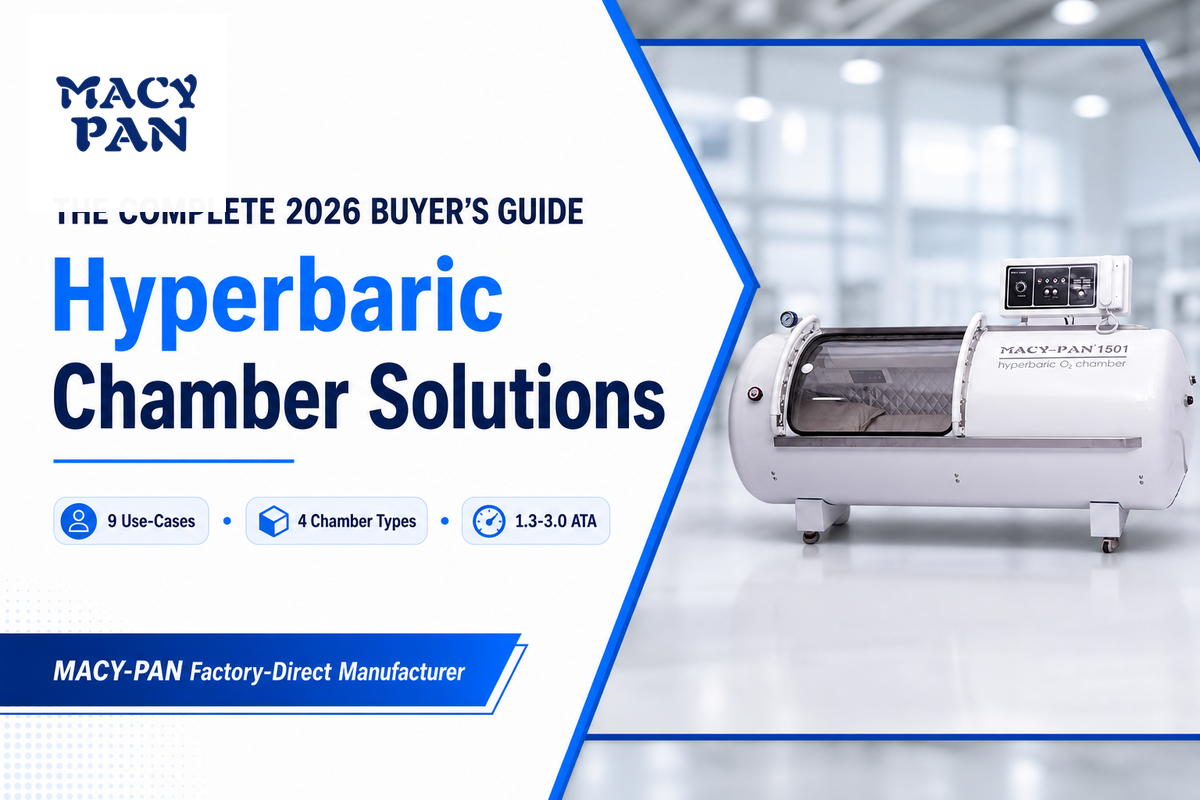
Hyperbaric chamber solutions are pressurized chamber systems, hard-shell or soft-shell, that deliver oxygen at more than 1 atmosphere absolute (ATA) inside a sealed enclosure. The category spans an enormous family of products — everything from roughly $7,500 for a soft-shell recovery bag suited to a home office to $130,000 or more for a multiplace clinical unit — which is precisely why there’s no one, generic “best chamber” answer. The chamber that fits a marathoner icing a hamstring isn’t the chamber a wound-care clinic needs, and neither is the chamber a veterinary hospital or an OEM reseller is shopping for. This guide clarifies how the buyer’s decision bifurcates at the first juncture, the four types of chamber you’ll likely encounter, a 9-branch use-case guide, the ailments and applications for which hyperbaric oxygen therapy (hbot) is truly intended, the appearance of a session, and how to procure a unit without being defrauded.
Quick answer: A hyperbaric chamber solution delivers oxygen at a pressure above 1 atmosphere absolute (ATA) inside a sealed chamber, ranging roughly 1.3–3.0 ATA depending on chamber type. Which solution actually fits you depends on two forks — personal vs. commercial buyer, then which of 9 common use-cases you’re solving for — not on any single “best” chamber, and not every chamber in this category meets the clinical definition of hyperbaric oxygen therapy.
What Is a Hyperbaric Chamber Solution?
A hyperbaric chamber solution is any pressurized chamber system — hard-shell or soft-shell, single-patient or multi-patient — built to deliver pure oxygen at pressures greater than 1 ATA inside a closed hyperbaric environment. That pressure difference is what defines hyperbaric oxygen therapy: it pushes more oxygen into the blood and tissues than normal air pressure can reach.
In practical terms, receiving hyperbaric oxygen therapy means sitting or lying in such a chamber while breathing pure oxygen at concentrations well above the roughly 21% found in ambient air. Greater pressure causes more oxygen to dissolve into the blood plasma, raising the blood-oxygen level and pushing excess oxygen into your body’s tissues that normal air pressure alone can’t reach, regardless of which chamber lies at the heart of a particular hyperbaric oxygen therapy session.
When a clinic or medical center says that they “can provide hyperbaric oxygen therapy” or “offer hyperbaric oxygen therapy for diagnosed medical condition,” they’re referencing the increased concentration of oxygen and greater pressure: it isn’t just the shell of the chamber that dictates whether your session involves clinically meaningful doses of pure oxygen at high pressures, or lower doses for the wellness industry. In short, Hyperbaric oxygen therapy elevates your blood oxygen levels far above and beyond normal levels – the entire premise behind every one of the chamber uses described below.
In hyperbaric medicine, the goal of using hyperbaric oxygen therapy is straightforward: get more oxygen in the blood and push extra oxygen into tissues in your body that circulation alone can’t reach. That’s why hyperbaric oxygen therapy increases dissolved oxygen levels well past what breathing room air ever could, and why wounds need oxygen faster than a compromised blood supply can typically deliver it on its own. Sitting inside a hyperbaric oxygen therapy chamber involves breathing pure oxygen at increased pressure and oxygen levels that raise the oxygen inside your bloodstream well past normal air-breathing levels, which is the entire mechanism behind the effects of hyperbaric oxygen therapy described throughout this guide.
Quick Specs
- Pressure range: ~1.3-2.0 ATA for many single-seat models, and up to 3.0 ATA for multiplace units requiring high pressure.
- Typical session length: 60–120 minutes (roughly 1–2 hr)
- Footprint: 7 sq ft (approx. 0.65 m²) of floor space is generally needed for a single-patient monoplace chamber body. Multi-seat clinic rooms usually range from 800-1,200 sq ft (approx. 75-110 m²) of clinic space that comply with NFPA 99 code requirements.
Oxygen Delivery Gradient
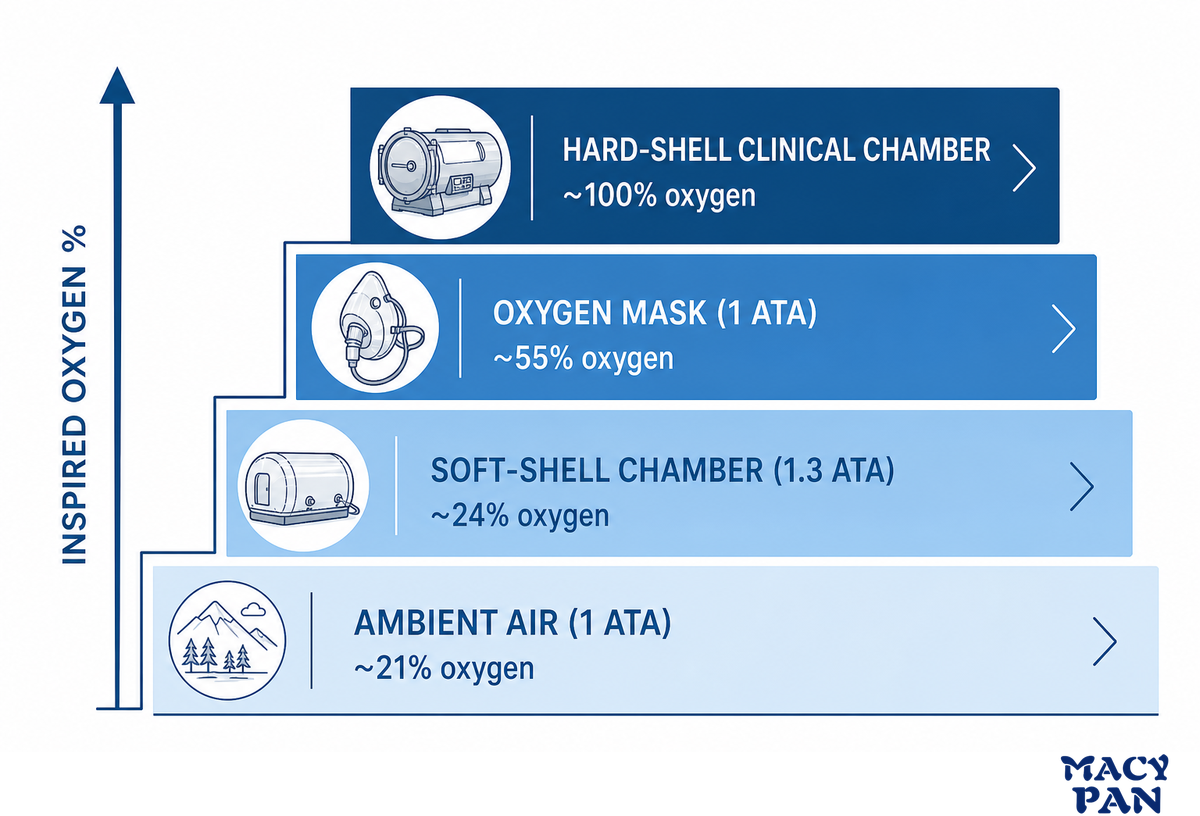
Standard atmospheric pressure at sea level is 1 ATA (approximately 14.7 psi) and in standard air at that level there’s roughly 21% oxygen. Slide into a soft-shell chamber at 1.3 ATA, and effective inspired oxygen increases to around 24%. Slip on a snug oxygen mask at ordinary atmospheric pressure and the percentage climbs to roughly 55%. Hard-shell chambers at clinical pressures push the oxygen level up to about 100%, which is the physiologic gradient every chamber in this guide is engineered to take a patient along – it’s just the speed of progression and the amount of oxygen that vary drastically.
Standard atmospheric pressure at sea level is 1 ATA (approximately 14.7 psi) and in standard air at that level there’s roughly 21% oxygen. Slide into a soft-shell chamber at 1.3 ATA, and effective inspired oxygen increases to around 24%. Slip on a snug oxygen mask at ordinary atmospheric pressure and the percentage climbs to roughly 55%. Hard-shell chambers at clinical pressures push the oxygen level up to about 100%, which is the physiologic gradient every chamber in this guide is engineered to take a patient along – it’s just the speed of progression and the amount of oxygen that vary drastically.
This next section may not appear on many buyer’s guides, but it’s worth reading before you scan a single spec. The Undersea and Hyperbaric Medical Society defines ‘clinical hyperbaric oxygen therapy’ as a physician-ordered, in-body therapy performed entirely within an ASME and NFPA 99 coded hard-shell chamber at a pressure of 2.0 ATA or greater, using medical-grade oxygen. The UHMS defines ‘mild hyperbaric oxygen therapy’ as any treatment below 1.5 ATA – and specifically states that its effectiveness is unproven. This is why ‘hyperbaric chamber solutions’ is a very broad category and ‘clinical hyperbaric oxygen therapy’ is a very narrow subset of it. No ‘wellness’ chamber in this buyer’s guide should ever be equated with a physician-prescribed hard-shell clinical chamber.
The Buyer-Path Fork: Personal vs. Commercial Chambers
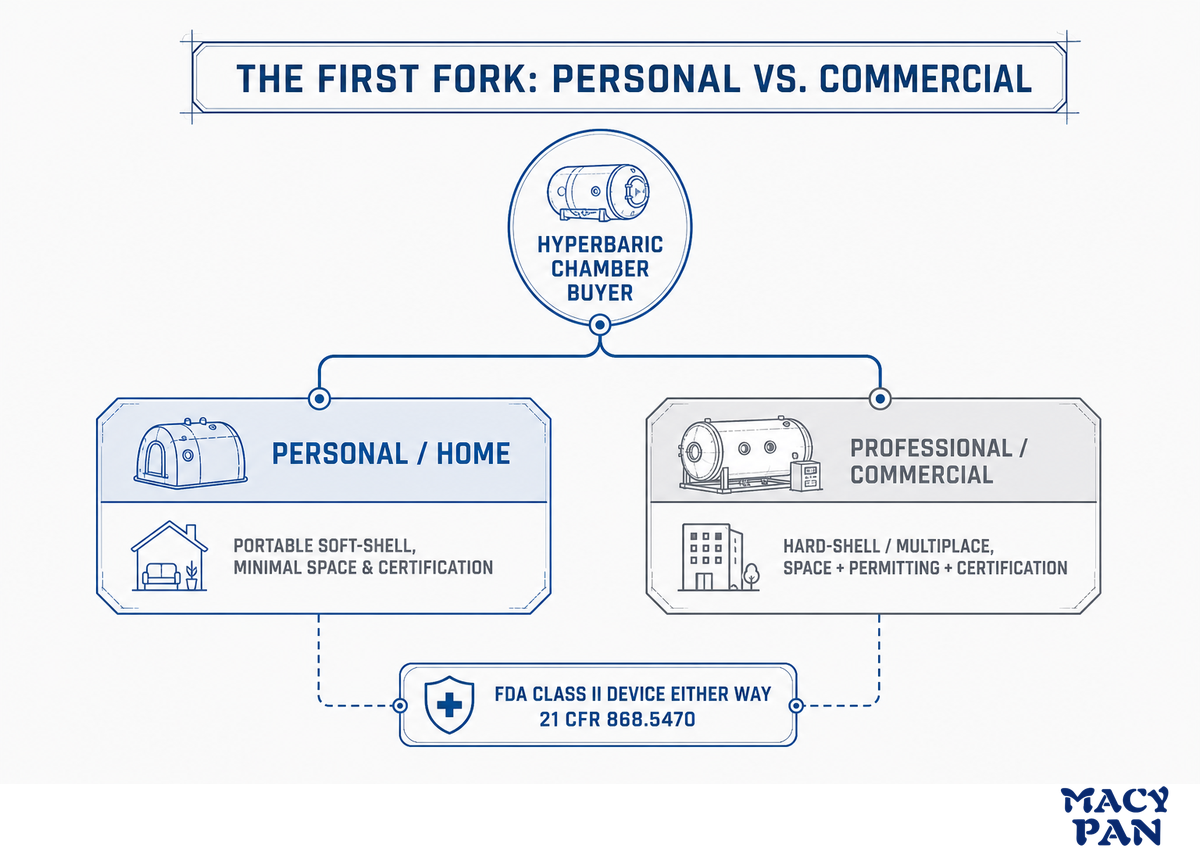
There are two major decision paths that begin long before you look at ATA specifications. Personal / home consumers generally seek a portable or soft-shell solution with minimal compliance and certification and space requirements. Professional / commercial / institutional users, on the other hand, are shopping for hard-shell and / or multi-person chambers with significant space, permitting and safety certifications.
However, regardless of whether you’re considering a portable soft-shell for your home office or an institutional chamber for a clinic, be advised that under 21 CFR 868.5470 the FDA considers all hyperbaric chambers as a Class II device, regardless of how the device will be used – they offer no exception to the regulation based on consumer classification. What this means for you is that your buyer decision becomes about installation process and complexities, not regulatory exemptions. If you’re primarily interested in ata levels and structural types, our hard-shell & medical-grade chamber guide should guide you well.
Chamber Types at a Glance
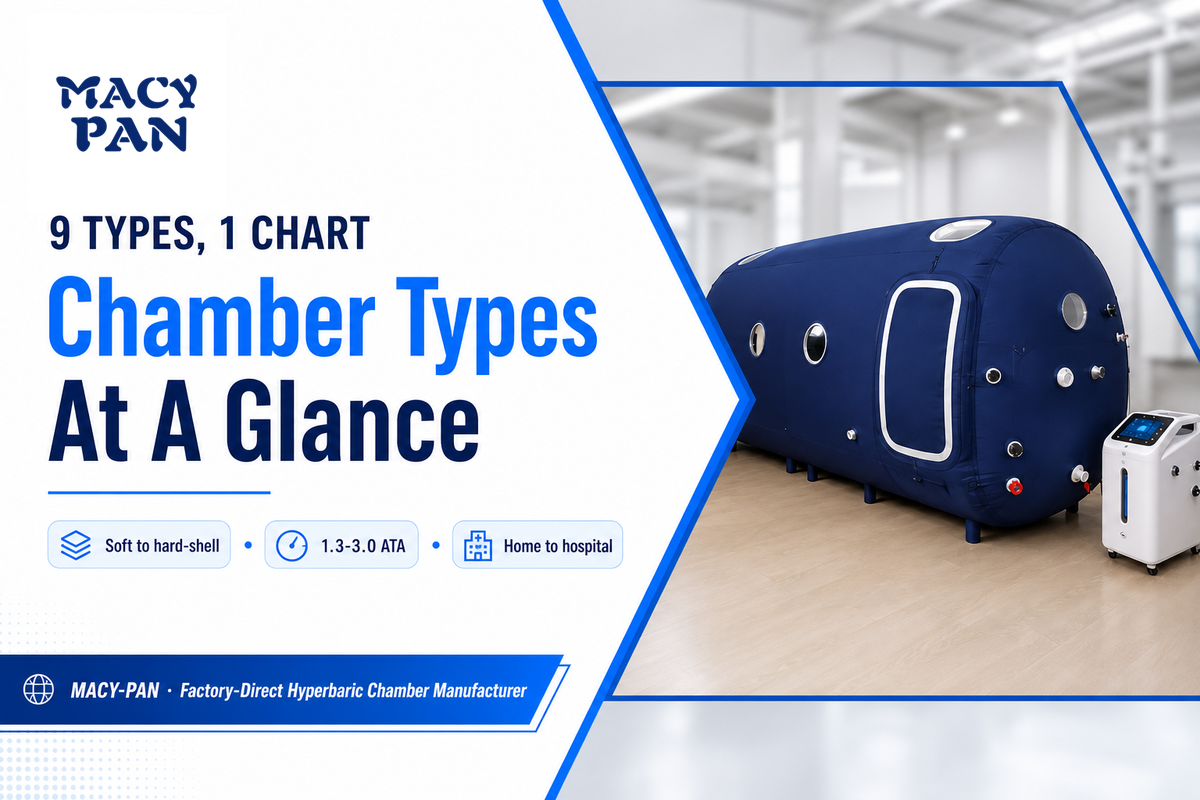
The chart below compares nine chamber types, and represents almost all commercially available solutions available from both mild hyperbaric (home) and clinical perspectives, as outlined above. This is only a snapshot; more information is available via the deep dives into each type below.
| Type | ATA ceiling | Pressure band | Typical setting |
|---|---|---|---|
| Soft-shell (single-seat) | ~1.3–1.5 ATA | “mild hyperbaric” band (below UHMS’s 1.5 ATA line) | Home, personal use |
| Portable soft-shell | ~1.3–1.5 ATA | “mild hyperbaric” band | Travel, athlete recovery |
| Soft-shell, multi-unit | ~1.3–1.5 ATA | “mild hyperbaric” band | Wellness center (multi-bed) |
| Soft-shell, single-seat | ~1.3 ATA | “mild hyperbaric” band | Beauty / anti-aging studio |
| Hard-shell monoplace (clinic-tier) | 1.5–2.0 ATA | Clinical band | Clinic, licensed practice |
| Hard-shell monoplace (advanced) | Up to 3.0 ATA | Clinical band | High-acuity clinical use |
| Hard-shell multiplace | 2.0–3.0 ATA | Clinical band, mask/hood O₂ delivery | Hospitals, high-volume clinics |
| Hard-shell multiplace (institutional) | 2.0–3.0 ATA | Clinical band, multi-unit deployment | Hospital systems, bulk order |
| Veterinary hard-shell | 1.5–2.0 ATA | Clinical band, animal-sized | Licensed veterinary clinics |
All of our soft-shell solutions fit within UHMS-defined ‘mild hyperbaric’ levels which the organization states is unproven (please re-familiarize yourself with the ‘clinical vs. mild’ distinctions if necessary.)
Choosing between a monoplace and a multiplace chamber often comes down to how many patients you need to treat per session and how much floor space you can dedicate to a special chamber setup. Our monoplace vs. multiplace comparison and our portable chamber guide go into greater detail.
The 9-Path Hyperbaric Use-Case Compass
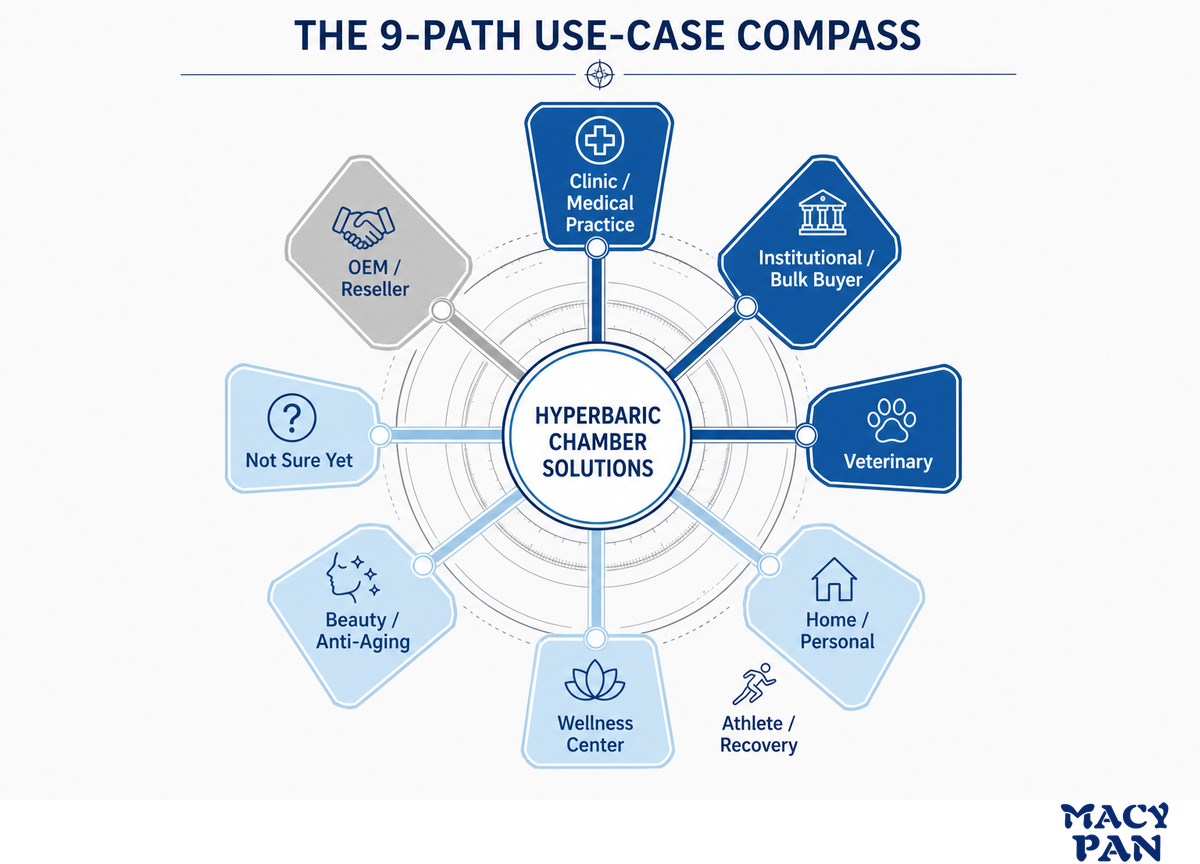
There are nine different buyer personas that nearly capture all of the hyperbaric chamber consumers that contact us. As mentioned in the clinic versus mild distinction above, there are two categories these nine paths fall into that aren’t clinically interchangeable: a clinic buyer and a wellness center buyer can both end up with a “hyperbaric chamber solution”, but only one of them is truly buying into the UHMS definition of hyperbaric oxygen therapy.
Clinical & Institutional-Grade Paths
| Buyer path | Recommended type | Target ATA | Budget tier |
|---|---|---|---|
| Clinic / medical practice | Hard-shell monoplace or multiplace | 2.0+ ATA | $47,995–$150,000+ |
| Institutional / bulk buyer (hospital system) | Multiplace, multi-unit order | 2.0–3.0 ATA | $129,000+ per unit |
| Veterinary (licensed clinical use) | Hard-shell monoplace, animal-sized | 1.5–2.0 ATA | Clinic-tier |
Prices above are illustrative U.S. market estimates as of 2026 and vary by configuration, options, and vendor — request a current quote directly from the manufacturer before budgeting.
Wellness & Home-Grade Paths
| Buyer path | Recommended type | Target ATA | Budget tier |
|---|---|---|---|
| Home / personal | Soft-shell portable | 1.3 ATA | ~$7,499+ |
| Athlete / recovery | Portable soft-shell | 1.3–1.5 ATA | Home-tier to studio-tier |
| Wellness center | Soft-shell, multi-unit | 1.3–1.5 ATA | Studio-tier |
| Beauty / anti-aging | Soft-shell, single-seat | 1.3 ATA | Studio-tier |
| Not sure yet / general curiosity | Start with a soft-shell or a consult | n/a | Entry-tier |
One additional ninth path, the OEM/reseller path, overlaps with both of the groups above and doesn’t fall neatly into either category; we cover this at length in the Sourcing section below.
To understand the hyperbaric chamber solution path relevant to you, you need to answer this:
If your intended use for the hyperbaric chamber is medical in nature, will it be delivered through a hospital, a medical clinic, or a specialty care center with physicians prescribing the use of oxygen at a level higher than normal air pressure, or in a home setting where oxygen levels above atmospheric pressure are used?
Clinic and institutional paths lead to our clinic & medical-practice chamber guide, while the home path leads to our home hyperbaric chamber guide. For athletes we’ve a dedicated athlete recovery chamber guide. Both the beauty/anti-aging and the veterinary paths are also broken down within our main solutions page (the hyperbaric chamber solutions hub).
What Conditions & Uses Does HBOT Address?
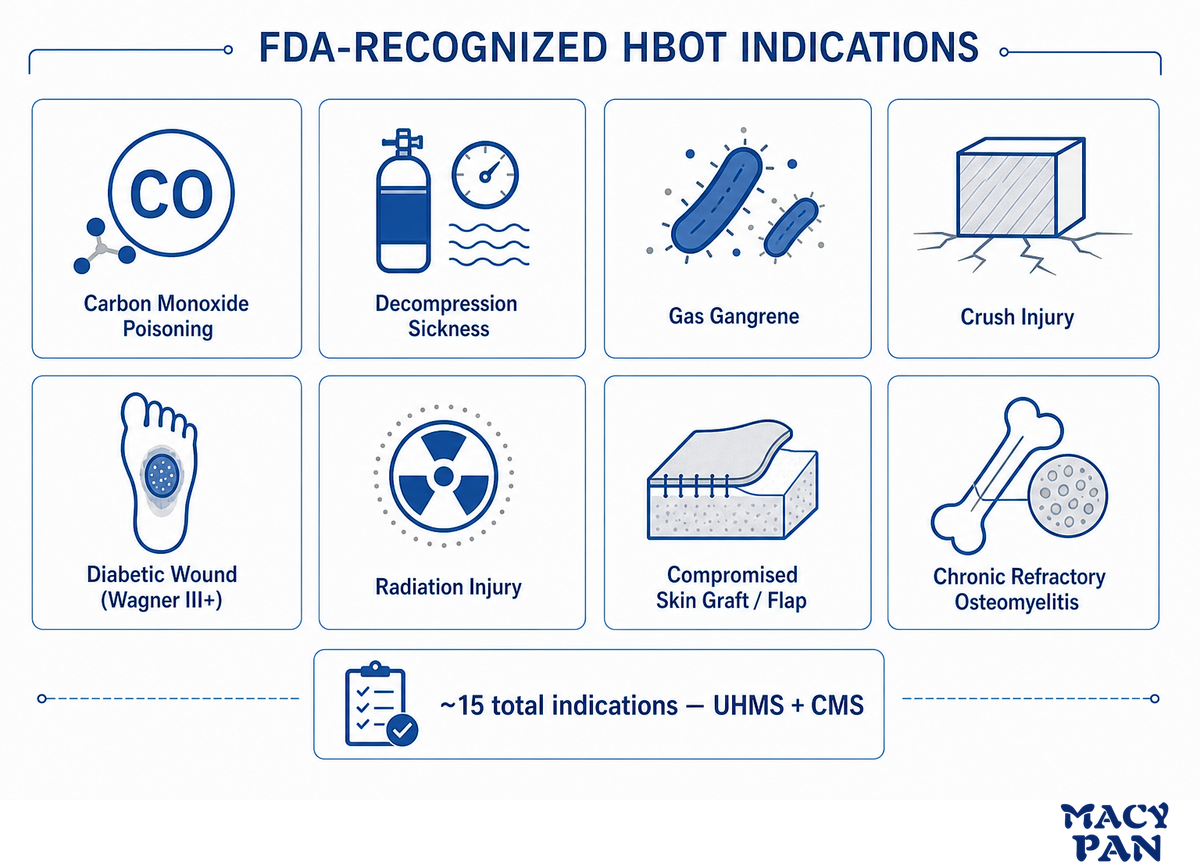
Hyperbaric oxygen therapy is indicated for a specific set of conditions as defined by the FDA, though the exact count varies by source: most references list about 15 indications based on both UHMS’s published indications list and Medicare’s national coverage determination, and the two lists aren’t identical. Commonly listed indications include carbon monoxide poisoning, decompression sickness, gas gangrene, crush injuries, and selected non-healing wounds.
An example for diabetic lower-extremity wounds, per CMS coverage criteria, would be a Wagner grade III or higher wound with no progress in healing for at least 30 days after standard medical treatment-confirmed by a physician, not just suggested. That criterion reflects a simple logic: a wound at that grade needs more oxygen than circulation alone can supply.
Hyperbaric oxygen therapy treats a range of conditions spanning acute emergencies and chronic wounds, and the oxygen treatment protocol for each differs by both pressure and duration. Hyperbaric oxygen is the solution for diseases caused by tissue starving for oxygen — first and foremost the treatment for decompression sickness, and then other infectious diseases and chronic wounds that programs at accredited hyperbaric medical facilities treat every day. For instance, centers that have experience with patients treated with hyperbaric oxygen therapy to mitigate the adverse effects of radiation therapy are utilizing an expanded set of indications based on strong clinical evidence, and many report that this therapy can help patients who haven’t found enough oxygen relief through standard wound care alone.
In addition to its FDA-cleared uses, hyperbaric oxygen therapy is explored off-label for other purposes-including the use of stem cells, treatment of chronic obstructive pulmonary disease, and a boost that helps the immune system fight infection more effectively are areas where research is ongoing. Nevertheless, these off-label applications should be discussed in the context of a specialty or critical-care setting because evidence is sparser outside the approved indications and the UHMS notes that mild hyperbaric exposure below 1.5 ATA in particular has not been demonstrated for these indications. Promotional language promoting the general benefits of hbot ought to make clear the difference between an FDA-approved and a speculative benefit. The benefits of hyperbaric oxygen therapy in FDA-approved indications have been demonstrated and are well-documented. In contrast, claims for other indications deserve careful review, not just affirmation.
Engineering Note
The hard-shell monoplace systems from MACY-PAN (HP1501, HP2202, and MC750) are designed with 304 stainless-steel pressure-vessel shells that have been 100% SGS-pressure-tested before they are shipped and that are constructed to the ASME pressure-vessel standard. Fire-safety measures are built to conform with NFPA 99 references, the same code standard associated with the FDA’s device classification database for Class II hyperbaric chambers. Any supplier would be expected to provide this level of manufacturing detail directly, rather than simply showcasing a logo indicating certification.
The hard-shell monoplace systems from MACY-PAN (HP1501, HP2202, and MC750) are designed with 304 stainless-steel pressure-vessel shells that have been 100% SGS-pressure-tested before they are shipped and that are constructed to the ASME pressure-vessel standard. Fire-safety measures are built to conform with NFPA 99 references, the same code standard associated with the FDA’s device classification database for Class II hyperbaric chambers. Any supplier would be expected to provide this level of manufacturing detail directly, rather than simply showcasing a logo indicating certification.
Session Mechanics, What to Expect
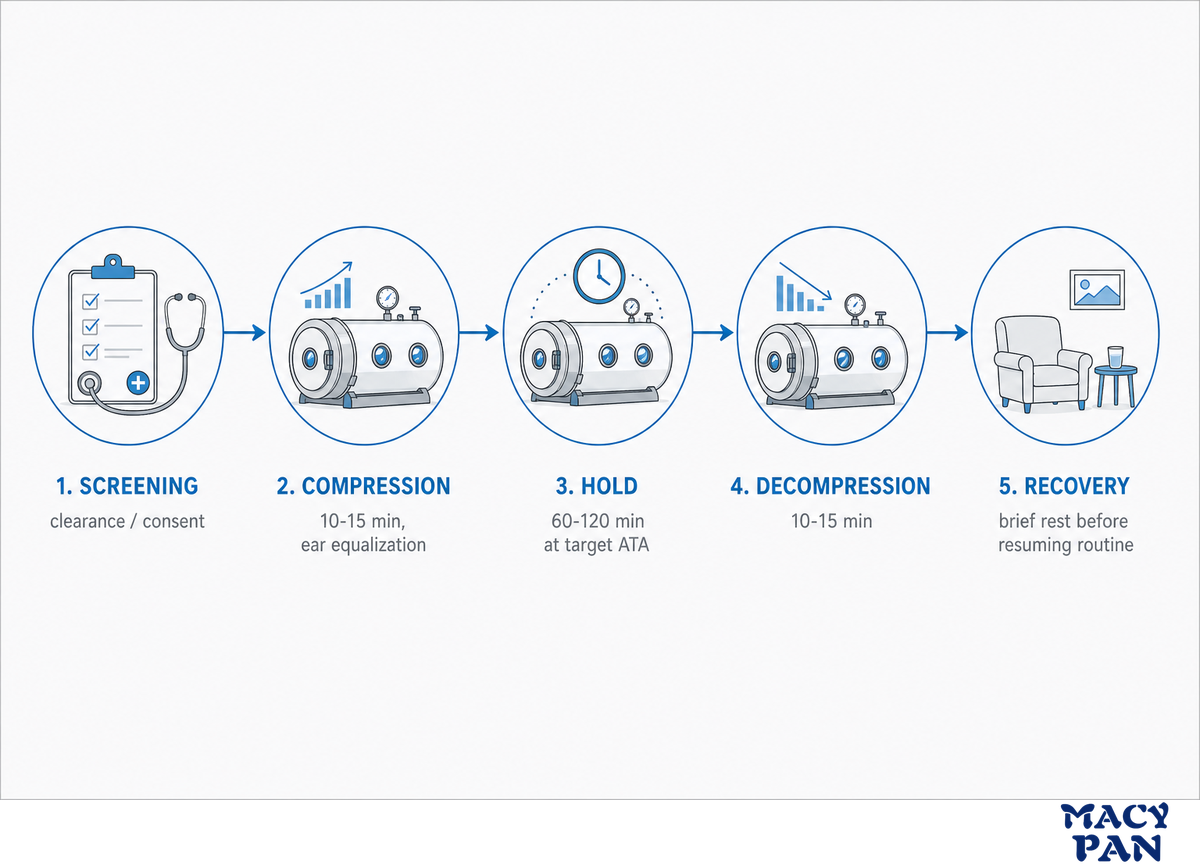
Here’s what to expect during hyperbaric oxygen therapy, from intake through the ride back down to normal air pressure. Previously, screening included a physician’s authorization to administer clinical hbot or basic health verification to receive soft-shell use of wellness grade; personal synthetic clothing, lighters, and any non-chamber rated electronics must be removed. Pressure then rises over approximately 10-15 minutes with sinus and ear equalizations-an activity analogous to ears equalizing when flying in an aircraft; subsequently, the patient remains at the desired pressure level for the designated hold period, typically between 60 and 120 minutes in total. After a 10-15-minute descent phase-an identical procedure to the ascent-the patient rests for a short period before they’re permitted to resume their routine.
When receiving hyperbaric oxygen therapy, you’ll likely feel pressure in your ears during the initial few minutes of the session — the same phenomenon as during an aircraft descent — which is why operators teach patients swallowing and jaw movements to equalize before increasing the pressure, explains a representative of a center offering these chamber-pressurized sessions. Centers regularly check patients’ blood pressure and pulse, plus oxygen saturation before and after the treatment session, especially for a hyperbaric patient undergoing a first treatment in a monoplace chamber.
Possible positive and negative effects of a monitored session of hyperbaric oxygen therapy include reduced recovery time in patients treated with wound care, other authorized uses prescribed by a physician, but the risks associated with these and any of the off-label applications include eye-wear correction with a mild decrease in distance acuity for those undergoing many sessions, fatigue, feelings of claustrophobia and, very rarely with prolonged high-oxygen exposure and pressure, oxygen toxicity, as documented in the NCBI Bookshelf clinical overview of hyperbaric oxygen therapy. These devices are often called “hyperbaric oxygen chambers” generally, which describes a class of approved device configurations, not a specific product.
This note deserves clarification: the total amount of therapy received isn’t dictated solely by pressure (ATA), as oxygen supply method, purity of the gas mixture, seal of the hood or mask, degree of medical supervision, the presence or absence of a medical prescription, and certification of the treatment facility also play a role in determining the actual delivered treatment. If a supplier makes it sound as though ATA alone is sufficient to specify the therapy, the claim should be reexamined because all these elements interact with each other.
There’s a common assumption among buyers that more pressure automatically means a better result, but that’s not necessarily true, and it runs contrary to how clinicians actually approach dosing. Published clinical HBOT research doesn’t show that higher pressure automatically produces a better outcome – in published protocol comparisons, lower-pressure arms have performed comparably to higher-pressure, pure-oxygen arms – while the risk of complications, including oxygen toxicity, is well-documented to climb as pressure and exposure duration increase. It’s a counter-intuitive finding for anyone assuming “higher ATA always means a better outcome,” and it’s exactly why pressure, session count, and duration belong on a prescribing physician’s chart rather than a marketing one.
More pressure, and more sessions, is not automatically better – the ATA and session count that help one patient can produce no benefit, or worse, in another. That’s a clinical judgment call, not a specification to shop for.
Athletes, Clinics & Wellness Centers, Quick Use-Case Notes
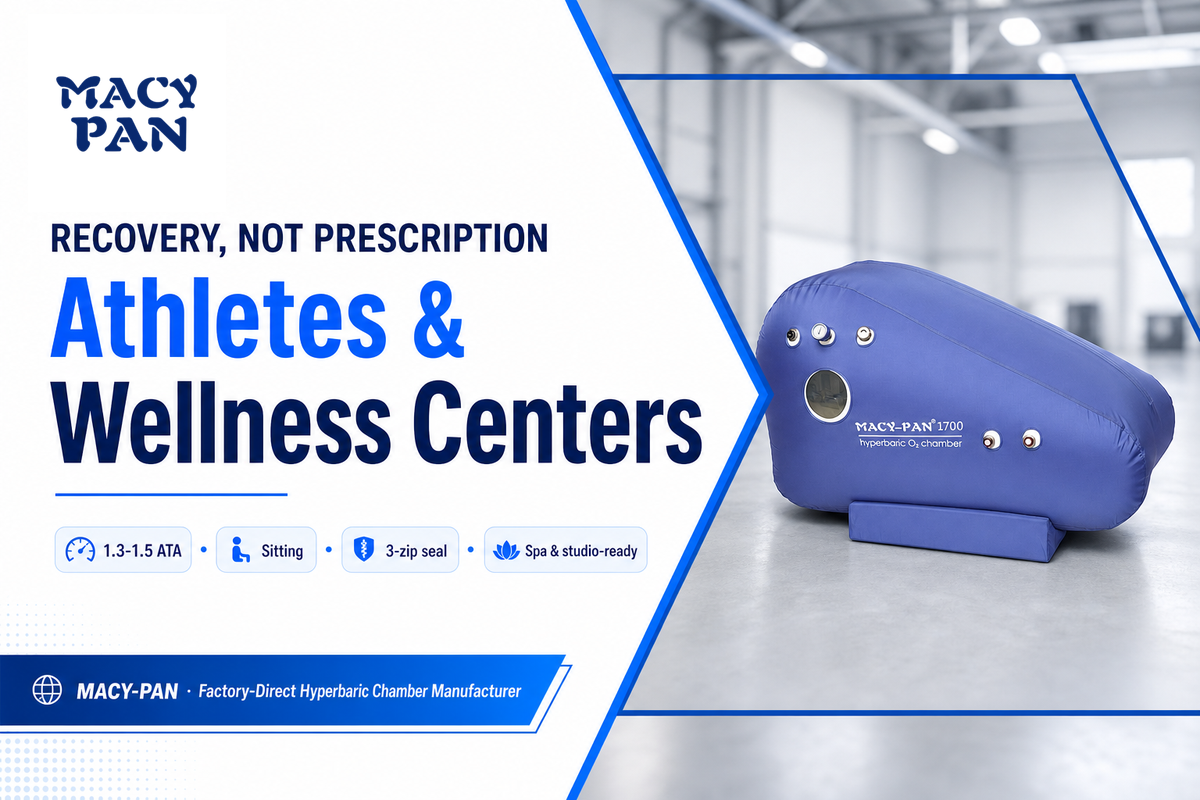
Recovery: For most athletes focused on recovery, soft-shell, lower-pressure models are the preferred entry point, usually in the 1.3-1.5 ATA range known as “mild hyperbaric” versus the higher 2.0 ATA that clinics may use with models such as the hbot; learn more in our athlete chamber guide.
Clinics and wellness centers: The hyperbaric chamber solutions provider might offer both but a physician-dispensed hbot under the authority of a medical practice and a mild hyperbaric wellness session under that of a wellness center are fundamentally different clinical and regulatory distinctions that marketing shouldn’t blur. For an in-depth look, see our wellness-center chamber guide.
Home use: Buyers considering purchasing their own soft-shell chamber versus using clinic sessions should do their math on the total cost of session-based therapy vs. the cost of purchasing. For the full breakdown, consult our hyperbaric chamber cost guide.
Sourcing a Hyperbaric Chamber Solution
Interest in “hyperbaric chamber uses”-the primary search phrase driving buyer research in this guide-has increased about 102% in the past 24-36 months. Search interest in home-use chamber options has grown alongside it, though buyer search behavior there splits across several overlapping phrasings rather than converging on one stable number. In concert, these trends indicate that buyer appetite for guidance exceeds that for clearly defined choices, a need best filled by a factory-direct OEM/ODM partner as opposed to a generic reseller for growing clinics and wellness centers.
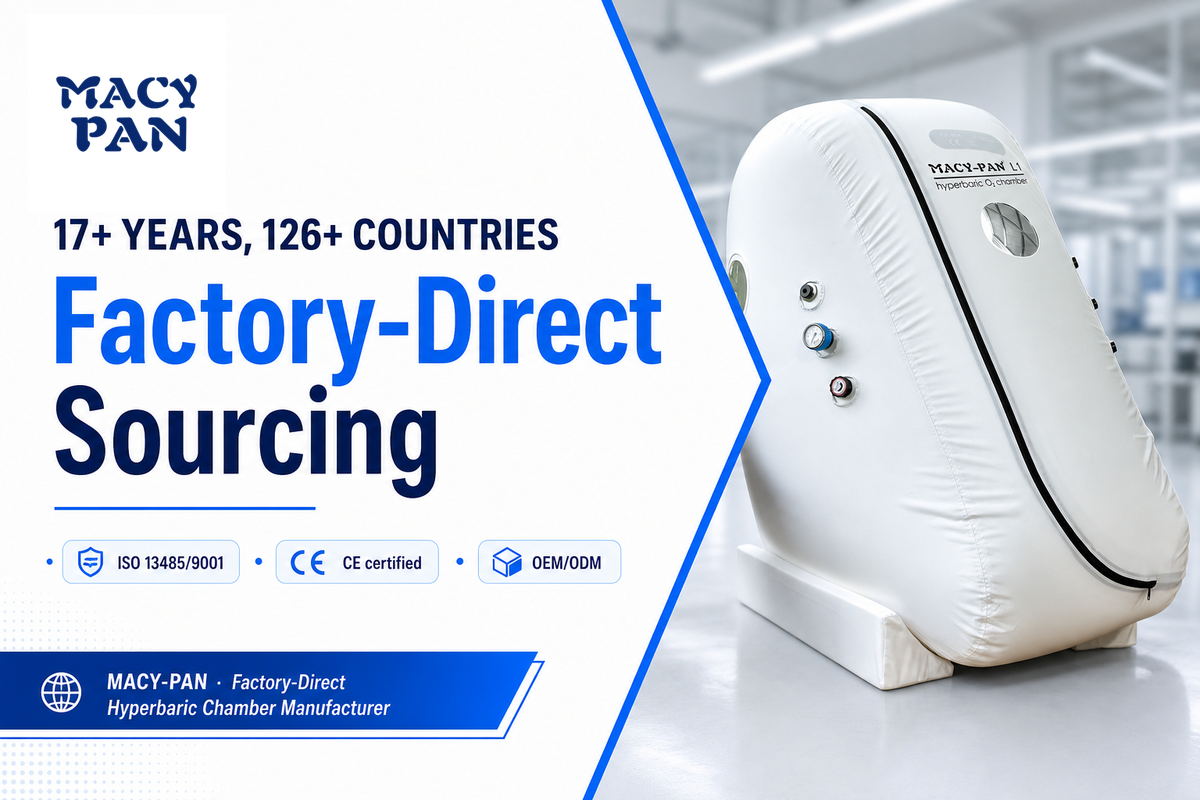
MACY-PAN (Shanghai Baobang Medical Equipment Co., Ltd.) has 19+ years of experience in manufacturing hyperbaric chambers, exporting to 126+ countries and holds the certified quality management system, ISO 9001, and CE certifications, as well as a registered patent for chamber design, with available OEM and ODM services.
💡 Buyer due-diligence note
Standards for chamber safety (such as ASME, FDA clearance, and NFPA 99) confirm if the hardware itself is built and tested appropriately, but they do not inherently confirm if any specific therapeutic claim marketed for that chamber has been approved by your local regulator. Regulators do enforce this distinction: Australia’s Therapeutic Goods Administration ordered a AU$3 million penalty against a seller for advertising unapproved therapeutic claims on hyperbaric devices. Confirm the actual cleared or registered indications for the claimed therapeutic benefits-not simply the certifications-of any chamber, whether buying for personal use or reselling, before you make your decision.
Need help with a specification comparison? Download our full chamber comparison guide or submit a quote request.
Frequently Asked Questions
What is not allowed in a hyperbaric chamber?
Hyperbaric chamber protocols forbid any items that could cause spark, static, or fire in an oxygen-rich atmosphere, including lighters, battery-operated electronics, synthetic clothing, and petroleum-based lotions or hair products.
Typically, hyperbaric chamber protocols forbid any items that could cause spark, static, or fire within an oxygen-rich atmosphere. These include items such as lighters, matches, battery-operated electronics not certified for use in the chamber, static-prone synthetic clothing materials (e.g., polyester, nylon), petroleum-based products such as certain lotions and hair products, and jewelry or metal accessories that could potentially become dislodged. Many facilities also do not permit the use of cell phones, or outside food and drink. Check with your facility and the manufacturer regarding their specific list of prohibited items.
How long can a person stay in a hyperbaric chamber?
Typical hyperbaric oxygen therapy sessions run 60-120 minutes, based on the condition treated, chamber type, and pressure setting used; clinical wound-care protocols commonly run 90 minutes per session.
Typical hyperbaric oxygen therapy sessions are from 60-120 minutes long, based on what’s being treated, the chamber type, and the pressure setting (ATA) used; common clinical treatment protocol settings for wound care or decompression sickness typically run for 90 minutes. Home use wellness or soft-shell chambers for general recovery are typically programmed for shorter, lower-pressure durations. It’s up to a treating physician or a manufacturer-certified operator to set session length and total number of treatments – never the patient. Pressure and session time both contribute to beneficial effects and potential risks.
What is the downside of hyperbaric oxygen therapy?
Barotrauma — pressure-induced discomfort or damage to the ears, sinuses, and rarely the lungs — is the most common downside, alongside transient nearsightedness, fatigue, and mild claustrophobia.
While generally safe and well-tolerated, understanding the benefits and risks of hyperbaric oxygen therapy matters before you begin, since it does carry potential risks and side effects. Barotrauma, or pressure-induced damage or discomfort to your middle ear, sinuses, and rarely your lungs, is the most common one. It is similar to the popping in your ears that occurs on airplane descent, and that’s why we instruct every patient on sinus and ear equalization techniques before their first treatment. Transient nearsightedness can occur with many sessions, but it should return to normal once treatment is stopped. Mild claustrophobia and fatigue have been reported. With extended periods at high pressure and oxygen concentrations, the risk of oxygen toxicity impacting the lungs and/or central nervous system exists, which is another reason that session duration and pressure should always be overseen by a qualified medical provider.
Is hyperbaric oxygen therapy safe for everyone?
Hyperbaric oxygen therapy is not safe for everyone: patients with untreated pneumothorax cannot receive treatment, and those with severe lung conditions or claustrophobia need physician clearance first.
No. A patient with untreated pneumothorax is prohibited from treatment in a hbot. Patients with any other serious lung condition, high fever, or those with severe claustrophobia should consult with a physician to determine the suitability of hbot treatment prior to the session.
How often should you do hyperbaric oxygen therapy?
Session frequency is determined entirely by the condition being treated and the prescriber’s recommendations — acute-care cases may need only a few sessions, while chronic wounds often require 20-40 or more.
The frequency of sessions is determined entirely by the condition being treated and the prescriber’s recommendations. A specific FDA-cleared condition like carbon monoxide poisoning may require only a few sessions at an acute-care setting, while protocols for a non-healing chronic wound or radiation injury may require five days of treatments per week over the course of 20-40 or more sessions-sometimes many more, depending on the response to the treatment. Scheduling for a wellness or low-pressure, soft-shell chamber used for general recovery or enhanced athletic performance won’t follow the standardized protocols established for clinical applications; it varies a great deal from person to person and depends on an individual’s preferences and health goals. Since both the total number of sessions and frequency can impact treatment results and potential risks, this should always be discussed with a qualified health care professional.
Not sure which chamber solution fits your use case?
MACY-PAN provides an extensive array of hyperbaric systems that meet a range of needs. Be sure to compare specifications, pressure ratings, and OEM or ODM configurations when considering MACY-PAN’s hyperbaric chamber line.
Related Articles
- Soft-Shell Hyperbaric Chamber Guide — how mild mHBOT units compare and where they fit
- Hyperbaric Chamber Pressure (ATA) Guide — matching pressure band to purpose
See also the hard-shell & medical-grade comparison, the monoplace vs. multiplace breakdown, and the cost guide linked above in this article.
Why We Wrote This
With more than 19 years designing and manufacturing hard-shell, soft-shell, monoplace, and multiplace hyperbaric chambers exported to 126 countries, MACY-PAN brings deep expertise across every chamber category in this guide. We wrote it around the same questions our sales engineers ask when advising clients on which chamber type fits their situation-including when a lower-pressure, soft-shell wellness device suits them better than a medical-grade hbot unit.
References & Sources
- Indications for Hyperbaric Oxygen Therapy — Undersea and Hyperbaric Medical Society
- 21 CFR 868.5470, Hyperbaric Chamber Device Classification — U.S. Electronic Code of Federal Regulations
- National Coverage Determination 20.29, Hyperbaric Oxygen Therapy — Centers for Medicare & Medicaid Services
- Safety Standard for Pressure Vessels for Human Occupancy (PVHO-1) — American Society of Mechanical Engineers
- Unauthorized Soft-Shelled Hyperbaric Chambers May Pose Serious Health Risks — Health Canada
- Hyperbaric Oxygen Therapy — National Library of Medicine (PMC)
- Hyperbaric Oxygen Chamber Services — University of Florida Small Animal Hospital
![Decision lenses: occupancy, gas path, access, staffing, facility interfaces, and exact-model evidence [article].](https://macypansolutions.com/wp-content/uploads/2026/10/monoplace-vs-multiplace-hyperbaric-chambers-featured-1-768x512.png)