Get in Touch with MACY-PAN Company

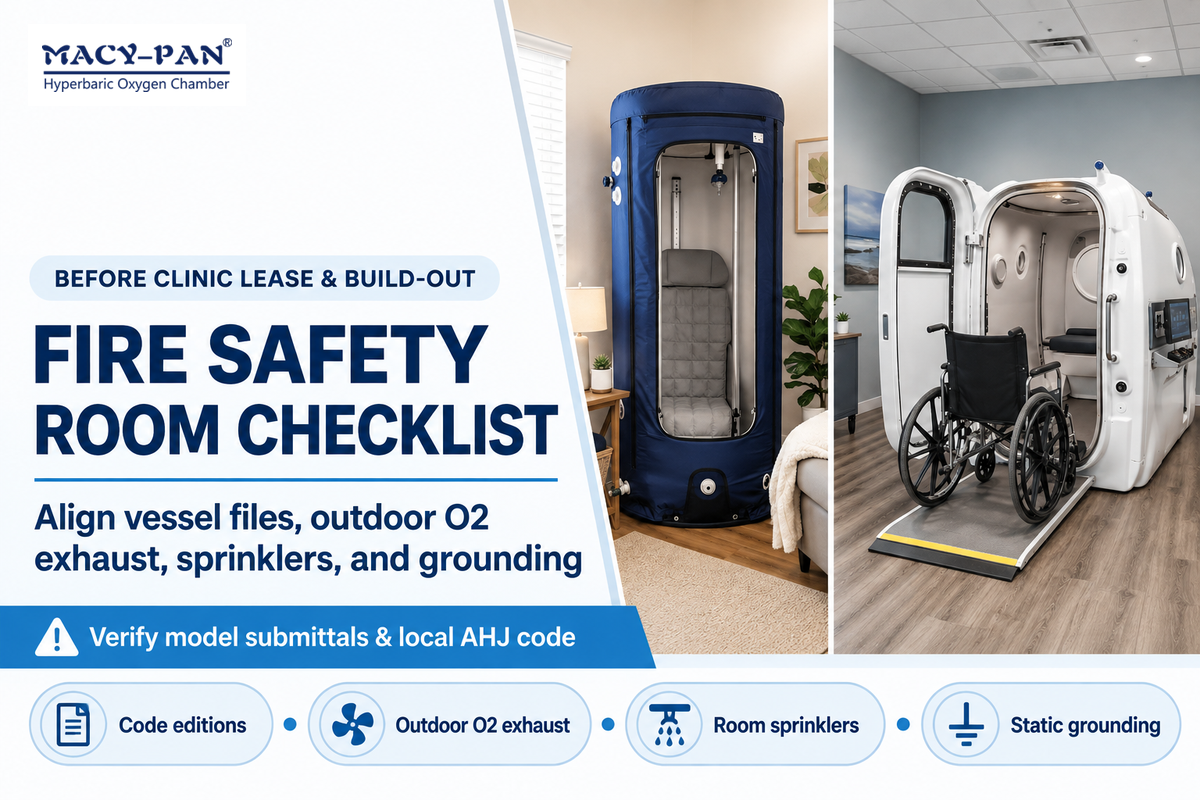
A hyperbaric chamber fire safety room checklist verifies the procurement of chambers in compliance with class rules, the presence of outdoor oxygen exhaust systems, automatic room sprinklers, and static grounding. A vessel test certificate doesn’t clear treatment rooms for patient operation. Procurement of pressure vessel files, building fire protection systems, and daily ignition screening is also required to be aligned across four project gates.
Updated October 2026 · Room fire-safety readiness for US clinic and hospital procurement teams
Verify four room interfaces before ordering a hyperbaric chamber: applicable code editions, dedicated outdoor oxygen discharge, room sprinkler versus internal deluge rules, and verified chamber-to-earth grounding continuity. Assign a named engineer or clinical lead to close each item before equipment delivery.
Core procurement checkpoints before room build-out
- Separate device premarket records from state and federal facility inspection editions.
- Route every monoplace oxygen exhaust line directly outdoors through dedicated noncombustible piping.
- Confirm room wet-pipe sprinkler (or approved alternative) coverage and verify unobstructed gurney egress in front of the door (such as the 10 ft to 12 ft used in monoplace layout examples).
- Establish an external contraband screening zone and prohibit floor waxing over conductive grounding paths.
Hyperbaric Medicine Fire Codes: NFPA 99, ASME PVHO-1, and AHJ Scope
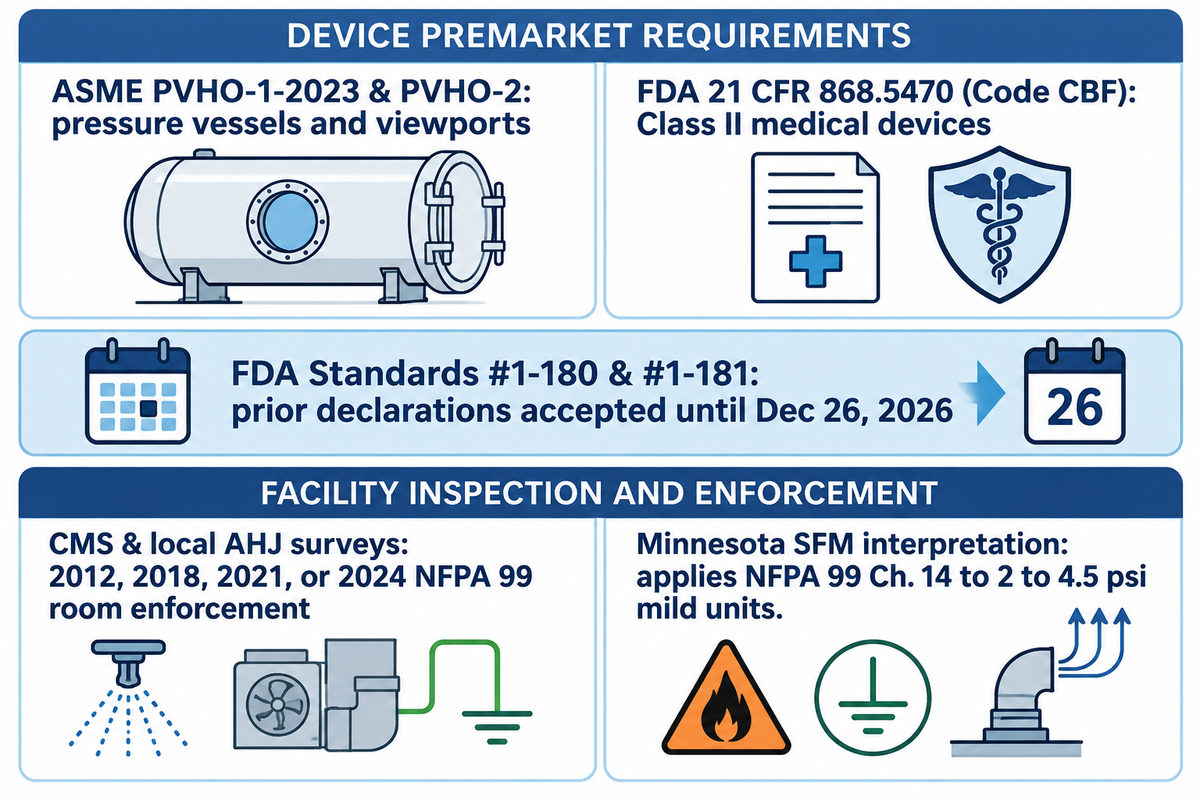
Hyperbaric medicine fire codes split oversight between device premarket rules and facility inspections. ASME PVHO-1-2023 and ASME PVHO-2 govern pressure vessels and viewports. The FDA recognizes NFPA 99:2024 and ASME PVHO-1-2023 for premarket submissions (accepting prior declarations until December 26, 2026), while CMS and local authorities enforce adopted room codes.
Delays in procurement can start when a clinic regards a vessel test certificate as a room occupancy permit. Manufacturing codes and building codes are different issues. The National Board of Boiler and Pressure Vessel Inspectors explains that ASME PVHO-1 sets design, fabrication, and testing rules for pressure vessels for human occupancy. That standard deals with the pressure vessel and its viewports and does not address building room sprinklers or facility exhaust chases.
Federal device oversight covers clinical marketing and operating instructions. Under 21 CFR 868.5470, hyperbaric chambers are classified as Class II medical devices, with Product Code CBF identifying the device category. FDA clearance applies to individual devices and their intended uses. On August 25, 2025, the fda issued a formal safety communication to health care facilities. The letter instructs providers to follow the manufacturer’s instructions for use, maintain grounding equipment, and supervise patients throughout treatment.
Recognition of standards for devices is distinct from facility inspections. According to FDA Recognized Consensus Standard #1-180 and Standard #1-181, the agency recognized NFPA 99:2024 and ASME PVHO-1-2023 on October 7, 2024. The agency accepts premarket declarations to the prior 2021 and 2019 editions until December 26, 2026. This transition governs device submissions rather than automatic clinic remodeling.
Operating clinics face a second timeline for room inspections. As reported by Health Facilities Management, the Centers for Medicare and Medicaid Services still enforces the 2012 edition of NFPA 99 for reimbursement surveys. Meanwhile, a state health department or municipal fire marshal may enforce the 2018 edition, the 2021 edition, or the 2024 code from the National Fire Protection Association. Coordinate these overlapping editions alongside your initial hyperbaric chamber room space and floor-load planning.
Outpatient wellness buyers must also check local rules for low-pressure chambers. Sales brochures sometimes claim that air-pressurized chambers bypass fire inspectors. However, the Minnesota State Fire Marshal interpretation applies NFPA 99 Chapter 14 by reference to mild chambers. Those units operate at 2 to 4.5 psi while delivering 90% to 95% oxygen via mask or nasal cannula. Always request a written determination from the local fire official before signing a lease.
Class A, Class B, and Mild Hyperbaric Chamber Fire-Risk Comparison
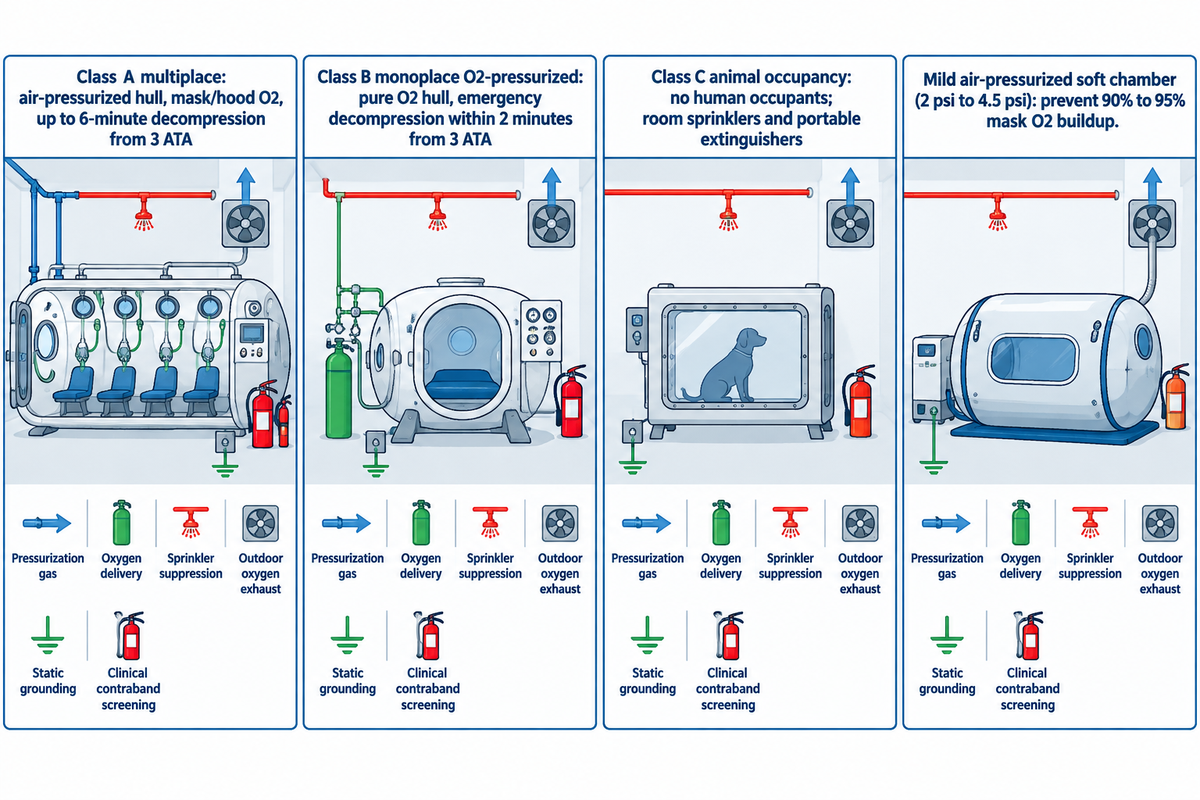
Hyperbaric chamber fire risk depends on occupancy count, vessel pressurization gas, and the method of oxygen delivery. Class A multiplace chambers pressurize with air, and deliver oxygen by mask or hood. Class B monoplace chambers pressurize the entire hull with pure medical oxygen. That design creates a potentially hazardous static electricity situation, and requires dedicated outdoor exhaust.
Buying the wrong room mechanical package usually stems from confusing chamber classes. NFPA 99 Chapter 14 classifies hyperbaric chambers into three categories. Class A is for multiple human occupants. Class B is for a single human occupancy and Class C is for animal occupancy with no human occupants. Every specific chamber configuration changes the ignition profile and the room utility schedule.
To prevent discrepancies in engineering specs, procurement teams can use the Chamber-Class Fire Control Split to check the pressurization medium, breathing-gas delivery method, and room hardware against the applicable requirements.
| Chamber Class & Category | Pressurization & Oxygen Delivery Method | Primary Fire Dynamics Risk | Room & Vessel Hardware Tier |
|---|---|---|---|
| Class A Multiplace Hard Chamber | Compressed air pressurization; patients breathe oxygen via mask or hood with built-in exhaust | Multiple occupants and up to 6-minute emergency decompression from 3 ATA; mask leaks can raise ambient oxygen | Internal deluge water spray plus independent handline; internal chamber atmosphere oxygen monitoring; fire-rated room separation |
| Class B Monoplace Oxygen-Pressurized Chamber | Pressurized throughout the hull with pure medical oxygen | High-oxygen chamber atmosphere; static sparks or prohibited personal items trigger rapid deflagration | No internal deluge required; emergency oxygen shutoff and decompression within 2 minutes from 3 ATA; dedicated outdoor exhaust per unit |
| Class B Monoplace Air-Pressurized Chamber | Compressed air hull pressurization with built-in breathing mask or hood delivery | Oxygen-enriched zones can develop through breathing-system leaks or unvented mask dump gas | Dedicated overboard dump exhaust to building exterior; room fire protection and grounding per manufacturer manual |
| Class C Animal Occupancy Chamber | Small vessel pressurized for animal occupancy with no human occupants | Localized oxygen enrichment during veterinary or laboratory oxygen protocols | Internal deluge not required per NFPA Journal; room requires automatic sprinklers (or approved alternative) and portable extinguishers |
| Air-Pressurized Mild Soft Chamber (Mask-Fed) | Oil-free compressed air (2 psi to 4.5 psi) with supplemental 90% to 95% oxygen via mask or cannula | Chamber hull holds air, but mask overflow and dump exhaust can create oxygen pockets in unventilated rooms | NFPA 99 Chapter 14 applied by reference in jurisdictions such as Minnesota; room ventilation, sprinklers, and AHJ occupancy review |
| Air-Pressurized Sitting Hard Chamber | Compressed air hull pressurization with low-pressure breathing circuit | Electrical console placement and room air exchange govern localized oxygen dilution | Dedicated electrical circuit per manufacturer load sheet; room fire protection and clear door egress |
| Multi-Chamber Monoplace Suite | Two or more Class B monoplace chambers operating in a shared clinical room | Shared exhaust headers risk back-flowing depressurization oxygen slugs into adjacent vessels | Independent noncombustible outdoor exhaust line per vessel; wall-mounted ambient room oxygen monitor |
| Hospital Inpatient Hyperbaric Suite | Class A or Class B vessels serving acute-care inpatients on stretchers | When support-system failure is likely to cause major injury or death, systems fall under NFPA 99 Risk Category 1 | Support systems evaluated under NFPA 99 Risk Category 1 criteria; verified chamber ground lug continuity; unobstructed gurney approach |
Differences in hardware between multiplace and monoplace units are driven by time required for decompression. In an NFPA Journal analysis, NFPA engineer Brian O’Connor describes 3 ATA emergency decompression limits. A Class A chamber can take up to 6 minutes to decompress, while a Class B monoplace chamber must finish decompression within 2 minutes. Faster offload times address pure oxygen fires that burn too rapidly for Class B chambers to use internal water spray. Class B chambers use rapid decompression and the cutoff of the oxygen supply to limit the duration of the fire.
Air-pressurized clinical and wellness units still require careful room engineering. With a therapeutic protocol that uses supplemental oxygen masks inside an air-filled chamber, it’s important that exhaled gas or mask leakage doesn’t accumulate in an unventilated room. Clients comparing hard-shell medical hyperbaric chambers to air-pressurized soft-shell mild chambers should examine each quote to see exactly when and where gas is supplied and removed.
4-Gate Room Fire Sign-Off Matrix for Hyperbaric Facilities (2025–2026 Checklist)
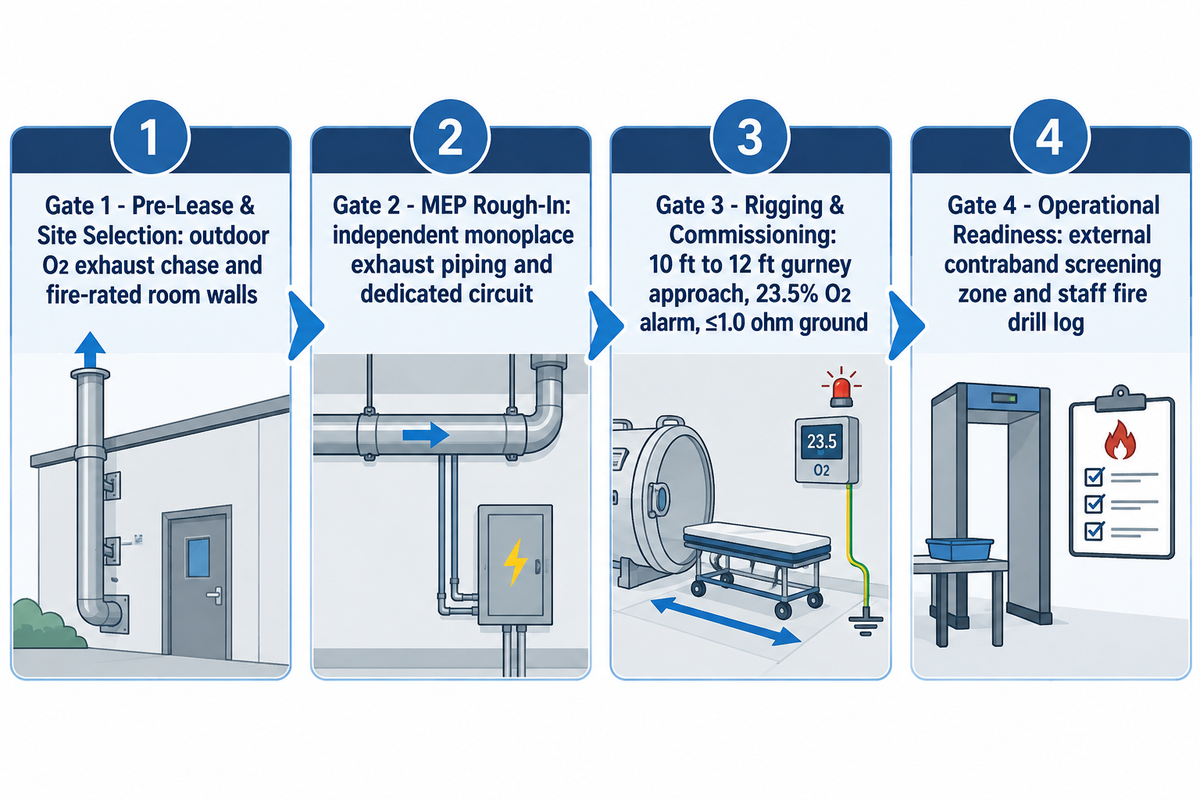
Procurement teams should follow a required four-gate sign-off process. This includes pre-lease site screening, mechanical rough-in inspections, equipment commissioning, and pre-opening fire drills. Having sign-offs tied to vendor payments and contractor milestones prevents late discovery of blocked exhaust paths and missing sprinkler coverage, among other things, after the chamber arrives.
In 2025 and 2026, state health departments and insurance underwriters have tightened pre-opening inspections for outpatient hyperbaric facilities. Project managers need to tie pre-lease site evaluations, mechanical rough-ins, equipment commissioning and pre-opening fire drills to physical verification records. Adequate room separation and access to support space and exhaust should be verified before issuing licenses by plan reviewers such as the Massachusetts Department of Public Health IP24 Checklist.
| Project Gate | Specification & Checklist Item | Published Standard & Verification Value | Sign-Off Owner |
|---|---|---|---|
| Gate 1: Pre-Lease & Site Selection | Dedicated outdoor oxygen exhaust path | Direct noncombustible duct chase or rated shaft to building exterior away from air intakes and windows | Mechanical Engineer + Building Landlord |
| Gate 1: Pre-Lease & Site Selection | Fire-rated walls and room fire suppression | Wall rating, door rating, and automatic wet-pipe sprinkler supply (or approved water-mist / clean-agent alternative) verified against adopted code | Architect + Local AHJ Reviewer |
| Gate 2: MEP Rough-In | Independent chamber exhaust piping | Each monoplace vessel piped individually outdoors; zero shared manifolds or ceiling plenum dumps | HVAC Contractor + Supplier Engineer |
| Gate 2: MEP Rough-In | Dedicated electrical circuit and ground bus | Dedicated branch circuit per manufacturer electrical schedule, emergency disconnect switch, and chamber grounding connection installed | Licensed Electrical Contractor |
| Gate 3: Rigging & Commissioning | Full gurney extension and viewport clearance | Stretcher rail extends fully with unobstructed door approach per manufacturer layout (10 ft to 12 ft in typical monoplace examples); viewports shielded from heat lamps | Clinic Project Lead + Installer |
| Gate 3: Rigging & Commissioning | Room oxygen alarm and ≤1.0 ohm ground test | Room monitor tested to alarm before ambient oxygen reaches 23.5%; hull-to-ground resistance measured at or below 1.0 ohm | Biomedical Engineer + Commissioning Tech |
| Gate 4: Operational Readiness | External contraband screening station | Dedicated changing area stocked with compliant hyperbaric patient garments and two-staff Go/No-Go sign-off sheets | Safety Director + Nurse Manager |
| Gate 4: Operational Readiness | Emergency decompression and drill log | Posted fire shutoff flowcharts, completed staff fire drill, and written AHJ final inspection sign-off | Safety Director + Hyperbaric Medical Director |
Skipping Gate 1 is the most expensive mistake in a clinic development. An interior basement suite can exhaust chamber air through the building and discharge it safely outdoors. Verifying the exhaust route before signing the lease protects a clinic from months of rent loss and contract liability.
Hyperbaric Oxygen Exhaust, Room Ventilation, and the 23.5% Environment Alarm
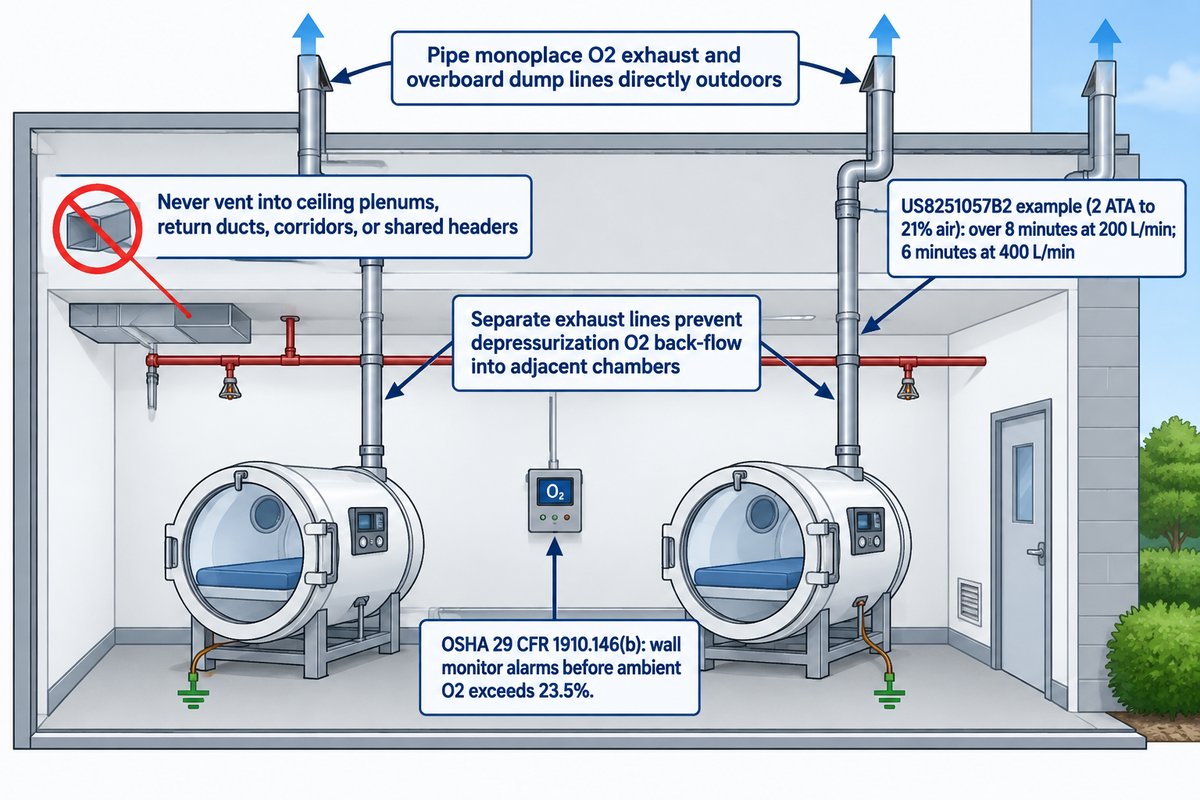
Monoplace oxygen exhaust and integral breathing overboard dump lines must be piped outdoors. Room ventilation dilutes released gas, but ambient oxygen can still exceed 23.5% if a leak overwhelms airflow. Class A chambers have internal alarms if the oxygen level increases and becomes hazardous. An outpatient room, however, doesn’t have built-in vessel alarms.
Three gas streams must be distinguished by buyers on mechanical drawings: chamber supply gas, chamber depressurization exhaust, and room HVAC air handling. Under OSHA 29 CFR 1910.146(b), any environment containing more than 23.5 percent oxygen by volume is considered an oxygen-enriched atmosphere. Oxygen enrichment can support the ignition of combustible materials, and increase the combustion rate; however, passing 23.5 percent oxygen doesn’t cause materials to ignite.
Where must hyperbaric chamber oxygen exhaust vent in a clinic building?
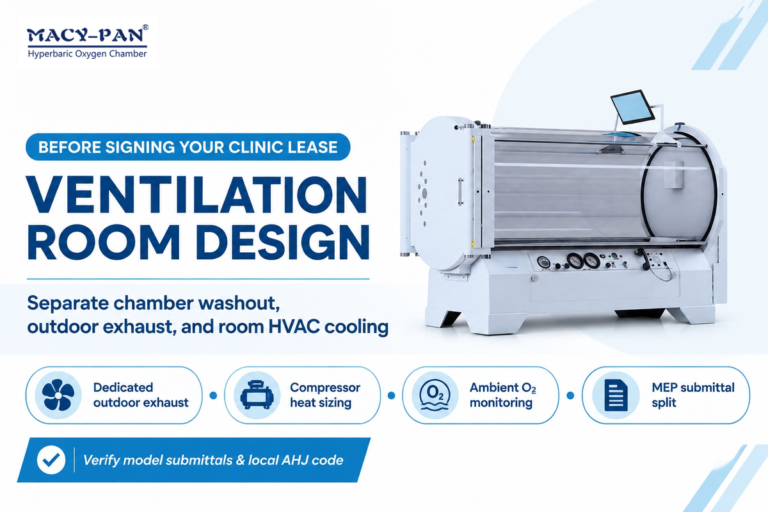
Exhaust pipes run outdoors to a safe, unobstructed open space via dedicated noncombustible piping. Monoplace oxygen exhaust must never discharge into ceiling plenums, return air ducts, corridors or shared multi-chamber exhaust headers. The termination must be clear of building intake air, doors, and ignition sources.
Chamber exhaust can’t be vented into the treatment space or a shared plenum for several reasons. In third-party U.S. Patent US8251057B2, which is assigned to Life Support Technologies, Inc. and invented by Glenn Butler, the supply and exhaust gas pass through different penetrators in a monoplace vessel. In the patent’s Sechrist 3200 example at 2 ATA, purging a pure oxygen chamber down to 21% air takes over 8 minutes at 200 L/min. Even at 400 L/min, it takes 6 minutes to purge. Because of the high volume of oxygen released during the depressurization, it back-flows into the adjacent monoplace chamber.
Room air changes and ambient sensors provide the second layer of defense. Class A chamber atmosphere monitoring can detect oxygen enrichment. Breathing-gas supply lines can carry pure oxygen and, thus, have a different oxygen concentration from the chamber atmosphere. Outpatient clinics operating monoplace or mask-fed chambers should also install wall-mounted room oxygen monitors set to alarm before ambient levels reach the 23.5% oxygen-enriched threshold. Required room air-change rates vary across state hospital codes and chamber heat loads. Mechanical engineers must size room exhaust in accordance with the adopted state code and the manufacturer’s peak dump flow.
Fire Suppression Support Systems: Deluge Water Spray vs. Wet-Pipe Sprinklers
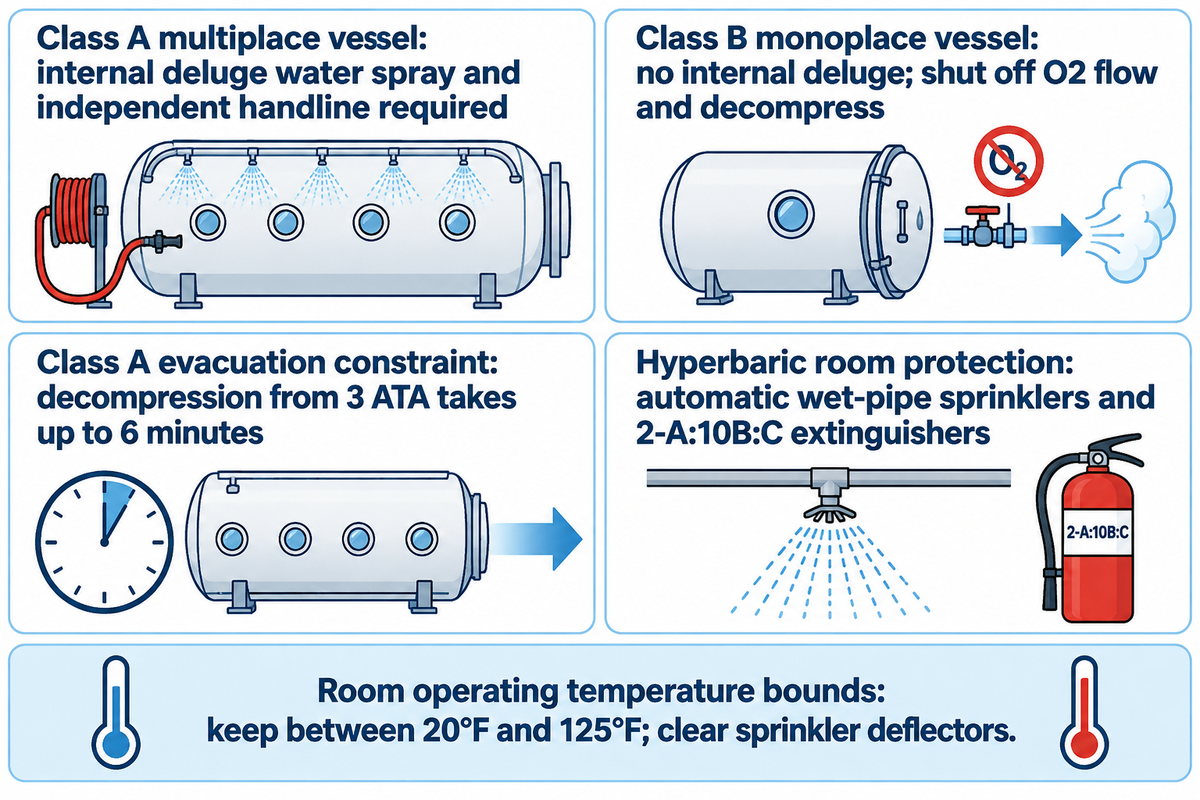
Internal deluge water spray and independent handlines are required in Class A multiplace chambers in accordance with NFPA 99 Chapter 14. Internal deluge systems aren’t required in Class B chambers. The room also requires building fire protection and rated portable extinguishers; the sign-off checklist should identify the required system and any approved alternative.
Budgets for design services can swing widely if designers confuse vessel suppression with room suppression. In NFPA 99, Category 1 applies to systems whose failure is likely to cause major injury or death to patients, staff, or visitors, as detailed in Consulting-Specifying Engineer. The hyperbaric room must remain within the manufacturer’s recommended temperature range and must not fall below 20°F or exceed 125°F.
Inside a Class A multiplace vessel, occupants can’t evacuate instantly during a fire because decompression from 3 ATA takes up to 6 minutes. Consequently, NFPA 99 requires an internal deluge water spray system capable of activating within seconds from both inside and outside the chamber. These systems must be coupled with an independent, manually operable handline located on a separate water source.
Engineering scopes for monoplace clinics are less complicated. According to the NFPA Journal hyperbaric fire protection guide, deluge systems aren’t required for Class B or C vessels. As stated in the document, the preferred method for fire response for Class B monoplace chambers is to shut off the oxygen flow and follow emergency (decompression) procedures. However, the room housing the monoplace chamber must be equipped with an automatic wet-pipe sprinkler system (or approved water mist or clean agent system), as well as portable extinguishers rated at least 2-A:10B:C. During inspections by the Joint Commission (or state fire marshals), clinics often fail if items like lighting tracks or privacy curtains obstruct the room sprinkler system deflector patterns.
Static Electricity Grounding, Low-Voltage Penetrators, and Room Circuits
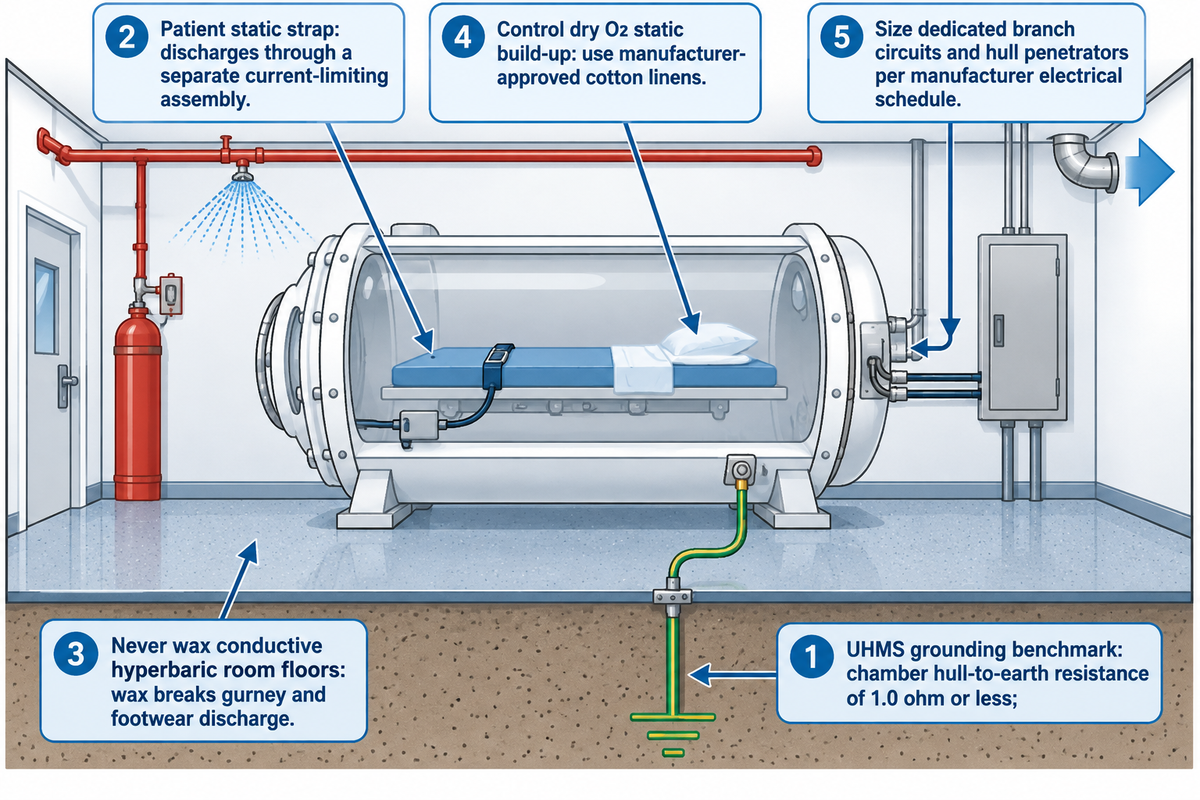
The UHMS grounding guidance specifies a grounding resistance of 1.0 ohm or less for chambers. Static patient grounding is done through a separate grounding assembly, which may include a current limiting resistor. Dedicated branch circuits, emergency disconnects, and electrical penetrations must be in accordance with the chamber manufacturer’s instructions and NFPA 99. Conductive floors must never be waxed.
In high oxygen environments, the minimum ignition energy of cotton, skin oil, or lint drops dramatically. A small electrostatic discharge that’s usually imperceptible in normal air can become a fatal ignition source in a pressurized oxygen vessel.
Why is static electricity grounding mandatory in hyperbaric rooms?
In the presence of enriched oxygen, the spark energy needed to ignite fabrics and skin oils is also drastically reduced. A current limiting assembly is used to safely discharge patient static to the chamber hull, which is then grounded to earth via a ground lug. Ungrounded surfaces, or waxed conductive surfaces, can trap a lethal electrostatic charge.
In the UHMS Safety and Technical Maintenance MEDFAQs safety experts state clinics should never wax a conductive hyperbaric room floor. Floor wax can break the electrostatic discharge path from gurney wheels and staff footwear. Biomedical engineers must test and log the resistance of the ground lug to earth, ensuring it remains below 1.0 ohm.
Gas flow and room humidity directly influence the build-up of static risk. The use of high-flow dry medical oxygen reduces humidity in the chamber, increases risk, and can build up static faster on dry skin and sheets. Adding blankets at the request of a cold patient increases the fuel load and makes static friction and risk worse, especially if the added blankets are of a different fabric to that approved by the manufacturer. Rooms must be kept at safe temperatures and chambers fitted with manufacturer-approved linens, including approved cotton linens.
On the electrical side, buyers must verify how the manufacturer’s engineering teams specify room power and hull electrical pass-throughs. Because published standards don’t set one identical branch-circuit amperage across all chamber models, electrical contractors must size dedicated branch circuits and emergency-off disconnects from the model-specific load sheet. Intercom wires and sensors passing through the pressure hull must use penetrators matching the manufacturer’s pressure-boundary and electrical specifications. When reviewing polymer control housings, procurement teams should distinguish UL 94 material flammability ratings from whole-device electrical safety listings.
Room Finishes, Viewports, and Emergency Procedures for Gurney Egress
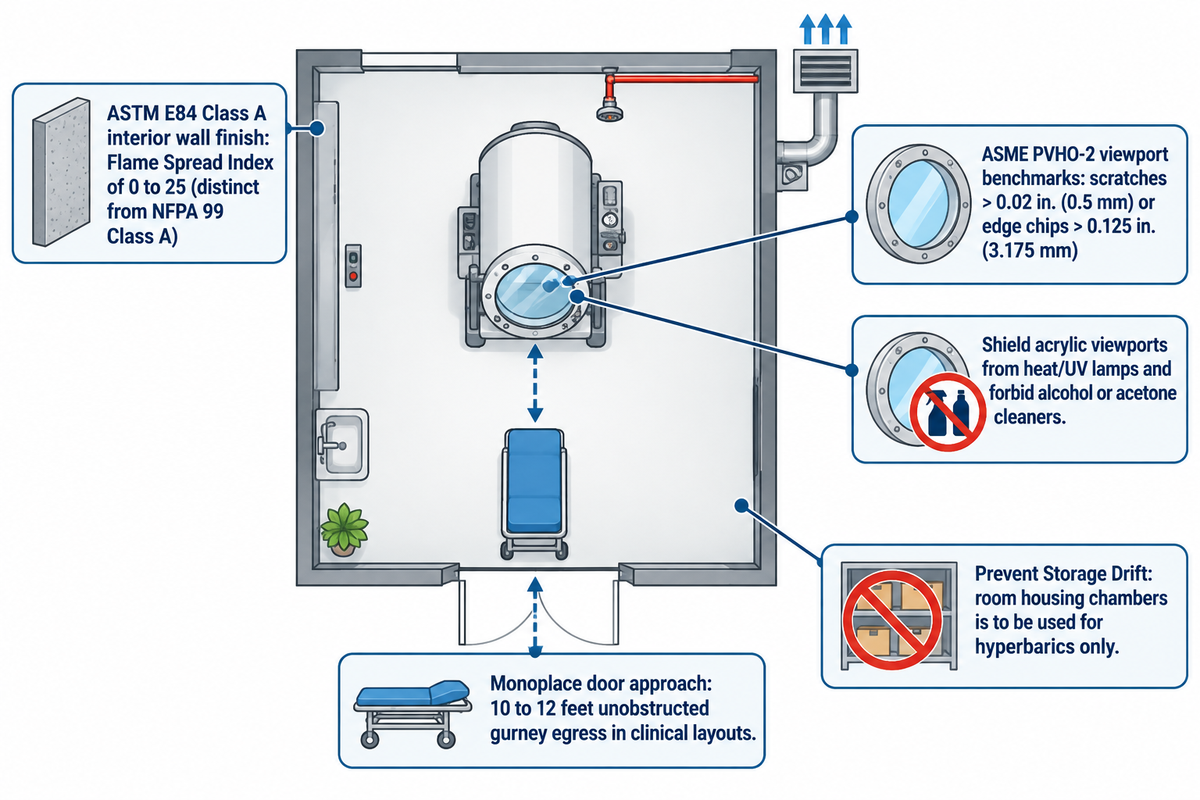
Hyperbaric room layouts require unobstructed gurney egress in front of monoplace doors (10 to 12 feet in clinical layout examples) and flame-resistant interior finishes. Architects must not mix up ASTM E84 Class A wall ratings with NFPA 99 Class A chambers, and staff must protect acrylic viewports from alcohol cleaner and mechanical rail impacts.
Architects new to healthcare construction often mix up two identical terms. An NFPA 99 Class A chamber is a multiplace pressure vessel; an NFPA 101 Class A interior finish has a Flame Spread Index of 0 to 25 and also meets the smoke-developed index requirement, with both indices measured using ASTM E84. A clinic installing an NFPA 99 Class B monoplace chamber still needs fire-resistant interior walls, out-swinging or clear-opening doors, and anti-static washable surfaces.
Clear floor space around the chamber is required for fire evacuation and is also a patient care and pressure vessel protection requirement. In the UHMS Standards and Codes MEDFAQs, the safety committee points out “Storage Drift,” the dangerous practice of stacking wound dressing boxes, linen carts, or oxygen cylinders in a chamber room. NFPA 99 states that the room housing the chambers is to be used for hyperbarics only. Crowding the gurney transfer clearance in front of a monoplace door (10 to 12 feet in standard clinical room layouts) blocks emergency procedures during a rapid patient extraction.
Tight rooms also damage acrylic pressure boundaries. UHMS maintenance records describe a clinic where an operator was forced to angle a transfer gurney in a cramped room. The metal rail on the gurney derailed and gouged the inside of the acrylic cylinder. In the UHMS maintenance MEDFAQs citing ASME PVHO-2, surface scratches deeper than 0.02 in. (0.5 mm) or edge chips wider than 0.125 in. (3.175 mm) are cited as severe damage benchmarks requiring specialist evaluation. Any viewport damage must still be evaluated under ASME PVHO-2 and the manufacturer’s maintenance manual before pressurization. Keep viewports away from radiant heaters or UV lamps, forbid alcohol or acetone cleaners that cause crazing, and coordinate door swing early with our hyperbaric chamber doorway and rigging clearance practical guide.
Wound Care Contraband Screening and Hyperbaric Facility Safety Risk Rules
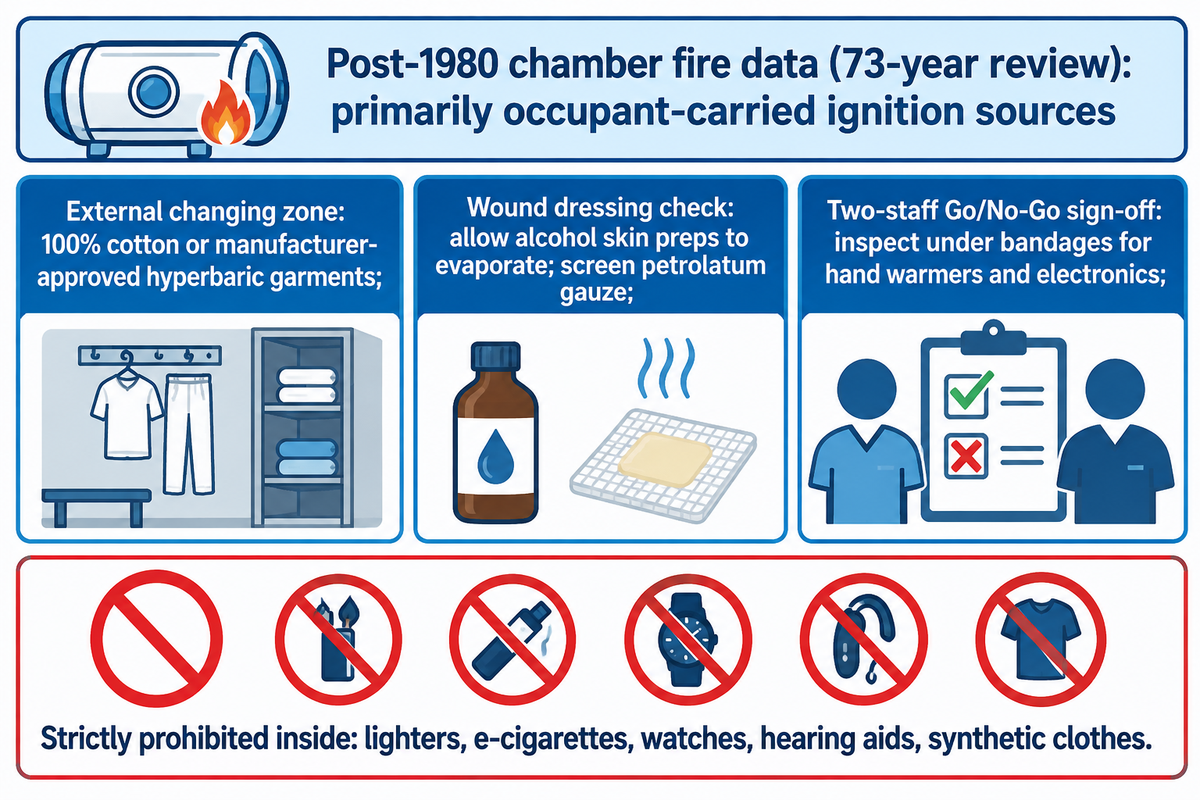
Wound care contraband screening is a frontline daily fire defense in clinical hyperbaric operations. Clinics must enforce a pre-entry changing zone, require patients to wear 100% cotton or manufacturer-approved hyperbaric patient garments, verify that alcohol prep vapors have fully evaporated, and complete a two-staff signed Go/No-Go checklist.
Historical fire data proves that engineering hardware can’t compensate for lax patient screening. A 73-year analysis of hyperbaric and hypobaric chamber fires by Sheffield and Desautels established that pre-1980 fires often stemmed from internal electrical faults. After 1980, however, chamber fires were primarily caused by prohibited ignition sources carried inside by an occupant. Recent clinical hyperbaric safety research in PMC similarly cites fatal incidents triggered by pocket warmers and unauthorized personal items, noting that rapid evacuation is impossible while a vessel is pressurized.
Are there residual flammable vapors that have not off-gassed on wound dressings?
Yes. Alcohol skin preps, solvent-based adhesive removers, and wet nail polish release flammable vapors. Petroleum-based wound ointments leave combustible residues that drying doesn’t remove. Staff must check each dressing before entry and allow volatile skin antiseptics to completely evaporate outside the chamber room. UHMS’s contraband Go/No-Go risk tool must also be consulted before pressurization.
Outpatient wound care centers have specific physiological and dressing challenges. Patients presenting for treatment of diabetic ulcers and radiation tissue therapy are seen wearing Petrolatum gauze, oil-based lotions, transdermal patches, and battery-powered medical devices. Risks associated with volatile hydrocarbons and battery thermal runaway escalate to fire in the presence of high concentrations of oxygen, resulting in the need to design the layout of the chamber room to include a dedicated area for patient changing and lockers outside the chamber room door.
Do enforce before chamber entry
- Provide approved cotton or manufacturer-approved hyperbaric patient garments.
- Require two trained staff members to sign a dated pre-dive contraband Go/No-Go sheet.
- Inspect under bandages for chemical hand warmers, petroleum dressings, and unapproved electronics.
Don’t allow into the chamber
- Lighters, e-cigarettes, watches, hearing aids, or Bluetooth earbuds.
- Wool, silk, or synthetic polyester street clothes that generate static sparks.
- Unapproved extra blankets that increase fuel severity and static friction.
Designate a Safety Director, CHT Qualification, and Maintenance Program Guideline
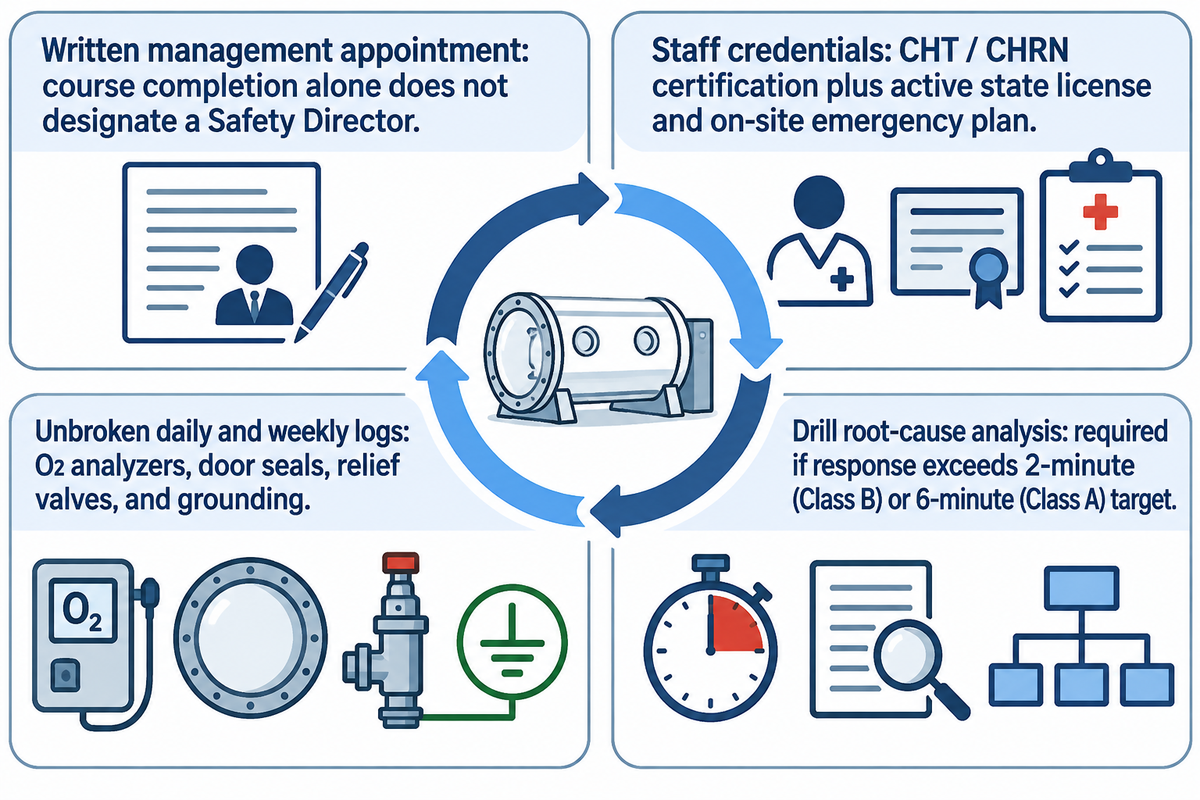
Facility management must formally designate a Hyperbaric Safety Director in order to enforce the safety program, staff qualification, regular emergency fire drills, and preventive maintenance logs. Completing a training course alone does not confer authority without written management appointment and collaboration with the hyperbaric medical director.
A compliant room still fails accreditation if governance records are missing. Under the Undersea and Hyperbaric Medical Society (uhms hyperbaric facility accreditation program), surveyors inspect both physical equipment and the paper trail proving daily oversight. Occupational safety guidelines from WorkSafeBC and the BC Medical Journal likewise emphasize formal staff training, medical supervision, and adherence to pressure vessel regulations.
Does a Safety Director Course designate someone as a Hyperbaric Safety Director?
No. Taking a Safety Director training course doesn’t, on its own, appoint a staff member to the role of Hyperbaric Safety Director. The administration of the facility, in conjunction with the hyperbaric medical director, must grant formal written Safety Director designation to an individual. That documentation delineates the appointing authority’s ability to stop (or not allow) the performance of unsafe treatments; enforce the rules of NFPA 99; and oversee maintenance.
Define staff credentials and emergency coverage as well. The National Board of Diving and Hyperbaric Medical Technology awards the Certified Hyperbaric Technologist and the Certified Hyperbaric Registered Nurse credentials. Every health professional holding a cht, rn or hyperbaric nursing qualification, under board of diving and hyperbaric standards, must also maintain an active state license and continuing education requirements. Having a qualified operator at the console doesn’t eliminate the requirement for a written contingency plan and an immediate on-site clinical response if a patient experiences a medical emergency or possible adverse reaction.
Surveyors audit the preventive maintenance program and test frequency for unbroken continuity. Scheduled daily and weekly preventive maintenance logs cover oxygen analyzer checks, door seal inspections, relief valve servicing, and grounding verification. If those records show unexplained date gaps, surveyors flag a systemic lapse. Whenever a safety breach occurs or an emergency drill exceeds the 2-minute monoplace or 6-minute multiplace decompression target, the safety director and medical director must document a formal root-cause analysis. They must also verify that corrective actions don’t allow the hazard to recur.
Hyperbaric Safety Submittal Procedure Before Ordering a Hyperbaric Chamber
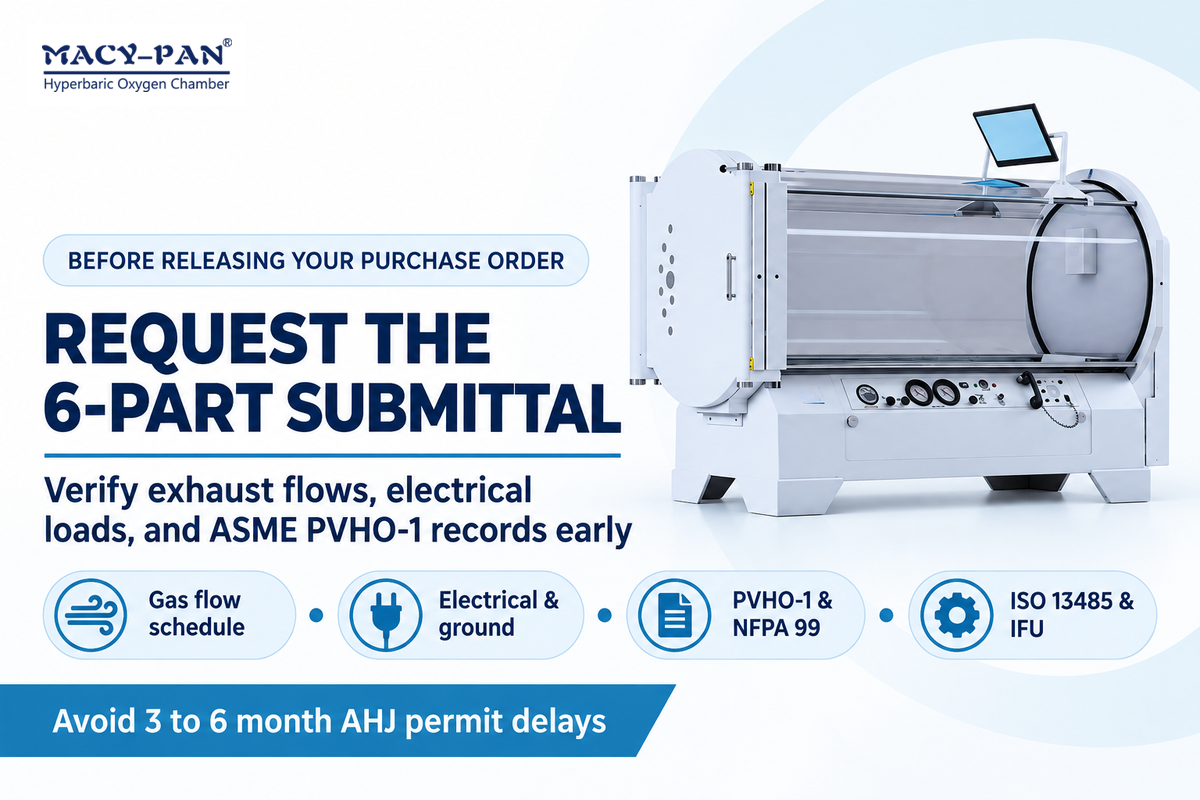
Before releasing a purchase order, procurement teams should collect a six-part hyperbaric safety submittal package from the manufacturer. This file covers peak oxygen exhaust flows, electrical and penetrator specifications, ASME PVHO-1-2023 and NFPA 99:2024 conformity declarations (noting the December 26, 2026 transition cutoff for prior premarket declarations), material flame reports, ISO 13485 certificates, and maintenance manuals.
Reviewing quotes for safety concerns incurs no cost, but changing exhaust chases post-delivery results in expensive change orders. The cost of site renovation and MEP work installation is dependent on the specifics of the local construction market, the building geometry and the existing fire-protection sprinkler capacity. As such, facility modification costs are based on quotes from local licensed contractors.
- Peak gas supply and exhaust flow schedule: Give the mechanical engineer exact normal purge rates (such as 200 L/min to 400 L/min in published monoplace purge examples), emergency dump rates, and connection fittings.
- Electrical load, low-voltage penetrator, and grounding drawing: Voltage ratings, circuit amperage, and the locations of the chamber’s grounding and bonding connections.
- Pressure vessel and viewport conformity dossier: Verify model-specific ASME PVHO-1-2023, ASME PVHO-2, and NFPA 99:2024 conformity records. Confirm whether any prior 2021 or 2019 premarket declaration of conformity falls within the December 26, 2026 FDA transition window.
- Interior material and mattress documentation: Flammability test reports for the chamber and patient transfer surfaces covering the vessel’s operating pressure and oxygen concentration, together with manufacturer material approvals.
- Quality management system verification: Distinguish medical-device ISO 13485 certification from general ISO 9001 factory management using our hyperbaric manufacturer verification checklist.
- Instructions for Use and maintenance manual: Deliver cleaning rules, prohibited item lists, and valve servicing intervals to the safety director before installation.
Working with an experienced manufacturer makes this engineering handoff much easier. Shanghai Baobang Medical Equipment Co., Ltd. (MACY-PAN) offers clinic hyperbaric chamber room solutions across its hard-shell and soft-shell product lines. Systems can be supplied with model-specific ASME documentation, certified quality management files, CE certificates, and third-party SGS test reports. As noted on our clinical solutions page, using uncertified equipment without complete technical files can result in the local AHJ rejecting equipment and delaying clinic opening between 3 to 6 months. After your technical submittal is approved, pair it with our hyperbaric chamber landed cost breakdown, to set your budgets for freight and rigging.
Frequently Asked Questions About Hyperbaric Room Fire Safety
Is a hyperbaric chamber fire safety room checklist mandatory before opening a clinic?
Jurisdictions enforcing NFPA 99 Chapter 14 and NFPA 101 require documented proof of room fire-safety compliance, which procurement teams organize into a pre-opening checklist.
No single federal agency issues one universal form for every state. However, state health departments, municipal fire marshals, CMS surveyors, and the UHMS accreditation program require documented proof of room fire protection before granting occupancy or reimbursement approval. Completing a structured checklist across exhaust piping, sprinklers, grounding, and contraband controls provides the exact audit trail inspectors demand.
Can patients wear polyester clothing or oil-based lotions inside a hyperbaric chamber room?
No. Synthetic fabrics and petroleum-based skin products are strictly prohibited inside oxygen-enriched chambers.
Polyester, wool, and nylon garments generate static electricity during patient movement. Petroleum jelly, mineral oil, hair spray, and un-dried alcohol lotions act as volatile fuels in high-oxygen environments. FDA safety guidance and NFPA 99 operating rules require patients to change into approved cotton or manufacturer-approved antistatic garments in an external screening area before entering.
Why is a hyperbaric facility maintenance program necessary for fire prevention?
Routine preventive maintenance catches hidden grounding breaks, oxygen leaks, and sensor drift before ignition occurs.
A documented maintenance program verifies that hull ground straps maintain low-resistance continuity, door elastomer seals and relief valves do not leak oxygen into the treatment room during 2 psi to 4.5 psi or higher clinical pressurization cycles, and room environment sensors remain calibrated within 20°F to 125°F operating limits. Continuous daily and weekly logs without date gaps satisfy UHMS accreditation surveyors and medical liability insurers.
How often must hyperbaric facilities conduct fire drills?
On the recurring schedule mandated by the facility’s accrediting body, state health department, and local fire code.
Clinical teams must practice immediate oxygen shutoff, emergency decompression within 2 minutes for Class B or 6 minutes for Class A from 3 ATA, and gurney extraction to a smoke-safe compartment, logging the response time and any root-cause corrective actions.
How long do clinics need to keep hyperbaric chamber preventive maintenance logs?
Retention periods for preventive maintenance logs follow state health department licensing rules, CMS survey look-back windows, and UHMS accreditation cycles.
Minimum retention windows for daily checklists, grounding tests, and fire drill records are set by state licensing boards, CMS inspection look-back rules, and the facility’s accreditation body. Engineering best practice is to archive ASME PVHO-1 pressure vessel certificates, acrylic viewport service-life logs, relief valve calibration certificates, and major electrical repair records for the entire operating life of the specific chamber so surveyors can verify uninterrupted compliance.
When does a hyperbaric room fire safety checklist need to be updated?
Immediately whenever equipment, utilities, room layouts, or adopted fire codes change.
Adding a second chamber, modifying HVAC exhaust ductwork, replacing conductive flooring, or transitioning to a newly adopted edition of NFPA 99 requires an immediate revision.
Do air-pressurized mild hyperbaric chambers require the same room deluge system as monoplace oxygen chambers?
NFPA Journal describes automatic sprinklers, water mist, or clean-agent suppression for rooms housing Class A, B, or C chambers. Class B chambers do not require an internal deluge system.
The phrase “room deluge system” confuses building fire sprinklers with internal chamber deluge spray. Under NFPA 99 Chapter 14, internal deluge water spray is required only inside Class A multiplace chambers. Both Class B monoplace oxygen chambers and air-pressurized mild chambers rely on room-level fire protection, automatic wet-pipe building sprinklers (or approved water-mist or clean-agent systems), 2-A:10B:C extinguishers, and room ventilation, as enforced by the local Authority Having Jurisdiction.
Key Takeaway
Treat hyperbaric fire safety as a four-gate engineering and clinical system. Lock in your chamber class, dedicated outdoor oxygen exhaust, room sprinkler clearance, and verified chamber-hull-to-earth-ground continuity before signing a room lease or approving construction.
Request a Model-Specific Room & Fire-Safety Interface Package
Share your target chamber class, room dimensions, floor level, exterior wall exhaust access, and local jurisdiction with MACY-PAN engineering. Our team will supply model-specific gas flow rates, electrical and grounding schematics, and regulatory documentation for your architect and fire marshal review.
Engineering & Regulatory Scope Disclaimer
This checklist organizes procurement and facility preparation inputs from published FDA, NFPA, OSHA, ASME, and UHMS technical sources. It does not replace stamped mechanical, electrical, or fire-protection engineering drawings, manufacturer Instructions for Use, or binding rulings from your local Authority Having Jurisdiction (AHJ).
References & Sources
- Follow Instructions for Safe Use of Hyperbaric Oxygen Therapy Devices, Letter to Health Care Providers (August 25, 2025), U.S. Food and Drug Administration.
- FDA Recognized Consensus Standard #1-180: NFPA 99:2024 Health Care Facilities Code, U.S. Food and Drug Administration.
- FDA Recognized Consensus Standard #1-181: ASME PVHO-1-2023 Safety Standard for Pressure Vessels for Human Occupancy, U.S. Food and Drug Administration.
- FDA updates requirements for hyperbaric chambers (April 2025), Health Facilities Management (ASHE).
- Fire protection for hyperbaric facilities in hospitals, NFPA Journal (National Fire Protection Association).
- 29 CFR 1910.146, Permit-required confined spaces (Oxygen-enriched atmosphere definition), Occupational Safety and Health Administration.
- Fire Code Interpretation: Mild Hyperbaric Oxygen Therapy (MSFC 609.1 / MBC 425.1), Minnesota Department of Public Safety State Fire Marshal.
- IP24 Compliance Checklist, Hyperbaric Suite, Massachusetts Department of Public Health.
- U.S. Patent US8251057B2: Hyperbaric chamber control and/or monitoring system and methods for using the same, Google Patents / USPTO.
- NFPA 99: A fire and life safety perspective, Consulting-Specifying Engineer.
- MEDFAQs, Safety & Technical: Maintenance (Floor waxing, grounding, and PVHO-2 acrylic limits), Undersea and Hyperbaric Medical Society.
- MEDFAQs, Safety & Technical: Standards and Codes (Exclusive room use and Storage Drift), Undersea and Hyperbaric Medical Society.
- The Use of Pressure Vessels for Human Occupancy in Clinical Hyperbaric Medicine, National Board of Boiler and Pressure Vessel Inspectors.
- Hyperbaric and hypobaric chamber fires: a 73-year analysis, Undersea & Hyperbaric Medicine (PubMed 9308138).
- Safety of Hyperbaric Medicine in Clinical Scenarios (2024), National Library of Medicine (PMC10922184).
- What Surveyors Look for in a Hyperbaric Accreditation Survey, Undersea and Hyperbaric Medical Society.
- WorkSafeBC: Hyperbaric chamber safety, British Columbia Medical Journal.