Get in Touch with MACY-PAN Company

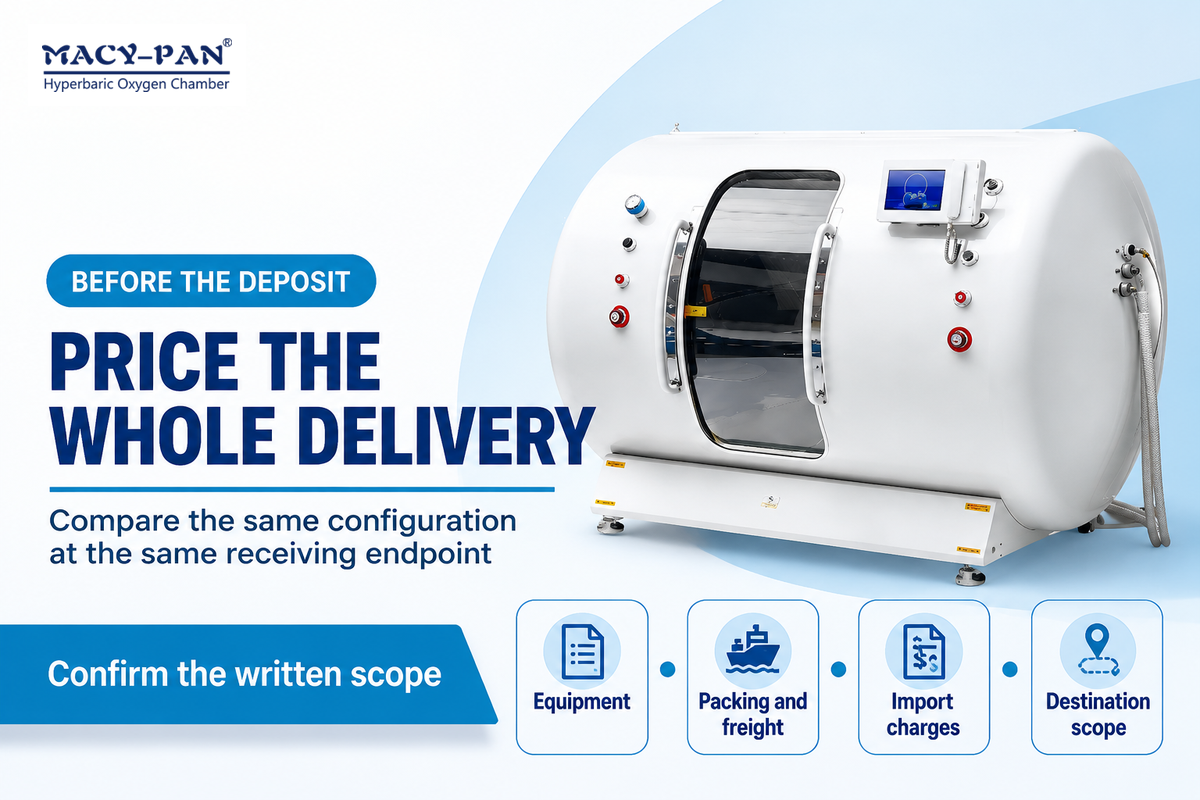
A hyperbaric chamber landed cost breakdown includes the price of the configured equipment, export packing, freight and insurance, import charges and delivery to a point agreed by the parties. Keep room preparation and first year operations cost separate. There’s no reliable universal percentage to add to a factory quote: the destination, customs treatment, packed dimensions and scope of delivery determine the result.
Equipment cost at destination = equipment + export/origin charges + main carriage/ insurance + import charges + destination handling/placement. Add facility preparation to obtain the opening budget. The distinction matters when a supplier promises delivery to a port while the buyer expects an unloaded chamber inside a treatment room.
What Costs Belong in a Hyperbaric Chamber Landed-Cost Estimate?
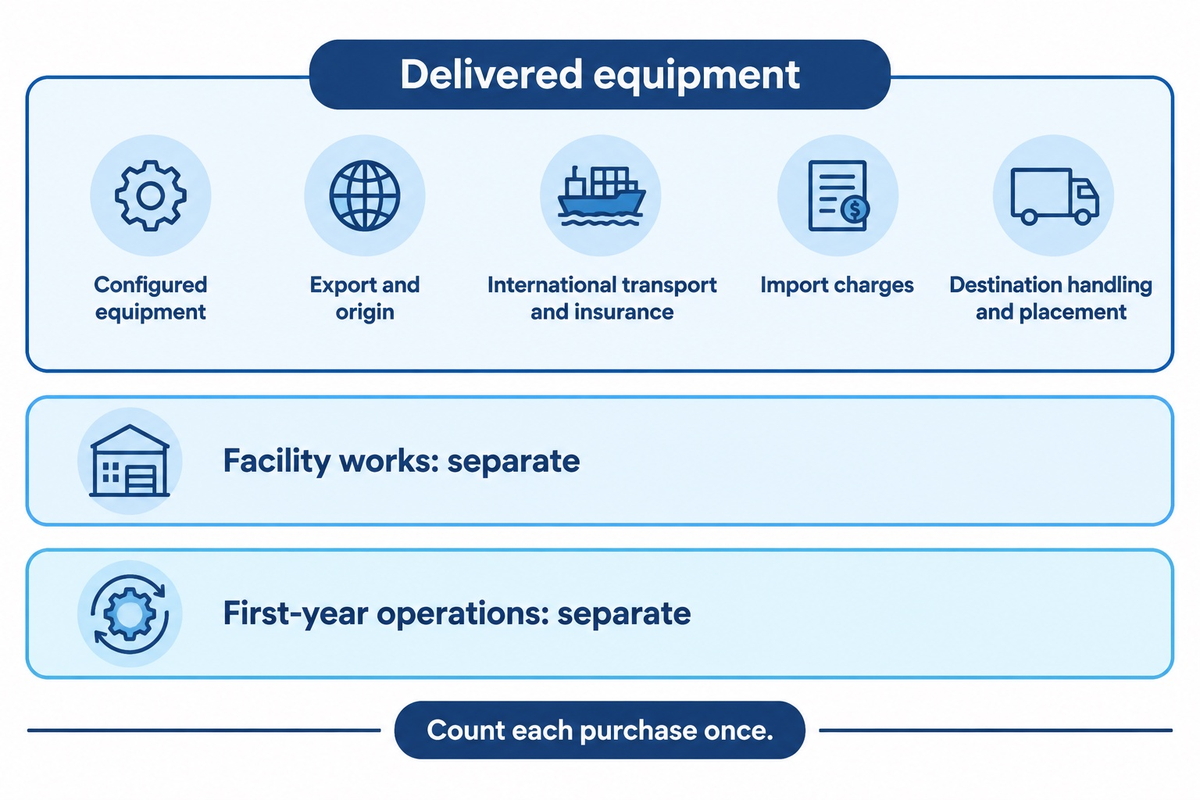
A chamber landed-cost estimate needs a named destination and a clear completion point, such as delivery ready for unloading or placement inside the room. The 5-Layer Landed Cost Waterfall is a useful tool to compare quotes from various suppliers at the same endpoint, prior to including facility works and operating costs, and to identify invoices and missing services.
The five layers are configuration, export/origin, international transport and insurance, import and destination. A cost item must be charged to only one of the five layers. If a supplier/forwarder indicates that the freight costs are embedded in the equipment price, such costs must be charged to that layer, and not again by the forwarder. This is a reconciliation method, not an industry pricing formula.
When considering two offers as a finance manager, focus on which of the excluded invoices arrives next. For example, a lower equipment price can lose its advantage due to unpriced destination handling, unloading, or installation. Please refer to our hyperbaric chamber cost guide for equipment price drivers. Herein, we discuss the purchase from quotation to delivery to the site.
The purchase price alone doesn’t depict the full cost of hyperbaric equipment delivered to the site. Compare hyperbaric chamber prices only with corresponding inclusions. A sticker price describes an offer; the chamber price on a complete project ledger includes the services needed to reach its stated endpoint.
Keep three totals. Record delivered equipment, facility works, and first-year operations separately. A spare kit bought with the chamber is an acquisition expense; replacement parts bought later are operating expenses. Count each purchase once.
Factory Equipment Baseline: Compare the Configuration First
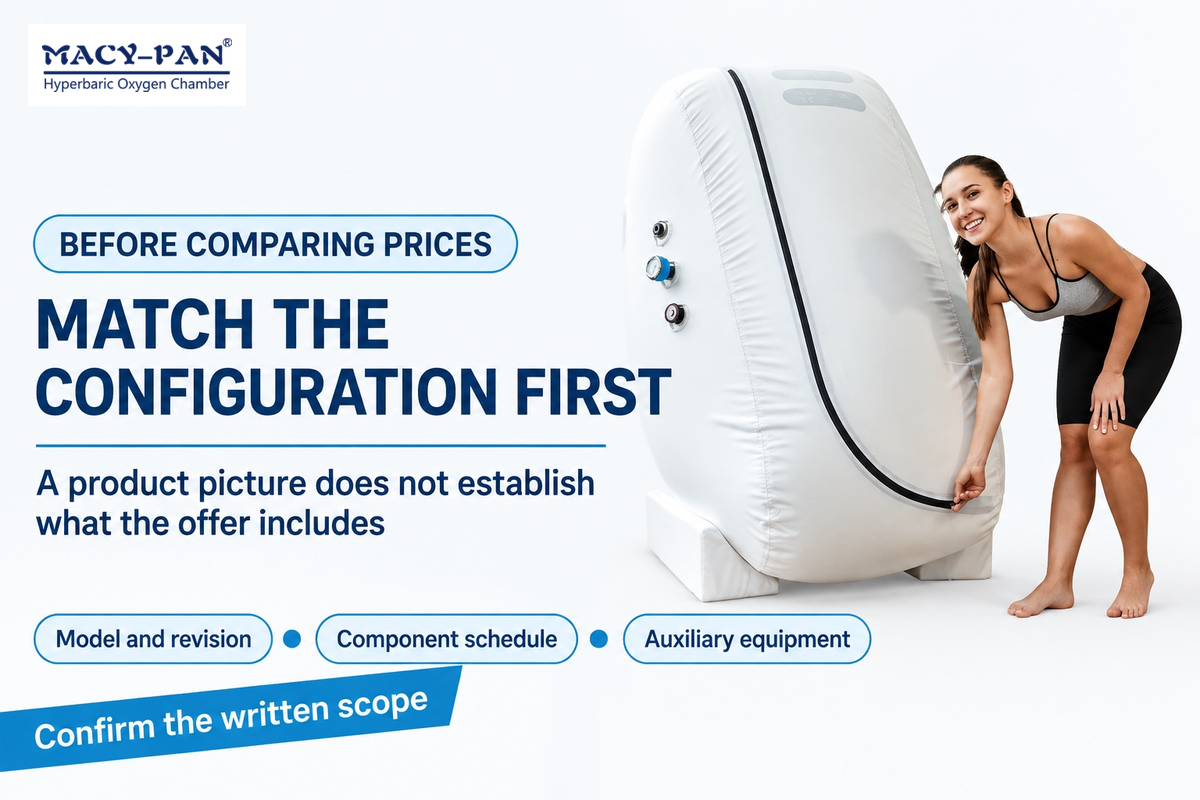
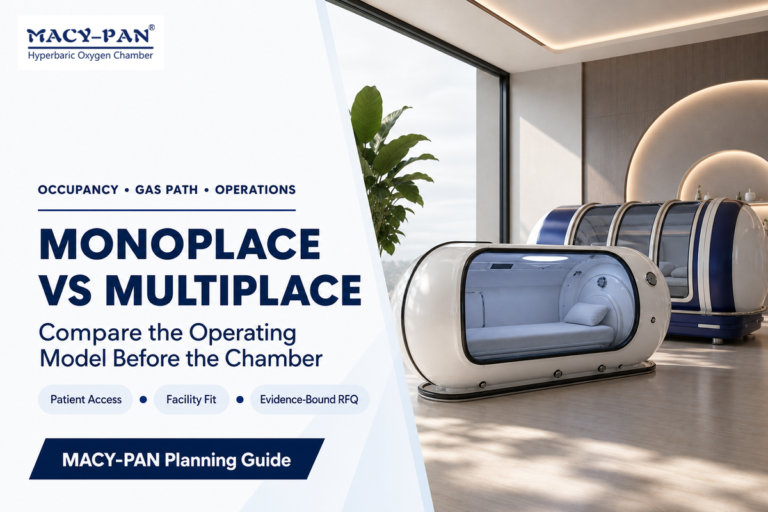
The baseline for equipment priced at the factory level is the price of a chamber, including accessories, under the agreed trade term, whether buying a home hyperbaric chamber or a clinical system. Match shell construction, occupancy, working pressure, oxygen-delivery arrangement, and supplied auxiliary equipment before comparing prices; these practical differences help you compare equivalent configurations. A soft chamber package and a rigid clinical system may differ in their transport and installation requirements in spite of similar equipment names.
Request a component schedule for the type of chamber used, tied to the model and revision described in the offer. Identify the chamber, Compressor, Oxygen delivery system, controls, and cooling equipment, if any, and other auxiliary equipment and installation components. A picture of an accessory next to a chamber doesn’t mean it’s included in the offer.
Suppose there’s a purchasing team looking at a complete offer versus a bare chamber offer. The bare offer may look like a cheaper version of the complete offer, but the buyer has to add the missing auxiliary units, their packing and freight. Resolve the bill of materials first; negotiating freight can’t resolve a configuration mismatch. The hard-shell chamber range, and the soft-shell chamber range, provide starting points, and the accepted offer determines what’s actually shipped.
Let intended use, including whether the system is offered as hyperbaric therapy equipment, govern the comparison. A pressure label by itself doesn’t establish that the equipment is eligible for clinical sale or use in the destination country. Verification of the exact product identity and the relevant evidence for market access must be completed to consider a quotation as an eligible purchase.
For HBOT equipment, itemize the oxygen concentrator if one is provided. Record the pressure and oxygen configuration, including whether pressure is specified relative to atmospheric pressure, without interpreting a marketing label as a specification. A concentrated oxygen system using a supplied concentrator is different from a pure oxygen system using a separate supply.
A low-pressure package still needs an itemized specification and a delivery endpoint. The label doesn’t identify what accessories, import services, or receiving arrangements are included.
Ask how the system is intended to pressurize, its specified air pressure, oxygen concentration, and required supply flow. The amount of oxygen affects the supply arrangement. Those are configuration fields to obtain from the supplier, not universal settings to apply to every chamber. The same goes for keeping a chamber pressurized during commissioning: follow the approved process for that model.
Packing Dimensions, Gross Weight, and Crate Architecture
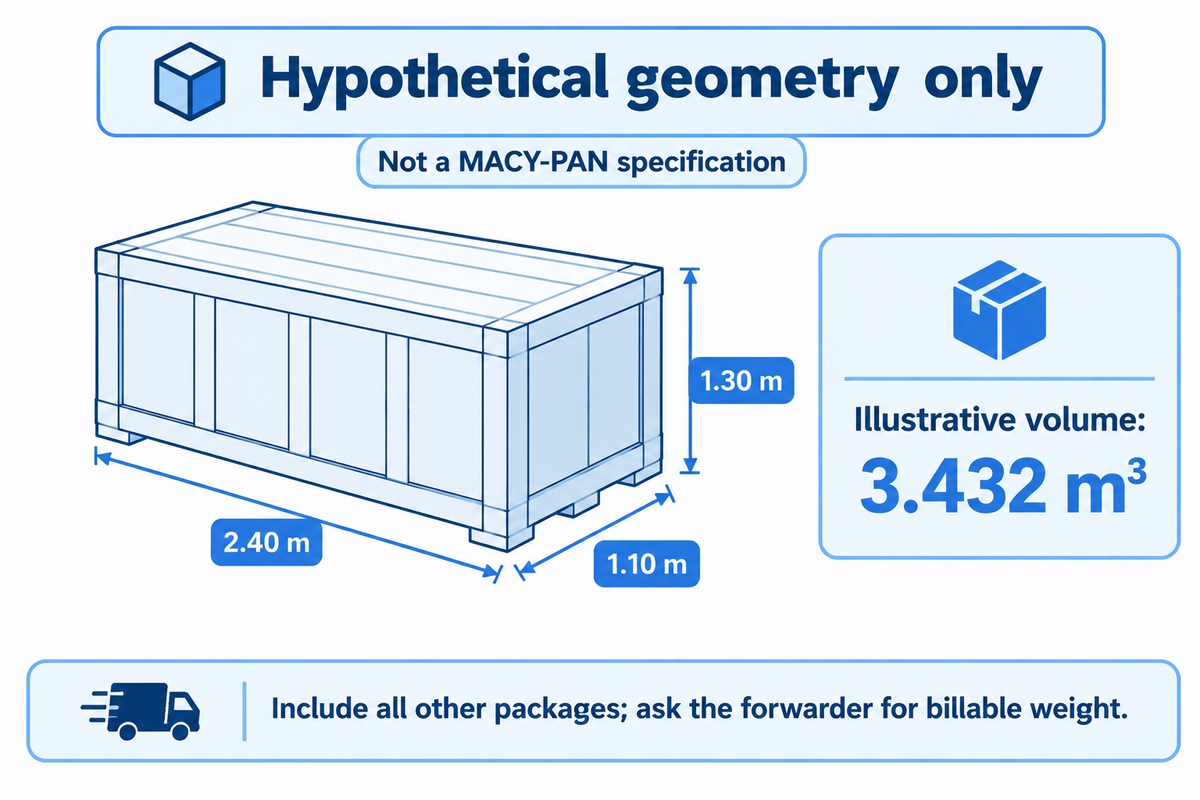
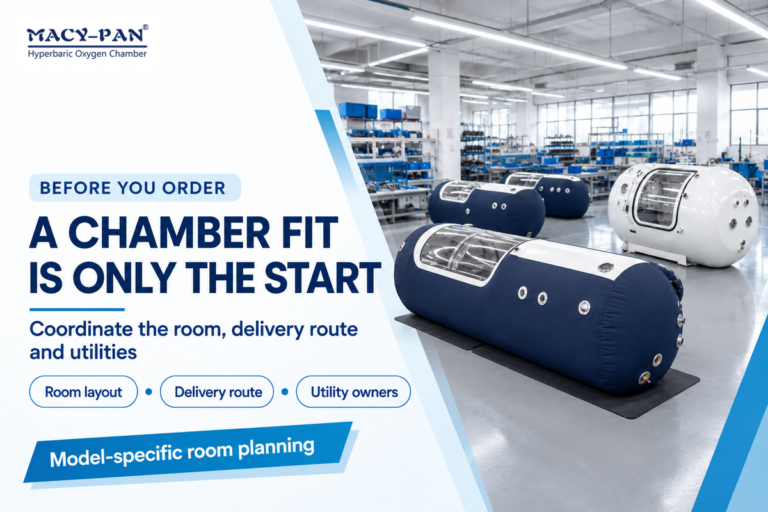
Freight quotes require the outside dimensions and gross weight of each shipping package, rather than the chamber’s operating footprint or bare-shell weight. Find out the crate count, the packing material and any handling and/or packing restrictions. There may be separate auxiliary packages that would impact the chargeable volume, even if the main chamber remains unchanged.
A folding enclosure in soft-sided chambers takes up less space when folded, but its auxiliary units take up space regardless. A rigid vessel retains its transport envelope and protective crate. Neither observation permits a reliable packed weight estimate of a named model. Request an actual packing list of the model in question, and include all packages in the freight inquiry.
Regulated solid wood packaging coming to the United States must be treated and marked in accordance with USDA APHIS wood-packaging guidance. Request photos of marks, and confirm the packing material. A separate treatment certificate is not a universal substitute for the required mark, and engineered packing materials may have different treatment requirements.
How Do Soft Portable and Hard-Shell Chamber Crates Differ in Chargeable Weight?
Compare the gross weight and volume of all shipments, then apply the carrier’s quoted charging rule. A lighter shipment can still be billed on dimensional weight, and a compact shipment can attract minimum charges. Compare all the packages, including the auxiliary modules, rather than just the two chamber enclosures.
A geometry-only example: Hypothetical crate dimensions of 2.40m X 1.10m X 1.30m occupy 3.432 m³. Don’t assume this example is a MACY-PAN specification. Include all other packages and ask the forwarder to calculate the billable weight. The packing checklist may be useful in documenting and organizing instructions for the packages.
International Freight: Compare Complete Transport Offers
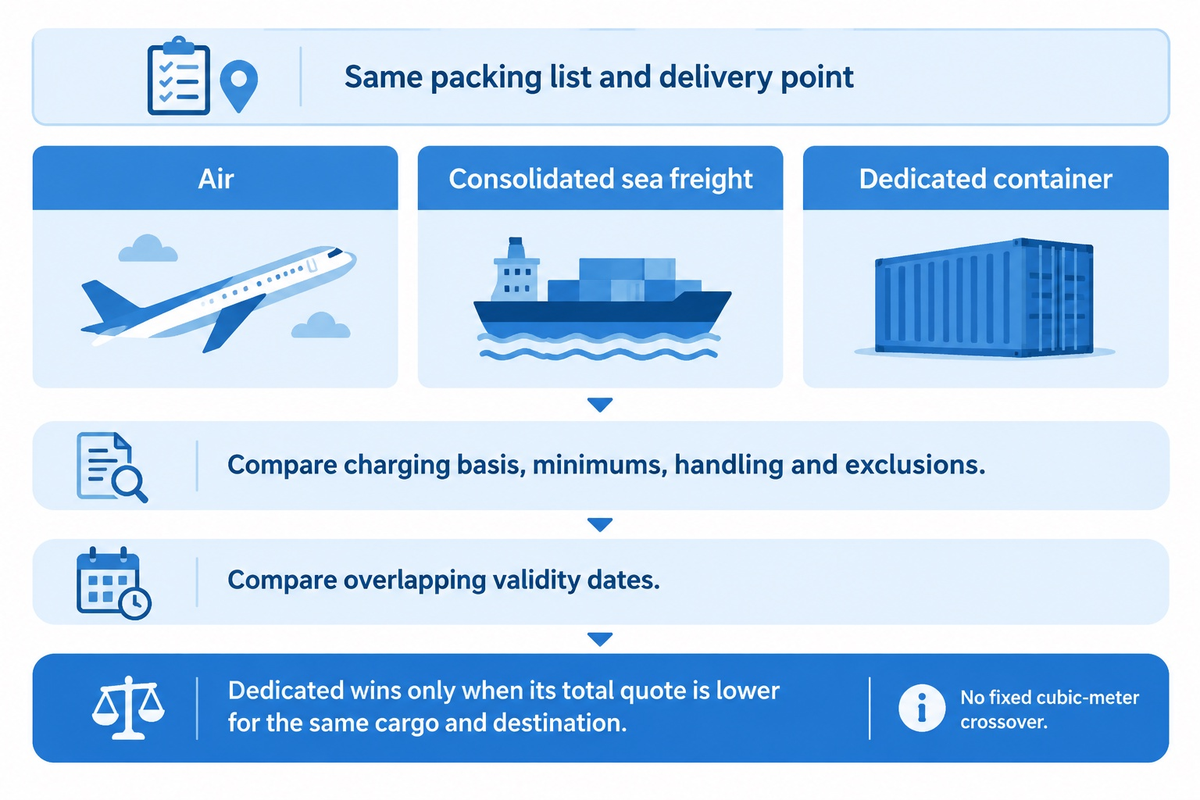
Consider air, consolidated sea freight, and dedicated container transport, quoting for the same packing list and delivery point. Obtain the charging basis, minimums, included handling and exclusions, if any. Lower linehaul rates for ocean transport don’t necessarily mean the mode is cheaper, as higher destination charges could apply.
Ask the forwarder to disclose gross weight, chargeable weight or volume, number of packages, route, validity date and excluded charges. Dimensional factors and minimums may vary between air and sea services. Apply the rules stated in the offer.
The Trade Administration’s explanation of carriage responsibilities helps to define which transport legs the seller pays. It doesn’t set freight rates. Because prices change, compare offers with overlapping validity dates and update expired lines before committing the shipment.
To decide on an opening date compare the additional transport cost with the delivery delay that may be avoided by taking the faster service. Consider customs clearance and the availability of the receiving party in a home vs clinic delivery comparison. A faster mode of transport doesn’t necessarily mean the shipment will be cleared and delivered faster. The clinic owner needs a project plan that describes the critical path and schedule, and not just the promise of a short transit time.
When Does a 20ft FCL Container Cost Less Than LCL Consolidation for Hyperbaric Chambers?
A dedicated container is cheaper when the total quoted cost is less than the consolidated shipment cost for the same cargo and destination. There’s no fixed cubic-meter cross over. Packing layout, destination charges, equipment and local delivery availability and arrangements can affect the result even for the same number of chambers.
Obtain a loading plan as well as a price comparison. A volume total doesn’t prove the crates will fit through the container doors, can be stacked or can be secured as proposed. The total cost should be evaluated only after the supplier and forwarder accept the proposed packing and handling.
Incoterms Cost Transfer and the Quote-to-Floor Exclusion Ledger
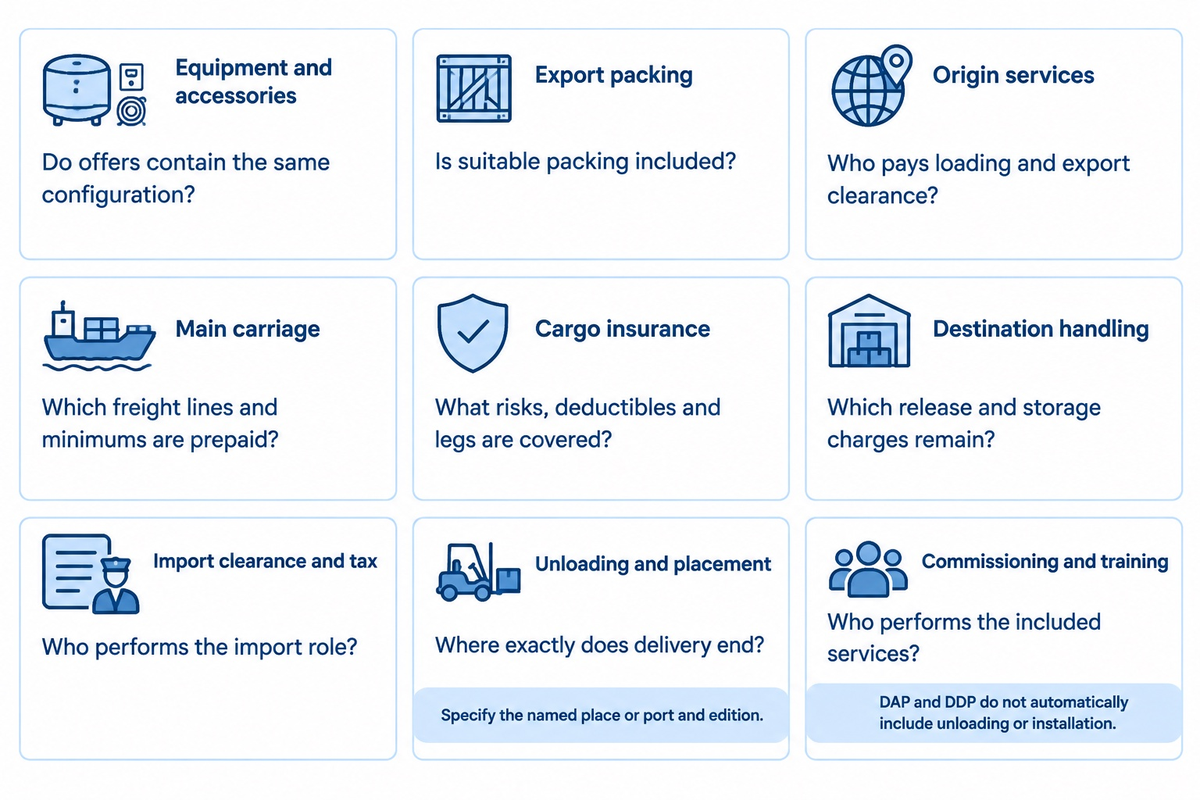
Incoterms identify responsibilities for delivery, cost and risk, but a named place or port and an edition have to be specified to define the rule. DAP and DDP allocate import clearance differently; neither automatically includes unloading and installation. Use the Quote-to-Floor Exclusion Ledger to express each of the omitted services.
The International Trade Administration’s Incoterms overview explains the functions and restrictions of the rules. An EXW quotation isn’t directly comparable with a delivered quotation. Under CIF, the seller has to transport the cargo to the named port and pays the cost of carriage, but the risk passes to the buyer when the goods are placed on board the vessel at the port of shipment. Under CIF, the seller also contracts for cargo insurance covering the buyer’s transit risk; check the policy to establish whether insurance covers each transport leg.
| Cost or responsibility | Question to settle | Evidence |
|---|---|---|
| Equipment and accessories | Do offers contain the same configuration? | Model/revision and component schedule |
| Export packing | Is suitable packing included? | Packing list, materials and handling instructions |
| Origin services | Who pays loading and export clearance? | Trade term and named collection/delivery point |
| Main carriage | Which freight lines and minimums are prepaid? | Valid forwarder quotation |
| Cargo insurance | What risks, deductibles and legs are covered? | Policy wording and insured value |
| Destination handling | Which release and storage charges remain? | Destination tariff or written inclusions |
| Import clearance and tax | Who performs the import role? | Broker review and product-specific assessment |
| Unloading and placement | Where exactly does delivery end? | Receiving and rigging scope |
| Commissioning and training | Who performs the included services? | Service scope and acceptance criteria |
Under DAP the buyer generally handles import clearance and import charges; under DDP these are generally the seller’s responsibility. Both terms provide for delivery ready for unloading at the named place. Unloading is covered under DPU, but unloading doesn’t mean installation. The ICC checklist makes this distinction. Confirm the importer is authorized to perform that role.
A low CIF price should be evaluated to determine which arrival charges are included. Some arrival services may already be included in the carriage contract; others are payable. Compare total charges and don’t be misled into thinking CIF is always the least expensive method. Our incoterms comparison presents the responsibility choices in more detail.
Customs Duties, Processing Fees, and Device Import Eligibility
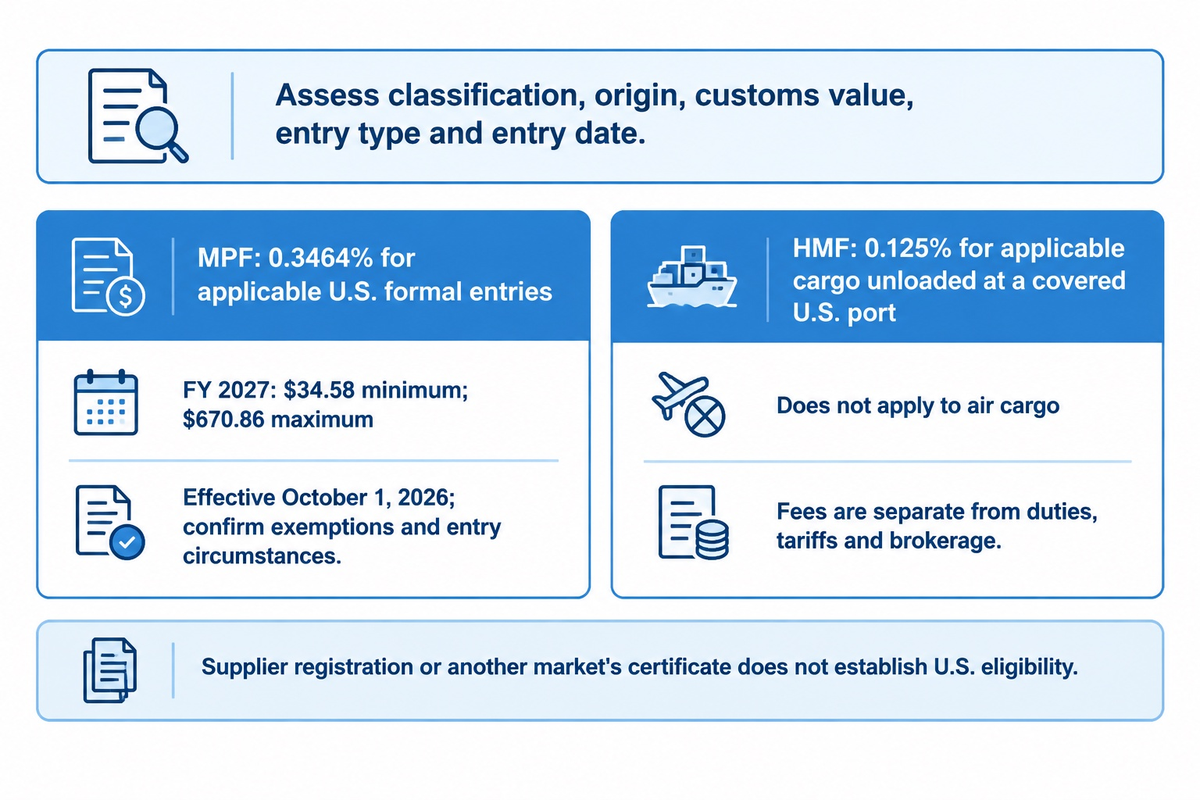
Calculate import charges from actual classification, origin, customs value, entry type, and entry date. Separate duties and additional tariffs from processing fees and brokerage. For a medical chamber, confirm applicable device import requirements before shipment. Supplier registration or certificate from another market doesn’t by itself establish U.S. import eligibility.
Don’t assign one tariff code or zero-duty code to every chamber. Send the model, intended use, a detailed description of the device, component and subcomponent information, the origin of the components, and the value. Obtain the rationale for the classification, and any applicable additional duties or exclusions. The budget won’t be final until these assessments are completed.
For applicable U.S. formal entries, the merchandise processing fee rate is 0.3464%. The CBP fiscal-year 2027 notice sets a $34.58 minimum and $670.86 maximum, effective October 1, 2026. Confirm exemptions and entry circumstances with the broker. These are fee limits, not an all-in clearance price.
The harbor maintenance fee rule provides a 0.125% fee for applicable commercial cargo unloaded at a covered U.S. port. It doesn’t apply to air cargo. Use the proper value of the cargo and exemption, if any, rather than multiplying the full budget.
What Documents Do US Customs and the FDA Require to Clear an Imported Hyperbaric Chamber?
Prepare the commercial invoice, packing list, transport documents, classification and origin information, and required product-specific device-entry data. Have the broker confirm bond and ocean-security filing requirements where applicable. FDA requirements depend on the device and importer roles; a universal chamber checklist cannot replace the actual product assessment.
FDA medical-device import guidance describes registration, listing, applicable premarket status, labeling, and other requirements. Form FDA 2877 relates to radiation-emitting electronic products subject to performance standards, rather than every chamber shipment. Organize the chamber customs documentation package before collection so discrepancies can be resolved before storage costs begin.
“The FDA does not recognize regulatory authorizations from other countries.”
Last-Mile Delivery, Doorway Rigging, and Facility Interfaces
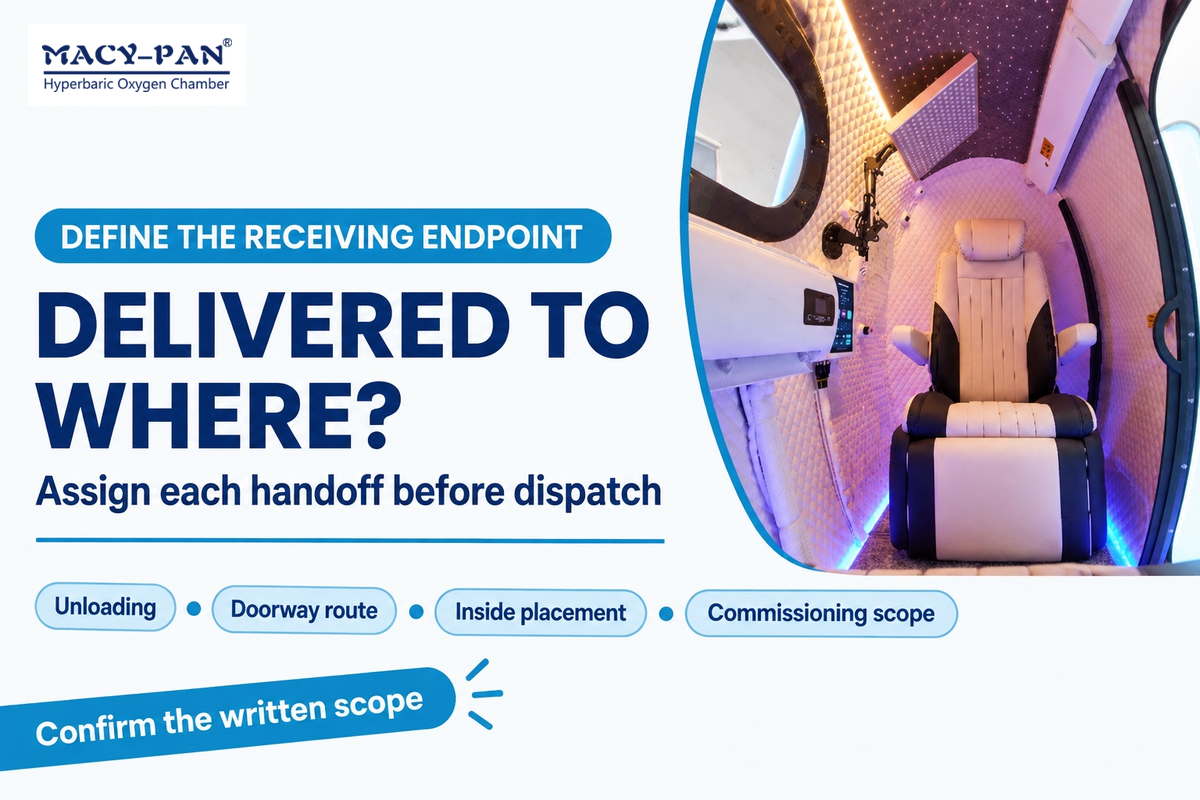
The last-mile budget covers transporting the actual packed load from the carrier to the agreed-upon receiving point. Confirm unloading equipment and appointments, access restrictions, and inside placement separately. A liftgate service does not establish that a long crate fits the platform or that the building route accepts the uncrated chamber, including a home chamber intended for home use.
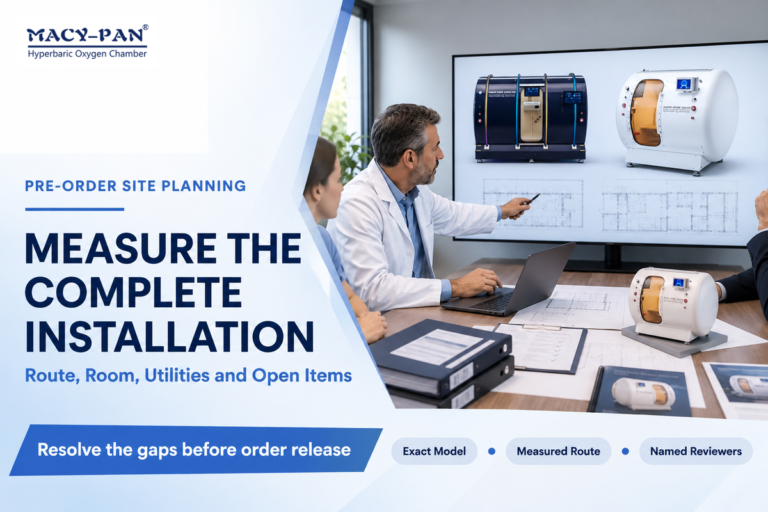
A handoff can be a bottleneck. The carrier arrives at the address and the rigger unloads the crate. Neither owns the move through the corridor. Prior to dispatch, assign an owner to each handoff. Procurement obtains transport drawings; facilities measures the route; the handling contractor selects suitable equipment and accepts the method.
| Handoff | Bottleneck | Owner and action |
|---|---|---|
| Carrier to unloading contractor | Platform, fork spacing or capacity does not fit the crate | Handler accepts weight, geometry and lifting instructions |
| Unloading area to doorway | Skid or fittings exceed the opening | Facilities measures route; supplier supplies transport envelope |
| Doorway to room | Corner, elevator or floor prevents placement | Facilities and rigger approve route and method |
| Placement to commissioning | Utilities or local approvals unfinished | Facilities and qualified installers price the actual requirements |
When Does Unloading a Hyperbaric Chamber Require a Forklift or Certified Rigger Instead of a Liftgate?
Use competent personnel and handling equipment whose rated capacities and approved method cover the actual load, geometry, center of gravity, and receiving conditions. Obtain a written handling plan when delivery exceeds the carrier’s accepted liftgate service. There’s no single weight or length threshold that makes every liftgate unsuitable or suitable.
A crate may be below the platform’s weight rating, yet overhang it, or place the center of gravity outside the permitted envelope. Weight-only acceptance misses that problem. Give the contractor the lifting instructions and a package drawing, and obtain acceptance of the entire move, including uncrating and temporary transport fittings.
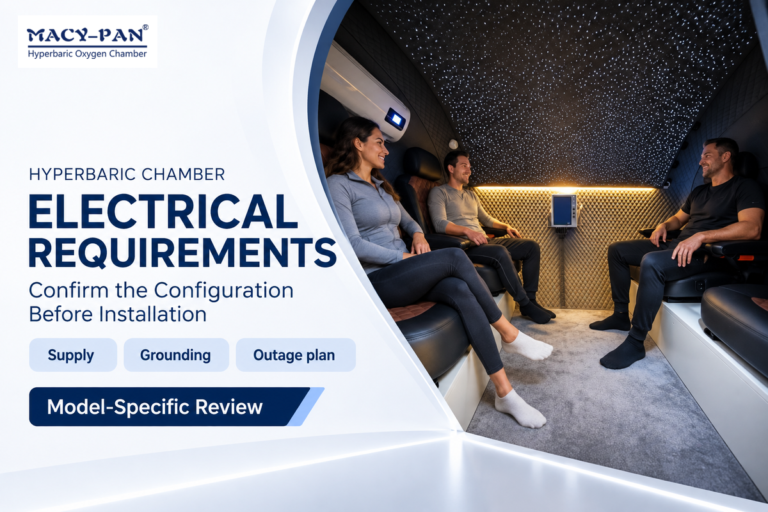
Price electrical, cooling, ventilation, gas-supply, grounding, and clearance requirements from the exact model’s installation documents. Local adoption and installation conditions will determine the applicability of the facility rules. The NFPA healthcare-code overview gives edition context. Our room requirements guide explains project interfaces. Neither of these documents will replace the installation instructions or satisfy local requirements.
First-Year Spare Parts and Operating Reserve
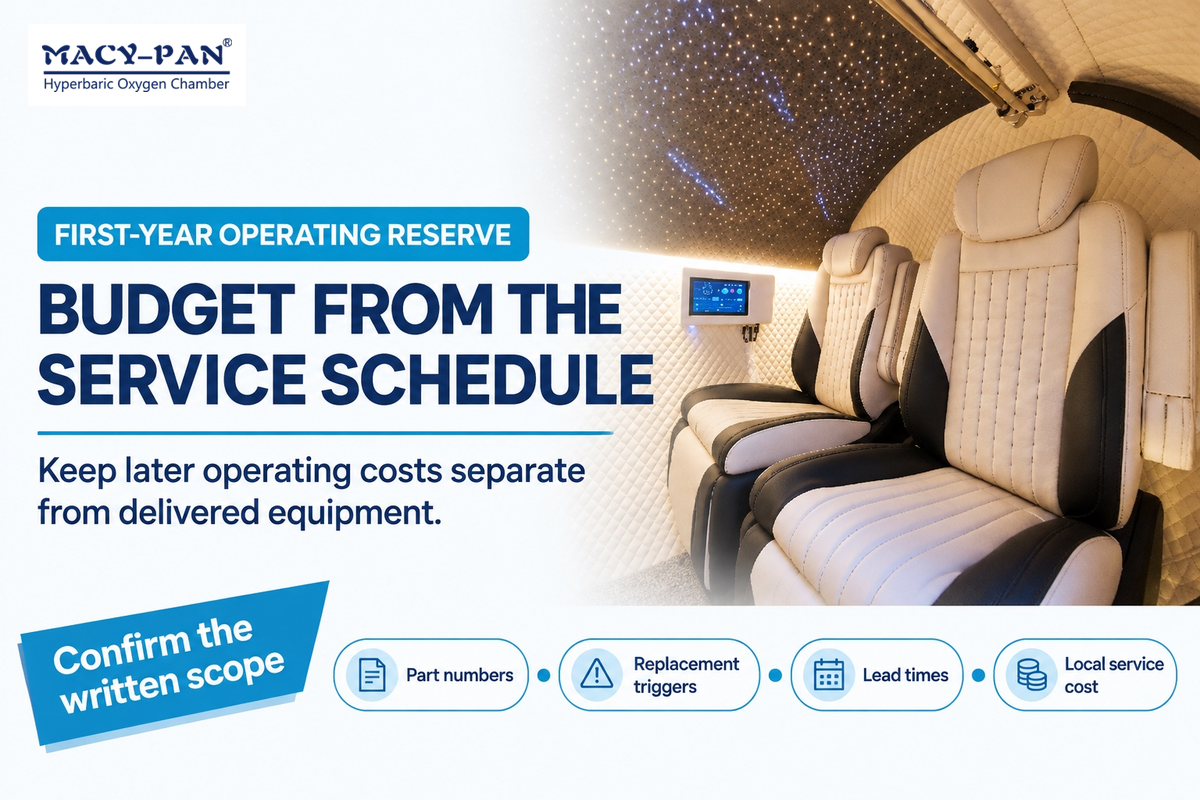
Establish the first year operating reserve based on the planned utilization, spare-parts prices, and service conditions in the locality. Keep it outside the delivered equipment costs unless a kit is sold along with the equipment. A percentage of equipment price can hide differences in warranty coverage, consumables, labor, and replacement-part freight.
Ask the manufacturer which filters, seals, and consumables the equipment uses, and what services the buyer can perform compared to what requires a service visit. Ask for part numbers, replacement triggers, and lead times. A general equipment description or a manual for an unrelated concentrator is not a chamber-specific service schedule. Follow the manufacturer’s specified service intervals for the chamber.
The FDA’s August 2025 safe-use letter calls for following manufacturer-recommended cleaning, maintenance intervals, and safety checks for each device. Budget operating costs from that schedule. Depending on the facility, the cost may include local service visits or separately contracted support.
Using a hyperbaric chamber also has a financing aspect. Compare the total obligation under rent-to-own terms, including the monthly payment, to the cash purchase. Monthly rentals belong in a separate cash-flow plan. They don’t remove the responsibility for delivering, setting up, or returning the equipment, unless the rental agreement states so.
Keep the reserve auditable
Record quantity × unit price, expected delivery cost, service labor, and the trigger for each planned item. Identify kits already included in the equipment invoice. Finance can then distinguish a cash reserve from a maintenance commitment and update the total when the service agreement arrives.
Consider co-shipment of spare parts. Co-shipping may eliminate the need for an additional shipment, but the shipment may increase package dimensions and weight, which may affect customs or increase the value of the goods shipped. Discuss the costs of additional shipping rather than assuming additional shipping is free. An owner opening with several chambers should also discuss whether critical spares are shared or held per unit.
Worked Landed-Cost Comparison and Final Quote Check
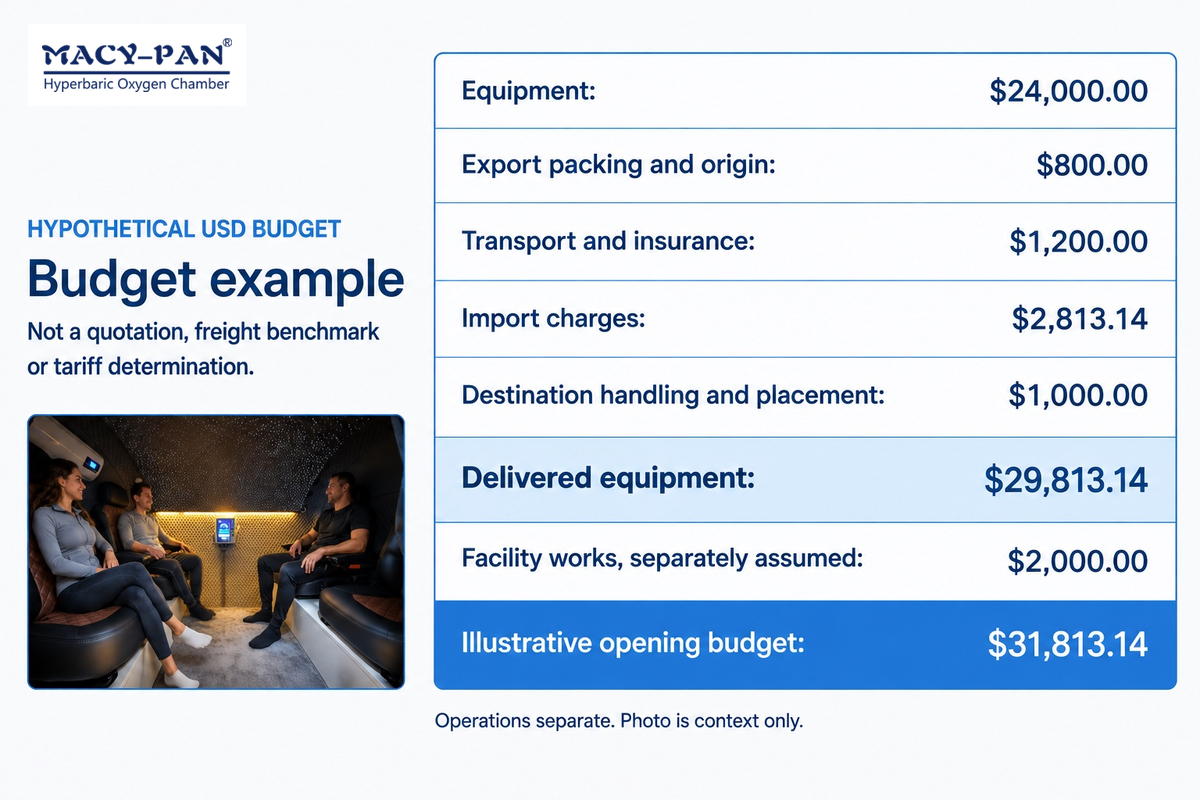
Use the five layers to determine a delivered total, then price facility works separately. The arithmetic below is a hypothetical budget exercise , not a MACY-PAN quotation, model specification, freight benchmark, or tariff determination. Before using the numbers to approve payment, replace all guessed amounts with valid offers and broker assessments.
Assume an illustrative equipment value of $24,000, $800 for export packing/origin services, $1,200 for transport and insurance, and $1,000 for destination handling and placement. The hypothetical duty/additional-tariff allowance is $2,400 and brokerage/bond services are $300. The values are illustrative for arithmetic purpose, not actual route prices or assessed chamber duty rate.
Assume a formal ocean entry with no applicable fee exemption and a $24,000 base for both fees in this exercise. MPF is $24,000 × 0.003464 = $83.14 after rounding; HMF is $24,000 × 0.00125 = $30.00. MPF falls between the fiscal-year 2027 limits. The actual assessment determines the valuation and applicability.
| Layer | Illustrative amount | Replace with |
|---|---|---|
| 1. Configured equipment | $24,000.00 | Accepted supplier quotation |
| 2. Export packing and origin | $800.00 | Supplier/forwarder itemization |
| 3. Main carriage and insurance | $1,200.00 | Valid route and coverage quotation |
| 4. Import charges | $2,813.14 | $2,400 assumed duty/tariff + $83.14 MPF + $30 HMF + $300 assumed broker/bond |
| 5. Destination handling and placement | $1,000.00 | Forwarder and handler scope |
| Delivered equipment total | $29,813.14 | Sum of layers; no duplicated prepaid charges |
| Facility works, separately assumed | $2,000.00 | Local installation and building quotations |
| Illustrative opening budget | $31,813.14 | Delivered equipment plus facility works; operations separate |
The example’s non-equipment delivered costs are $5,813.14, or 24.2% of the assumed equipment value, rounded. This is an output of illustrative inputs; it isn’t a recommended contingency. Change the tariff allowance, endpoint, and freight offer to alter the percentage. Do not add these lines again to a DDP offer already including them.
Prior to the deposit, finance needs the total delivered; facilities needs the approved receiving route and priced utility work; procurement needs configuration, delivery point, and exclusions. Resolve unpriced required services prior to final offer comparison. Use the landed cost estimator with verified quote inputs; confirm tariff treatment and delivery scope separately. Send intended use, configuration, destination and receiving constraints when you request an itemized chamber quotation from MACY-PAN.
Frequently Asked Questions
How much should I add to the factory price for delivery?
No fixed percentage works for every chamber shipment.
Add actual excluded costs for packing, transport, insurance, import charges, and delivery to the chosen endpoint. Keep room preparation outside delivered-equipment cost. A tariff assessment or difficult receiving route can change the answer substantially, while a delivered quotation may already include many lines. Treat the worked percentage only as the result of its stated assumptions.
Does a DDP quote include installation inside my clinic?
DDP doesn’t automatically include unloading or installation.
The named place and service contract specify where delivery ends. Ask separately about unloading, uncrating, moving through the building, utility connections, commissioning, and training. A seller may offer these services in addition to trade-term obligations, but obtain written inclusion and acceptance criteria before counting the offer as a complete installation.
Can a packing list replace a site access survey?
A packing list and an access survey answer different questions.
The packing list describes what the carrier transports. The survey describes the route through openings, turns, elevators, and the final room. Give both to the handler. A crate reaching the building can still fail at a narrow turn, and an uncrated vessel may need a different method from the one used to unload its crate.
Are treatment sessions part of landed cost?
HBOT treatment charges are fees for hyperbaric oxygen therapy, separate from equipment landed cost.
Should first-year spare parts ship with the chamber?
Compare incremental co-shipping cost with a separate order.
Confirm compatibility, shelf life, and storage requirements. Ask whether the kit affects packed volume, goods value, or customs documents. Co-shipping may be useful, but it doesn’t make freight or import charges automatically zero.
Why can a cheap CIF ocean quote cost more at arrival?
The carriage figure may exclude destination services.
Request the destination agent’s charges and identify what the carriage contract already covers. Compare totals at the same delivery endpoint. Count each prepaid handling service once.
References & Sources
- International Trade Administration, Know Your Incoterms.
- International Chamber of Commerce, Incoterms 2020 checklist, 2024 update.
- CBP, Fiscal Year 2027 customs user fee adjustments.
- 19 CFR 24.24, Harbor maintenance fee.
- USDA APHIS, Import ISPM 15-compliant wood packaging material.
- FDA, Importing medical devices and radiation-emitting electronic products.
- NFPA, Healthcare code edition changes.
About This Cost Model
Prepared by XCX for MACY-PAN buyers comparing equipment and delivery scope. The cost layers combine public trade and import guidance with an explicitly hypothetical calculation. They aren’t a supplier price list or a statement that a chamber has regulatory clearance. Model-specific packing, installation, warranty, and quotation details come from the actual order documents.