Get in Touch with MACY-PAN Company


A soft vs hard hyperbaric chamber decision should start with pressure, oxygen delivery, intended setting, safety standards, and service support, not shell material alone. Soft chambers can fit home wellness and portable mild-pressure routines. Hard chambers better fit clinics, rehab centers, premium wellness facilities, and dealers that need a stronger compliance and service story.
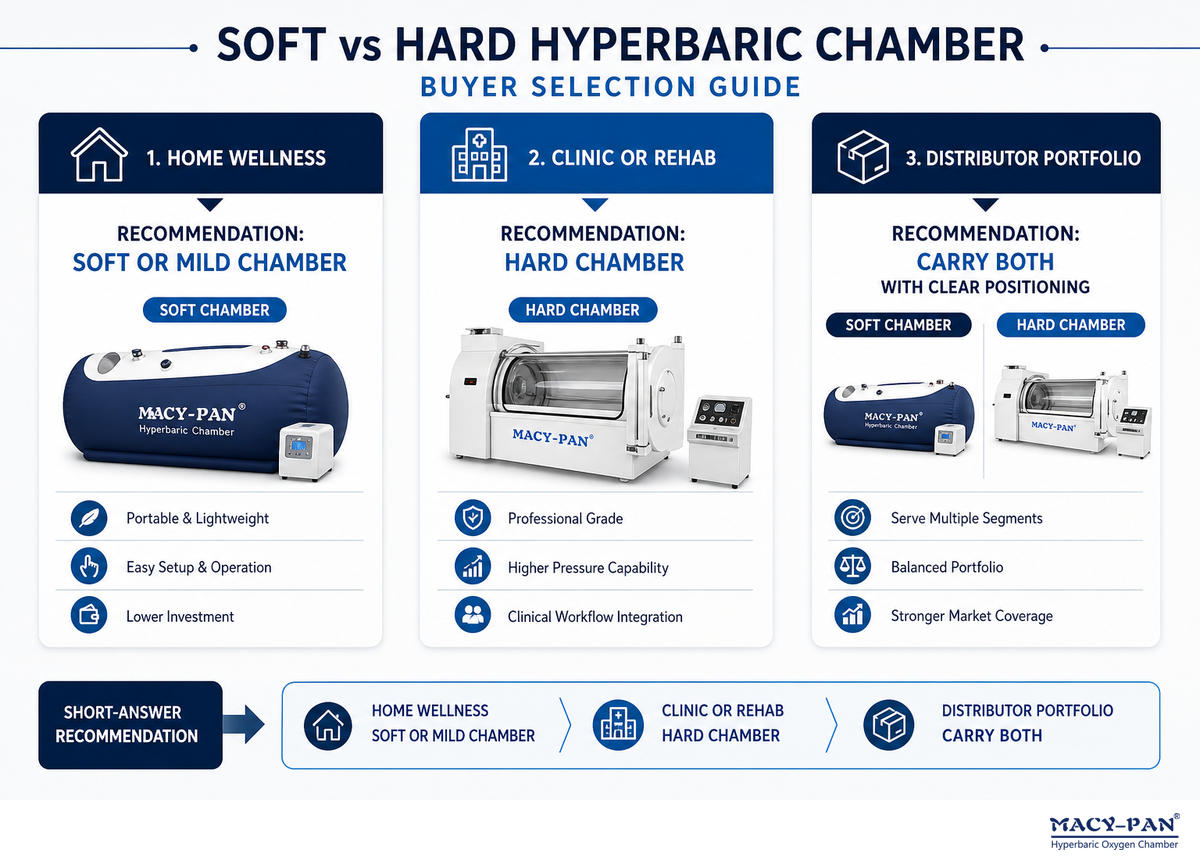
Short answer: choose a soft unit when portability, lower infrastructure, and mild pressure are the priority. Choose a hard-shell unit when higher pressure capability, rigid construction, clinical workflows, and long-term facility use matter more. For distributors, the strongest portfolio often includes both, with strict claim boundaries for each buyer type.
This guide is for equipment selection and channel planning. It is not medical advice, and it does not replace physician supervision where hyperbaric oxygen therapy is being used for a medical condition. For U.S. medical use, buyers should verify model-specific FDA 510(k) status, labeling, instructions for use, and local operating rules before purchasing.
Home wellness
Soft or mild chamber
Lower room requirements, mobile versions and operating pressures ranging around 1.3-1.5 ATA in specific devices.
Clinic or rehab
Hard-shell chamber
Sturdier construction, the availability of higher pressure options, more demanding room layout constraints, and more explicitly defined expectations for clinical workflow.
Dealer portfolio
Carry both
Soft models widen the entry point; hard models support clinics and premium buyers. Sales language must separate wellness use from medical treatment claims.
Soft vs Hard Hyperbaric Chamber: The Short Answer
The real distinction is not solely whether the chamber wall is soft or hard. It also includes the pressure ceiling, the oxygen delivery, how closely the patient is monitored, fire safety controls, installation, service, and what a seller may credibly represent.
For buyers comparing mild pressure therapy for home wellness, recovery routines, or a portable wellness service, a soft shell mild chamber usually fits first. Buyers who need a rigid unit, a stronger safety system, and a more clinical operating environment should compare a hard medical chamber.
If you only need a short product-page comparison, MACY-PAN already has a focused soft vs hard chamber comparison. This article goes deeper for buyers and resellers who need to decide which model class belongs in a facility, showroom, or product catalog.
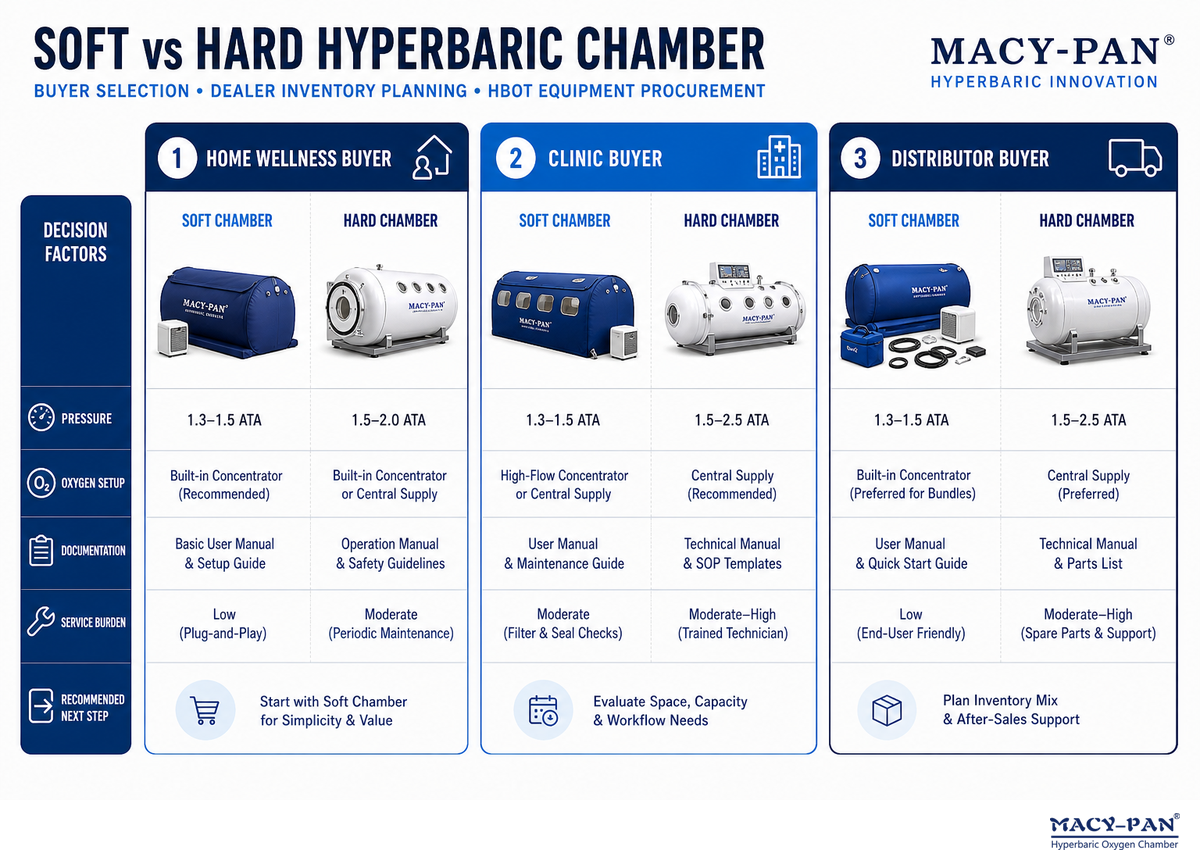
Comparison Table: Pressure, Oxygen, Setup, And Buyer Fit
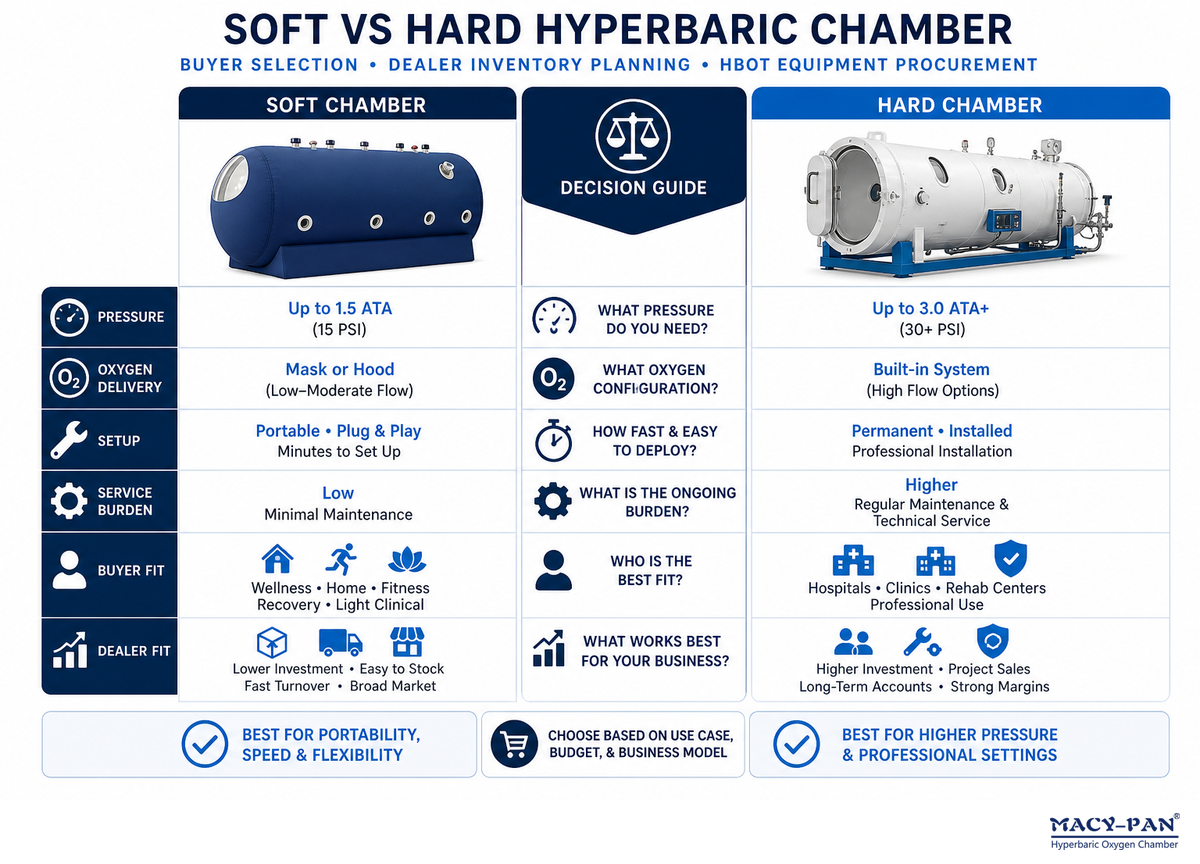
| Decision factor | Soft or mild chamber | Hard-shell chamber | Buyer meaning | Dealer meaning |
|---|---|---|---|---|
| Pressure range | Often 1.3, 1.4, or 1.5 ATA on selected models. | Often selected for 1.5-2.0 ATA buyer needs, with clinical settings commonly using higher-pressure protocols under medical control. | Pressure goal must match the intended use. | Segment leads by pressure need before quoting. |
| Oxygen delivery | Compressed air chamber with oxygen commonly delivered by mask or headset from a concentrator. | Built for more controlled oxygen-at-pressure operation, with exact method tied to model and protocol. | Do not confuse chamber pressure with inspired oxygen concentration. | Explain oxygen pathway in every quote. |
| Structure | Flexible TPU or fabric-based shell on many portable units. | Rigid steel or acrylic construction, with material tied to the selected model. | Comfort, access, room fit, and durability differ. | Hard units need more installation and training support. |
| Setup burden | Lower room-prep needs and easier shipping. | More planning for space, electrical, access, service, and safety checks. | Installation readiness can decide the purchase. | Pre-sale facility checklist lowers support friction. |
| Claim boundary | Best sold with wellness or mild-pressure language unless market clearance and medical supervision support more. | Better fit for professional settings, but still requires correct regulatory pathway and operator training. | Claims must match device status and setting. | Dealer scripts should be reviewed before launch. |
| Best fit | Home buyer, wellness studio, recovery routine, entry-level reseller line. | Clinic, rehab center, premium wellness site, hospital planning, serious showroom. | Setting decides the safer first quote. | Mixed inventory captures more buyer stages. |
Pressure Is The First Split: Mild Pressure vs Clinical-Grade HBOT
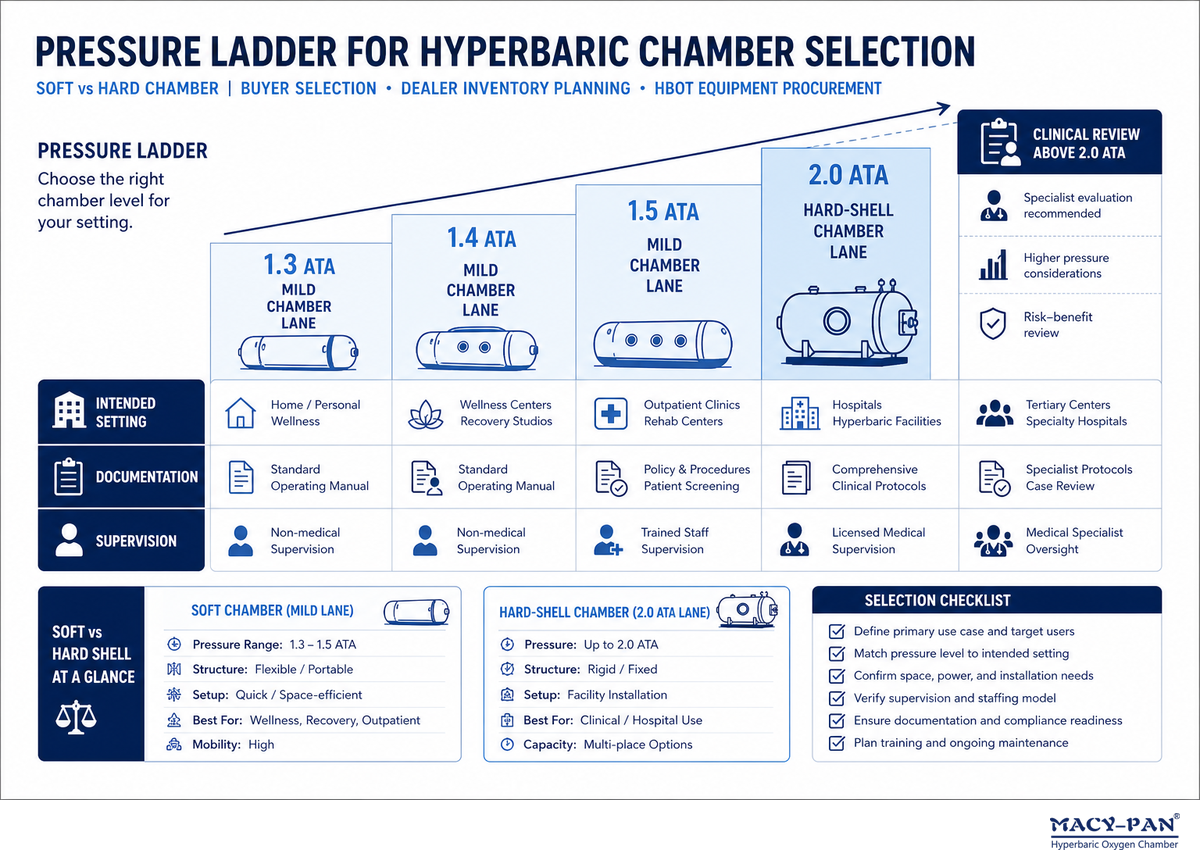
Pressure is the fastest way to separate a soft chamber from a hard-shell unit. Many soft or mild units sit around 1.3-1.5 ATA. MACY-PAN’s soft and mild chamber family includes models such as L1, ST1700, ST2200, ST801, and MC4000 in that pressure family.
Hard-shell buyers often ask for 1.5 ATA, 2.0 ATA, or a system designed for more formal clinical operation. MACY-PAN’s hard chamber families include HP2202, HP1501, MC750, and HE5000 series options, with pressure and configuration varying by selected unit.
Clinical boundaries matter. UHMS materials describe standard clinical hyperbaric medicine as involving higher pressure and high oxygen delivery, often in the 2.0-3.0 ATA range under physician-led practice. That does not make every home or wellness chamber unsafe. It means the claim, setting, and supervision must match the device and intended use.
UHMS authors put the boundary bluntly: “The delivery of hyperbaric medicine IS the practice of medicine.”
For a buyer, this is the practical rule: mild pressure can be appropriate for wellness positioning, recovery routines, and lower-infrastructure buyers. Medical treatment language belongs only where the device status, indication, supervision, protocol, and facility controls support it.
Engineering Note: Pressure Does Not Travel Alone
Pressure is only one factor. A buyer needs to also check the oxygen source, breathing interface, chamber shell, pressure-control hardware, grounding, fire prevention guidance, cleaning, maintenance, training, patient monitoring, and listed device standards. FDA ties safe use to manufacturer instructions and recognized references like NFPA 99 and ASME.
Oxygen Delivery: Chamber Air, Mask Oxygen, And 100% Oxygen Claims
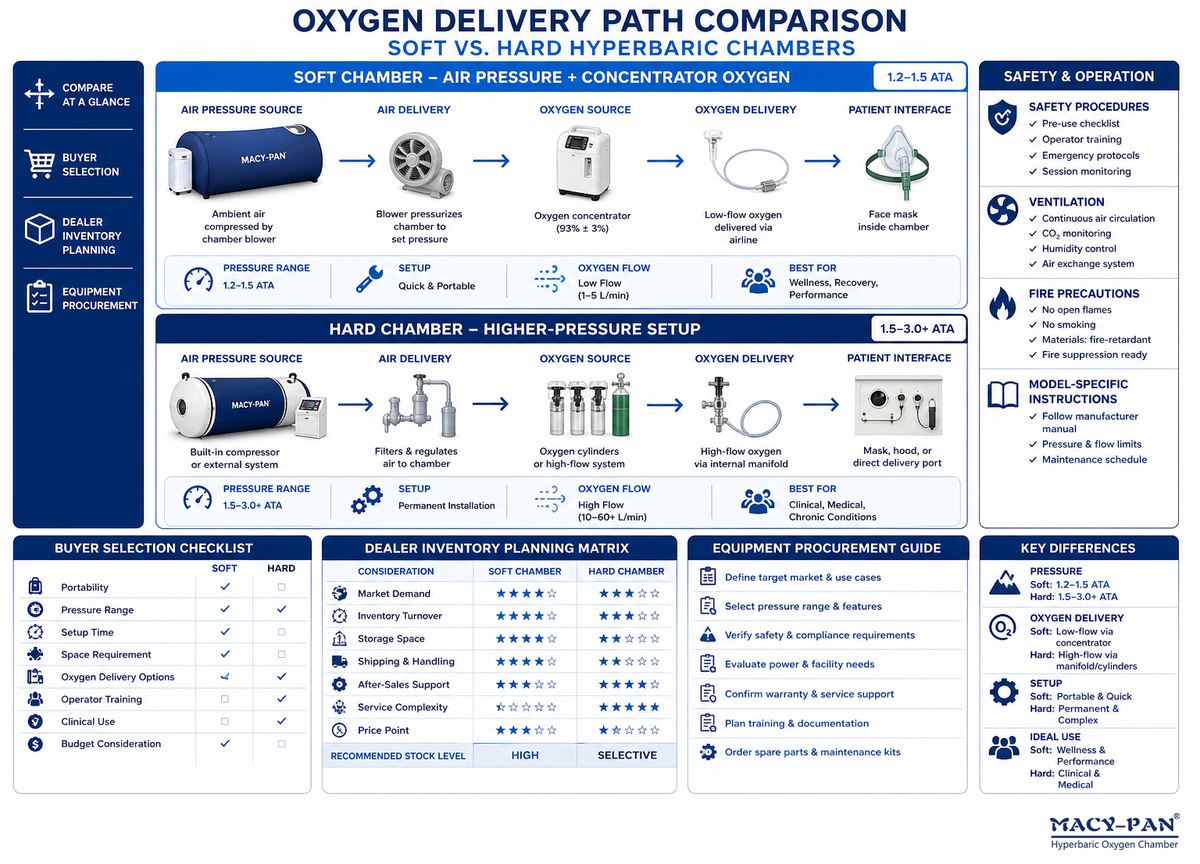
Many buyers hear “hyperbaric oxygen chamber” and assume the entire chamber is filled with pure oxygen. That is not how every system works. Soft chambers commonly pressurize with air while oxygen is delivered through a mask or headset from an oxygen concentrator. Hard systems can be designed for higher oxygen-at-pressure operation, but exact oxygen delivery depends on the chamber design, accessories, protocol, and safety controls.
This is where sales copy often becomes risky. Used correctly, a soft unit can be valuable for the right buyer, but it should not be described as the same as a physician-supervised clinical HBOT system if the pressure, oxygen delivery, supervision, and clearance pathway differ. FDA warns users and providers to follow device instructions, fire-prevention procedures, training, monitoring, cleaning, and safety checks.
Medical buyers also ask about the difference between hard and soft systems when the benefits of hyperbaric oxygen therapy are discussed for wound care. A protocol may aim to increase oxygen levels or let a patient breathe pure oxygen, but those decisions belong inside a physician-led plan. Portable chambers can still serve wellness buyers; one benefit of hyperbaric planning is knowing which claims belong outside a sales script.
For dealers, the cleanest explanation is also the safest: separate chamber pressure from oxygen concentration, then explain the breathing interface. If a buyer asks for “100% oxygen,” do not answer with a brochure phrase. Confirm the exact device, intended market, prescription or supervision requirements, operating protocol, and local compliance path.
Terminology note: buyers may compare a hard shell chamber with a soft shell chamber, listings for inflatable hyperbaric chambers, or a hard-sided chamber in the same search session. In clinical literature, UHMS is the Undersea and Hyperbaric Medical Society, and the wider hyperbaric medical society often separates mild hyperbaric or portable hyperbaric systems from hyperbaric oxygen treatment. Generic hyperbaric therapy language is too broad for dealer claims unless the device status and protocol support it. The practical question is how much oxygen in a pressurized environment reaches the user: oxygen concentration, arterial oxygen levels, 100 percent oxygen claims, and whether a simple oxygen mask is used with soft-sided hyperbaric chambers all need careful review.
Soft Chambers: Best Fit, Limits, And MACY-PAN Examples
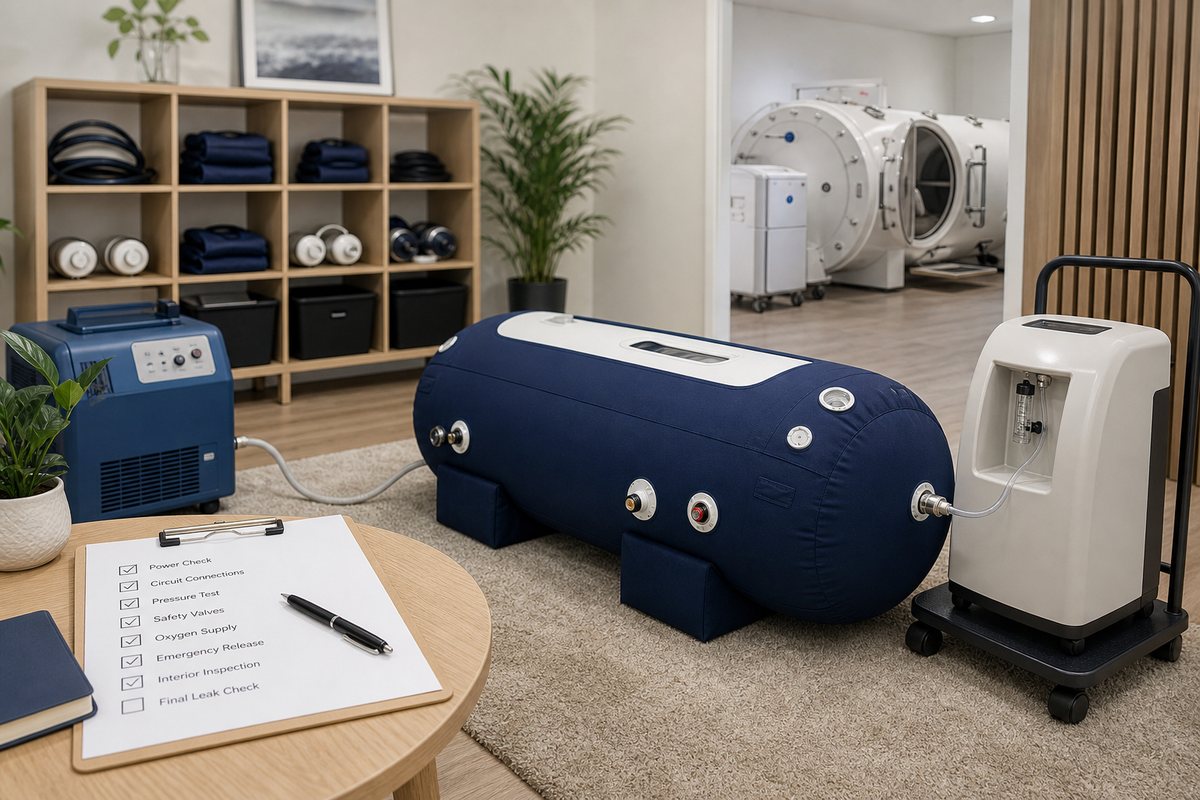
Soft chambers are valuable in the market because they are more accessible for low-pressure oxygen therapy. They are lighter, easier to transport, fit well into homes or wellness rooms and generally are less costly to ship and set up. For a buyer interested in low-infrastructure devices for their own recovery or wellness programs, a soft unit may be a smart choice.
MACY-PAN’s soft/mild line includes L1, ST1700, ST2200, ST801, and MC4000 model families, with 1.3, 1.4, and 1.5 ATA options varying by model and package. On MACY-PAN’s broader hyperbaric chamber by pressure page, buyers can sort units by ATA before comparing accessories or room needs.
Positioning is the limit. Sellers should not frame a soft chamber as a shortcut around medical supervision, FDA clearance, or facility safety rules. UHMS has warned consumers about soft-sided bag chambers that are not registered with FDA or built to recognized pressure-vessel and health-care standards. That warning is not a reason to dismiss every soft chamber. It is a reason to verify supplier documents, intended use, labeling, oxygen setup, support, and safety training before buying.
Hard Chambers: Best Fit, Limits, And MACY-PAN Examples
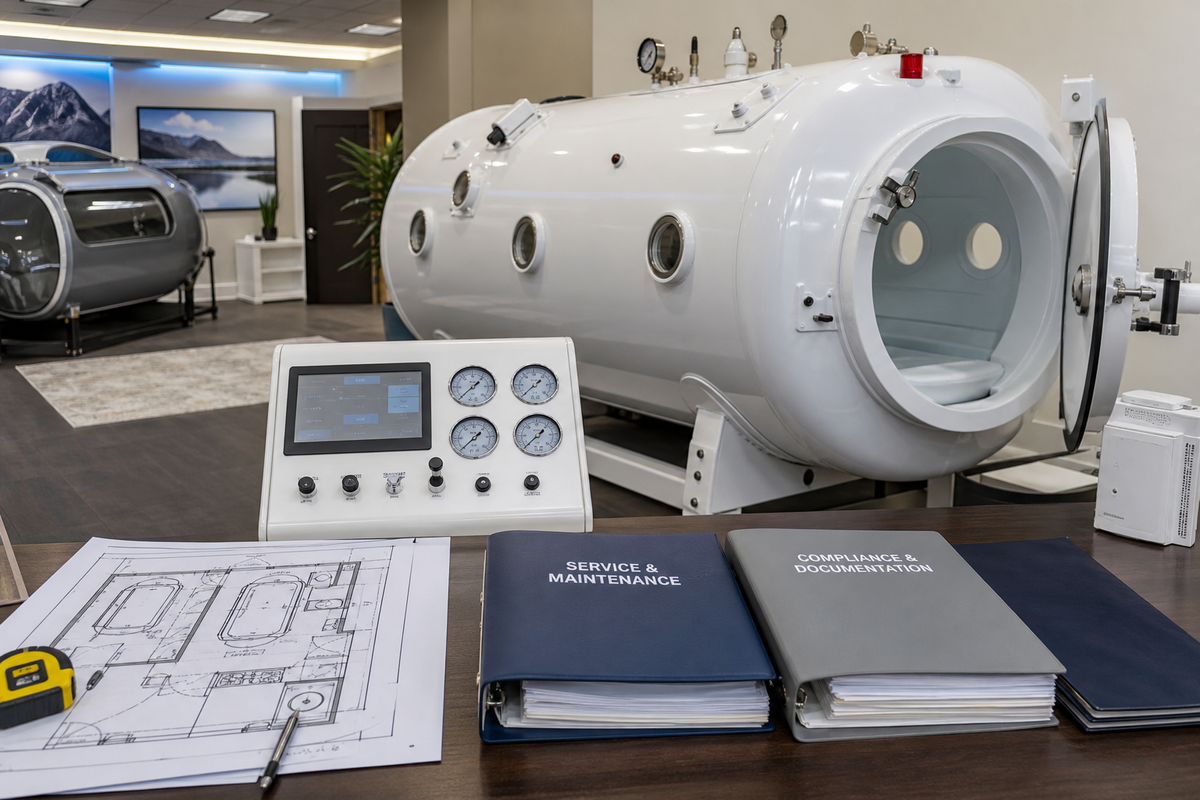
A hard-shell unit is usually the better direction when the buyer needs a rigid structure, a more permanent room setup, a higher-pressure buying path, and a professional operating story. Clinics, rehab centers, premium wellness centers, hospitals, and serious distributors often start here because the chamber itself supports a more formal service environment.
MACY-PAN lists hard chamber families such as HP2202, HP1501, MC750, and HE5000 series units, with stainless steel or rigid-shell designs varying by model. In MACY-PAN’s general hyperbaric chambers catalog, buyers can compare soft, hard, monoplace, and multiplace categories in one place.
Cost and readiness set the limit. Hard chambers ask more from the facility: space, delivery access, electrical planning, training, maintenance, service response, safety checks, and stronger documentation. Buyers who cannot support those basics may be better served by a mild chamber, or by delaying purchase until the room and operating team are ready.
Buyer Matrix: Which Chamber Fits Your Setting?
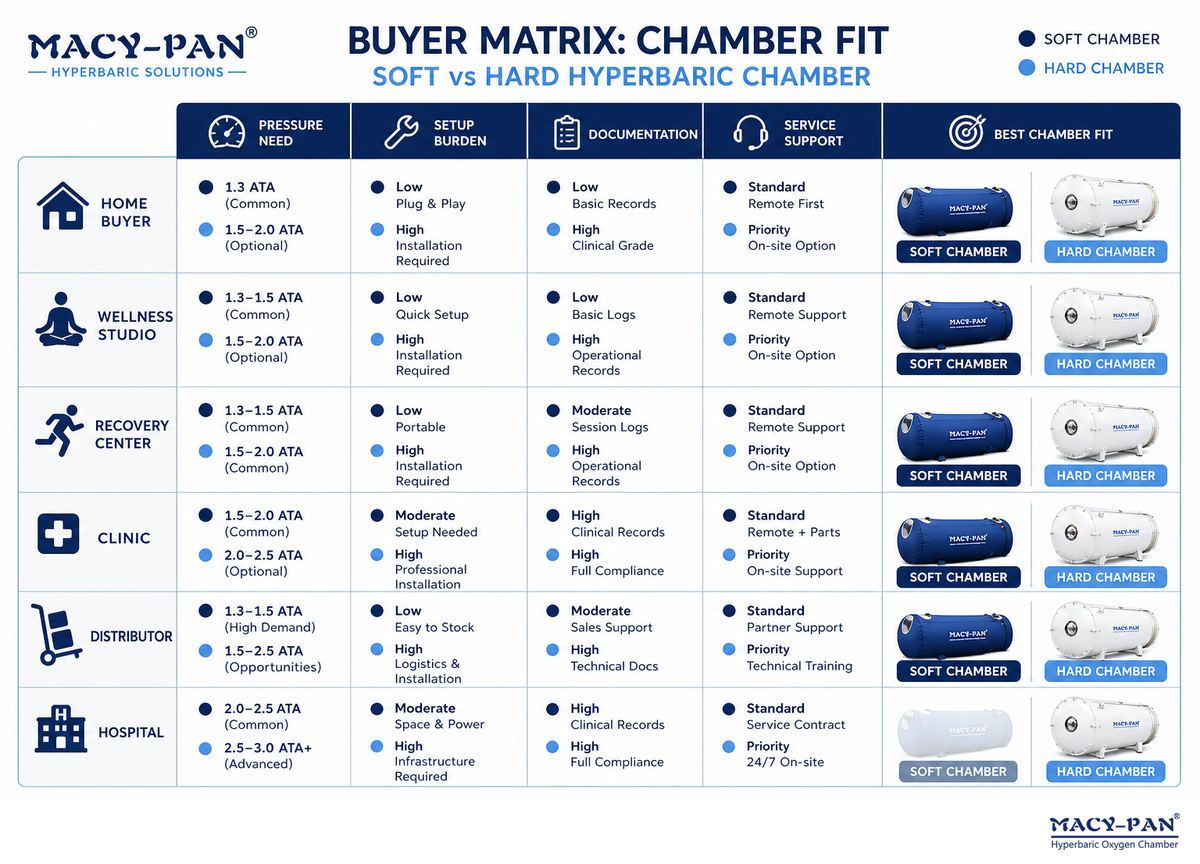
| Buyer setting | Better starting point | Why | Main risk to check |
|---|---|---|---|
| Home buyer | Soft or mild chamber | Lower infrastructure and easier setup. | Do not treat mild use as medical treatment without physician direction. |
| Wellness studio | Soft first, hard later if demand supports it | Easy entry point and lower room planning. | Marketing claims need review before launch. |
| Physical therapy or recovery center | Depends on service model | Soft can fit recovery routines; hard can support a more permanent professional service. | Staff training and safety documentation. |
| Wound-care or medical clinic | Hard-shell unit, with medical oversight | Clinical treatment requires more than a pressure vessel. | FDA status, protocol, supervision, room safety, payer rules. |
| Distributor or reseller | Both | Soft chambers widen entry-level sales; hard chambers support clinic-grade projects. | Sales scripts must not blur wellness and medical claims. |
| Hospital or multi-person facility | Hard or multiplace planning | More formal facility, staffing, and safety demands. | Capital planning, standards, training, maintenance, and local approvals. |
Certification Decoder: What Each Standard Does And Does Not Prove
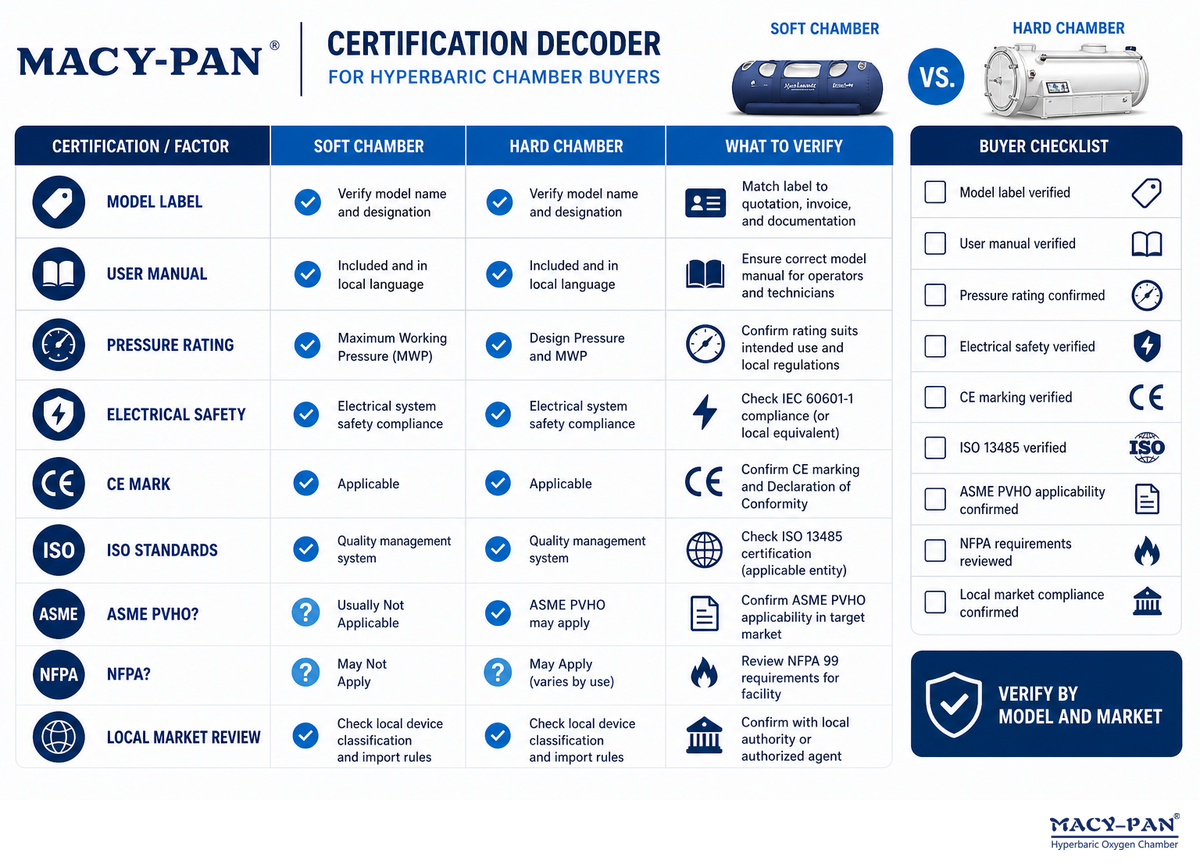
Certification language can make a buyer feel safe too quickly. Responsible chamber suppliers should welcome document checks, but each document answers a different question. ISO 13485 quality management system speaks to medical-device quality management. CE relates to European conformity. ASME concerns pressure vessels for human occupancy. NFPA 99 relates to health-care facility safety, including hyperbaric facility considerations. FDA Class II and 510(k) relate to U.S. regulatory clearance for a specific device pathway.
| Document or standard | What it helps prove | What it does not prove by itself |
|---|---|---|
| certified quality management system | Quality-management system for medical devices. | It is not a U.S. FDA clearance for every chamber model. |
| CE | Conformity for relevant European requirements. | It does not replace market-specific medical-device review elsewhere. |
| ASME | Pressure-vessel design standard for human occupancy. | It does not define the whole clinical protocol. |
| NFPA 99 | Health-care facility safety considerations, including hyperbaric environments. | It is not a product brochure claim; it must be tied to facility operation. |
| FDA Class II / 510(k) | U.S. device pathway for chamber product code CBF and regulation 21 CFR 868.5470. | Category rules do not prove that a particular model has clearance; verify the exact listing. |
Cost And Ownership: The Cheap Chamber Can Become Expensive
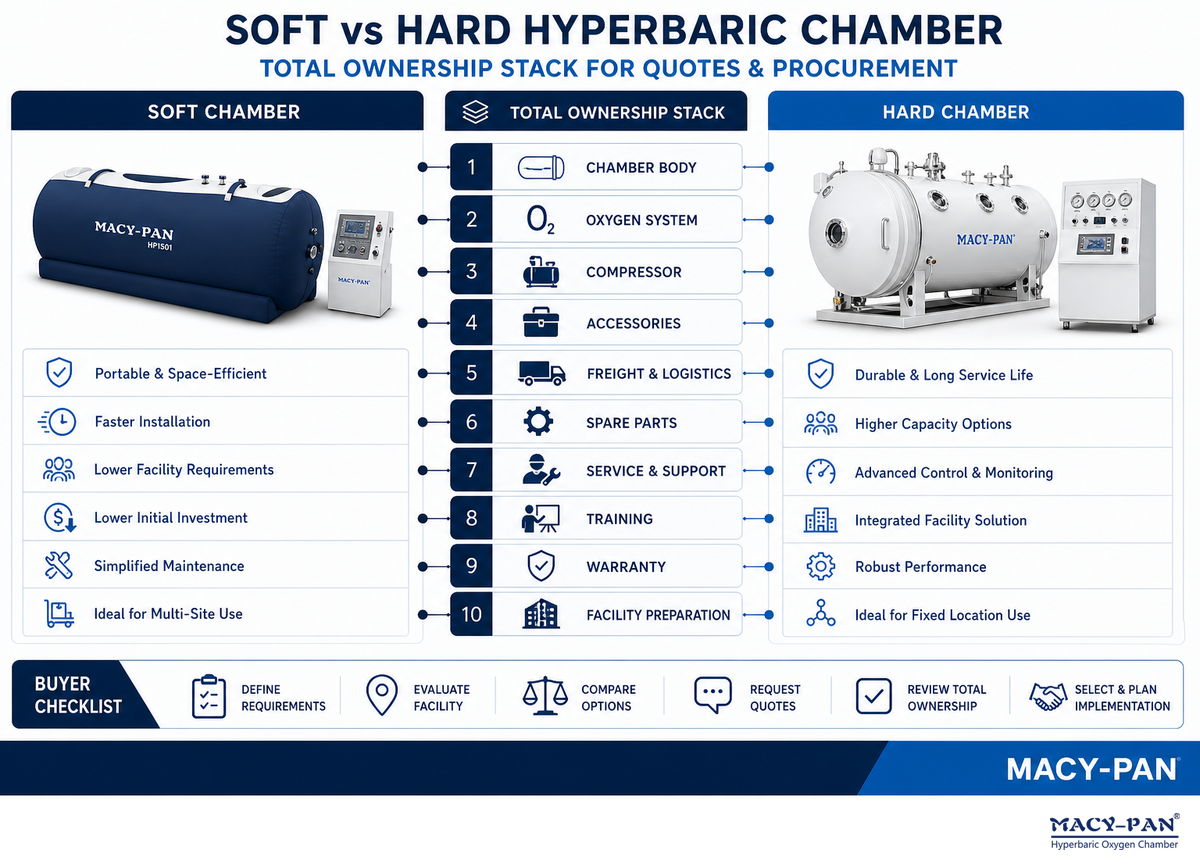
Equipment price is only the first line. Serious comparisons include shipping, installation, room readiness, oxygen accessories, maintenance, training, warranty, service response, staff time, and marketing review. Soft chambers may lower the first purchase barrier. Hard chambers may cost more, but they can also support a higher-value professional service when the facility is ready.
For a home buyer, a lower setup burden may be worth more than a higher pressure ceiling. For a clinic, service stability and documentation can be worth more than a small discount. For a distributor, after-sales support may decide repeat business more than the first margin number.
MACY-PAN presents itself as a direct manufacturer with 19+ years in hyperbaric equipment, certified quality management system, ISO9001, CE certification, patent registration, OEM product support, and exports to 126+ countries. Those claims are useful for supplier screening, but buyers should still ask for model-specific documents, warranty terms, spare-parts support, lead time, training materials, and country-specific compliance support.
Dealer Inventory Ladder: How Resellers Should Carry Soft And Hard Chambers
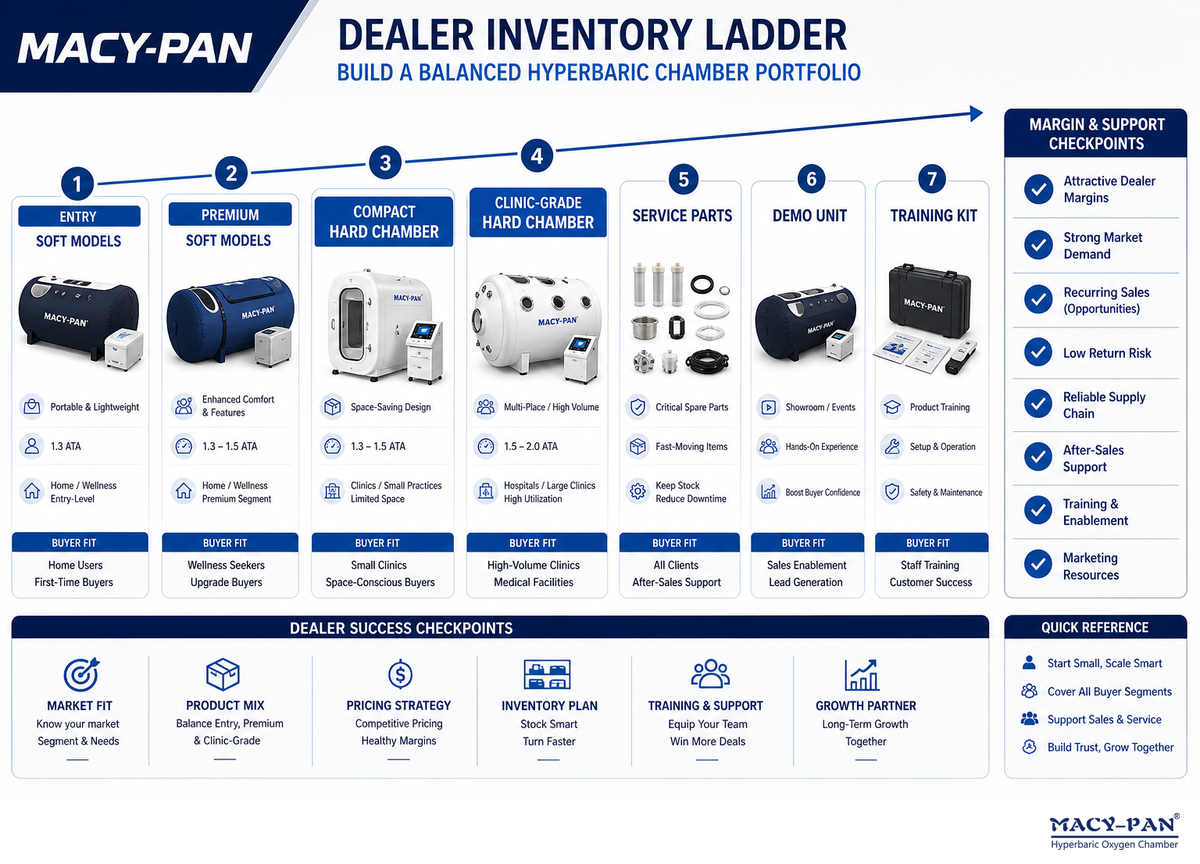
Resellers do not need to choose one chamber type forever. One cleaner strategy is to build an inventory ladder. Entry-level buyers start with soft or mild chambers. Clinics and premium wellness centers move toward hard units. Larger facilities may need custom hard-shell, monoplace, or multiplace planning.
Starter tier
Soft or mild models for home buyers, wellness rooms, and portable services. Use plain wellness language and keep medical claims out unless the buyer market and device status support them.
Professional tier
Hard-shell models for clinics, rehab centers, and premium wellness buyers. Quote installation, training, warranty, and service together with the device.
Project tier
Custom, OEM/ODM, or multi-unit planning for distributors and facilities that need branding, showroom inventory, or long-term service coverage.
MACY-PAN’s hyperbaric chamber export and shipping page is the next step for buyers and resellers who need to understand factory-direct supply, international delivery, documentation, packing, and country-level planning before choosing soft, hard, monoplace, or custom chamber options. Treat shipping as part of model selection: access size, crate planning, lead time, after-sales service, and import documents can change the real cost of a soft-versus-hard decision.
Need A Soft, Hard, Or Mixed Chamber Shipping Plan?
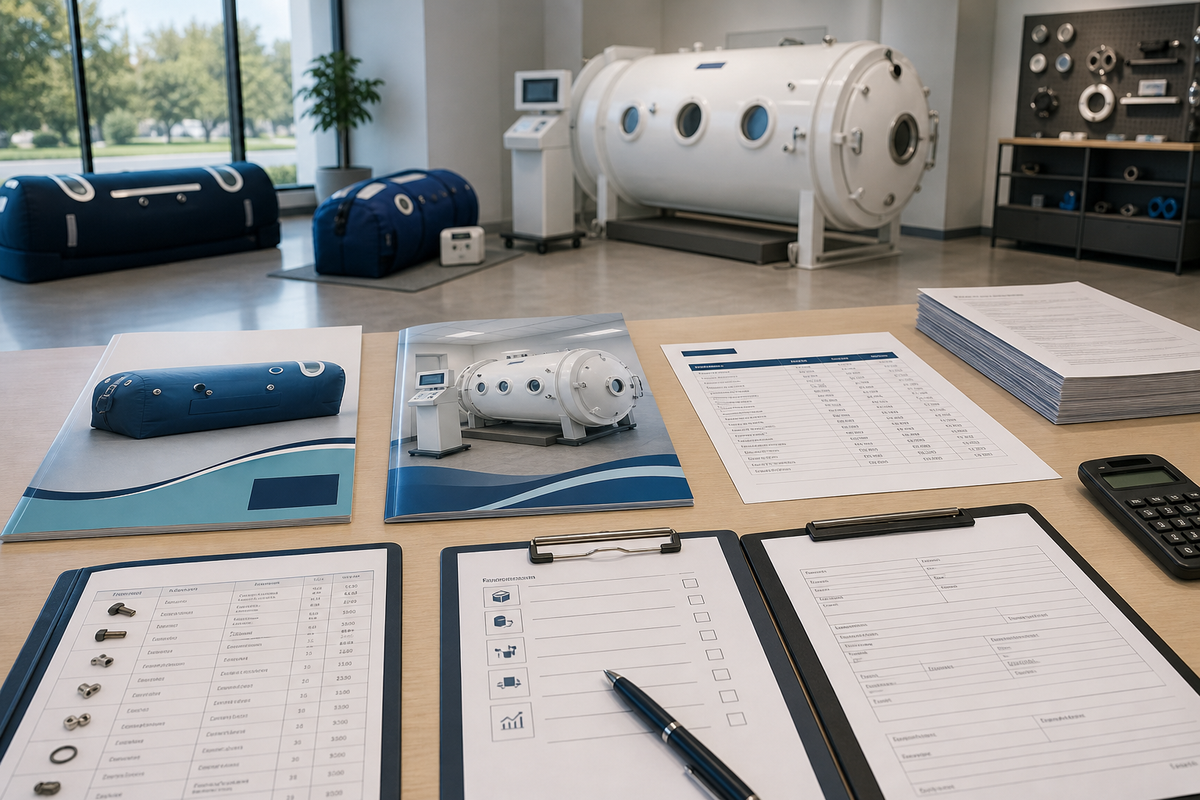
MACY-PAN works with family buyers, clinics, wellness facilities, and sales companies requiring OEM/ODM options, model comparison, factory-direct supply, and export shipping support.
Three Real Buying Scenarios
Scenario 1: A wellness studio wants a simple entry offer
A soft unit could work well for studios selling relaxation, general wellness, or recovery practices that use carefully worded claims, provided appropriate screening, cleaning, staff training, and session logging. They are not ideal for claims of equivalency to clinical therapy for listed medical conditions, as that creates significant risk.
Scenario 2: A clinic wants a medical service line
For clinic operations, the focus must be on hard-shell planning, physician oversight, device documentation, operational protocols, safety controls, patient monitoring, and clear boundaries for billing. Coverage for hyperbaric oxygen therapy through Medicare and other payors is limited to a defined set of conditions and requirements, with no coverage for any other uses under national coverage determinations.
Scenario 3: A distributor is building a showroom
Distributors can present both soft and hard models in a showroom, providing training on pressure differences, oxygen delivery systems, documentation, warranty parameters, and any limitations for billing. Showroom catalogs can cater to home and professional buyers separately; the quoting process must reflect these distinctions early on to avoid confusion or premature commitments.
Decision Checklist Before You Buy
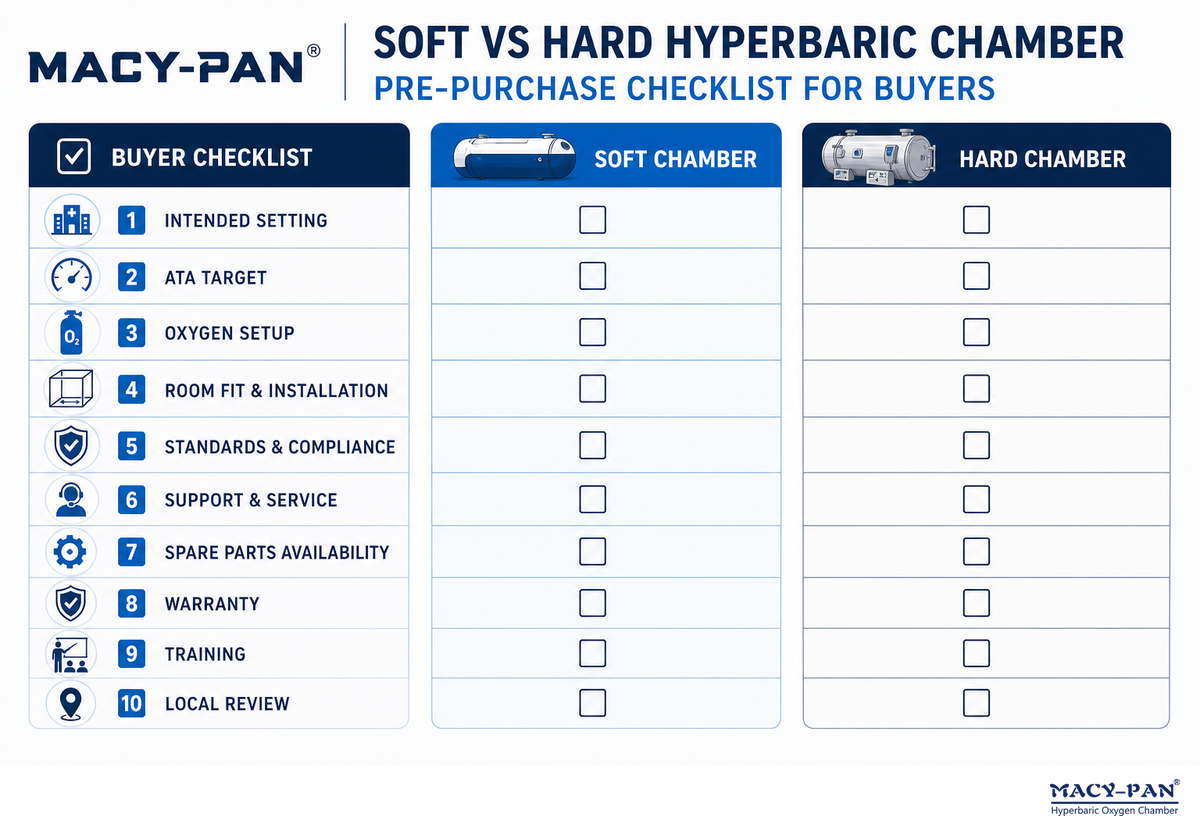
- Understand the intended usage scenario: home use, wellness studio, clinic, rehabilitation facility, distributor showroom, or hospital setting.
- Choose the pressure target before choosing shell type.
- Clarify the oxygen delivery method and the specific concentration delivered to the user during sessions.
- Ascertain whether the chambers are intended for wellness purposes or medical treatment.
- Request model-specific documents, not only company-level certificates.
- Verify that the devices meet all relevant certifications, including FDA, CE, ISO, ASME, NFPA, and any applicable local regulations for the target market.
- Plan training, maintenance, cleaning, emergency process, and service support before installation.
- For products destined for resale, review and approve all marketing claims prior to their public release.
Final Recommendation
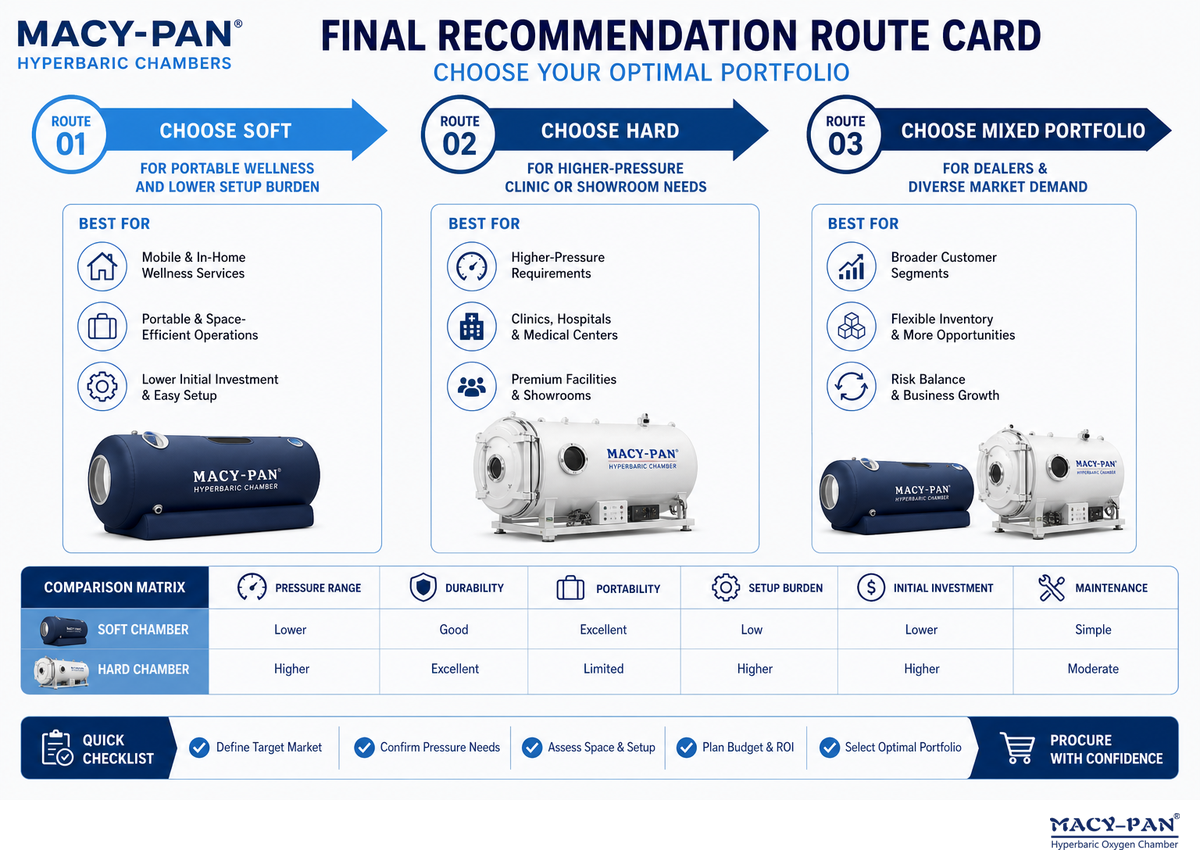
For home wellness and portable mild-pressure therapy, a soft unit is often the better first quote. For clinics, rehab centers, premium wellness facilities, and medical-service planning, a hard-shell unit deserves the first review. For distributors, the winning answer is usually not soft or hard. It is a clear ladder: soft chambers for entry demand, hard chambers for professional buyers, and a written claim policy that protects the seller and the customer.
MACY-PAN can support that ladder with soft, hard, monoplace, and custom chamber options, plus OEM/ODM supply for sales companies. Start with the hyperbaric chamber export and shipping page if you need factory-direct supply, shipping planning, and country-level support before final model selection.
FAQ
Is a hard chamber always better than a soft chamber?
Not typically. Hard chambers are generally better suited for professional settings requiring higher pressures, more extensive installation considerations, and a clinical environment for operations. Soft chambers often serve as the preferred option for home wellness and mild HBOT sessions or for buyers with less infrastructure capacity.
Are soft hyperbaric chambers effective?
They can be useful for the purpose they are designed and sold for. Claim boundary is the issue. Soft chambers operating in a mild pressure range should not be presented as the same thing as physician-supervised clinical HBOT unless the device status, protocol, supervision, and intended use support that claim.
Can a soft chamber use pure oxygen?
Many soft chambers use compressed air for chamber pressure and supply oxygen through a mask or headset from a concentrator. Chamber environment and inspired oxygen pathway are different things. Buyers should ask the supplier to explain the exact oxygen setup for the model they are considering.
What pressure should I look for?
The primary considerations will depend on intended use. Consumers of home wellness equipment are likely to compare 1.3-1.5 ATA soft or mild chambers. Clinicians and other professional facilities are likely to consider hard-shell units at 1.5-2.0 ATA or higher, once protocol, supervision and local regulations are vetted.
Does FDA Class II mean every chamber model is cleared?
No. The category describes a pathway; verify the model listing, labeling, instructions, and intended market.
Which chamber type should a distributor carry first?
New distributors often start with one soft model and one hard model. That creates a clear comparison for entry buyers and professional buyers. Sales teams should be trained to explain pressure, oxygen delivery, documents, warranty, service, and claim limits.
What should I ask a supplier before buying?
Seek product specifications, including operating pressure, oxygen system configuration, certifications and relevant FDA/local-market regulatory documents; also ask about warranty, service plans, spare parts availability, lead times, installation requirements, training materials and written guidelines on approved marketing claims. If you plan to resell the devices, you also need to know who handles technical questions post-installation and who will approve the claims you plan to publicize. These two areas alone can make or break a distributor relationship beyond the first order.
Where can I compare MACY-PAN chamber categories?
Start with the main hyperbaric chambers category, then review soft, hard, and pressure-specific pages. Dealers can also use the export and shipping page to plan logistics, documents, and delivery route before requesting a model mix.
Related Reading And Tools
- Hard shell hyperbaric chamber guide
- Soft shell hyperbaric chamber guide
- Hyperbaric chamber cost guide
- Compare chambers by ATA pressure
- MACY-PAN export and shipping support
References And Sources
- FDA: Follow Instructions for Safe Use of Hyperbaric Oxygen Therapy Devices
- FDA product classification: hyperbaric chamber, product code CBF
- CMS National Coverage Determination 20.29: Hyperbaric Oxygen Therapy
- UHMS: When It’s Better to Be Under More Pressure
- UHMS consumer warning on soft-sided bag chambers
- UHMS response to FDA hyperbaric safety communication
![Decision lenses: occupancy, gas path, access, staffing, facility interfaces, and exact-model evidence [article].](https://macypansolutions.com/wp-content/uploads/2026/10/monoplace-vs-multiplace-hyperbaric-chambers-featured-1-768x512.png)