Get in Touch with MACY-PAN Company

Add hyperbaric oxygen therapy to your practice is a four-part project, not a single hardware purchase: Staff Certification, CPT/HCPCS Reimbursement Mechanics, Facility Compliance, and a Real Cost Picture all have to clear before a single patient visit can even be billed out.
Quick Specs
| FDA Device Classification | Class II, 21 CFR 868.5470, 510(k) required, non-GMP-exempt |
| Recognized Consensus Standards | NFPA 99:2024, ASME PVHO-1-2023 |
| Primary Billing Codes | CPT 99183 (physician), HCPCS G0277 (facility, per 30-min unit) |
| Primary Technician Credential | Certified Hyperbaric Technologist (CHT), National Board of Diving and Hyperbaric Medical Technology (NBDHMT) |
| FDA-Cleared Reimbursable Indications | 14 conditions (see H2-3) |
Most other guides aimed at clinic owners address the hardware and stop; this guide tells you what happens after the chamber arrives — starting with staffing, billing, facility compliance, and the real cost picture, all covered below.
To establish a hbot program you must employ a Certified Hyperbaric Technologist (or equivalent direct physician oversight), define a billing path using either CPT 99183 or HCPCS G0277, and certify that your facility complies with both ASME PVHO-1-2023 and NFPA 99:2024. Any one of these three is sufficient for claim denial, AHJ inspection failure, or – in existing enforcement actions – criminal prosecution.
Key Points
- Reimbursement is handled through two discrete codes, physician supervision (CPT 99183) and facility/chamber use (HCPCS G0277); for chronic wound indications specifically, coverage also requires documented proof that a 30-day trial of standard medical care failed to produce measurable healing — separate from the claims-processing and prior-authorization steps that follow.
- A physician with hyperbaric training (MD, DO, NP, or PA) must be immediately available during every hyperbaric session for the technologist-that’s a staffing, not a preference, requirement.
- NFPA 99’s newly-released 2024 edition adds requirements to fire suppression, including those specifically for hyperbaric chambers, beyond the existing ASME PVHO-1 standard.
- DOJ’s largest-ever federal health care fraud crackdown in history, in 2025, included a hbot-specific billing fraud prosecution involving unauthorized use of physician billing numbers.
Is Your Practice Ready for Medical-Grade HBOT?

Prior to selecting a chamber, the practice needs to identify the path on which they actually reside. The FDA’s own product classification record recognizes the hyperbaric chambers as a Class II medical device (21 CFR 868.5470) and clears it via the 510(k) process, meaning it’s not GMP-exempt and designated as a life-sustaining/life-supporting device.
The significance is illustrated by that same FDA record’s list of Recognized Consensus Standards, which all cleared Class II devices are expected to adhere to, with the current version referencing NFPA 99:2024 and ASME PVHO-1-2023 (the prior editions, NFPA 99:2021 and ASME PVHO-1-2019, remain listed for devices cleared under earlier cycles).
FDA classification dictates two market pathways: soft-shell “mild” devices that max out at ~1.3-1.5 ATA and typically fall into the wellness and recovery niche, which may not require PVHO certification, and hard-shell medical devices capable of reaching 2.0-3.0 ATA. This latter group of medical devices must satisfy the complete regulatory compliance chain (FDA, ASME, NFPA) outlined here and would be what a hyperbaric physician would prescribe to treat an FDA-cleared condition. Failing to distinguish between the two tracks is the single most frequent strategic mistake in planning, since the facility, staffing, and billing requirements that follow all apply to the medical-grade hard-shell devices, and only partly-or not at all-to soft-shell systems.
From a mechanical standpoint, what’s occurring within the chamber is actually fairly basic (even if the compliance layer isn’t): pressurizing the chamber above normal air pressure levels allows the patient’s lungs to dissolve far more oxygen into their blood plasma than can be achieved by breathing at sea-level pressure. That higher concentration of oxygen levels boosts the amount of oxygen the blood cells can deliver to the patient through their circulatory system to support blood flow in getting the oxygen to the blood vessels who are in turn feeding oxygen-starved tissue-that’s the physiological basis of all 14 reimbursable indications covered in H2-3, from wound healing to decompression sickness.
Readiness Self-Check
| If your goal is… | You’re on the… | Which means |
|---|---|---|
| Billing insurance for wound care, post-surgical recovery, or another FDA-cleared indication | Medical / hard-shell track | Full CPT/HCPCS billing, CHT staffing, ASME PVHO-1/NFPA 99 compliance apply (H2-2 through H2-4) |
| Cash-pay recovery, longevity, or performance sessions only | Wellness / soft-shell track | No FDA-cleared-indication billing path; staffing and facility bar is lower but liability and AHJ scrutiny is rising (H2-8) |
| Unsure — considering both | Start medical-track | Easier to add cash-pay wellness sessions to a compliant medical program than to retrofit compliance onto a wellness-first launch |
One important data point to know before you part with your cash: A 2025 case in Michigan where a facility’s management and operating staff face criminal charges is a matter of public record. While the specifics are beyond the scope of this guide, the basic lesson is that the equipment is beside the point; the issue was what happens when accreditation, supervision and documentation rules are disregarded. Every requirement below is in the guide because there’s a corresponding negative consequence in the real world resulting from some gap in compliance.
Staffing: Technician Certification, Physician Training & Safety Director Requirements

Your hbot, which must be medically-grade, hard-shell in configuration, requires at least three different positions to be filled. None of these roles can be filled with “whomever’s available that day.”
How Do You Become a Certified Hyperbaric Technician?
Certified Hyperbaric Technologist (CHT) is the credential you need, administered by the National Board of Diving and Hyperbaric Medical Technology (NBDHMT). Candidates must complete an approved hyperbaric technology training program (accredited, whether delivered in person or as a hyperbaric certification course online) and a specified preceptorship — structured, hands-on clinical experience under a certified technologist or physician — before taking the CHT exam.
NBDHMT also runs a criminal background check on each candidate-a felony conviction will disqualify you-and requires recertification every 2 years (requiring 24 hours of continuing education in each cycle). It’s a significant operating cost you can’t ignore.
The second is physician supervision. This is usually the biggest sticking point for new operators. NBDHMT requires (by their own published standard) that the facility’s CHT be immediately supported in every session by a physician trained in hyperbaric medicine (this can be a MD, DO, NP or PA). That doesn’t mean the doctor must be within a reasonable radius and on call; you must be able to staff for physician availability during all of your hours of operation. This is why most freestanding hbot facilities schedule their sessions into blocks rather than being open for walk-in patients throughout the day — each individual session commonly runs 1 to 1.5 hours, so a single physician-covered block can support several back-to-back patients.
Third is a safety director required for hard-shell chamber in the context of NFPA 99 regulations. This position is responsible for chamber operation procedures, fire safety equipment inspections and general emergency response protocols. You can train one of your existing CHTs to fill this position or hire a full-time officer as patient volume dictates.
“We didn’t add hyperbaric as a wellness amenity. We added it because the data on surgical recovery is unambiguous, and our patients deserve every advantage we can offer.”
Dr. Lisa Cassileth, Founder, The Practice Healthcare; Clinical Chief of Plastic Surgery, Cedars-Sinai
Field reports from practices that launch hbot programs consistently mention the same first mistake: hiring or training a technician, then finding out the required physician-availability component doesn’t mesh with the schedule. Doing the physician side first (figuring out who can cover the session times) then hiring or training a technician prevent an expensive re-tool.
Getting Paid: CPT Codes, HCPCS, and Insurance Reimbursement Mechanics
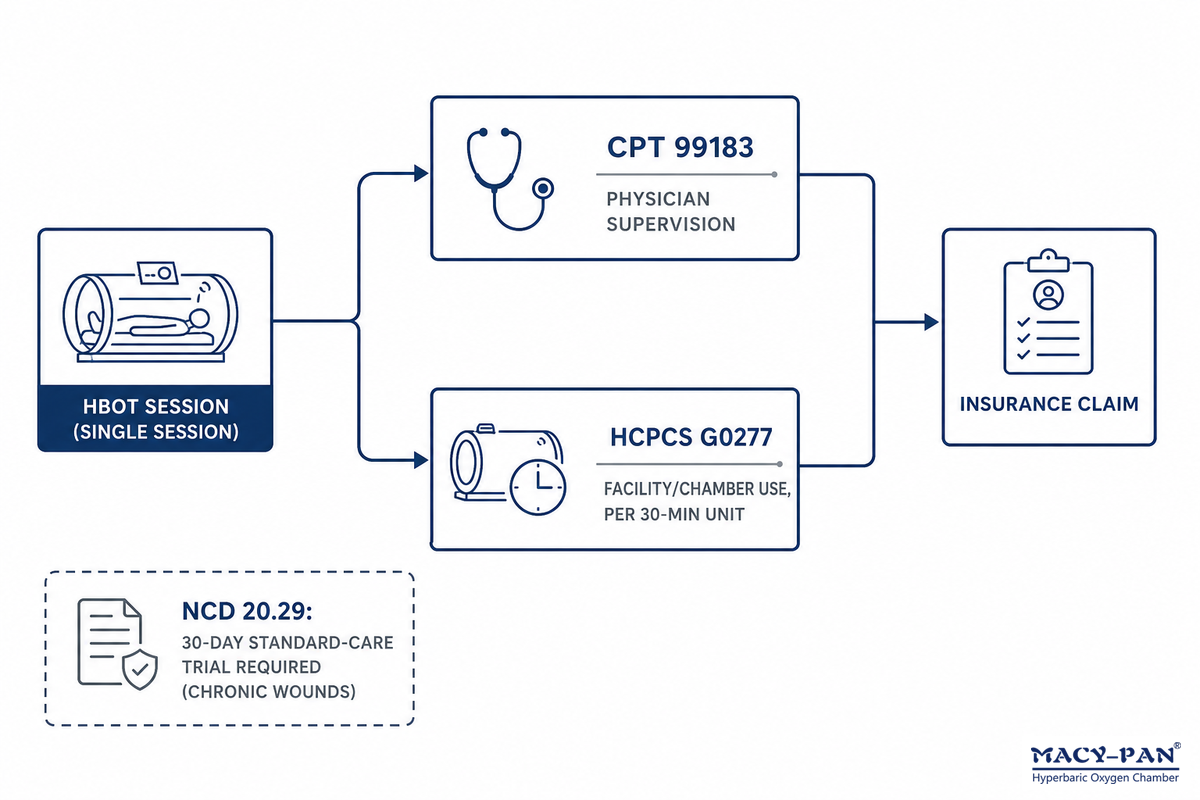
99183 CPT code reimbursement is only half the picture: hbot billing is typically broken down by two separate codes that many new practices don’t realize are two distinct codes. Code CPT 99183 is billed once per session to account for the physician’s presence/ supervision, regardless of session length. HCPCS G0277 (replacing C1300 on Jan 1, 2015) covers the facility/ chamber usage, billed in 30-minute units. Billed under one code, not both, or billed with incorrect unit logic for G0277 are known common reasons for denial.
What Is the CPT Code for Hyperbaric Oxygen Therapy?
CPT 99183 (“Physician attendance and supervision of hyperbaric oxygen therapy, per session”) is billed one time per session by the attending physician according to Medicare’s official coding guide. Facility utilization – the actual chamber time – is billed under HCPCS G0277 in 30-minute units from start of pressurization through the end of depressurization. Either code being absent from a claim, or improperly billed, are frequently cited reasons for hbot denial.
Reimbursement, even for an FDA-approved indication, is not automatic. Medicare’s National Coverage Determination 20.29 (currently in effect, last reviewed April 2017 — roughly 9 years ago as of this writing) has an established list of conditions covered and specifies, for chronic wound care in particular, that it applies only if there are no measurable signs of healing after 30 days of conventional wound care. A 30-day time-gap trial, unaddressed or under-documented in your chart, is another leading cause of denial for hyperbaric billing specialists – not a coding error, but a documentation timing issue. Note, also, that NCDs specify what conditions are covered, not all details about individual claims processing; local contractor policies, prior authorizations, and payer-specific guidelines still come into play.
| Category | FDA-Cleared Indication |
|---|---|
| Wound / tissue | Chronic non-healing wounds (after 30-day standard-therapy trial) |
| Wound / tissue | Compromised skin grafts and flaps |
| Wound / tissue | Crush injuries |
| Wound / tissue | Delayed radiation injury (soft tissue/bone) |
| Wound / tissue | Osteoradionecrosis |
| Infection | Chronic refractory osteomyelitis |
| Infection | Necrotizing soft tissue infections |
| Infection | Gas gangrene |
| Emergency / acute | Carbon monoxide poisoning |
| Emergency / acute | Air or gas embolism |
| Emergency / acute | Decompression sickness |
| Other | Central retinal artery occlusion |
| Other | Sudden sensorineural hearing loss |
| Other | Intracranial abscess |
Unapproved indications like sports performance enhancement, cognitive boost, anti-aging, and the like, aren’t covered. While a cash-pay hbot program for these uses is perfectly legal, submitting these as covered treatments under an approved indication to circumvent insurance is exactly the type of activity that attracts federal investigation, and what forms the basis for the enforcement case described in H2-7.
Facility & Regulatory Compliance: What AHJ and Payers Actually Require
Do You Need a License to Operate a Hyperbaric Chamber?
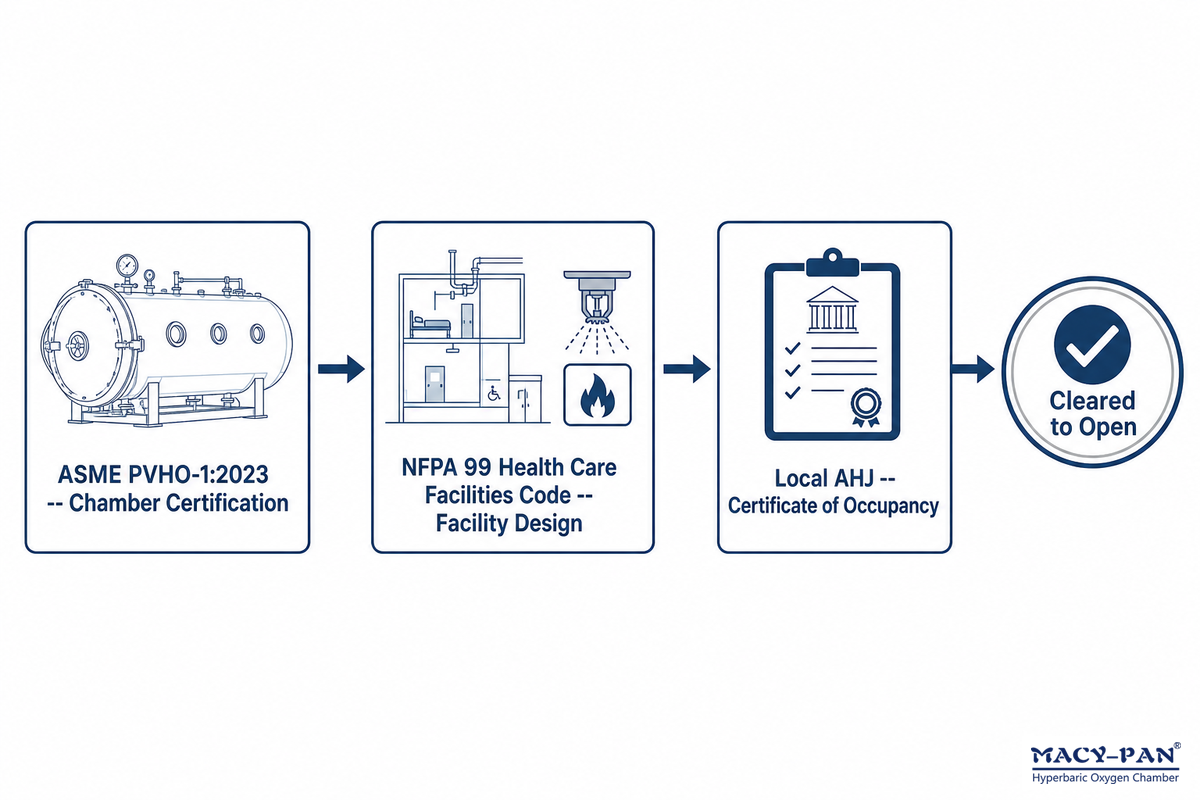
There isn’t a single national “hyperbaric operator’s license.” Operating a hard-shell medical-grade chamber does require meeting three facility-level requirements: ASME PVHO-1-2023 certification for the chamber itself (included in FDA-accepted standards lists), a space designed to NFPA 99’s Health Care Facilities Code, and a certificate of occupancy from your local AHJ (often your local fire marshal) before opening.
The lack of attention to this series of approvals is often the reason a compliance snafu becomes a 3 to 6 month inspection failure instead of a simple fix.
NFPA 99 is updated every 3 years and in the 2024 version included an update of specific importance to new installations: “Added requirements for new primary and secondary fire-suppression system for hyperbaric chambers.” Previously, the standard simply required a Class A chambers to include a prescriptive deluge-type water spray system plus a handline-end of story. That 2024 version maintains this requirement, but now allows for approved alternative-system solutions, giving clinics more flexibility in how they address this need. If your chamber vendor or installer quoted on an older version of NFPA 99, this is definitely worth chasing up directly.
We are not providing the full ASME PVHO-1 certification chain, the AHJ permitting checklist, or a model-by-model comparison in this article. Instead, these details are provided on MACY-PAN’s clinic compliance guide for hyperbaric chambers, which includes vendor documentation for certification records (ASME PVHO-1, ISO 13485, CE, SGS test reports) to be produced on request.
Choosing Your Chamber: Monoplace vs Multiplace, Hard-Shell vs Soft-Shell
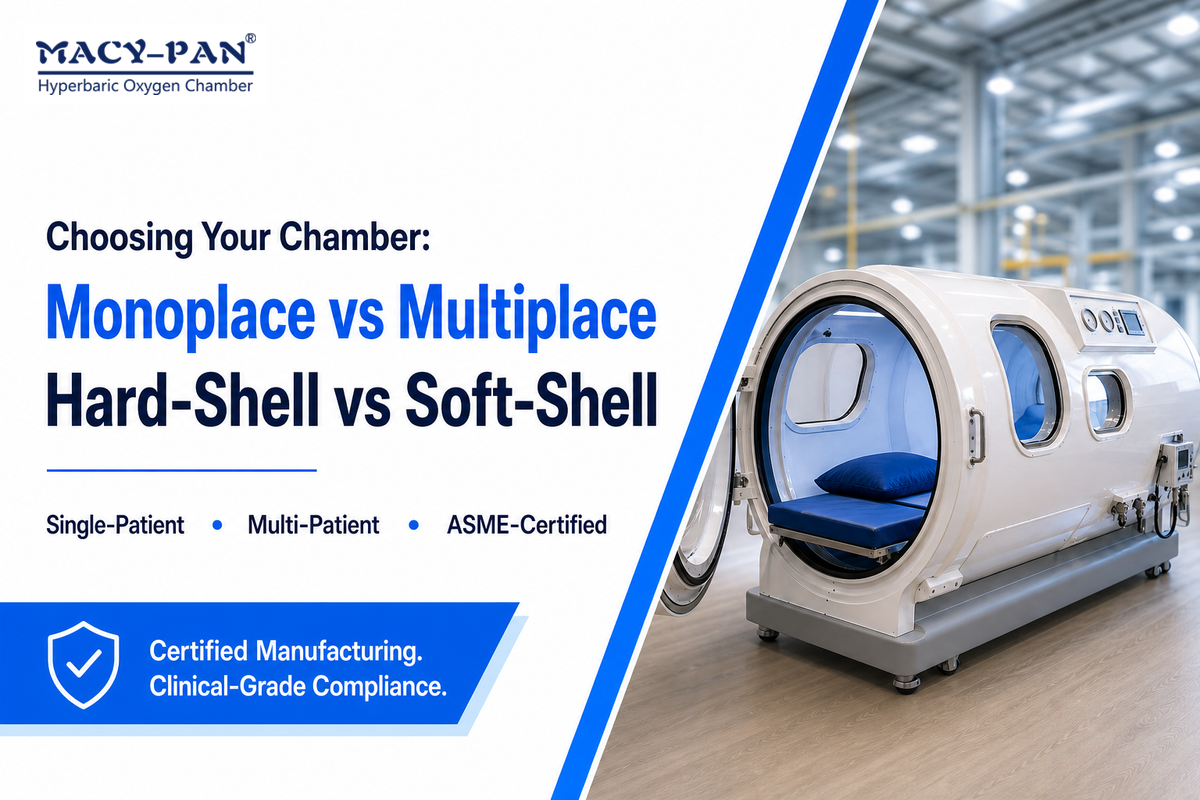
With staffing, billing, and compliance covered, the decision between the types of chamber models comes down to relatively simple, fundamental business decisions around patient volume and floor plan. One of the simpler types is a monoplace chamber, which treats a single patient per session in a pure oxygen environment, and compared to another type like a multiplace chamber which treats several patients at a time on oxygen masks within a shared, ambient-air environment.
✔ Monoplace
- Smaller footprint, simpler AHJ permitting
- Pure oxygen environment, no mask required
- Best fit: single-provider clinics, wound care, sports medicine
⚠ Multiplace
- 1–5 patients per session; staff can accompany patients
- Higher throughput per chamber-hour, higher upfront footprint/cost
- This type of model is well-suited for: Dedicated wound care programs, patients with high-anxiety, and/or patients requiring direct staff supervision.
MACY-PAN’s clinical chamber selection guide, comparing the various ASME PVHO-1-certified monoplace and multiplace models and outlining specifications, offers a higher-level look, while our hard-shell hyperbaric chamber guide and soft-shell chamber guide dig into the specifics of the different configurations.
The Business Case: The 4-Layer HBOT Launch Cost Stack
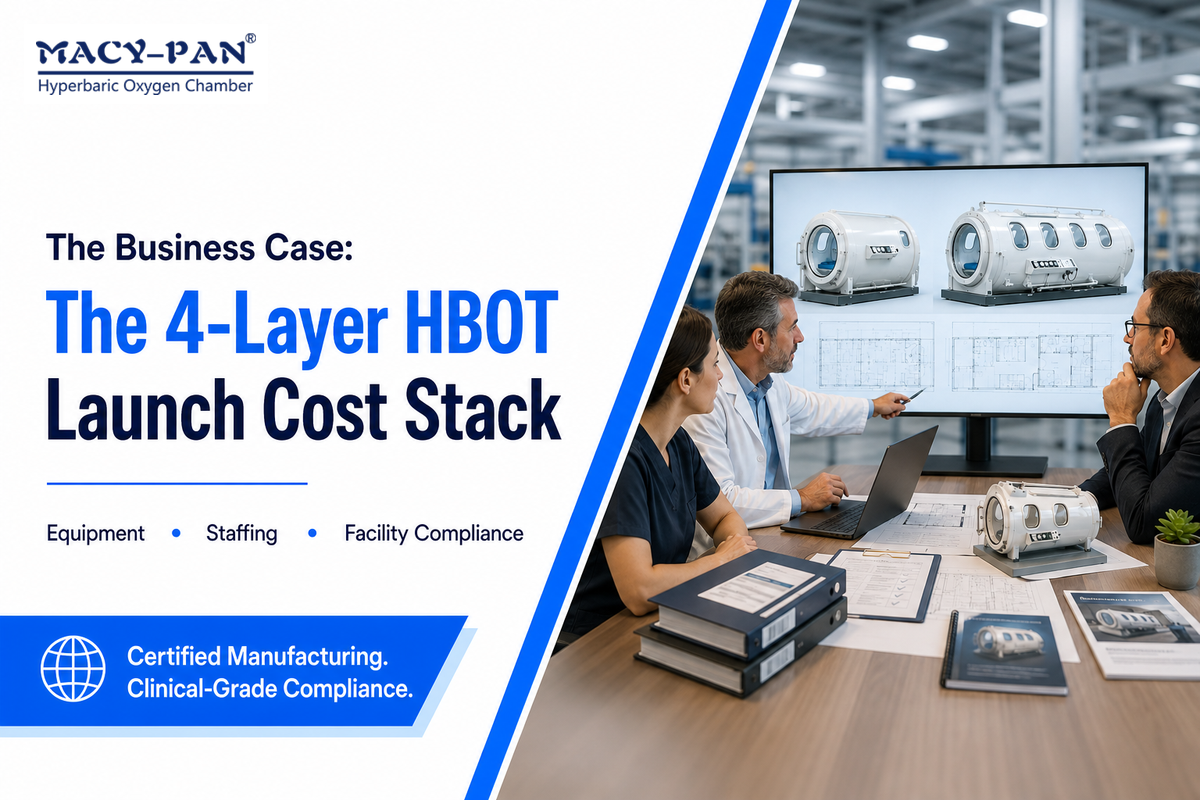
In a great many practice-launch articles, discussions end at the chamber’s price sticker, not where actual launch costs lie – and the costs exist across four distinctly layered areas, missing even one of which is the leading cause of budget run-offs.
The 4-Layer HBOT Launch Cost Stack
| Layer | What’s Included | Order-of-Magnitude Range |
|---|---|---|
| 1. Equipment | Chamber, compressor, oxygen supply, installation | Factory-direct hard-shell monoplace typically starts around $40,000–$100,000+; multiplace and larger configurations run higher — request current factory-direct pricing rather than resale-market figures |
| 2. Staffing | CHT salary, physician coverage hours | Hyperbaric technologist salary figures reported across 4 independent job-listing platforms (ZipRecruiter, Glassdoor, Salary.com, Indeed) converge on a $47,051–$61,814/year range nationally, roughly $23–$30/hour (not an official BLS/O*NET occupation-specific figure — treat as directional) |
| 3. Certification & Training | CHT exam/preceptorship, 24 CEU hours every 2 years, safety director training | Recurring cost, not one-time — budget per technician, per recertification cycle |
| 4. Facility Compliance | ASME PVHO-1/NFPA 99 build-out, AHJ inspection, fire-suppression system | Varies by existing facility condition; NFPA 99:2024’s added fire-suppression options can affect build-out cost depending on which system path is chosen |
Our framework for this conversation deliberately exceeds that of a simple chamber ROI calculator to represent a complete launch budget picture, rather than how quickly one specific chamber pay for itself. For a specific chamber ROI calculation for a specific model against its peers (e.g., on its competitors’ pricing), please use our clinic payback model. For a comparison of the industry standard pricing for hyperbaric chambers, please see our hyperbaric chamber cost breakdown.
Common HBOT Launch Mistakes to Avoid
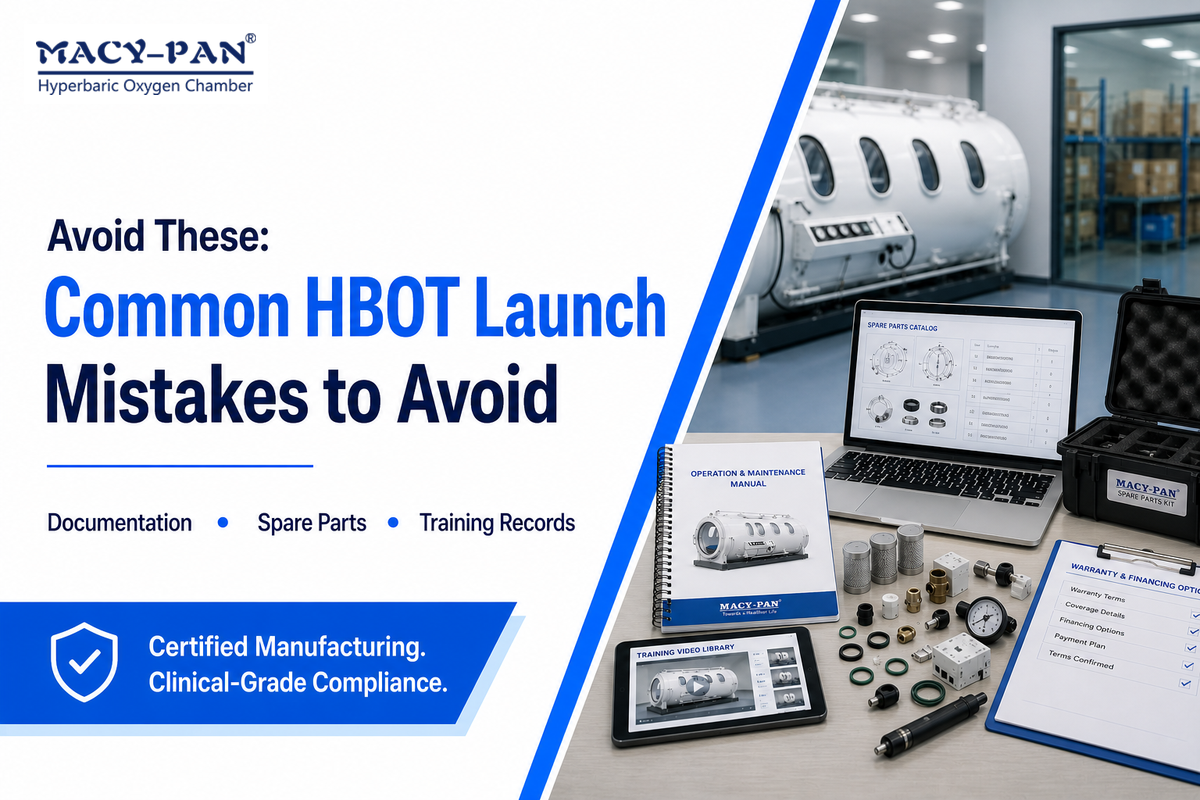
Three patterns, based on real-world data, can be observed again and again regarding how hbot billing and compliance go wrong – they aren’t risks, they’re reality.
⚠️ Mistake 1: Billing Only One Code
Many clinics are rejected from receiving payment if submitting the CPT 99183 billing code without also submitting the facility fee of the HCPCS G0277 code (and vice versa) because they need to be filed together to create a complete claim.
⚠️ Mistake 2: Under-Documenting the 30-Day Trial
In order for the hbot claim to be covered for chronic wound care (under NCD 20.29), clinics must have documented evidence of having tried standard care for at least 30 days before they start the hbot treatment without measurable improvement. Without sufficient documentation of this prerequisite window, denial rates climb even if the treatment was otherwise suitable.
⚠️ Mistake 3: Treating Provider Identifiers as Administrative Detail
The DOJ’s 2025 National Health Care Fraud Takedown was the largest in DOJ history-324 defendants and over $14.6 billion in intended losses-according to its press release announcing the sweep. One case brought by the U.S. Attorney’s Office for the Eastern District of Virginia alleged that a hbot clinic executive submitted fraudulent claims for HBOT by using physicians’ National Provider Identifiers (NPIs) without their knowledge or consent, leading to $1.9 million in losses for one payer, alone, per the DOJ’s own case summary. Regardless of how you contract with a billing partner, every physician whose NPI appears on a claim must have actually prescribed and monitored that particular hyperbaric session.
Industry Outlook: What’s Changing in Clinical HBOT Right Now
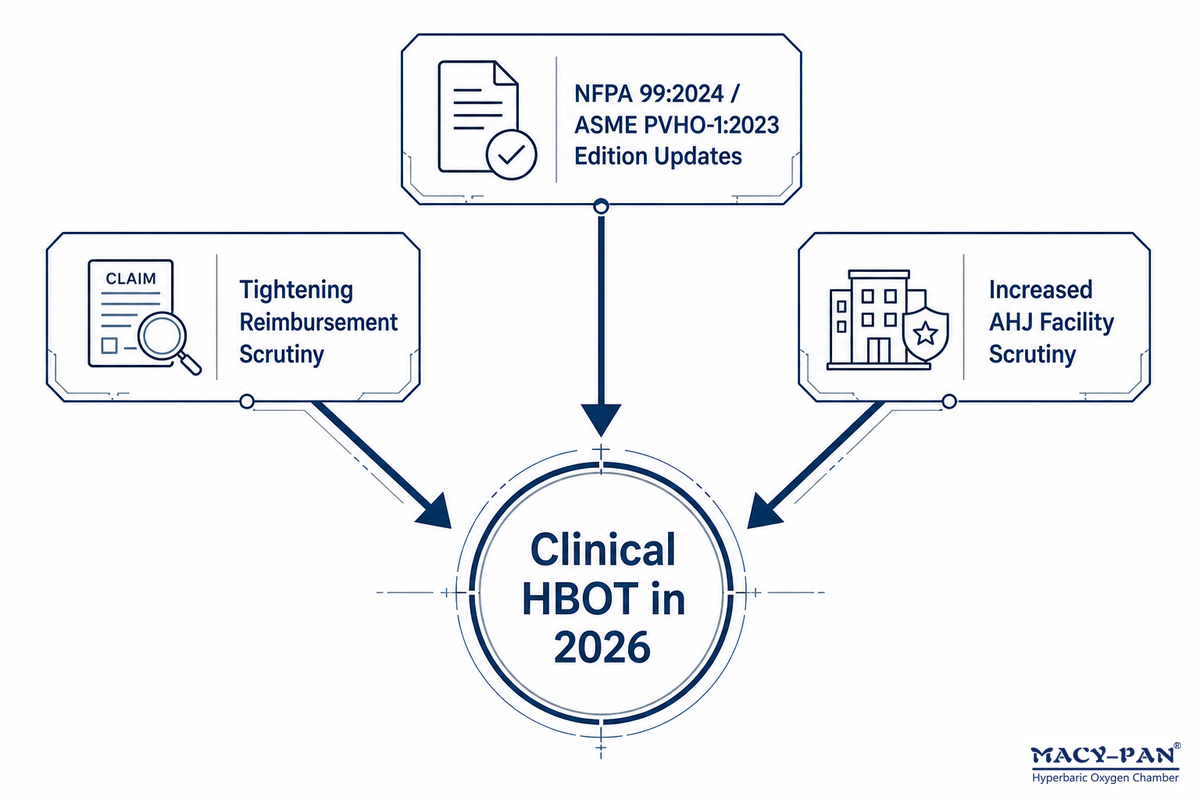
If your practice is launching in 2026, the most significant change you’ll face isn’t the projected growth-it’s simultaneously tightening reimbursement scrutiny and increased facility requirements. Not only are hbot billing practices now specifically a target in the 2025 federal fraud crackdown, but as more wellness operations with soft-shell chambers claim “clinic-grade” status, AHJs and payers are scrutinizing whether those chambers actually possess current ASME PVHO-1 and NFPA 99 certification. This presents an opportunity for compliant practices and a risk for those that aren’t.
To put this in practical terms, before your 2026 launch, it’s worth taking two concrete steps: Confirm with your chamber vendor that they can provide certification in current editions of NFPA 99 and ASME PVHO-1 (NFPA 99:2024 and ASME PVHO-1-2023), rather than just previous versions, and make verification of the treating physician’s identifier part of your billing process from day one. NFPA 99 and ASME PVHO-1 are generally updated every 3 years, so expect at least one more compliance-related edition update between your 2026 launch and your first major equipment replacement cycle.
Just for reference (this information shouldn’t be substituted for diligent compliance planning and reimbursement strategy), various market research firms estimate the global hyperbaric oxygen therapy devices market to be worth about $4 billion by 2026, growing at a rate of around 5-6% per year through the early 2030s.
Frequently Asked Questions
Q: What’s the difference between CPT 99183 and HCPCS G0277?
View Answer
For each hyperbaric session, the supervising physician’s time is captured by CPT code 99183 and billed once per session. Facility and equipment use are captured by HCPCS code G0277 and billed based on a minimum of 30-minute increments. Submitting only one of these two codes is a frequent cause of rejected or underpaid claims.
Q: Does Medicare cover hyperbaric oxygen therapy for clinic patients?
View Answer
Medicare coverage of hbot is outlined in National Coverage Determination 20.29, which specifies FDA-approved indications-this is not a general-purpose covered service. When using hyperbaric oxygen therapy for chronic wounds, prior failure to respond to at least 30 days of standard wound care is required to qualify for Medicare coverage. Use of hyperbaric oxygen for off-label indications such as sports performance enhancement or longevity is not covered by Medicare and must be billed on a cash basis.
Q: How long does it take to become a certified hyperbaric technician?
View Answer
NBDHMT doesn’t have a fixed time table since it’s tied to training and preceptorship, but you need to complete the official hyperbaric tech training program, along with supervised preceptorship hours, to take the CHT exam. All candidates need to undergo criminal background checks. As CHT, you will need to obtain 24 hours of continuing education every 2 years. Keep this time dedicated to your profession, it’s more than a sprint to a one-time certification.
Q: Can a wellness clinic offer medical-grade HBOT, or only licensed medical practices?
View Answer
A wellness center can offer cash-paid non-medical sessions with a soft-shell chamber. For hard-shell hbot medical devices associated with FDA-cleared indications, however, you’ll need a doctor’s prescription, as well as physician supervision-something that usually fall within the scope of a licensed medical clinic, not necessarily a wellness center.
Q: What indications are FDA-approved for HBOT insurance reimbursement?
View Answer
Medicare’s policy covers up to 14 conditions, including non-healing wounds, carbon monoxide poisoning, decompression sickness, skin grafts with poor perfusion, among others. You’ll find the entire list in the “billing” section.
Q: Is hyperbaric oxygen therapy safe for clinic patients?
View Answer
hbot is among the safest medical procedures today if used within correct protocols and parameters of patient and equipment selection.Most documented complications are minor and can be as simple as ear and sinus pain while pressure is increased or brief visual changes-as long as guidelines regarding certification and supervision are correctly followed.
Why We Write This
MACY-PAN produces hard-shell hyperbaric chambers which are ASME PVHO-1-2023 compliant for clinics, dealers and OEM clients. We put together this guide because all of these topics – certifications, billing and compliance – were asked by almost every new client we encountered. We know that the required information is hidden within confusing CMS coding guides, NBDHMT certification requirements, and even obscure NFPA codes that most clinic managers are never exposed to unless it’s too late.
References & Sources
- Medicare National Coverage Determination 20.29, Hyperbaric Oxygen TherapyCenters for Medicare & Medicaid Services
- Billing and Coding Guidelines for Hyperbaric Oxygen (HBO) TherapyCenters for Medicare & Medicaid Services
- Hyperbaric Chamber Product Classification (CBF), 21 CFR 868.5470U.S. Food & Drug Administration
- Certified Hyperbaric Technologist Training and CertificationNational Board of Diving and Hyperbaric Medical Technology
- Key Health Care Changes in the 2024 Editions of NFPA 99 and NFPA 101National Fire Protection Association
- U.S. Attorney Announces Charges as Part of DOJ’s National Health Care Fraud Enforcement ActionU.S. Department of Justice, Eastern District of Virginia
- HBOT Billing and Coding: CPT 99183, G0277 & Medicare GuidelinesMedical Billers and Coders
Related Articles
- Hard-Shell & Medical-Grade Hyperbaric Chambershow pressure, certification, and build quality separate clinical devices from wellness boxes
- Soft Shell Hyperbaric Chamberswhat they really do and how to buy one safely
- How Much Does a Hyperbaric Chamber Cost?a full 2026 price breakdown by type
- The World’s Leading Hyperbaric Chamber Manufacturersa 20-company comparison
- OEM vs ODM vs Private Label for Medical Devicesfor practices exploring branded equipment programs
Updated: July 2026Reviewed by the MACY-PAN Technical Team