Get in Touch with MACY-PAN Company

Updated July 2026
A cheaper alternative to a hyperbaric chamber is a lower-cost path that either preserves the required pressure-based service or targets a different, condition-specific goal with its own evidence. The phrase doesn’t point to one product. Mixing up access, equipment, and treatment choices can make the cheapest-looking option the wrong one.
An oxygen concentrator shows the problem clearly. It supplies oxygen at normal atmospheric pressure; it doesn’t create the increased ambient pressure of a hyperbaric chamber. Lower-priced oxygen equipment can have a valid intended use without being a mechanism-equivalent replacement for HBOT.
Urgent-use stop rule: suspected decompression sickness, carbon monoxide poisoning, an air or gas embolism, or another medical emergency isn’t a price-comparison project. Seek emergency medical evaluation instead of delaying care to compare chambers, rentals, or home oxygen equipment.
Key takeaway
Preserve the clinical or practical goal first, then reduce cost. A cheaper access path can preserve HBOT; an oxygen-only device cannot reproduce pressurization.
Quick answer
- Lowest ownership commitment: supervised clinic sessions for a finite, prescribed course.
- Potentially lower patient expense: diagnosis- and criteria-specific coverage when the applicable policy supports it.
- Lower equipment commitment: a bounded rental, verified used chamber, or financing plan after safety and service checks.
- Not an HBOT substitute: a normal-pressure oxygen concentrator, canned oxygen, an oxygen bar, or an unrelated recovery device.
- Different route, different evidence: a condition-specific therapy can target an outcome without replacing the HBOT mechanism.
In this guide
Start With the Pressure-Equivalence Test
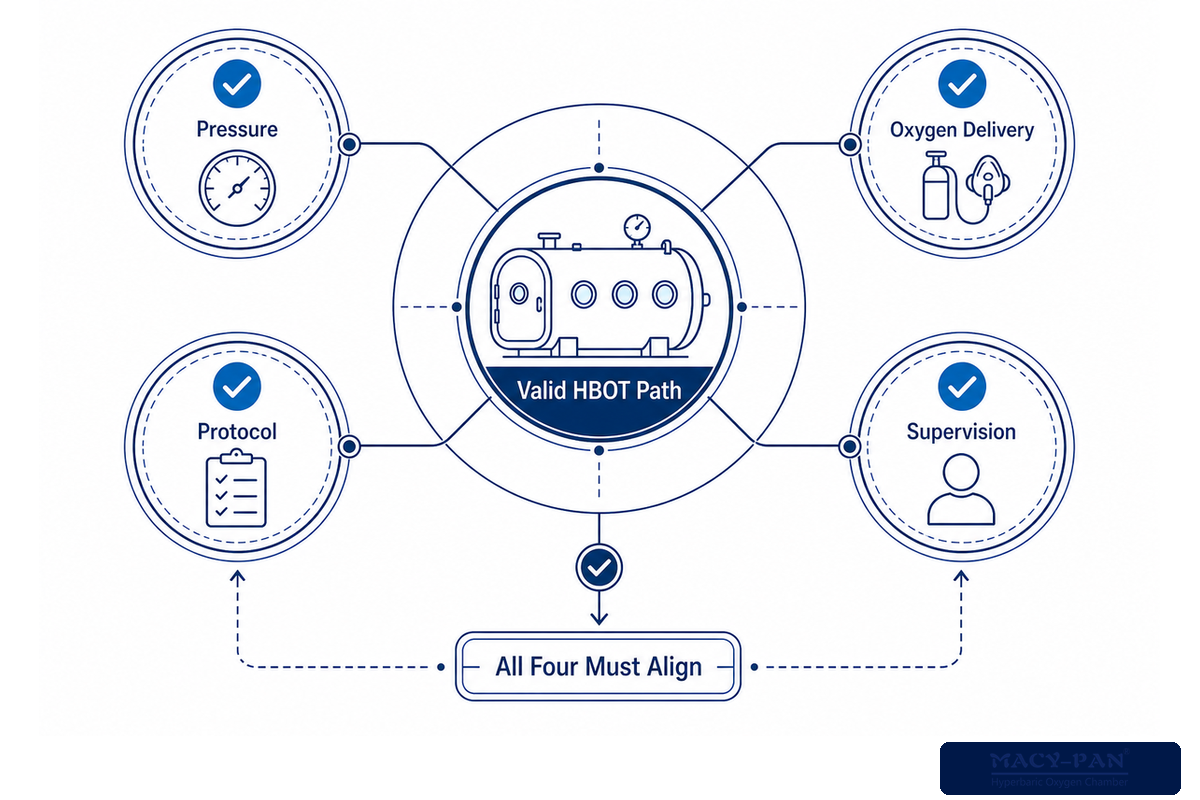
Run the Pressure-Equivalence Test before comparing prices. Confirm whether the option increases ambient pressure, how oxygen is delivered, whether the protocol fits the stated goal, and who controls screening, supervision, maintenance, and emergencies. Changing one of those elements may still leave a useful option, but not an automatically equivalent one.
Pressure-Equivalence Test: a four-question screen that separates a cheaper HBOT access path from an oxygen product or a condition-specific alternative.
Hyperbaric oxygen therapy combines oxygen-rich delivery or pure oxygen with a pressurized environment. The European code of good practice identifies three essentials: chamber, pressure, and oxygen. It also treats a clinical service as a complete system that includes people, procedures, maintenance, emergency readiness, and administration.
Pressure definitions depend on source and context. StatPearls uses a broad HBOT definition of at least 1.4 atmospheres absolute with 100% oxygen. Professional clinical guidance may add more specific thresholds, indications, chamber standards, and oversight requirements. No single pressure number works as a universal consumer approval rule.
Understanding hyperbaric therapy starts with the mechanism. In plain language, hyperbaric oxygen therapy involves breathing oxygen in a pressurized setting so higher pressure can help more oxygen dissolve into blood plasma than normal-pressure delivery can. That describes a bloodstream mechanism, not a universal treatment benefit.
At 1 atmosphere absolute, an oxygen mask can increase inspired oxygen and affect oxygen levels or oxygen saturation, but it doesn’t create chamber pressure. Saying the body can “gather more oxygen” isn’t enough to establish equivalence.
- Confirm pressurization — ask whether the option raises ambient pressure around the patient, rather than merely increasing oxygen concentration.
- Identify oxygen delivery — document the gas source, concentration, interface, and whether the protocol uses air or medical-grade oxygen.
- Match the protocol — connect pressure, duration, frequency, and setting to the actual diagnosis or nonmedical goal.
- Verify the operating system — name the clinician or responsible operator, maintenance process, fire controls, and emergency response plan.
The test catches a category error. “More oxygen” and “oxygen under increased pressure” aren’t interchangeable. Pressurization capability alone doesn’t prove that a proposed protocol is appropriate, supervised, or supported for a particular condition.
Pressure-first rule: if an option removes pressurization, clinical oversight, or a goal-matched protocol, describe the difference before discussing the discount.
Readers who need product-level detail can review MACY-PAN’s hyperbaric chamber pressure categories. This guide stays at the decision level, so it doesn’t duplicate a model selector or a complete soft-versus-hard comparison.
Five Lower-Cost Paths That Preserve the Right Goal
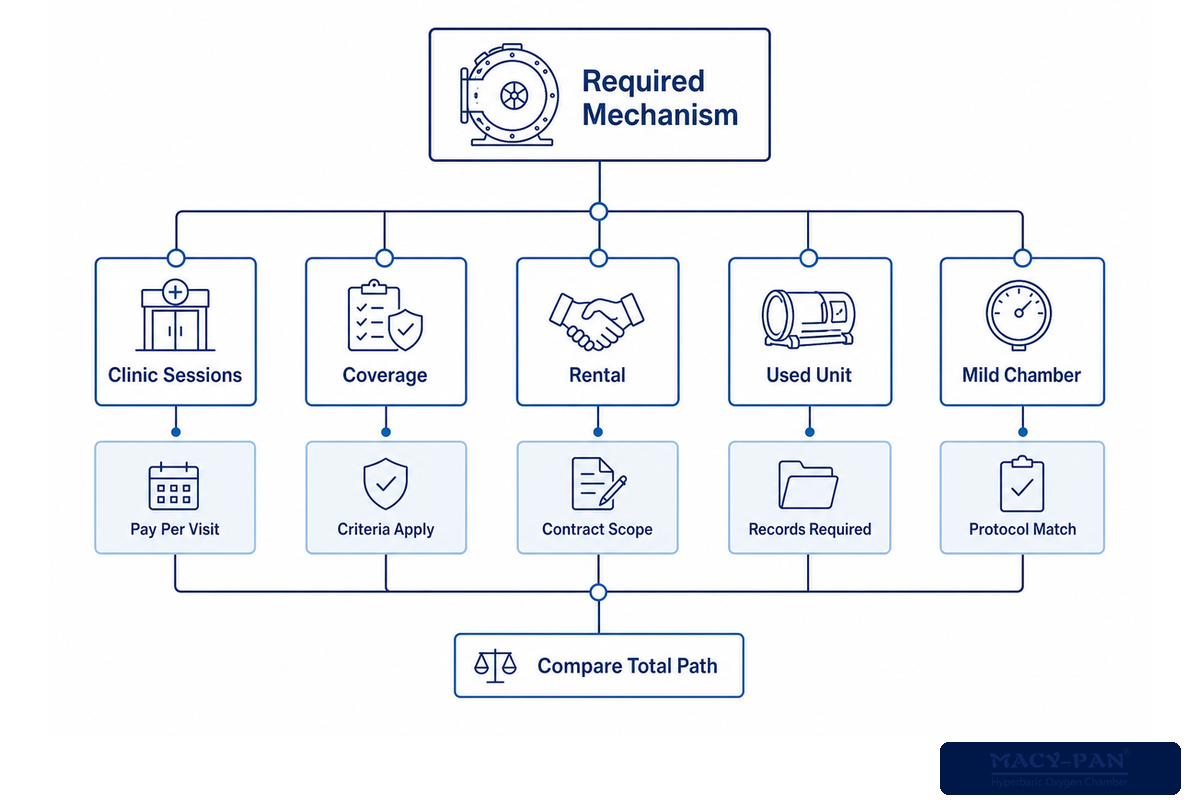
Five paths can lower upfront spending without pretending a normal-pressure oxygen product is HBOT: clinic access, eligible insurance coverage, a bounded rental, a documented used chamber, or financing. Each path changes a different cost variable, so the right choice depends on duration, frequency, location, service support, and clinical need.
Pay for supervised clinic access instead of owning equipment
For a prescribed, finite course, clinic access avoids buying a chamber, arranging installation, maintaining the equipment, and building operating capability. Travel, scheduling, missed work, and repeated appointments still matter, which is why geographic accessibility belongs in the comparison.
Clinic access also preserves the people-and-procedure layer of the service. That matters when screening, pressure changes, oxygen delivery, and a response to symptoms require trained staff. It isn’t the cheapest route for every schedule, but it’s the clearest starting point when long-term equipment access is unnecessary.
Check diagnosis- and criteria-specific coverage
Insurance coverage is conditional, not a wholesale discount. Medicare NCD 20.29 lists covered conditions and requirements; its diabetic lower-extremity wound provision includes specific wound classification, diabetes, and failure-of-standard-care criteria. Other insurers, plans, jurisdictions, and indications can differ.
Ask the treating facility to verify the policy, diagnosis coding, prior authorization, documentation, network status, and patient responsibility. “Covered by insurance” should mean the payer has evaluated the actual case, not that a web page mentioned the condition.
Rent or lease when the contract is bounded
A bounded rental can reduce the initial commitment, but a monthly payment doesn’t reveal the whole contract. Compare delivery, setup, oxygen equipment, consumables, technical support, replacement during downtime, pickup, damage responsibility, access requirements, renewal, and early termination.
Delivery day is often the first practical stress test. Narrow doorways, stairs without a handling plan, or missing electrical and oxygen interfaces can turn “available at home” into a delayed installation. Confirm route dimensions and site requirements before signing.
Renewal language deserves the same attention as the headline rent. Put the end date, pickup window, deposit return, auto-renewal trigger, and cancellation notice in a one-page comparison. That tells you more than an isolated hyperbaric chamber rental cost.
Consider used equipment only with traceable records
Used equipment may lower acquisition cost while preserving pressurization, but missing records should stop the purchase. Ask for model and serial identification, original documents, inspection history, preventive maintenance, repairs, replaced components, current condition, installation compatibility, service availability, and jurisdiction-specific requirements.
Service records do more than document past work. They show whether recurring problems were addressed, who performed repairs, whether supported parts remain available, and whether a future maintenance baseline can be established. Cosmetic condition can’t replace that trail.
For a detailed equipment review, use the hyperbaric certification decoder and involve qualified technical and regulatory reviewers. This article doesn’t certify a particular used device.
Use financing to change cash flow, not to claim savings
Hyperbaric chamber financing spreads payments; it doesn’t prove a lower total cost. Compare total payments, finance charges, deposit, warranty, service, training, installation, insurance, ownership timing, and early-exit terms.
Financed ownership can fit frequent, planned access when the equipment, site, staff, and service model are already justified. It’s a poor way to solve uncertainty about diagnosis, protocol, or demand. Resolve those questions before changing the payment schedule.
Readers who need price arithmetic should use the separate hyperbaric chamber cost guide. Keeping detailed calculations there prevents this decision guide from competing with the site’s established cost page.
Mild and Lower-Pressure Chambers: Less Expensive Does Not Mean One Category
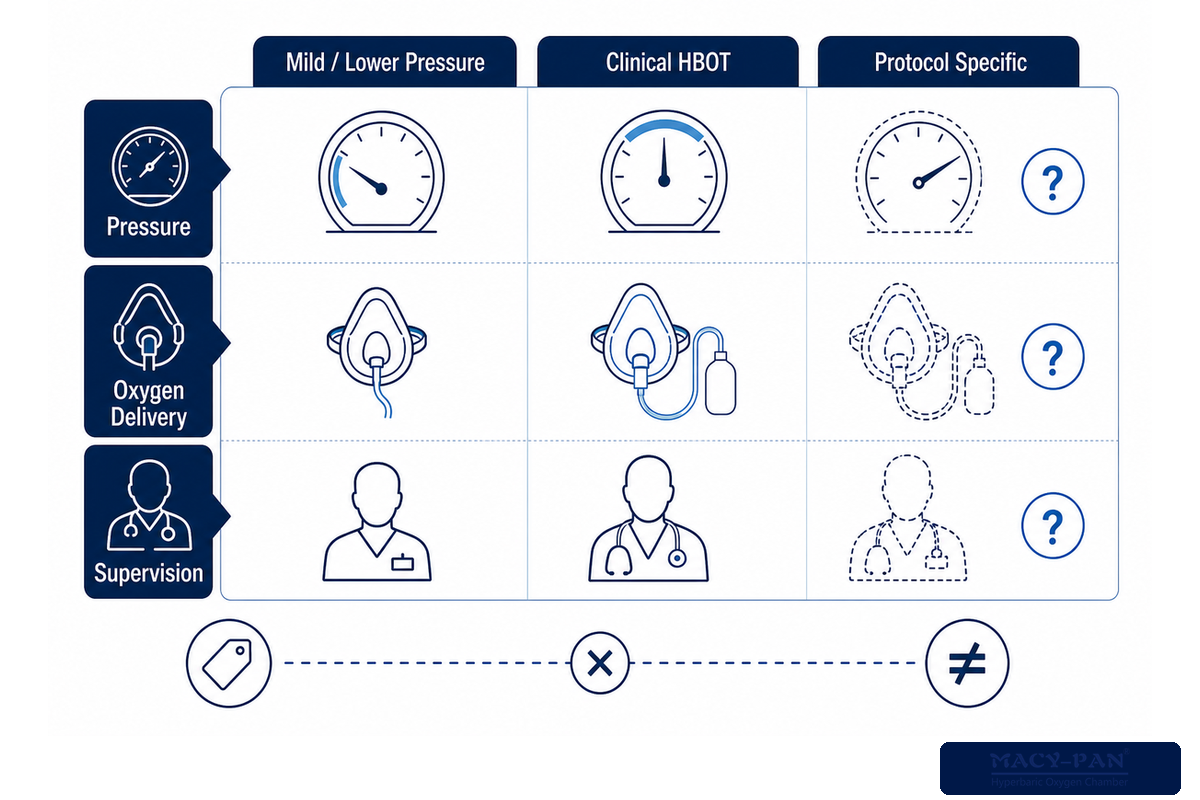
Mild hyperbaric chambers may cost less than higher-pressure clinical systems, but “mild” covers different devices, gases, pressures, settings, and intended uses. Lower pressure alone doesn’t establish clinical equivalence, regulatory status, supervision quality, or suitability for a medical condition.
A small open-label randomized study in hospitalized patients with COVID-19 shows why blanket statements fail. Its protocol used 1.45 ATA with near-100% oxygen for at least five 90-minute sessions. Researchers reported faster correction of hypoxemia, but no significant difference in several major outcomes, including acute respiratory distress syndrome, mechanical ventilation, or death.
That trial doesn’t make every sub-2.0 ATA device a clinical substitute. It involved a narrow hospitalized population and a small sample. The study shows that lower-pressure protocols can exist in supervised research, not that any consumer device is validated or that results transfer to another condition.
Use four labels when comparing mild hyperbaric treatment: actual operating pressure, gas and oxygen-delivery method, intended setting, and responsible medical or safety oversight. Then ask for evidence tied to the proposed condition and protocol.
Equipment catalogs often group hyperbaric oxygen chambers as monoplace and multiplace systems. Monoplace hyperbaric equipment treats one occupant, while a multiplace hyperbaric system accommodates more than one person. Those types of hyperbaric chambers still differ in protocol, setting, and oversight. Each hyperbaric oxygen therapy chamber or other HBOT chambers must be evaluated on the complete use case.
Choosing the best hyperbaric chamber is therefore a requirements exercise, not a universal ranking. No single best chamber exists independently of the pressure, setting, staffing, service, and intended-use questions in this guide.
Mild hyperbaric oxygen therapy is another label that needs its own pressure, gas, setting, and supervision details. Even a stated treatment session format doesn’t transfer evidence from one protocol or indication to another.
For hardware differences, see the dedicated soft-shell hyperbaric chamber guide. This section intentionally avoids repeating construction, feature, and purchasing details.
What Does Not Replace a Hyperbaric Chamber Mechanistically?
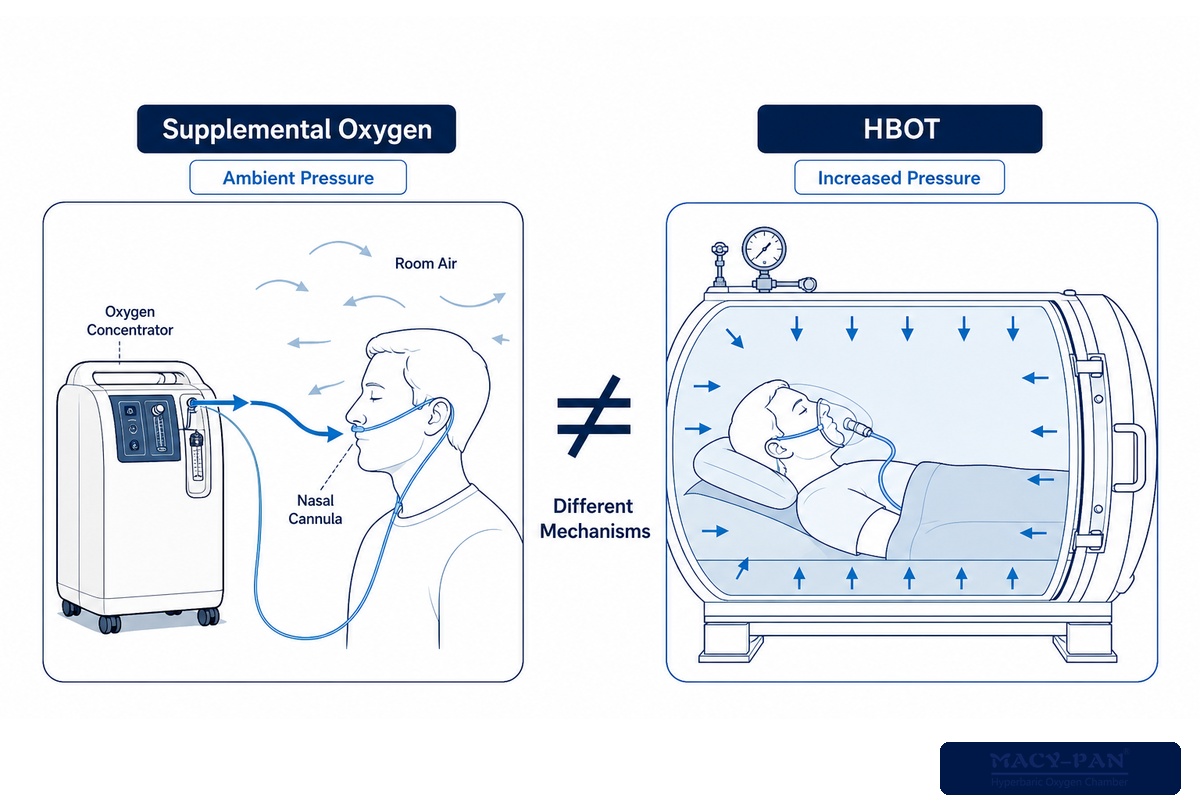
Normal-pressure oxygen devices and unrelated wellness equipment don’t replace a hyperbaric chamber mechanistically because they don’t reproduce increased ambient pressure around the user. Some can have separately supported uses, but they can’t borrow HBOT indications or outcome claims merely because oxygen or recovery appears in the description.
MedlinePlus describes oxygen therapy as extra oxygen delivered through devices such as tanks or an oxygen concentrator. That can be prescribed for low blood oxygen and other medical conditions, but the surrounding pressure stays normal. HBOT adds a pressurized chamber to the oxygen-delivery system.
| Category / option | Raises ambient pressure? | Delivery route | May have a separate valid use? | Can it borrow HBOT evidence? |
|---|---|---|---|---|
| Oxygen concentrator | No | Supplemental oxygen at normal pressure | Yes, when prescribed for its intended purpose | No |
| Standard supplemental oxygen | No | Mask or nasal interface at normal pressure | Yes, for clinician-directed oxygen therapy | No |
| High-flow oxygen | No | Clinician-directed oxygen at normal pressure | Yes, in its own clinical context | No |
| Oxygen bar | No | Consumer oxygen exposure at normal pressure | Product- and claim-specific only | No |
| Canned oxygen | No | Portable consumer oxygen product | Product- and claim-specific only | No |
| Exercise with oxygen | No | Exercise plus supplemental oxygen | Evidence must match the proposed goal | No |
| Topical oxygen | Not whole-body pressurization | Oxygen applied locally to a wound | Possibly, for a condition-specific wound-care question | No; different route and evidence base |
| Unrelated recovery or wellness device | No | Device-specific | Only if independently supported | No |
“Alternative to hyperbaric” can mean two different things. A mechanism-preserving alternative finds another way to access an appropriate chamber and protocol. An outcome alternative uses a different intervention for a specific condition. The second option needs its own evidence and clinician judgment.
Search results may also mix EWOT, spa oxygen, and traditional methods marketed to support recovery into the same list. Those are separate categories, and each needs evidence for its own mechanism, intended use, and safety profile.
When a Different Treatment May Target the Same Goal
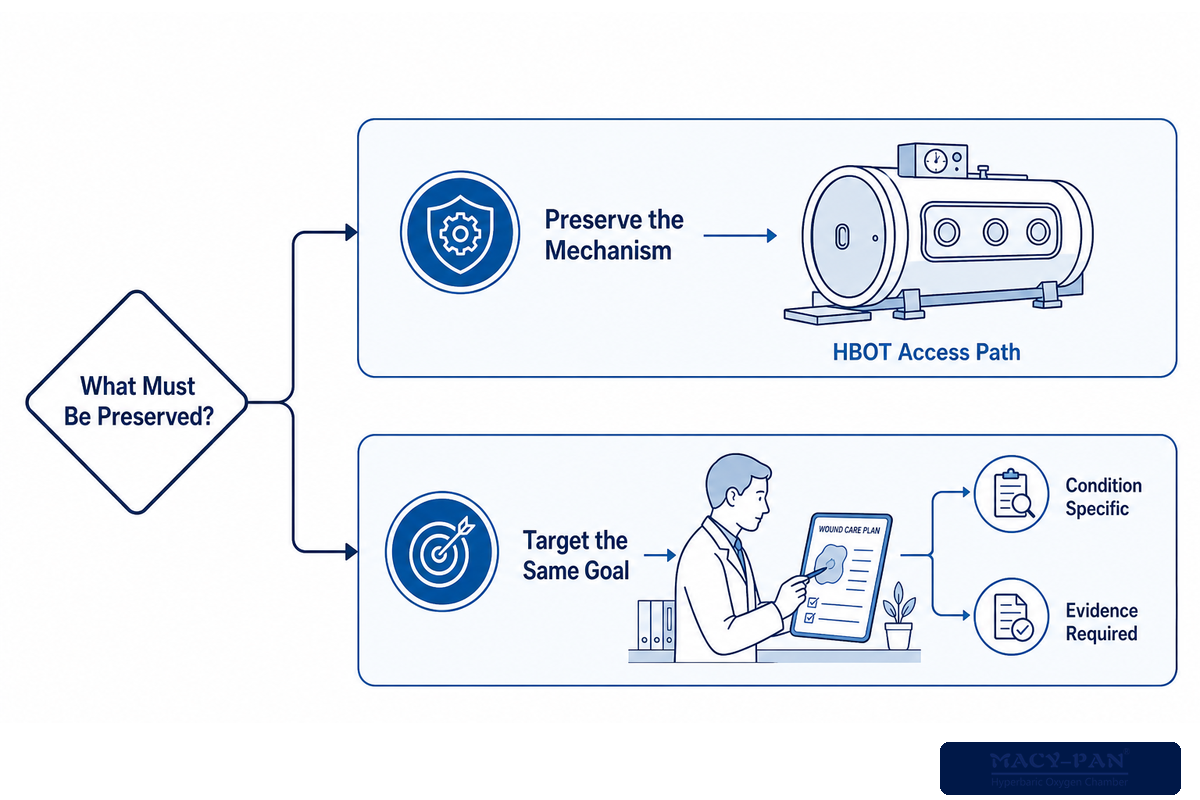
A different treatment may target the same clinical outcome without replacing HBOT. Make the comparison diagnosis-specific: ask whether the alternative has evidence for that condition, route, setting, and patient group. Never transfer the benefits of hyperbaric oxygen therapy to a device or modality that works through another mechanism.
Topical oxygen for selected diabetic foot-ulcer care is one example. A 2022 systematic review and meta-analysis included seven randomized trials with 614 participants and reported a higher healing rate for topical oxygen than control, with a pooled risk ratio of 1.63. The authors also noted uncertainty and the need for further research.
The current Medicare local coverage determination draws the same mechanism boundary: topical oxygen isn’t HBOT. It notes that some intermittent topical-oxygen systems can be used at home by a trained patient or caregiver, yet the cited local policy is a noncoverage determination and characterizes the evidence as poor or weak. Coverage conclusions can vary by jurisdiction and policy.
Mechanism-preserving access path
- Uses a chamber and increased ambient pressure
- Matches pressure and oxygen delivery to the stated protocol
- Keeps screening, supervision, maintenance, and emergency controls in view
- Compares clinic, rental, used, or financed access
Condition-specific outcome alternative
- May use a different biological or delivery mechanism
- Requires evidence for the exact diagnosis and patient group
- Needs its own safety, supervision, and coverage review
- Cannot inherit HBOT indications or treatment claims
The practical question for a clinician isn’t “What’s a cheap HBOT substitute?” It’s “For this diagnosis and outcome, which supported options are appropriate, and what does each require?” That wording prevents a mechanism mismatch while leaving room for valid alternative treatments.
Alternative therapies may be described with phrases such as “reduce inflammation,” “stimulate repair,” “promotes healing,” or “natural healing processes.” These are outcome claims, not proof of equivalence. Evidence about the benefits of HBOT or benefits of hyperbaric treatment can’t be transferred to another modality without diagnosis-specific support.
Use the 3-Part Pressure-Path-Place Decision Grid
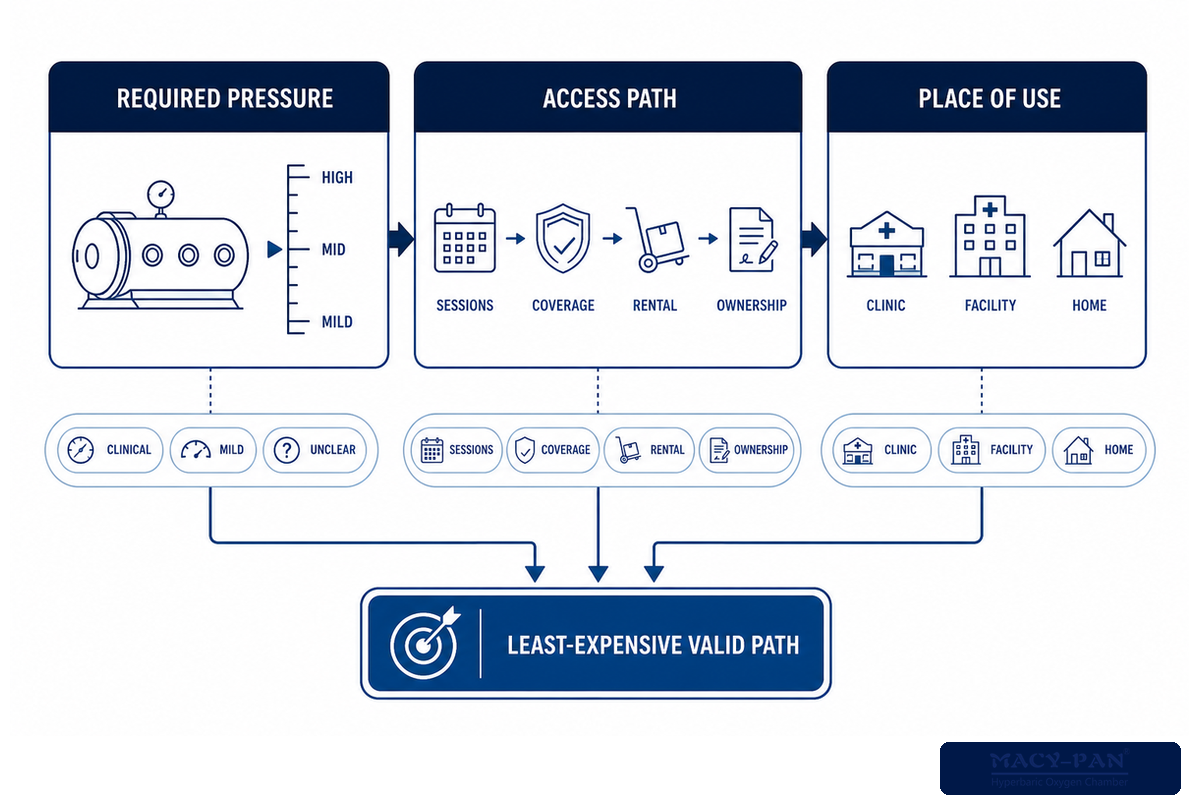
The Pressure-Path-Place Decision Grid selects the least-expensive valid route by testing three variables in order: the required pressure and protocol, the access path, and the place of use. Price comes after fit. A failed pressure or safety requirement eliminates an option even when the monthly payment looks attractive.
Pressure-Path-Place Decision Grid: decide what mechanism is required, how to access it, and where it can be operated responsibly.
| Situation | Pressure question | Likely path to evaluate first | Place | Limitations / not suitable for |
|---|---|---|---|---|
| Suspected urgent indication | Clinician determines protocol | Emergency medical evaluation | Appropriate medical facility | Not suitable for home price shopping or treatment delay |
| Prescribed finite course | Protocol already specified | Supervised sessions plus coverage check | Hospital or supervised facility | Travel and scheduling may remain burdensome |
| Diagnosis or goal uncertain | Not yet established | Clinical assessment before equipment | Clinical setting | Do not finance or rent to solve diagnostic uncertainty |
| Frequent, planned non-urgent access | Document required pressure and delivery | Compare bounded rental, verified used, and financed purchase | Qualified clinic or suitable installed location | Requires utilization, service, staffing, and site justification |
| Home convenience request | Do not infer equivalence from oxygen or “mild” alone | Screen candidacy, site, supervision, and support first | Home only if the complete plan is suitable | No substitute for emergency capacity or goal-matched medical care |
Stop the comparison when there’s no diagnosis-specific goal, the seller asks you to infer equivalence from oxygen alone, service history is missing, supervision is undefined, or the contract hides inclusions and exit terms. Those are unresolved requirements, not minor price objections.
For a home-use evaluation, the home chamber candidacy and safety self-check can organize questions. It doesn’t replace a clinician, facility policy, local rules, or device documentation.
Safety Boundaries Before You Cut Cost
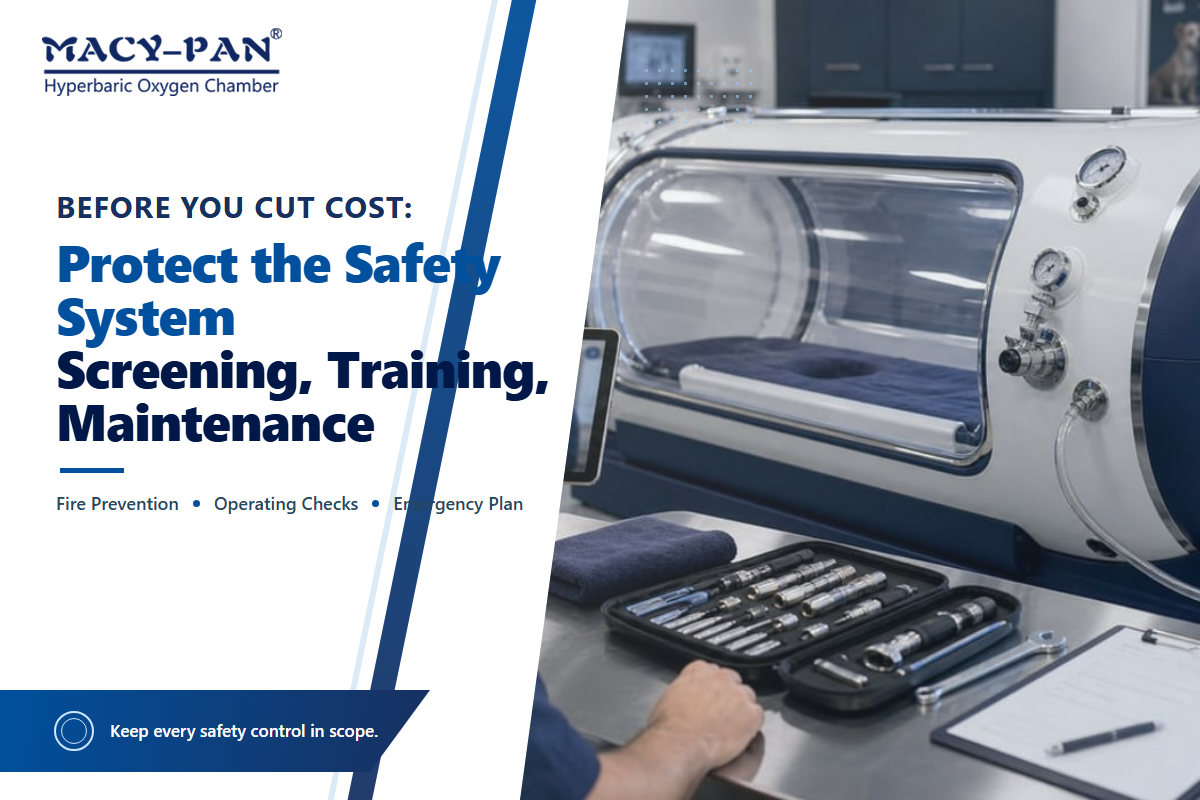
Safety is an operating system, not an accessory on a quotation. Before cutting cost, verify medical screening, intended use, trained supervision, fire and oxygen controls, cleaning, preventive maintenance, inspection, and an emergency or transfer plan. Without those controls, a cheap chamber isn’t a complete alternative.
MedlinePlus lists risks and precautions for hyperbaric oxygen therapy, including ear or sinus effects, temporary vision changes, low blood sugar in people treated with insulin, oxygen-toxicity seizures, and fire risk in oxygen-rich environments. Screening and monitoring should match the patient and protocol.
StatPearls identifies untreated pneumothorax as an absolute contraindication to HBOT. That’s one reason an internet checklist can’t replace medical screening.
Potential side effects, individual health needs, concurrent treatment, and the operating setting all belong in coordinated care. Equipment price can’t answer those questions.
Search language needs the same discipline. “FDA-approved,” “overall health,” “brain injuries,” “blood flow,” and “new blood vessels” aren’t interchangeable evidence categories. A listing that says 1.3 ATA or 120 minutes supplies numbers, not medical suitability. Every pressure, duration, indication, and outcome still requires source-matched review.
When NOT to buy a hyperbaric chamber
Don’t buy when the medical goal is undefined, a promised result is unsupported for the proposed protocol, the site can’t meet operating requirements, or no qualified person owns safety and maintenance. Pause when records are missing, oxygen and fire controls are vague, training is optional, or emergency transfer depends on improvisation.
Do
- Define the intended use and pressure protocol
- Verify instructions, training, and responsible supervision
- Request inspection, maintenance, and repair records
- Document fire controls and emergency response
Don’t
- Assume more oxygen means the same treatment
- Treat a low payment as proof of low total cost
- Use missing records as a bargaining opportunity
- Delay urgent evaluation to compare equipment
Commercial discussions should end with documentation, not a treatment promise. MACY-PAN can explain chamber categories, installation scope, training options, service support, and equipment records. Diagnosis, candidacy, protocol selection, and coverage remain with the appropriate clinical and payer professionals.
Frequently Asked Questions
Searchers also ask “how much does it cost to rent a hyperbaric chamber,” about the pros and cons of hyperbaric chamber use, and about side effects of oxygen concentrator use. The answers below keep cost, mechanism, and safety questions separate.
What is the cheapest alternative to buying a hyperbaric chamber?
Answer
For a prescribed finite course, supervised clinic sessions usually require less upfront commitment because the facility supplies the chamber, staff, maintenance, and operating system. Compare travel, scheduling, coverage, network status, prior authorization, and out-of-pocket responsibility. Frequent long-term access needs a separate rental-versus-purchase analysis based on actual utilization and site readiness.
Is an oxygen concentrator a cheaper alternative to a hyperbaric chamber?
Answer
No. As the MedlinePlus oxygen-therapy overview explains, an oxygen concentrator supplies concentrated oxygen at normal pressure, while HBOT combines oxygen delivery with increased ambient pressure inside a chamber. The devices solve different mechanism questions. A concentrator may have a valid prescribed purpose, but it can’t inherit HBOT indications, pressure-dependent effects, or clinical evidence simply because both involve oxygen.
Is a mild hyperbaric chamber the same as clinical HBOT?
Answer
Not automatically. Mild devices and protocols differ in pressure, gas, oxygen delivery, intended setting, standards, and oversight. A sub-2.0 ATA protocol can appear in supervised clinical research, but that fact doesn’t validate every lower-pressure device, prove suitability for home use, or transfer evidence between medical conditions. Compare the complete protocol and operating system, not the pressure label alone.
Can insurance cover hyperbaric oxygen therapy?
Answer
Sometimes. Coverage depends on the condition, policy criteria, documentation, authorization, network, and patient responsibility. Medicare NCD 20.29 is one example, not a universal guarantee.
Is renting a hyperbaric chamber cheaper than buying?
Answer
Renting can reduce upfront commitment, but it’s cheaper only when the full contract and expected use period support that result. Compare delivery, setup, oxygen equipment, consumables, technical support, replacement during downtime, pickup, deposits, damage responsibility, auto-renewal, and cancellation. Also confirm doorway access, installation requirements, and who pays if the planned site can’t accept the chamber. A monthly rate alone can’t answer the question.
Can topical oxygen replace HBOT for wound care?
Answer
Topical oxygen isn’t a mechanism substitute for HBOT. It applies oxygen locally rather than exposing the body to increased ambient pressure. Evidence, candidacy, protocol, and coverage must be evaluated for the exact wound and jurisdiction.
What records should I request before buying a used chamber?
Answer
Request model and serial details, original documents, inspection history, preventive maintenance, repair forms, replaced components, a current-condition assessment, installation requirements, supported parts, service contacts, and applicable compliance records. Confirm who performed past work and whether future maintenance is available. Missing traceability should pause the purchase until qualified technical and regulatory reviewers can resolve it.
When should I stop comparing prices and seek urgent care?
Answer
Seek emergency evaluation when decompression sickness, carbon monoxide poisoning, gas embolism, or another acute emergency is suspected. Don’t delay care to compare equipment.
Choose the Least-Expensive Valid Path, Not the Cheapest Label
The right cheaper alternative to a hyperbaric chamber preserves the actual goal. For some readers, that means supervised sessions or eligible coverage. For others, it means a bounded rental, a documented used device, or financing after the site and operating plan are justified. A different treatment belongs in a condition-specific clinical comparison.
If you’re evaluating equipment, ask MACY-PAN for pressure documentation, intended-use information, installation requirements, training and service scope, and maintenance support. Use the hyperbaric chamber selector, then prepare a documented project inquiry. Equipment guidance isn’t medical advice and doesn’t guarantee treatment outcomes or insurance coverage.
Prepare a Pressure-Appropriate Equipment Brief
Share the intended setting, required pressure range, expected use frequency, installation location, service expectations, and local documentation needs. MACY-PAN can help organize an equipment discussion without substituting for clinical evaluation.
Transparency statement: This guide separates mechanism-equivalent access from condition-specific outcome alternatives. It doesn’t rank products, provide a universal price table, diagnose a condition, prescribe a protocol, or promise coverage. Government, clinical, academic, and professional sources support the safety and evidence boundaries; commercial pages informed only the questions buyers should ask.
References & Sources
- Oxygen Therapy MedlinePlus, U.S. National Library of Medicine
- Hyperbaric Oxygen Therapy: Patient Instructions MedlinePlus, U.S. National Library of Medicine
- European Code of Good Practice for Hyperbaric Oxygen Therapy PubMed Central
- Hyperbaric Oxygen Therapy StatPearls, National Center for Biotechnology Information
- National Coverage Determination 20.29 Centers for Medicare & Medicaid Services
- Clinical Trial of Hyperbaric Oxygen at 1.45 ATA PubMed Central
- Topical Oxygen Therapy for Diabetic Foot Ulcers: Systematic Review and Meta-analysis PubMed
- Local Coverage Determination L37873: Topical Oxygen Therapy Centers for Medicare & Medicaid Services
![Decision lenses: occupancy, gas path, access, staffing, facility interfaces, and exact-model evidence [article].](https://macypansolutions.com/wp-content/uploads/2026/10/monoplace-vs-multiplace-hyperbaric-chambers-featured-1-768x512.png)