Get in Touch with MACY-PAN Company

Facility-planning guide · Updated October 2026
Monoplace vs multiplace hyperbaric chamber describes the operating model of each format and gives insight before a layout, staffing plan or supplier shortlist is finalized.
Direct answerA monoplace chamber typically treats one occupant and is monitored from outside. A multiplace chamber can accommodate several occupants and may allow a trained attendant inside. Neither format is universally better. The decision also depends on chamber gas, breathing interfaces, patient access, compatible equipment, staffing, facility interfaces, schedule design, maintenance, and model-specific evidence.
The label is only the beginning. “Monoplace” and “multiplace” describe occupancy, but they do not establish the complete gas path, pressure envelope, intended use, equipment compatibility, regulatory status, or clinical result of a particular device. That information is in the documentation of the device being modeled and the requirements of the proposed site.
This guide is for equipment and facility planning. It does not select treatment, prescribe a protocol, or replace qualified clinical, safety, engineering, regulatory, or authority-having-jurisdiction review. The guide provides the purchaser with three tools: a Hidden Bottleneck Map, a Capacity Worksheet and an RFQ Evidence Matrix.
Monoplace Chamber vs Multiplace Chamber: The 60-Second Answer
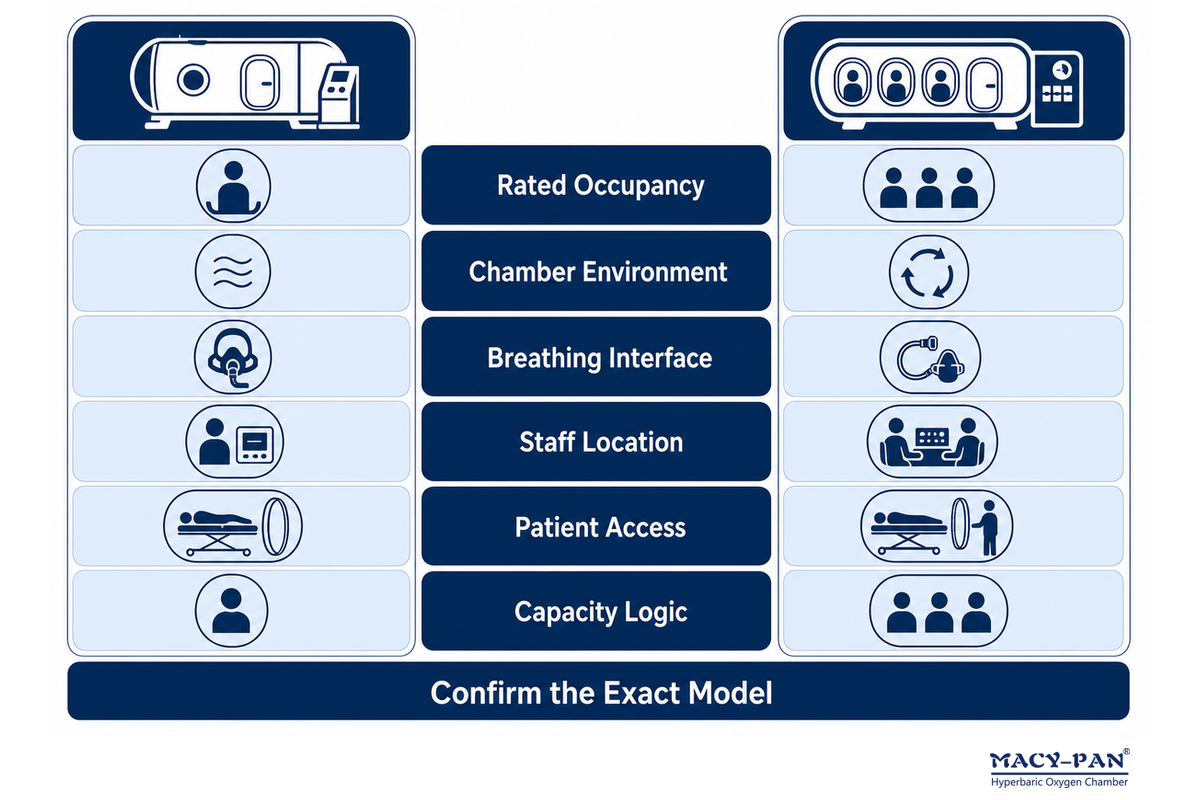
Of the monoplace and multiplace chambers, the most visible difference is in occupancy, but a more complete comparison would require assessing rated occupancy, chamber pressurizing gas, patient breathing gas and staff location. Designs of this nature tend to follow recognizable patterns; individual models may differ so each description requires a review of the documentation.
| Decision field | Monoplace: typical pattern | Multiplace: typical pattern |
|---|---|---|
| Rated occupancy | One occupant | Several occupants; confirm the model |
| Chamber environment | Often oxygen-rich; confirm the model | Often pressurized air; confirm the model |
| Breathing interface | May use the chamber environment | Often individual mask or hood; confirm the model |
| Staff location | Usually outside the chamber | An attendant may be inside |
| Patient access | External observation and communication | Potential hands-on access inside |
| Capacity logic | One station per chamber; staggered operation may be possible | Several stations may share a scheduled session |
| Decision risk | Choosing from occupancy alone and failing to confirm the exact model, site, staffing, and operating boundary | |
Each type of chamber is usually pictured differently, but the two types of HBOT chambers are not defined by shell material. A monoplace oxygen chamber may use a clear acrylic cylinder and is designed for one patient at a time. A system built to treat multiple patients is multiplace, and its approved documentation sets the exact capacity. Rated pressure may be expressed in ATA or atmospheres absolute.
Keep general comparisons separate from product decisions. MACY-PAN’s monoplace and multiplace chamber configurations provide first-party model information. Use the RFQ matrix below to verify any configuration you’re considering.
How HBOT Chamber Gas and Oxygen Delivery Differ
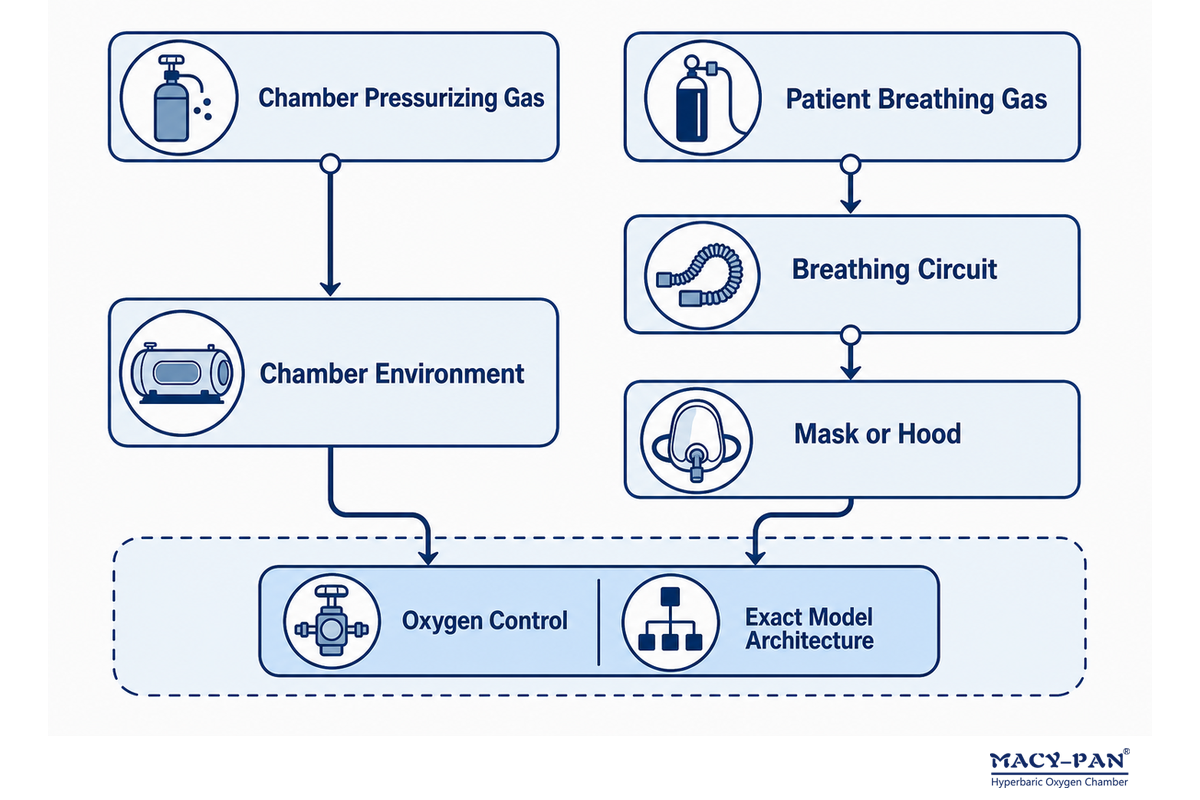
Ask, “what pressurizes the chamber?” and “what does each occupant breathe?” as two separate questions. Many monoplace systems use an oxygen-rich chamber environment. Many multiplace systems use a pressurized-air cabin while occupants receive oxygen through individual masks or hoods. This is a common architectural design, not a hard rule.
When a chamber is pressurized, the enclosure atmosphere and breathing circuit may follow different paths. Descriptions of hyperbaric medicine indicate patients breathe pure oxygen, but a HBOT chamber RFQ still requires the actual oxygen level, flow, and interface, as well as monitoring method. In many multiplace HBOT systems, the chamber room is pressurized with compressed air. Typically, when the chamber is pressurized with regular air, a breathing circuit connects the hood or mask to a supply of breathing gas. Confirm the exact model architecture.
The presence of an air pressurized cabin does not negate the need for oxygen control. Oxygen delivery equipment, clothing and material controls, grounding where specified, cleaning, maintenance, monitoring, prohibited items, staff training, and emergency procedures still require formal attention. The FDA’s August 2025 safety communication tells facilities to follow the instructions for the specific device rather than infer safe practice from a category name.
Evidence requestAsk the supplier for the gas-flow diagram, breathing-system description, operating pressure envelope, alarm and monitoring functions, cleaning and material restrictions, and the current instructions for the proposed configuration.
Commercial pages of the MACY-PAN hard-shell hyperbaric chamber range may help identify candidates. The delivered model’s controlled documents remain the evidence source for project approval.
Patient Access, Monitoring, and Compatible Equipment
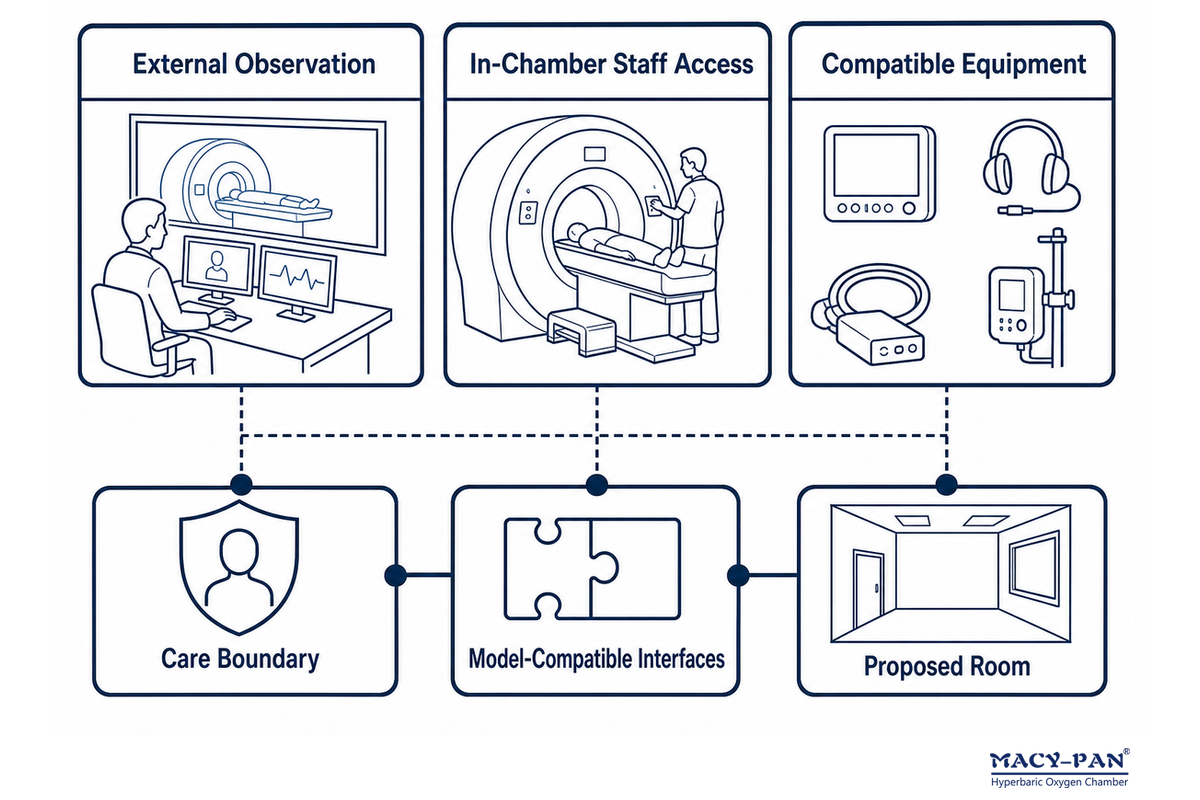
Practically speaking, do personnel working with hyperbaric equipment need to be located within the pressure environment? A monoplace patient is typically observed and contacted from the outside. A multiplace arrangement may position the trained hyperbaric medical staff inside the chamber, which could modify the plan for hands-on intervention, monitoring, communication, and compatible equipment. Safety and comfort also need to be assessed.
A 2015 critical-care review listed staff-access advantages for in-chamber staff and compatible intensive-care equipment for critically ill patients. It also listed benefits for monoplace systems for staffing and equipment installation. The review is limited to critical care and does not prove that multiplace is better for every patient or facility; an earlier systematic review found no comparative efficacy or safety studies that establish a universal winner.
Prior to selecting a system, map how the system integrates with the rest of the facility: communication, observation, pass-throughs, compatible monitoring devices, patient transfer, emergency decompression, and extraction. The clinical lead defines the care boundary. The supplier identifies model-compatible interfaces. The facility team verifies how those interfaces work in the proposed room.
Safety Discipline Applies to Both Formats
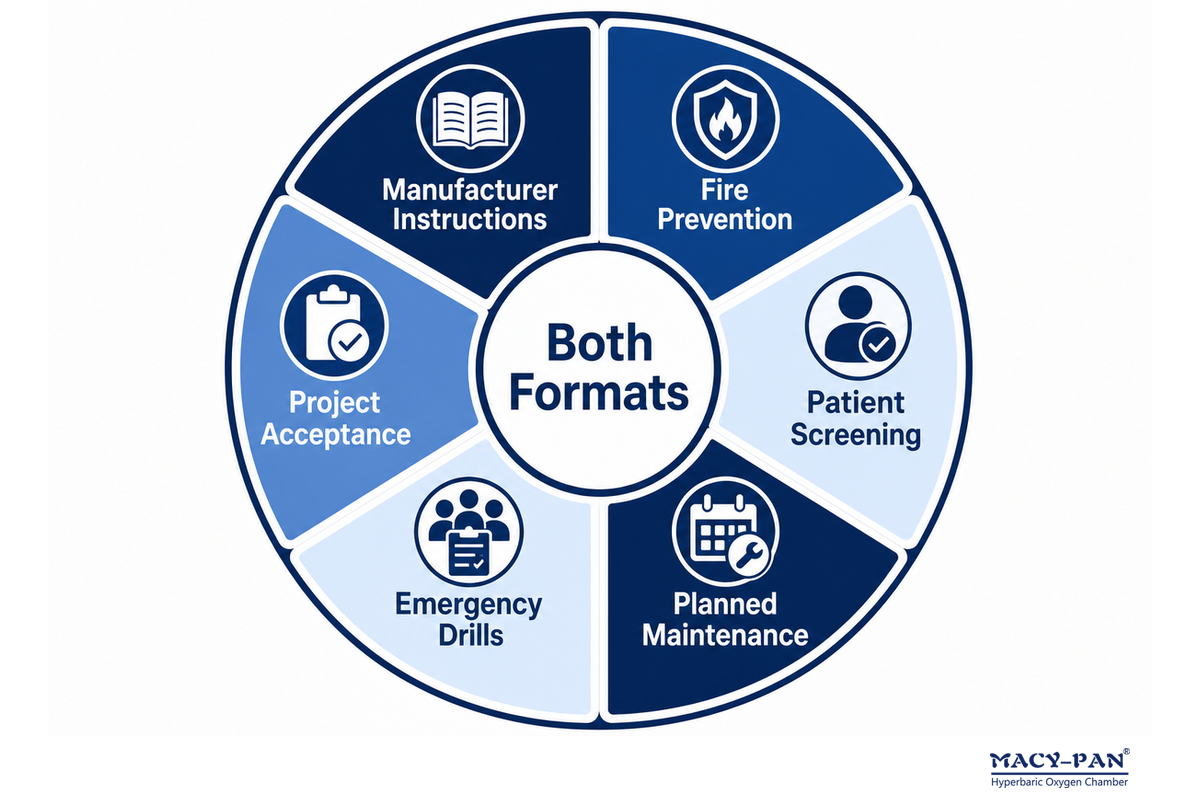
Neither format eliminates the need for operating controls for device-specific functions. Both types of hyperbaric oxygen chambers need a control plan for manufacturer instructions, fire prevention, trained supervision, patient screening, prohibited items, compatible clothing and materials, cleaning, routine checks, planned maintenance, emergency drills, event reporting, and changes.
“Ensure fire prevention and safety measures are followed for HBOT devices.”
The applicable codes, recognized standards, local adopted editions, project requirements, and authority having jurisdiction must be identified for the actual site. The FDA’s current CBF classification page lists NFPA 99:2024 and ASME PVHO-1:2023 among recognized standards. That listing is useful evidence, but it does not substitute for local adoption, the device’s own instructions, or project acceptance.
Due to the age and location of some professional guidance, it may not be applicable to every project. Use it to frame questions, then verify whether its edition, geography, and scope fit the project. Don’t assume that staffing numbers, room classifications, or inspection intervals from legacy facilities are applicable to new facilities.
Facility, Staffing, and Hyperbaric Chamber Service Boundaries
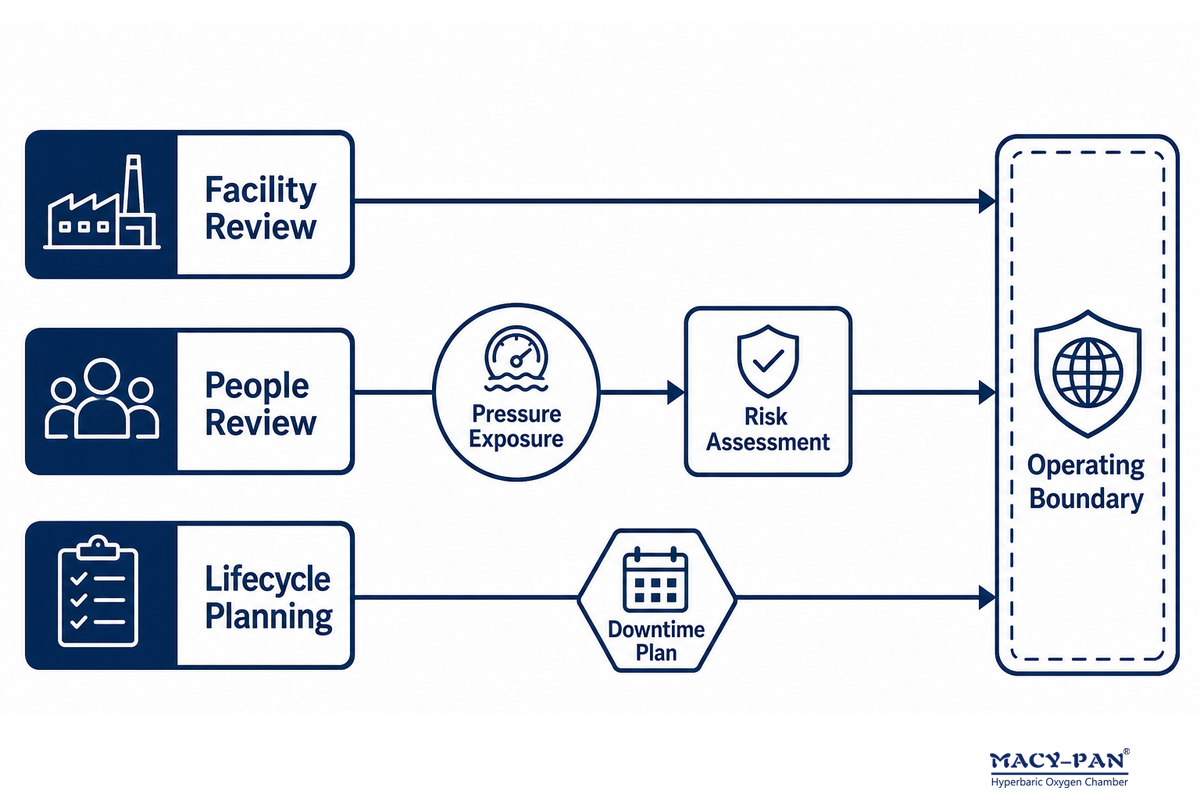
Separate the decision into facility, people, and lifecycle operations. A facility review covers access and egress, utilities, gas supply and storage, ventilation, structural interfaces, service clearances, emergency power, communications and commissioning. A multiplace installation may affect several of these interfaces. An assignment of clinical and safety responsibilities, operators, attendants, maintenance and emergency support constitutes a people review.
Staffing is based on intended use, patient acuity, chamber configuration, risk assessment and applicable requirements, not on a universally copied ratio. If an attendant must be located in the multiplace chamber due to an operating model, then risk assessment must include pressure exposure. A case report from 2024 documented recurrent cutaneous decompression sickness in an attendant located in the chamber. This case report documents risk; however, it doesn’t demonstrate what the incident rate may be or suggest one model of chamber may be safer than the others.
Lifecycle planning should identify inspection schedules, consumables, calibration, compatible cleaning materials, preventive maintenance, training renewal, spare parts, remote support, escalation, and a downtime plan. These items may influence the operability of a system after commissioning.
Hidden Bottleneck Map: Find the Constraint Before You Count Seats
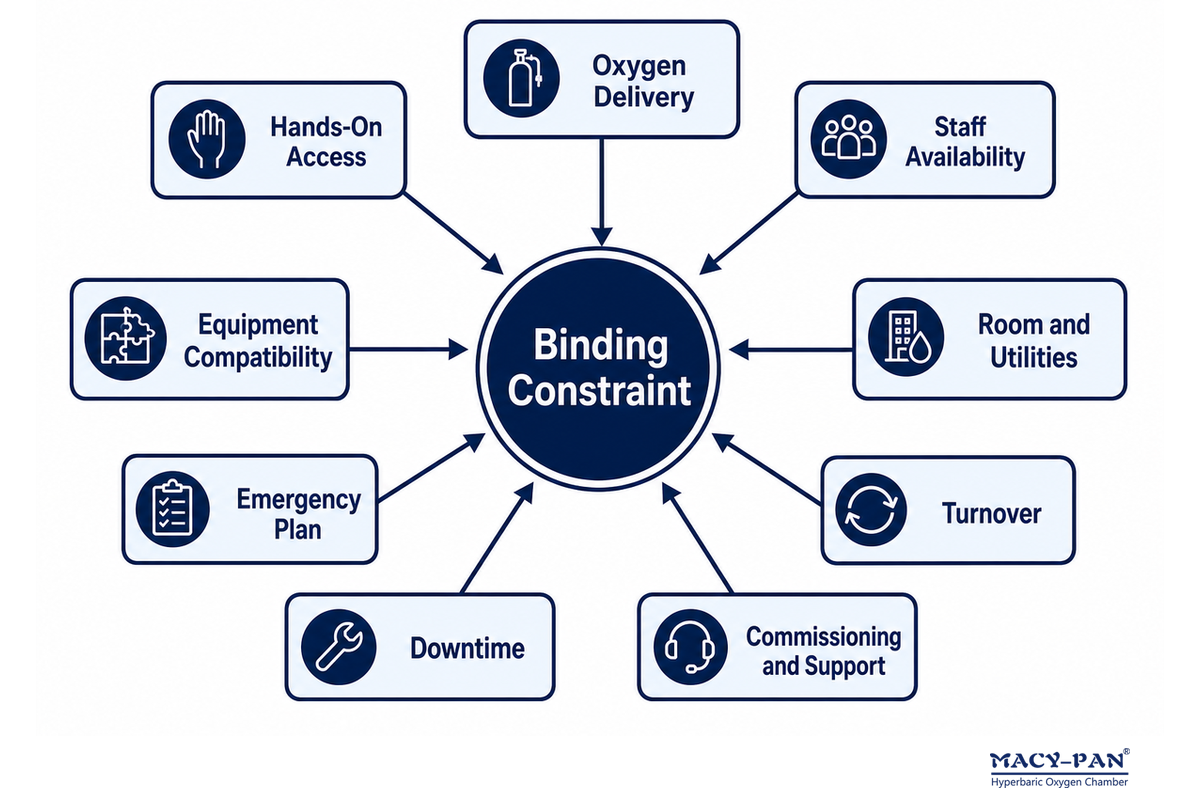
Rated occupancy matters only when another constraint is not already binding. Use this map with the medical director, hyperbaric safety or operations lead, facility engineer, and procurement owner before considering chamber counts.
| Constraint | Monoplace implication | Multiplace implication | Evidence / owner |
|---|---|---|---|
| Hands-on access | Plan external monitoring and response | Define attendant role and exposure controls | Care boundary / clinical lead |
| Equipment compatibility | Verify interfaces for the exact chamber | Verify each device in the pressure environment | Compatibility schedule / safety lead |
| Oxygen delivery | Verify chamber gas and supply controls | Verify each breathing interface and supply path | Gas-flow diagram / safety lead |
| Staff availability | May support independent station schedules | Session and attendant coverage may bind capacity | Roster model / operations |
| Room and utilities | Multiple chamber connections and service zones | Larger shared installation boundary | Interface schedule / facility engineer |
| Turnover | Each station can have a separate reset path | Group preparation can hold a scheduled session | Observed minutes / operations |
| Emergency plan | Define response for each occupied unit | Define response for all occupants and attendants | Drill record / safety lead |
| Downtime | One station may stop while others remain available | One outage may affect the scheduled group | Service plan / maintenance |
| Commissioning and support | Define acceptance tests, training, spares, escalation, and change control before layout approval | Evidence matrix / procurement | |
Capacity Worksheet: Compare Operations With Your Own Inputs
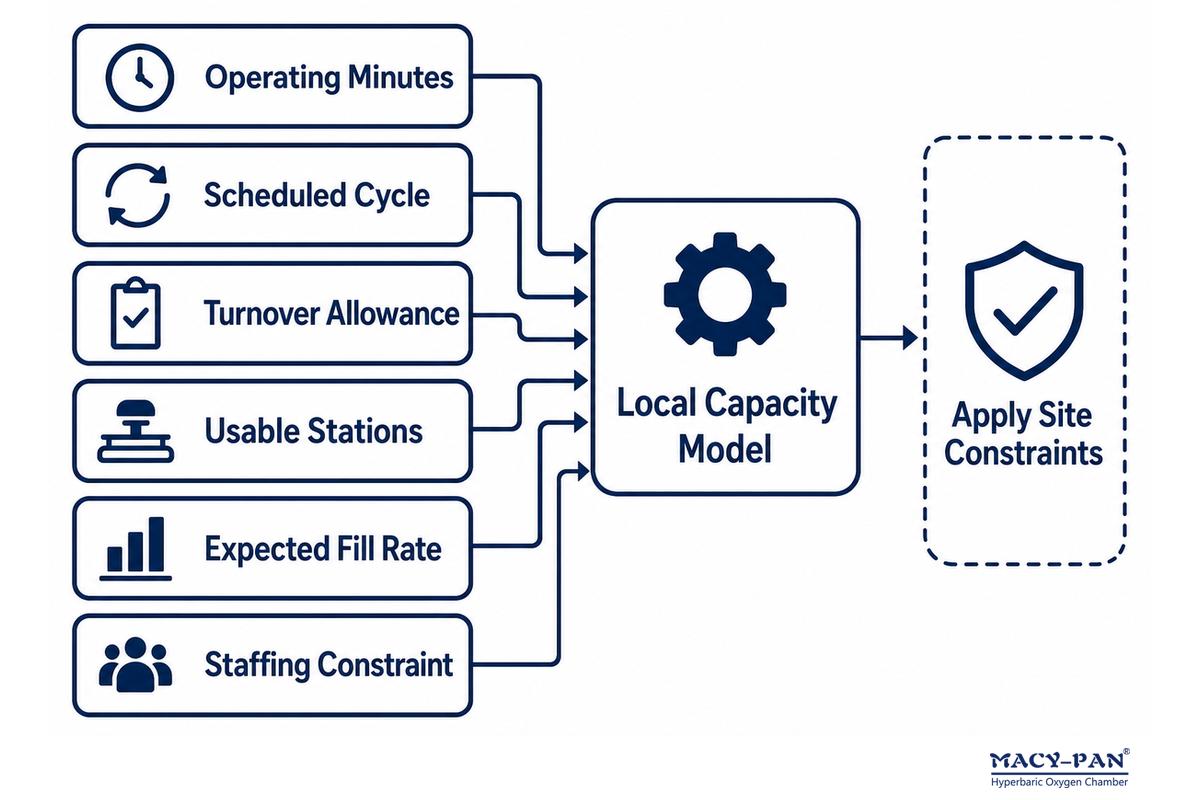
Do not convert rated seats directly into an annual throughput promise.
Record available treatment stations, scheduled cycle time, turnover allowance, operating hours, expected fill rate, planned downtime, and the staffing constraint. Referral eligibility and local payer or coverage rules are separate demand-side inputs; they are not equipment performance specifications.
Fill-in capacity model
Planned sessions per day = available operating minutes ÷ (scheduled cycle + turnover allowance)
Planned occupied station-cycles = sessions × usable stations × expected fill rate
Then apply staffing, planned downtime, patient-access, equipment, referral, and emergency-plan constraints. Use locally approved inputs; this arithmetic isn’t a clinical protocol or productivity guarantee.
Hypothetical example: If a proposed schedule makes 480 operating minutes available, uses a 120-minute scheduled cycle plus 30 minutes of turnover, and has four usable stations at a planning fill rate of 75%, the arithmetic produces three complete sessions and nine occupied station-cycles. Staffing limits, emergency drills, maintenance windows, or incompatible patient needs could reduce that number, and it’s a planning example, not a benchmark.
A 2025 Hong Kong single-center study reported 151 patients and 1,699 patient episodes in 2022 as compared to 253 patients and 3,656 episodes in 2023. Various concomitant factors such as more multiplace sessions, the introduction of a new monoplace service, and staffing changes and improvements as well as the promotion of referrals, occurred during the study period. The study is important because it shows that often several inputs simultaneously affect chamber operations, and it isn’t possible to isolate chamber-format effects.
Teams that need an early first-party shortlist can use the MACY-PAN hyperbaric chamber selector. Treat its result as an intake aid, then replace its assumptions with approved clinical, staffing, room, and demand inputs.
RFQ Evidence Matrix: What to Ask Before Layout Approval
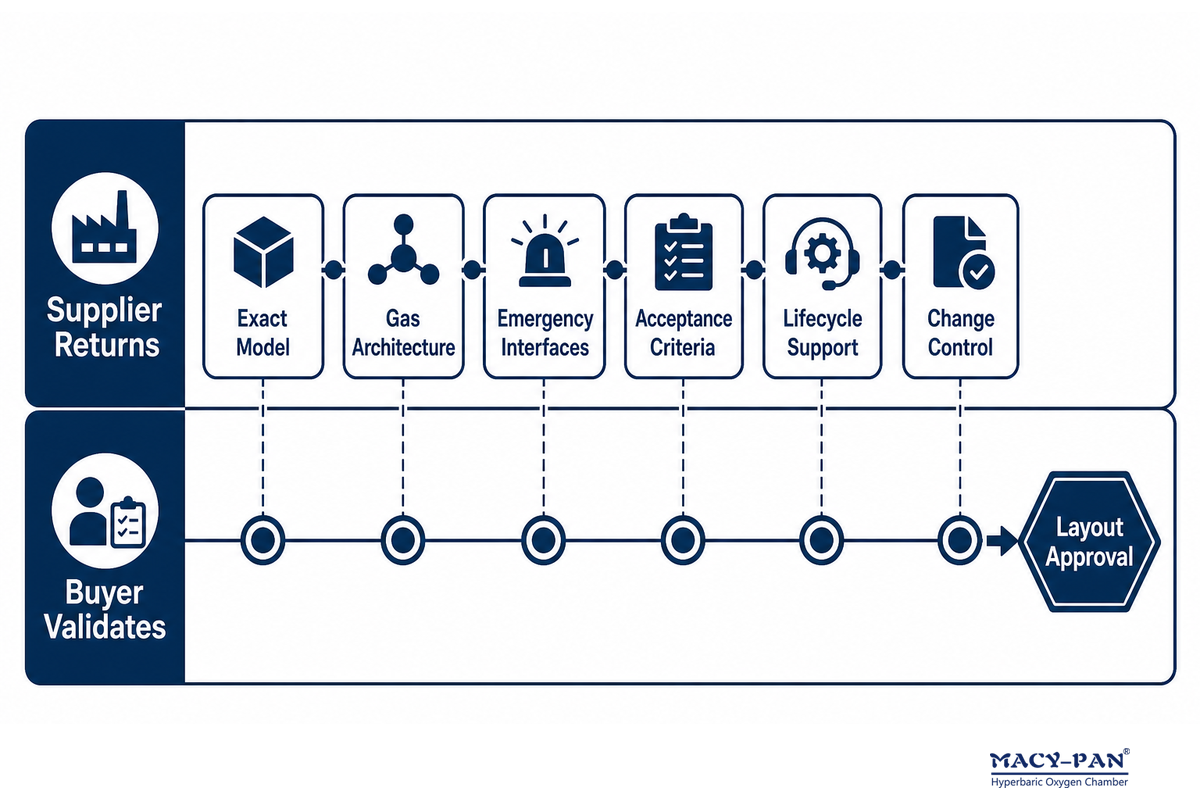
An RFQ with a defensible response framework names what the supplier returns and what the buyer validates. A brand logo, generic certificate image, or family brochure isn’t model-specific proof.
| Field | Supplier returns | Buyer validates |
|---|---|---|
| Intended use and occupancy | Exact model, users, configuration, rated occupancy | Care boundary and proposed use |
| Pressure, gas, and breathing system | Diagrams, envelope, interfaces, alarms, instructions | Utility, oxygen-control, and operating fit |
| Access and compatible equipment | Communication, pass-through, compatibility list | Monitoring, transfer, and emergency workflow |
| Room and emergency interfaces | Loads, clearances, supply, ventilation, emergency provisions | Site design and authority requirements |
| Inspection and project evidence | Applicable test records, inspection records, manuals, change history | Model/configuration identity and acceptance criteria |
| Standards and project requirements | Declared editions and model-specific basis | Local adoption and authority acceptance |
| Training and commissioning | Agenda, competency checks, test plan, handover records | Named trainees and acceptance witnesses |
| Lifecycle support | Commissioning, training, cleaning, maintenance, warranty, spares, escalation | Ownership, renewal, downtime, and service-response plan |
| Change control | Revision history and notice process | Impact review before accepting a substitution |
For consideration for territory, qualification, training and support discussions, review MACY-PAN’s distributor program first. It’s a first-party commercial hand-off and shouldn’t be considered independent evidence of clinical effectiveness or universal suitability.
Decision Framework: Choose the Operating Model, Then the Chamber
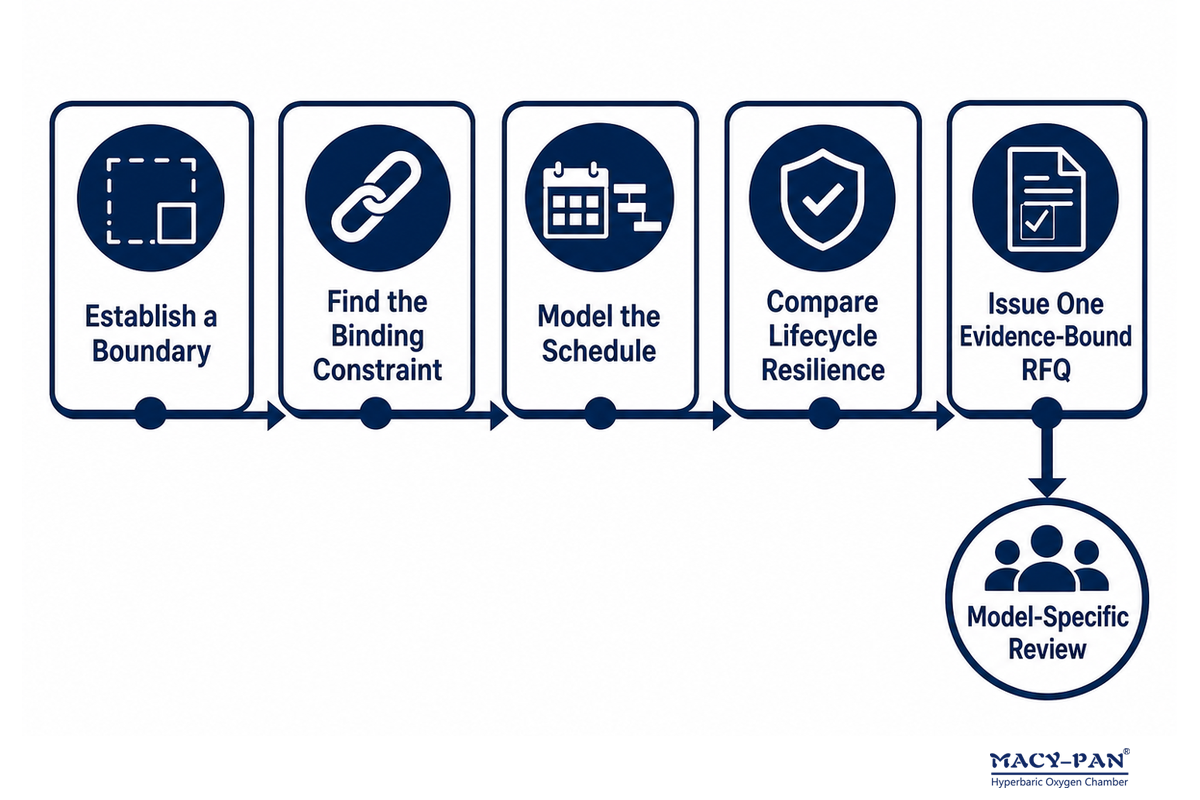
- Establish a boundary. Qualified clinical leadership specifies intended use, patient population, supervision, and care limits.
- Find the binding constraint. Use the Hidden Bottleneck Map before you compare nominal seats.
- Model the schedule. Complete the Capacity Worksheet with the staff plan and local demand inputs proposed.
- Compare lifecycle resilience. Review evidence on service, training renewals, spares, downtime, and change controls.
- Issue one evidence-bound RFQ. Require respondents to specify the exact model and configuration, then assign every validation item to a buyer owner.
A monoplace fleet may fit an operation that values independent stations, staggered starts, or partial availability during one-unit downtime. A multiplace chamber may fit an operation that needs scheduled group sessions or in-chamber attendant access. A staged combination may work for some operations. None of those is a recommendation until the care, facility, staffing, schedule, and evidence inputs are known.
Bring the operating brief, not just a seat countThe MACY-PAN company profile presents the business as a hyperbaric chamber manufacturer with distributor support. Use the three tools in this guide to organize your requirements, then request a model-specific review.
Discuss Your Chamber Project
Discuss Your Chamber Project
Frequently Asked Questions
What are the two main clinical hyperbaric chamber formats?
Monoplace and multiplace describe how many occupants a chamber is designed to hold and often signal different operating architectures. A monoplace system generally treats one person and is monitored from outside. A multiplace system can hold more than one occupant and may include a trained attendant. The labels alone don’t establish breathing-gas design, pressure envelope, intended use, clinical outcome, or regulatory status. Record occupancy, gas path, breathing interface, and staff location as separate comparison fields. Use those fields in every model-specific evidence request. Before supplier comparison, ask the clinical lead to define intended use and the care boundary. The facility team then confirms utilities, room interfaces, and emergency response. A format label can’t complete either review.
Is a multiplace chamber always better than a monoplace chamber?
No. Critical-care literature identifies situations where hands-on staff access and compatible equipment inside a multiplace chamber can matter. The same literature notes potential installation and staffing advantages for monoplace systems. That isn’t a universal ranking. The decision depends on intended use, patient acuity, supervision, facility interfaces, staffing, schedule, maintenance, and exact-model documentation.
Does an air-pressurized multiplace chamber remove oxygen fire risk?
No. The cabin gas and the patient breathing gas are separate design questions. A multiplace system may deliver oxygen through masks or hoods, so oxygen-related controls still require formal attention. Follow the specific device instructions and verify fire prevention, prohibited items, compatible materials, clothing, grounding where specified, cleaning, monitoring, training, maintenance, and emergency procedures for the proposed configuration.
How many patients can a multiplace chamber treat at once?
Use the rated occupancy in the approved documentation for the exact model. Practical capacity may be lower because the session schedule, patient mix, breathing interfaces, attendant coverage, turnover, planned downtime, emergency plan, and compatible equipment can become binding constraints. Run the Capacity Worksheet with local inputs instead of applying a universal range from a vendor comparison. Empty stations, a late group start, or one staffing gap can reduce realized volume without changing the chamber’s rating. Five rated positions don’t guarantee five usable stations for every scheduled session. The breathing interfaces and compatible equipment selected for that session may reduce the available positions.
Which documents should a buyer request before choosing a chamber?
Request model-specific intended-use and performance information, pressure and gas architecture, rated occupancy, breathing interfaces, installation and utility requirements, emergency provisions, applicable test and inspection records, training scope, cleaning and maintenance instructions, warranty and spare-parts terms, commissioning responsibilities, and after-sales escalation. Clinical, safety, facilities, and procurement owners should validate each item against the proposed site and applicable requirements.
References & Sources
- FDA: Follow Instructions for Safe Use of Hyperbaric Oxygen Therapy Devices (2025)
- 21 CFR 868.5470: Hyperbaric Chamber
- FDA product classification CBF and recognized standards
- Lind, 2015: Pro and con review of monoplace and multiplace chambers for critical care
- Systematic review of monoplace versus multiplace efficacy and safety evidence
- European Code of Good Practice for Hyperbaric Oxygen Therapy, 2022 review
- UHMS: Monoplace Hyperbaric Chamber Safety Guidelines
- UHMS: Multiplace chamber staffing position statement
- Hong Kong Journal of Emergency Medicine, 2025: single-center capacity development study
- 2024 case report: recurrent decompression illness in a multiplace inside attendant
Final takeaway: Choose the operating model first and foremost. Verify that the precise chamber, room, staff plan, maintenance program, and supplier evidence align with the operating model selected.