Get in Touch with MACY-PAN Company

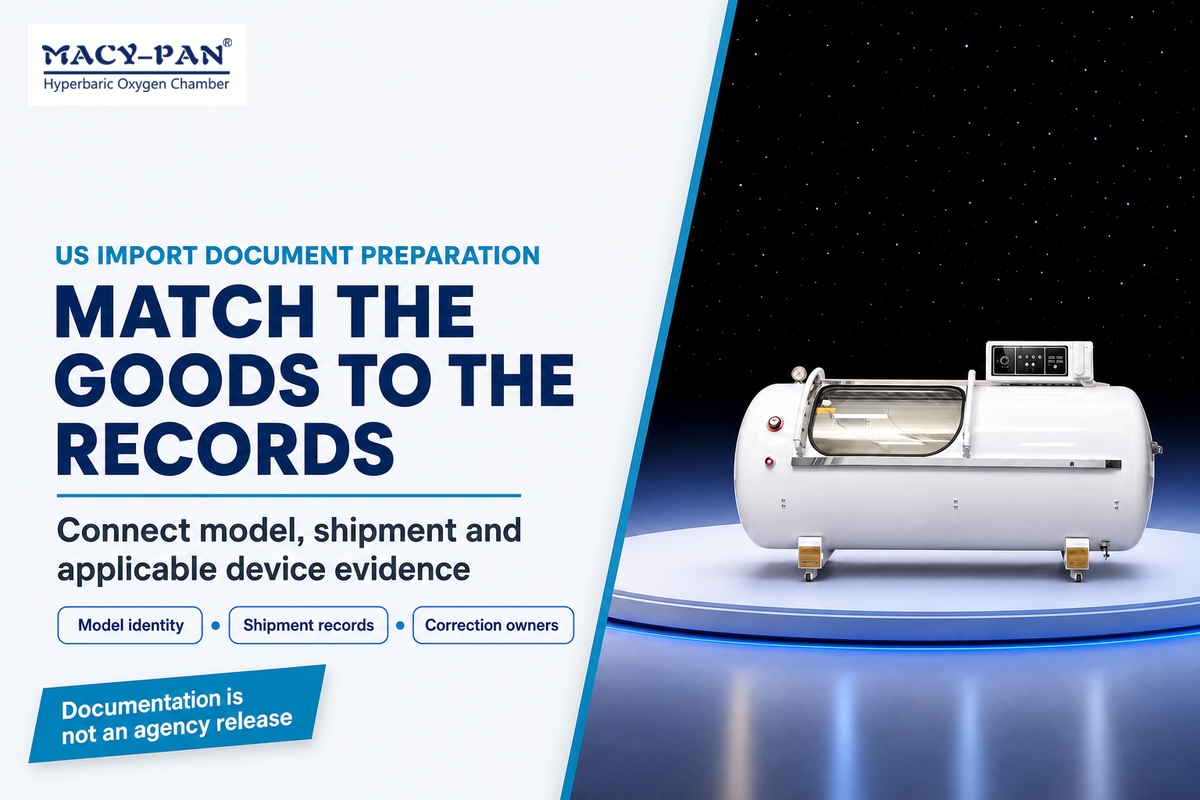
Hyperbaric chamber customs documentation should be complete, connecting the chamber you ordered to the goods being shipped, and using the equipment records for Customs entry. A folder full of certificates can still leave that connection unresolved. A complete description of the records needed and a record owner should be identified before the booking becomes expensive to change.
Updated October 2026 · US import preparation
Hyperbaric chamber customs documentation links shipment records with applicable device-entry evidence. Match six fields across the invoice, packing list and model records, then resolve discrepancies with the issuer and broker before dispatch.
Before you approve dispatch
- Goods quantity and crate count measure different things; explain the relationship.
- FDA registration is not proof of product clearance.
- Name the party who can correct each source record.
- Confirm the applicable filing and agency status separately from the carrier booking.
Which documents belong in your import package?
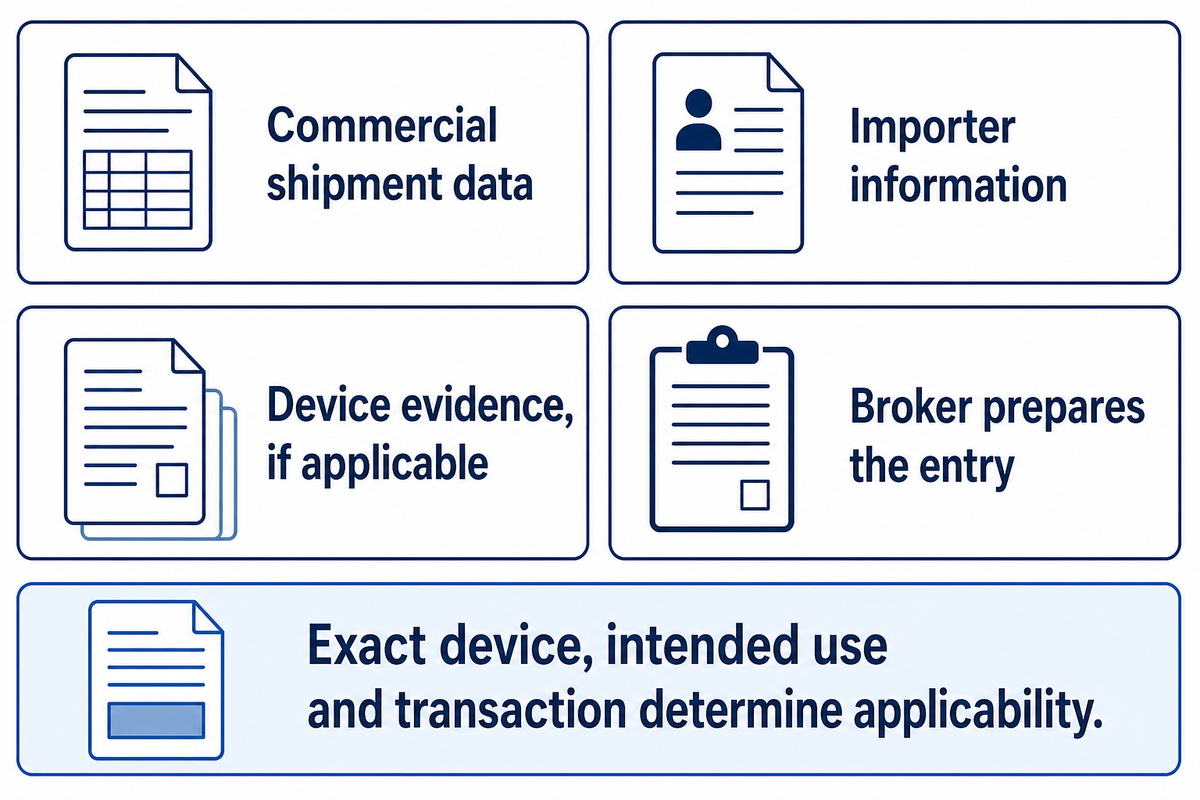
A US chamber import package combines commercial shipment data, information on the importer, and device evidence, if applicable. The supplier is able to complete most of the commercial shipment data but the buyer and filer must address country specific entry requirements. The exact device, intended use and transaction determine which supporting records apply.
What hyperbaric chamber customs documentation do I need?
Use the information your broker requests (commercial invoice, detailed packing list and transport information), and provide the precise manufacturer and model identity, the intended use of the device, and any registration, listing or premarket status information that applies. Ask the filer to identify any missing entry data before treating the package as ready.
Sort the import documents by who can supply them. Invoice issuers can explain sales and state their values. The packing team can describe the contents of packages. The importer can provide its transaction and business information. The device manufacturer or its representative can supply device records. The broker can use this information to prepare the entry.
The FDA’s medical-device import guidance includes other requirements beyond shipping documentation. These include the device’s applicable registration, listing, labeling and premarket requirements. Do not consider a supplier’s standard document folder to be a determination that every device in the folder can be lawfully imported to the United States.
Transport booking answers questions about how and where freight will be moved. A device record answers a different question about the product being offered. Use the wider hyperbaric chamber export and shipping guide for logistics planning and this document stays focused on matching the goods with their records.
Commercial invoice and packing list: match the shipment
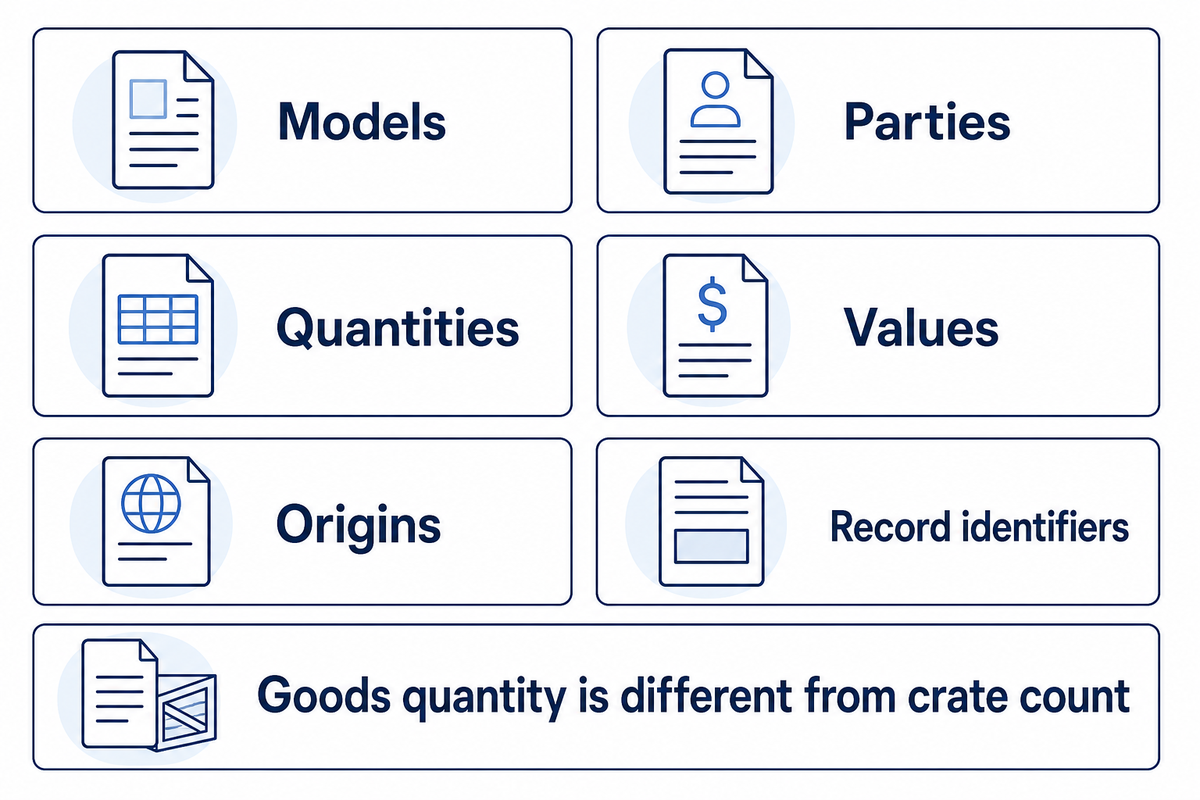
Invoice and packing-list consistency means that they both describe the same product(s) in their respective records. An invoice can describe a complete system while a packing list describes its separate packages. Procurement should be able to follow the model and included items from the order to each package without having to invent a missing connection.
19 CFR 141.86 indicates the details of goods descriptions, quantities, prices or values, currencies and countries of origin on invoices. The International Trade Administration’s explanation of packing lists deals with the description of the contents of packages, their weights and measurements. This is the reason why a package count isn’t necessarily the same as a sale unit count.
6-Field Customs Identity Crosswalk
The 6-Field Customs Identity Crosswalk aligns the information of models, parties, quantities, values, origins, and record identifiers across shipping documents.
| Field and check | Illustrative record comparison | Buyer decision | Limitations / unresolved question |
|---|---|---|---|
| 1. Model identity | Order: model A; invoice: model A; packing list: model A | Compare the configuration, not only the family name | A matching name alone does not prove admissibility |
| 1. Included accessories | Order lists chamber and agreed accessories; crate list identifies where each is packed | Ask about any omitted or substituted item | An accessory can need its own description or review |
| 2. Seller and manufacturer | Invoice names trading seller; device evidence names manufacturing firm | Document each party’s role and the product connection | Different legitimate roles need not have identical names |
| 2. Importer and consignee | Broker instructions name the importer; delivery record names the recipient | Resolve roles with the broker | A delivery address does not establish importer eligibility |
| 3. Goods quantity | Invoice: 1 system; package contents together account for 1 system | Reconcile included goods against the order | Do not change this to 3 systems because there are 3 crates |
| 3. Package count | Packing list: crates 1–3; transport information: 3 packages | Trace each crate to its contents | Actual packing can differ from this illustration |
| 4. Value and currency | Invoice currency and item values match the agreed commercial record | Send unexplained differences to finance and issuer | Customs valuation can require more than invoice price |
| 5. Origin | Invoice origin is supported by the relevant product information | Ask the filer how origin must be declared | Seller address alone does not prove origin |
| 6. Product identifiers | Available model and serial identifiers connect goods to supporting records | Resolve an unexplained alias or serial mismatch | Do not invent a serial number before one is assigned |
| 6. Document revision | Broker has the issuer’s corrected invoice and matching packing list | Identify which versions supersede the old files | A newer filename does not prove the contents were corrected |
Let’s say a buyer orders one chamber system with its agreed accessories. The supplier packages it in three crates. Finance sees “1 system” on the invoice and “3 packages” on the transport information, then asks for the invoice to be changed. This of course creates a new error if the shipment contains only one system. Instead, the packing team is asked to show which ordered items are in crates 1, 2 and 3. Then the broker is able to assess a coherent description of the goods and packages. If the third crate contains an extra item absent from the order, the team must resolve that item rather than force the two totals to match.
To prepare a packing list for customs, a link needs to be traced between the items and their packages. Use the separate hyperbaric chamber export packing checklist for physical packing preparation; matching paperwork cannot establish that a crate is adequately built.
Importer of record and customs broker responsibilities
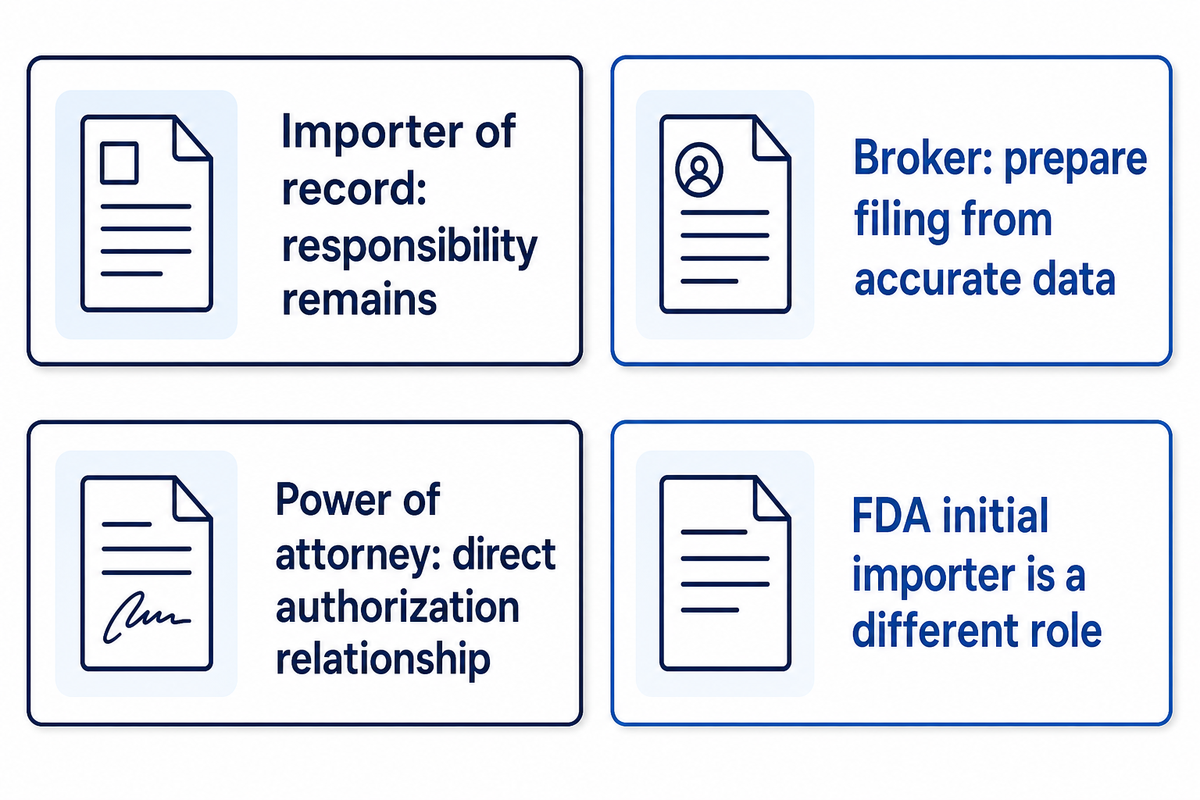
A customs broker can handle filing, but the importer of record still needs to be defined. The CBP states the importer of record is still responsible for understanding the requirements and ensuring compliance with applicable federal laws and regulations, even if filing is outsourced. The importer needs to provide accurate information to the broker in order for filing to be correct and discrepancies need to be resolved.
Make sure you confirm the importer, broker, and supplier before you approve the order. CBP’s importer-responsibility guidance is the starting point. FDA’s “initial importer” is a different regulatory role; therefore, you cannot assume that each recipient, importer of record, and initial importer are the same.
Do customs documents need to be signed?
Signature requirements vary by document and transaction. Refer to the receiving party to determine which signature, authorization or original is required. For example, CBP requires a customs broker to execute its power of attorney directly with the importer of record or drawback claimant; that does not establish a universal handwritten-signature rule for every invoice.
The CBP broker power-of-attorney guidance distinguishes the direct authorization relationship from assistance by another logistics party. Procurement should record who signs, who supplies data and who can authorize a correction. A forwarder passing documents along isn’t automatically filling every role.
Check the responsibilities outlined in the contract if the supplier quotes delivery with customs-related services. The hyperbaric chamber shipping Incoterms guide describes the commercial allocation; however, it doesn’t settle the admissibility of the device or identify an eligible importer by itself.
Hyperbaric oxygen device evidence is separate from shipping paperwork
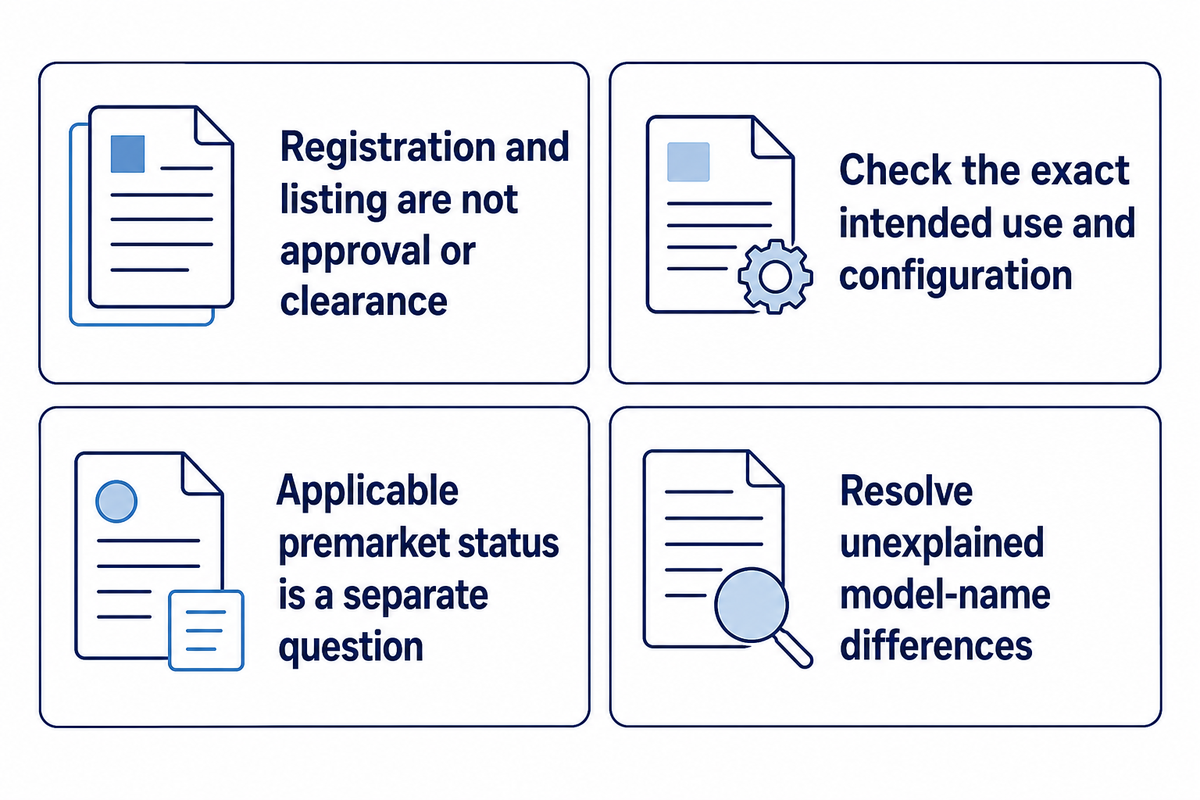
Evidence must pertain to the product being imported, how it’s to be used and the configuration relevant to that use. A chamber can be described in a commercial invoice; however, that doesn’t mean the device requirements for that chamber are satisfied. Check the evidence against the relevant product.
FDA establishment registration and device listing do not denote approval, clearance or authorization of the facility or its devices. The agency’s explanation of registration and misleading certificates makes that distinction explicit.
Read each record to determine what question it can answer. Registration identifies an establishment; listing identifies a device or other activity. Where premarket authorization is required, the clearance or approval answers a separate marketing status question for the device. Ensure that the scope of the evidence pertains to the intended use and configuration of the device. Evidence prepared for other markets doesn’t automatically pertain to the US just because it’s included in the same file.
“the FDA does not issue registration certificates to medical device establishments.”
Consider a private-label buyer whose purchase order uses a sales name while the supplier’s supporting record uses another model identifier. Don’t assume fraud. “Same machine” shouldn’t be the final answer to the link. Request a written justification for the link and configuration supported by the evidence. Provide the intended use and the accessories to the broker and the responsible regulatory contact. If the link isn’t resolved, the owner can postpone making the dispatch decision in question while the supplier gives the missing evidence. Renaming the invoice to resemble a certificate would conceal the question instead of answering it.
In cases of equipment offered for hyperbaric oxygen therapy, keep treatment claims out of the customs description unless they’re an exact representation of the product and documentation. A hyperbaric medical product description should name the product; it shouldn’t include unsubstantiated treatment claims. Comparing monoplace and multiplace hyperbaric chambers can clarify the ordered configuration, but neither category name supplies a regulatory conclusion.
The public resources at accessdata.fda.gov can help locate device records. The results of a public record search must be verified against the actual product. Some identifiers must come from the listed firm. Don’t copy your competitor’s authorization number. Choosing a universal tariff code for a generic chamber description isn’t acceptable.
Prepare entry and ocean shipment data
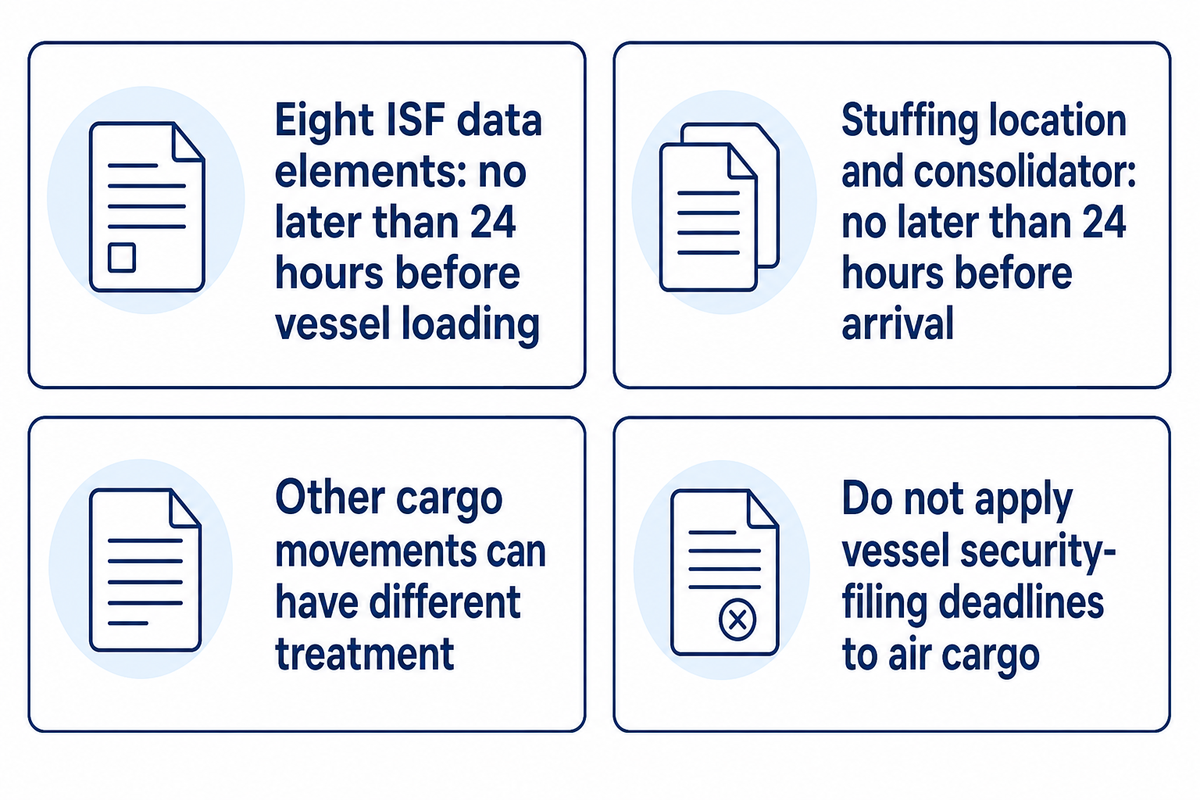
Entry preparation needs correct data formatting and the right documents. Provide the transport mode and route to the filer in a timely manner to allow them to identify any advance requirements. Security filing for ocean vessels has specific time frames that should be matched to the actual movement of the cargo; an air consignment shouldn’t be given a deadline for a vessel security filing.
According to CBP, eight Importer Security Filing data elements are due no later than 24 hours before cargo is loaded on a vessel destined for the United States; container stuffing location and consolidator data have a different latest deadline of 24 hours before arrival. In CBP’s ISF guidance, different treatment is given to some other cargo movements. It’s best to let the filer validate the treatment given to each movement, rather than assuming that treatment and turning it into a deadline for all movements.
FDA’s entry-information guidance explains how applicable data are transmitted. FDA classification codes, FDA import product codes and customs tariff codes perform different functions. The agency’s product-code guidance distinguishes a three-letter device classification code from the seven-position import code. Let the filer resolve the actual code instead of copying a label between unrelated fields.
An ocean booking can create an advance-data deadline before the goods leave the supplier. Procurement should therefore agree when the filer needs usable information, not just when the supplier plans to email a final invoice. A revised document received after filing also needs an explicit handoff so the filer can assess whether entry data must change.
Resolve document discrepancies before dispatch
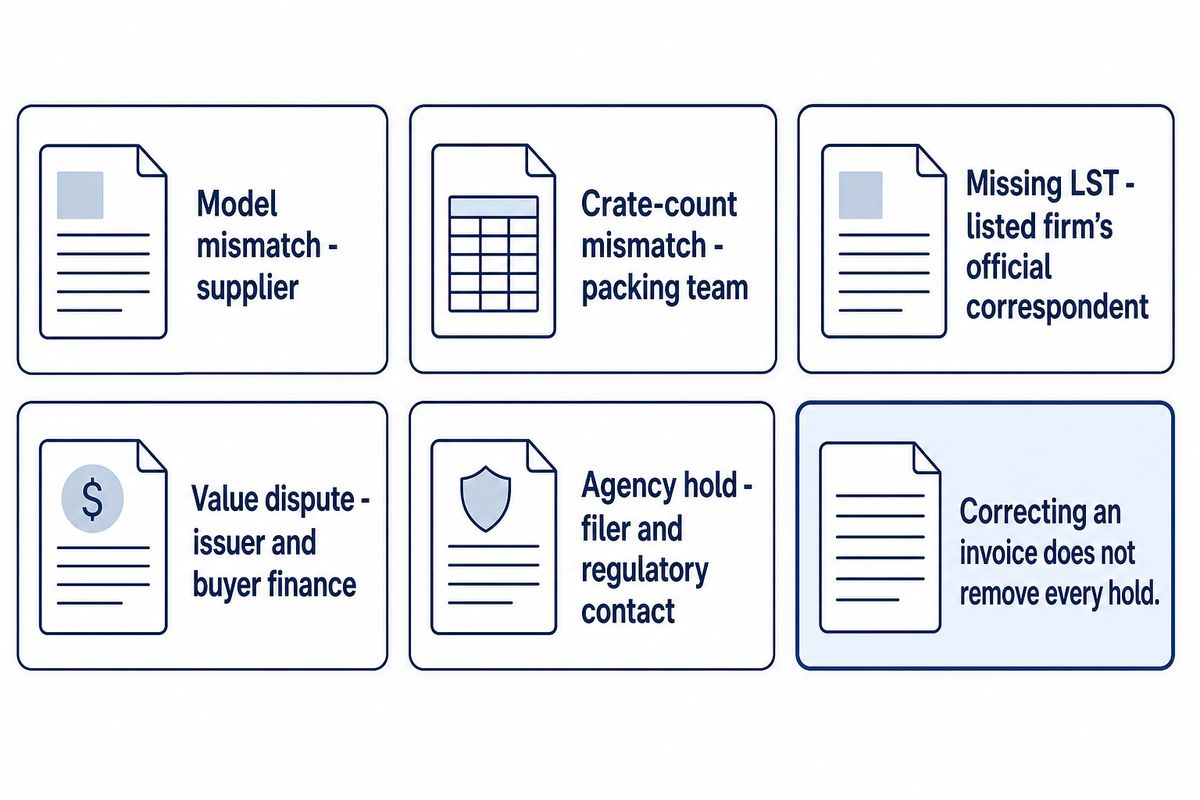
An effective discrepancy review identifies the conflicting field, the party that can resolve it and the decision that is still open. Filing errors can require corrected source information, while some admissibility issues need a different response. Keep the buyer’s dispatch approval distinct from any decision made by CBP or FDA.
FDA describes the device listing number, or LST, as proprietary and not publicly available; the listed establishment’s official correspondent can supply it. The agency’s medical-device entry-error guidance also addresses missing or unrecognized establishment identifiers. Request the record from the party that controls it.
When considering the cause for delays in clearing customs, first, determine whether the open item is lack of entry data, a conflicting source record or an agency request concerning the goods. Sending the same certificate folder again won’t answer which of these questions has been resolved.
Correction-Owner Dispatch Matrix
The Correction-Owner Dispatch Matrix allocates each discrepancy to the record owner and separates document correction from the pending regulatory decision.
| Problem found | Correction owner / evidence | Buyer or filer action | Limitations / not resolved |
|---|---|---|---|
| Model differs between invoice and order | Supplier: confirmed configuration and corrected issued record | Trace which document is wrong | A text correction cannot establish clearance |
| Private-label name differs | Manufacturer: documented identity relationship | Send the connection to the responsible reviewer | Do not assume two names mean equivalent products |
| Accessory omitted from description | Supplier: item identity and packing location | Ask filer whether description or treatment changes | Chamber evidence may not cover every accessory |
| 1 system confused with 3 crates | Packing team: contents by crate | Reconcile the units without changing the goods count | Illustrative quantities, not a standard package |
| Manufacturer identifier unrecognized | Manufacturer / relevant firm contact: correct identifier | Have filer check the submitted entry data | Seller’s trading name may not be the manufacturer |
| LST missing | Listed firm’s official correspondent or relevant manufacturer contact | Obtain applicable listing information | Do not invent a public LST lookup result |
| Invoice value or currency disputed | Invoice issuer and buyer finance: transaction records | Resolve the discrepancy before using the corrected invoice | Filer still determines applicable valuation treatment |
| Importer role unclear | Buyer / proposed importer / broker: role and authorization | Resolve the arrangement before relying on it | A forwarder contact alone is insufficient |
| Old document remains in circulation | Issuer: identified replacement revision | Notify affected recipients which file supersedes it | Check whether already-filed data also need correction |
| Agency hold or import-alert issue | Filer and responsible regulatory contact: actual notice and scope | Follow the applicable agency process | Correcting an invoice does not remove every hold |
When a corrected document is not enough
A concrete limitation appears in FDA Import Alert 89-16, concerning listed device firms that refused a foreign-establishment inspection. Its guidance says their products should remain subject to detention without physical examination until an FDA inspection is completed. Third-party inspection reports only help FDA prioritize inspection requests. That example does not describe the status of MACY-PAN or any particular chamber; it explains why a factory-level issue cannot be reduced to an invoice typo.
Suppose the buyer receives a carrier delivery update while the filer has a Notice of FDA Action requiring specified goods to be held for examination. The owner wants to install the chamber, but the logistics update has not answered the agency-status question. The receiving team should obtain the actual notice and instructions from the filer before distributing the affected goods. FDA’s examination guidance explains that disregarding a notice and distributing goods can lead to redelivery and bond action. Record the agency status beside the logistics status so an internal receiving decision does not rest on an unrelated delivery message.
Send a complete document request to your supplier
A good supplier request identifies the destination, the intended use, and the exact ordered configuration. The request should also identify the records required to answer the buyer’s outstanding questions. Ask for a named document contact and a consistent revision set. Keep requests for supplier evidence separate from the broker’s obligation to define filing requirements.
For a MACY-PAN chamber order, include the model and agreed accessories, suggested means of transport, and the broker’s document questions. Instruct the supplier to identify which records cover that configuration and which points require a response from a third party. FDA’s entry-error guidance supports obtaining identifiers from the appropriate firm contact rather than speculation.
Do
- Name the exact model and intended use.
- List the unresolved document fields.
- Identify the person who can correct each record.
Don’t
- Request a generic “FDA certificate” as proof of clearance.
- Rewrite supplier records without the issuer.
- Promise a clearance date from a completed checklist.
Send your MACY-PAN chamber document request to the supplier with the above mentioned information to ensure that the requested document concerns the product you want to purchase.
What to recheck in 2026
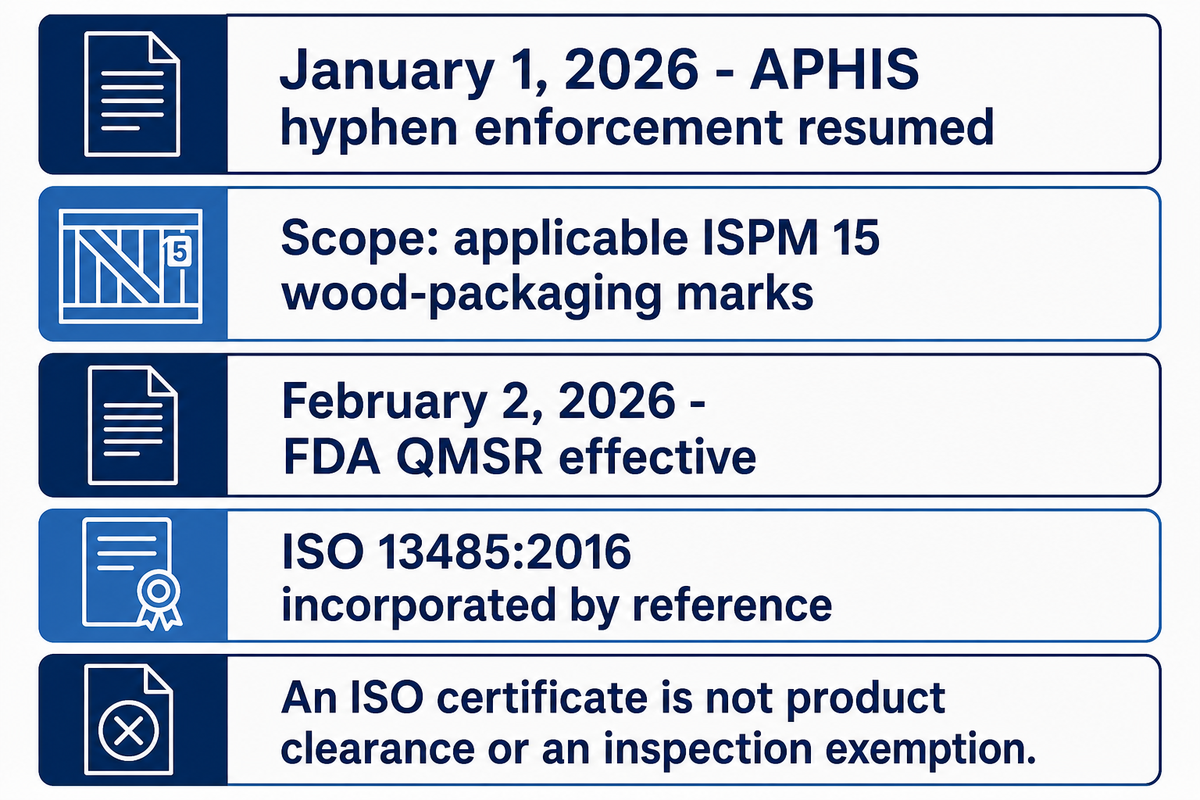
There are two dated changes pertaining to this purchase. Ask the packing provider to present evidence of wood packaging to which covered wood packaging standards apply, and ask the device contact how current quality-system requirements apply. Don’t make either of these checks into universal chamber certificates.
APHIS resumed enforcement of the hyphen between the country code and producer code in applicable ISPM 15 wood-packaging marks on January 1, 2026. The APHIS enforcement reminder concerns that marking detail after a temporary suspension. Other applicable wood-packaging requirements did not disappear during the suspension. Review the actual crate material and mark with the packing provider; a chamber’s commercial invoice does not replace that packaging check.
FDA states that the Quality Management System Regulation became effective on February 2, 2026 and incorporates ISO 13485:2016 by reference. The FDA QMSR explanation addresses the quality-system framework for applicable manufacturers. Product authorization and quality-system compliance remain separate questions.
FDA does not require or issue certificates of conformance to ISO 13485, and having such a certificate does not exempt a manufacturer from an FDA inspection. QMSR FAQ 13 states that boundary directly. Procurement should therefore avoid both errors: accepting an ISO certificate as product clearance, or treating absence of that voluntary certificate alone as proof of noncompliance.
Key takeaway
Match the six document fields, assign unresolved differences to their owners, and keep dispatch approval separate from agency release. A consistent package helps the handoff; it does not replace the decisions that apply to the exact goods.
Frequently asked questions
Do hyperbaric chamber customs documents need notarization?
Confirm notarization for the specific record and destination.
There’s no single notarization rule for every destination or document. Ask your customs broker which record needs an original, certification or legalization, and why it applies to your transaction. An ordinary invoice, a preferential-origin claim and a device regulatory record serve different purposes. Request any extra certification early, rather than having every supplier document notarized without an identified requirement.
Is there one customs-document template for every destination?
Use destination-specific requirements alongside the supplier template.
No. A useful supplier template collects stable shipment facts, but it can’t decide the rules that apply in every importing country. Keep the manufacturer, model, accessories, quantities, values and origin identifiable, then ask the destination broker which local entry fields and supporting records are needed. For a US shipment, device entry requirements also depend on the specific product and its intended use.
Can I send customs documents as PDFs?
Agree the submission format and any original-document requirements.
PDFs can be a practical format for the buyer and broker to review a document package, but a PDF copy isn’t automatically sufficient for every filing or transport document. Confirm the required submission channel, acceptable signature and any original-document requirement with the party receiving it. Keep a clear revision date and replace superseded files so the broker doesn’t prepare an entry from an old invoice.
Who should correct an incorrect supplier invoice?
Ask the invoice issuer to correct the record.
The invoice issuer should correct its invoice. Send the precise discrepancy and supporting order details to that issuer, then give the revised version to the broker and other affected parties.
Does a complete document package guarantee customs release?
A complete folder does not guarantee an agency release.
No. Completeness is a useful preparation standard, not a promise of admissibility or a release decision. A document can be present yet refer to another model, an earlier configuration or a different manufacturer. The broker still needs accurate transaction and entry data, and the relevant authorities may review the goods and request further information. Keep commercial readiness separate from regulatory conclusions: an invoice proves what a seller billed, while a packing list describes the packages and their contents. Neither record by itself establishes that a medical device meets every applicable US requirement. Before dispatch, ask which material questions remain open and who’s responsible for answering them. If the exact model can’t be connected to the evidence being offered, obtain that connection instead of marking the file complete because a certificate is attached. The buyer-side release checklist should record those unresolved questions explicitly.
Are air and ocean shipment documents identical?
Transport mode changes some documents and advance-data requirements.
No. The transport document and advance-data obligations can differ by mode. Give your broker the actual route and transport plan, and confirm the required handoff before booking. Don’t apply an ocean-specific filing deadline to air cargo simply because both shipments contain the same chamber.
How this guide was prepared
US chamber-document guidance here draws on the linked FDA, CBP, APHIS and government trade sources, reviewed in October 2026. The crosswalk and correction matrix are buyer-created methods. Examples are hypothetical, with no claim about a customer’s shipment or any specific MACY-PAN model’s authorization. Shipment-specific requirements and current agency notices need review by the responsible parties.
References & Sources
- FDA's medical-device import guidance
- 19 CFR 141.86
- International Trade Administration's packing-list explanation
- CBP's importer-responsibility guidance
- CBP broker power-of-attorney guidance
- explanation of registration and misleading certificates
- China Office perspective on registration certificates
- CBP's ISF guidance
- FDA's entry-information guidance
- product-code guidance
- medical-device entry-error guidance
- FDA Import Alert 89-16
- FDA's examination guidance
- APHIS enforcement reminder
- FDA QMSR explanation
- QMSR FAQ 13