Get in Touch with MACY-PAN Company

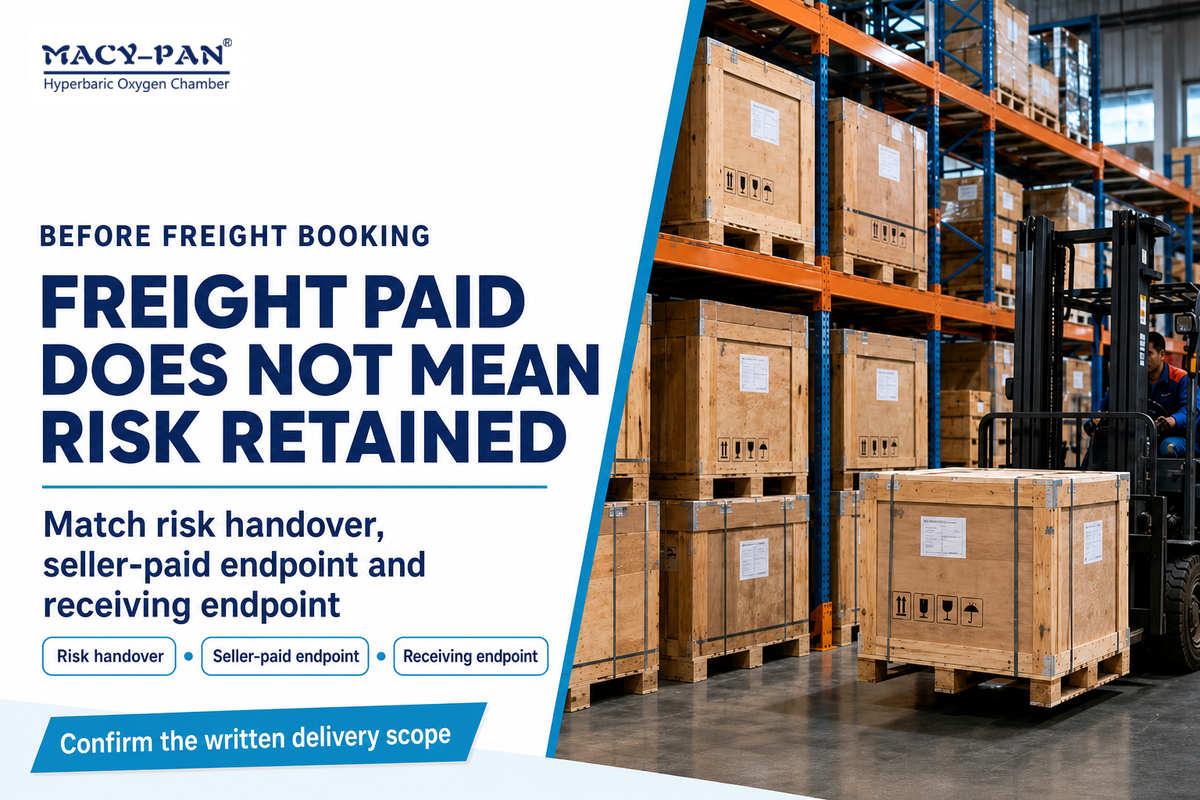
Compare hyperbaric chamber shipping Incoterms in three ways: where risk passes, where seller-paid transport ends, and where your team gets the crate. Hyperbaric chamber shipping Incoterms are trade rules allocating delivery obligations, risks and costs. EXW, FCA, FOB, CIF, DDP, and others shift the costs and risks; paying freight doesn’t mean the seller bears the risk of transport.
Quick Specs: the contract check
- Reference: Incoterms 2020, with the exact named place or port.
- Main comparison: EXW, FCA, FOB, CIF and DDP.
- Receiving inputs: packed dimensions, gross weight, access and unloading arrangements.
- Separate agreements: payment, ownership, product admissibility and installation.
A quotation for a chamber can look very precise, while leaving port to warehouse transportation, insurance gaps, and the unloading operations to be performed by the purchaser. The delivery boundary is of major interest to the procurement function, while comparable transport costs are critical to the finance function. The transport and receiving arrangements in the purchase order require unambiguous answers. Put those answers on the same purchase order prior to booking.
Incoterms responsibilities at a glance
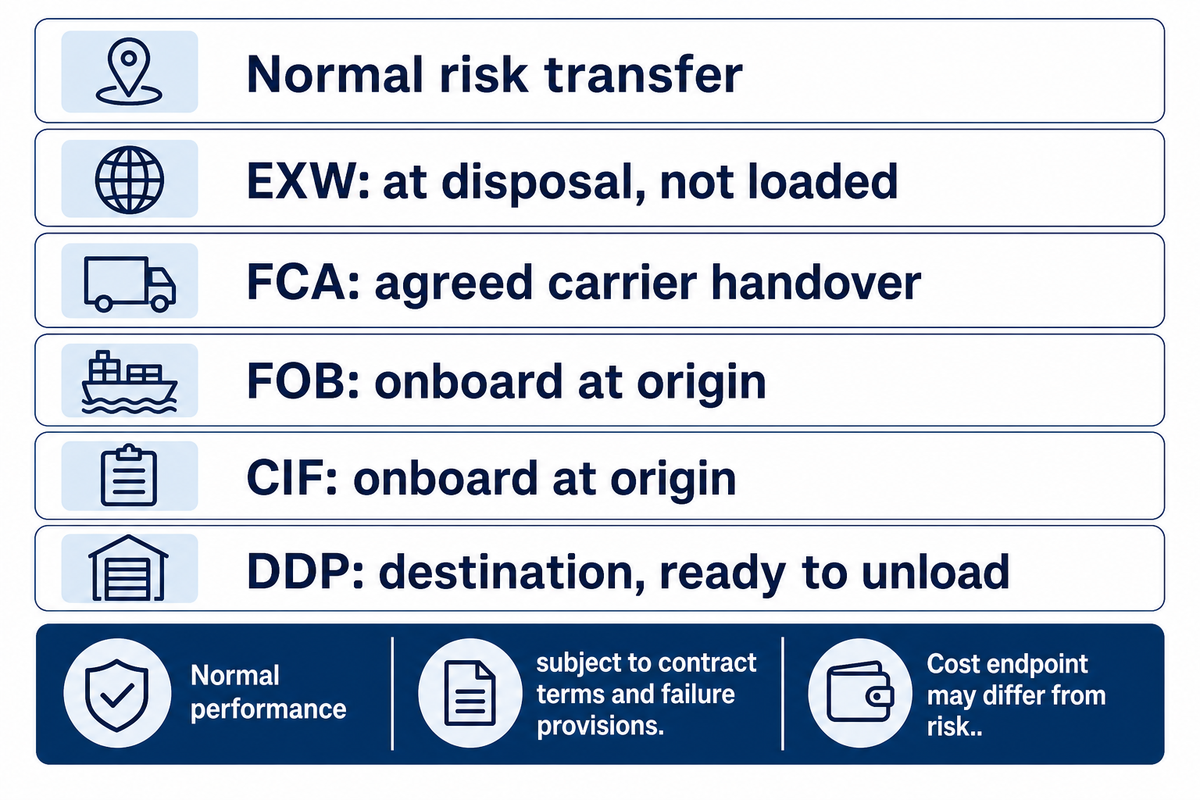
The rules concerning delivery, shipping costs and risks of transit divide obligations and transport costs between buyer and seller. The International Chamber of Commerce publishes 11 Incoterms rules: seven suit any transport mode, while four cover sea and inland waterway transport. The chosen rule will be applied in concert with a specific location stated in the sales contract.
What Are Incoterms in Shipping?
Incoterms, short for international commercial terms, are standardized trade terms used in international trade and domestic sales. They specify how the seller must deliver the goods and allocate related risks and costs. They do not settle ownership, payment deadlines, product approval or every service needed after arrival.
The ICC review of Incoterms® 2020 defines the rules. The matrix is based on normal performance, subject to explicit terms of the contract and provisions for failure. “Buyer” and “seller” define contractual responsibility, even if a forwarder performs the work.
| Decision | EXW | FCA | FOB | CIF | DDP | Limitations |
|---|---|---|---|---|---|---|
| Transport mode | Any | Any | Sea/waterway | Sea/waterway | Any | Match the actual handover. |
| Normal risk transfer | At disposal, not loaded | Agreed carrier handover | Onboard at origin | Onboard at origin | Destination, ready to unload | Failure provisions can alter timing. |
| Factory vehicle loading | Buyer | Seller at own premises | Seller’s pre-delivery scope | Seller’s pre-delivery scope | Seller’s pre-delivery scope | FCA elsewhere has a different boundary. |
| Export clearance | Buyer | Seller | Seller | Seller | Seller | Confirm practical ability to perform. |
| Main freight booking | Buyer | Buyer | Buyer | Seller | Seller | Ancillary agreements may add services. |
| Seller-paid transport endpoint | No carriage obligation | Named handover | Onboard, shipment port | Named destination port | Named destination point | Cost endpoint may differ from risk. |
| Required seller cargo insurance | None | None | None | Clause C equivalent minimum | None | Insurance absence is not a recommendation. |
| Import clearance and duties | Buyer | Buyer | Buyer | Buyer | Seller | DDP does not confer importer eligibility. |
| Destination unloading | Buyer arranges | Buyer arranges | Buyer arranges | Buyer; check carriage charges | Buyer risk; check included charges | Paid unloading does not itself move risk. |
| Installation included by rule | No | No | No | No | No | Agree commissioning scope separately. |
A crate may pass into the custody of the carrier before contractual risk passes; seller-paid freight may continue after risk transfers to the buyer. Keep custody of the goods, cost and risk, in separate fields. Use the International Shipments Preparation Guide for broader shipping process.
EXW: check loading and export arrangements
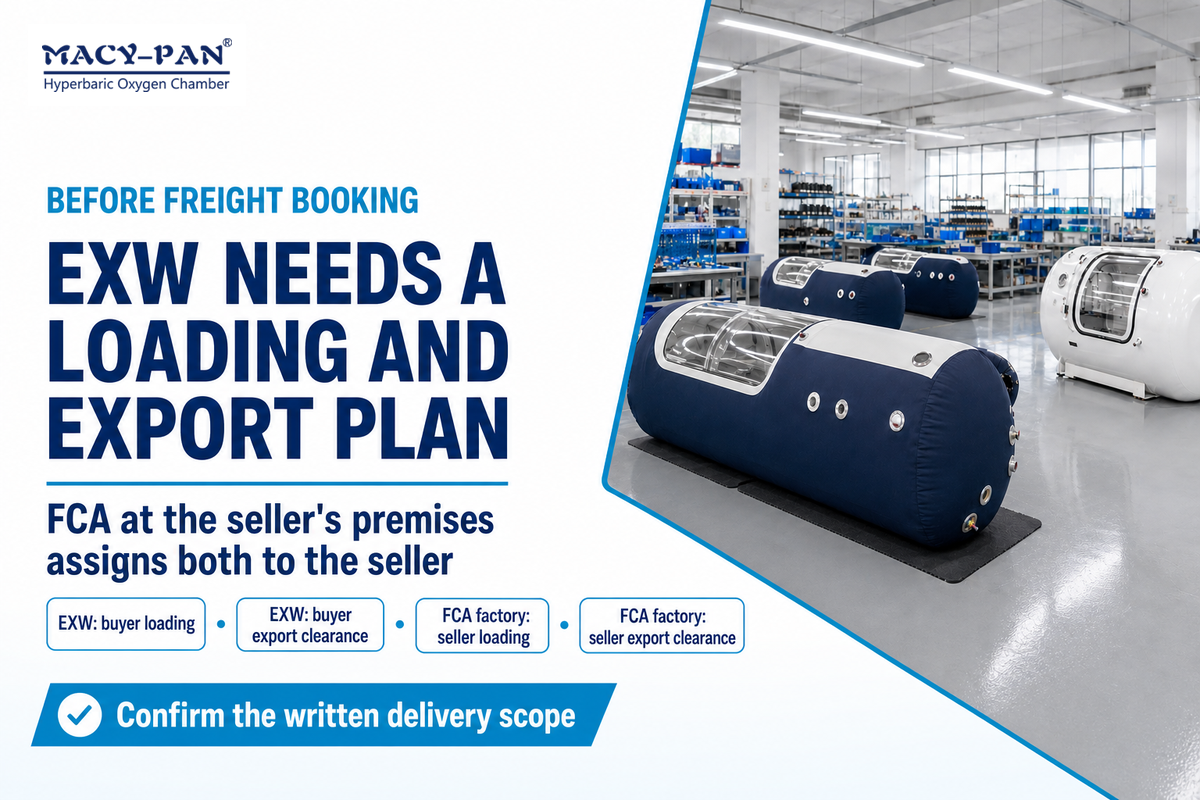
EXW, or ex works, leaves loading and export arrangements to the buyer after the seller makes the goods available at the agreed point. FCA at the seller’s premises assigns loading of the goods and export clearance to the seller. This is important to consider when your forwarder can’t help you with the local export formalities.
At EXW, it’s presumed that the seller makes the goods available, but doesn’t load the collecting vehicle. The allocation of tasks and risk is not varied merely by the seller physically assisting the loading. In such a case, who undertakes loading, at whose risk, and how any variation affects the contract should be clearly documented. The ICC Academy EXW/FCA comparison provides more information.
| Term and location | Loading boundary | Export obligation |
|---|---|---|
| EXW factory | Buyer loads collecting vehicle | Buyer |
| FCA factory | Seller loads buyer’s collecting vehicle | Seller |
| FCA named terminal | Seller’s vehicle arrives ready for unloading | Seller |
Hypothetical procurement scenario. The distributor requests EXW terms because it will have strong logistics support for international transactions. Its forwarder then explains that the quoted service begins only after export clearance. The factory can load the crate, but nobody has agreed who will complete the export formalities. The distributor asks for an FCA factory alternative. The distributor sends both scopes to finance, and asks for an explanation of the differences. The quote separates the seller’s loading and clearance activities from the buyer’s onward freight. Finance can assess the additional quoted scope without assuming EXW produces a lower delivered cost. Before issuing the order, the distributor confirms the collecting vehicle, pickup time, and the contact details of the carrier. No rate saving is presumed.
FOB or FCA: match the actual handover
For containerized cargo handed to the carrier before vessel loading, FCA usually describes the practical handover more closely than FOB. Free on board requires onboard delivery at the named port of shipment. Decide from the operation your seller can perform, including the interval between terminal receipt and loading onto the vessel.
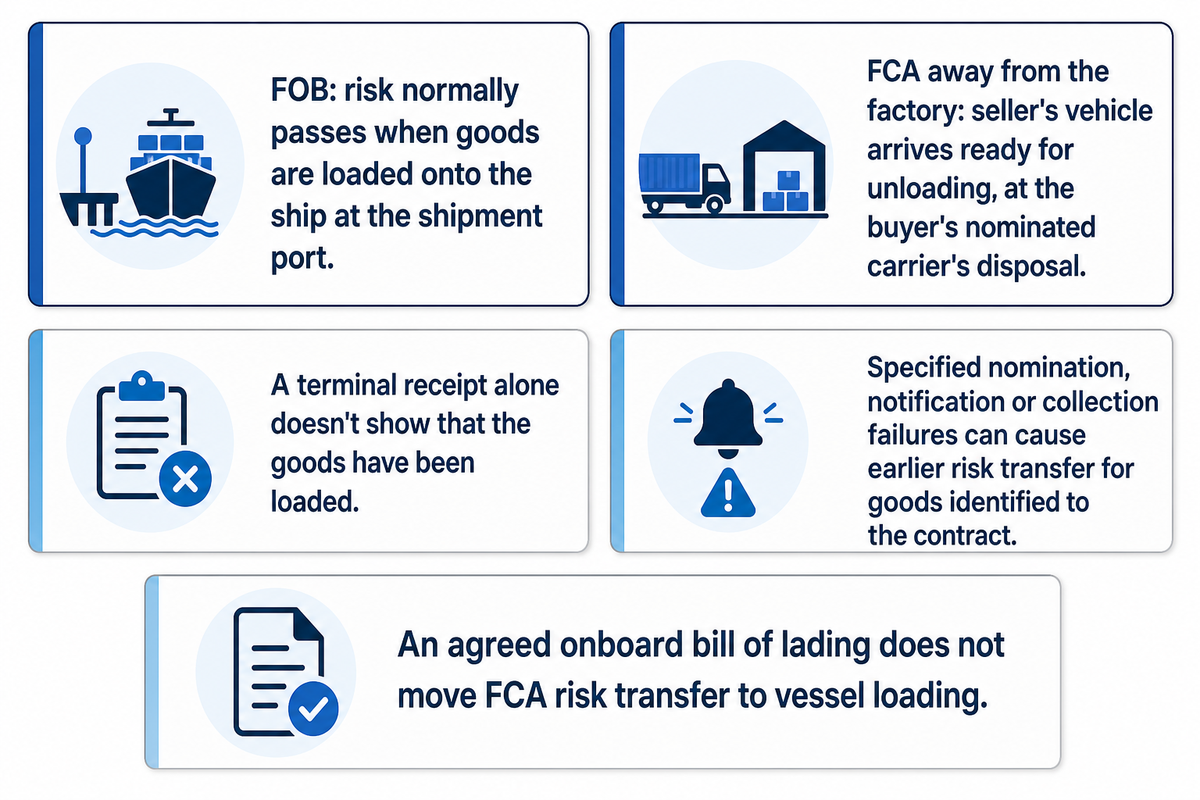
Under FOB, risk normally passes when the goods are loaded onto the ship at the port of shipment. A terminal receipt alone doesn’t show that the goods have been loaded. FOB isn’t categorically forbidden for every container: seller-controlled onboard delivery can support it. The ICC selection checklist directs attention to the delivery operation.
For FCA elsewhere than the factory, the seller delivers on its arriving vehicle, ready for unloading, at the disposal of the carrier or person chosen by the buyer. Name the specific location and appointment conditions. Avoid describing this as delivery only after terminal staff unload the crate.
The ICC FCA B3 provisions cover the buyer’s failures to nominate or notify, as well as a nominated carrier’s failure to take the goods. If the goods are clearly identified to the contract, risk can pass from the applicable agreed date, nominated time or period-end when the stated nomination, notification or collection failures occur. A collection that’s missed should be dealt with promptly.
If payment requires an onboard bill of lading (BL), discuss the FCA 2020 option with the carrier and bank prior to the contract. An agreed instruction for the carrier to provide the seller that document does not move FCA risk transfer to vessel loading.
CIF: separate freight payment from transit risk
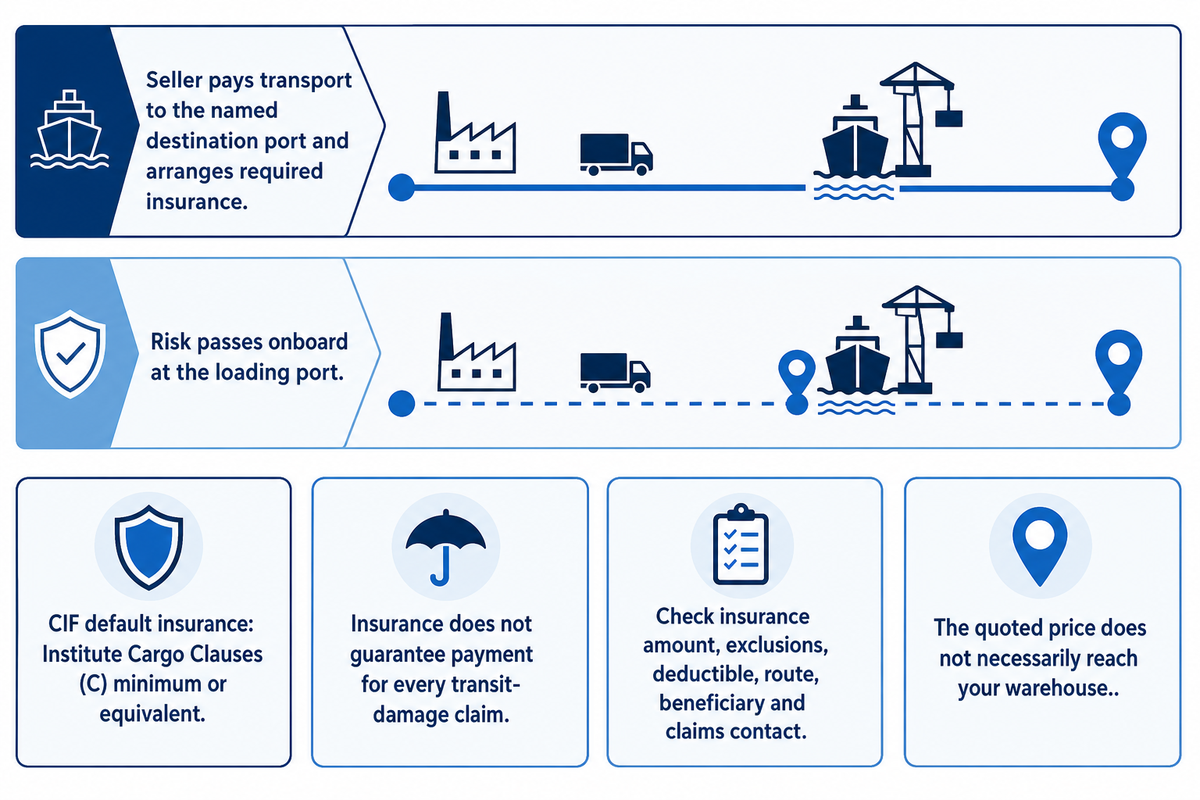
CIF combines seller-paid freight to the destination port with risk transfer onboard at origin. The remaining transit risk is borne by the buyer, although the seller has acquired the required cargo insurance. For a chamber purchase, check the policy and the destination charges separately from the attractive port-to-port freight total.
Who bears the various costs and risks?
Under CIF, the seller covers transport to the named port of destination and arranges the required insurance. The risk passes onboard at the loading port. So, Cost, Insurance and Freight doesn’t mean that the seller bears damage or loss throughout the voyage, or that the quoted price reaches your warehouse.
The ICC Academy CIF/CIP explanation explains that CIF’s default Institute Cargo Clauses (C) minimum coverage is different from CIP’s broader Clauses (A) default, or equivalent cover. Generally, CIP, Carriage and Insurance Paid To, supports multimodal transport and transfers risk at delivery to the first carrier. Neither label guarantees payment for every claim for damages to goods in transit.
Ask the insurer to confirm insurance amount, exclusions, deductible, route, beneficiary and claims contact. CIF isn’t identical to CFR: CFR implies no obligation on the seller to secure insurance. Both require care over destination unloading charges included in the carriage contract.
Hypothetical finance scenario: A purchasing manager receives a CIF quote for a crated chamber to a port in the USA. The finance worksheet treats the seller’s freight payment as protection until arrival. Reviewing the worksheet, the forwarder unbundles the onboard origin risk point and the paid destination. The insurance certificate is asked for. Meanwhile, the receiving team is asking who will arrange the inland transport. The purchasing team requests written confirmation of which destination charges are included. The purchasing team also requests advice from an insurance broker to confirm if the insurance cover is adequate for the shipment. The company hasn’t discovered any damage to the goods or filed a claim. The company is exercising due diligence by reviewing the insurance coverage prior to purchasing the goods. Its approval decision remains open until the uninsured exposures and remaining delivery scope are understood.
DDP: confirm the importer and unloading boundary
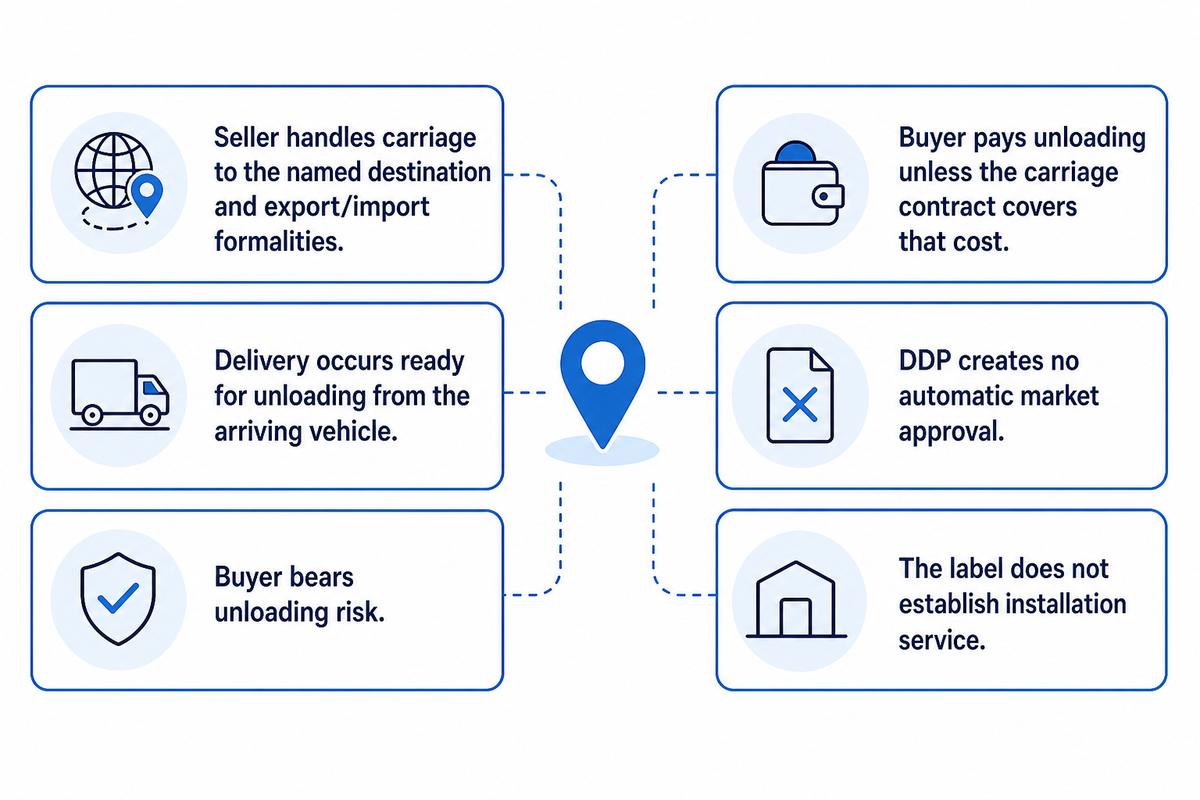
DDP, Delivered Duty Paid, places carriage to the named destination and export/import formalities with the seller. Delivery occurs with the goods ready for unloading from the arriving vehicle. Confirm that the importing arrangement is workable and that your site can unload; the label alone establishes neither product admissibility nor installation service.
According to the ICC Academy DDP explanation, the buyer is responsible for unloading risk. The buyer also pays for unloading unless that cost is covered by the carriage contract. It’s also prudent to check if the transporter provides the unloading equipment and if that cost is covered in the transport contract.
Obtain the importing party’s identity, customs clearance arrangement, import duty allocation and delivery-point description. Under DDP, the seller is responsible for import formalities. Under DAP, import clearance is with the buyer; DPU includes seller unloading but also leaves import clearance with the buyer. A supplier unwilling or unable to fulfill DDP may offer DAP.
For US medical-device imports, the FDA import guidance describes requirements for specific products and parties, including initial importers. Check those requirements alongside customs responsibilities for the ordered model; DDP creates no automatic market approval.
If the shipment uses regulated solid-wood packaging, review APHIS wood packaging requirements and its actual construction. Not all wooden crates use the same construction materials. Match that review with the chamber export packing checklist.
Compare quotes at the same delivery point
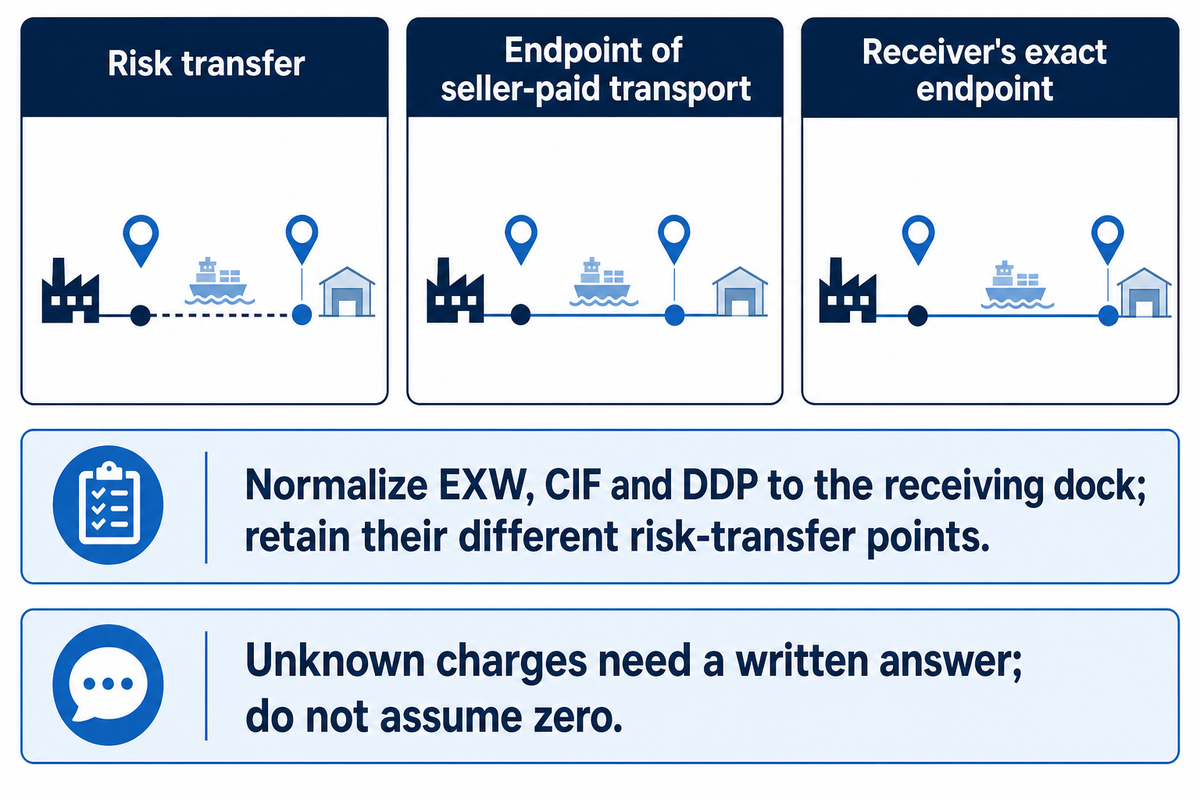
Make sure that comparable chamber quotations have the same exact physical endpoint. Confirm explicit cost owners for the quoted scope. Normalize EXW, CIF and DDP offers to the receiving dock, then retain their different risk-transfer points. An unknown terminal charge or unloading exclusion is an unresolved scope item. A lower quoted headline doesn’t necessarily mean a lower delivery cost.
The 3-Point Delivery Match
A 3-Point Delivery Match records risk transfer, the endpoint of seller-paid transport, and the receiver’s exact endpoint on one quotation.
The worksheet is hypothetical. All three offers pertain to the same crated chamber, and a fictitious U.S. warehouse dock. In this example, “Included” means seller-priced scope, while “Excluded” means the buyer must budget it. “Unknown” means a written answer is required and can’t be assumed to be zero.
| Cost category | EXW factory offer | CIF port offer | DDP dock offer | Responsible party / next action | Limitations |
|---|---|---|---|---|---|
| Export packing | Included | Included | Included | Supplier confirms packing revision | No crate material assumed. |
| Factory pickup loading | Excluded | Included | Included | Buyer/forwarder prices EXW loading | Written variations require agreement. |
| Origin inland movement | Excluded | Included | Included | Forwarder prices EXW origin leg | Exact pickup point required. |
| Export formalities | Excluded | Included | Included | Buyer confirms EXW export capability | Agent availability must be checked. |
| Main carriage | Excluded | Included to port | Included to dock | Supplier/forwarder states endpoints | Payment does not identify risk. |
| Cargo insurance | Excluded | Included, Clause C baseline | Unknown | Buyer and insurer review cover | DDP requires no seller policy. |
| Destination terminal handling | Excluded | Unknown | Included for normal delivery | Forwarder verifies carriage inclusions | CIF costs depend on carriage scope. |
| Import clearance and duties | Excluded | Excluded | Included | Buyer or DDP seller confirms arrangement | No tariff rate estimated. |
| Truck to receiving dock | Excluded | Excluded | Included | Receiving team confirms access | Dock delivery excludes room placement. |
| Dock unloading service | Excluded | Excluded | Unknown | Buyer books; supplier clarifies included cost | DDP unloading risk remains buyer’s. |
| Detention, demurrage and return delays | Unknown | Unknown | Unknown | Forwarder identifies billing and return duties | Actual terms and cause matter. |
Request free-time terms, charge triggers, equipment return location, and the party monitoring deadlines. The Federal Maritime Commission’s detention and demurrage guidance covers time-related charges. There’s no uniform allowance or rate to complete this field. Contractual allocation and the reasons for the delay, as well as applicable billing rules, need to be assessed.
Finance should retain currency, quote validity and exclusions beside every amount. Procure-to-pay resolves the seller’s responsibility; a forwarder prices the buyer’s responsibility; receiving confirms access. Logistics management fails when teams assume another has budgeted the last leg.
Name the receiving point before booking
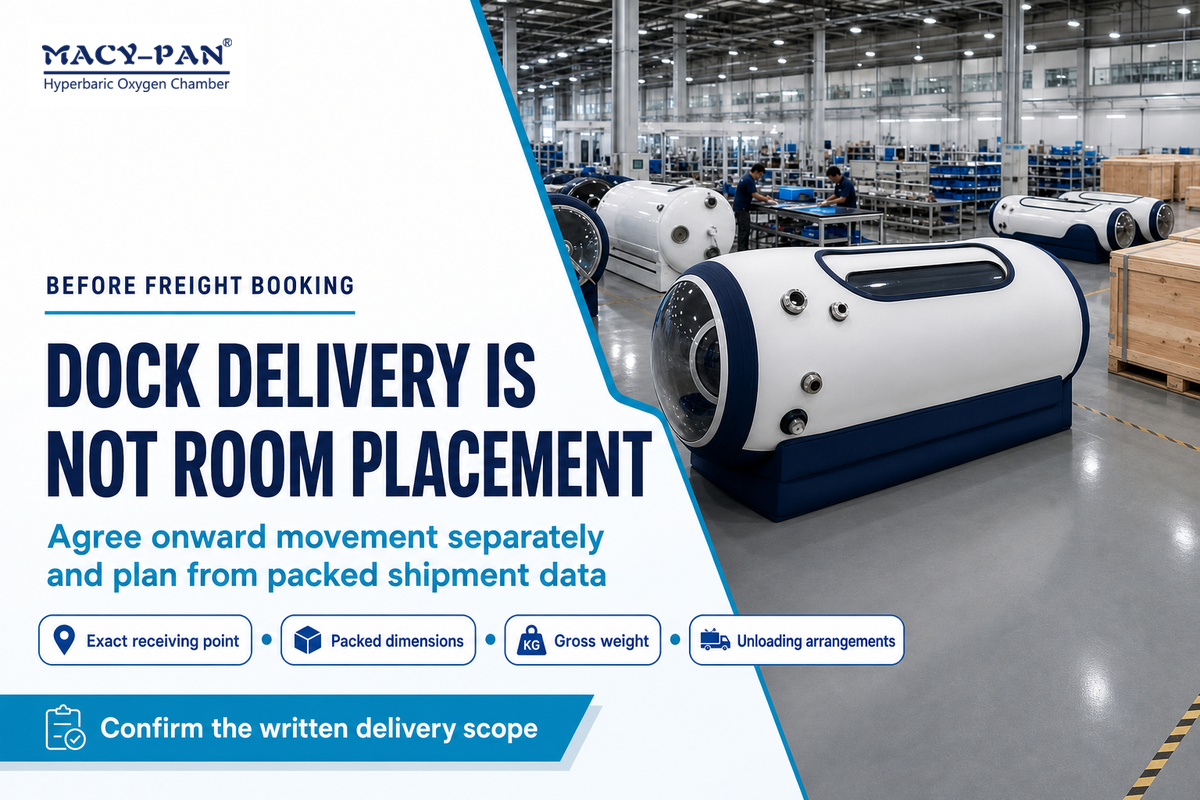
A named city doesn’t denote a usable receiving point. Dock, gate and address, as well as whether the shipment stays on the truck for buyer unloading, must be included. Request order-specific packed dimensions, gross weight, and lifting instructions. Confirm equipment and access prior to shipping the goods.
The seller must ensure its quoted scope is in line with the agreed delivery point. Ask it to provide the buyer with the revised packing list used in the freight offer. Delivery of goods to the dock doesn’t include movement to the intended room, unless otherwise agreed. Equipment net weight can’t replace packed gross weight for planning a reception.
A design for a chamber with a transport envelope is shown in US20250057713 A1, published in 2025. A proposed chamber design in US20250057713A1, published in 2025 , describes removable or folding stiffeners to address access constraints. This design illustrates how a transport envelope may be model-specific. It presents no MACY-PAN feature or availability and provides no basis to dismantle an ordered chamber.
A hypothetical receiving scenario. The facility buyer accepts delivery to its street address and assumes the chamber will be directed to the intended room. Before booking, the warehouse team reviews the packed drawing and states the truck that’s to be used for the delivery can’t use its regular unloading position. The purchasing manager requests that the supplier and carrier agree to a different receiving point and separately price the required handling. Facilities staff also review the onward access path using the manufacturer’s instructions. The order is unbooked while these issues are resolved. No one estimates lifting capacity from a product photograph or considers patent drawings as authorization to remove structural parts. The revised delivery description gives the receiving staff an operation that can be planned.
Request a chamber-specific Incoterm quote
Choose an Incoterm around handover and clearance work where FCA meets the requirements of buyer-controlled onward carriage with seller export clearance, CIF requires a sea delivery and insurance review, and DDP requires a feasible seller import arrangement. The final destination and your receiving capability should govern the options chosen.
Common failure modes: when a quoted term does not fit
Reject an EXW scope that assigns export work your organization can’t arrange. The ICC EXW/FCA guidance supports considering FCA where the allocation creates the problem. Buying extra freight services doesn’t automatically repair the export obligation in the contract.
Don’t approve a CIF transaction on the assumption that freight payment keeps risk with the seller. The ICC CIF guidance places normal delivery on board at the origin. An insurance certificate has to be checked to see if cargo has been covered for the route and if it’s in order for the cargo.
Temporarily pause consideration of a DDP offer if the seller is unable to clarify its import arrangement or names only a city. The ICC DDP discussion focuses on the destination and import duties. An independent statement about scope is required to define a separate installation promise.
Finally, the selected rule shouldn’t be seen as a complete purchase contract. The US International Trade Administration overview differentiates Incoterms from other contractual issues. Seller and buyer need compatible payment, ownership and service terms. Familiar trade practices seen elsewhere in the supply chain can’t replace the agreement.
Do
- Name the handover point.
- Assign every excluded charge.
- Confirm unloading arrangements.
Don’t
- Equate paid freight with retained risk.
- Assume DDP includes installation.
- Enter unknown charges as zero.
In a FreightWaves report on Incoterms training, Maria De Gannes mentioned capturing variations.
“Any variations should be clearly stated in writing and agreed to by all parties to the transaction.”
Provide the seller with model, quantity, packed shipment details, destination address, desired end point, clearance arrangement and unloading capability. The buyer must provide enough receiving information for a usable quote. Request the rule, exact named place or port, and “Incoterms 2020.” Keep model and packing changes aligned through OEM change control.
Key takeaway
Use the 3-Point Delivery Match before comparing totals: risk handover, seller-paid endpoint and receiving endpoint must all be explicit, even when they differ.
Review the MACY-PAN export quotation scope, then send MACY-PAN your chamber and receiving requirements for a model-specific quote. Ask what delivery options are available for your route.
Frequently asked questions
Answers provided in this section use the ICC’s current Incoterms 2020 framework, checked in October 2026. Each rule must have its exact named place or port; abbreviated delivery terms leave too much room for interpretation.
How many Incoterms are for sea and inland waterway transport?
Four: FAS, FOB, CFR and CIF.
FAS, Free Alongside Ship, places the delivery point alongside the vessel at the shipment port. Putting goods next to the vessel differs from FOB’s onboard delivery. CFR and CIF also use onboard origin delivery, although the seller pays onward freight. For a chamber moving through several modes, confirm where the goods are handed over before selecting a sea-only rule.
Which is better, EXW or DDP?
Choose according to buyer capability and the seller’s ability to perform.
A buyer with established export and transport arrangements may value the control available under EXW. A buyer handles far less transport coordination under a workable DDP agreement, but must still plan unloading. Compare the complete delivery scope and named importing arrangement. A convenient label can’t compensate for an obligation neither party can fulfill in the countries concerned.
What is FOB and CPT?
FOB uses onboard sea delivery; CPT combines carrier delivery with seller-paid onward carriage.
CPT means Carriage Paid To and applies to any mode. The seller contracts transport to the agreed place of destination, while risk normally passes when the goods reach the first carrier. FOB instead uses the vessel at the shipment port as its delivery point. Under either rule, compare the documented delivery event with the actual transport of goods before accepting the quote.
Which organization publishes Incoterms?
The International Chamber of Commerce publishes the rules.
ICC standardizes these terms for global trade. Incorporate the selected rule and edition into your contract; don’t rely on an abbreviation used informally in email.
2020 Incoterms vs. 2010 Incoterms: What Changed?
Relevant changes include DPU terminology, CIP insurance and an FCA document option.
Incoterms 2010 used DAT, Delivered at Terminal. The 2020 edition renamed it DPU to recognize unloading at places beyond terminals. CIP’s default insurance became Clause A or equivalent, while CIF retained Clause C. FCA added an agreed arrangement for an onboard bill of lading. Those changes don’t automatically revise an existing contract that specifies another edition.
Which is the latest version of Incoterms?
ICC presents Incoterms 2020 as the current edition.
That’s the publisher’s position checked in October 2026. A guide bearing a newer year isn’t evidence of a new rules edition.
Who pays CFR Incoterms?
The seller pays contracted freight to the named destination port.
CFR means the seller arranges that carriage, but normal risk passes from seller to the buyer onboard at origin. Destination unloading charges require attention to the carriage contract. The buyer normally handles import formalities and subsequent delivery. CFR doesn’t require the seller to purchase cargo insurance, so decide separately how transit exposure will be covered.
References & Sources
Rule interpretation: ICC Incoterms 2020 and the linked ICC Academy comparisons. US import and receiving context: FDA import guidance, APHIS packaging requirements and FMC detention and demurrage guidance. Scenarios and worksheet are editorial examples, not reported shipments or carrier quotations.