Get in Touch with MACY-PAN Company

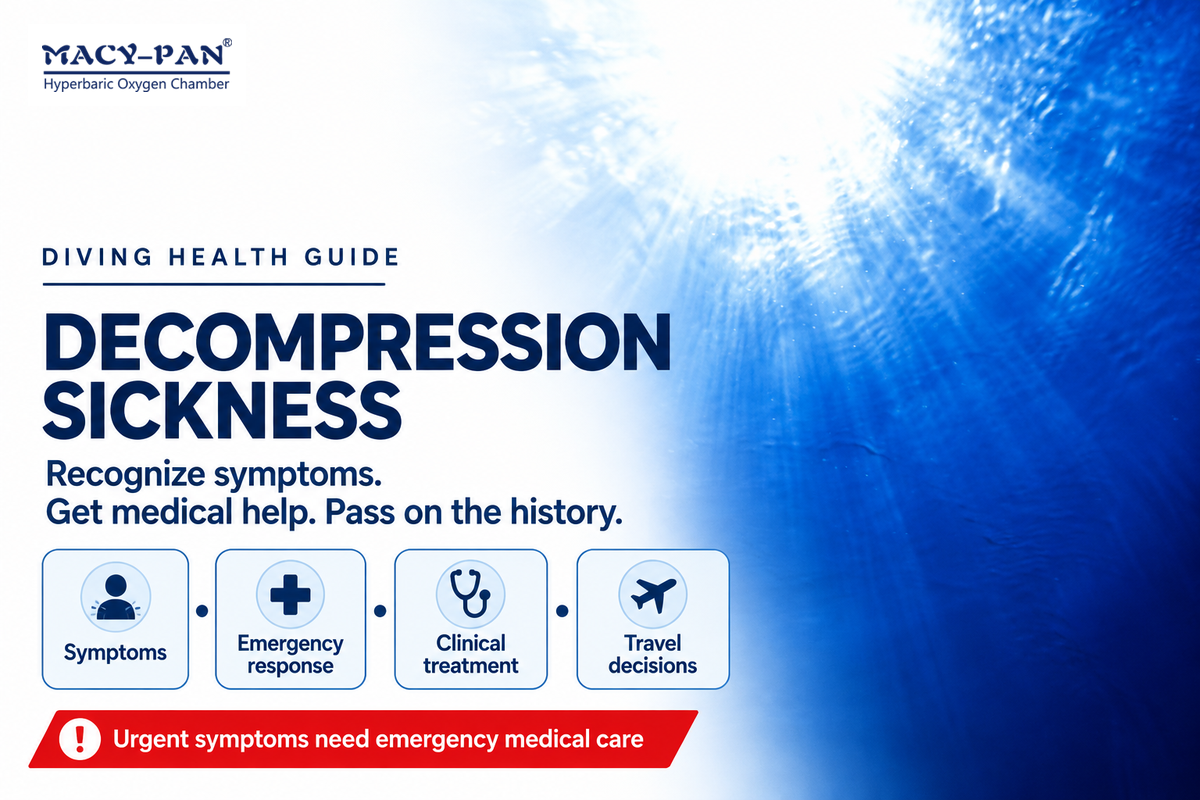
Decompression sickness, colloquially known as the bends, is an injury caused by inert gas bubbles forming as the ambient pressure drops. A diver may experience pain, skin discoloration and numbness; if severe there may be difficulty breathing or moving, or altered consciousness. A dive that stayed within the dive computer’s limits can still be followed by symptoms.
Possible dive emergency? New weakness, trouble walking, confusion, breathing difficulty or collapse after a dive requires urgent help. Activate local emergency medical services. A trained provider should give emergency oxygen while help is arranged. The Divers Alert Network emergency hotline, +1-919-684-9111, can assist with diving-medicine advice and coordinated care after local emergency services are activated.
This article describes what to report and why clinical decisions depend on more than a dive computer countdown. MACY-PAN provides chamber equipment; an injured diver requires a medical service capable of evaluating and treating dive injuries.
What is decompression sickness?
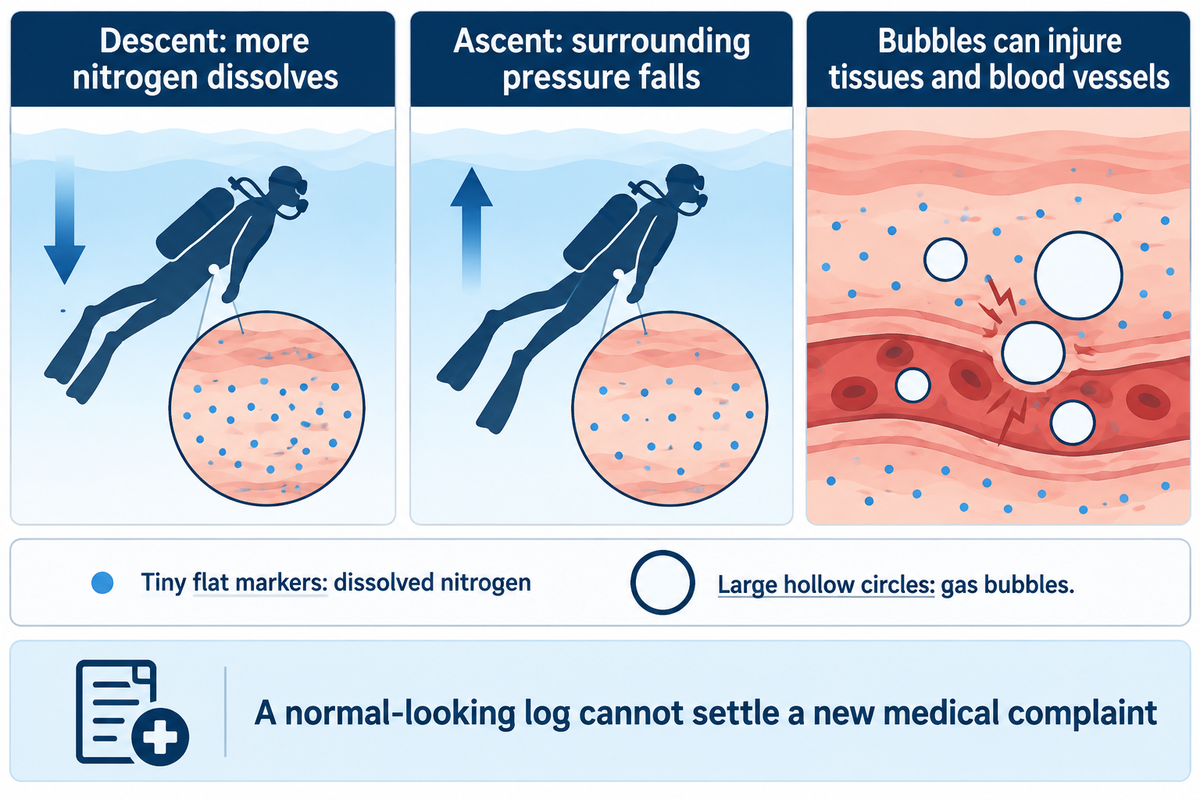
Decompression sickness in scuba divers develops when dissolved inert gas forms bubbles during or after a reduction in pressure, with nitrogen being the main inert gas involved in air diving. The injury can affect tissues and blood vessels, so the bends can cause far more than joint pain after an apparently uneventful dive.
As a diver descends, the pressure increases and more nitrogen dissolves in the body; as the diver ascends, the partial pressure of the gas being inhaled drops and dissolved nitrogen moves toward the lungs to be exhaled. Depth, time and the ascent profile shape this gas exchange.
Tissues do not absorb or eliminate nitrogen at the same rate.
Bubble formation is only part of the pathophysiology. Nitrogen bubbles can obstruct small vessels, distort tissues and trigger inflammatory injury, which explains why the cause of decompression sickness is more involved than simply having made an obviously rapid ascent. Understanding the physiology helps recreational divers recognize why a normal-looking log cannot settle a new medical complaint. The 2024 clinical overview by Simon Mitchell describes these mechanisms and the limits of simple classifications.
A familiar dive profile can create false reassurance: the buddy feels fine, the computer showed no violation, and lifting cylinders offers an obvious explanation for a sore arm. Those details belong in the history. They do not justify ignoring new numbness or weakness. DAN’s discussion of a computer-compliant diving accident explains that different decompression models and settings do not give identical safety margins.
Decompression illness, or DCI, is the broader term that includes both DCS and arterial gas embolism. It matters how you describe your symptoms; help does not need to wait until someone on the boat has decided which label to use.
Signs and symptoms of decompression sickness
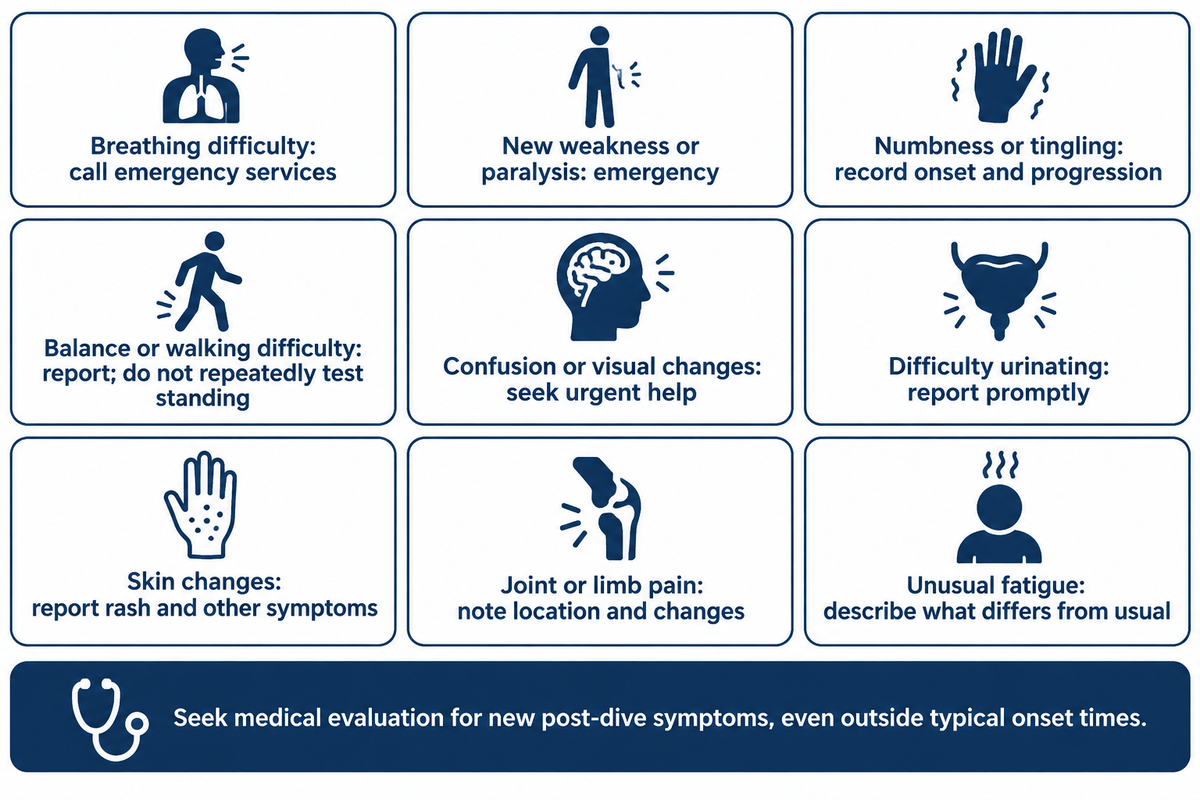
DAN describes decompression sickness symptoms as usually appearing within 15 minutes to 12 hours after surfacing , although severe signs can start sooner and delayed symptoms can occur. Pain, unusual fatigue, skin changes and neurological symptoms deserve attention in the dive context, even when their onset falls outside that typical timing range.
| Finding | What to notice and report |
|---|---|
| Breathing difficulty or chest symptoms | Shortness of breath, cough, frothy sputum or chest tightness: activate emergency services. |
| Weakness or paralysis | New loss of strength or difficulty using an arm or leg is an emergency. |
| Numbness or tingling | Record the body area, onset and progression; do not dismiss a new sensory change. |
| Balance or walking difficulty | Report unsteadiness, vertigo or inability to walk; do not make the person repeatedly stand to prove it. |
| Confusion or visual changes | Describe the change from normal behavior or vision; seek urgent medical help. |
| Difficulty urinating | Report this promptly, especially with leg, back or sensory symptoms. |
| Skin changes | Describe itching, swelling or a blotchy, marbled rash and any other symptoms. |
| Joint or limb pain | Note its location and whether it is new, worsening or different from a known injury. |
| Unusual fatigue or feeling unwell | Explain how the feeling differs from the person’s usual post-dive state. |
Skin bends (including cutis marmorata) may not seem as ominous as weakness. Skin anomalies may be associated with other problems, however. Guidelines differ in how they classify skin findings; the S2k diving-accident guideline uses a more conservative severity classification than some other international definitions.
A diver should report new skin anomalies, not merely assume that a visible rash is harmless.
As for the old descriptions, they split injuries into Type I and Type II DCS. Those descriptors are too crude for self-triage. Spinal cord decompression sickness may cause sensory changes, weakness or bladder problems, while inner-ear involvement may produce pronounced vertigo.
A significant diving injury does not always involve the classic painful joint.
When can signs of decompression sickness appear?
DAN states that typical onset occurs 15 minutes to 12 hours after surfacing, but signs may begin during decompression, immediately after surfacing or later. Although uncommon, delayed onset can occur after altitude exposure, including air travel. Tell the clinician when the first change actually appeared, even if it seemed minor then; the time someone finally reported it may be much later.
Fear of losing a trip or inconveniencing a boat can make people downplay symptoms. A good report is factual: “This tingling started after the dive and is new to me”; an uncertain cause is a reason to seek medical advice, not a reason to conceal the observation.
What to do if you suspect decompression sickness
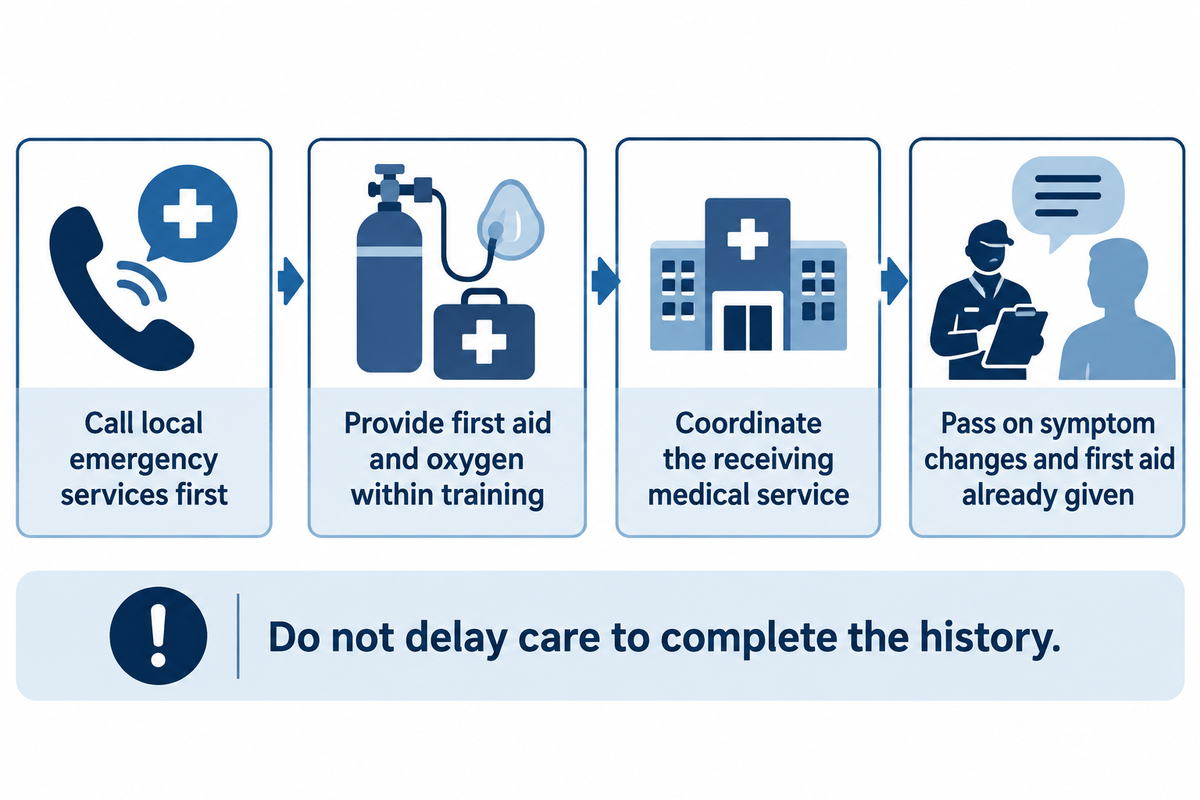
Initial management of decompression illness starts with first aid within the rescuer’s training: call local emergency services immediately, assist with airway and breathing, and have a trained provider give high-concentration oxygen. If possible, review the dive history for the last 48 hours before the injury without delaying care or rapid transport.
- Call for medical help. Give the location, callback number, dive history and current symptoms; use local emergency services first.
- Provide trained first aid. Attend to airway and breathing, use emergency oxygen equipment within training and follow dispatcher or medical instructions.
- Coordinate the receiving service. DAN and the medical team can confirm the appropriate facility and transport arrangements.
- Pass on the timeline. Report symptoms, changes and first aid already given without delaying transfer.
Oxygen can alleviate symptoms without healing the injury. Leave it to the specialists even if the diver claims to have returned to normal. Symptoms may come back or a slight neurological deficit may be missed.
Do not return the diver underwater to attempt improvised recompression.
Breathlessness is especially important because pulmonary DCS is only one possible cause. Immersion pulmonary edema, aspiration and lung barotrauma can look similar. The SPUMS/UKDMC statement on immersion pulmonary edema describes different positioning and fluid-management needs. Follow emergency guidance and support a position that permits breathing; do not force a breathless casualty flat or load them with fluids. Do not use a head-down position. A person with impaired consciousness must not be given oral fluids.
Dive-to-Care Handover: a filled example
Let’s say a buddy reports tingling upon returning to a boat. Another crew member rings the emergency service while the trained oxygen provider starts first aid. The caller has the computer and the operator’s log, but does not wait to download all the logs before calling.
They isolate knowns from missing details and give the latest symptom update. Here’s a fictional handover demonstrating what that report might look like. The dive depths and times are sample entries, not a safe diving schedule.
The table makes no diagnosis, severity rating or predicted result. If details are missing, say so and send them later.
| Field | Example entry |
|---|---|
| Location and contact | Boat at the marked pickup point; caller gives coordinates and callback number directly to dispatch. |
| Diver’s baseline | Alert and speaking; new tingling differs from the diver’s usual state. Relevant medical history still being confirmed. |
| Previous day’s dives | Operator log records 20 m / 30 min and 18 m / 35 min; complete computer records available to forward. |
| Today’s dives | Operator log records 18 m / 40 min and 12 m / 35 min; exact profiles and surface intervals to accompany the report. |
| Breathing gases and events | Air reported; verify gas and any computer alerts or unusual events from the actual records. |
| Last surfacing | 14:10, as recorded by the operator. |
| First symptom | 14:25, new tingling reported in the left forearm. |
| Initial response | 14:26 emergency call; 14:27 trained provider starts oxygen and records delivery method. |
| Latest update | 14:31: diver reports less tingling; breathing and observed function are relayed separately. Medical assessment remains arranged. |
| Outstanding information | Full preceding 48-hour history, ascent rates, surface intervals and relevant injuries to be forwarded without delaying care. |
A dive buddy’s report and a clinician’s examination serve different purposes. Describe what happened, including any apparent response to oxygen, without making a novice perform a demanding neurological test before allowing evacuation. DAN’s DCI resource lists the history fields and stresses that examination should not interfere with prompt transport.
DCS, arterial gas embolism and nitrogen narcosis
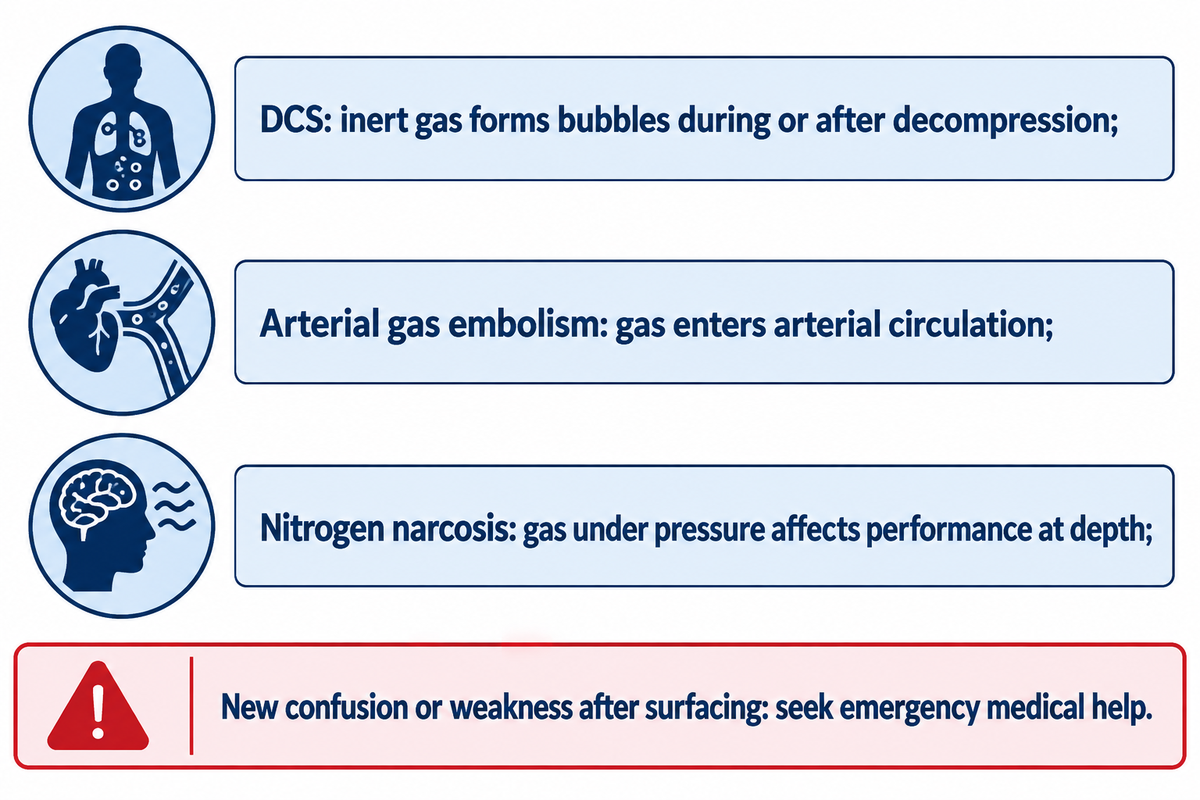
DCS and the arterial gas embolism both are kinds of decompression illness, and their initial treatment is comparable. Nitrogen narcosis is a different effect of breathing gas under pressure at depth. Confusion or weakness after surfacing should therefore trigger medical evaluation rather than an attempt to dismiss the problem as lingering narcosis.
| Condition | Main distinction | Practical implication |
|---|---|---|
| DCS | Inert gas comes out of solution and forms bubbles during or after decompression. | A compliant profile does not exclude it. |
| Arterial gas embolism | Gas enters arterial circulation, commonly after pulmonary barotrauma during ascent. | Sudden post-surfacing neurological changes require emergency help. |
| Nitrogen narcosis | Gas under pressure affects mental performance at depth. | Persistent symptoms at the surface need another explanation and assessment. |
Is decompression sickness the same as nitrogen narcosis?
No. Nitrogen narcosis usually clears as a diver makes a controlled ascent and the pressure falls; DCS involves injury associated with bubble formation and its effects. The CDC Yellow Book’s diving chapter distinguishes these conditions. A person on the boat with new neurological symptoms should not be sent back into the water to test that distinction.
Timing and dive history inform the receiving clinician; however, unusual presentations do occur. An injured diver may also have another complication of scuba diving or an unrelated medical problem. Communicate to emergency responders any respiratory symptoms, sign of aspiration, complaints of chest pain or injury and the probable decompression injury.
Recompression treatment: why the clinical setting matters
A common treatment for decompression sickness is U.S. Navy Treatment Table 6: DAN describes an initial pressure of 2.8 atmospheres absolute, equivalent to about 60 feet or 18 meters of seawater , and a usual duration just under five hours. The clinician in charge of the treatment chooses the table; extensions may be applied.
Recompression decreases bubble volume. Breathing oxygen also supports nitrogen elimination and oxygen transport to affected tissues. The higher partial pressure of oxygen carries a risk of oxygen toxicity, so treatment tables include controlled gas changes and monitoring.
The DAN treatment chapter describes oxygen periods, air breaks and why a person may require further sessions.
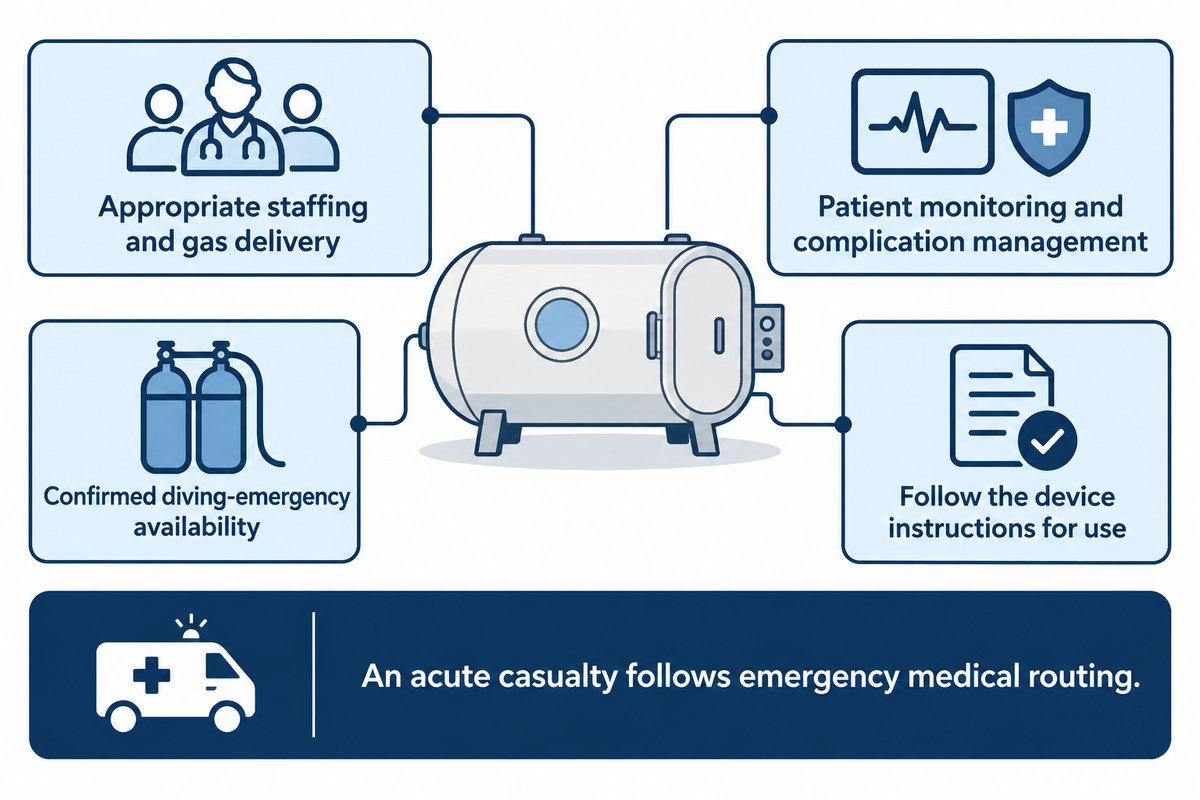
“Review and follow the manufacturer’s instructions for use for each hyperbaric oxygen therapy (HBOT) device being used.”
Clinical diagnosis and treatment begin with the diver’s history and examination. A normal MRI does not by itself rule out acute neurological DCS, and imaging may be required to look for another explanation or a coexisting condition such as a pneumothorax before recompression. Waiting for a scan solely to “prove the bends” can delay clinical assessment.
The diving-medicine team will determine which investigations are needed.
Definitive treatment for severe DCI is usually medical recompression with oxygen, while treatment options for selected mild cases in remote locations can vary when transfer is difficult or dangerous. Severity definitions and local protocols also vary. That expert-led exception does not mean that staying home with oxygen is appropriate or that delayed presentation makes consultation pointless.
A chamber service needs more than a pressure vessel. Suitably equipped monoplace and multiplace facilities can treat selected diving casualties, but their staffing, gas delivery, monitoring and ability to manage complications must match the patient. Confirmed availability matters: some facilities do not accept diving emergencies or operate outside scheduled hours. Medically supervised hyperbaric oxygen therapy and a consumer wellness session are different care arrangements.
For facility planners, MACY-PAN’s hard-shell chamber equipment is a separate equipment-planning topic. Start with the intended clinical service, the applicable device documentation and the responsible medical team. Our monoplace and multiplace staffing considerations and chamber room fire-safety planning guides address that preparation. An acute casualty should follow emergency medical routing.
Recovery, flying and returning to diving
Recovery from the bends can be complete, but improvement, discharge, flying home and returning to diving are different decisions because the clinician must take into account the original injury, residual symptoms and the person’s individual circumstances. Typical advice not to fly for an uninjured diver cannot clear a person who has had DCI or recompression therapy.
Can you fully recover from the bends?
Yes, they can make a full recovery. Some people require more than one treatment, and severe neurological injury can leave lasting deficits despite care. It is not possible to predict an individual’s prognosis based on a general success rate.
Ask the treating team how to report recurrent symptoms, what follow-up is needed and how to increase activity; persistent or worsening problems require reassessment.
Follow-up can also address why the event occurred. The 2025 SPUMS/UKDMC atrial-shunt statement advises against routine screening of all divers, while recommending consideration of assessment after specified histories of DCS. A patent foramen ovale or another right-to-left shunt is one possible issue for specialist discussion, not a reason for every reader to seek a procedure.
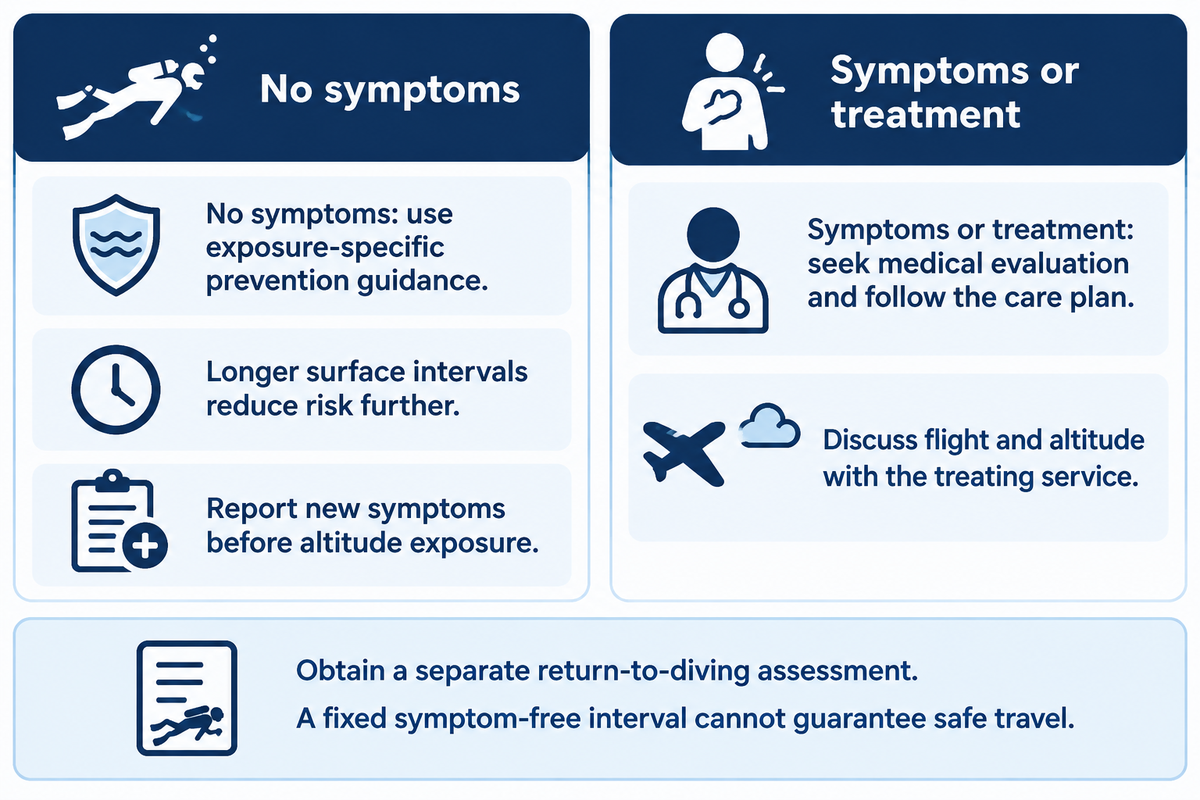
Routine flight guidance for divers with no symptoms
No symptoms after diving
- Use exposure-specific prevention guidance.
- Longer surface intervals reduce risk further.
- Report any new symptoms before altitude exposure.
Symptoms, diagnosed DCI or treatment
- Seek medical evaluation and follow the care plan.
- Discuss flight and altitude with the treating service.
- Obtain a separate return-to-diving assessment.
| Dive exposure | CDC’s recommended interval |
|---|---|
| Single no-decompression dive | At least 12 hours after surfacing |
| Multiple dives or multiple days of diving | At least 18 hours |
| Dive requiring decompression stops | 24–48 hours |
This is not a guarantee that a flight is risk free; these are risk-reduction suggestions. The symptomatic or treated diver belongs in the medical pathway shown alongside the table.
Can you fly after hyperbaric treatment?
Flying after treatment for DCI requires advice from the diving-medicine service treating the diver. The decision to travel or fly after treatment depends on the nature of the injury and extent of recovery, not simply the time since the last dive. Evidence for a universal post-treatment interval is limited, and a fixed number of symptom-free hours cannot guarantee safe travel.
Consider a traveler who has completed recompression and wants to use the original ticket home. Their escort recalls the normal post dive waiting rule, and presumes the flight is settled. A useful next step is to query the treating service about the flight, any residual symptoms and onward travel over the hills.
The tourist also requires a plan for contacting care if residual symptoms recur. A modified booking may be required, but neither the airline schedule nor the dive computer makes such medical judgements. Before departure, the patient and escort can retain the service’s written travel and follow-up guidelines together.
Treatment access, costs and dive insurance
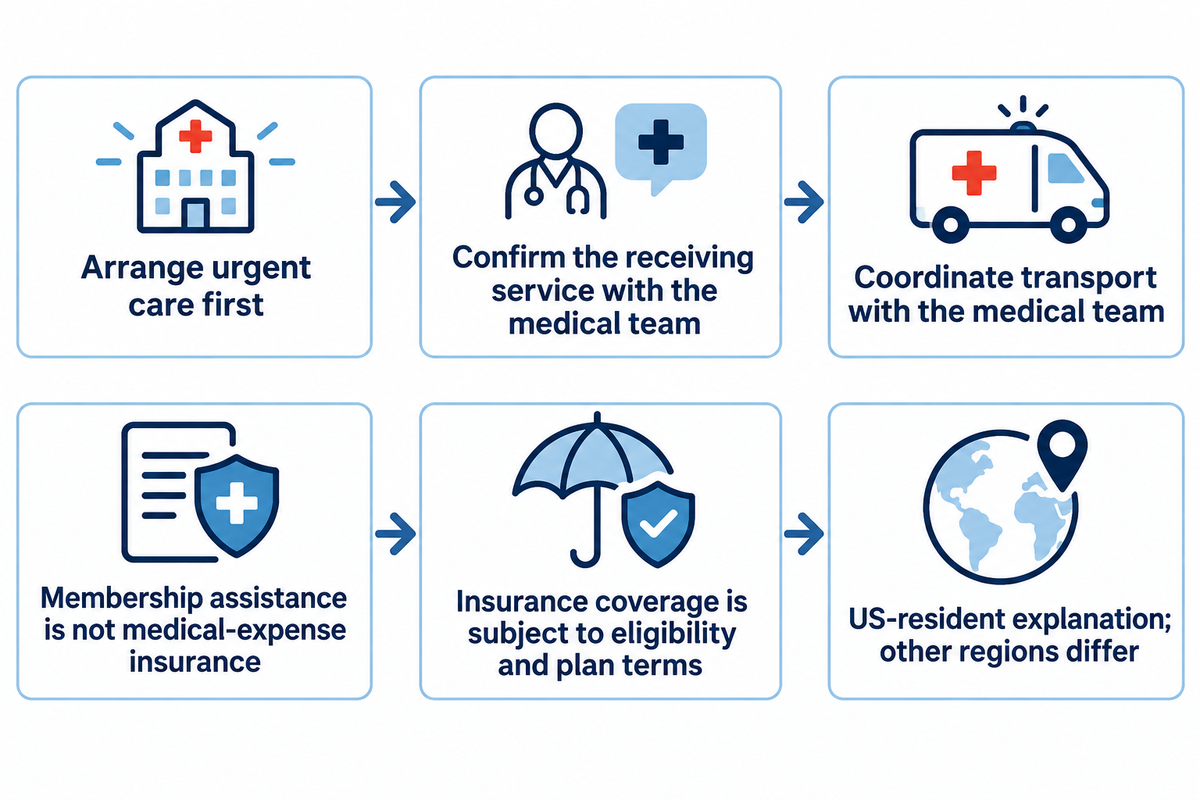
Treatment of decompression illness may include emergency assessment, transport, chamber treatment, hospital care and follow-up, with the invoice reflecting the actual episode and location rather than an equipment price or wellness-session price. Arrange urgent care first. A friend may gather policy & billing info while the specialists take care of the damage.
DAN’s chamber-availability guidance explains why injured divers should be assessed through local medical services. The nearest advertised chamber may be closed, unable to take an unstable patient or not set up for diving emergencies. The receiving team and transport service need a coordinated destination.
Imagine a traveler has a DAN membership card but believes this will settle each chamber and hospital bill. The buddy reads the documentation while the staff continues treatment. The questions are distinct: who secures the emergency transport, which medical bills are the insurer’s liability, which are not, and does it include a medically required longer stay?
Having the phone numbers, policy, and receipts readily available fosters that discussion. The traveller’s companion should communicate to the insurance company what the attending physician has prescribed, not opt for a less costly clinical solution. Compensation can only be obtained based on the contracted policy and individual eligibility in conjunction with terms and conditions of the policy for the intended destination and activity.
For members whose principal residence is in the United States, DAN distinguishes membership assistance from dive accident insurance. Membership transport and travel-assistance benefits do not cover the actual medical costs of a dive accident. Separate insurance can cover eligible medical expenses subject to the plan. Availability and terms vary by state; other regions have different arrangements.
Current guidance for the next dive
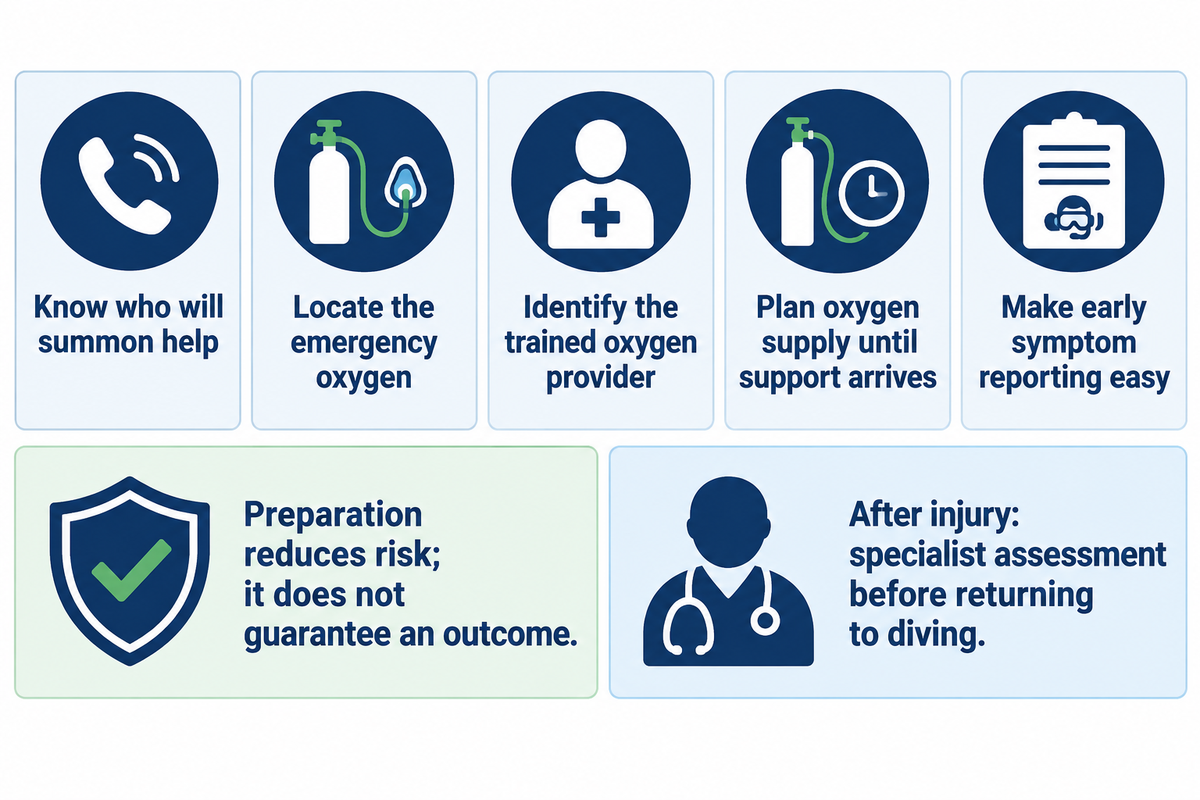
Safe diving practices reduce the risk of decompression sickness without removing it. Future planning should combine conservative profiles, appropriate training, reliable communications and an emergency plan. After a diving injury, return to recreational diving starts with a specialist assessment of recovery and relevant medical conditions, rather than a decision based only on elapsed time.
CDC diving guidance recommends conservative approaches to recreational scuba diving. Know the decompression model and settings used by the dive computer and leave a margin rather than treating the displayed limit as a target.
Report a rapid ascent, an omitted decompression stop or a short surface interval; the absence of these events does not rule out DCS. Changing a breathing gas mixture, including enriched air nitrox, changes gas exposure and still requires gas-specific training and an appropriate dive plan.
The pressure change of ascent is just a piece of decompression stress. Make sure, before the boat departs, that you know who will summon help, where the emergency oxygen is located, who is trained to administer it, and how long it will last until other support arrives. The operator should make it simple to report symptoms. “Let us know early” is more useful than making divers prove they are ill before they can ask for assistance.
Conservative planning reduces risk for decompression sickness, while medical treatment aims to limit morbidity and mortality if an injury occurs; neither a prevention routine nor therapy for decompression illness guarantees an individual outcome. Capture the dive records and follow instructions of the treating team. For a planned clinic, oxygen delivery into tissue and hyperbaric treatment risks provide relevant context for a separate equipment discussion with the responsible clinicians.
Frequently asked questions
Can decompression sickness go away on its own?
Some relatively mild symptoms may disappear, but the absence of symptoms is not a safe reason not to seek medical evaluation.
Clinical decisions on mild cases are governed by the findings of the examination, evolution of symptoms, local protocol and availability of recompression. Different guidelines specify different severity classifications. Seek a diving-medicine consultation and do not attempt to grade the injury.
Response to oxygen may be short term and symptoms that return or worsen require urgent medical care.
How is decompression sickness diagnosed?
DCS is primarily diagnosed on the basis of the dive history, clinical examination and the presenting symptoms.
A clinician considers the pressure exposure, onset, neurological findings and other explanations. A normal scan does not by itself rule out early neurological injury, although imaging or tests may be needed for another suspected medical condition or a complication. Bring your dive computer and any past records, and do not postpone essential medical care to prepare an ideal history.
Can decompression sickness happen after a shallow dive?
Yes. A shallower dive by itself does not rule out DCS.
Depth is just one dimension of the exposure: duration, repetitive diving, ascent and individual factors also matter. Very shallow exposures are usually associated with much lower risk but a new symptom still needs to be considered in the right context. Sudden post-dive neurological or respiratory symptoms may also have another serious cause and require urgent evaluation.
Is decompression sickness fatal?
Severe DCS can be fatal.
Difficulty breathing, collapse or significant neurological changes need emergency care. Early assistance is important; do not wait for pain or every classic symptom to appear.
Which gas causes decompression sickness?
Nitrogen constitutes the bulk of the inert gas in the air-dive DCS.
Other inert gases found in specialized breathing mixtures may also be involved in DCS.
Can decompression sickness affect people who do not dive?
DCS can affect people exposed to other substantial reductions in surrounding pressure, including compressed-air workers, aviators and astronauts.
These scenarios include varying exposures, different countermeasures and occupational medical protocols. An ordinary ache after routine travel is not automatically DCS. Assessment requires the actual pressure history and a compatible clinical picture. A suspected decompression event should be reported to the emergency / occupational medical system with particulars of both the exposure and the clinical presentation.
The diving examples presented in this article illustrate the mechanism and the need for medical assessment, but they do not replace workplace, aviation or spaceflight protocols.
References & Sources
- CDC Yellow Book 2026: Scuba Diving—Decompression Illness and Other Dive-Related Injuries, James Chimiak and Daniel A. Nord, April 23, 2025.
- Mitchell’s clinical review of decompression illness, Diving and Hyperbaric Medicine, 2024.
- Decompression Illness, Divers Alert Network, Ed Thalmann.
- Chapter 4: Treating Decompression Sickness, Divers Alert Network.
- Why Does DAN Not Share Chamber Availability, Divers Alert Network.
- Full Treatment, Marty McCafferty, Alert Diver, February 1, 2010.
- S2k guideline for diving accidents, GMS German Medical Science, 2023.
- Joint position statement on immersion pulmonary oedema and diving, SPUMS and UKDMC, 2024.
- Joint position statement on atrial shunts and diving: 2025 update, SPUMS and UKDMC.
- Know Your Benefits: DAN Membership & Dive Accident Insurance, Divers Alert Network, September 3, 2025.
- Follow Instructions for Safe Use of Hyperbaric Oxygen Therapy Devices, U.S. Food and Drug Administration, August 25, 2025.