Get in Touch with MACY-PAN Company

Ear Barotrauma: Symptoms, Treatment and How to Equalize in a Chamber

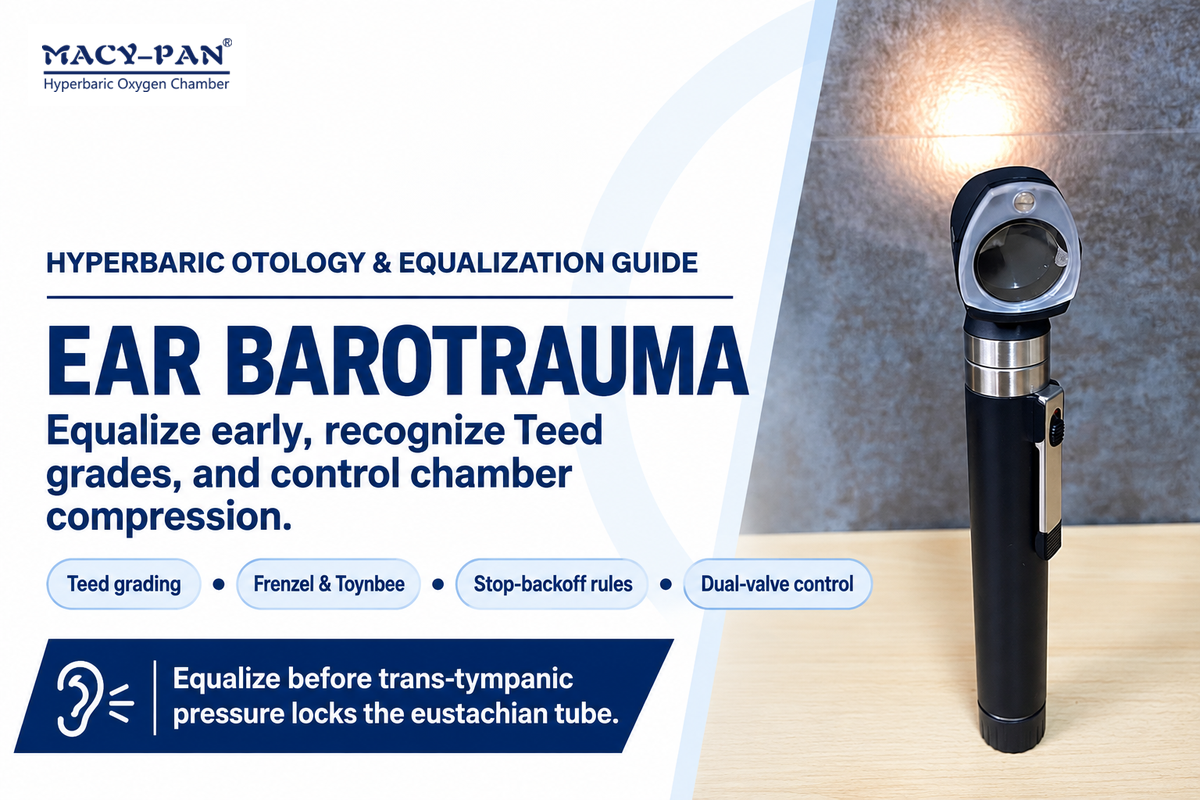
Ear barotrauma (medically known as barotitis media or middle ear barotrauma) is damage to the lining of the eardrum and middle ear due to an unbalanced pressure difference between the environment and the middle ear’s air-filled cavity. When there’s an increase in ambient air pressure or water pressure faster than the eustachian tube can vent gas into the tympanic cavity (such as during hyperbaric oxygen therapy, a scuba dive, or on an aircraft descent), it leads to a vacuum in the middle ear cavity. This causes the lining to be pulled inwards. Equalizing the pressure at the start of compression helps prevent the gradient from exceeding 60 mm Hg (where ear pain and fullness start) or reaching approximately 90 mm Hg, the point at which external tissue pressure locks the eustachian tube lips shut.
The lining of the ear can be damaged due to a buildup of pressure. This can lead to things such as Fullness or discomfort in the ear or hearing loss. This is usually a temporary condition and heals on its own as the fluid and swelling go down. However, uncompensated compression can progress across the six-tier Modified Teed grading scale from tympanic membrane erythema (Grade 1) to hemotympanum (Grade 4) or a perforated eardrum (Grade 5) requiring otorhinolaryngology evaluation. Next, we’ll discuss the mechanics of Trans-tympanic pressure, Differential diagnosis of inner ear barotrauma, Low Force equalization maneuvers, Hyperbaric chamber compression protocols, and Dual-valve hardware controls engineered by MACY-PAN.
What Is Ear Barotrauma and Why Does the Eustachian Tube Lock Under Pressure?
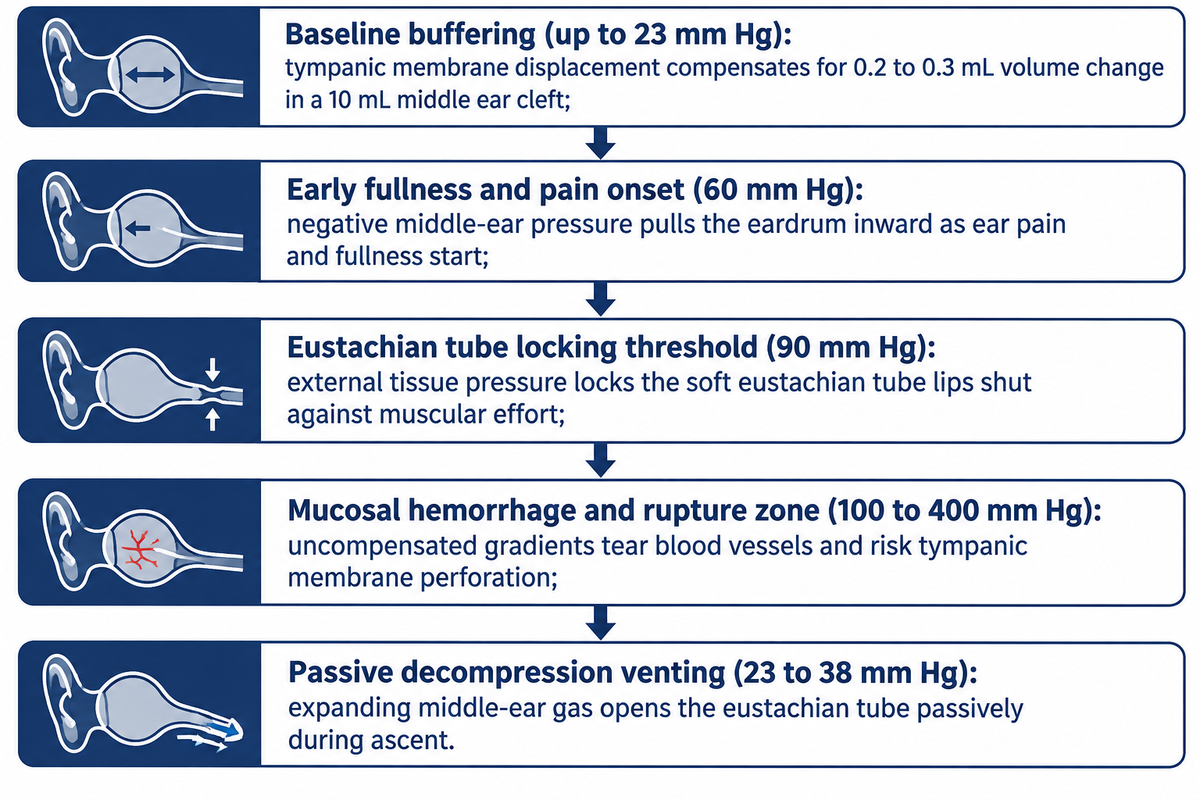
Ear barotrauma is when the eustachian tube doesn’t open at the right times to balance changes in external atmospheric pressure. This causes a mechanical pressure difference across the tympanic membrane. In normal conditions, at sea level (1.0 ATA), the air pressure in the middle ear matches that of the outside ear canal and the eardrum is in a neutral position, ready to vibrate. Injury can occur during travel to high altitudes, when boarding a flight, or during hyperbaric chamber exposure. This is because the ambient pressure changes quickly and the middle ear space can’t ventilate and admit gas quickly enough.
The separation of the outer and middle ear explains the rapid effect of changes in ambient pressure on the ear. The external ear canal conducts sound waves to the outer surface of the eardrum, while the middle ear behind the drum is a rigid, bone-walled cavity housing three auditory ossicles (malleus, incus, and stapes). The only natural airway connecting the rigid, bone-walled cavity to the back of the human nose and throat (the nasopharynx) is the eustachian tube.
“Swallowing or yawning opens the eustachian tube and allows air to flow into or out of the middle ear. This helps equalize pressure on either side of the ear drum. If the eustachian tube is blocked, the air pressure in the middle ear is different than the pressure on the outside of the eardrum. This can cause barotrauma.”
According to Boyle’s Law (P1 × V1 = P2 × V2, at constant temperature), the volume of a fixed gas mass is inversely proportional to absolute pressure. As documented in hyperbaric otology research (PMC4297009), inward displacement of the tympanic membrane can compensate for volume changes of only 0.2 to 0.3 mL and counteract negative pressures of approximately 23 mm Hg in a middle ear cleft with a mean volume of 10 mL. At the same time, passive nitrogen diffusion between the middle ear mucosa and mixed venous blood is only at 0.0008 mm Hg/min, making gas boluses through the eustachian tube essential during hyperbaric compression, aircraft descent and diving.
If an occupant delays ear clearing while outside pressure climbs, negative pressure in the middle ear draws fluid and blood into the mucosal lining (edema) and pulls the soft cartilaginous walls of the eustachian tube together. According to the NIH StatPearls Ear Barotrauma clinical reference, Divers Alert Network (DAN) middle-ear barotrauma guidance, and Lima et al. (PMC4297009), a trans-tympanic differential exceeding 60 mm Hg causes pain, fullness, and conductive hearing loss; once the gradient reaches roughly 90 mm Hg, surrounding tissue pressure exceeds the maximum pulling force of the tensor veli palatini muscle and locks the eustachian tube lips shut. That 60 to 90 mm Hg physiological threshold is a clinical average; actual locking pressure varies with individual tubal cartilage angulation and mucosal edema.
| Threshold Category & Gradient | Direction & Phase | Middle-Ear & Eustachian Tube Physiological Response | Clinical Source Basis (PMC4297009 / DAN) | Required Occupant / Operator Action |
|---|---|---|---|---|
| Baseline Buffering (≤23 mm Hg) | Early compression (negative middle-ear pressure) | Pars flaccida and pars tensa retraction displaces 0.2 to 0.3 mL in a 10 mL middle-ear cleft | Sadé & Neuman (PMC4297009): membrane mobility buffers up to ~23 mm Hg | Begin proactive gentle swallowing or yawning as compression starts |
| Passive Venting (23 to 38 mm Hg) | Decompression / ascent (positive middle-ear pressure) | Expanding tympanic gas passively forces the one-way eustachian tube valve open | Lima et al. (PMC4297009): passive exhaust opens tube between 23 and 38 mm Hg | Allow passive air escape; swallow or use Toynbee if mild fullness occurs |
| Symptomatic Stretch (>60 mm Hg) | Uncompensated compression | Pronounced inward tympanic stretching, mucosal vasodilation, fullness, and ear pain | Lima et al. (PMC4297009): gradient exceeding 60 mm Hg causes pain and fullness | Pause chamber compression immediately (Hold); do not allow pressure to rise |
| Tubal Locking (~90 mm Hg) | Delayed equalization during compression | External tissue pressure compresses eustachian tube lips beyond tensor veli palatini force | Lima et al. (PMC4297009): tubal blockage occurs when gradient reaches ~90 mm Hg | Lower chamber pressure slightly (Backoff) until the ostium unlocks, then clear gently |
| Membrane Rupture (100 to 400 mm Hg) | Severe uncompensated compression | Subepithelial hemorrhage, serous transudation, hemotympanum, or anterior eardrum tear | Lacey & Amedee (PMC4297009): perforation typically occurs between 100 and 400 mm Hg | Abort compression, decompress slowly, and arrange otoscopic medical diagnosis |
How to remove pressure from ears?
To alleviate pressure in the ears during or after a change in ambient pressure: first halt the increase in external pressure or slightly reduce the chamber pressure if the eustachian tube has locked, and then stimulate the tensor veli palatini muscle by any of the following: swallowing, yawning, sipping water, chewing gum, or gently performing a Toynbee or Frenzel maneuver. If these measures are unsuccessful, consult a clinician.
Never blow hard against a pinched nose if sharp pain or dizziness is present.
If nasal mucosal swelling occurs after flying or hyperbaric oxygen therapy, resting with the head elevated and using a clinician-approved saline rinse can alleviate obstruction by shrinking edema of the ostium.
Symptoms of Ear Barotrauma and the Modified Teed Scale (Grades 0 to 5)
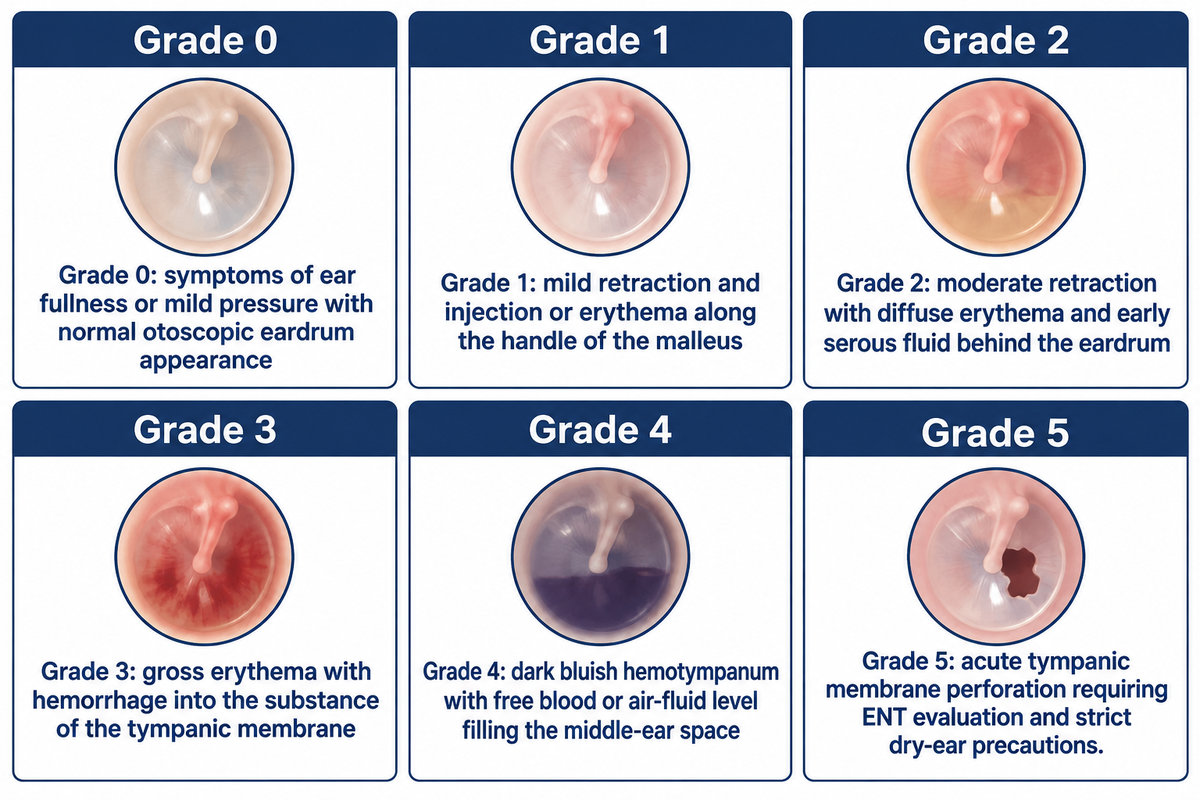
The symptoms of ear barotrauma are directly related to the trans-tympanic pressure gradient and the duration of middle ear vacuum. During the early stages of this condition, occupants often feel like there’s fluid clogged in their ear, often referred to as airplane ear which happens during the flight descent or while going for a dive and causes slight hearing loss and some discomfort.
When air pressure in the ear isn’t equalized, the middle ear vacuum creates a negative pressure that draws blood out of the mucosal capillaries. As detailed in Cedars-Sinai’s Ear Barotrauma clinical overview and hyperbaric otology reviews (PMC4297009), severe symptoms include sharp ear pain, moderate to severe conductive hearing loss, a sensation of fluid or water trapped behind the drum, tinnitus, and bleeding from the ear canal if the tympanic membrane ruptures.
To evaluate the physical examination findings in hyperbaric medicine and diving evaluations, clinicians examine the tympanic membrane with an otoscope and classify the injury using the six-level Modified Teed Scale (grades 0-5):
| Modified Teed Grade Type | Otoscopic Examination Findings | Typical Subjective Signs and Symptoms | Clinical Course & Outlook | Hyperbaric Chamber & Clinical Protocol Action |
|---|---|---|---|---|
| Grade 0 | Normal tympanic membrane landmarks and mobility; no visible erythema | Transient ear fullness or mild pressure sensation during compression | Mild symptoms resolve shortly after pressure equalizes | Coach equalization technique; resume compression at a slower, gentler ramp |
| Grade 1 | Tympanic membrane retraction with vascular injection (redness) along the handle of the malleus | Clogged ear sensation, mild earache, slight muffled hearing | Self-limited mucosal redness that subsides with rest | Pause hyperbaric exposure until otoscopy and tubal patency normalize |
| Grade 2 | Retraction and diffuse erythema of the eardrum with slight subepithelial pinpoint hemorrhage | Moderate ear pain during pressurization, persistent fullness, conductive dullness | Reversible tissue congestion without free middle-ear blood | Hold further HBOT sessions until pain resolves and clinician confirms drum mobility |
| Grade 3 | Gross intratympanic hemorrhage across the eardrum surface with dark ecchymosis | Marked ear pain, noticeable conductive hearing loss, persistent plugged feeling | Subepithelial bleeding requiring gradual mucosal resorption | Suspend chamber compression; medical doctor evaluation for anti-inflammatory care |
| Grade 4 | Free blood or serosanguinous fluid level in the middle ear cavity (hemotympanum); dark blue drum | Severe fullness, bubbling or fluid-shifting sensation, moderate conductive hearing loss | Middle-ear fluid may take weeks to drain or clear | Suspend HBOT; refer to otolaryngologist (ENT); consider myringotomy if HBOT is urgent |
| Grade 5 | Perforated eardrum (tear of the tympanic membrane, often anterior); blood in external ear canal | Sudden sharp pain followed by abrupt pressure relief, bleeding, and conductive hearing loss | Ruptured eardrum may take weeks up to 2 months to heal | Keep ear canal strictly dry (no ear drops); formal ENT management before pressure exposure |
What could be causing my unbearable ear pain?
Painful hyperbaric compression and flying or diving causes rapid stretching of the tympanic membrane, similar to what happens when the negative pressure in the middle ear exceeds 60 mm Hg. As the uncompensated pressure difference increases, the eardrum bows inwards and the pain becomes worse. Once negative middle ear pressure exceeds 60 mm Hg, the eardrum bows sharply inward with progressive pain; as the uncompensated differential reaches roughly 90 mm Hg, the eustachian tube locks shut, and gradients between 100 and 400 mm Hg tear blood vessels into the tissue layers and middle ear cavity (Teed Grades 3 to 5). A further increase to 100 to 400 mm Hg causes tearing of the blood vessels in the mucoperiosteum (Teed grades 3 to 5).
Severe pain is immediately alarming, and it’s even more concerning when it’s paired with a loud pop and the sudden stop of the pain, along with the drainage of fluid/blood into the ear canal. If these symptoms occur, it’s likely that the eardrum has ruptured, releasing pressure and creating a membrane tear. With that being said, several days after barotrauma, if pain and fever return with discharge, Acute Otitis Media (ear infection) must be ruled out by a health care provider.
Barotrauma Symptoms and Causes: Middle Ear vs. Inner Ear, Sinus, and Reverse Squeeze
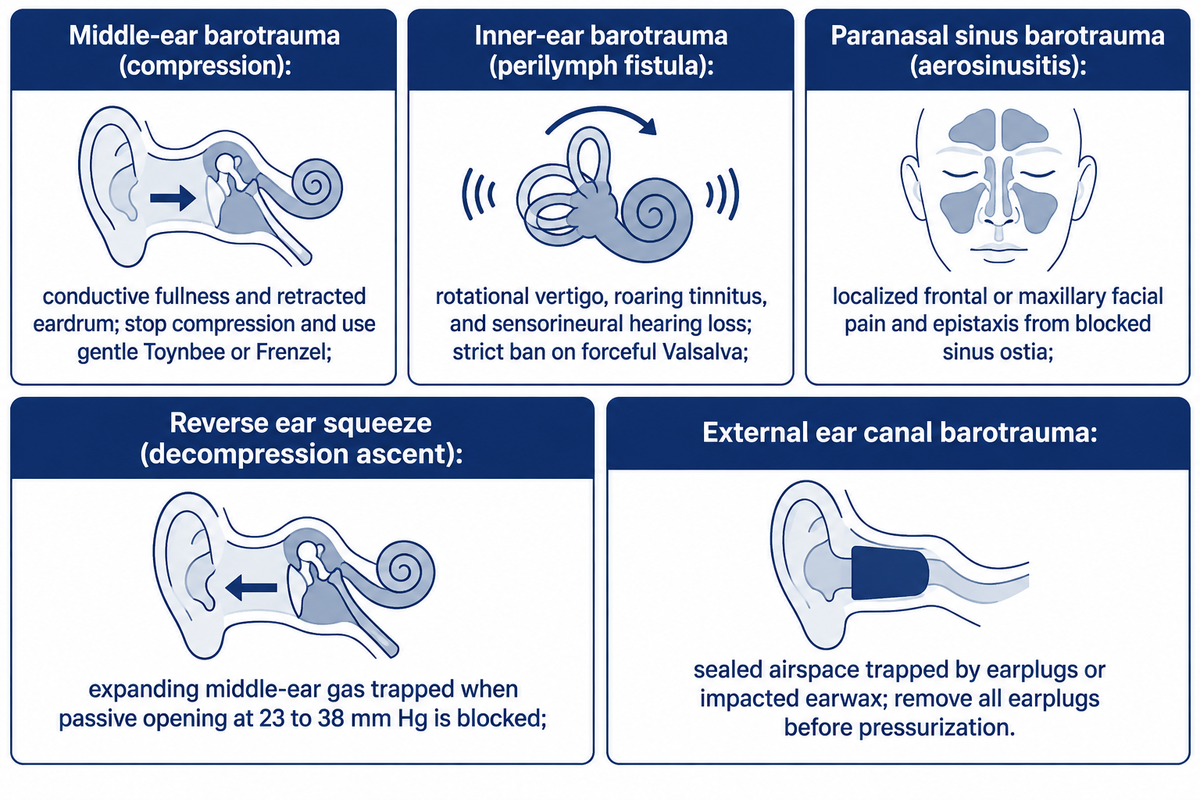
Evaluating barotrauma symptoms and causes requires separating conductive middle ear injury from inner ear barotrauma, paranasal sinus barotrauma (aerosinusitis), reverse ear squeeze on decompression, and external ear canal barotrauma (as well as systemic pulmonary lung or gastrointestinal barotrauma in deep diving). All five otic and sinus conditions have their origin in ambient air pressure changes. Mistaking a middle ear for an inner ear injury can lead to sensorineural injury if the patient continues to forcefully blow his/her nose after barotrauma.
“If the pressure in the tympanic cavity is lower than the pressure of the surrounding tissue, this imbalance results in negative pressure (a relative vacuum) in the middle-ear space. It causes tissue to swell, the eardrum to bulge inward, leakage of fluid and bleeding of ruptured vessels. At a certain point an active attempt to equalize will be futile, and a forceful Valsalva maneuver may injure the inner ear.”
References to the diver (Bolus Chamber) and eustachian tube (Hap) can be found in Divers Alert Network’s Inner-Ear Barotrauma (IEBT) Reference. When a chamber occupant or a diver performs a violent Valsalva against a closed eustachian tube, the increase in pressure in the thoracic and cranial spinal fluids transmits to the cochlear perilymph while the middle ear, which is at a low pressure, creates a gradient. This gradient can rupture the round and oval windows and create a perilymph fistula. During the process of making a decompression ascent, the eustachian tube opens passively when the pressure in the middle ear reaches between 23-38 mm Hg. By contrast, during decompression, expanding tympanic gas normally opens the eustachian tube passively between 23 and 38 mm Hg, so reverse barotrauma on ascent is rare unless severe pressure variations (such as 74 mm Hg/s) or acute mucosal swelling trap the expanding gas. For hyperbaric and diving teams reviewing Differences in decompression sickness and ascent barotrauma, the five way diagnostic matrix differentiates the various presentations:
| Barotrauma Type & Condition | Anatomical Structure Involved | Triggering Pressure Phase | Hallmark Signs and Symptoms | Immediate Action & Valsalva Rule |
|---|---|---|---|---|
| Middle-Ear Barotrauma (MEBT) | Tympanic membrane and middle ear cavity behind the drum | Compression / Descent (rising ambient pressure) | Ear fullness, conductive muffled hearing, progressive ear pain, Teed 1–5 otoscopic redness or blood | Halt compression, reduce pressure slightly to unlock ostium, use gentle swallowing, Toynbee, or Frenzel |
| Inner-Ear Barotrauma (IEBT) | Cochlea, vestibular labyrinth, round or oval window membrane | Compression (often triggered by a forceful Valsalva against a locked tube) | True rotational vertigo, roaring tinnitus, sudden sensorineural hearing loss, nausea or vomiting | Strictly prohibit any further Valsalva or nose-blowing; keep head upright and seek emergency ENT care |
| Reverse Ear Squeeze | Middle ear cavity (expanding gas trapped by ostial edema when passive 23–38 mm Hg vent fails) | Decompression / Ascent (falling ambient pressure) | Outward pressure fullness, sharp pain during chamber depressurization, transient alternobaric vertigo | Pause decompression, swallow or perform Toynbee maneuver (never blow positive pressure into the nose) |
| Sinus Barotrauma (Aerosinusitis) | Paranasal sinuses (frontal, maxillary, ethmoid, or sphenoid ostia) | Compression or Decompression | Sharp forehead, cheekbone, or upper-tooth pain; mild epistaxis (nosebleed) on decompression | Halt pressure ramp, equalize slowly, and treat underlying nasal or sinus inflammation |
| External Ear Canal Barotrauma | Outer ear canal skin and outer tympanic epithelium | Compression while wearing occluded earplugs or impacted wax | Localized canal pain, petechial bruising or blood blisters on canal wall and outer eardrum | Remove sealed earplugs before any hyperbaric chamber compression or underwater diving |
What could be causing a feeling like something is moving in my ear even though there’s nothing there?
A sensation that liquid, bubbles, or a small object is shifting inside the ear after a flight, dive, or hyperbaric session is often due to serous effusion or mixed air-fluid bubbles shifting behind the eardrum in the middle ear cavity. When the middle ear is under negative pressure, it can pull fluid off of the mucosal lining (Teed Grades 2 to 4). Tilting the head or swallowing can shift the fluid meniscus against the inner surface of the tympanic membrane.
Clicking or fluttering of the Tympanic Membrane can occur with swollen walls of the eustachian tube that stick and unstick during swallowing. Rarely, it may occur with middle ear Myoclonus (brief spasms of the Tensor Tympani or Stapedius). Since the fluid is behind the eardrum, it can’t be removed with an otoscope. The fluid will ultimately be absorbed as edema of the mucosa subsides.
How to Equalize Ear Pressure Safely: Passive Swallowing, Toynbee, Frenzel, and Gentle Valsalva
Learning how to equalize ear pressure means recruiting the throat and soft palate muscles (tensor veli palatini and levator veli palatini) to pull the eustachian tube open before a high trans-tympanic pressure gradient can lock it shut. Studies in clinical physiology (PMC4297009) show that the critical active opening time for the eustachian tube is between 0.1-0.9 seconds. In clinical physiology studies ( PMC4297009 ), critical active opening times for the eustachian tube last 0.1 to 0.9 seconds, and anatomical angulation varies across the population, from straight 170-degree tubes that equalize effortlessly (48% of individuals) to 125-degree tubes (30%) and double S-shaped tubes (22%) that carry a higher risk of ear barotrauma if the user waits too long to clear.
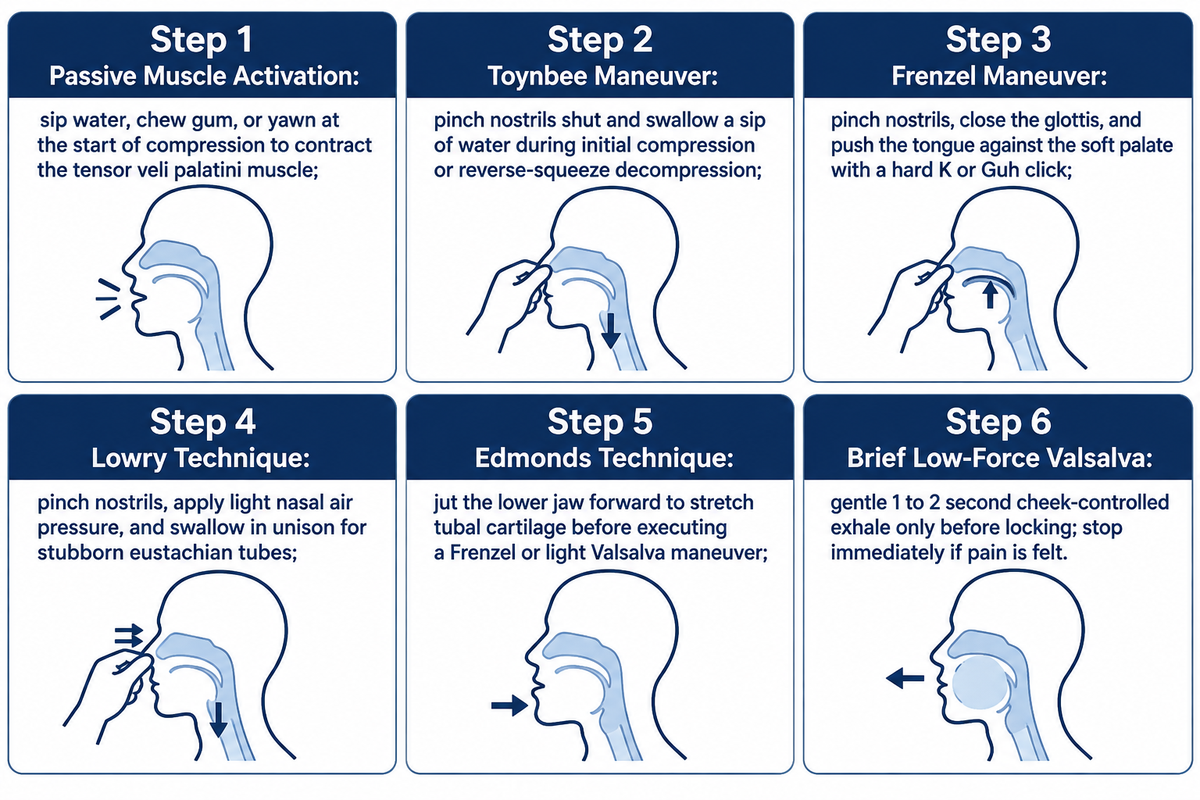
DAN’s diving physiologists, as well as WebMD’s Ear Barotrauma medical guide, highlight that passive maneuvers like yawning or sipping water work best for pressure shifts. The chamber shouldn’t exceed 1 atm for compression for continuous BSP. The entire volume should be pressurized. Some low-force methods of equalization don’t require high nasopharyngeal pressure and can be used at the beginning of compression to vent pressure and eliminate pressure gradients before proceeding to more forceful methods. Our 6-Method Equalization Ladder, ordered from lowest nasopharyngeal pressure to the highest, follows:
- At the beginning of compression, use Step 1: Passive Muscle Activation (Swallowing and Yawning) by sipping water, chewing gum, or yawning to contract the tensor veli palatini muscle and vent mild pressure differences.
- Once passive swallowing isn’t enough, apply Step 2, The Toynbee Maneuver (Pinched-Nose Swallow): By pinching your nose shut and swallowing a small sip of water, the muscular pull opens the eustachian tube while tongue movement equalizes gas, making it ideal during both initial compression and reverse-squeeze decompression.
- For multi-ATA chamber ramps, use Step 3, The Frenzel Maneuver (Closed-Glottis Tongue Piston): Pinch the nostrils, close the vocal cords (glottis) as if lifting a weight, and push the back of the tongue upward against the soft palate (making a hard “K” or “Guh” sound) to compress only the air in the nasopharynx without raising chest or intracranial pressure.
- Obstinate tubes require Step 4 – The Lowry Technique (Pinched-Nose Pressurization plus Swallow):. Pinch the nostrils, apply light nasal air pressure, and swallow in unison to help the air pressure and pull the muscles together.
- To help further, add Step 5 – The Edmonds Technique (Anterior Jaw Thrust Combination):. Stretch the tubal cartilage, then perform a Frenzel or light Valsalva maneuver.
- Only as an early backup before locking occurs, use Step 6, Brief, Low-Force Valsalva Maneuver (Cheek-Controlled Exhale): Pinch your nose, keep your mouth closed, and blow gently against the nostrils for no more than 1 to 2 seconds, stopping immediately and signaling for a pressure hold if resistance or pain is felt. If a block or discomfort is felt, stop blowing and signal for a pressure hold.
| Equalization Technique Type | Primary Biomechanical Mechanism | Step-by-Step Execution | Best Application in Hyperbaric & Diving Use | Force Profile & Safety Boundary |
|---|---|---|---|---|
| 1. Passive Swallowing / Yawning | Contraction of tensor veli palatini pulls cartilaginous tubal wall open for 0.1–0.9 s | Sip water, chew gum, or yawn widely every 20–30 seconds during pressurization | Mild 1.3 ATA soft-chamber ramps, commercial flights, driving in the mountains | Zero positive air force; ineffective once gradient approaches 60–90 mm Hg |
| 2. Toynbee Maneuver | Muscular swallowing combined with closed-nostril pressure shift | Pinch your nose shut, keep mouth closed, and swallow a small sip of saliva or water | Both compression and decompression (safe for relieving reverse ear squeeze) | Very low force; avoids intrathoracic and perilymphatic pressure spikes |
| 3. Frenzel Maneuver | Tongue acts as an isolated mechanical piston in the nasopharynx with closed glottis | Pinch nose, close vocal cords, and drive the rear tongue upward (“K” sound) | Primary method for multi-ATA clinical chambers and free/scuba divers | High precision, low systemic risk; does not raise thoracic venous pressure |
| 4. Lowry Technique | Simultaneous gentle nasal pressurization and muscular swallowing | Pinch nostrils, apply light nasal air pressure, and swallow at the exact same moment | Stubborn eustachian tubes during 1.5 to 2.0 ATA hard-chamber compression | Moderate coordinated skill; keeps required blowing pressure low |
| 5. Edmonds Technique | Anterior jaw thrust pre-stretches tubal cartilage during Frenzel or gentle Valsalva | Jut lower jaw forward and downward, tilt head slightly, and execute Frenzel/Valsalva | Asymmetric ear clearing when one ear consistently lags behind the other | Low mechanical risk when paired with Frenzel tongue compression |
| 6. Gentle Valsalva Maneuver | Diaphragmatic/expiratory air pressure against closed nostrils forces ostium open | Pinch nostrils, close mouth, and exhale softly for 1–2 seconds until a soft pop occurs | Backup method only when done early before 90 mm Hg tubal locking occurs | High risk if forced (violent blowing against a locked tube can rupture round window) |
Scenario 1 (First-Time Chamber Occupant Coaching Before Door Closure): While conducting an orientation for a 1.5 ATA session, an attendant notices a first-time user practicing the Valsalva maneuver by puffing their cheeks and forcefully blowing air out through a closed tube. Understanding that forcefully blowing air against a closed tube increases pressure, the attendant coaches the user to switch to the Toynbee and Frenzel techniques. The user practices “K” by doing a tongue-piston click and checks if their nostrils are flaring. The attendant also coaches the user to sip and actively clear their throat before each step up in pressure to relieve built up airflow. The user completes the entire pressurization ramp with no ear fullness.
Hyperbaric Chamber Compression Rates (kPa/min) and Step-Hold Equalization Protocols
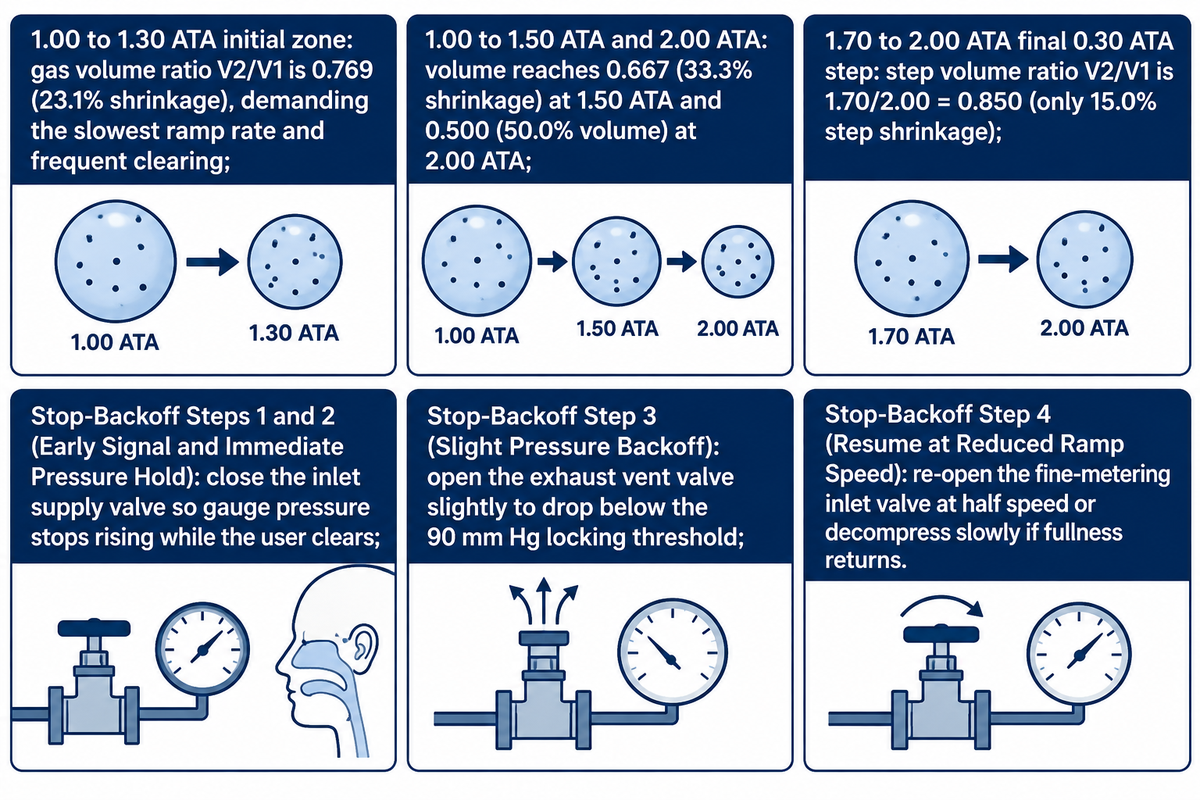
Controlling compression rates in hyperbaric chambers is the key lever for preventing ear pain during hyperbaric oxygen therapy. Even if a chamber is pressurized slowly, healthy adults with normal eustachian tube function can still develop ear pain.
Pressurizing across a slight initial range near atmospheric baseline actually isn’t less harsh on the eardrum than pressurizing across an equal gauge increment at a higher pressure. Lima et al. (PMC4297009) document, most middle ear barotraumas occur in the first 10 meters of compression (equivalent to 2 absolute atmospheres compression in HBOT), because under Boyle’s Law, the closer to sea-level surface pressure, the greater the fractional volume variation of an enclosed gas space per unit of pressure rise. The compression milestones and rate adjustments below serve as planning baselines; actual compression curves must be adjusted for the chamber’s rated working pressure and the occupant’s real time equalization feedback.
Applied Example of Boyle’s Law (Assumed Chamber Compression from 1.00 to 2.00 ATA): Applying Boyle’s Law (V2/V1 = P1/P2 at constant temperature), let’s examine an initial 0.30 ATA compression step versus a final 0.30 ATA compression step within an assumed hyperbaric chamber.
- Between 0.30 ATA steps from 1.00 ATA to 1.30 ATA, the gas volume ratio V2/V1 is 1.00/1.30 = 0.769 (76.9% of the original volume) meaning that the trapped middle ear gas shrinks by 23.1% and must be continuously made up by the eustachian tube.
- Across an intermediate step from 1.00 ATA to 1.50 ATA , the unreplenished volume ratio V2 / V1 equals 1.00 / 1.50 = 0.667 (66.7% of initial volume, a 33.3% cumulative volume contraction), and by 2.00 ATA (equivalent to 10 meters of water depth), V2 / V1 reaches 1.00 / 2.00 = 0.500 (50.0% of initial volume). At 2.00 ATA, that’s to say at 10 meters of water depth, V2/V1 would be equal to 1.00/2.00 = 0.500 (50.0% of the initial volume).
- On the last 0.30 ATA increment from 1.70 ATA to 2.00 ATA, the step volume ratio V2/V1 is equal to 1.70/2.00 = 0.850 , yielding a step volume shrinkage of only 15.0%. By contrast, across the final 0.30 ATA increment from 1.70 ATA to 2.00 ATA , the step volume ratio V2 / V1 equals 1.70 / 2.00 = 0.850 , a fractional step shrinkage of only 15.0%, confirming why the initial compression zone from 1.00 to 1.30 ATA demands the slowest ramp rate and most frequent ear clearing.
When comparing 1.3, 1.5, and 2.0 ATA chamber pressure tiers, operators and home users can apply our 1.0-to-2.0 ATA Middle-Ear Compression & Stop-Backoff Matrix below to coordinate ramp stages and equalization checkpoints:
| Chamber Compression Stage | Target Pressure Zone | Middle-Ear Gas & Tubal Biomechanics (PMC4297009) | Recommended Equalization Frequency | Operator & Valve Control Action |
|---|---|---|---|---|
| Stage 1: Pre-Door Baseline | 1.00 ATA (Ambient sea level) | Neutral eardrum; 10 mL middle-ear cleft at atmospheric equilibrium | Practice 1–2 dry Toynbee and Frenzel clicks before door closure | Confirm zero cold/allergy congestion and zero earplugs worn |
| Stage 2: Initial Seal & Early Ramp | 1.00 to 1.05 ATA (First pressure rise) | Highest Boyle’s Law fractional volume change per unit pressure; drum buffers only ≤23 mm Hg | Begin proactive swallowing or Toynbee every 20–30 seconds immediately | Throttle inlet valve to a gentle starting ramp; confirm verbal intercom link |
| Stage 3: Pre-Locking Checkpoint | 1.05 to 1.15 ATA (Critical tubal zone) | Unequalized gradient approaching 60 mm Hg triggers pain; ~90 mm Hg locks tubal lips | Active Toynbee or Frenzel clearing; never allow fullness to build into pain | Hold pressure (0 kPa/min) immediately if either ear lags; vent slightly to unlock |
| Stage 4: Mild Chamber Plateau | 1.30 ATA (Soft-shell mild HBOT) | Steepest initial surface-zone volume contraction completed; gas must be fully equalized | Final plateau swallow/Frenzel check to verify symmetric acoustic clarity | Transition to steady 1.30 ATA treatment soak once occupant confirms comfort |
| Stage 5: Intermediate Hard Plateau | 1.50 ATA (Hard/sitting chamber tier) | Continued compression requires repeated gas boluses from nasopharynx to tympanic cavity | Clear every 30–45 seconds; add Lowry or Edmonds jaw thrust if one ear lags | Verify zero residual fullness via two-way intercom before locking plateau |
| Stage 6: Clinical Multi-ATA Plateau | 2.00 ATA (Equivalent to 10 m depth) | Completes the first 10 m (2 ATA) compression zone where most HBOT barotrauma occurs | Maintain regular Frenzel clearing through upper ramp; monitor for monoplace 100% O2 effects | Stabilize at 2.00 ATA; during decompression, pace descent so tube vents at 23–38 mm Hg |
To keep occupants from crossing the 60 to 90 mm Hg pressure differential, our 4-Step Chamber Stop-Backoff Protocol is utilized to control each pressurization cycle.
- At the earliest sign of resistance, execute Step 1, Signal at Fullness, Never at Pain: The occupant signals via intercom or hand gesture (or turns the internal valve in a solo home chamber) the moment ear fullness begins, well before trans-tympanic pressure reaches the 60 mm Hg pain threshold or the 90 mm Hg locking threshold.
- To stop the increase in pressure, do Step 2 – Immediate Pressure Hold: Close the inlet supply valve, and gauge pressure will stop rising. Have the occupant sip water and attempt either a swallow, Toynbee, or Frenzel maneuver.
- If the tube has already locked, execute Step 3, Slight Pressure Backoff to Unlock the Ostium: If the ear doesn’t pop within a few seconds of holding, open the exhaust vent valve slightly to lower chamber pressure by a small increment; reducing nasopharyngeal pressure below the 90 mm Hg locking threshold allows the eustachian tube lips to separate and pop open effortlessly. This should let the eustachian tube lips part and the tube will pop open.
- When both ears clear, proceed to Step 4 – Resume at Reduced Ramp Speed: Open the inlet valve to the fine metering setting at half the previous pressure ramp speed and continue clearing the ears through the residual pressure in the band. Stop and slowly decompress if fullness returns.
Pre-Session Ear Screening, Cold and Allergy Contraindications, and the Earplug Rule
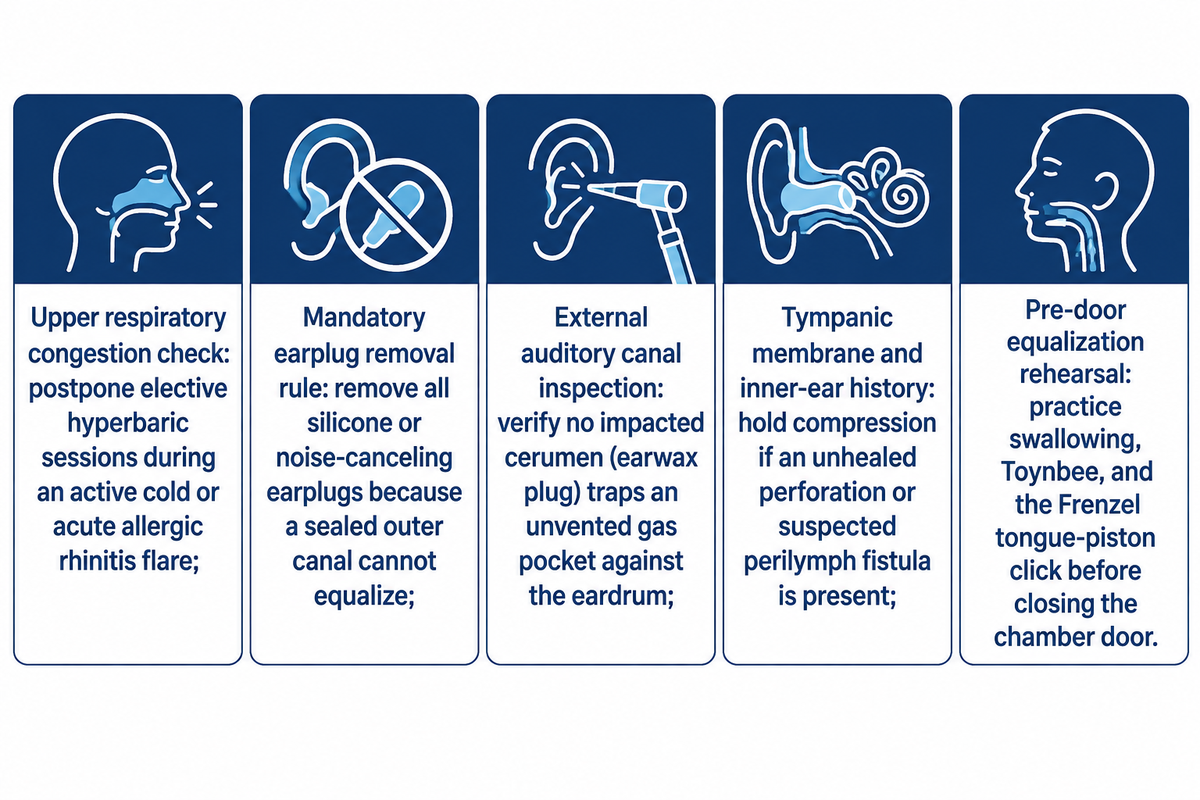
Prevention of ear barotrauma begins with the screening of temporary nasal, sinus and ear canal conditions. Any metered compression ramp can’t force air through a swollen eustachian tube ostium shut by a cold or allergies.
As cited in Cleveland Clinic’s Barotrauma clinical reference, and our companion guide to hyperbaric oxygen therapy side effects and safety screening, upper respiratory congestion is the single most common modifiable risk factor for otic barotrauma. Operators and home users should ensure five pre-session clearance rules are met for every chamber session.
| Screening Category & Condition Type | Anatomical & Tubal Impact | Pre-Pressurization Assessment Method | Clinical Source Reference & Standard | Chamber Operator Action Setting |
|---|---|---|---|---|
| Acute Viral Rhinitis (Common Cold) | Nasopharyngeal mucosal edema obstructs the cartilaginous eustachian tube ostium | Pre-session symptom interview and nasal airflow check | MedlinePlus and Cleveland Clinic barotrauma clinical guidance | Postpone elective hyperbaric compression until nasal congestion resolves |
| Seasonal Allergic Rhinitis Flare | Histamine-mediated swelling narrows the tubal lumen during pressure shifts | Review active allergy symptoms and prescribed intranasal therapy | NIH StatPearls and Cedars-Sinai otic barotrauma overview | Reschedule or coordinate clinician-approved anti-inflammatory management |
| Acute Bacterial Sinusitis | Purulent ostial blockage prevents both sinus and middle-ear gas equilibration | Assess facial tenderness, purulent discharge, and sinus pressure | Divers Alert Network and Merck Manual otic and sinus reference | Defer chamber compression and refer for medical evaluation |
| Occlusive Silicone or Foam Earplugs | Creates a sealed airspace between the plug and tympanic membrane that cannot equalize | Mandatory visual ear canal inspection before door closure | Divers Alert Network external ear canal barotrauma safety rule | Remove all earplugs and occlusive in-ear devices prior to pressurization |
| Impacted Cerumen (Earwax Plug) | Complete canal occlusion traps an unvented external gas pocket against the eardrum | Pre-session otoscopic inspection of the external auditory canal | NIH StatPearls external ear barotrauma pathophysiology | Clear impacted cerumen professionally before hyperbaric exposure |
| Unhealed Tympanic Membrane Perforation | Compromised eardrum integrity requires specialist verification before pressure cycling | Otoscopic history review and otolaryngology clearance verification | WebMD and MedlinePlus ruptured eardrum recovery guidelines | Hold hyperbaric sessions until complete membrane healing is confirmed |
| Suspected Inner-Ear Perilymph Fistula | Round or oval window tear risks worsening cochlear injury under pressure gradients | Screen for true rotational vertigo, roaring tinnitus, or sensorineural loss | Divers Alert Network Inner-Ear Barotrauma differential diagnosis | Immediate specialist referral and strict ban on forceful Valsalva maneuvers |
| First-Time Naive Chamber Occupant | Unpracticed clearing reflexes increase the risk of delayed equalization and locking | Coach swallowing, Toynbee, and Frenzel tongue-piston maneuvers at baseline | Peer-reviewed hyperbaric otology patient coaching protocols | Start with a gentle initial compression ramp and frequent verbal check-ins |
| Supine Positioning Without Head Elevation | Flat recumbent posture increases cephalic venous pressure and mucosal congestion | Verify backrest elevation or upright seating configuration before door lock | Hyperbaric otology pathophysiology studies on posture and venous engorgement | Use upright seating or raise the head and torso to support tubal opening |
| Screening Factor Type | Pathophysiological Mechanism Under Pressure | Pre-Session Verification Check | Operational Decision (Go / Postpone / Refer) |
|---|---|---|---|
| Acute Common Cold or Upper Respiratory Infection | Viral mucosal edema and thick mucus plug the nasopharyngeal ostium of the eustachian tube | Ask about new sore throat, rhinorrhea, nasal stuffiness, fever, or sinus pressure | Postpone elective hyperbaric sessions until cold symptoms and nasal patency fully resolve |
| Active Allergic Rhinitis Flare | Histamine-mediated turbinate and tubal swelling narrows the airway lumen and impairs drainage | Verify whether seasonal allergy or dust/pollen flare is causing nasal obstruction or ear crackling | Postpone during acute flare, or obtain physician guidance on antihistamine / nasal steroid control |
| Occluded Earplugs or Sealed In-Ear Earbuds | Traps a sealed pocket of ambient air between the plug and eardrum that cannot equalize | Inspect both ears visually before door closure to confirm zero foam, wax, or silicone plugs are worn | Mandatory removal: never allow occluded earplugs or sealed in-ear monitors inside a chamber |
| Unhealed Prior Barotrauma (Teed Grade 1–5) | Residual tympanic edema, effusion, or perforation tears further under renewed pressure stress | Perform baseline otoscope check if occupant reported fullness or pain during a prior session | Hold sessions until otoscopy confirms normal eardrum appearance, zero effusion, and tubal patency |
| Sedated, Intubated, or Non-Communicative Patients | Inability to swallow on command or report ear fullness prevents timely stop-backoff adjustments | Clinical hospital HBOT assessment of airway and conscious communication capacity | Require hyperbaric physician and ENT evaluation (prophylactic myringotomy or tubes when indicated) |
Scenario 2 (Sealed Noise-Canceling Earplugs Before Pressurization): While at a sports recovery wellness center, an athlete inserts dense silicone swimming earplugs during a 1.3 ATA session to block compressor hum and rest. Before the door checks, the attendant notices the earplugs and instructs their removal, referring to DAN’s safety rule about not diving or pressurizing with earplugs, as a sealed outer ear canal wouldn’t be able to vent or equalize during compression.
Ear Barotrauma Treatment, Decongestant Limits, Recovery Timelines, and ENT Red Flags
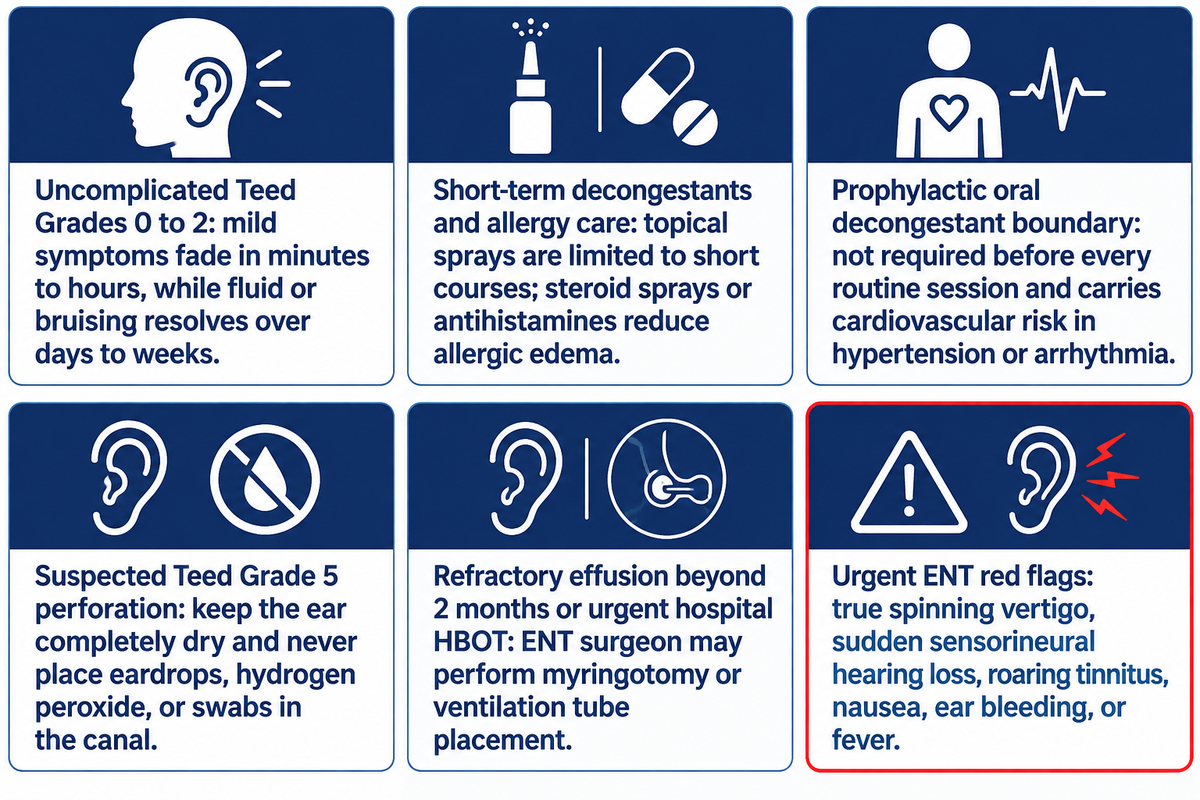
Ear barotrauma treatment scales directly with otoscopic severity on the Modified Teed classification and compromised inner ear or eardrum. According to Cedars-Sinai and WebMD, you can manage uncomplicated mild cases (Teed Grades 0-2) with may not need any treatment. As Cedars-Sinai and WebMD note, you may not need any treatment for uncomplicated mild cases (Teed Grades 0 to 2): mild symptoms often fade within a few minutes to a few hours after returning to normal pressure, while moderate fluid or eardrum bruising resolves over several days to weeks as mucosal inflammation subsides. Note that these recoveries apply to straightforward barotrauma without a superimposed secondary bacterial infection.
In cases where persistent eustachian tube congestion traps negative pressure or serous fluid behind an intact eardrum, a medical doctor or otolaryngologist (ENT specialist) may recommend targeted pharmacological or procedural therapy:
- To alleviate acute ostial swelling, health care practitioners recommend use of short-term topical nasal decongestants. MedlinePlus clinical guidelines state that decongestants, when taken by mouth or by a nose spray, help clear nasal congestion and allow the eustachian tube to open; however, topical vasoconstrictor sprays are limited to short-term use to avoid rebound rhinitis medicamentosa.
- Regarding routine pre-session pills and the evidence boundary on prophylactic oral decongestants: not all clients requiring routine HBOT are required to take oral sympathomimetic decongestants before every hyperbaric session. If an individual has hypertension or arrhythmia, taking oral decongestants before every HBOT carries a cardiovascular risk. Until further research is available, maintaining slow ramp control and Frenzel/Toynbee coaching remain the primary preventative measures.
- For allergic inflammation, health care professionals prescribe nasal corticosteroids, antihistamines, and analgesics: intranasal steroid sprays, or oral antihistamines alleviate allergic tubal edema, and oral analgesics alleviate the symptoms of an earache.
- In the case where eardrum integrity is in doubt, there’s a strict ban on ear canal drops in a suspected perforation: Both DAN and WebMD state that if rupture of the eardrum (grade 5 Teed) is suspected, no eardrops or objects should be placed in the ear canal, and the ear should be kept completely dry.
- In the case of refractory middle ear fluid or if HBOT is required to be performed in an urgent/emergent setting, myringotomy surgery or placement of tympanostomy tubes is also considered: WebMD and MedlinePlus state that if, after 2 months, there’s no improvement in eardrum fluid/effusions or if a client requires urgent, repeated HBOT to assist in wound healing and is unable to equalize, then an ENT surgeon may perform a myringotomy or ventilation tube placement to equalize and assist in fluid removal. Ear tubes aren’t permissible for scuba diving.
How to ease ear barotrauma?
After a hyperbaric session, flight, or dive, ease ear barotrauma by stopping all pressure exposures, and rest with your head propped up on pillows to ease nasopharyngeal venous congestion. Use oral analgesics for ear discomfort, if permitted by your clinician. As nasal stuffiness starts to abate, try swallowing, yawning, or gently sipping warm water to ventilate the eardrum.
If discomfort isn’t alleviated within a few hours and/or there are urgent symptoms such as true spinning vertigo, sudden sensorineural hearing loss (i.e. severe irreversible hearing loss), loud roaring tinnitus, nausea, vomiting, drainage or bleeding from the ear canal and/or a fever, contact a health care provider or ENT specialist immediately.
Chamber Hardware That Protects Ears: Dual Pressure Valves, Intercoms, and Sitting vs. Lying Postures
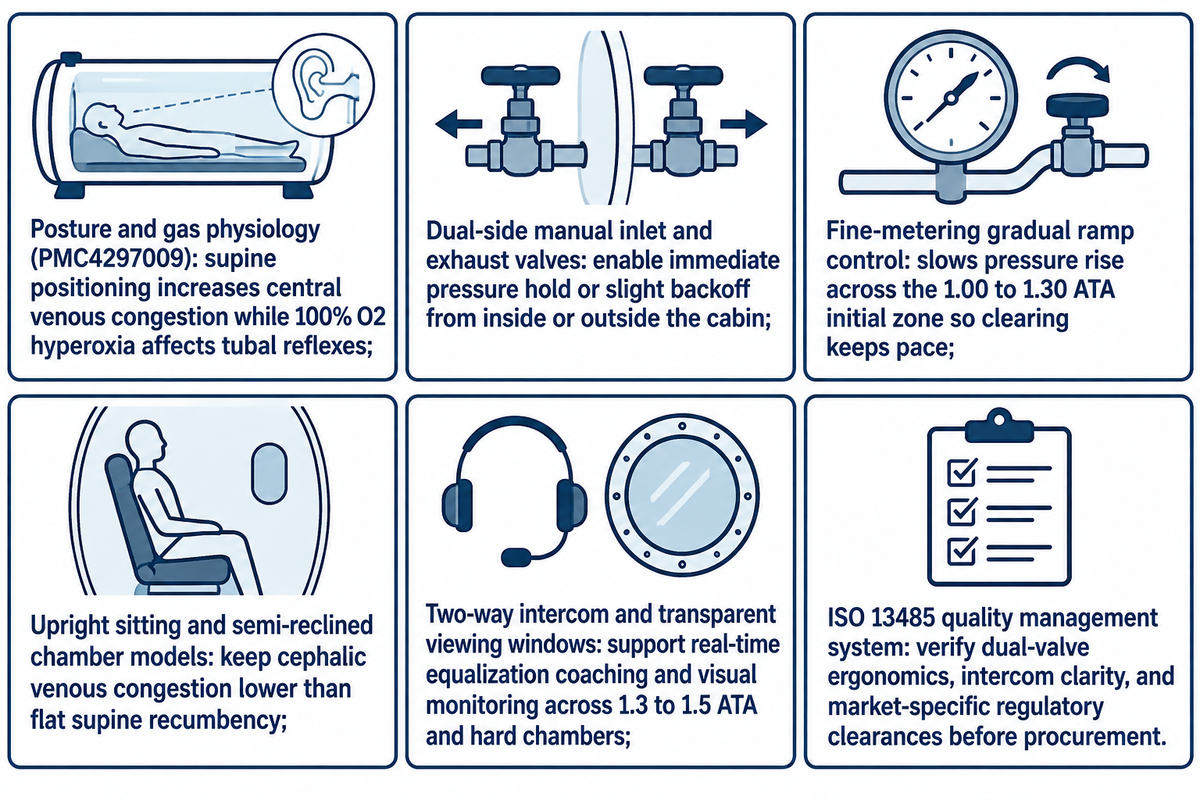
While clinicians use their judgment for diagnosing and treating ear pain associated with hyperbaric exposures, the design and engineering of hyperbaric chambers largely determine how occupants and attendants can quickly and easily pause compression when ear fullness begins. In addition, as Lima et al. (PMC4297009) highlight, patients lying in the supine position in monoplace chambers pressurized with 100% O2 develop central venous congestion, and in hyperbaric oxygen therapy (HBOT) environments, hyperoxia can suppress the eustachian tube reflex, making ergonomic posture and responsive valve controls essential.
Under its documented ISO 13485 medical-device quality management system which certifies quality management processes while buyers verify market-specific regulatory clearances separately, MACY-PAN engineers both soft-shell mild hyperbaric chambers (1.3–1.5 ATA) and hard-shell monoplace and multiplace chambers around six ear-protection hardware controls:
| Hardware Component Type | Engineering Mechanism | Solo Home User Benefit | Attended Clinic Benefit | Buyer RFQ Verification Check |
|---|---|---|---|---|
| Dual Internal & External Pressure Control Valves | Synchronized manual or pneumatic inlet/exhaust valves accessible from both inside and outside the vessel | Allows a solo occupant to halt compression or vent pressure immediately without external help | Lets the outside attendant modulate ramp speed while giving the patient an internal override | Verify that both internal and external depressurization valves operate smoothly without electrical power |
| Fine-Metering Variable Rate Valves | Graduated needle or proportional throttling valve governing smooth gas inflow and outflow | Prevents sudden pressure surges during the sensitive initial compression zone above 1.0 ATA | Enables tailored gentle ramps for pediatric, elderly, or first-time clinic patients | Confirm fine-metering adjustability across the initial compression band |
| Internal & External Calibrated Pressure Gauges | Paired mechanical pressure gauges readable inside the cabin and on the exterior console | Lets the user track exact pressure milestones for proactive ear clearing | Allows attendant and patient to coordinate step-hold checkpoints between 1.0 and 2.0 ATA | Check gauge scale resolution and factory calibration documentation |
| Continuous Two-Way Intercom System | Hands-free acoustic intercom with internal microphone/speaker and external operator handset | Connects home users to a family member or supervising attendant outside the chamber | Ensures instant verbal feedback (“Hold pressure”) before gradient reaches 60 mm Hg | Test voice clarity under active compressor flow and verify backup call-button alarm |
| Upright & Semi-Reclined Sitting Geometry | Ergonomic adjustable seating in sitting and multiplace chambers vs. flat supine tubes | Counteracts supine central venous congestion (PMC4297009) so eustachian tubes open more easily | Improves swallowing mechanics and comfort for patients who struggle to equalize lying flat | Compare upright sitting hyperbaric chambers against horizontal models for ear-sensitive users |
| Redundant Mechanical Safety Relief Valves | Twin independent spring-loaded overpressure relief valves preset to the vessel’s rated ATA | Prevents over-pressurization above rated working pressure even if an inlet regulator stays open | Provides passive mechanical fail-safe protection independent of digital screens | Request valve set-pressure certificates and verify dual-valve redundancy per chamber pressure categories |
Scenario 3 (Using Dual-Side Valves and Upright Seating to Address a Persistent Left Ear): While using a sitting HBOT chamber, a user notices left ear fullness while still in the compression ramp. This user is seated upright (a more advantageous anatomic position for cephalic venous congestion), and has manual access to the internal vent valve, so can pause inflow, vent a small pressure to open the ostium, take a sip of water and perform a Frenzel. The left eustachian tube popped open, and the user was able to continue to finish the compression to 1.3 ATA.
When assessing hyperbaric chambers for a clinic, wellness facility, or home recovery program, contact the engineering team at MACY-PAN to discuss dual side valve options, two way intercoms, and sitting versus horizontal chamber designs based on your operational requirements.
| Control Type & Operational Tier | Primary Equalization Mechanism | Target Occupant Profile & Setting | Published Clinical Study & Source Scope | Verification Standard & Operator Rule |
|---|---|---|---|---|
| Passive Swallowing and Water Sipping | Tensor veli palatini contraction gently parts the eustachian tube ostium | Alert adults during early low-gradient chamber compression | MedlinePlus and WebMD baseline equalization recommendations | Begin sipping water as soon as cabin airflow starts |
| Chewing Gum or Hard Candy Salivation | Sustained masticatory and swallowing frequency maintains intermittent tubal venting | Wellness and mild hyperbaric users across steady pressurization ramps | Cleveland Clinic and Cedars-Sinai preventive ear clearing guidance | Verify swallow safety and avoid aspiration hazards inside the cabin |
| Toynbee Pinched-Nose Swallow Method | Combines palatal muscle traction with closed-nostril pressure equilibration | Occupants experiencing early ear fullness during compression or ascent | Divers Alert Network middle-ear equalization technique comparison | Pinch nostrils briefly while swallowing a small sip of water |
| Frenzel Closed-Glottis Tongue Piston | Compresses nasopharyngeal gas via posterior tongue thrust without thoracic strain | Multi-atmosphere clinical sessions and users with angulated eustachian tubes | Divers Alert Network and hyperbaric medicine otology references | Coach the vocal-fold lock and upward tongue click before pressurization |
| Lowry Combined Pressurization and Swallow | Synchronizes gentle nasal pressure with active palatal muscular opening | Experienced occupants clearing stubborn unilateral tubal resistance | Diving and hyperbaric otology advanced equalization taxonomy | Coordinate light pinched-nose pressure with an immediate swallow |
| Edmonds Anterior Jaw-Thrust Combination | Forward mandibular shift pre-stretches peri-tubal soft tissue during clearing | Users with asymmetric left-right eustachian tube opening thresholds | Divers Alert Network manual equalization method classification | Pair gentle jaw advancement with a Frenzel or low-force maneuver |
| Dual-Side Manual Inlet and Exhaust Valves | Allows immediate cabin pressure hold or slight backoff from inside or outside | Solo home occupants and attended clinical hyperbaric installations | ISO medical-device quality management and chamber ergonomics | Confirm smooth internal and external valve actuation before every cycle |
| Fine-Metering Gradual Ramp Rate Control | Limits rate of ambient pressure rise so active clearing keeps pace with Boyle contraction | Initial surface-to-target compression zone where gas volume shifts fastest | Peer-reviewed hyperbaric barotrauma incidence and ramp-rate studies | Maintain a conservative initial ramp and pause immediately on fullness |
| Upright Sitting Chamber Posture Option | Reduces cephalic venous congestion compared with flat supine recumbency | Occupants prone to nasal stuffiness or positional middle-ear fullness | Hyperbaric otology research on central venous pressure and tubal function | Position occupant upright or semi-reclined with water within reach |
Frequently Asked Questions About Ear Barotrauma
How long does ear barotrauma last?
Teed Grades 0 to 2 (symptoms of ear barotrauma or Mild Barotrauma) usually resolve in a few minutes to hours to a few days after ambient pressure equalizes and eustachian tube swelling goes down. If there’s moderate middle ear fluid or bruising behind the eardrum, recovery may take a few weeks. A perforated or ruptured eardrum (Teed Grade 5) may take 2 months to heal and requires medical clearance before another hyperbaric treatment or flying/diving.
Can hydrogen peroxide relieve ear pressure?
No. Hydrogen peroxide softens earwax only in the outer ear canal and can’t cross an intact eardrum to reach a pressure difference in the middle ear cavity. Ear barotrauma stems from a eustachian tube blockage behind the tympanic membrane. Therefore, drops put in the ear canal won’t lower the middle-ear pressure and hydrogen peroxide shouldn’t be used to treat it. In fact, if the eardrum is ruptured, irritation of the middle-ear mucosa can be very painful.
Will ear pressure ever go away?
Yes, usually, when the eustachian tube opens, and any serous fluid trapped in it drains to the nasopharynx, middle-ear pressure and conductive hearing loss resolve completely. If a clogged sensation, conductive hearing loss, or fluid bubbling persists beyond 7 to 14 days (or is accompanied by rotational vertigo, tinnitus, or ear discharge) an otolaryngologist can perform tympanometry and prescribe targeted anti-inflammatory therapy, or consider a minor myringotomy if middle-ear effusion persists beyond 4 to 8 weeks.
What is ear barotrauma also known as?
Ear barotrauma is also called airplane ear, ear squeeze, barotitis media, or aerotitis media, based on whether flying, scuba diving, or hyperbaric compression caused it.
What are possible complications of ear barotrauma?
Most ear barotrauma cases resolve with temporary conduction deafness. Severe or untreated ear barotrauma cases result in acute perforated eardrum, secondary bacterial otitis media (ear infection), or chronic serous otitis media and require ventilation tubes. If the occupant performs a forceful Valsalva against a locked eustachian tube, the intracranial and perilymphatic pressure increases and ruptures the round or oval window causing inner ear barotrauma with perilymph fistula and hearing loss, and severe rotational vertigo.
Who is at risk for ear barotrauma?
Anyone exposed to rapid ambient pressure shifts during hyperbaric oxygen therapy, flying or scuba diving is at risk, especially individuals with a cold or allergies.
References & Sources
- MedlinePlus Medical Encyclopedia (National Library of Medicine / Ashutosh Kacker, MD, FACS) – Ear Barotrauma: Causes, Symptoms, Treatment, and Prevention
- National Center for Biotechnology Information (NIH StatPearls NBK499851), Pathophysiology, Eustachian Tube Locking, and Teed Classification of Ear Barotrauma
- Divers Alert Network (DAN), Middle Ear Barotrauma (MEBT): Mechanisms of Injury and Manifestations, as well as Prevention
- Divers Alert Network (DAN), Inner Ear Barotrauma (IEBT): Perilymph Fistula and Differentia Diagnosis
- National Center for Biotechnology Information (PMC4297009), Middle Ear Barotrauma after Hyperbaric Oxygen Therapy: New Insights Regarding Pathophysiology
- Cleveland Clinic, Barotrauma: Causes, Symptoms, Treatment and More
- Cedars-Sinai Health Library, Ear Barotrauma: Symptoms, Causes and Treatment
- WebMD (Reviewed by Nayana Ambardekar, MD), Ear Barotrauma: Symptoms, Causes, Treatment, Prevention
- International Organization for Standardization (ISO 13485:2016), Medical Devices: Quality Management Systems Requirements for Regulatory Purposes
Factory Selection Support
Need a hyperbaric chamber matched to your room, pressure target, and compliance documents?
MACY-PAN helps clinics, wellness centers, distributors, and home buyers compare soft-shell, hard-shell sitting, and professional-grade lying chambers before quotation. Send your intended use, available space, country, and preferred ATA range, and our team will recommend a practical model path.
2007HBOT manufacturing since
126+countries shipped to
1.3-2.0ATA chamber range
Related Posts
Trending now