
Get in Touch with MACY-PAN Company


Quick Specs
| Chamber pressure | 1.5-3 ATA (hospital/clinical range 2-3 ATA) |
| Oxygen delivered | 100% pure oxygen (vs. ~21% in room air) |
| Plasma oxygen increase | Roughly 10-20x normal (Henry’s Law plus the shift from ~21% to 100% inspired oxygen) |
| Session length | 90 minutes to 2 hours |
| FDA/UHMS-approved uses | 13-16 conditions, depending on source (see below) |
Hyperbaric oxygen therapy delivers 100% oxygen inside a pressurized chamber. The benefits of hyperbaric oxygen therapy are narrower and more specific than most marketing copy suggests: roughly 13 to 16 conditions carry official backing depending on the source and edition consulted, from carbon monoxide poisoning to diabetic wound healing — while claims about cancer, autism, and Alzheimer’s remain explicitly unproven by the FDA’s own account. This guide separates the documented benefits from the marketing overreach, explains the mechanism in plain terms, and covers the safety trade-offs competitor pages tend to skip. Throughout, the focus stays on the actual, evidence-based effects of hyperbaric oxygen therapy for a specific, approved list of conditions — not a description of it as a general oxygen treatment for any medical condition a seller wants to attach it to.
In short: Hyperbaric oxygen therapy (HBOT) pressurizes 100% oxygen so blood plasma carries roughly 10-20x its normal oxygen load to tissue, driving faster wound healing, infection control, and tissue repair — but only for a specific, UHMS-recognized list of conditions; uses like cancer, autism, or Alzheimer’s are explicitly not FDA-approved.
What Hyperbaric Oxygen Therapy Actually Does to Your Body

Hyperbaric oxygen therapy works by combining two physics facts: pure oxygen carries more oxygen than room air, and pressure forces more of it into solution in your blood plasma. At 3 ATA breathing 100% oxygen, the oxygen dissolved directly in plasma alone reaches about 6.8 mL per 100 mL of blood, per StatPearls-documented hyperbaric physiology, which is the physical basis for why chamber pressure — not just breathing pure oxygen — is what makes this therapy work.
(At sea-level room air, that dissolved fraction is a small share of your blood’s total oxygen content — most of it rides on hemoglobin instead, per the mechanistic review published in Cureus, archived on PMC; the plasma jump is the same principle that makes a soda can fizz harder under pressure. At 3 ATA, though, the math changes: total blood oxygen content rises from about 16.2 to about 23 mL per 100 mL of blood, an increase driven largely by that same dissolved-plasma-oxygen effect.) That extra dissolved oxygen reaches tissue that hemoglobin-bound oxygen struggles to reach, including swollen or poorly-perfused areas where normal blood flow can’t deliver enough blood supply on its own. In practice, that means breathing pure oxygen inside a hyperbaric oxygen therapy chamber increases the amount of oxygen the blood can carry far beyond what normal air at atmospheric pressure delivers — the same underlying physics scuba divers manage when handling pressure changes underwater, just engineered deliberately rather than avoided — Henry’s Law itself is a function of the gas’s partial pressure, which is exactly what a hyperbaric chamber is raising. The net effect is a much higher concentration of oxygen in the blood than normal air alone can achieve: extra oxygen reaching areas the bloodstream normally struggles to supply, and local oxygen levels raised high enough to support healing that stalled tissue can’t manage on its own.
What Happens During Hyperbaric Oxygen Therapy?
You lie in a sealed chamber while air pressure gradually rises to 1.5-3 ATA over several minutes, then breathe 100% oxygen for 90 minutes to 2 hours before a slow depressurization.
Most patients feel a sensation of ear fullness during compression, similar to the pressure change on a flight — this is normal and can be relieved with swallowing or yawning (a technician will coach you through it if it’s your first session). Inside the chamber, there’s no need to force deep breathing; you breathe normally, and many patients read, listen to audio, or rest. Sessions for chronic conditions are typically repeated over days or weeks, while acute emergencies like carbon monoxide poisoning may call for a single, longer session. Multiplace chambers (several patients, technician inside with you) and monoplace chambers (one patient, enclosed tube) both follow this same compression-treatment-decompression pattern. A technician monitors blood pressure and pulse throughout, and raises the pressure in the chamber gradually rather than all at once to keep compression comfortable.
A Full List of FDA/UHMS-Approved Uses (and What’s Still Unproven)

Ask three sources how many conditions hyperbaric oxygen therapy is approved for, and you’ll likely get three different numbers — 13, 14, or 16, depending on the manual edition, facility itemization, or reimbursement list they’re citing. That’s not a factual disagreement; it reflects real differences between the Undersea and Hyperbaric Medical Society’s clinical-indications list, how individual facilities break that list into line items, and the narrower set of conditions Medicare and commercial insurers separately recognize for reimbursement. UCLA Health’s hyperbaric medicine program itemizes the UHMS list into 16 line entries (splitting combined categories like CO poisoning into two rows); trade press outlet MassDevice cites 13 based on the device’s FDA clearance labeling. UCLA Health’s itemized list — what this guide calls The UCLA 16-Entry Line — is used as the primary reference below.
What Are the Benefits of HBOT?
HBOT delivers documented benefit for a defined list of FDA/UHMS-recognized conditions — from carbon monoxide poisoning to diabetic wound healing — not for the sweeping wellness claims often attached to the acronym; the table below itemizes exactly which conditions carry that backing and which remain unproven or investigational, per the FDA’s own consumer guidance.
| Category | Approved / Documented | Limitations / Not suitable for |
|---|---|---|
| Emergency/acute | Air or gas embolism | Time-critical — treat as soon as possible after onset |
| Emergency/acute | Carbon monoxide poisoning | Delayed treatment reduces effectiveness — not for mild, asymptomatic exposure |
| Emergency/acute | Carbon monoxide poisoning complicated by cyanide poisoning | Cyanide co-exposure changes the emergency protocol — treated as a distinct indication from CO poisoning alone |
| Emergency/acute | Decompression sickness in divers | Requires immediate recompression protocol, not a delayed elective session |
| Emergency/acute | Severe anemia when blood transfusion isn’t an option | Adjunct measure, not a substitute for addressing the underlying cause |
| Wounds/tissue | Diabetic foot ulcers and other problem wounds | Requires clinical wound-severity grading to qualify — not every hard-to-heal wound automatically qualifies |
| Wounds/tissue | Crush injury, compartment syndrome, and acute traumatic ischemias | Timing-sensitive relative to the traumatic event |
| Wounds/tissue | Compromised skin grafts and flaps | Post-surgical, coordinated with the surgical team |
| Wounds/tissue | Acute thermal burn injury | Adjunct to standard burn-unit care |
| Wounds/tissue | Delayed radiation injury (soft tissue and bony necrosis) | For injury that develops after radiation treatment, not during active cancer treatment itself |
| Infection | Necrotizing soft-tissue infections | Adjunct to antibiotics and surgical debridement, not a replacement for either |
| Infection | Clostridial myositis and myonecrosis (gas gangrene) | Surgical emergency — HBOT supports, doesn’t replace, surgery |
| Infection | Refractory osteomyelitis | For chronic bone infection unresponsive to standard antibiotic therapy |
| Infection | Intracranial abscess | Adjunct to neurosurgical and antibiotic management |
| Sensory/vascular | Idiopathic sudden sensorineural hearing loss | Effectiveness drops the longer treatment is delayed after onset |
| Sensory/vascular | Central retinal artery occlusion | Time-critical, ophthalmologic emergency |
| Not FDA-approved | Cancer | FDA states this use is unproven, not merely under-researched |
| Not FDA-approved | Autism spectrum conditions | FDA states this use is unproven |
| Not FDA-approved | Lyme disease | FDA states this use is unproven |
| Not FDA-approved | Alzheimer’s disease | FDA states this use is unproven |
None of this means “avoid HBOT for anything off this list” — it’s that a facility or seller claiming HBOT treats an unlisted condition is making a marketing claim, not citing regulatory approval. MassDevice reported the FDA fielded 27 complaints over three years about centers offering oxygen-chamber “treatment” for conditions outside the device’s labeling — ask any provider which specific approved indication your condition falls under.
Wound Healing and Chronic, Non-Healing Wounds

Diabetic foot ulcers and other wounds that stop healing on their own are among the most documented uses of hyperbaric oxygen therapy, and the mechanism is straightforward: chronically low tissue oxygen is a major reason these wounds stall, and HBOT directly raises tissue oxygen tension while triggering new blood vessel growth (angiogenesis) and collagen production needed to close the wound. This is why HBOT appears on the UHMS-approved list specifically for “enhancement of healing in selected problem wounds” — the word “selected” matters, since the therapy is typically an adjunct alongside standard wound care (debridement, offloading, infection control), not a standalone fix. In practice, that means giving the body’s natural healing process enough oxygen to work with: injured tissues in a stalled wound often can’t complete the healing process because local circulation alone can’t deliver enough oxygen, and it’s that extra margin that helps the body heal when standard wound care alone has stopped making progress. It doesn’t replace wound care — it helps heal what standard care alone couldn’t close, per MedlinePlus.
“Hyperbaric therapy can help wounds, particularly infected wounds, heal more quickly.”
— MedlinePlus Medical Encyclopedia, U.S. National Library of Medicine
Carbon Monoxide Poisoning and Severe Infections

Carbon monoxide poisoning is one of the oldest and most firmly established uses of hyperbaric oxygen therapy: CO binds to hemoglobin roughly 200 times more readily than oxygen does, crowding out your blood’s normal oxygen-carrying capacity, and the pressurized 100% oxygen environment both displaces CO faster and delivers oxygen directly via dissolved plasma while your hemoglobin recovers. Elimination speed makes the case on its own: per StatPearls, CO’s half-life in the body runs about 5 hours on room air, drops to roughly 1.5 hours on high-flow normobaric oxygen, and falls to about 0.5 hours under hyperbaric oxygen at 3 ATA — other sources give somewhat different point estimates, but every account agrees the acceleration under pressure is substantial. Per one commonly cited clinical reference, carboxyhemoglobin (COHb) above roughly 25% is generally treated as severe poisoning that most experts agree justifies hyperbaric treatment (lower thresholds apply for pregnant patients specifically), or at any COHb level when the patient shows cardiac involvement, severe acidosis, loss of consciousness, or neurological impairment — clinicians weigh symptoms alongside the blood test rather than the COHb number alone, because tissue damage doesn’t track the lab value in a straight line. Delayed neuropsychiatric syndrome (cognitive deficits, personality changes, movement disorders) develops in up to an estimated 40% of severe cases per one clinical reference (reported rates vary widely across studies), typically emerging around 20 days after exposure (documented range: 3 to 240 days), which is the real-world stake behind moving a patient into a chamber quickly rather than accepting the delay and added risk of standard oxygen alone. That same acute, emergency medical logic extends to necrotizing soft-tissue infections and gas gangrene (clostridial myonecrosis), where HBOT’s antimicrobial and tissue-oxygenation effects work alongside — not instead of — surgery and IV antibiotics. These are acute, hospital-driven uses, distinct from the elective wellness framing common in soft-shell chamber marketing.
Brain Recovery and Athletic Performance — What’s Backed, What’s Still Research

Brain-injury recovery and athletic-performance claims are where hyperbaric oxygen therapy marketing overreaches furthest ahead of the approved-indications list. Neither traumatic brain injury/concussion recovery nor athletic recovery appears among UHMS’s approved conditions — both remain active research areas, not settled clinical indications. That doesn’t mean the research is empty: peer-reviewed reviews on HBOT’s neuromodulatory effects exist and are ongoing, but “there’s active research” and “this is an approved medical use” are different claims, and this article keeps them separate because blurring the two is exactly how wellness-clinic marketing overreaches. If a provider markets HBOT for concussion recovery or athletic performance, ask directly whether that use is UHMS-approved or investigational — the honest answer, as of this writing, is investigational, and the real risk is paying out of pocket for a use with no guarantee of insurance coverage or established clinical benefit (see Harvard Health Publishing‘s review of evidence-based uses versus unproven claims).
The Oxygen Delivery Multiplier — One Mechanism Behind Every Benefit

Every benefit covered above — wound healing, infection control, tissue repair — traces back to the same underlying cellular chain. Elevated tissue oxygen triggers angiogenesis (new blood vessel formation), mobilizes stem cells involved in tissue repair, boosts collagen cross-linking needed for wound strength, and strengthens the oxygen-dependent antimicrobial activity of white blood cells fighting infection. Mechanism reviews also describe HBOT modulating inflammatory signaling pathways (including HIF-1α/VEGF dynamics, which govern how tissue responds to low oxygen) — which is the biological reason a single therapy shows up across such different-looking conditions as diabetic ulcers, radiation injury, and CO poisoning: they all share an oxygen-delivery bottleneck at the tissue level, and pressurized oxygen is the common fix. That same bottleneck shows up after radiation therapy, where healthy tissue near a treatment site can be starved of oxygen for years — HBOT is UHMS-approved specifically to counter the delayed effects of radiation on tissue that hasn’t healed on its own. Modulating those inflammatory pathways is also how HBOT can reduce inflammation at the tissue level, not just raise oxygen delivery, and that growth of new blood vessels is one of the mechanisms most consistently cited across the clinical literature, including the mechanistic review published in Cureus.
💡 Pro Tip
More pressure is not automatically better. Oxygen behaves like a dose inside a hyperbaric chamber — excess pressure raises the risk of oxygen toxicity rather than scaling up the benefit, which is why approved protocols specify a defined ATA range rather than “as much pressure as tolerable.” At high enough levels for long enough, breathing oxygen can itself become harmful — a phenomenon sometimes called oxygen poisoning — which is exactly why session pressure and length are both capped rather than left open-ended.
Risks, Side Effects, and Where Marketing Claims Go Too Far

Hyperbaric oxygen therapy is generally well-tolerated under proper medical supervision, but it isn’t risk-free, and a page that only lists benefits isn’t giving you the full picture.
Is Hyperbaric Oxygen Therapy Safe?
Yes, for its approved uses under medical supervision — but middle ear barotrauma, oxygen toxicity at excess pressure, and claustrophobia are documented, real side effects, and the FDA issued a 2025 safety communication on device fire risks.
Ear “fullness” or discomfort during compression (middle ear barotrauma) is the most common side effect, caused by the eardrum struggling to equalize pressure — autoinflation techniques (swallowing, yawning) prevent most cases. Claustrophobia is a real concern for enclosed monoplace chambers; multiplace chambers and pre-treatment coaching help, and sedation can be considered case-by-case for severe symptoms. In 2025, the FDA issued a safety communication specifically urging health care providers to follow manufacturer instructions for hyperbaric oxygen therapy devices after reports of fire-risk incidents — a reminder that these are pressurized, oxygen-rich medical devices requiring trained operation, not household appliances.
✔ What real HBOT claims sound like
- “Approved for [specific UHMS-listed condition], under physician supervision”
- “Adjunct to standard wound care / antibiotics / surgery”
- “Investigational for [condition] — not yet UHMS-approved”
⚠ Marketing overreach to be skeptical of
- “Treats cancer / autism / Alzheimer’s / Lyme disease” (explicitly not FDA-approved)
- “No side effects” (ear barotrauma and oxygen toxicity are real, documented risks)
- “More sessions / higher pressure is always better” (pressure is dosed, not unlimited)
Hyperbaric Oxygen Chambers — Clinic Treatment vs. Personal Units

Not every hyperbaric chamber delivers the same evidence-backed benefit, and this is the nuance most benefit articles skip entirely. A 2026 peer-reviewed narrative review in the journal Medical Sciences makes the case explicitly: hospital-grade HBOT (typically 2-3 ATA) and “mild” hyperbaric oxygen therapy or mHBOT (typically 1.5 ATA or below, the pressure range of most soft-shell portable chambers) are commonly marketed as interchangeable by chamber sellers, practitioners, and even scientists — but the review argues this common assumption fails once you account for the different pressure and dose-response physiology involved. In plain terms: clinical evidence gathered at 2-3 ATA in a hospital chamber doesn’t automatically transfer to a 1.3 ATA soft-shell home unit. That distinction matters when comparing chamber types by pressure rating. Not every special chamber you see marketed converts the same oxygen concentration into the same high levels of oxygen exposure — a hospital unit’s higher pressure means much more oxygen dissolved into plasma per session even though both feed 100% oxygen in, and that difference in the delivery of oxygen is exactly what the review is warning buyers not to assume away.
| Aspect | Clinical HBOT (2-3 ATA) | Mild/Soft-Shell HBOT (mHBOT, ≤1.5 ATA) |
|---|---|---|
| Pressure range | 2-3 ATA | Typically 1.3-1.5 ATA |
| Chamber construction | Rigid steel/acrylic, monoplace or multiplace | Soft-shell fabric, portable |
| Oxygen source | 100% oxygen via built-in delivery | 100% oxygen via mask/hood, concentrator-fed |
| UHMS-approved indications apply | Yes — the approved-conditions table above is based on this pressure range | Not automatically — per the 2026 review, evidence doesn’t transfer downward |
| Typical setting | Hospital or UHMS-accredited facility | Wellness clinic or home use |
| Regulatory pathway | FDA-cleared medical device, clinical protocol | Often marketed as a wellness device — confirm FDA clearance status directly with the seller |
| Insurance coverage | Medicare Part B / commercial insurance for approved conditions | Personal chamber purchase is generally not covered |
| Session cost | Roughly $150-650/session per cost-guide aggregators | One-time purchase or rental, cost varies by seller |
| Accessibility features | Facility-dependent | Varies by model — e.g. MACY-PAN’s vertical U-shaped dual-zipper opening (US20230201059A1) targets wheelchair access |
MACY-PAN’s own design work is a good example of a practical chamber-design difference, not a claim about benefit transfer. MACY-PAN (the brand of Shanghai Baobang Medical Equipment Co., Ltd.) has a U.S. patent application (US20230201059A1, filed 2021, published 2023; listed as pending per Google Patents as of August 2026) for a soft-shell chamber with a vertical, U-shaped dual-zipper opening — a larger, door-like entry to address a real accessibility problem: usual narrow, straight-zipper chamber openings are difficult for wheelchair users to access without assistance. It’s the kind of practical detail that isn’t as important in benefit listicles but is very important to someone serious about buying a chamber.
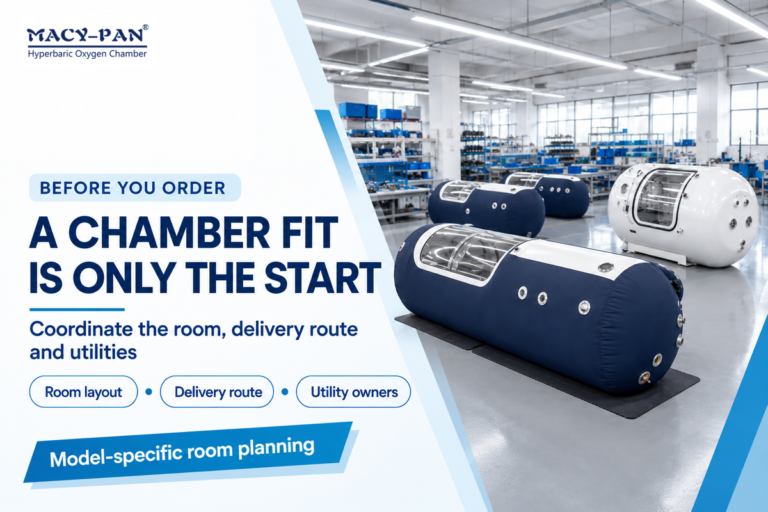
Monoplace chambers (single-patient, fully enclosed) and multiplace chambers (multiple patients, staff present inside) are the two broad clinical formats; soft-shell portable units populate the lower-pressure mHBOT category cited above. For a closer look at choosing a chamber for skin and anti-aging applications specifically, consult MACY-PAN’s hyperbaric chamber solutions for beauty and anti-aging guide.
Cost per session varies quite a bit: cost-guide aggregation sites report a range of about $150 to $650 per session at an independent clinic versus a hospital setting, with a median estimate at $250, and full course of treatment (20-40 sessions for chronic indications) often totaling thousands of dollars without insurance coverage. Medicare Part B has traditionally covered some hospital-outpatient HBOT costs for approved indications after the annual deductible — confirm specific details of coverage directly with Medicare or your insurer, as the rules and deductible amounts change year to year.
What’s Changing in Hyperbaric Medicine

The list of approved uses for hyperbaric medicine isn’t stagnant, however. First published in 1977, UHMS’s Indications Manual has guided the field for nearly five decades; UHMS and Best Publishing Company released its 15th Edition in 2024, adding avascular necrosis (AVN, also called aseptic osteonecrosis) as a newly approved indication and a new chapter dedicated to HBOT dosing.
UCLA Health’s list above doesn’t yet reflect AVN, which is exactly the lag this section is describing — individual facility lists trail the national manual, sometimes by years. By contrast, FDA’s own device-clearance labeling is comparatively static — it doesn’t track UHMS’s periodic indication additions, which is exactly why the two lists show different, both-correct condition counts.
That’s the real way the field expands — not an exponential rise in what “HBOT treats,” but an ongoing consensus review adding periodic new entries to its working clinical guide. Practically speaking, “the complete guide to the benefits of HBOT” is only valid as of its publication date, so cross-check UHMS’s current indications manual directly before relying on any single article, including this one.
Key Factors to Consider Before Pursuing HBOT
- Confirm your condition is on the current UHMS-approved indications list, not just claimed by a marketing page.
- Ask whether the institution is UHMS-accredited.
- The use of HBOT is generally an adjunct to conventional therapy, rather than a substitute.
- Verify insurance/Medicare coverage for your approved condition before purchasing a multi-session course.
- Inquire about chamber pressure (ATA) and if it correlates with the research on your condition (soft-shell mHBOT and clinical HBOT aren’t equivalent).
Frequently Asked Questions
What are the pros and cons of hyperbaric oxygen therapy?
Pros: strong evidence for a specific list of conditions like CO poisoning and diabetic wounds, low invasiveness. Cons: limited to approved conditions, ear/pressure side effects, and real cost if uninsured.
For its roughly 13-16 UHMS-approved uses, HBOT carries decades of clinical use and a well-understood mechanism as its clearest advantage. Its weaknesses: it’s not the miracle cure it’s sometimes portrayed as, treatments take an actual chunk of your time (1.5-2 hrs repeated for weeks), and the cost can be significant without insurance covering your particular condition. What you’re actually doing each session is simple to describe — you breathe in pure oxygen while pressure does the work — but the ability to heal that it unlocks is specific to conditions where oxygen helps close a real physiological gap, not a general wellness boost.
Does insurance cover hyperbaric oxygen therapy?
Often yes for UHMS-approved conditions treated in a hospital outpatient setting — Medicare Part B has historically covered a share of costs after the deductible — but coverage for unapproved uses or personal chamber purchases is generally not covered.
The list that your insurer adheres to is the approved list of indications from above — the logic is simple: if your condition is included on this approved list and you receive this treatment from an approved facility, it will usually be covered (depending on your plan limits and deductible amount). Off-label use coverage and personal chambers for home use are generally not covered, so check your individual plan.
How long does a hyperbaric oxygen therapy session last, and how many do I need?
Individual sessions run 90 minutes to 2 hours; chronic conditions like wound healing typically require a multi-week course of repeated sessions, while acute emergencies may need only one longer session.
Exact session count depends entirely on your specific condition and treatment protocol, set by your treating physician — there’s no universal number. Acute uses (CO poisoning, decompression sickness) are often resolved in one to a few sessions; chronic wound healing courses commonly run over several weeks of daily or near-daily sessions.
Can I get hyperbaric oxygen therapy if I’m pregnant?
Hyperbaric oxygen therapy during pregnancy is a medical decision that must be made with your treating physician, weighing your specific condition against pregnancy-specific risk factors — it is not a general self-service decision.
These are condition-specific and patient-specific risk calculations that a general article cannot responsibly render for you, and this question ought to be brought before your OB/GYN and hyperbaric team together before any session is booked.
Are there unapproved uses of hyperbaric oxygen therapy?
Yes — the FDA explicitly states HBOT is not proven effective for cancer, Lyme disease, autism, or Alzheimer’s disease, despite some centers marketing it for these conditions.
This is covered in detail in the approved-uses table above. FDA’s position here is specific: these aren’t merely “under-researched” uses, they are uses the agency has reviewed and found unproven. For approved indications, treatment at a UHMS-accredited facility is the safer path.
What is the “miracle” of hyperbaric oxygen therapy?
There isn’t one — HBOT’s real value is a well-understood physiological mechanism applied to a specific, evidence-backed list of approved conditions, not a general cure-all for whatever ails you.
“Miracle” framing is common in consumer search results but doesn’t match how the therapy actually works or what it’s approved for. The more accurate framing — and the one this article uses throughout — is that HBOT is a well-documented medical treatment with a defined, periodically-updated scope, not an unlimited wellness solution.
Why We Write This
MACY-PAN has manufactured hyperbaric oxygen chambers for 17 years, exporting to 126+ countries under ISO 13485 and ISO 9001 certification. This article draws on FDA and UHMS public guidance plus MACY-PAN’s own engineering work, including a pending U.S. patent application (US20230201059A1) on wheelchair-accessible chamber design — and deliberately separates FDA-approved uses from investigational or unproven ones rather than blurring the two.
References & Sources
- Hyperbaric Oxygen Therapy: Get the Facts — U.S. Food and Drug Administration
- Indications for Hyperbaric Oxygen Therapy — UCLA Health, Hyperbaric Medicine Program
- Hyperbaric Oxygen Therapy — MedlinePlus Medical Encyclopedia, U.S. National Library of Medicine
- FDA Safety Communication, Follow Instructions for Safe Use of HBOT Devices — issued by the FDA, hosted via the Undersea and Hyperbaric Medical Society resource library
- Hyperbaric Oxygen Therapy: Evidence-Based Uses and Unproven Claims — Harvard Health Publishing
- Hyperbaric Oxygen Therapy and Mild Hyperbaric Oxygen Therapy Are Not Synonymous: A Narrative Review — Medical Sciences (MDPI), 2026
- Hyperbaric Oxygen Therapy in Modern Surgical Practice: Mechanistic Basis and Clinical Applications Across Specialties — Cureus, archived on PMC (National Institutes of Health)
- US20230201059A1, Vertical Soft U-Shaped Opening and Closing Sealed Air-Pressure Chamber — Shanghai Baobang Medical Equipment Co., Ltd. (USPTO/Google Patents)
- FDA Warns on Oxygen Chamber Scams — MassDevice
- Hyperbaric Treatment of Carbon Monoxide Toxicity — StatPearls, NCBI Bookshelf, National Library of Medicine
- Announcing HBO’s Newest Indication: Avascular Necrosis — Undersea Hyperbaric Medicine Section, American College of Emergency Physicians
Related Articles
- Hyperbaric Chamber Solutions for Beauty & Anti-Aging — MACY-PAN’s commercial solutions page for this application
- MACY-PAN Hyperbaric Chamber Manufacturer — chamber types, specifications, and OEM/wholesale options
![Decision lenses: occupancy, gas path, access, staffing, facility interfaces, and exact-model evidence [article].](https://macypansolutions.com/wp-content/uploads/2026/10/monoplace-vs-multiplace-hyperbaric-chambers-featured-1-768x512.png)