Get in Touch with MACY-PAN Company


A hyperbaric chamber export packing checklist is a review of an ordered item against its shipping instructions, protective packaging and crate dimensions and a plan for receiving it. Approve the evidence for the actual shipment before authorizing shipment.
Updated October 2026 · By XCX
Before the crate closes
- Confirm the exact model, accessories and manufacturer-approved transport configuration.
- Review the crate load path, moisture protection and destination wood-packaging requirements.
- Match each package identifier to its contents, measured dimensions, weight and photographs.
- Agree who can unload, inspect and report an exception at the destination.
This guide is for procurement teams, importers and receiving staff organizing international shipments (freight). Packing acceptance is different from customs clearance, installation and readiness for hyperbaric oxygen therapy (HBOT). A well-documented crate doesn’t confirm that a medical device is authorized for its intended use in a specific market.
1. Start with the chamber and shipment specification

An export packing specification begins with the item being shipped (chamber model, ordered configuration, accessories) and its approved transport condition. Provide the specification against the purchase order, and obtain measurements and handling instructions of the packed item. A hyperbaric chamber product page dimension or operating pressure can’t represent the size, mass and handling limitations of the finished pack.
How should a hyperbaric chamber be packed for international freight?
Agree with the manufacturer and packer a model-specific method for support, restraint, and opening sequence, and for protecting vulnerable surfaces and accessories. Provide the route and unloading condition. The CTU Code packing guidance isn’t a drawing for the crate.
Chamber type modifies the questions. A soft chamber could have manufacturer-approved folding and storage requirements. A hard-shell chamber needs its approved support and handling arrangement. As for a monoplace chamber or a larger multiplace chamber, determine if the shipment is a complete assembly or has separately packed modules. Never infer the answer from chamber design alone.
MACY-PAN’S soft-shell chamber models and hard-shell chamber range help identify product families. Request order-specific packing sheets before booking freight. Technical specifications, for example chamber pressure, expressed in ATA, differ from shipping measurements.
Consider an illustrative example where a buyer books a vehicle using a chamber width of 900 mm. The complete crate is of 1,120 mm width and the receiving doorway is of 1,050 mm width. The discrepancy is noticed only when the warehouse requests a crate drawing. A product specification was used to address a packaging question. The buyer asks the packer to verify the actual external dimensions of the package, and the receiving team approves a feasible route, before it’s dispatched. Removing panels at the doorway isn’t assumed to be safe or allowed. The objective of this example is to verify that the packed envelope is reconciled with the access, before freight is booked, as opposed to taking a shot in the dark when the truck arrives.
2. Approve the crate and its handling points
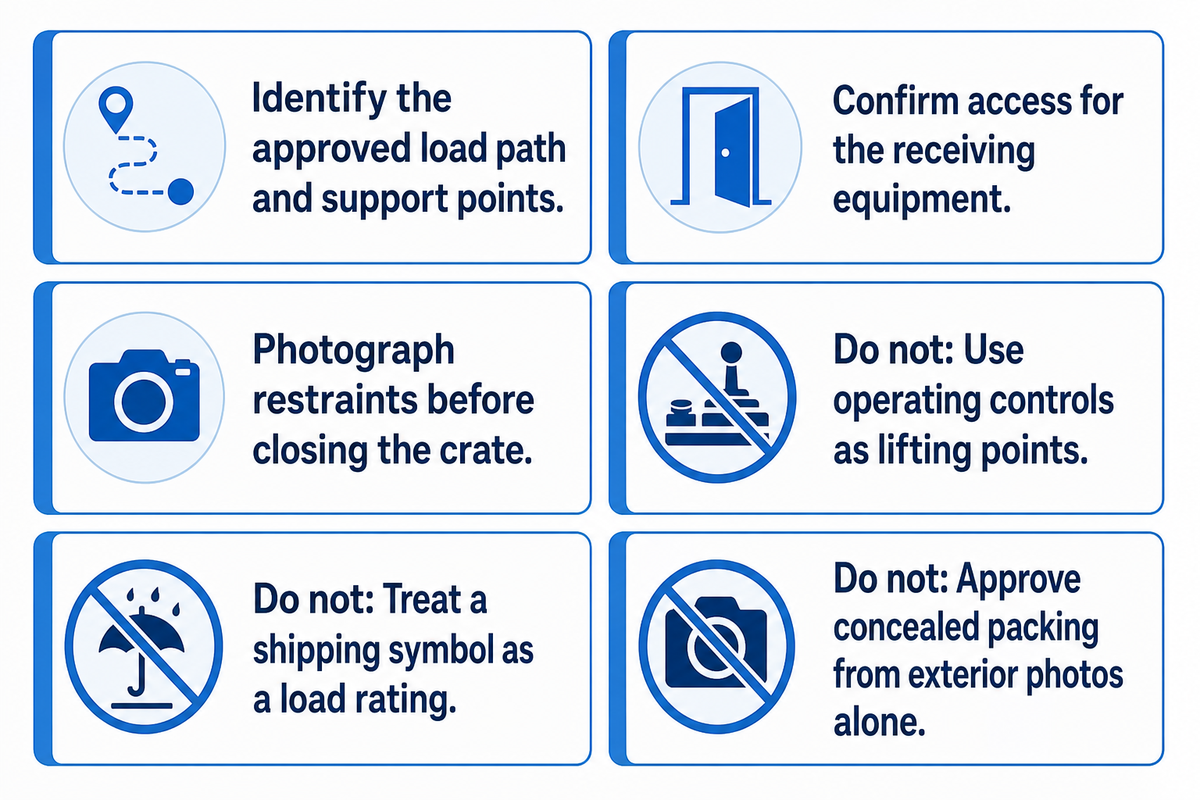
Crate approval requires an explanation of how the complete packed load is supported, restrained and moved. Request a drawing or packing specification indicating the base, approved lifting or fork-entry points, vulnerable areas and method of opening. Exterior panels cover the most critical aspect of a pack, which is how the equipment is connected to the load-bearing base and how the restraint is secured to the base.
FedEx’s crate packing guide says fasteners must be rated for the entire load (item and crate). This is a useful question for the packer and isn’t a justification for choosing lumber thickness or fasteners from a photograph. Determine who designed the packing and what shipment conditions it covers.
Separate three decisions: the attachment of the chamber to its base, protection of the chamber against contact or abrasion, and securing the packaged load in the transport unit. The guidance on securing materials discusses blocking, bracing and the securing equipment to be used. It doesn’t sanction the use of restraints attached to a viewport, door, pipe, or control panel.
Do
- Identify the approved load path and support points.
- Confirm access for the receiving equipment.
- Photograph restraints before closing the crate.
Don’t
- Use operating controls as lifting points.
- Treat a shipping symbol as a load rating.
- Approve concealed packing from exterior photos alone.
A less expensive crate may still be acceptable, but the quotation must describe the same load and route. Reject comparisons based only on panel material when the base, restraint and handling arrangement remain unspecified.
3. Check solid wood, plywood and packing marks
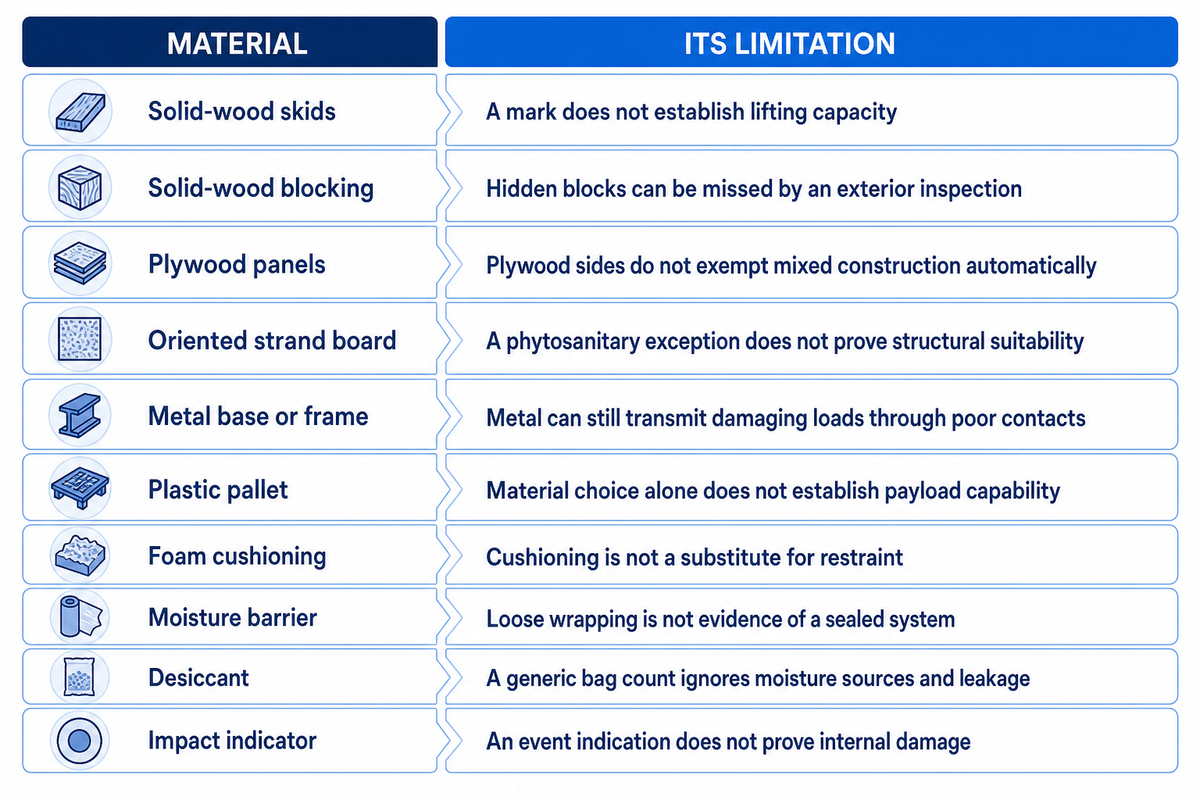
Wood-packaging materials checks are for the materials actually used and the destination’s regulations. Inspect panels, skids, blocks and loose dunnage separately. A crate with plywood sides can still contain regulated solid wood, and an applicable phytosanitary mark addresses wood treatment and identification rather than the finished crate’s mechanical strength.
For regulated wood packaging imported to or transiting through the United States, USDA APHIS requirements specify treatment and marking requirements, and address pest conditions. The APHIS alternatives section identifies processed materials such as plywood and oriented strand board (OSB) as outside its regulated wood-packaging category. Canada’s wood packaging guidance distinguishes wholly processed packaging from construction containing unprocessed wood. Neither statement applies exemptions to all crates with plywood panels.
The material review that follows with the packer and destination customs broker groups questions on packaging and doesn’t prescribe a particular chamber packing design.
| Part or material | What to establish | Evidence to request | Limitations / Not suitable for |
|---|---|---|---|
| Solid-wood skids | Applicable wood treatment and load-bearing role | Material description, mark photos, base drawing | A mark does not establish lifting capacity |
| Solid-wood blocking | All internal pieces included in the wood review | Open-crate photographs and packing record | Hidden blocks can be missed by an exterior inspection |
| Plywood panels | Processed panel material and any solid-wood framing | Construction schedule showing both | Plywood sides do not exempt mixed construction automatically |
| Oriented strand board | Destination scope and designer-approved structural use | Material identification and design acceptance | A phytosanitary exception does not prove structural suitability |
| Metal base or frame | Approved supports, restraint and contact protection | Packing drawing and manufacturer instructions | Metal can still transmit damaging loads through poor contacts |
| Plastic pallet | Actual loading and handling suitability | Applicable pallet specification and load arrangement | Material choice alone does not establish payload capability |
| Foam cushioning | Material compatibility and protected contact areas | Approved packing specification | Cushioning is not a substitute for restraint |
| Moisture barrier | Barrier material, seams and closure method | Protection plan and closure photographs | Loose wrapping is not evidence of a sealed system |
| Desiccant | Selection for the enclosed system and duration | Packer’s moisture-control basis | A generic bag count ignores moisture sources and leakage |
| Impact indicator | Model, activation, placement and response procedure | Supplier instructions and dispatch photograph | An event indication does not prove internal damage |
For crates labeled “compliant” by the supplier, ask compliant with which destination requirement and for which components. Keep the wood material declaration and mark photographs with the packing record. Country of origin, duty rate and customs classification remain separate documentation questions for the transaction.
4. Match moisture protection to the freight route
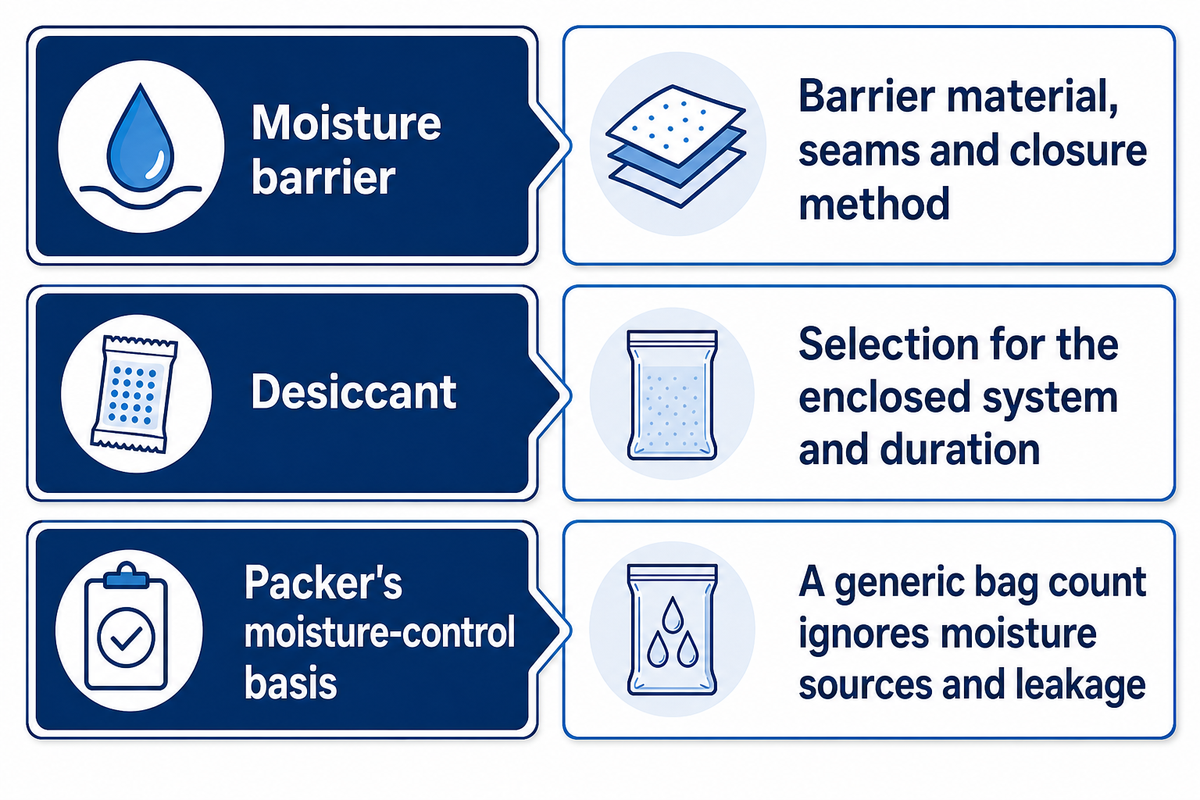
There needs to be a system defined by barrier or ventilation arrangements and exposure duration, packaging materials and moisture sources. Ask the packer to explain the assumptions before accepting wrapping and desiccant as sufficient. Dry appearing wood at the time of shipment and an intact outer crate don’t account for conditions during transit.
Virginia Tech’s white paper on moisture in sea containers identifies various moisture sources including cargo and packaging materials and discusses heat treatment vs. drying. The demand for desiccants is system dependent and a universal quantity per crate would hide those variations.
Ask whether “multi-layer export packaging” means abrasion protection, a moisture barrier, or cushioning or all three. Identify who closes the barrier after inspection and what happens if the barrier must be opened during a handoff. Explain the purpose of ventilation. Airflow can bring moisture into a container as conditions change. Therefore extra openings don’t guarantee an improved system.
Illustrative scenario, not a documented customer case: Consider a buyer reviewing two pack-offers for the same ocean shipment. Both offers contain a wooden crate and desiccant. One offer contains a description of the barrier material, states what’s protected, describes the enclosure, and gives the closure procedure. The other offer gives a bag count, but doesn’t identify what’s protected. Each packer is asked to provide an offer for the same protection plan, and provide assumptions about storage and transport. The cheaper offer may become acceptable once those details are supplied. Until then, the offers can’t be fairly compared. If a customs inspection opens the package, then the receiving instructions must also state who’s qualified to restore the approved protection. Buying more desiccant doesn’t answer these questions.
For oxygen-contact components, moisture control is only one concern. Their protective packaging must also preserve the manufacturer specified cleanliness, as the next step explains.
5. Secure the chamber and identify every accessory
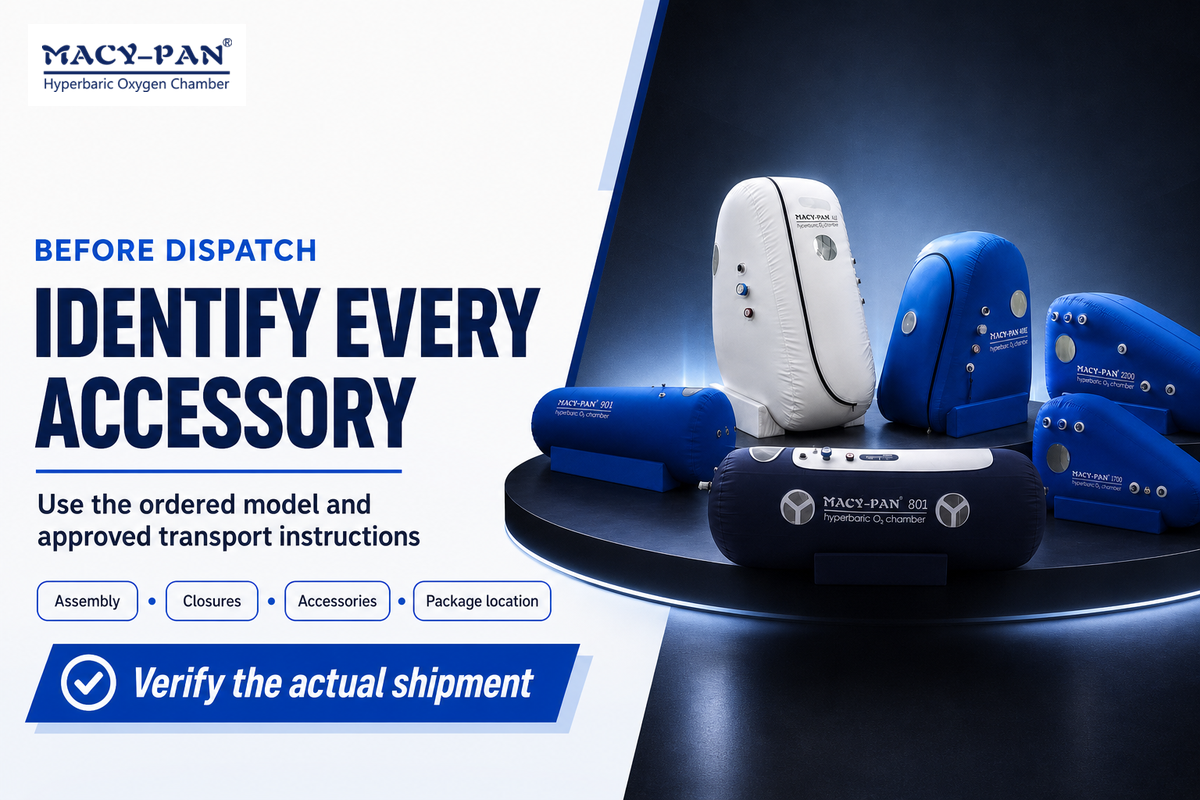
Proper transport preparation belongs to the exact model’s manufacturer-approved instructions. Determine what remains assembled, what needs separate protection, and which accessories travel in each package. Obtain photographs before closure, and resolve incomplete or missing instructions before release. Generic advice to open valves, remove controls or add straps isn’t a substitute for an approved transport configuration.
Add to the inventory the oxygen concentrator, cooling equipment, hoses, spare parts and ordered controls, as provided. When an oil-free compressor is ordered, give the exact model and its package location. Identify pressure control components, digital pressure displays and an emergency release valve, as pertinent, by the manufacturer’s terminology. Transport instructions should address protection of emergency pressure release components, if provided. Inquire how each is protected; don’t assume it should be removed. Operating instructions for pressurization and depressurization are not automatically transport instructions.
For components prepared for oxygen-rich service, ASTM G93/G93M-25, sections 4.3 and 4.6, describes preserving achieved cleanliness through packaging and labeling until use. The guide does not stipulate a specific cleanliness level for all cases. Contact the manufacturer to determine which oxygen delivery components require such protection, and retain the closure in the condition approved by the manufacturer. Do not apply a generic cleaning method, oil or adhesive to a surface in contact with oxygen.
Review the actual list of accessories to be shipped to classify for transport. If compressed oxygen cylinders or lithium cells and batteries are included, ask a qualified forwarder to determine the applicable route and packaging requirements before booking. US rules illustrate why this matters: 49 CFR 173.302(f) addresses specified compressed gases by aircraft, while 49 CFR 173.185 distinguishes lithium-battery configurations and exceptions. An electric concentrator, by that definition, is not a compressed oxygen cylinder.
Carry packing exceptions to the hyperbaric chamber Pre-shipment Inspection. “Ready” should mean the transport preparation has been checked, not merely that the equipment passed an operating demonstration.
6. Match crate labels to the packing list
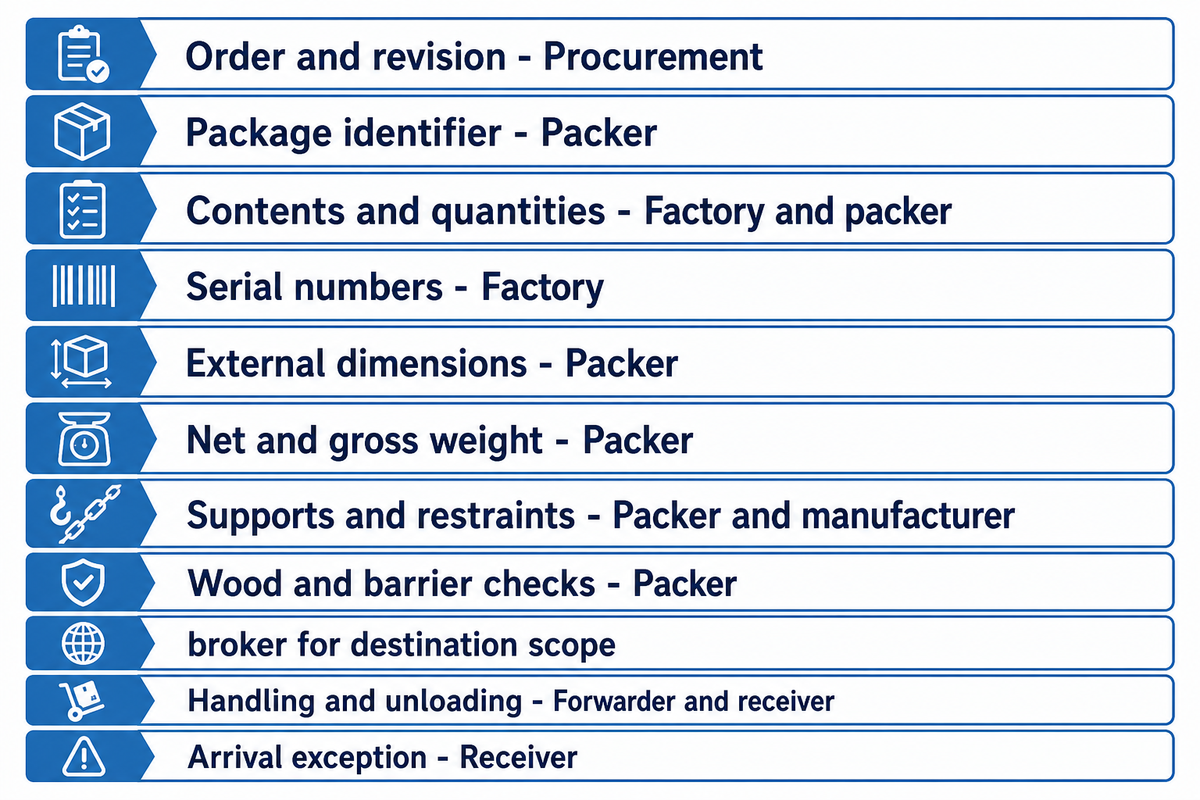
Each package should have a unique identifier that leads the receiver to the contents, measured external dimensions, weight, and inspection photographs. Cross-check those records before dispatch and again after repacking. The International Trade Administration explains a packing list by package; a shipment total alone gives the receiver too little information to reconcile individual crates and accessory cartons.
The International Trade Administration packing-list guide identifies contents, weight and dimensions for each package. Their common export documents guidance also explains applicable package marks and dimensions and states that a packing list doesn’t replace a commercial invoice. Use the broker’s requirements for the actual transaction.
Crate-to-Receipt Evidence Chain
The Evidence Chain links each package identifier to its contents and evidence of packing. The Chain also links the package to its arrival record.
This is our proposed buyer’s worksheet, not an official form. Add it to the order file and name the person who resolves discrepancies.
| Record | Responsible party to agree | Acceptance evidence | Limitations / Not suitable for |
|---|---|---|---|
| Order and revision | Procurement | Approved model and accessory list | A previous order cannot define this shipment |
| Package identifier | Packer | Same identifier on crate, list and photo set | Unreadable labels break the connection |
| Contents and quantities | Factory and packer | Itemized list for the specific package | Shipment totals do not locate an accessory |
| Serial numbers | Factory | Assigned equipment identifiers recorded accurately | Do not invent serials for unnumbered items |
| External dimensions | Packer | Completed package measured in stated units | Unpacked product dimensions cannot replace them |
| Net and gross weight | Packer | Clearly labeled measurements in kg | Estimated accessory sums are not weighed gross mass |
| Supports and restraints | Packer and manufacturer | Approved arrangement and open-crate photos | Photos alone cannot validate an unknown design |
| Wood and barrier checks | Packer; broker for destination scope | Material record, relevant marks and closure evidence | One check does not prove the other |
| Handling and unloading | Forwarder and receiver | Approved method, access and equipment arrangement | A delivery address is not an unloading plan |
| Arrival exception | Receiver | Condition photos and carrier-specific report | A clean-looking crate does not prove commissioning readiness |
Illustrative filled record: Package A contains the ordered chamber assembly; its fictional completed dimensions are 2,400 × 1,200 × 1,300 mm and fictional gross weight is 420 kg. The record links its label to the contents list and open-crate photographs. Release remains on hold because the receiving team hasn’t confirmed unloading equipment. None of these numbers is a MACY-PAN model specification or a recommended handling limit.
Which product details need to match across the packing documents?
Reconcile model designations, ordered quantities, assigned identifiers, and package references wherever they appear. A bill of lading, invoices, and a packing list have different functions, but conflicting information creates needless confusion for the customs officer and receiving team. Keep the hyperbaric chamber documentation package associated with the same approved configuration.
7. Compare the packing quotation and delivery access

A comparable packing quotation describes included materials, the type and level of protection, measurements, inspection records and assumptions regarding the handling by the destination party. Ask the supplier to price the same thing and say what they’ll exclude. The lowest unit price doesn’t resolve a missing unloading plan, and broad delivery terms don’t explain every physical handoff in the supply chain.
Procurement can use the worksheet above to compare evidence, while finance checks separately priced work. Who pays for inspection opening and resealing, storage or other agreed services? What about changed access? Clarify delivery terms. If there’s a proposed DDP arrangement, have the contract and logistics specialists clarify the terms; don’t assume the label settles unloading responsibility or demurrage exposure.
Packing quotation request — specify your actual shipment
| Parameter | Required information | Why it matters | How to verify |
|---|---|---|---|
| Model and accessories | Exact ordered configuration | Defines packing contents | Approved order list |
| Completed dimensions | External length, width and height in mm | Checks route and access | Measured packing sheet |
| Completed mass | Gross weight per package in kg | Supports handling planning | Weighing record |
| Moisture protection | System and exposure assumptions | Makes offers comparable | Packing specification |
| Destination access | Doorways, turns and unloading method | Prevents an unresolved handoff | Receiver’s access survey |
| Release evidence | Photos, document revision and named approver | Defines what acceptance means | Completed release record |
When not to approve the packing
Hold approval for a missing input that may affect whether the shipment can be handled as planned. Some examples of this include an unconfirmed load-bearing base, missing manufacturer’s transport instructions, incompatible package IDs, or access that hasn’t been validated against the completed crate. Assumptions don’t become facts due to deadlines. The CTU Code’s route and handling considerations provide reasons as to why the destination needs to be part of the packing discussion prior to dispatch.
A label can also give a false sense of security. Plywood panels don’t settle the status of solid wood skids. Heat treatment doesn’t confirm that wood is dry. An impact indicator doesn’t show that a chamber is intact. All require their own acceptance criteria.
Instruct the responsible party to close the specific gap and then update the relevant record and approval. Don’t ask for a broad “safe for export” statement that nobody can assess against the order. If the manufacturer cannot provide the needed transport configuration, escalate that missing instruction before the packer proceeds. This checklist helps organize acceptance; it can’t provide an absent engineered design, dangerous-goods classification, or destination authorization.
8. Prepare the receiver before the shipment arrives
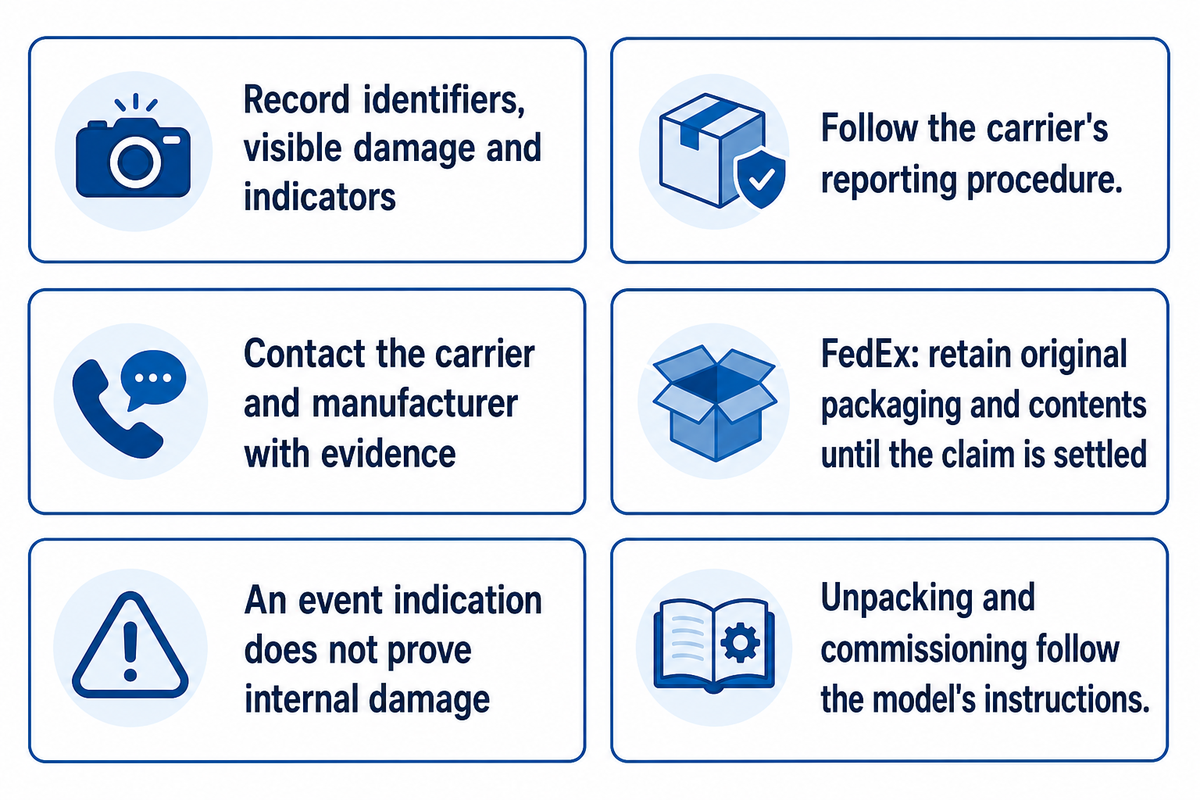
Preparation to receive the shipment should specify how the shipment will be unloaded, the sequencing of inspections, the reporting contact, and how the package will be opened. The contact at the receiving facility should be given the instructions, as well. The shipping record should identify the means by which the shipment will be transported and how it will be handled at the receiving facility. Even if delivery is to a hyperbaric facility or a home user, the receiver should be able to describe how the shipment will be handled and what they’ll do if the condition of the shipment differs from that described on the shipping record.
Agree which photographs to take while the package remains in its delivered condition: identifiers, visible damage, relevant indicators and surrounding packaging. Document internal and external condition as the approved opening sequence permits. Follow the carrier’s reporting procedure. For example, FedEx claims procedure requests that customers retain the original packaging and contents until the claim is settled. That doesn’t mean an acceptance standard or deadline has been established for all freight services.
“First, learn whether the damage occurred in manufacturing, distribution or in transit.”
Illustrative scenario, not a documented customer case: If a receiving team sees a triggered impact indicator but can’t see a break in the outer panels, the receiving team takes photos of the impact indicator, package identifier and surrounding surfaces and follows the agreed carrier and manufacturer’s escalation procedure. No employee uses the triggered impact indicator alone to declare internal damage and no employee treats an intact outer panel as proof the equipment is serviceable. The team leaves the packaging and arranges an inspection as required by the interested parties. A complete receiving record differentiates between what has been observed and what has been confirmed. That distinction helps a technician investigate the equipment and helps the logistics team discuss the shipment without overstating either conclusion.
SpotSee’s MAG 2000 description describes an indicator event as exposure that may have caused damage. Unpacking, installation, checks before you pressurize the chamber, and commissioning still follow the model’s instructions.
Industry Outlook: 2026 Marking and Receiving Checks
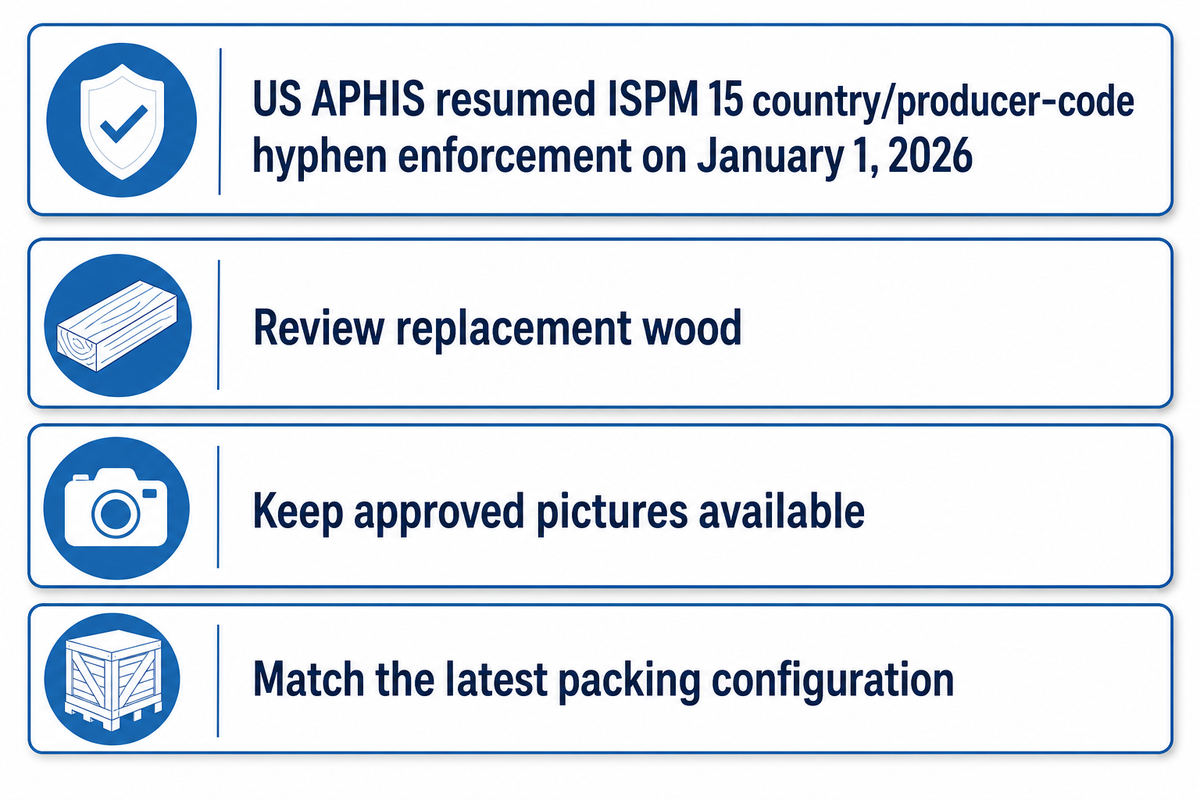
US-bound wood-packaging reviews in 2026 should account for a specific enforcement change: APHIS resumed enforcing the hyphen between the country and producer codes in the ISPM 15 mark on January 1, 2026. Therefore, verify the marks on the packaging actually supplied, including any relevant replacement wood, rather than relying on older approved photographs.
The APHIS enforcement notice says the temporary suspension ended on December 31, 2025. Other requirements were ongoing during the suspension. This is an enforcement detail restricted to the U.S. and doesn’t make a case for a newly developed global standard for treatment, nor provide evidence that all countries use identical border procedures.
The impact on buying is clear: include current and legible mark photographs as part of shipment reviews when the destination and wood packaging material require it. Old packing quotations may describe the correct wood packaging material and attach a photograph of a previous crate. Ask the packer to identify which evidence belongs to the completed package and the broker to confirm the destination scope. You shouldn’t copy or modify regulated treatment marks yourself.
Repacking also needs to be monitored. If an inspection or repair adds replacement skids or bracing, the material record and relevant evidence must explain that changed packing. The receiving team should be informed about changes to the crate identifier and opening arrangement. Otherwise, the package may arrive with paperwork that describes an earlier configuration.
For future orders, include the document revision and package ID in the release email, along with the final packing list. Keep the approved pictures available to the receiver. This document consistency measure, proposed here, may be useful in practice. It provides the factory, packer, importer and warehouse with a shared record of packaging changes between closure and arrival.
No chamber-packing market-growth figure is needed to justify these checks. The relevant change is a dated, verifiable marking requirement, along with a concrete action for affected buyers. Review the destination rules for each shipment. A previous successful import of a product shouldn’t be considered an approval for the same packaging for future imports.
Frequently Asked Questions
Which hyperbaric chamber export packing checklist should I use?
Use a checklist tied to the actual model, accessories, freight route and destination handling method.
Start with the manufacturer’s current transport instructions, then have the packer describe construction, support points, moisture protection and inspection records. Record the completed package measurements and connect them to its identifier. A generic form is a starting point; it cannot establish permitted handling loads, valve positions or material compatibility for your chamber. Resolve those questions with the responsible manufacturer and packer.
Should the export packing checklist be signed?
A dated sign-off can identify who checked packing against the agreed specification.
Name the order, model, package identifiers and document revision, and link the approval to the actual photographs and measurements. Agree who can release the shipment and who resolves exceptions. A signature alone does not prove packing adequacy, replace destination documentation requirements or guarantee carrier acceptance. The supporting records need to show what was checked and which configuration was approved.
Can we use our own commercial invoice template?
You can propose a template for the supplier and customs broker to review against the transaction’s requirements.
Confirm required fields, descriptions, quantities, identifiers and values before dispatch. Keep the invoice consistent with the supporting shipment documents. The packing list separately identifies package contents and measurements; it does not replace the commercial invoice. Template appearance is less useful than accurate information that the broker can use for the destination and that the receiver can reconcile with the delivered goods.
Should I print the checklist or keep it digitally?
Keep the controlling revision accessible to everyone who must check or release the shipment.
Digital records connect photographs and revisions; a printed copy can help where warehouse access is limited. Agree which version controls approval and follow any document-format requirements confirmed for the shipment.
Who is responsible for the paperwork, the factory or the importer?
Assign preparation, checking and approval responsibilities before packing begins.
The factory usually holds the ordered configuration and equipment identifiers. The packer records the completed packaging, while the importer and appointed broker confirm destination entry requirements. Those are practical divisions to agree, not universal legal allocations. The carrier and receiver also need the handling information relevant to their work. Write down who prepares each record, who checks it, who approves changes and who supplies the final version to the warehouse. Where several companies handle the shipment, identify the person who reconciles their records before dispatch and the contact who handles an arrival exception. Do not assume a freight label or broad delivery term settles every document and unloading obligation. A named owner for each unresolved item makes the handoff easier to manage.
Key takeaway
Approve the shipment when its actual contents, packing configuration, measurements and receiving arrangements agree with the evidence—not when a generic checklist is merely filled in.
For model-specific hyperbaric chamber exports, send MACY-PAN the model, destination, route, and accessory list, as well as any known constraints for unloading. Request a packing plan review and finalize the freight booking once approved.
References & Sources
- Planning of packing United Nations Economic Commission for Europe, CTU Code resources.
- Packing and securing materials United Nations Economic Commission for Europe.
- Wood packaging material imports US Department of Agriculture, Animal and Plant Health Inspection Service.
- Wood packaging questions and answers Canadian Food Inspection Agency.
- Moisture in sea containers Virginia Tech Center for Packaging and Unit Load Design.
- G93/G93M-25 public scope and significance ASTM International.
- 49 CFR 173.302 and 49 CFR 173.185 Electronic Code of Federal Regulations.
- Packing list and common export documents International Trade Administration.
- Mitigating packaging damage in the supply chain Packaging Digest.
- ISPM 15 hyphen enforcement notice USDA APHIS.