Get in Touch with MACY-PAN Company

Reviewed by the Shanghai Baobang Medical Equipment Co., Ltd. technical team (Updated November 2026)
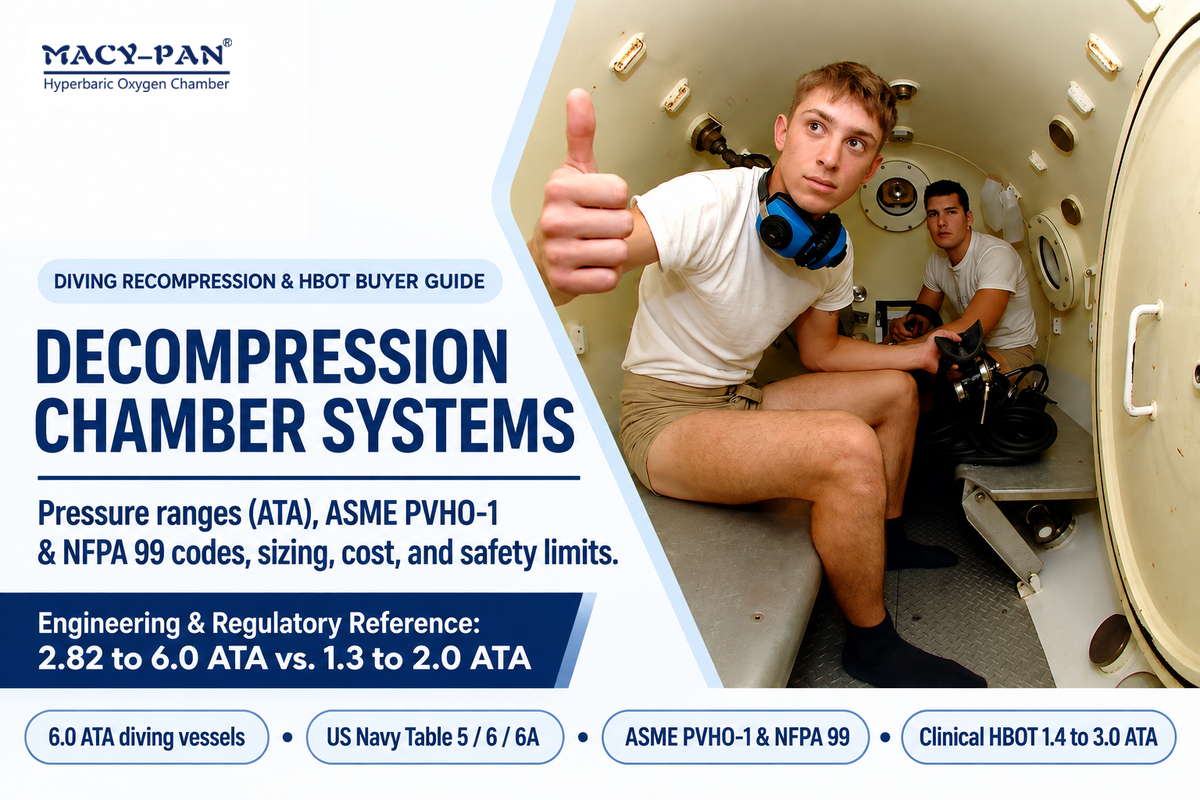
A decompression chamber is a sealed pressure vessel, not a wellness capsule, engineered to return divers safely from depth or treat gas-bubble injury. Confusing a commercial diving chamber system, clinical device, and a wellness bag wastes capital. Effectively managing pressure changes reduces the risks associated with pressurization and decompression.
Commercially, diving decompression chambers support planned surface decompression or emergency recompression. US Navy treatment tables include recompression at 2.82 ATA (60 fsw), while OSHA 29 CFR 1910.423 requires at least 6.0 ATA (165 fsw) vessel capability for covered diving operations. Medical hyperbaric devices fall under FDA 21 CFR 868.5470 without a fixed ATA ceiling, whereas aviation hypobaric chambers operate below 1.0 ATA.
Key Engineering Takeaways
- Mild 1.3 to 1.5 ATA soft-shell chambers reach approximately 4.4 to 7.35 psig at sea level, exceeding the 2 psig (1.14 ATA) scope threshold of PVHO-1 where adopted. Still, they won’t provide 2.82 to 6 ATA diving recompression.
- Dual OSHA deployment rules: Covered air dives (>100 to <220 fsw) and out-of-NDL dives (<300 fsw) require a 165 fsw dual-lock chamber within 5 minutes under 29 CFR 1910.423(c). Recreational nitrox instructors qualify for 1910.401(a)(3) exemptions. Dive-site chambers are required for mixed-gas diving at any depth covered by 1910.426(b)(1).
- Historic chamber fire record: In a 73-year audit of 35 hyperbaric fires and 77 deaths, every fatal fire occurred above 28% oxygen. Chambers pressurized with compressed air below 23.5% oxygen accounted for every survivor.
- Directional pressure split: Diving and clinical chambers raise pressure above sea-level ambient (~101.3 kPa). Conversely, cited aviation hypobaric research drops internal chamber pressure to approximately 20 to 33 kPa absolute.
Quick Specs
| Commercial Diving Recompression Range | 2.82 to 6.0 ATA (60 to 165 fsw / 26.7 to 73.5 psig) |
| Clinical Hospital HBOT Operating Band | 1.4 to 3.0 ATA (~100% medical oxygen, FDA Class II CBF) |
| Mild Wellness Portable Pressure | 1.3 to 1.5 ATA (~4.4 to 7.35 psig air/concentrator) |
| Aerospace Hypobaric Vacuum Band | Below 1.0 ATA (~20 to 33 kPa / 8,459 to 11,498 m) |
| Referenced Vessel Standard | ASME PVHO-1-2023 (>2 psig where adopted) + ASME Section VIII |
| Commercial Diving Oxygen Limit | Below 25 percent O2 by volume (29 CFR 1910.430) |
| Facility Enriched-Oxygen Trigger | >23.5% O2 defines oxygen-enriched hazard in NFPA 99 / OSHA 1910.146 |
| FDA Consensus Standard DoC Transition | December 26, 2026 cutoff for PVHO-1-2019 Declarations of Conformity |
What Is a Decompression Chamber and Why Do Divers Use One?
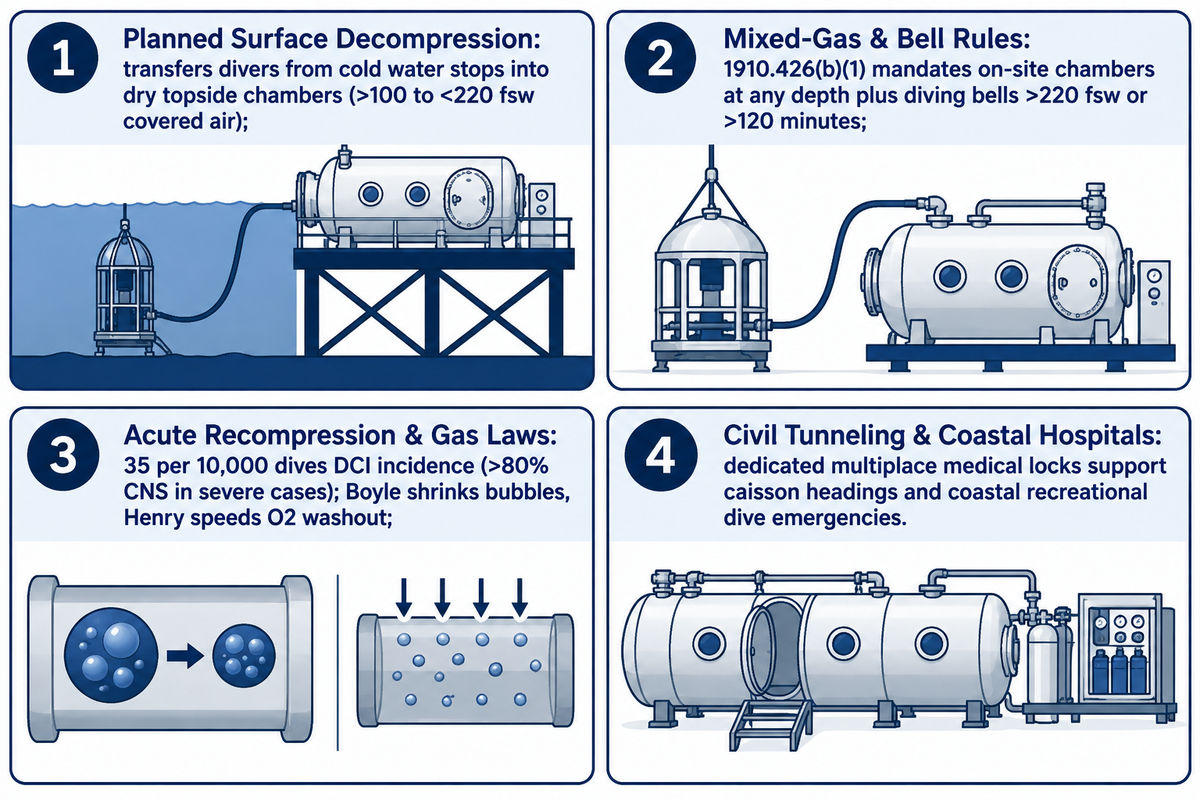
As described in OSHA 29 CFR 1910.423(c), covered air dives (>100 to <220 fsw) and out-of-NDL dives (<300 fsw) require a 165 fsw (6.0 ATA) dual-lock chamber. Recreational nitrox instructors qualify for 1910.401(a)(3) exemptions. Dive crews perform planned decompression or emergency recompression following prescribed clinical or military treatment tables.
A decompression chamber is used for two different functions: planned surface decompression and medical recompression. In offshore and harbor construction, surface decompression moves divers rapidly from underwater stops into a topside diving support chamber. Controlled pressure reduction is then performed in a dry hull instead of cold water. As described in 29 CFR 1910.426(b)(1), mixed-gas operations must keep a decompression chamber ready at the dive site at any depth. For mixed-gas diving deeper than 220 fsw or involving inwater decompression longer than 120 minutes, a diving bell is required under 1910.426(b)(1)(i) (except when heavy gear is worn or in physically confining spaces).
Why do divers go into decompression chambers?
Divers enter a decompression chamber for scheduled surface decompression after deep worksite exposures or for recompression treatment if trapped inert gas bubbles are present. According to Johnson et al. (2022), decompression illness incidence is up to 35 per 10,000 dives, with central nervous system involvement exceeding 80% in severe cases.
There are two gas laws that govern recompression after missed decompression stops. Recompressing the diver inside a pressure chamber under Boyle’s law reduces bubble diameter to relieve mechanical obstruction. Breathing pure oxygen also raises the partial-pressure gradient under Henry’s law. That accelerates nitrogen washout and reduces the risk of decompression sickness progression without guaranteeing instant reversal of inflammation.
Beyond offshore dive boats and saturation diving spreads, compressed-air civil tunneling projects operate dedicated multiplace medical locks adjacent to pressurized caisson headings. Hospital diving services and hyperbaric centers also run multiplace chamber operations to treat recreational diving accidents from coastal sites.
Decompression Chamber vs. Hyperbaric Chamber vs. Hypobaric Chamber
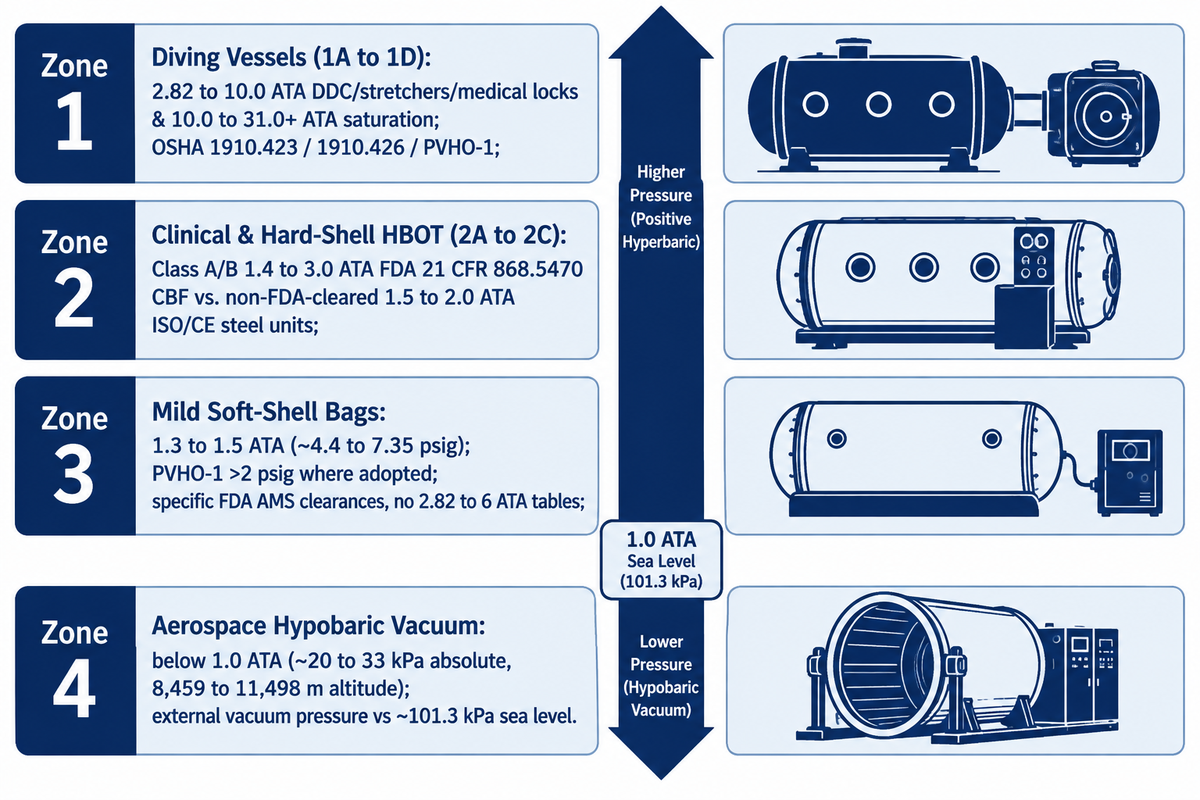
Every diving decompression chamber is a hyperbaric vessel operating above atmospheric pressure. Under FDA 21 CFR 868.5470, medical hyperbaric chambers have no fixed ATA cap: UHMS sets HBOT at ≥1.4 ATA, while clinical protocols run 2.0 to 3.0 ATA. Aviation hypobaric chambers instead drop pressure below ambient (~20–33 kPa absolute).
Buyers and clinic operators can confuse these equipment classes. One reason for this may be that all the vessels have a sealed hull and pressure gauges. However, they don’t all move pressure in the same direction. Hyperbaric treatment chambers, for instance, apply increased atmospheric pressure above sea-level ambient air (~101.3 kPa). By contrast, peer-reviewed hypobaric research drops aviation chamber internal pressure down to approximately 33 kPa absolute (8,459 m altitude) and 20 kPa absolute (11,498 m).
4-Zone Pressure-to-Code Ladder
This four-zone, nine-tier classification matrix aligns chamber working pressure with breathing gas rules, vessel standards, and clinical oversight.
| Zone & Vessel Type | Pressure Band | Gas Interface | Primary Standard / Code | Operational Boundary |
|---|---|---|---|---|
| Zone 1A: Commercial Twin-Lock DDC | Up to 6.0–10.0 ATA (165+ fsw) | Compressed air hull + BIBS 100% O2 | OSHA 1910.423 / PVHO-1 / IMCA | Surface decompression & acute dive injury |
| Zone 1B: Saturation System & Closed Bell | 10.0–31.0+ ATA (>300 fsw) | Heliox breathing mixture + TUP | OSHA 1910.426 / DNV-OS-E402 | Continuous subsea habitat & deep offshore work |
| Zone 1C: Portable Emergency Stretcher | 2.82–6.0 ATA (transport rated) | Air pressurization + mask/BIBS | PVHO-1 transport / military spec | Requires mating flange to twin-lock host vessel |
| Zone 1D: Tunneling / Caisson Medical Lock | 2.82–6.0 ATA | Compressed air + BIBS O2 | ASME PVHO-1 / local tunnel rules | Compressed-air civil worker recompression |
| Zone 2A: Hospital Class A Multiplace HBOT | 2.0–3.0 ATA (up to 6.0 ATA select) | Compressed air + BIBS / hood O2 | FDA Class II CBF / NFPA 99 Ch. 14 | Only select centers accept 24/7 diving casualties |
| Zone 2B: Hospital Class B Monoplace HBOT | 1.4–3.0 ATA (typically 2.0–3.0) | 100% O2 or air + mask | FDA 21 CFR 868.5470 / PVHO-1 | No inside tender; single-patient clinical HBOT |
| Zone 2C: Hard-Shell Clinical/Wellness Unit | 1.5–2.0 ATA rigid steel | Air hull + concentrator headset | ISO 13485 QMS (export/CE; not FDA 510(k)-cleared) | Non-diving HBOT & wellness; not 6 ATA compliant |
| Zone 3: Mild Soft-Shell Chamber | 1.3–1.5 ATA (~4.4–7.35 psig) | Filtered room air (+ concentrator on equipped units) | Specific FDA 510(k) clearances (e.g., AMS); PVHO-1 >2 psig where adopted | Spans the 1.4 ATA threshold; clinical HBOT also requires appropriate inspired O2, while 2.82–6 ATA tables exceed this chamber pressure range |
| Zone 4: Aerospace Hypobaric Chamber | Below 1.0 ATA (~20–33 kPa) | Evacuated air + hypoxia O2 mask | ASME PVHO-1 external pressure | Simulates rapid decompression at altitude |
Sources: 29 CFR 1910.423, 21 CFR 868.5470, UHMS Low-Pressure Position Statement, and PMC9745335.
Recompression Treatment Tables: How Diving Chambers Treat Decompression Sickness and AGE
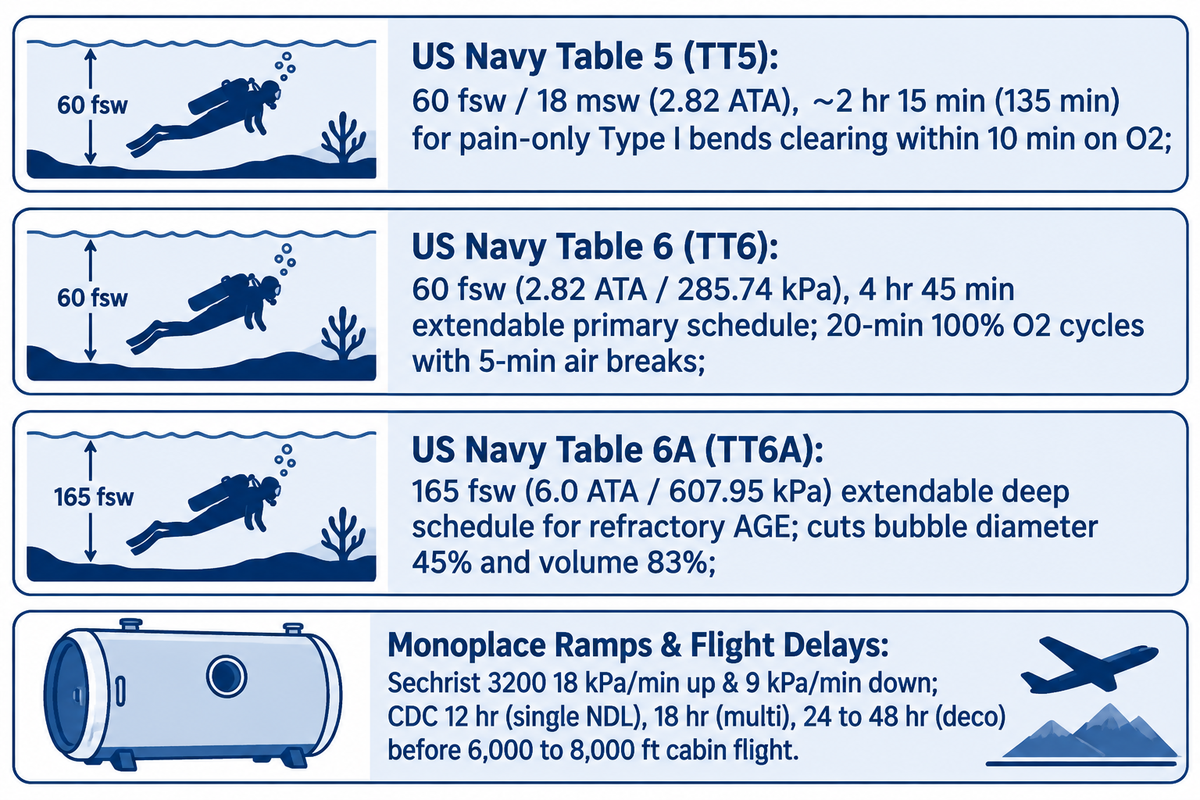
US Navy Treatment Table 6 runs at least 4 hours and 45 minutes starting at 60 feet of seawater (2.82 ATA / 285.74 kPa per Johnson et al., 2022). Milder pain-only cases clearing within 10 minutes may use Table 5 (~2 hours 15 minutes; Banham et al., 2022 lists 60 fsw / 18 msw as 284 kPa).
Hyperbaric recompression table selection for managing decompression sickness is based upon neurological status and early response during oxygen breathing. For refractory arterial gas embolism (AGE) or severe cardiopulmonary bends, physicians may extend Table 6 or escalate to Table 6A at 165 fsw (6 ATA / 607.95 kPa). According to Johnson et al. (2022), at 165 fsw, the diameter and volume of bubbles are decreased by 45% and 83%, respectively. Still, Table 6 stays the routine starting regimen to balance nitrogen washout against oxygen toxicity.
| Protocol | Max Depth / Pressure | Base Duration | Primary Indication & Bubble Effect |
|---|---|---|---|
| US Navy Table 5 (TT5) | 60 fsw / 18 msw (2.82 ATA) | ~2 hr 15 min (135 min) | Pain-only Type I bends resolving within 10 min on O2 at 60 fsw |
| US Navy Table 6 (TT6) | 60 fsw (2.82 ATA / 285.74 kPa) | 4 hr 45 min (extendable) | Primary recompression table for neurological DCS, vestibular injury, and AGE |
| US Navy Table 6A (TT6A) | 165 fsw (6.0 ATA / 607.95 kPa) | Extendable deep 165 fsw schedule (USN Diving Manual) | Refractory arterial gas embolism; reduces bubble diameter 45% and volume 83% |
Scheduled 5-minute air breaks interrupt 20-minute 100% oxygen breathing intervals to preserve pulmonary function and curb central nervous system oxygen toxicity risk limits. Meanwhile, published trial records confirm modified Sechrist 3200 monoplace protocols rely on an 18 kPa/min compression rate and a 9 kPa/min decompression ramp (the slowest decompression rate possible for the Sechrist 3200 chamber). Those rates apply when 30-minute multiplace stops aren’t feasible.
What happens if you don’t decompress after deep sea diving?
Skipping required decompression stops traps supersaturated nitrogen in blood and tissues, forming gas bubbles that obstruct microcirculation and cause joint pain (“the bends”) or neurological injury. On the other hand, arterial gas embolism (AGE) occurs when pulmonary barotrauma forces alveolar gas into arteries during ascent, even if you don’t exceed the no-decompression limits.
Symptoms of decompression sickness include joint ache, skin marbling, extreme fatigue, numbness, urinary retention, and vertigo. Early recognition and proper surface emergency triage for bends symptoms are critical to prevent transport delays. Even if surface supplemental oxygen temporarily eases discomfort, flying inside pressurized aircraft cabins (6,000-8,000 feet cabin altitude) may cause residual bubbles to expand. The CDC Yellow Book (2025) recommends waiting 12 hours after one no-decompression dive, 18 hours after multiple dives, and 24 to 48 hours after decompression-stop dives.
Pressure Ratings (ATA, PSI, FSW), Key Components, and Built-In Breathing Systems (BIBS)
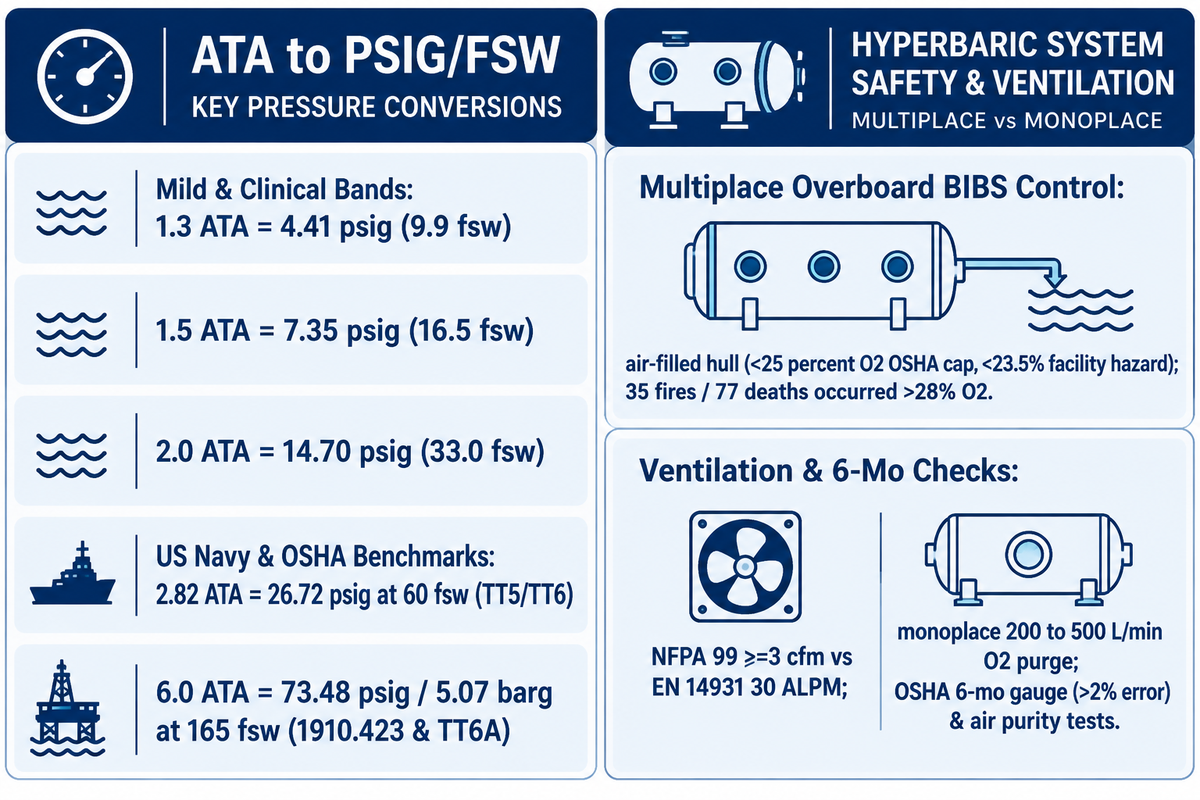
At sea level (14.696 psia, 0 psig), gauge pressure follows P_psig = (ATA – 1) × 14.696 and seawater depth follows Depth_fsw = (ATA – 1) × 33. That places US Navy Table 6 at 26.72 psig (2.82 ATA / 60 fsw) and Table 6A at 73.48 psig (165 fsw).
Unlabeled psi figures on brochures often blur absolute pressure with gauge differential pressure. Sea-level ambient pressure is 1.0 ATA rather than zero; converting absolute pressure to gauge pressure using our chamber ATA-to-PSIG setpoint conversion guide helps keep ASME PVHO-1 structural limits distinct from therapeutic tissue oxygen dosing.
Worked Sea-Level Conversion Example: Assumed inputs: sea-level ambient pressure equals 14.696 psia and seawater hydrostatic gradient equals 33 fsw per atmosphere. Suppose a dive supervisor checks a deck chamber control console reading 73.5 psig during a commercial dive test. Dividing 73.5 psig by 14.696 psi/atm yields 5.0 atm gauge pressure, matching 6.0 ATA absolute (5.0 + 1.0) and 165 fsw (5.0 × 33). That matches the statutory OSHA 29 CFR 1910.423(c)(1) recompression floor.
| Absolute Pressure (ATA) | Gauge Pressure (psig) | Bar Gauge (barg) | Seawater Depth (fsw / msw) | Typical Chamber Role |
|---|---|---|---|---|
| 1.3 ATA | 4.41 psig | 0.30 barg | 9.9 fsw / 3.0 msw | Soft-shell mild wellness bag; above 2 psig PVHO-1 floor |
| 1.5 ATA | 7.35 psig | 0.51 barg | 16.5 fsw / 5.0 msw | Rigid sitting/personal HBOT chamber |
| 2.0 ATA | 14.70 psig | 1.01 barg | 33.0 fsw / 10.0 msw | Hard-shell clinical & wound-care HBOT standard |
| 2.82 ATA | ~26.75 psig (26.72 at 60.0 fsw) | ~1.84 barg | 60.06 fsw (~60 fsw / 18 msw) | US Navy Treatment Table 5 & Table 6 start |
| 6.0 ATA | 73.48 psig | 5.07 barg | 165.0 fsw / 50.0 msw | OSHA 1910.423 floor & US Navy Table 6A |
Key components separate air-pressurized multiplace chambers from oxygen-pressurized clinical tubes. Multiplace diving chambers pressurize the hull with a filtered air supply while occupants breathe 100% medical oxygen through Built-In Breathing Systems (BIBS). That breathing supply system vents exhaled oxygen overboard to keep hull air under 29 CFR 1910.430(f)(3)(i)’s 25 percent diving cap and below 23.5% O2. Historic fire reviews (Sheffield & Desautels, 1997; UHMS) report 35 hyperbaric fires and 77 fatalities linked to enriched oxygen and combustibles, underscoring strict exhaust control of BIBS.
Within multiplace chambers, chemical CO2 scrubbers remove exhaled carbon dioxide during closed intervals. NFPA 99 specifies at least 3 cfm per non-BIBS occupant, compared with 30 actual liters per minute per person (minimum air-supply capacity sizing over a specified duration) in European EN 14931 guidance (Matity et al., 2023). Conventional oxygen-pressurized monoplace hospital tubes don’t use overboard BIBS because open-loop oxygen purges at 200 to 500 liters per minute maintain cooling and CO2 washout (US8251057B2, expired prior-art disclosure). Under OSHA rules, gauges undergo deadweight or master calibration every 6 months and on >2% discrepancy, while gas supply purity is tested every 6 months. Calibrating depth gauges maintains accurate pressure readings across pressure levels when holding constant pressure during stepped recompression stops.
Decompression Chamber Types: Multiplace, Monoplace, Twin-Lock, and Portable Systems
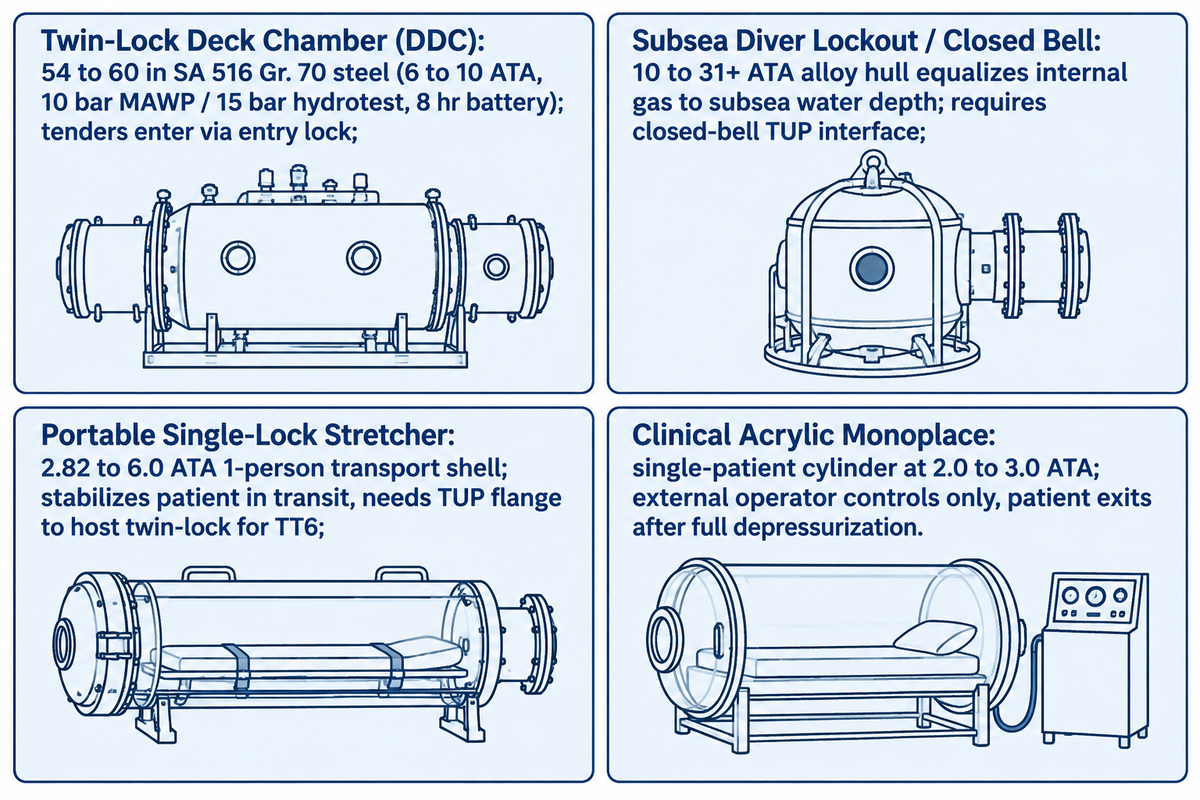
Under 29 CFR 1910.423(c)(1) to (3), covered air dives (>100 to <220 fsw) or out-of-NDL dives (<300 fsw) require a dual-lock, multiplace chamber positioned within 5 minutes. Clinical hospitals don’t stage dive barges and rely mainly on acrylic monoplace tubes or non-diving steel vessels.
A twin-lock deck decompression chamber (DDC) separates pressure integrity into an entry lock and a larger main lock, usually built in 54- to 60-inch diameters. For example, a containerized 60-inch steel DDC (JK Subsea JK-ADC-AP-CLASS) uses SA 516 Grade 70 pressure-vessel steel rated to 10 bar MAWP and 15 bar hydrotest. Its control panel retains up to 8 hours of battery backup. Tenders and medics enter through the entry lock, while main lock divers remain pressurized, though exiting tenders follow required decompression stops. Reviewing facility planning, including single-occupant and multiplace room footprint differences , clarifies floor footprint and staffing early.
What is a diver lockout chamber?
A diver lockout chamber is a pressure compartment built into a submarine, subsea habitat, or closed bell. It equalizes internal gas pressure with the surrounding water pressure so divers can exit into the sea and re-enter the chamber. Surface saturation transfer requires a compatible closed-bell TUP interface.
In subsea operations, lockout compartments enable underwater exit, unlike topside deck decompression chambers that stay dry on vessels or barges. Portable hyperbaric stretchers can stabilize one patient in transit and, with compatible TUP flanges, can be mated to a twin-lock vessel for full Table 6 treatment.
| Chamber Topology | Compartment Architecture | Representative Shell / Pressure | Attendant Access |
|---|---|---|---|
| Twin-Lock Deck Chamber (DDC) | Entry lock + main lock + medical lock | 54–60 in SA 516 Gr. 70 steel; 6–10 ATA | Yes; main lock stays pressurized while exiting tenders follow required decompression |
| Subsea Diver Lockout / Closed Bell | Floodable wet trunk + dry habitat/bell | Deep offshore alloy vessel; 10–31+ ATA | Deck saturation transfer requires compatible closed-bell TUP interface |
| Portable Single-Lock Rescue Unit | 1-person transportable composite/metal shell | 2.82–6.0 ATA emergency transit | None until coupled to host twin-lock flange |
| Clinical Acrylic Monoplace | Single compartment acrylic cylinder | Single-patient acrylic cylinder; 2.0–3.0 ATA | External operator only; patient exits only on depressurization |
Safety Standards and Compliance: ASME PVHO-1, NFPA 99, OSHA, and FDA Rules
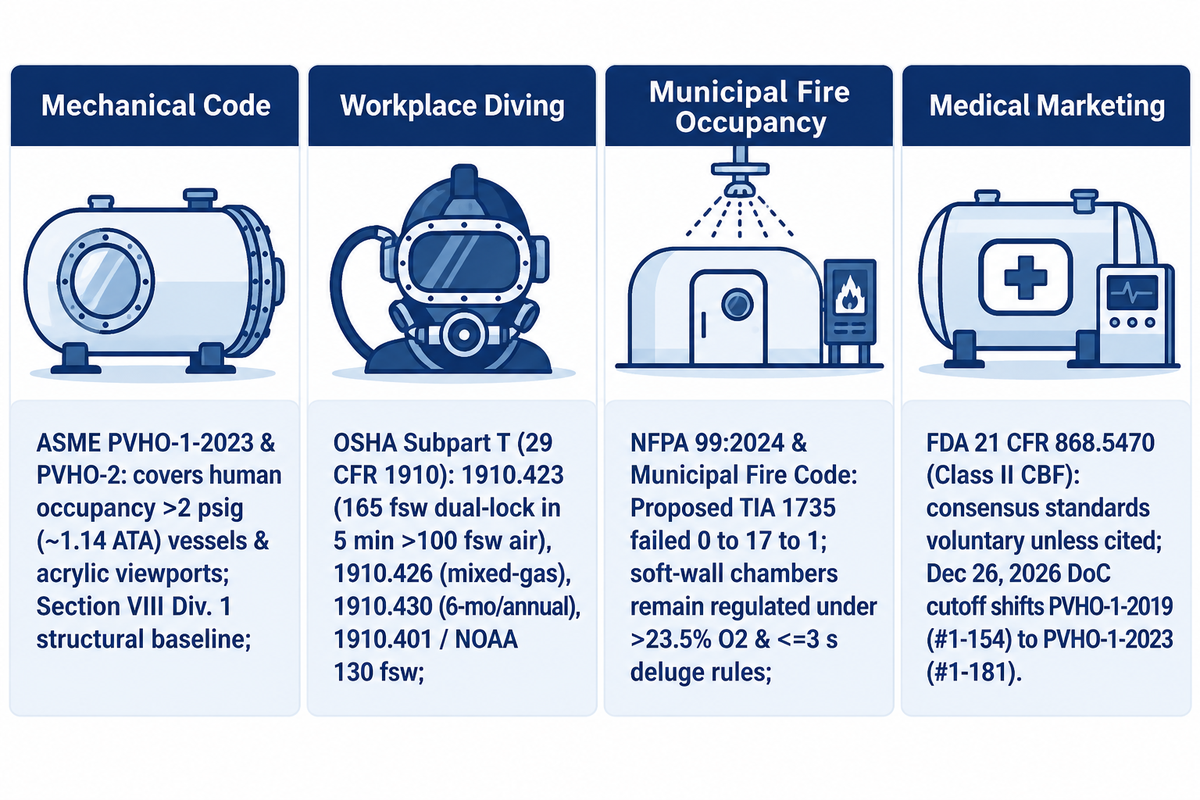
ASME PVHO-1-2023 sets structural criteria for covered human-occupancy pressure vessels above 2 psig (1.14 ATA). Enforcement depends on statutory adoption: OSHA Subpart T governs safe decompression in diving, NFPA 99 guides facility fire rules, and FDA 21 CFR 868.5470 classifies medical chambers.
Strict triggers are in effect for commercial diving systems by dive mode and depth. Under 29 CFR 1910.423(c)(1) to (3), surface-supplied air diving deeper than 100 fsw and shallower than 220 fsw requires a dual-lock, multiplace chamber with a minimum pressure capability of 165 fsw, available within 5 minutes. Out-of-NDL dives <300 fsw share that minimum, while dives deeper than 300 fsw require full dive-depth capability. By contrast, 29 CFR 1910.426(b)(1) mandates a dive-site chamber for mixed-gas operations at any depth. NOAA holds an alternate standard variance for qualifying SCUBA dives with a no-decompression cutoff at 130 fsw, and 29 CFR 1910.401(a)(3) exempts qualifying recreational instructors breathing >22% oxygen nitrox within the limits stated in Appendix C.
| Standard / Regulation | Authority | Published Trigger / Parameter | Adoption & Inspection Scope |
|---|---|---|---|
| ASME PVHO-1-2023 | ASME / FDA Rec #1-181 | >2 psig (~1.14 ATA) human occupancy | Applies via codes, FDA filings, or contracts; shell, viewports, piping & records |
| ASME Section VIII Div. 1 | ASME Boiler & PV Code | JK Subsea JK-ADC-AP-CLASS example: 10 bar MAWP / 15 bar hydrotest | Pressure-vessel construction requirements |
| ASME PVHO-2 | ASME Post-Construction | In-service acrylic viewport evaluation | Ongoing viewport crack, crazing & lifecycle tracking |
| OSHA 29 CFR 1910.423 | US Dept. of Labor | >100 fsw trigger; ≥165 fsw (6 ATA) within 5 min | Surface-supplied air & out-of-NDL diving |
| OSHA 29 CFR 1910.426 | US Dept. of Labor | Chamber ready at any depth; bell >220 fsw | Mixed-gas commercial diving & closed bells >300 fsw |
| OSHA 29 CFR 1910.430 | US Dept. of Labor | Covered diving: <25 percent O2; 6-mo air & deadweight/master gauge checks; annual 1.5× hose | Commercial diving equipment maintenance tagging & oxygen-service piping |
| OSHA 29 CFR 1910.401(a)(3) | US Dept. of Labor | >22% O2 nitrox SCUBA within NDL | Conditional exemption for recreational dive instructors |
| NFPA 99:2024 Chapter 14 | NFPA / Municipal IFC | ≤3 sec deluge; >23.5% O2 hazard threshold | TIA 1735 rejected 0–17–1; soft-wall chambers remain within scope where adopted |
| FDA 21 CFR 868.5470 (CBF) | US FDA CDRH | Class II 510(k); Dec 26, 2026 DoC cutoff | Transition from PVHO-1-2019 (#1-154) to 2023 (#1-181) |
Real Municipal Enforcement Case: On May 6, 2024, the Des Moines Fire Department issued an enforcement ruling under the 2021 International Fire Code. The decision rejected an appeal for a commercial soft-sided chamber lacking ASME PVHO-1 records. Fire Protection Engineer Jeremy Eekhoff cited NFPA 99 Proposed TIA No. 1735, which failed 0–17–1 when petitioners tried to exempt fabric chambers, alongside OSHA 1910.146(b) rules classifying any space above 23.5% oxygen as a hazardous oxygen-enriched atmosphere.
“As the proposal was denied, the 2024 edition of NFPA 99 still requires all hyperbaric chambers to comply with ASME-PVHO-1, and the committee members comments clearly indicate that soft-wall chambers are meant to be within the scope of and regulated by NFPA 99.”
Source: Jeremy Eekhoff, Fire Protection Engineer, Des Moines Fire Department Appeal Report, May 6, 2024
Federal premarket processes and local fire inspections have little in common. Per FDA Standards Conformity Guidance, recognized consensus standards remain voluntary for premarket submissions unless incorporated by regulation. After December 26, 2026, FDA premarket Declarations of Conformity transition from ASME PVHO-1-2019 to PVHO-1-2023 or General Use evidence. Separately, municipal fire marshals enforce whichever International Fire Code and NFPA 99 editions local ordinances adopt for building occupancy.
⚠️ Important Fire Safety Distinction
OSHA 1910.430(f)(3)(i)’s legacy 25% oxygen diving-chamber limit isn’t a safe clinical room threshold: NFPA 99 and OSHA 1910.146(b) define >23.5% O2 as oxygen-enriched, and SIMSI recommends monitoring alarms starting above 22.5% O2.
Can 1.3–2.0 ATA Mild or Clinical Hyperbaric Chambers Replace a Diving Decompression Chamber?
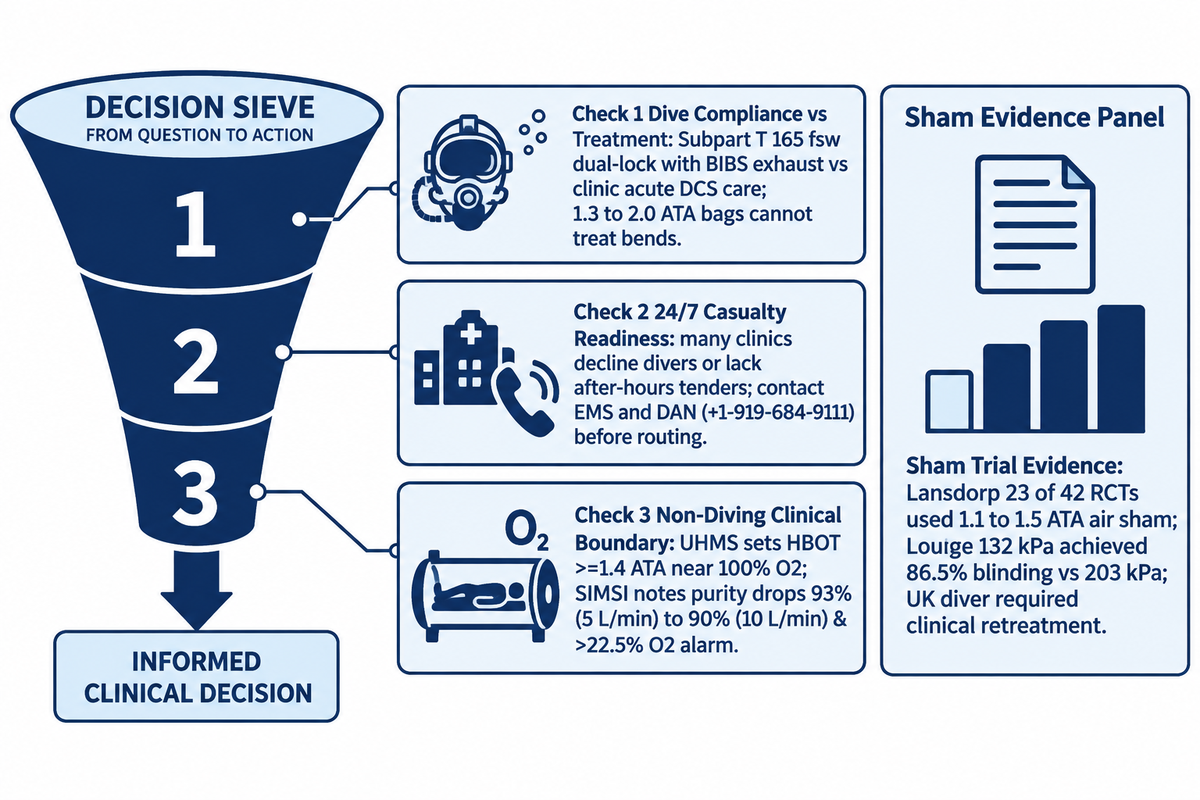
No. Neither a 1.3 to 1.5 ATA soft shell unit nor a 2.0 ATA clinic chamber meets the requirements of a 6 ATA commercial diving decompression chamber. They won’t meet the vessel pressure or life-support scope required for OSHA dive backup or acute US Navy DCS care.
Two technical constraints explain this boundary. First, soft-shell chambers running room air or low-flow concentrators at 1.3–1.4 ATA don’t meet the UHMS clinical threshold quoted below, and specific FDA clearances cover acute mountain sickness rather than DCS.
“Hyperbaric oxygen therapy is defined as an intervention in which an individual breathes near 100% oxygen while wholly enclosed inside a hyperbaric chamber at a pressure equal to or greater than 1.4 ATA.”
Source: Undersea and Hyperbaric Medical Society (UHMS) Position Statement, Low-Pressure Fabric Chambers
Additionally, SIMSI (2025) notes that low-flow oxygen concentrators fall short because purity drops from ~93% at 5 L/min to ~90% at 10 L/min without cabin >22.5% O2 alarms.
Second, hyperbaric randomized trials frequently use 1.1 to 1.5 ATA air exposures as sham controls rather than active treatment. In Lansdorp & van Hulst (2018), 23 of 42 systematic-review trials delivered 1.1 to 1.5 ATA as sham pressure. Likewise, Louge et al. (2023) showed compressing subjects to 132 kPa (1.3 ATA) with ventilation and heating achieved 86.5% sham blinding against 203 kPa (2.0 ATA) via ear equalization. Meanwhile, UHMS Pressure (2023) reported a UK recreational diver whose bends persisted after low-pressure sessions and required clinical retreatment.
3-Check Chamber Qualification Sieve
This three-point screening checklist covers diving pressure and gas-loop capability, 24/7 readiness for dive-casualty admission, and non-diving clinical or wellness boundaries before procurement.
- ✔Check 1: Dive Compliance vs. Medical Treatment Scope. Covered air and mixed-gas dive crews under OSHA Subpart T must stage compliant dive-site chambers, including 165 fsw dual-lock vessels with overboard BIBS exhaust where 1910.423 applies. Acute DCS patients need a medical center equipped for clinical treatment tables because 1.3 to 2.0 ATA wellness bags won’t suffice.
- ✔Check 2: 24/7 Diving Casualty Admission Readiness. Divers Alert Network (DAN) notes many clinics don’t accept divers or lack after-hours tender staffing. Contact EMS and DAN (+1-919-684-9111) first rather than self-routing to a nearby 2.0 ATA clinic.
- ✔Check 3: Non-Diving Clinical/Wellness Boundary. For outpatient wellness or non-diving HBOT programs, consult our outpatient 1.3–2.0 ATA wellness and clinic chamber tiers instead of sizing up to offshore 6 ATA deck spreads.
How Much Does a Decompression Chamber Cost? Equipment, Utilities, and Maintenance
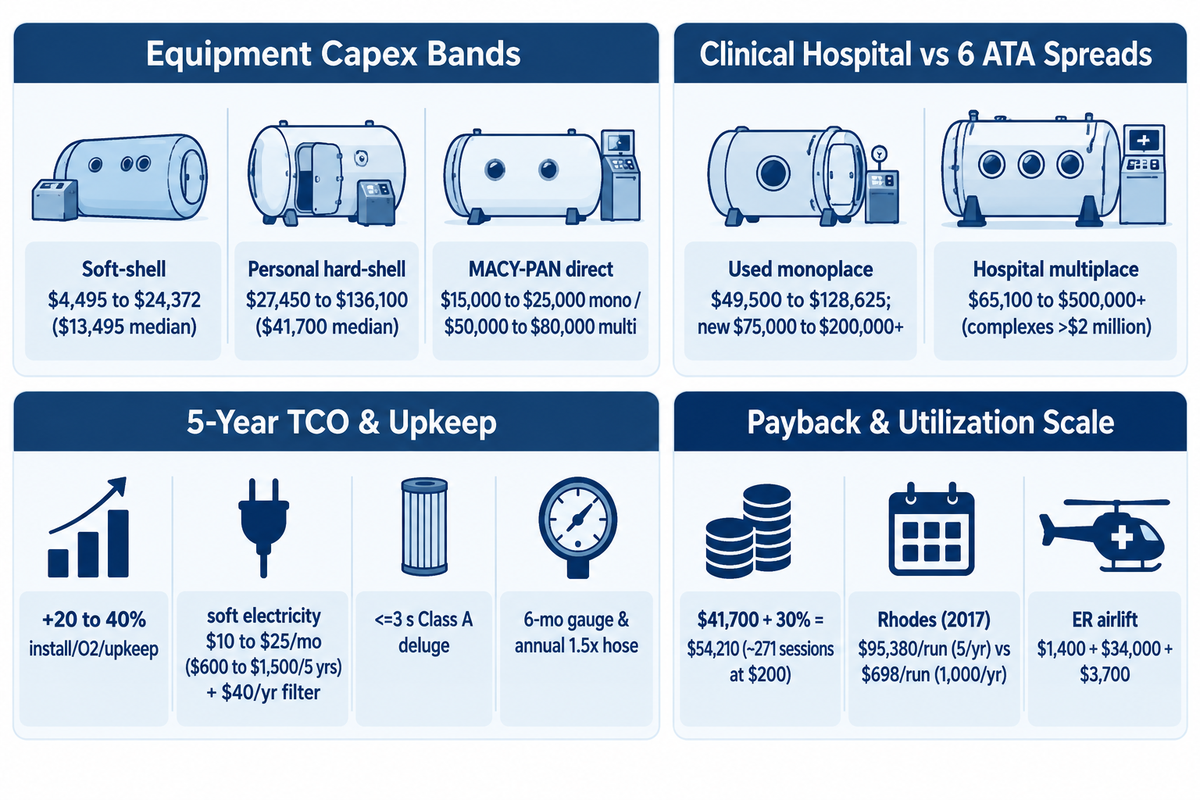
Compared to mild or clinical chambers, commercial diving vessels shift equipment budgets drastically. Published 2026 US retail indices place soft-shell units at $4,495 to $24,372 ($13,495 median) and personal 1.8–3.0 ATA hard-shells at $27,450 to $136,100 ($41,700 median), whereas factory-direct non-diving steel monoplaces sit in the $15,000–$25,000 band and multiplace systems run $50,000–$80,000 (MACY-PAN hard-shell series). Used clinical monoplaces span $49,500 to $128,625, new hospital systems reach $200,000+, and diving spreads require bespoke quotes.
How much does a decompression chamber cost compared with a clinical or wellness hyperbaric chamber?
Clinical multiplace chambers span $65,100 to $500,000+ in published 2026 US market surveys and reach above $2 million for hospital complexes, well above $4,495–$24,372 soft-shell units. Used 3.0 ATA clinical monoplaces run $49,500–$128,625 and personal hard-shells list at $27,450–$136,100, while 6 ATA diving spreads require bespoke quotes.
Bare equipment prices omit breathing oxygen supply hardware, high pressure gas lines, compressed air pressure piping, applicable NFPA 99 chamber and facility fire protections, room clearance, and recurring inspections. Across published 2026 US retail budgets, installation, oxygen delivery, and upkeep add roughly 20 to 40% above sticker price. Where applicable, NFPA 99 Class A clinical chambers also require deluge systems with an activation time of ≤3 seconds, while diving spreads add 29 CFR 1910.430 testing and ASME PVHO-2 acrylic checks.
5-year total cost of ownership:
| Cost item | 1.3–1.5 ATA Soft-Shell Wellness | 1.8–3.0 ATA Personal & Clinical Monoplace | 6.0 ATA Diving DDC (Commercial Spread) |
|---|---|---|---|
| Purchase price | $4,495–$24,372 listed ($13,495 median, Jul 2026) | $27,450–$136,100 personal; $49,500–$128,625 used monoplace; $75,000–$200,000 new monoplace | Quote-required custom offshore diving spread |
| Setup & lifecycle adder | O2 concentrator & setup (20–40% budget band covers install, O2 & upkeep) | Room utilities & medical O2 (Class A deluge ≤3s where NFPA 99 applies) | DNV/ABS lifting frame, HP air banks, BIBS dump piping |
| Energy (5-yr electricity) | $10–$25/mo ($600–$1,500 over 5 yrs; standard wall outlet draw) | HVAC + high O2 purge (200–500 L/min in O2 monoplaces) | Dual diesel/electric HP compressor bank + chiller |
| Maintenance & spares (5-yr) | Zipper seals, $40 yearly filter pack + shipping | Acrylic PVHO-2 checks, seals, annual safety checks | Covered diving: 6-mo air & deadweight/master gauges; annual 1.5× hose |
| Downtime risk (5-yr) | High fire-marshal stop-work risk if non-PVHO-1 | Missing grounding or annual checks halt clinic use | Failed 1910.430 logs halt >100 fsw & mixed-gas dives |
Payback & Utilization Example: Combining the 2026 $41,700 median personal hard-shell price with an assumed 30% installation, oxygen, and upkeep allowance (from 20–40% budget bands) gives a combined purchase, installation, oxygen, and upkeep budget of $54,210. Dividing $54,210 by a $200 session benchmark equals roughly 271 sessions before staffing or lease costs. By contrast, Rhodes et al. (2017) documented DCS cost falling over 100-fold with volume: $95,380 per treatment at 5 annual standalone runs versus $698 per treatment at 1,000 hospital runs. Figures reflect those 2026 retail listings and 2003–2015 Colorado records rather than offshore vessel budgets.
On the patient side, off-label clinic packages frequently reach $10,000 to $12,000 out-of-pocket. Acute diving accidents carry steep transport multipliers. One ScubaBoard billing log totaled $1,400 for ER triage, $34,000 for helicopter airlift, and $3,700 for chamber care.
Decompression Chamber Manufacturers vs. Clinical Hyperbaric OEMs: How to Verify Suppliers
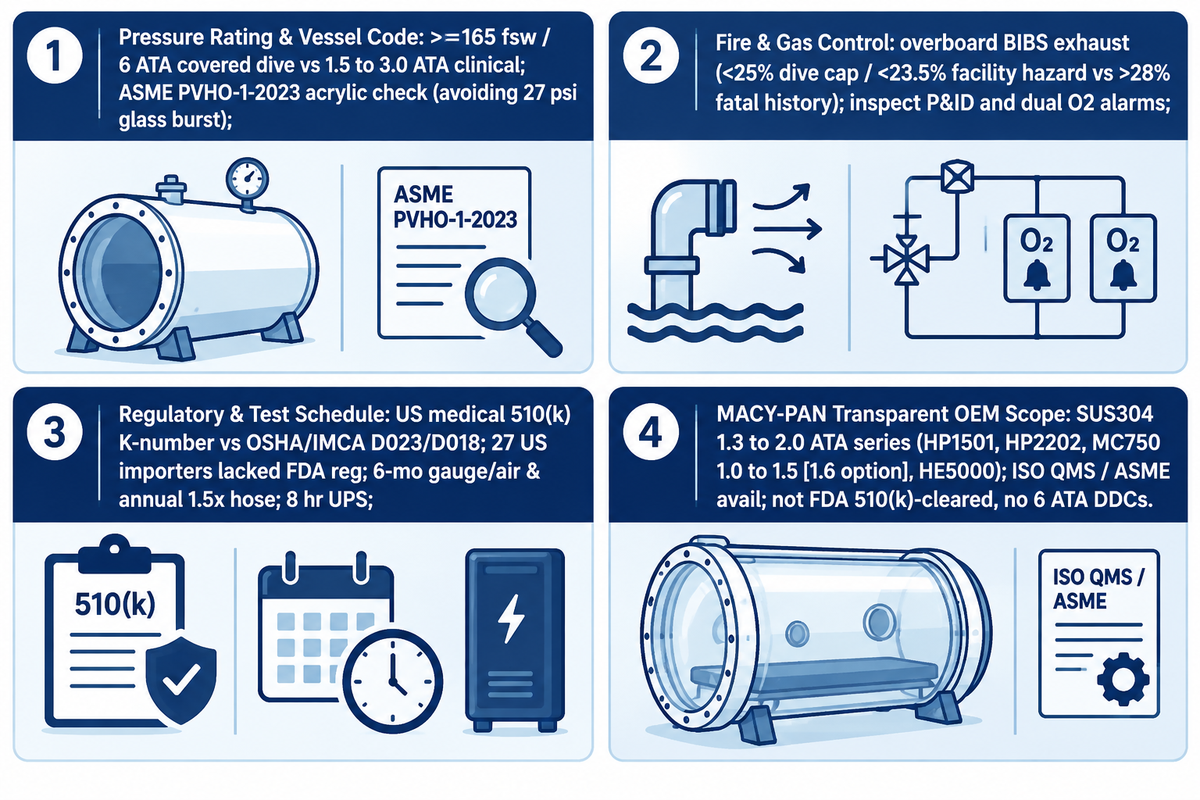
Commercial diving chamber builders separate technical scopes across ASME PVHO-1 pressure-vessel design, IMCA D023 system design and IMCA D018 inspection/testing guidance, and DNV, ABS, or Lloyd’s marine classification. That commercial diving framework differs from FDA 510(k) review for Class II hospital monoplace chambers and from the framework for non-diving 1.3–2.0 ATA clinic or wellness HBOT hardware.
Non-PVHO chamber components can create documented structural hazards. In Murray (2026, Undersea & Hyperbaric Medicine), a May 2023 Lehi, Utah failure shattered a non-PVHO glass viewport at 27 psi, injuring two occupants. Separately, the review traced 27 active US importers (sourcing from 23 suppliers) that lacked US FDA registration as medical-device manufacturers. Earlier field reporting (Clinica La Bendicion, Q1 2014) recorded over $3,000 monthly on oxygen cylinders ($28 per refill), showing why gas logistics can’t be skipped.
RFQ checklist (copy these specifications into your quote request):
| Parameter | Recommended range | Why it matters | How to verify |
|---|---|---|---|
| Pressure Capability | ≥165 fsw / 6 ATA for covered OSHA dive chambers; 1.5–2.0 ATA wellness/clinic vs. 2.0–3.0 ATA FDA clinical examples | Matches rated chamber pressure to dive-code or clinical/wellness application | Stamped vessel nameplate & pressure-test report |
| Pressure Vessel & Viewport Code | ASME PVHO-1-2023 & Boiler Code where applicable; marine class (DNV/ABS/LR/CCS offshore containers) | Addresses acrylic viewport safety (vs 27 psi non-PVHO glass failure) | Request Form PVHO-1 compliance records & resin traceability |
| Oxygen Concentration Control | Overboard BIBS exhaust limiting O2 buildup in air-pressurized hulls | Historic audit linked fatal fires to >28% O2 vs <23.5% air survivors | Inspect P&ID overboard exhaust & dual-alarm O2 monitors |
| Regulatory & Inspection Files | FDA 510(k) CBF (medical marketing); OSHA requirements and IMCA D023 / D018 inspection and testing documentation (diving) | Local fire approval and clinical reimbursement require separate determinations | FDA 510(k) K-number (US medical); applicable OSHA compliance and IMCA D023 / D018 records (diving) |
| Gauge & Hose Test Schedule | Covered diving: 6-mo air & deadweight/master gauge check; annual 1.5× hose | Required under 29 CFR 1910.430 for covered commercial diving systems | Verify master calibration ports & relief valve certificates |
| Control Power Backup | Up to 8 hours UPS battery on comms/monitors | Maintains voice comms & O2/CO2 telemetry on power loss | Verify factory acceptance test on loss-of-mains load |
Transparent OEM Scope Note: MACY-PAN (Shanghai Baobang Medical Equipment Co., Ltd.) builds 1.3–2.0 ATA soft-shell, sitting, and stainless-steel 1.5–2.0 ATA hard-shell HBOT systems (including 1.5 ATA HP1501, 2.0 ATA HP2202, 1.0–1.5 ATA [1.6 option] MC750 stretcher unit, and 2.0 ATA HE5000). MACY-PAN states that its models are manufactured under ISO quality management systems, with ASME documentation available for applicable stainless-steel units (such as HP2202), though these non-diving units lack FDA 510(k) clearance. We don’t design, certify, or sell commercial 6 ATA diving decompression chambers.
Industry Outlook: Stricter Mild-Chamber Enforcement and Modern Diving Chamber Monitoring
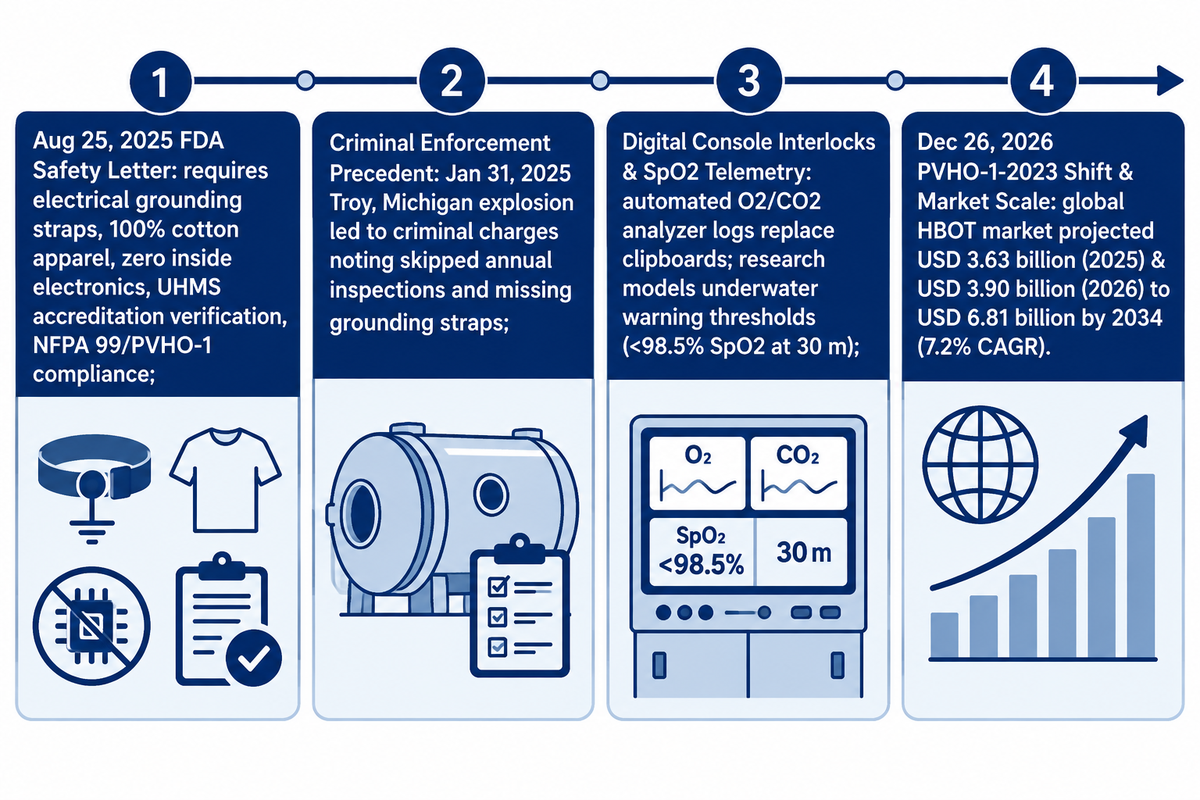
Which 2025–2027 compliance and console upgrades belong in new chamber procurement contracts? The August 25, 2025 FDA safety letter, 2025 fire investigations, and upcoming premarket documentation transitions push buyers to require audited PVHO-1 vessels, grounding hardware, and digital O2/CO2 monitoring upfront.
Following fatal 2025 US monoplace fires, the FDA issued an August 25, 2025 Letter to Health Care Providers. It stresses electrical grounding, 100% cotton apparel, no inside electronics, and NFPA 99/PVHO-1 adherence. After the January 31, 2025 Troy, Michigan explosion, criminal charges followed and Michigan’s attorney general noted skipped yearly inspections and omitted patient grounding straps. Separately, FDA advises clinical buyers to verify UHMS facility accreditation.
Newer facility builds replace manual clipboards with digital monitoring and control systems providing automated O2/CO2 analyzer logs and safety interlocks. Parallel physiological telemetry research tests underwater warning models (<98.5% SpO2 at 30 m). As clinical background, Fortune Business Insights projects HBOT markets rising from USD 3.63 billion (2025) and USD 3.90 billion (2026) to USD 6.81 billion by 2034 (7.2% CAGR). It’s cheaper to specify interlocks and vessel records upfront so facilities don’t face costly post-delivery retrofits.
Frequently Asked Questions
What is the purpose of a decompression chamber?
A decompression chamber can either stage safe pressure reduction back to surface pressure for commercial divers or, under treatment protocols that call for it, recompress injured divers up to 6 ATA so nitrogen bubbles shrink and dissolve.
In commercial offshore operations deeper than 100 fsw or in mixed-gas diving, bringing a worker quickly onto a deck vessel avoids lengthy cold-water stops while preserving hyperoxic off-gassing. During acute decompression sickness or arterial gas embolism, a pressurized recompression chamber combines mechanical gas compression under Boyle’s law with a steep oxygen washout gradient under Henry’s law until neurological symptoms clear safely.
How long do you stay in a decompression chamber?
Standard emergency recompression under US Navy Treatment Table 6 lasts at least 4 hours and 45 minutes starting at 60 fsw (2.82 ATA / 285.74 kPa).
Milder joint pain clearing within 10 minutes on oxygen at 60 fsw may use US Navy Table 5 (~2 hours 15 minutes). Severe neurological decompression sickness or arterial gas embolism can trigger Table 6 extensions beyond 5 hours or deep 165 fsw Table 6A schedules. Planned surface decompression times vary with the dive profile and the decompression schedule used.
Why do commercial diving chambers include a small medical lock?
A small medical lock allows the tenders outside to pass food, water, diagnostics, and medicines to persons at depth without depressurizing the main chamber.
Because twin-lock vessels or saturation habitats stay pressurized for hours or days, opening the main chamber door would lead to severe barotrauma and acute bubble injury. Isolating a compact auxiliary pass-through compartment, equipped with independent equalization and exhaust valves, allows pressure to be maintained constant for the duration of the supply transfer.
Is a hyperbaric chamber a medical device?
Yes, FDA classifies medical hyperbaric devices as Class II products under 21 CFR 868.5470 (CBF).
Jurisdiction depends on intended clinical use rather than location alone, alongside OSHA diving rules and PVHO-1 structure.
Can a decompression chamber be used for non-diving medical conditions?
Hospital Class A multiplace chambers (typically 2.0 to 3.0 ATA, with select units rated up to 6 ATA) treat diving injuries and recognized medical conditions including carbon monoxide poisoning, refractory osteomyelitis, and diabetic foot wounds. Offshore barge chambers follow maritime diving workflows and lack hospital clearance and clinical patient-care staffing.
Providing patient care inside a US medical facility requires applicable FDA 510(k) device clearance, NFPA 99 Chapter 14 facility fire protection, medical-grade oxygen delivery, and licensed physician supervision.
What is the difference between decompression and recompression chambers?
Decompression chambers and recompression chambers can be physically the same 6 ATA dual-lock steel vessels, differentiated by their operational missions.
Decompression chambers are employed for planned topside stops, whereas recompression chambers are utilized for treating unplanned bends and/or gas embolism.
Does MACY-PAN sell commercial diving decompression chambers?
No. MACY-PAN builds 1.3–2.0 ATA soft-shell, sitting, and hard-shell hyperbaric chambers rather than 6 ATA diving decompression spreads.
Operations covered by OSHA 1910.423 require PVHO-1 dual-lock steel systems rated to ≥165 fsw built by marine diving constructors. Non-diving export clinics and wellness centers seeking non-FDA-cleared 1.5 to 2.0 ATA stainless-steel HBOT models can review our series below.
Planning a Non-Diving Clinical or Wellness Hard-Shell Chamber?
MACY-PAN’s SUS304 stainless-steel 1.5–2.0 ATA monoplace, stretcher (MC750 at 1.0–1.5 ATA), and multiplace sitting HBOT series, built under ISO quality management without US FDA 510(k) clearance, are designed for export clinics and wellness centers. These non-diving vessels are not 6 ATA offshore diving units, and are suited for export wellness and clinical outpatient programs.
The Team Behind This Report
Prepared and reviewed by the Shanghai Baobang Medical Equipment Co., Ltd. engineering team. Standards cited include ASME PVHO-1-2023, OSHA Subpart T, NFPA 99:2024, FDA 21 CFR 868.5470, and US Navy tables, separating covered diving spreads from 1.3–2.0 ATA clinic units. Price references cite published 2026 US retail indices alongside MACY-PAN OEM specifications.
References & Sources
- 29 CFR 1910.423: Decompression Chambers (Subpart T, Commercial Diving Operations), Electronic Code of Federal Regulations (eCFR)
- 29 CFR 1910.426: Mixed-Gas Diving, Occupational Safety and Health Administration (OSHA)
- 29 CFR 1910.430: Equipment Inspection, Maintenance, and Decompression Chambers, OSHA
- 29 CFR 1910.401: Scope and Application (Recreational Instructor/Guide Exemption), OSHA
- Federal Register Notice (May 15, 2019): NOAA Alternate Commercial Diving Standards, OSHA
- 21 CFR 868.5470: Hyperbaric Chamber Classification, eCFR / US Food and Drug Administration (FDA)
- FDA CDRH Recognized Consensus Standard #1-154 (ASME PVHO-1-2019 Transition Period), US FDA
- Division of Standards and Conformity Assessment (Declaration of Conformity Process), US FDA
- Follow Instructions for Safe Use of Hyperbaric Oxygen Therapy Devices (August 25, 2025), US FDA Letter to Health Care Providers
- Hyperbaric Chambers Appeal Report (May 6, 2024; NFPA 99 Proposed TIA No. 1735), City of Des Moines Fire Department
- Scuba Diving: Decompression Illness and Other Dive-Related Injuries (2025), CDC Yellow Book
- Banham et al. (2022): Randomised Controlled Trial of Modified Monoplace Recompression Tables, Diving and Hyperbaric Medicine / PMC
- Johnson et al. (2022): USN Table 6 vs Table 6A in Severe Decompression Illness, PLOS ONE / PMC
- Decompression Rates in Hypobaric Chambers (2022), Frontiers in Veterinary Science / PMC
- Lansdorp & van Hulst (2018): Double-Blind Trials in Hyperbaric Medicine, Clinical Trials / PMC
- Louge et al. (2023): Hyperbaric Placebo Blinding Assessment at 132 kPa, PubMed
- Rhodes et al. (2017): Treating Decompression Sickness: Standalone vs. Community Hospital Cost Analysis, Military Medicine / PubMed
- Park et al. (2025): Wearable Heart Rate and Oxygen Saturation Monitoring in Diving, Healthcare / PMC
- Matity L, Burman F, Kot J, Caruana J (2023): Effectiveness of hyperbaric chamber ventilation (EN 14931 / NFPA 99), Diving and Hyperbaric Medicine / PMC
- Sheffield & Desautels (1997): Hyperbaric and Hypobaric Chamber Fires: A 73-Year Analysis, Undersea and Hyperbaric Medical Society (UHMS)
- Murray (2026): Hyperbaric Chamber Safety & Import Compliance Audit, Undersea & Hyperbaric Medicine (UHMS)
- UHMS Position Statement on Low-Pressure Fabric Hyperbaric Chambers, Undersea and Hyperbaric Medical Society
- When It’s Better to Be Under More Pressure (Q1 2023), UHMS Pressure
- SIMSI Position on Low-Pressure Hyperbaric Chambers (Q2 2025), UHMS Pressure
- Treating Decompression Sickness: Dive Medical Reference Book, Divers Alert Network (DAN)
- Treating DCS in the Miskito Coast (Q1 2014), DAN Alert Diver
- Hyperbaric Oxygen Therapy: Off-Label Costs and Clinical Evidence, MedPage Today
- Four Charged in Fatal Michigan Hyperbaric Chamber Explosion (March 11, 2025), MedPage Today
- Hyperbaric Chamber Fire Safety Record and NFPA 99 Review, Regenerated.com
- 2026 US Multiplace Complex Pricing Survey Note (PCCI upper bound >$2M; third-party retail links omitted; see MACY-PAN Factory Hard-Shell Pricing)
- JK-ADC-AP-CLASS Containerized Twin-Lock Air Decompression Chamber, JK Subsea
- US8251057B2: Hyperbaric Chamber Gas Purge Flow Disclosure, Google Patents
- Hyperbaric Oxygen Therapy Market Size and Forecast (2025–2034), Fortune Business Insights
Related Articles
- Non-Diving Clinical and Wellness Hyperbaric Chamber Solutions: Choosing compliant commercial systems
- Hyperbaric Oxygen Monitoring and NFPA 99 Fire Safety Checklist: Deluge systems, grounding, and 23.5% O2 limits
- Hyperbaric Chamber Floor-Load, Slab and Utility Planning Guide: Doorways, slab loading, and HVAC planning