Get in Touch with MACY-PAN Company

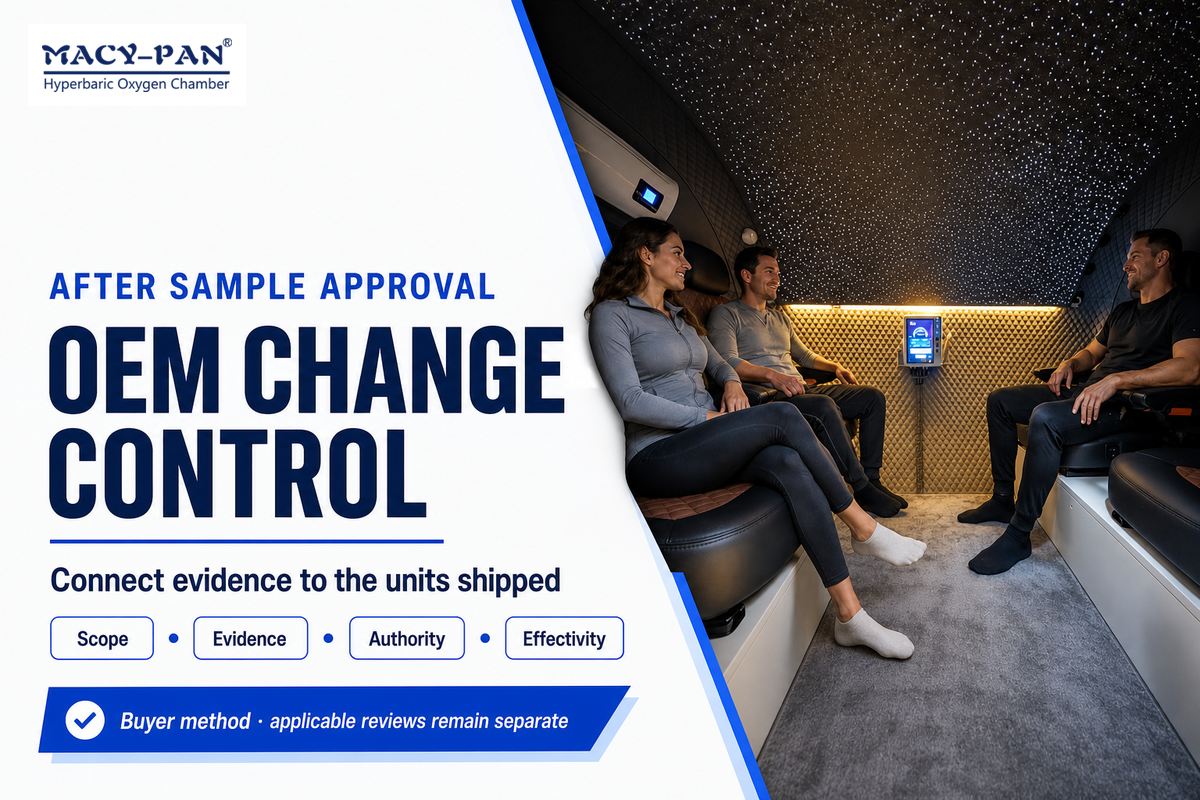
Hyperbaric chamber OEM change control connects an approved configuration to the items shipped with each order. Agree who will review a change, the evidence they’ll rely on and the units impacted prior to approving the change.
A supplier may replace a regulator, update the control panel or send a newer manual. The model name stays the same. Purchasing must still confirm if the approved configuration changed, if the evidence supports the change and if the next shipment is correct.
Quick reference: four proposed approval checks
- Scope: identify the old and proposed configurations.
- Evidence: connect the affected functions to the review and verification.
- Authority: record the responsible technical, regulatory and commercial decisions.
- Effectivity: identify the units or lots allowed to receive the change.
These checks are a buyer method, not a regulatory approval form. Examples below are fictional and don’t describe MACY-PAN test results or contract terms.
This guide covers changes to approved requirements. Refer to your OEM project brief if requirements are still unresolved. Equipment changes require additional evaluation; a purchase release can’t authorize clinical use.
Freeze the approved chamber configuration
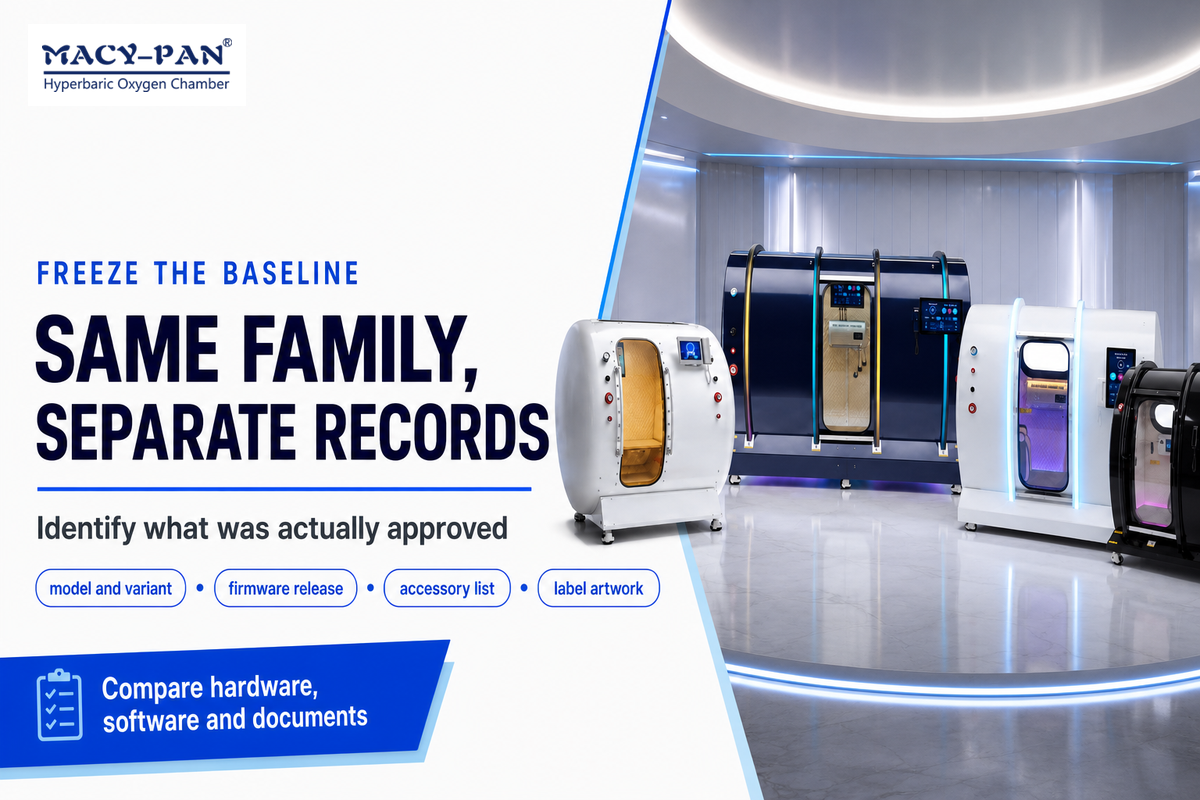
An approved chamber baseline identifies the agreed hardware, software, accessories and documents delivered with the order. Use it to evaluate changes. Record approval and identify all changes. A sample photo of the equipment may not illustrate the details of the configuration that purchasing, engineering and quality must review and reconcile.
NASA’s configuration-management guidance describes a baseline as agreed, documented attributes at a point in time. That is a useful general engineering principle, not a medical-device rule. The public abstract of ISO 10007:2017 likewise addresses configuration management across a product’s life cycle.
Record agreed model and variant, relevant component identifiers, firmware release, accessory list, label artwork and instruction manual revisions. Keep separate records for different chamber models; don’t merge records for different monoplace and multiplace configurations. In the absence of shared design records, agree access to evidence to support your decision. The chamber documentation package helps organize the evidence without requiring unrestricted access to the manufacturer’s design records.
For a multiplace chamber order, record the approved occupancy configuration rather than copying over another model’s baseline.
Illustrative situation: Buyer approves a sample of a monoplace chamber, with a particular controller and communication interface. The next quotation is for the same model name, but a different accessory communication interface. The buyer believes the sample approval covers the order, and doesn’t expect a price change. Quality states a comparison with the approved configuration is required to determine what evidence is needed to resolve the issue. The desired outcome is a decision regarding the interface in question, and affected documentation. An updated brochure wouldn’t be of any help. It is a mistake to assume the new configuration is acceptable until otherwise determined.
Decide which changes need written approval
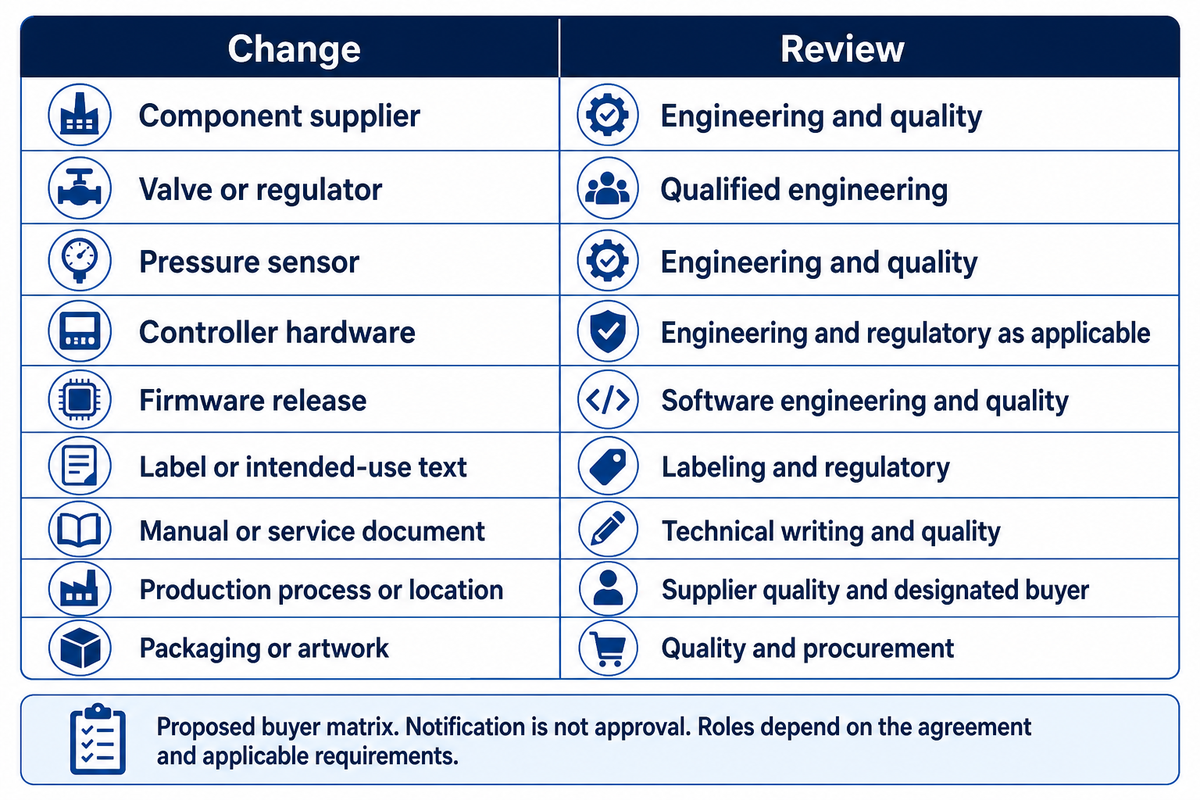
Change approval belongs to the change categories and responsibilities, agreed for the order. Separate notification from permission to change, and keep the regulatory assessment distinct from the commercial decision. If the supplier is unable to describe the configuration, or give the evidence agreed, keep the change proposed, rather than accepting an undefined substitution.
For applicable devices, FDA’s modification framework takes into account the effects on safety, effectiveness, and intended use. Not every component change necessitates a new 510(k). The responsible manufacturer has to decide on the appropriate route, and a purchase order signature cannot substitute that assessment.
How should OEM buyers control component, firmware, label and document changes?
Use a change request to capture the baseline, the proposed change, affected functions and units, and provide justification and reviewers before the change is made. The supplier’s notice, technical assessment, regulatory determination and buyer acceptance should be documented as separate decisions. Close the request when the evidence and the shipped configuration can be aligned.
Adapt this matrix to your situation. This example assigns questions and owners, not universal engineering acceptance criteria.
| Proposed change | Evidence to request | Responsible review | Limitations / hold condition |
|---|---|---|---|
| Component supplier | Old/new identity and affected characteristics | Supplier engineering; buyer quality | Same rating alone does not settle equivalence |
| Valve or regulator | Interface and affected-function assessment | Qualified engineering personnel | Unresolved oxygen or pressure-control compatibility |
| Pressure sensor | Measurement interface and applicable verification | Engineering and quality | Range alone does not establish system compatibility |
| Controller hardware | Hardware/software compatibility and verification record | Engineering; regulatory function as applicable | Evidence covers a different configuration |
| Firmware release | Release identity, impact review and relevant regression evidence | Software/controls engineering and quality | Version or changed behavior cannot be identified |
| Label or intended-use text | Controlled comparison and applicable regulatory assessment | Labeling and regulatory responsibility holders | Unreviewed safety, indication or identifier change |
| Manual or service document | Revision-to-configuration compatibility mapping | Technical writing and quality | Instructions describe another shipped version |
| Production process or location | Impact assessment and agreed qualification evidence | Supplier quality; buyer’s designated reviewer | Change introduced before required approval |
| Packaging or artwork | Assessment of protection, labels and traceability | Quality and procurement | Do not call it administrative until affected functions are checked |
A common mistake is to assume that no response to a notification means acceptance. Put the response and approval process in writing and don’t create an automatic approval rule because production is waiting.
Set evidence for component substitutions
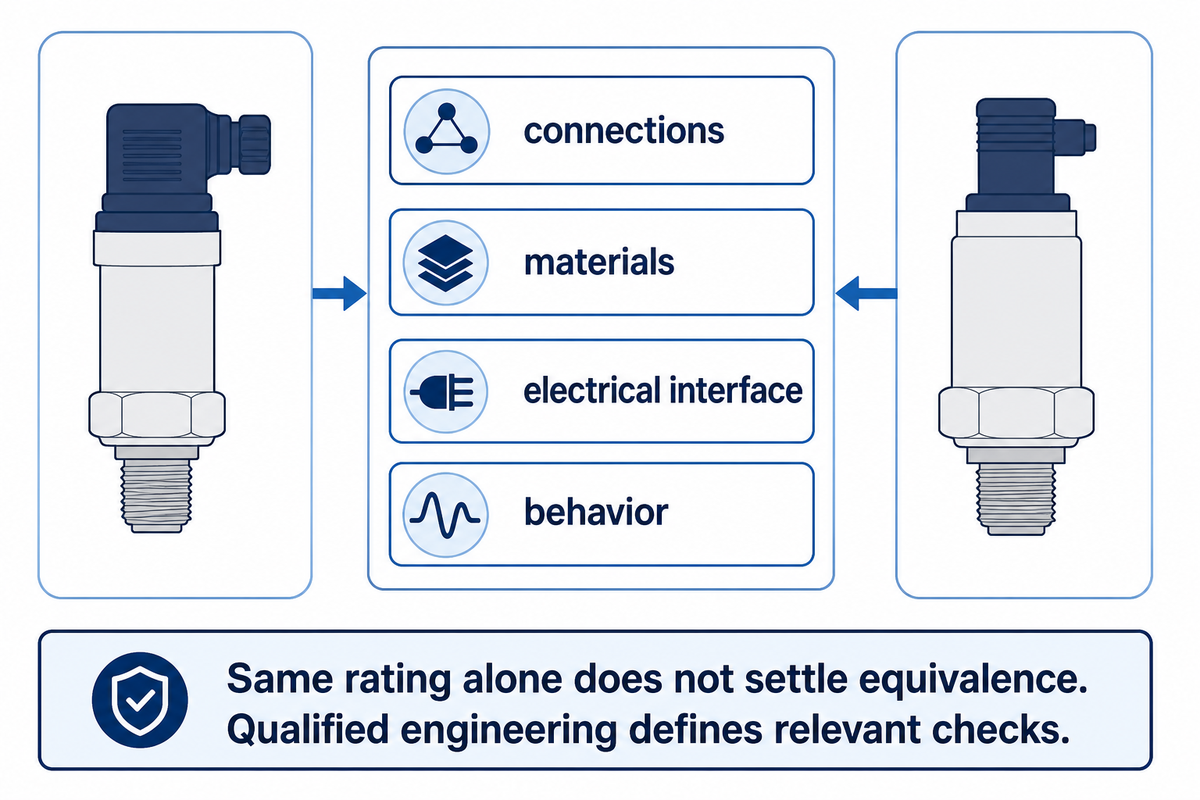
Component substitution evidence should assess characteristics that are relevant to the chamber configuration. Components can be equal in headline rating and still vary in connections, materials, electrical interface, or behavior. Have engineering evaluate the affected functions and the evidence needed to verify equivalence prior to procurement’s acceptance of the supplier’s equivalence claim.
The MEDIBAROX control-system study illustrates an interconnected arrangement of sensors, controllers, valves, and operator interfaces. It presents findings about the researched system, without establishing MACY-PAN performance. It explains why a part must be studied within its surrounding system.
For a control valve or regulator, consider connections, intended air or gas service, oxygen supply compatibility and affected pressure control functions. Components used in an oxygen-rich environment or pure oxygen system need to be assessed on a case-by-case basis. A component catalogue entry or a generic statement about pressure vessels for human occupancy doesn’t demonstrate system suitability.
Ask if documented air pressure is relative to atmospheric pressure or absolute, and uphold that consistency. Different pressure levels can’t be considered interchangeable operating conditions. Relate the proposed substitution to the project safety requirements and regulatory requirements.
For a changed sensor reporting pressure in the chamber, what value and units are shown? If an agreement names a standard from the American Society of Mechanical Engineers, indicate the applicable document and edition, rather than taking the organization’s name as an acceptance criterion.
Engineering note
Ask what changes at the interface. A pressure sensor’s range doesn’t describe its output, connection or integration with the controller. Qualified personnel should define the necessary checks; this guide supplies no test pressure or acceptance tolerance.
Link change-specific evidence to the factory acceptance test plan. Previous test results may stay pertinent, need to be supplemented, or no longer address the changed configuration. Give the rationale rather than insist on a complete retest or assume a retest is unnecessary.
Verify firmware and control system changes
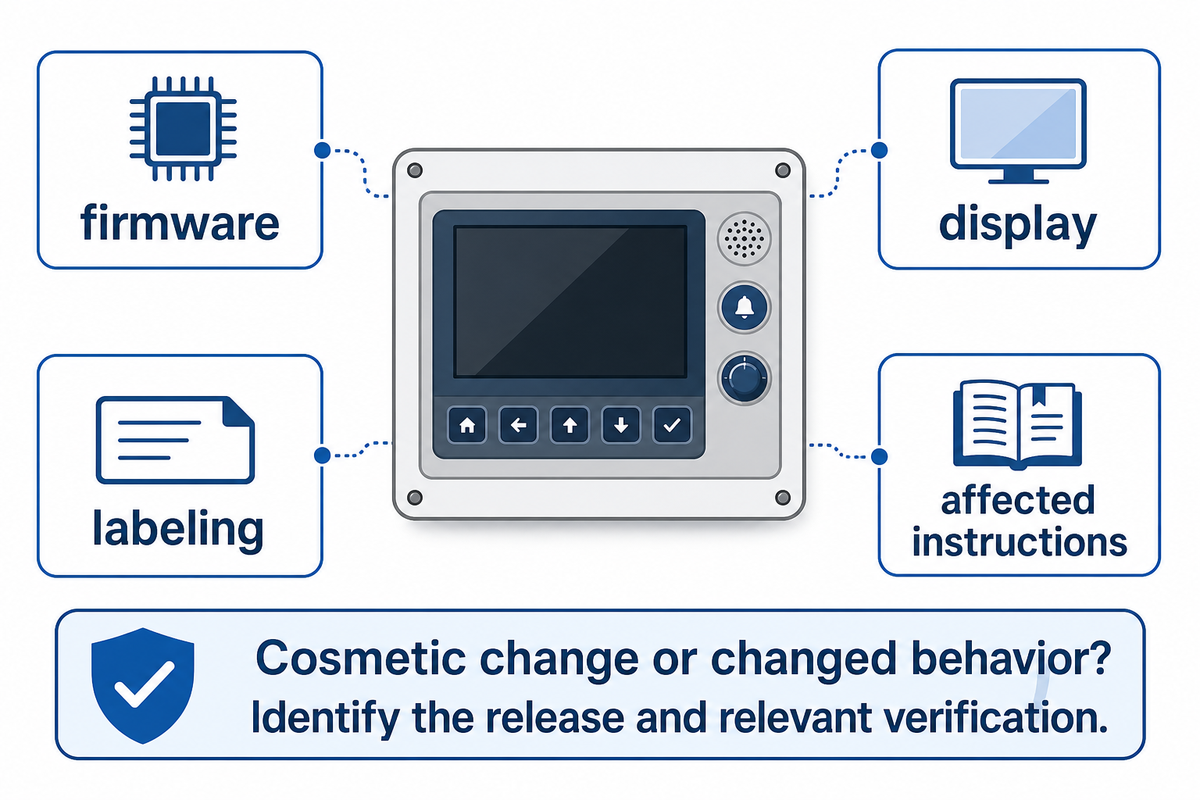
A review of the firmware should identify the release and explain what changes were made to the control system. Connect the impact assessment to relevant verification activities, compatible hardware, and affected instructions. It isn’t appropriate to assume that a firmware change to the control system automatically means a new regulatory submission is required.
FDA’s software change guidance includes firmware; changes may also affect the display, labeling and other device features. Review the complete affected configuration and the affected instructions rather than focusing on the software file only.
Can a control-panel update change the approved configuration?
Yes. There may be changes in the firmware, display and labeling as well as in the control system and the user input. Determine which elements and features changed and the functions that are affected. Evidence should correspond to that combination. Sales literature or a control system change description doesn’t establish whether the changed behavior is acceptable or the instructions are compatible.
Illustrative situation: This illustrative situation is based on the case where an OEM buyer receives notification of a change to their screen layout right before shipment. The supplier states this new design is easier to read. The buyer’s quality lead asks if the changes are strictly cosmetic or if the changes affect how the technician sees status and warnings. Engineering states the release note provides information on the changes to the functions in review and if any transitions between the automatic control and manual controls were impacted. The purchase department verifies the manual included with the unit describes that interface. The purchase department makes a decision based on the evidence described and the applicable assessment, and not on the assumption that an enhanced/easier to read screen means there’s no risk. A release note without software identity leaves the comparison incomplete.
For functions that pressurize or decompress the chamber, request evidence for changed compression, decompression or pressure control. Don’t recommend a treatment profile from a procurement checklist. Agree how installed software will be labeled; a build identifier or checksum may be used where the manufacturer’s process supports it.
Identify which subsystems a changed control signal reaches. If chamber control affects flow control or chamber pressure, ask which supporting evidence covers the changed behavior. A switch from manual to computer control also requires an explanation of the operator’s duties. In chamber systems with controls inside the chamber, distinguish those controls from the external panel in the comparison.
Review should determine if a change impacts chamber pressurization. Review whether the change affects how the system is commanded to compress or release gas. Review should also determine if a change only impacts the display. If the interface displays chamber temperature, review should determine if the change impacts the measurement. Review should also do this for temperature and humidity; if an improvement is evident in patient comfort, it doesn’t prove equivalence.
Keep labels and instructions in step
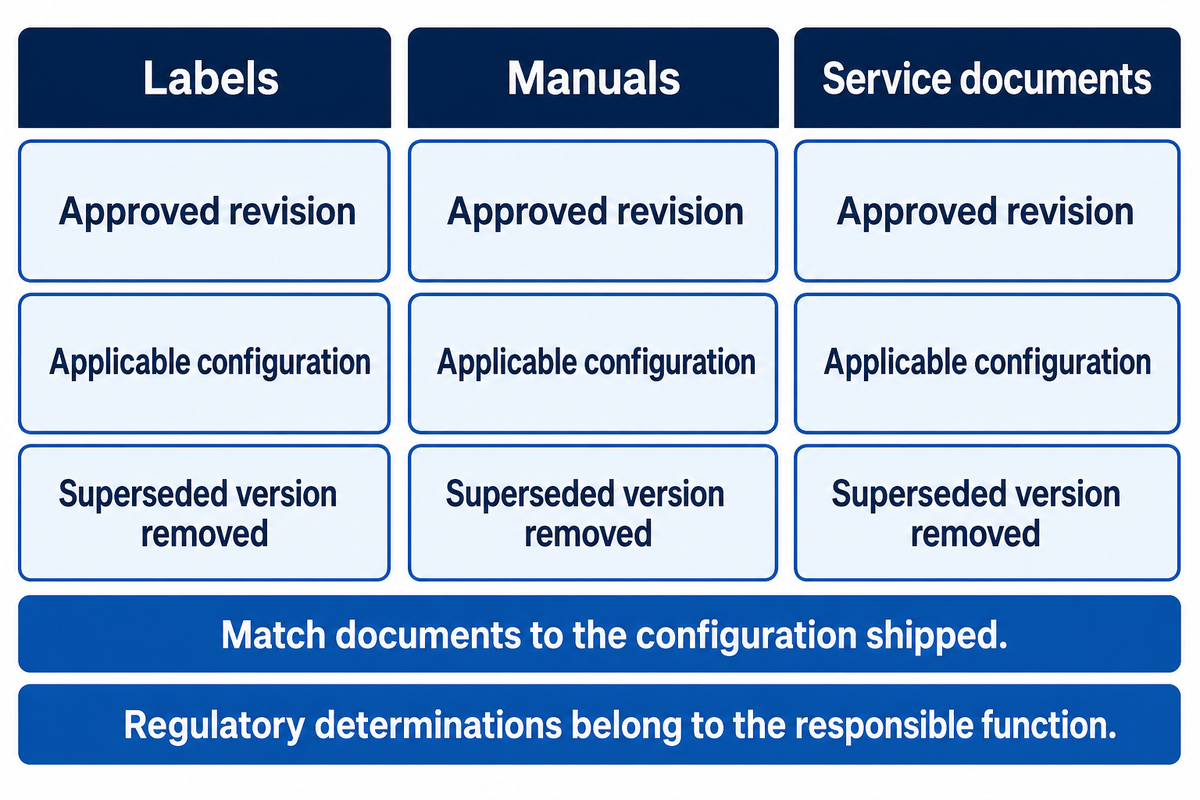
Labels, manuals and service documents should correspond with the configuration shipped. Changes should be approved. Review should determine what updates were made to safety information, intended use and device identification and remove superseded information from the delivery package.
As mentioned in FDA’s August 2025 hyperbaric oxygen therapy safety letter, following user manuals and maintenance instructions is a safety concern for HBOT devices, alongside handing over the right documents.
As mentioned in 21 CFR 830.50(a), a change which creates a new version or model of a device required to bear a UDI requires a new device identifier. Not all firmware changes result in a new UDI. Assign this determination to the responsible regulatory function.
For a monoplace hyperbaric chamber or a multiplace hyperbaric configuration, check the instructions that come with the order describing the delivery of oxygen and the operator interface. Other configurations of the hyperbaric oxygen chamber may have different instructions. Check that a manual covers oxygen through a mask if it’s described in the order. Don’t assume treatment pressure or oxygen concentration or any indication if two products have the same family name.
Adding decompression sickness as an indication on a label is a question for the responsible regulatory function. A document editor shouldn’t make broad statements about the therapy system while correcting a component description.
Use the model documentation checklist to record supplied revisions and their applicable configuration. An up-to-date, general manual doesn’t meet the requirement if no one has verified which units it covers.
Allocate retesting, delays and old stock
Change costs must be allocated prior to the change. The cause of the change and the affected inventory have to be determined and evidence has to be identified. The contract should capture buyer requests, supplier substitutions, obsolescence and nonconformance corrections. Cost ownership and notice periods are a function of the agreement and obligations; the questions that follow are an example of a negotiating aid.
A 2016 NVE/Pacesetter quality agreement is a good example from the recent past. Section 1.1 distinguishes notice within 10 days of awareness of a potential change from detailed information at least 180 days before the proposed implementation of change that may affect performance, safety or effectiveness. It also requires prior written approval. These are the terms of the agreement and not general MACY-PAN or chamber deadlines.
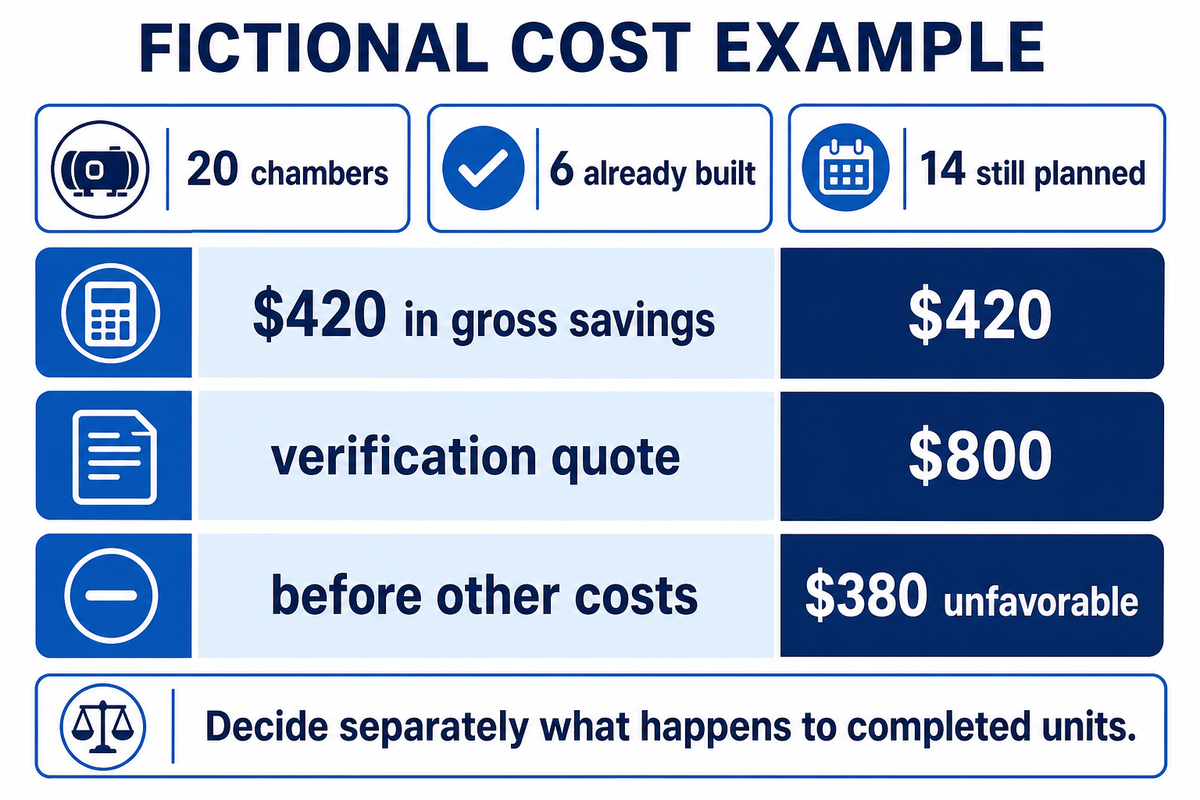
Illustrative cost decision: an order contains 20 chambers, with 6 already built and 14 still planned. A proposed replacement saves $30 on each planned unit, giving 14 × $30 = $420 in gross savings. Suppose the change-specific verification quote is $800. The comparison is already $380 unfavorable before freight, rework or document changes. Procurement can’t justify the substitution from component price alone. Finance asks whether the quoted verification cost is the only additional expense, while quality decides what evidence is necessary. The parties also need a written decision for the 6 completed units: retain the approved configuration, assess rework or handle them separately. None of those options follows automatically from the arithmetic.
Record who commissions and pays for work, who approves schedule changes, and what happens to obsolete components, finished units, and spare parts. Link these decisions to the OEM order requirements to avoid changing the product agreement by adjusting the delivery date.
Release affected units with the 4-Record Change Release Map
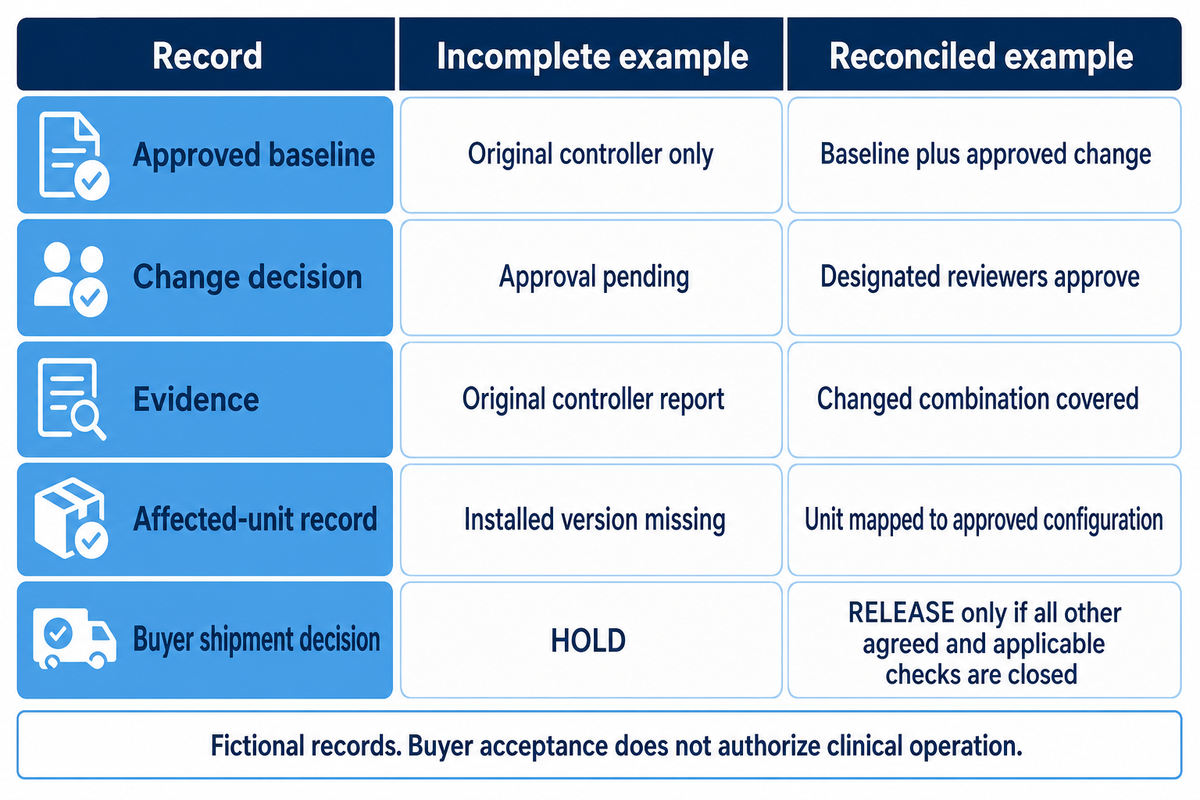
The 4-Record Change Release Map links an approved baseline, captures a change decision, documents evidence and links the affected units. Lot or serial identifiers can be used to relate the evidence to affected units. A completed map supports the buyer’s release decision; it isn’t evidence that all operational and regulatory obligations have been satisfied.
FDA’s UDI explanation illustrates the device identifier and conditional production identifier (e.g. lot or serial number) and explains that lot information and serial numbers may be included on the label. Current quality-system records provisions also discuss identification and servicing records. Neither endorses this buyer table.
| Record | Example A: incomplete | Example B: reconciled |
|---|---|---|
| Approved baseline | BASE-A; original controller identified | BASE-A plus approved change CHG-B |
| Change decision | CHG-B submitted; approval pending | CHG-B approved by designated reviewers |
| Evidence | Report describes the original controller | Accepted report covers the changed combination |
| Affected-unit record | Shipment list omits installed versions | Unit EX-B mapped to approved hardware, software and documents |
| Buyer shipment decision | HOLD: approval and configuration evidence incomplete | RELEASE only if all other agreed and applicable checks are closed |
When not to accept the changed shipment
Acceptance by the buyer is held when the supplier’s evidence describes a different configuration, approval is missing, or the affected unit list can’t be reconciled. A generic certificate won’t be accepted. The pre-shipment checklist can carry the final comparison, but it can’t cure an unresolved technical assessment.
Already delivered devices require a separate branch. Applicable correction or removal reporting requirements concern responsible manufacturers or importers under specified conditions. For field upgrades, FDA distinguishes servicing from remanufacturing by the actual activity and its effect on the device. Do not treat a signed buyer form as the answer to those questions.
Do
- Identify the changed configuration.
- Connect evidence to affected units.
- Close the applicable review branches.
Don’t
- Accept a model name as the whole baseline.
- Use a generic certificate as a unit record.
- Equate purchasing acceptance with permission to operate.
Industry Outlook: Apply the Current US Quality Framework
For US projects, review older supplier agreements against the current quality-system framework and the responsibilities of the parties involved. Older agreements may illustrate where responsibilities and frameworks are embedded. Update responsibilities, references and evidence access as needed. A historical agreement illustrates how responsibilities are drafted, but it may not capture the current frameworks and responsibilities applicable to the chamber.
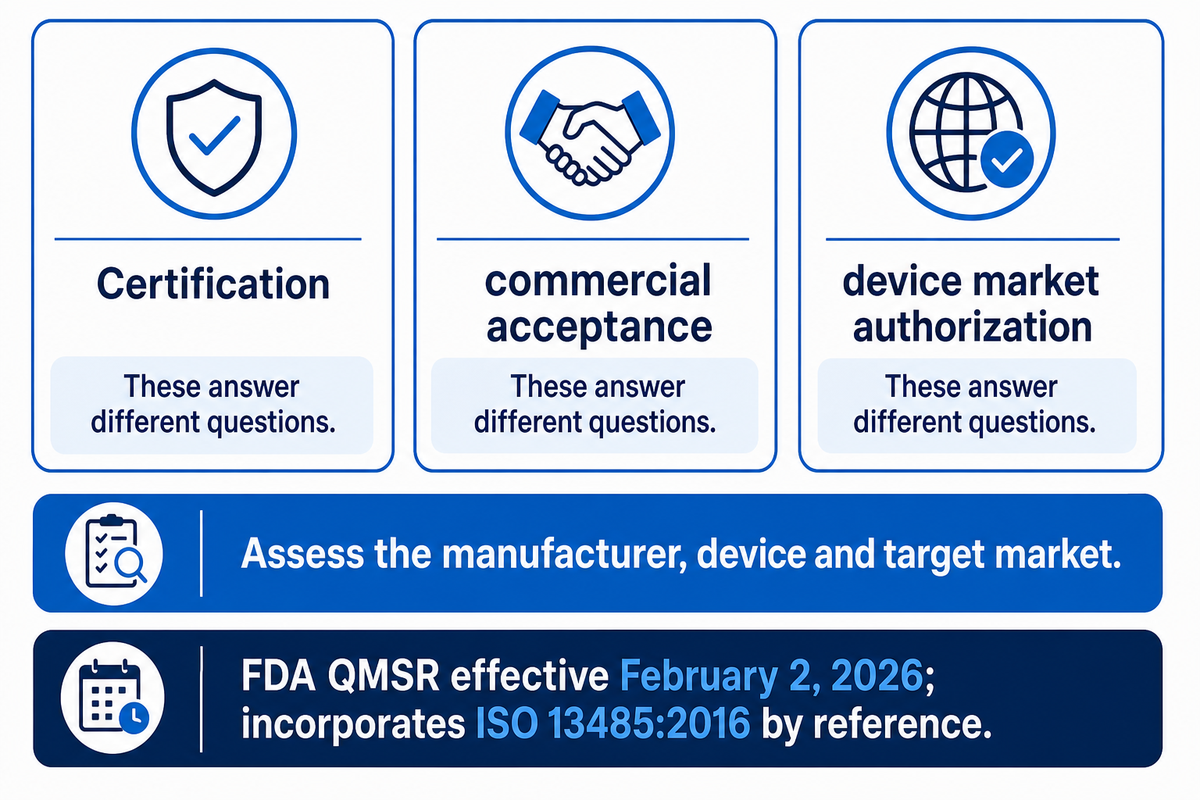
FDA states that the Quality Management System Regulation became effective on February 2, 2026 and incorporates ISO 13485:2016 by reference. Its applicability must be assessed for the manufacturer and device. Do not describe the transition as upcoming or assume an older quality-system citation remains an adequate explanation on its own.
Certification, commercial acceptance and device market authorization answer different questions. A CE mark does not answer a US-market authorization question. ISO’s public overview explains that certification is not a requirement of the standard itself; this does not remove requirements imposed by applicable medical device regulations or a particular agreement.
“ISO does not perform certification.”
For the next order identify the responsible manufacturer, the market in question, and the person authorized to make each regulatory determination. Then connect those decisions to the commercial change procedure. An old certificate, a patent or a signed sample sheet by itself doesn’t establish the status of an altered device.
Maintain the specificity in the tech discussion. When a change order or document occurs, ask which baselines and records are impacted. Expectation for industry growth in general doesn’t help in assessing shipment sufficiency. The best work prep for a 2026 project is to have a responsibility map, and an order-specific request for evidence.
Frequently asked questions
Who should approve an OEM chamber change?
The designated reviewers should approve within their own responsibilities.
How to assign the decision
Ask supplier engineering to explain the technical impact and quality to confirm the evidence and records. Assign regulatory decisions to the responsible function for the device and market. Procurement can settle the commercial terms, while finance reviews cost consequences. Name the final release authority in the agreement so a technical comment, sales email or unsigned request isn’t mistaken for complete approval.
Is the same component rating enough to approve a substitute?
No. A matching headline rating leaves other compatibility questions open.
What the comparison should cover
Check whether the replacement changes interfaces, materials, dimensions, connections, performance limits, service needs or an affected safety function. The supplier should explain which existing evidence still applies and which checks need supplementation. Record the approved replacement identifier and the first affected units. Qualified engineering review determines the relevant comparison; a purchasing checklist shouldn’t invent universal test thresholds.
What belongs in an OEM change control template?
Include identities, impact, evidence, decisions and affected units.
Fields to carry into the request
Record a unique change identifier, the reason, old and proposed configurations, affected documents, impact assessment, required verification and responsible approvers. Add the intended effective date and the serial numbers or lots that will use the change. Include the disposition of existing stock. Keep request, approval and shipment release separate so submitting a completed form can’t be mistaken for permission to implement or ship.
Does every firmware change require a new 510(k)?
No. The applicable FDA assessment depends on the change and device.
What determines the answer
For devices subject to the relevant requirements, the responsible manufacturer must evaluate the change under the applicable framework. Its impact matters; the supplier’s description of an update as minor doesn’t decide the outcome.
When should the change-control procedure start?
Agree it before accepting the next production order.
Handling a change after production starts
Establish the baseline while the approved sample and supporting documents are easy to identify. Decide which changes require notice, written approval or additional evidence. If a change is proposed after production begins, separate completed units from units still planned. Identify each group’s configuration and decide how existing components, finished units and spare parts will be handled. Purchasing should reconcile dates and quantities with quality before accepting a revised shipment plan. A proposed implementation date isn’t a release authorization. Keep the request open until evidence, responsibilities, affected units and document compatibility have been reconciled. Any separately applicable regulatory or field-action assessment must also reach the appropriate responsible party.
Send a bounded change request to MACY-PAN
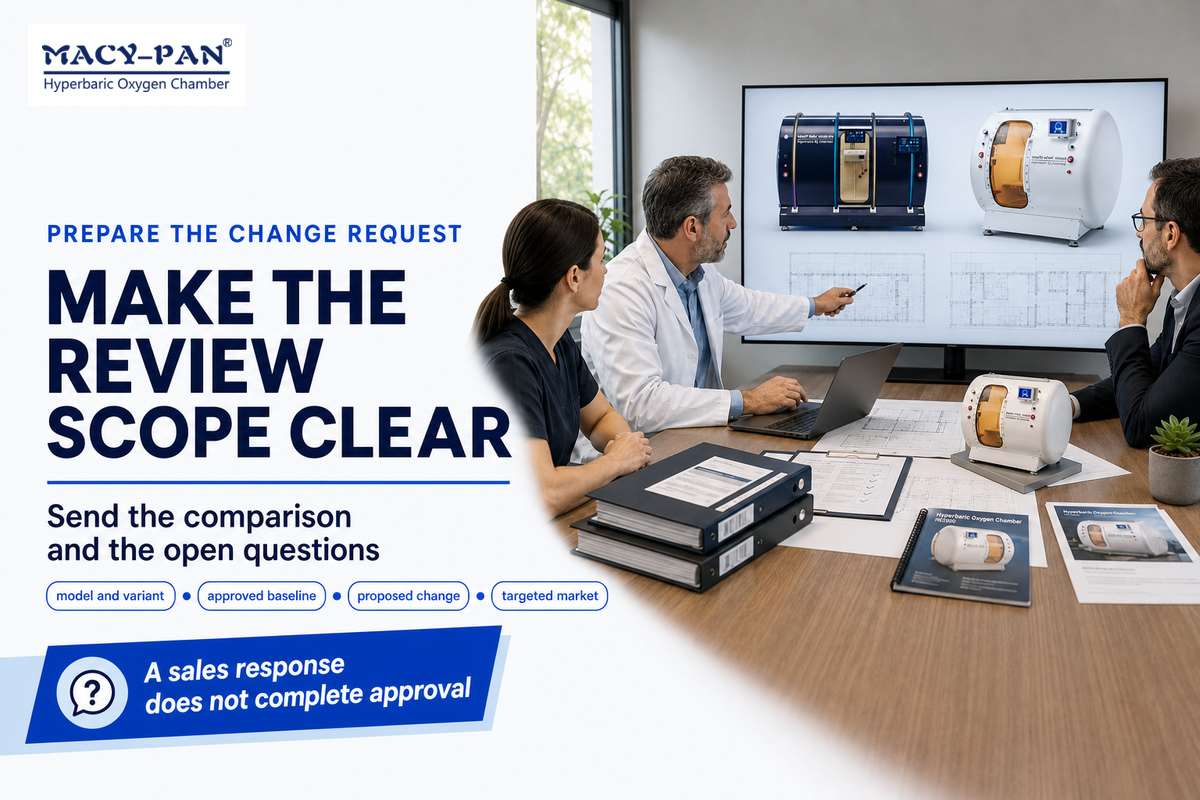
For a chamber OEM and wholesale project, provide model and variant, approved baseline, proposed change, targeted market, impacted orders, required decision date. Include supporting comparisons and open questions. This defines the scope of the technical discussion, without implying that a sales response completes the approval.
Key takeaway
Accept a changed shipment when its configuration, evidence, responsible decisions and affected-unit records agree under the applicable requirements and contract.
Send your OEM change request with supporting records, including any unresolved items requiring a response.
Related purchasing guides
References & Sources
- Configuration Management, section 6.5 National Aeronautics and Space Administration; general engineering context.
- ISO 10007:2017 public abstract International Organization for Standardization.
- Is a New 510(k) Required for a Modification to the Device? US Food and Drug Administration.
- MEDIBAROX control-system research Gracia and colleagues, 2018, hosted by PubMed Central.
- Deciding When to Submit a 510(k) for a Software Change to an Existing Device US Food and Drug Administration.
- Follow Instructions for Safe Use of Hyperbaric Oxygen Therapy Devices US Food and Drug Administration, August 2025.
- 21 CFR 830.50: Changes that require use of a new device identifier Electronic Code of Federal Regulations.
- NVE/Pacesetter supplier quality agreement 2016 private agreement filed with the Securities and Exchange Commission; contractual example, not regulatory guidance.
- UDI Basics US Food and Drug Administration.
- 21 CFR 820.35: Control of records Electronic Code of Federal Regulations.
- 21 CFR 806.10: Reports of corrections and removals Electronic Code of Federal Regulations.
- FDA Issues Final Guidance to Clarify Remanufacturing of Devices that Need Maintenance or Repair US Food and Drug Administration.
- Quality Management System Regulation US Food and Drug Administration.
- ISO 13485 overview International Organization for Standardization.