
Get in Touch with MACY-PAN Company

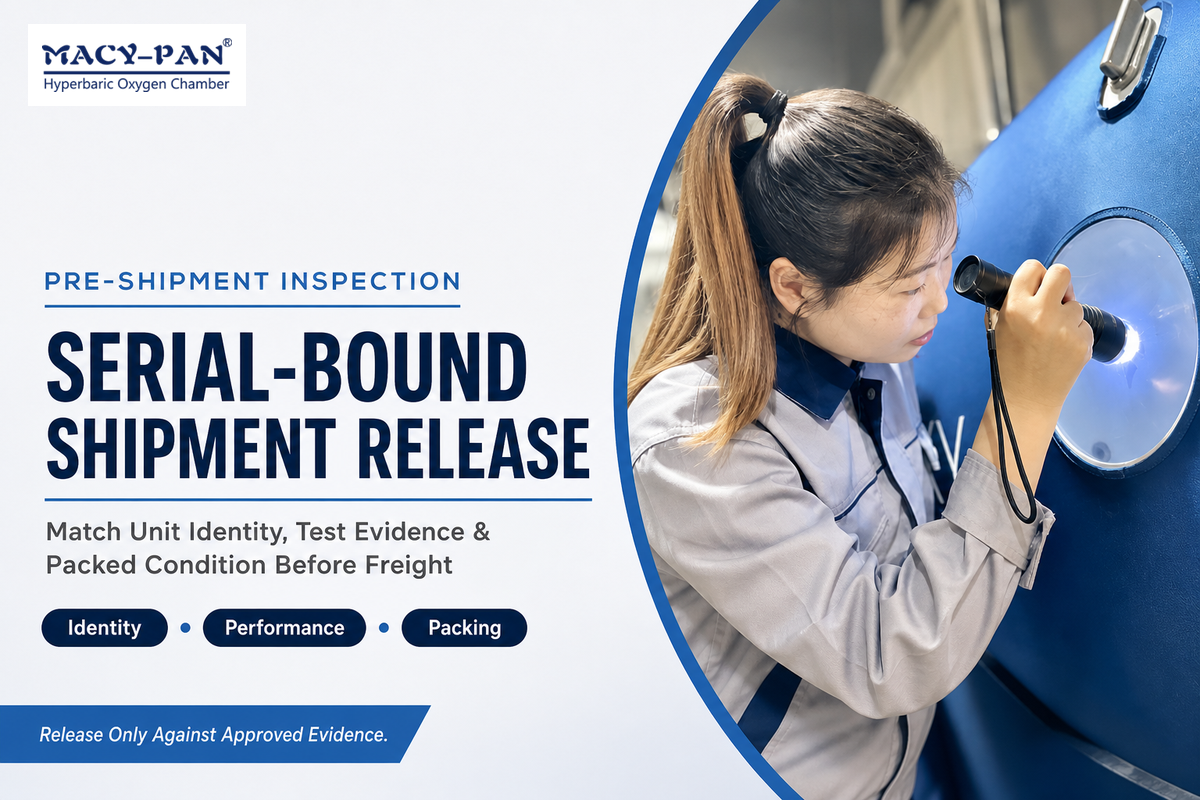
A hyperbaric chamber pre shipment inspection checklist is a serial-bound buyer record used to verify more than a finished unit’s clean appearance. It should authenticate the exact chamber, its approved configuration, its test evidence, and its packed condition for one signed freight-release decision. The checklist below is used by importers, distributors, clinics, and project buyers to review the completed chamber before handover.
Direct answer: release the shipment only when identity, performance, safety-function, record, and packing evidence all match the approved acceptance basis. Open safety, identity, regulatory, or traceability gaps remain stop-ship items unless a formally authorized and limited disposition says otherwise.
Key takeaways
- Calibration certificates prove a traceability chain, not automatic fitness for the buyer’s pass/fail decision.
- Serial identity and destination-market device identity answer different questions; check both where the latter applies.
- Factory acceptance occurs before freight handover. Receipt, installation, site acceptance, and clinical commissioning remain separate gates.
- MACY-PAN publicly describes final inspection and packing inspection as separate steps in its six-gate process.
>2 psiASME’s published PVHO-1 scope threshold for pressure differential
6 gatesMACY-PAN’s stated internal inspection sequence
72 hoursMACY-PAN’s stated aging-test duration within that sequence
Quick inspection record
| Release object | One identified chamber and its ordered accessory pack |
| Acceptance basis | Purchase order, approved revisions, test protocol, destination interfaces, and approved deviations |
| Core evidence | Identity, performance, safety functions, records, and packing proof |
| Final output | Release, controlled concession, retest, hold, or reject, signed by the named authority |
Hyperbaric Chamber Pre-Shipment Checklist: What It Releases and What It Does Not
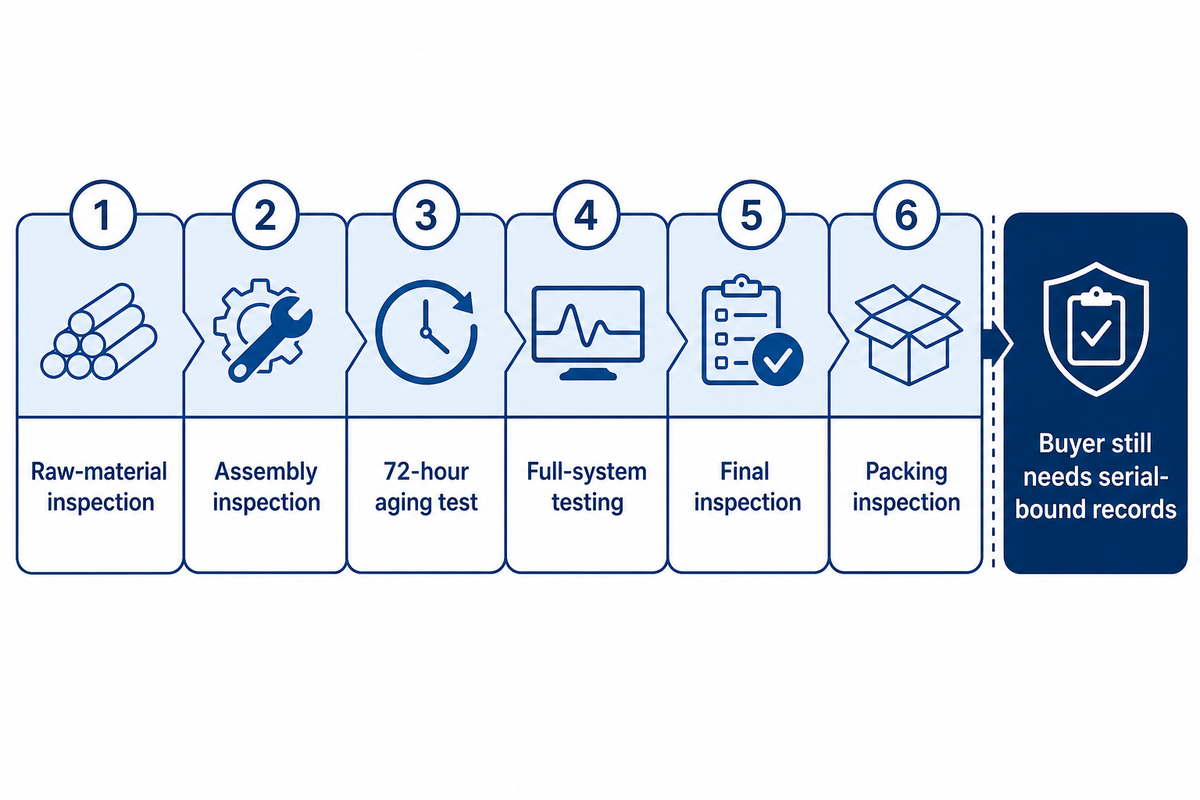
A hyperbaric chamber pre-shipment inspection release decision integrates the approved order, configuration, test requirements, and evidence pack for one identified unit. The release determines whether freight handover may proceed; it does not certify the supplier, approve the installed site, or authorize patient care in the destination market. MACY-PAN’s published process separates raw-material inspection, assembly inspection, a 72-hour aging test, full-system testing, final inspection, and packing inspection into six gates. This is supplier-stated process evidence, not independent certification, so the buyer still needs serial-bound records for the delivered unit.
Procurement teams typically consolidate four distinct functions into a single worksheet. An hyperbaric chamber RFQ checklist defines the purchase function. A hyperbaric chamber factory audit reviews the supplier’s operational systems and processes. Factory acceptance tests the finished order before shipment. Site acceptance verifies the installed equipment, local utilities, and contract requirements. The site acceptance test occurs at the end user’s site after arrival. Buyer risk and evidence dependency, not claimed popularity, determine the checklist order.
“Design, fabrication, inspection, testing, marking, and stamping.”
Common mistake: treating a supplier’s “QC passed” stamp as a buyer release. The buyer still needs the unit identity, applicable criteria, raw or reviewable results, deviation status, and the name of the person authorized to release freight.
Procurement objection: A chamber has already been tested by factory QC, so a buyer checklist appears redundant. Manufacturer testing may follow an internal plan, while shipment release tests the buyer’s approved requirements. ASME’s public scope starts above a 2 psi pressure differential, but that scope statement is not a project-specific acceptance tolerance.
Freeze the Acceptance Basis Before the Floor Inspection Starts
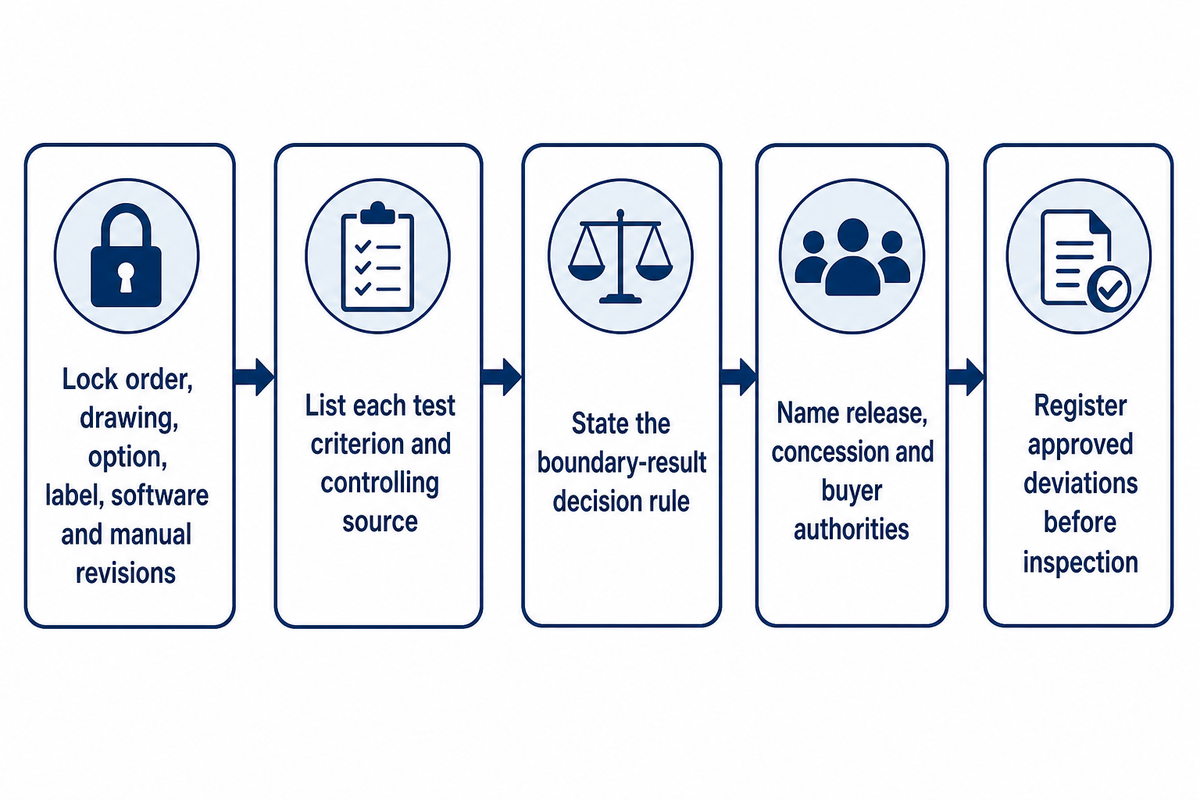
The inspector needs a controlled baseline before examining the chamber. The baseline identifies the purchase-order line, approved drawing revision, ordered options, factory acceptance test (FAT), destination interfaces, decision rule for borderline measurements, approved deviations, and those authorized to issue release or concession.
Uncontrolled conditions lead to ambiguity after a result appears. The sales staff may compare the unit to the latest catalogue while the engineer uses an earlier drawing. The inspector may mark “pass” against an ordered gas connection and language pack without knowing whether the mains supply or accessory list changed. Freeze the references first, then record the physical match and any discrepancies.
Illustrative Project Atlas: a hypothetical order calls for 230 V, 50 Hz, a factory test at 1.5 ATA for 90 min, and a buyer-agreed ±0.02 bar decision band that accounts for the stated measurement uncertainty. Its route plan also records a 2.4 m crate, 1,200 kg gross mass, a 24-hour road leg, a 75 % humidity boundary, and a 25 °C storage ceiling. These figures are an illustration of record structure, not universal chamber limits.
Acceptance-basis sequence
- Lock the order, drawing, option, label, software, and manual revisions.
- List each test criterion and its controlling source.
- State how uncertainty and boundary results will be judged.
- Name release, concession, and buyer-acceptance authorities.
- Register approved deviations before the inspection begins.
Traceability and fitness for purpose are separate questions. The same separation applies to the acceptance basis and the conformity decision. The current quality certificate answers the question “Can this test result be traced?” The acceptance basis answers whether the result is suitable and how a boundary result will be called.
Procurement objection: Decision rules belong to the laboratory, not the buyer. Laboratories can suggest a pass criterion, but the commercial release team must know which rule governed the pass statement. Project Atlas cannot treat a reading inside its ±0.02 bar decision band as an automatic pass if the approved rule calls it indeterminate or requires retest.
Evaluate Unit Identity, Workmanship, and Order Completeness
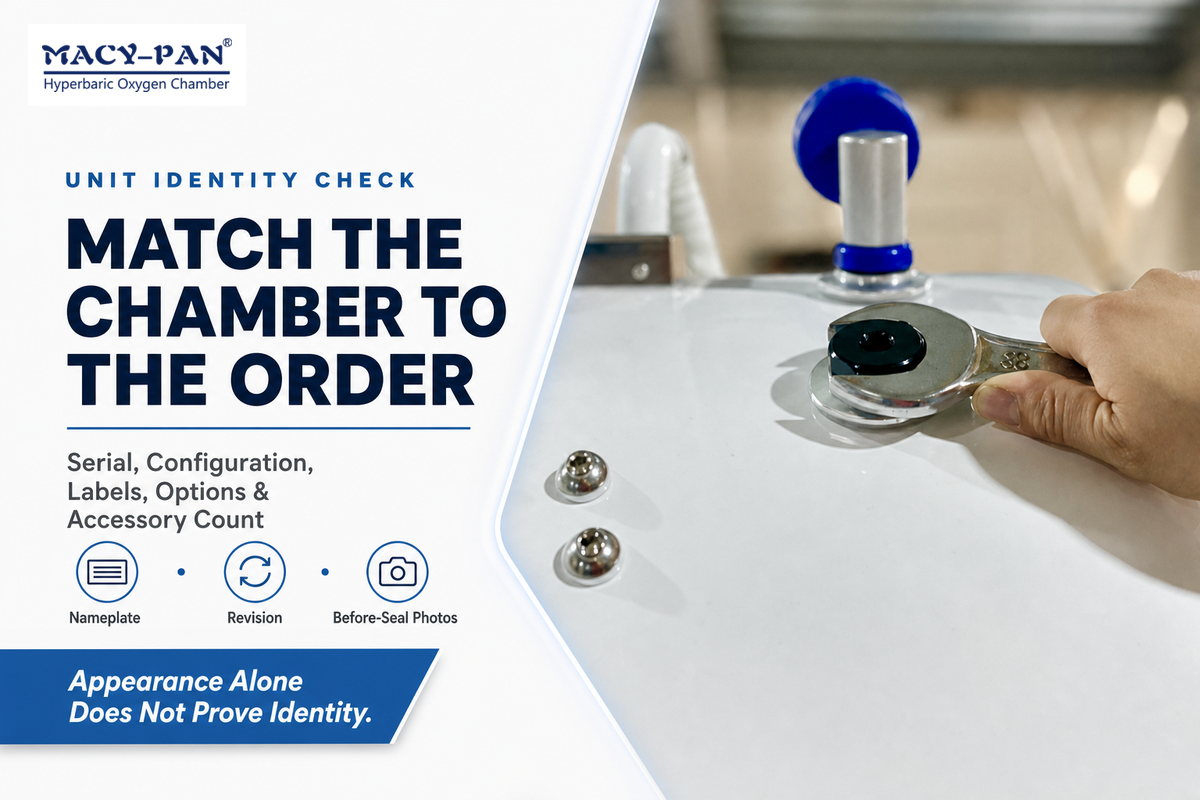
The inspection confirms that the listed components, the physical chamber, its options, labels, accessories, and records belong to the accepted order. Appearance, functionality, and other evaluation of the components should be performed only after matching the model, production serial, nameplate data, visible construction, language, interfaces, spare parts, and destination-market identity.
Pristine appearance does not prove that the chamber is the ordered unit. Photograph the full nameplate and serial number in one view if the camera allows it. Take separate views of components, interfaces, connectors, controls, pressure indicators, doors, viewports, gas interfaces, and accessory cartons. Check that shipped quantities match the number authorized. Reconcile the evidence before packing hides it.
| Evidence type | Physical check | Record to retain | Limitations / Not suitable for |
|---|---|---|---|
| Order identity | PO line, buyer project, quantity | Order-to-unit cross-reference | Packing-list presence alone does not prove the unit matches |
| Production identity | Serial and build record | Nameplate photo plus typed transcription | Do not accept a loose serial label without a physical link |
| Approved model | Chamber family, pressure rating, configuration | Approved drawing and configuration revision | Serial identity does not replace model or revision identity |
| Destination identity | Required label, language, market reference | Applicable product-code or clearance cross-check | FDA identity applies to the US, not every market |
| Electrical identity | Voltage, frequency, plug or connection | Nameplate and ordered-interface photo | Do not infer 230 V or 50 Hz from destination alone |
| Gas interface | Connection, hose, regulator, ordered supply arrangement | Interface photo and approved schematic | Factory evidence cannot approve the installed gas system |
| Workmanship | Finish, closures, seals, viewport, fasteners, labels | Dated defect and overview photos | Cosmetic acceptance limits must come from the contract |
| Ordered options | Controls, communication, seats, mattress, cooling, accessories | Option-by-option reconciliation | Catalogue availability does not prove the option is installed |
| Spares and tools | Part identity and quantity | Count sheet and before-seal photo | Carton count does not prove correct contents |
In the FDA’s US classification records, hyperbaric chambers are listed under product code CBF, 21 CFR 868.5470, Class II, with a 510(k) submission type. For buyers, a 510(k) is a premarket submission intended to demonstrate substantial equivalence to a legally marketed predicate device. That does not mean every hyperbaric chamber is cleared. Where applicable, it provides a model-level identity for US buyers to verify separately from the production serial number. The production serial identifies one unit; it does not by itself establish the applicable model-level clearance.
Project Atlas still needs its 230 V and 50 Hz nameplate, ordered configuration revision, and applicable market identity matched to that production serial. Wrong-market labeling on the correct serial remains a release deficiency.
Evaluate Pressure, Hold, Leak, Door, and Seal Performance
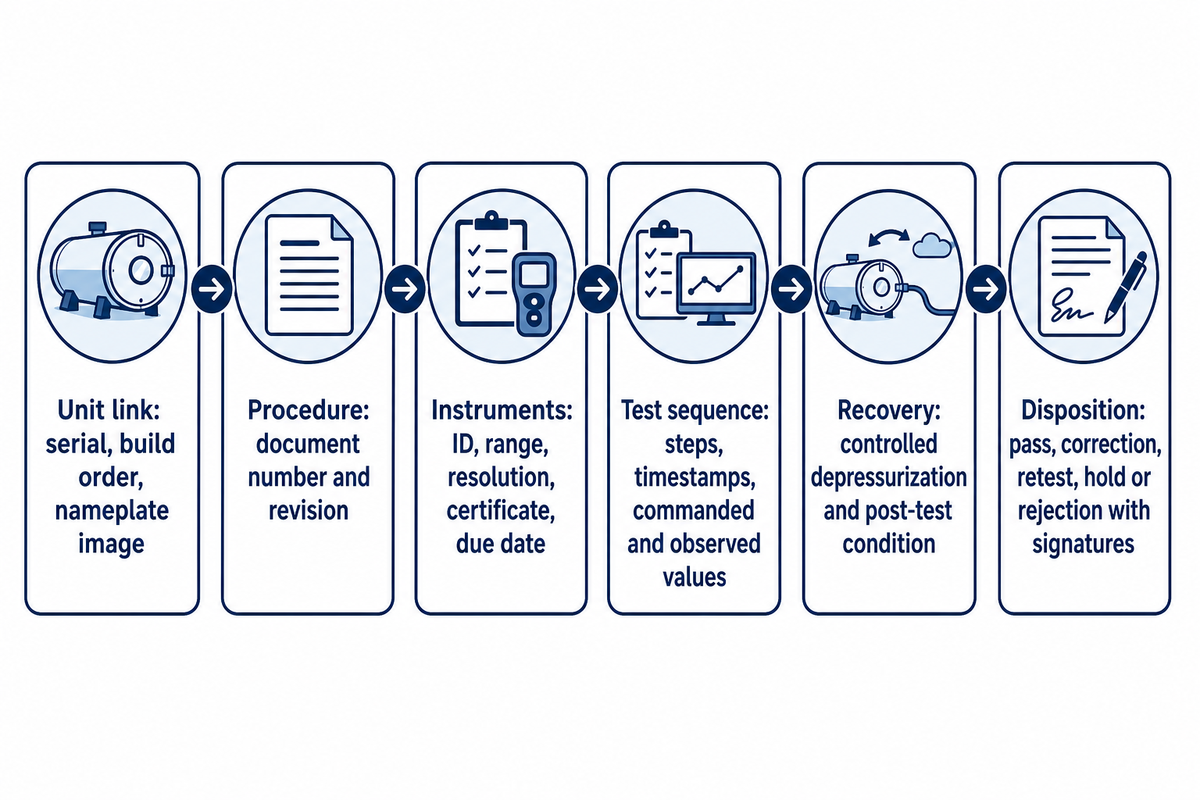
Acceptance of a pressure system requires a witnessed test record tied to the serial-numbered chamber. The record should identify the chamber, instruments, calibration status, applicable uncertainty, and approved criteria. It should also capture the sequence, readings, observations, abnormal conditions, and deviations. A witness should attest to the test, retest status, signatories, and recorded observations. Numeric acceptance limits still come from the governing order or protocol.
What are the steps involved in a pressure vessel inspection checklist?
Before controlled pressurization, confirm the test procedure and system identity. Review visible condition, instrument suitability, door and seal condition, the required hold, leak observations, and deviations. Confirm controlled depressurization and the system’s return to a safe state before release. Hyperbaric chamber criteria must remain tied to the approved design basis and purchase requirements.
| Record field | What to capture | Why it can block release | Limitations / Not suitable for |
|---|---|---|---|
| Unit link | Serial, build order, nameplate image | Prevents a result from another unit being reused | A file name is not enough |
| Procedure | Document number and revision | Defines the sequence and approved basis | Do not replace it with an undocumented shop routine |
| Instruments | ID, range, resolution, certificate, due date | Shows whether the reading chain is traceable | Traceability alone does not prove fitness |
| Decision rule | Treatment of uncertainty and boundary results | Stops an ambiguous result from becoming an automatic pass | Project Atlas’s ±0.02 bar band is illustrative only |
| Pre-test condition | Shell, door, seal, viewport, connections | Separates pre-existing damage from test effects | Visual review cannot replace required testing |
| Test sequence | Steps, timestamps, commanded and observed values | Makes the result reviewable | Never borrow a 90 min hold from another order |
| Leak evidence | Method, observation points, readings, photos | Shows where and how leakage was assessed | No universal leak limit is stated here |
| Recovery | Controlled depressurization and post-test condition | Captures closure, seal, and control problems after the cycle | A pressure trace alone omits physical condition |
| Disposition | Pass, correction, retest, hold, or rejection with signatures | Turns readings into an authorized decision | Unsigned status is not a release |
Project Atlas shows 1.5 ATA, a 90 min hold, the instrument certificate and uncertainty, and an agreed ±0.02 bar decision rule. Values within the band go to the defined boundary disposition. Verbal approval does not make the evidence “good enough.”
Procurement objection: A calibrated digital display is visible in the test video. An image of the display can support the record, but it does not identify the reference instrument, uncertainty, sequence, criterion, or result owner. Require a complete evidence chain, especially when one reading controls freight release.
Test Controls, Alarms, Interlocks, Communication, and Emergency Functions

Functional acceptance compares each commanded input with the system’s expected and observed response under normal and approved simulated-fault conditions. The record should document the function name, test method, expected response, observed response, evidence file, deviation, and retest result. The response and any deviation must be evaluated and signed by the authorized reviewer for the shipped chamber.
NFPA’s public summary of its 2024 edition discusses added hyperbaric fire-suppression requirements and consolidated electrical-system performance, testing, and maintenance language. The FDA’s 2025 safety communication calls for manufacturer instructions, grounding, trained staff, cleaning, maintenance, safety checks, and prohibited-item controls. Neither document outlines a universal unit-level test method; the approved configuration must define it.
Function test pattern
Command → expected response → observed response → evidence reference → deviation status → retest → authorized disposition. Apply the pattern to pressure control, alarms, communication, closure or door safeguards, emergency actions, indicators, and any ordered accessory that can affect safe operation.
A normal cycle demonstration should include challenges to alarms and interlocks. It should not test safeguards absent from the approved configuration while missing ordered functions. The inspector should reconcile the installed function list and witness only approved simulations that do not create an uncontrolled hazard.
Project Atlas’s illustrated function demonstration runs on the ordered mains supply of 230 V and 50 Hz. Its pressure-control demonstration refers to 1.5 ATA. The evidence file records the 90 min cycle segment in which each expected response was checked. These values are part of a hypothetical scenario only.
Procurement objection: “It’s understood that the valve and/or alarm are acceptable as evidenced by a component certificate.” Component evidence demonstrates the system and/or subsystem traceability and/or identity only. It doesn’t provide evidence of how the system/subsystem is wired, the logic of the software, installation, set point, system response, ownership of the system, or the completeness of the system. Verify how the integrated system behaves; a factory test of one system or subsystem doesn’t establish that the completed installation is acceptable for clinical use.
Verify Oxygen, Electrical, Grounding, and Ventilation Evidence
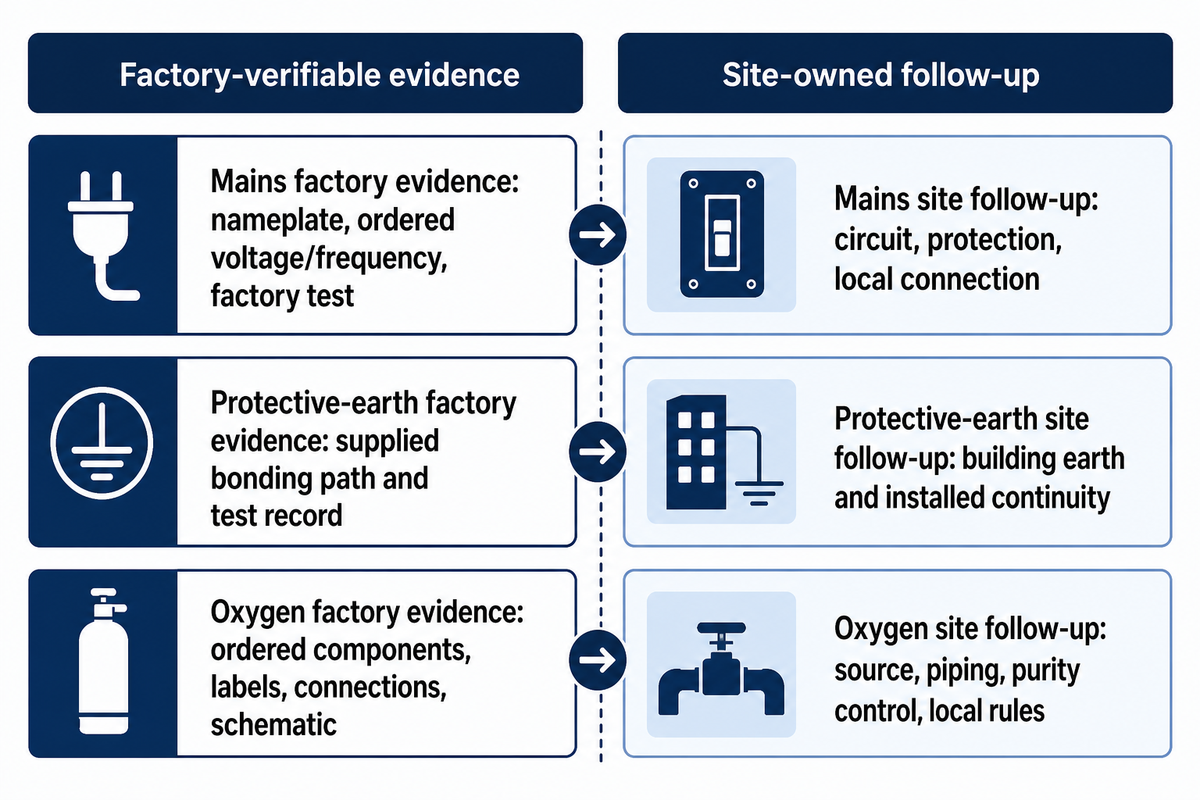
Each safety-critical function should be aligned to the ordered system, destination, applicable source, available evidence, and unresolved site dependencies. Factory acceptance testing (FAT) can confirm supplied components, but it does not approve the clinical, building, gas, electrical, ventilation, grounding, or fire-safety arrangements.
| Interface category | Factory-verifiable evidence | Site-owned follow-up | Limitations / Not suitable for |
|---|---|---|---|
| Mains supply | Nameplate, ordered voltage/frequency, factory test | Circuit, protection, local connection | A 230 V nameplate does not approve the branch circuit |
| Protective earth | Supplied bonding path and test record | Building earth and installed continuity | Factory grounding does not prove site grounding |
| Oxygen supply | Ordered components, labels, connections, schematic | Source, piping, purity control, local rules | Do not infer installed-system approval from component labels |
| Ventilation | Chamber assumptions and supplied interfaces | Room design, discharge route, installed performance | No global airflow threshold is claimed here |
| Communication | Installed device and factory function check | Room integration and operating procedure | A factory audio test may not reflect room noise |
| Fire controls | Ordered chamber provisions and records | Facility arrangement, adoption, inspection | NFPA edition and jurisdiction must be confirmed |
| Environmental limits | Manufacturer-stated storage and operation conditions | Room temperature and humidity verification | Project Atlas’s 25 °C and 75 % are illustrative |
| Training | Manuals, training scope, attendance record | Competency, local authorization, refresher plan | Attendance is not proof of competence |
| Commissioning | Factory handoff requirements | Installed verification and final authorization | Pre-shipment release cannot commission patient care |
Each unresolved site condition is documented in the handoff log with an owner and acceptance record. A blank or generic “done” entry can be misread as completed work. Record each site condition as “factory verified,” “site condition pending,” “not ordered,” or “not applicable with reason.”
Procurement objection: “The chamber ran correctly at the factory, so the site interfaces are proven.” Project Atlas’s hypothetical 230 V, 50 Hz, 25 °C, and 75 % conditions show why that logic fails. The site supply and conditions determine the question, even with a chamber that is unchanged.
Match Calibration, Test Reports, Manuals, and Revisions to the Shipped Serial
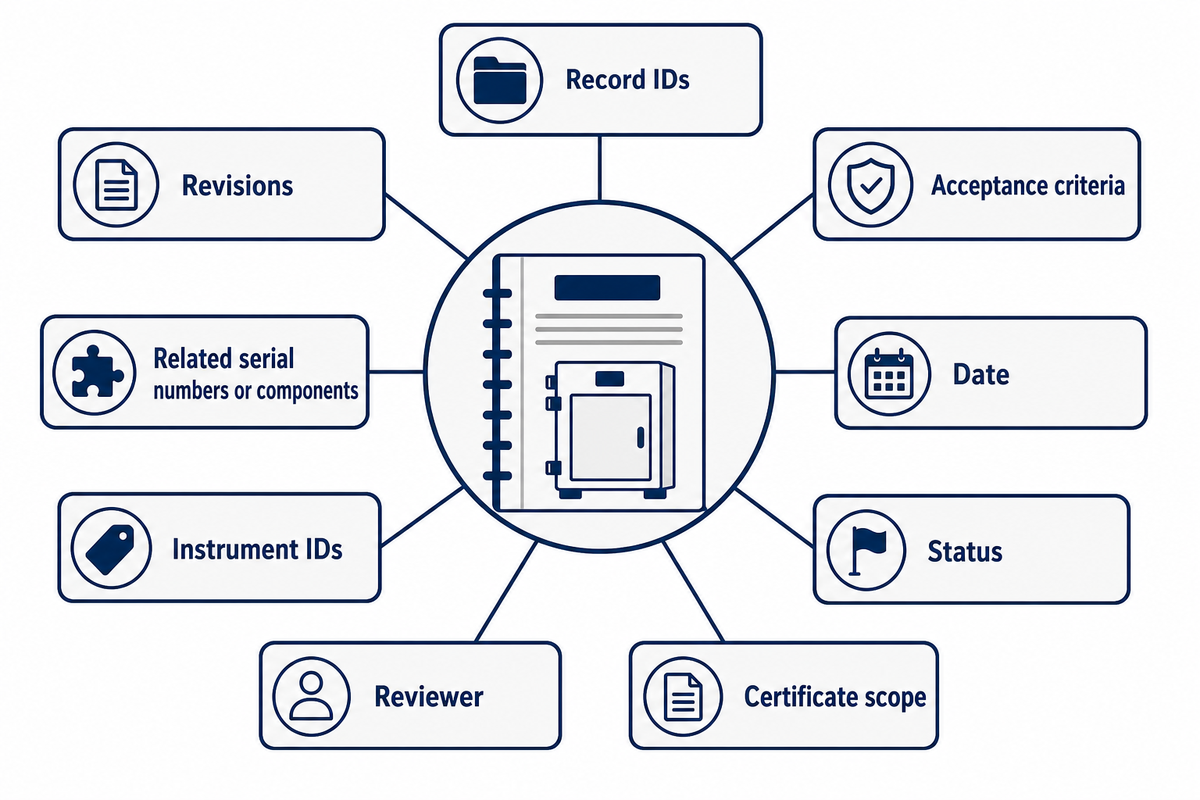
Records should close only when each item belongs to the shipped unit, current configuration, approved revision, and acceptance requirement. Match acceptance reports to the serial number of the corresponding equipment. Match manuals to the delivered controls. Match drawings to the options that are installed. Match destination references to the correct model and variant.
Count-based review is inadequate. Ten files may still contain errors if they describe an old revision, another serial number, or the wrong inspection report. Build a record-to-unit cross-reference. It should contain record IDs, revisions, related serial numbers or components, instrument IDs, acceptance criteria, date, status, reviewer, and certificate scope.
NIST states that traceability requires a documented and uninterrupted calibration chain in which every step contributes to uncertainty. The buyer must verify the equipment’s range, resolution, due date, scope, fitness for intended use, and stated requirements. A current calibration certificate does not make unsuitable equipment fit for the acceptance decision.
Project Atlas’s hypothetical pressure record links its 1.5 ATA result and 90 min sequence to the named instrument and ±0.02 bar decision rule. Its electrical record links 230 V and 50 Hz to the ordered revision. The crate list then links to the same production serial.
Common mistake: accepting one certificate as proof of the complete chamber. Product identity, quality-system certification, component conformity, instrument calibration, and destination authorization have different scopes. Record the exact claim each item supports and the claim it cannot support.
Procurement objection: “Every component needs its own serial number.” Not necessarily. Traceability depth follows the approved quality plan, safety relevance, replacement control, and regulatory obligations, while the final index still links every release-critical record to the delivered chamber and relevant component or instrument.
Inspect Packing, Preservation, Handling Marks, and Export Readiness
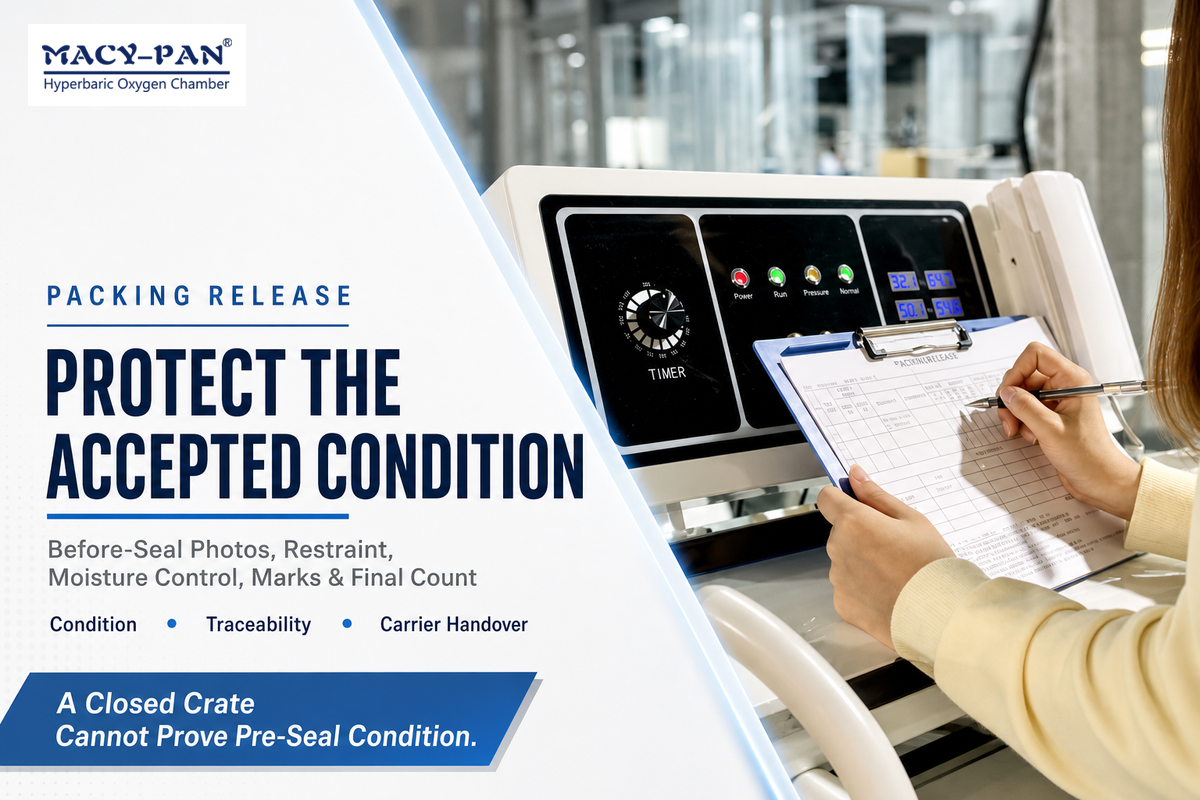
The packing inspection must show that the accepted chamber is fit for its agreed transport route, will retain its condition, and includes the required accessories and traceability evidence. Controls for transport moisture must also be evidenced, along with crate condition, handling marks, and the chamber’s recorded weight and dimensions. Before transport, photographs of the chambers must also be taken.
ISTA lists several test series and purpose-specific procedures rather than one universal transport test. ISTA 1G, for example, describes a screening procedure for packaged products weighing 150 lb (68 kg) or less; it does not automatically prescribe a chamber test. Shipping documents provide the actual mass, dimensions, and characteristics needed to select the route and package method.
| Packing checkpoint | Evidence before sealing | Release question | Limitations / Not suitable for |
|---|---|---|---|
| Clean and dry condition | Dated overview and sensitive-area photos | Was accepted condition preserved? | A closed crate cannot prove pre-seal condition |
| Moving-part restraint | Restraint points and approved method | Can motion damage the unit? | Do not improvise against delicate surfaces |
| Moisture control | Barrier, desiccant or approved protection record | Does it fit route duration and climate? | Project Atlas’s 75 % boundary is illustrative |
| Impact protection | Blocking, cushioning, clearances, contact points | Are loads kept away from vulnerable parts? | A generic foam layer is not a validated method |
| Accessory placement | Labeled positions and item photos | Can loose items damage or disappear? | Carton quantity alone does not prove identity |
| Crate geometry | Length, width, height, center of gravity | Can the carrier and consignee handle it? | Project Atlas’s 2.4 m length is not a product specification |
| Mass | Gross and net mass record | Does the handling plan match the load? | Project Atlas’s 1,200 kg is hypothetical |
| Marks and labels | Handling, orientation, consignee, case number | Can handlers identify the required treatment? | Marks do not replace physical protection |
| Packing-list closure | Signed reconciliation and sealed-case photos | Is every accepted item accounted for? | Do not sign before the final count |
Project Atlas uses the hypothetical inputs 2.4 m, 1,200 kg, 24 hours, 75 %, and 25 °C to evaluate and select a packing plan. It uses the same inputs for the carrier handoff, before-seal photo index, and receipt-inspection brief. Consequently, the receiving team can compare like with like.
Procurement objection: “Export-grade wooden packing is enough.” That phrase doesn’t identify internal restraint, moisture control, shock exposure, case mass, handling points, or the distribution method. Use the supplier’s hyperbaric chamber export shipping plan as a starting point, then bind it to the order and route.
Use the 4-Evidence Shipment Release Dossier for Release, Concession, Retest, Hold, or Reject
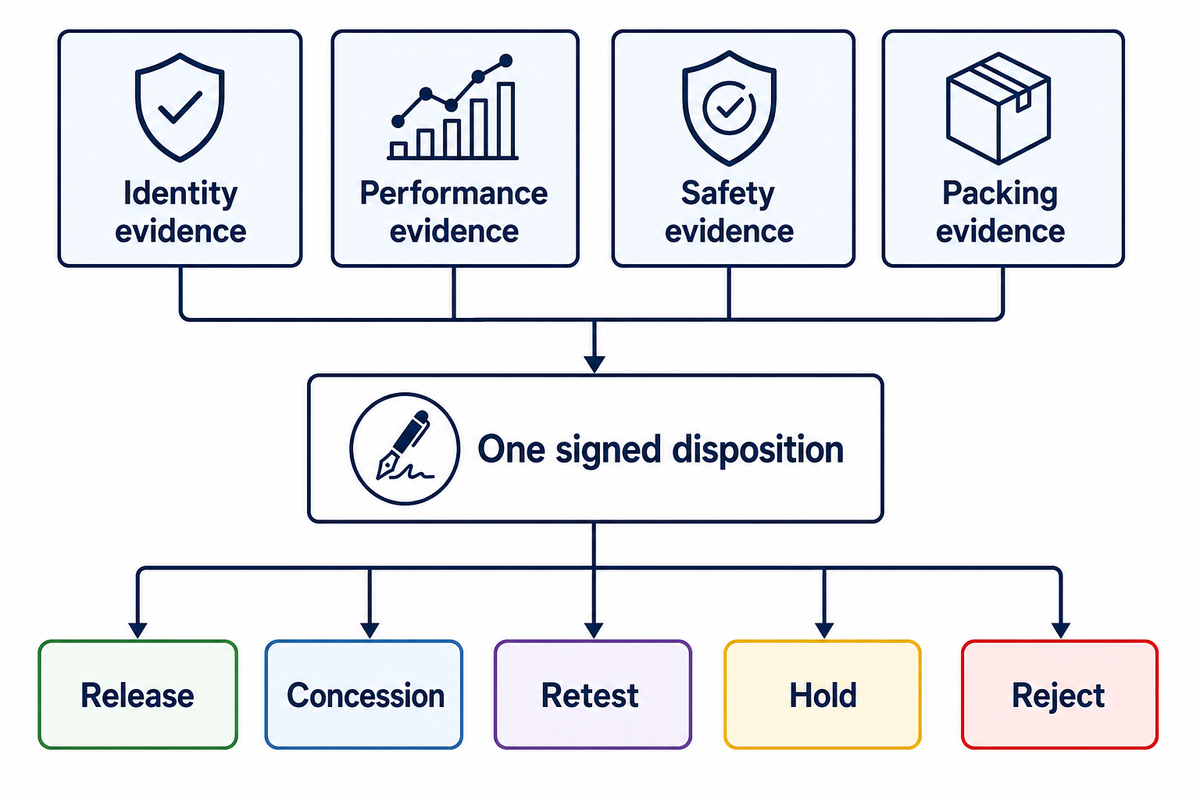
The final shipment will not be released until there is evidence that the shipping package is safe, contains the accepted shipped unit, and closes unit identity, tested performance, safety-function, interface, and packing requirements. Evidence supporting shipment is evaluated by named authorities, and each finding records an owner, deadline, disposition, and supporting file.
The 4-Evidence Shipment Release Dossier joins identity, performance, safety, and packing proof to one signed disposition. Named and designated authorities evaluate that evidence and sign the release decision.
Pro QC’s operational guidance states that when an inspection results in a “Non-Conformance” finding, the shipment remains held while reporting, corrective action, and re-inspection occur. This guidance is operational, not a regulation. The approved path to resolution may consist of correction, re-verification, retest, or formal acceptance. Email reassurance should not release the hold on a quality finding.
Stop-Ship Disposition Board
| Finding | Evidence gap | Immediate action | Retest or approval | Limitations / Not suitable for |
|---|---|---|---|---|
| Wrong serial | Unit and records do not match | Hold and reconcile identity | Full record-to-unit review | Never close by relabeling alone |
| Wrong market label | Destination identity unresolved | Hold and obtain regulatory review | Authorized identity confirmation | A correct serial does not cure it |
| Wrong electrical nameplate | Order and unit conflict | Hold and correct configuration | Repeat affected tests | Project Atlas requires 230 V and 50 Hz |
| Missing pressure trace | Performance cannot be reviewed | Hold and repeat or recover valid evidence | Authorized technical review | A pass stamp cannot replace the trace |
| Boundary pressure result | Decision rule controls outcome | Apply the agreed rule | Retest or stated boundary disposition | No informal “close enough” within ±0.02 bar |
| Expired instrument status | Traceability at test time unresolved | Hold affected result | Technical validity review or retest | A later certificate may not cure prior data |
| Alarm mismatch | Expected and observed response differ | Correct and retest | Witness accepted response | Normal-cycle video is insufficient |
| Open grounding evidence | Safety interface unresolved | Hold factory release | Accepted test record | Site work cannot excuse missing factory evidence |
| Accessory shortfall | Order incomplete | Add, verify, and recount | Packing-list closure | Use concession only if expressly authorized |
| Cosmetic deviation | Contract acceptance unclear | Document location and extent | Buyer approval or repair | Not eligible if function or corrosion protection is affected |
| Crate damage before handover | Protection may be compromised | Open, inspect, repair, and re-seal | New before-seal evidence | Carrier urgency does not waive review |
| Missing release signature | Decision owner absent | Hold handover | Name, signature, date, scope | A system status is not an authorization |
A controlled concession, or exception, is a discretionary case-by-case decision and should not be read as authorization to ship. Controlled exceptions and concessions should be documented, with scope, limitations, rationale, approvers, and any contract, quality-system, or destination-rule basis defined. The quality-management-system rules, affected records, and downstream actions should also be documented. Other product gaps, including safety, identity, regulatory, and traceability, should be considered stop-ship issues unless competent authority expressly resolves them.
Project Atlas reaches “release” only when the 230 V, 50 Hz, 1.5 ATA, 90 min, and ±0.02 bar evidence chain is accepted, while its 2.4 m, 1,200 kg, 24 hours, 75 %, and 25 °C packing inputs close without conflict. One missing mandatory packet produces hold or retest, not a qualified release.
A discretionary conditional release requires a permitted basis, defined scope, named signatories, and a receiving-side action. Releasing the product without those documented controls transfers risk without an authorized decision.
Separate Factory Release from Site Acceptance and Clinical Commissioning
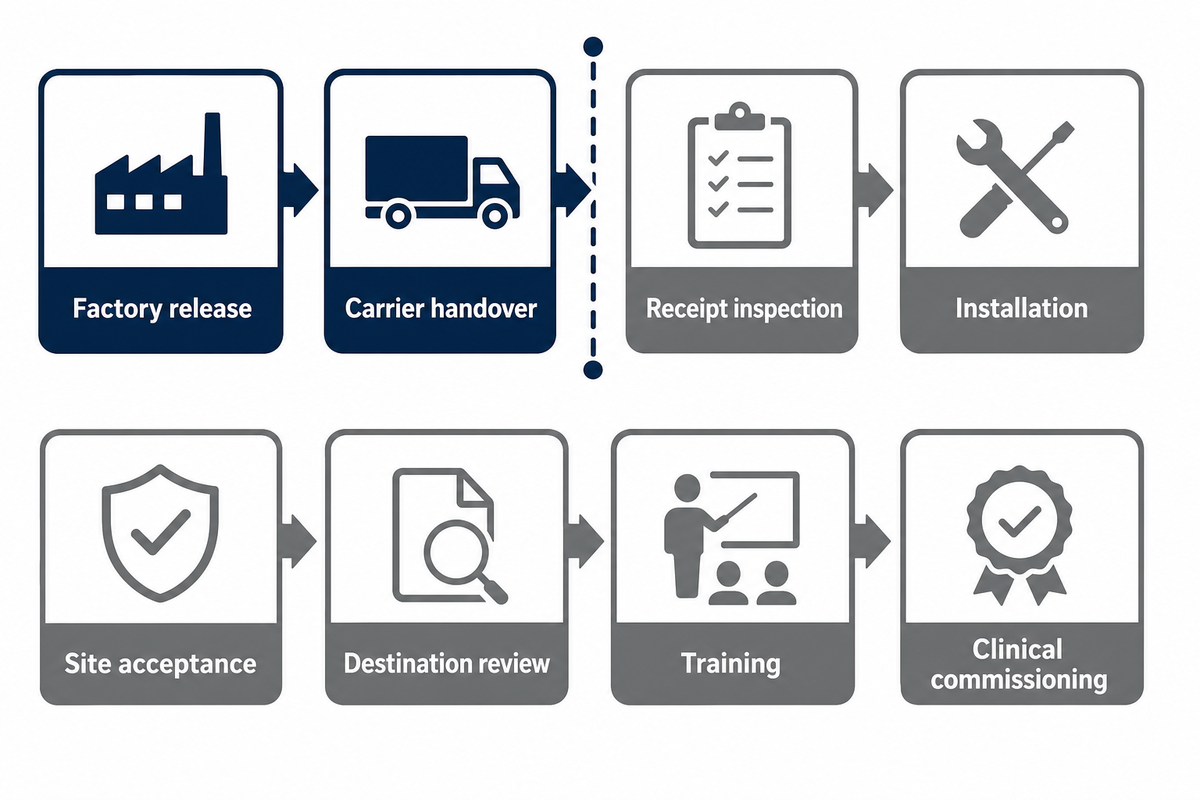
Releasing the product for shipment should not be done unless it has been confirmed that all product requirements have been met and all packaging inputs are accepted. A factory-released product should not be considered proof that receipt inspection, installation, utility checks, site acceptance, staff training, or clinical commissioning services have been provided.
DXP’s reviewed industry guidance states that factory acceptance tests (FATs) occur in a controlled environment before shipment and site acceptance tests (SATs) occur after installation. Contracts and local regulations still govern the project-specific definitions. Separating FATs and SATs assigns each evidence requirement to the responsible team.
| Gate | Primary owner | Evidence | Decision boundary |
|---|---|---|---|
| Factory release | Supplier plus buyer/inspector | Four-evidence dossier and signature | May the accepted unit enter freight? |
| Carrier handover | Shipper and carrier | Case count, condition, dimensions, mass | Did custody transfer in recorded condition? |
| Receipt inspection | Consignee | External condition, shock/tilt, seal, shortage record | Did transit change condition or completeness? |
| Installation | Qualified installer | Positioning, assembly, connections, checks | Is installation complete per instructions? |
| Site acceptance | Buyer and site team | Installed function and utility results | Does the installed system meet the site basis? |
| Destination review | Importer and regulatory owner | Applicable model, label, registration or clearance record | May this device enter and be used in that market? |
| Training | Employer and qualified trainer | Scope, attendance, competency record | Are assigned people authorized and competent? |
| Clinical commissioning | Facility’s clinical and safety authority | Policies, staffing, emergency readiness, approvals | May the service begin patient care? |
Keep clinical and facility duties out of the freight-release decision
Although procurement intersects with hyperbaric medicine, shipment release is not a clinical, pre-treatment, or patient-safety check. UHMS and Diving and Hyperbaric Medicine sources address the clinical and facility issues. The medical director and hyperbaric physician belong to post-delivery governance. Other required personnel include medical staff, chamber operators, and credentials such as CHT or RRT. Proper training of personnel is the employer’s responsibility. Staffing is the site’s responsibility. These facility duties do not change when commercial materials call the unit an HBOT chamber, a hyperbaric oxygen therapy chamber, or a hyperbaric oxygen chamber.
Clinical risk assessments may include barotrauma, oxygen toxicity, decompression sickness, partial pressure of oxygen, prohibited items, flammable materials, fire hazards, risk management, and assessment. Fire-safety measures, fire suppression systems, safety equipment, safety protocols, and other safety requirements are not replaced by a factory-sealed chamber inspection. The site team applies manufacturer safety recommendations and implements those procedures to ensure patient safety during hyperbaric clinical services.
Facility accreditation and hyperbaric facility accreditation concern the operation of clinical hyperbaric facilities. Requirements for the installation and operation of clinical services may draw on the Health Care Facilities Code, commonly cited as NFPA 99, and other National Fire Protection Association material. Factory release identifies the pending equipment owner; it cannot grant accreditation to hyperbaric facilities.
The technical handoff documents whether the unit is a monoplace chamber or a multiplace chamber system, plus the chamber structure and acrylic where relevant. It records the chamber pressure evidence, chamber serial, oxygen delivery and medical gas interfaces, any supplied flowmeter, and limits for the chamber environment or other hyperbaric conditions.
Transferring chamber ownership also transfers instructions, a preventive maintenance plan, the maintenance schedule, and hyperbaric chamber maintenance records. Marketing the unit as an “oxygen chamber” or “medical-grade” does not settle responsibility for chamber maintenance. Use the shipment checklist to review the documentation and physical chamber together for identity and handoff. The shipment checklist does not authorize hyperbaric oxygen treatment or establish safe operation inside the chamber.
The assessment process for hyperbaric chamber inspection transfers responsibility for chamber operation and hyperbaric safety to the site instead of marking those duties complete at shipment.
The final 24 hours of Project Atlas’s road leg end with receipt inspection before installation at the destination site. The factory’s 230 V and 50 Hz records travel with the unit, but the site team still tests the installed supply and grounding. The factory record stating 1.5 ATA does not authorize a treatment protocol or clinical service.
Procurement objection: Repeating quality checks at the site increases time and cost. Transport, installation, local utilities, and destination requirements introduce new conditions that may require additional checks and equipment. A few planned readiness checks usually cost less than discovering after installation that the accepted factory configuration cannot be connected, documented, or authorized as intended.
Frequently Asked Questions
What should be included in the inspection checklist?
A buyer checklist should cover the controlled acceptance basis, unit and market identity, workmanship, ordered options, pressure and leak evidence, controls and emergency functions, oxygen/electrical/grounding interfaces, calibration and report traceability, accessories, packing, open findings, retest evidence, and the final signed disposition. Each line should name the required evidence, not only a yes/no status.
What test records should a buyer receive before shipment?
Request serial-bound records for the approved factory tests, including procedure and revision, instruments and calibration status, applicable uncertainty, acceptance criteria, readings or traces, observations, deviations, corrections, retest results, and signatories. Add function-test evidence, interface records, manuals and drawings at the delivered revision, the packing list, and before-seal photographs. Contract and destination requirements decide the final set.
Should every chamber component have its own serial number?
No universal rule requires every item to carry a serial. Traceability depth follows the quality plan, safety relevance, replacement control, and applicable regulatory duties. The release pack must still connect every critical report, certificate, instrument, option, and replaceable safety-related item to the delivered chamber through a serial, lot, part number, or other controlled identifier.
Does a third-party inspection certify the factory?
No. A third-party inspector reports against an agreed scope. Product inspection, a quality-system audit, product certification, destination approval, and factory certification are different activities. State the assignment and decision authority in the inspection contract.
What happens when the chamber fails pre-shipment inspection?
Record the finding with evidence, affected requirement, owner, and immediate containment. Decide whether it needs correction, technical review, retest, buyer approval, hold, or rejection. Repeat every affected test after a change, then link the new result to the original finding. A limited concession belongs in the record only when the contract, quality system, and destination obligations permit it. The concession should name its scope, limits, approvers, downstream action, and expiry or closure condition. Safety, identity, regulatory, and traceability gaps shouldn’t disappear inside a general “accepted with comments” status. Freight handover occurs only after the named release authority signs the resulting disposition.
Does factory acceptance replace site acceptance?
No. Factory acceptance tests the completed chamber before shipment under factory conditions. Site acceptance checks the installed chamber, local utilities, interfaces, transport effects, and site responsibilities after arrival. Clinical commissioning adds staffing, procedures, emergency readiness, destination authorization, and permission to begin patient care.
Need a Serial-Bound Factory Release Pack?
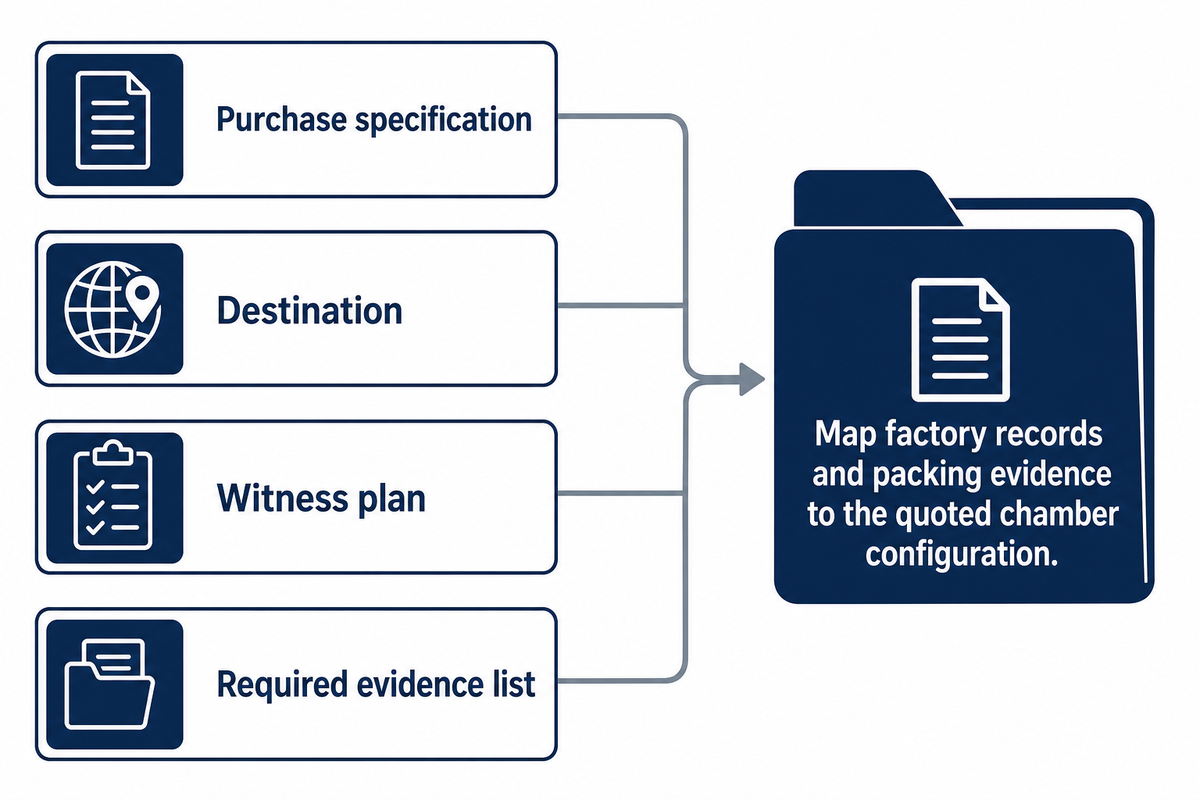
Send MACY-PAN your purchase specification, destination, witness plan, and required evidence list before production closes. The team can map requested factory records and packing evidence to the quoted chamber configuration. Include the intended acceptance basis, chamber serial fields, and destination-specific handoff constraints.
Scope and transparency
This guide supports procurement and factory-release planning. It doesn’t state universal pressure, leak, oxygen, electrical, grounding, ventilation, or clinical limits. Use the purchase contract, approved protocol, manufacturer instructions, applicable standards, destination rules, and competent technical or regulatory review for the specific chamber and site. The Project Atlas values are clearly marked hypothetical formatting examples.
Related buying resources
- Hyperbaric chamber product range for model and configuration review
- Hard medical hyperbaric chamber configurations for project discussions
- OEM hyperbaric chamber supplier guide for supplier and customization decisions
- How to choose a hyperbaric chamber before the order reaches inspection
- MACY-PAN manufacturing and factory process for first-party process context
References & Sources
- PVHO-1:2023, Safety Standard for Pressure Vessels for Human Occupancy American Society of Mechanical Engineers
- Key Health Care Changes in the 2024 Editions of NFPA 99 and NFPA 101 National Fire Protection Association
- Metrological Traceability: Frequently Asked Questions and NIST Policy National Institute of Standards and Technology
- ISO 13485:2016, Medical devices, Quality management systems International Organization for Standardization
- Follow Instructions for Safe Use of Hyperbaric Oxygen Therapy Devices U.S. Food and Drug Administration
- Product Classification: Hyperbaric Chamber, Product Code CBF U.S. Food and Drug Administration
- Hyperbaric medicine review of mild chamber safety and regulatory oversight Undersea and Hyperbaric Medical Society
- ISTA Test Procedures International Safe Transit Association
- ILAC Guidance Documents, including G8 and G17 International Laboratory Accreditation Cooperation
- What Happens After a Failed Pre-Shipment Inspection? Pro QC International
- Factory Acceptance Testing: Process, Procedure, and FAT/SAT Boundary DXP Enterprises