
Get in Touch with MACY-PAN Company

Hyperbaric chamber electrical requirements begin with ordering the correct model and ensuring that the power supply at the site matches the power requirements of the accessories. Verify voltage, frequency, phase, circuit protection, grounding, and outage arrangements with the manufacturer and a licensed electrical professional.
A clinic can order the correct hyperbaric chamber, but still face delays in opening if the support equipment doesn’t match the prepared room. Prior to undertaking any electrical work, obtain the installation documents of the equipment being purchased, including its air compressor, oxygen concentrator and cooling options. A catalog specification is just the beginning of that discussion.
- Match the actual equipment nameplates and manuals to the building supply.
- Review normal loads, startup conditions and fault protection separately.
- Document grounding, static controls and approved accessories.
- Agree what each function must do during an outage before selecting backup equipment.
| Decision | Record to obtain | Responsible reviewer |
|---|---|---|
| Supply compatibility | Ordered-unit voltage, Hz, phase and connection details | Manufacturer and electrical professional |
| Complete load | Powered-equipment list with normal and starting requirements | Supplier and electrical designer |
| Safety and continuity | Grounding instructions, accessory restrictions and outage plan | Facility safety lead and installation team |
| Permission to proceed | Applicable approvals, completed tests and handover records | Facility owner and relevant local authorities |
This document outlines procurement and site preparation. Electrical design, installation and acceptance belong to qualified professionals working with the applicable local requirements. For other aspects of the broader building survey use the installation site survey guide.
Voltage, Frequency and Phase: Start With the Ordered Configuration
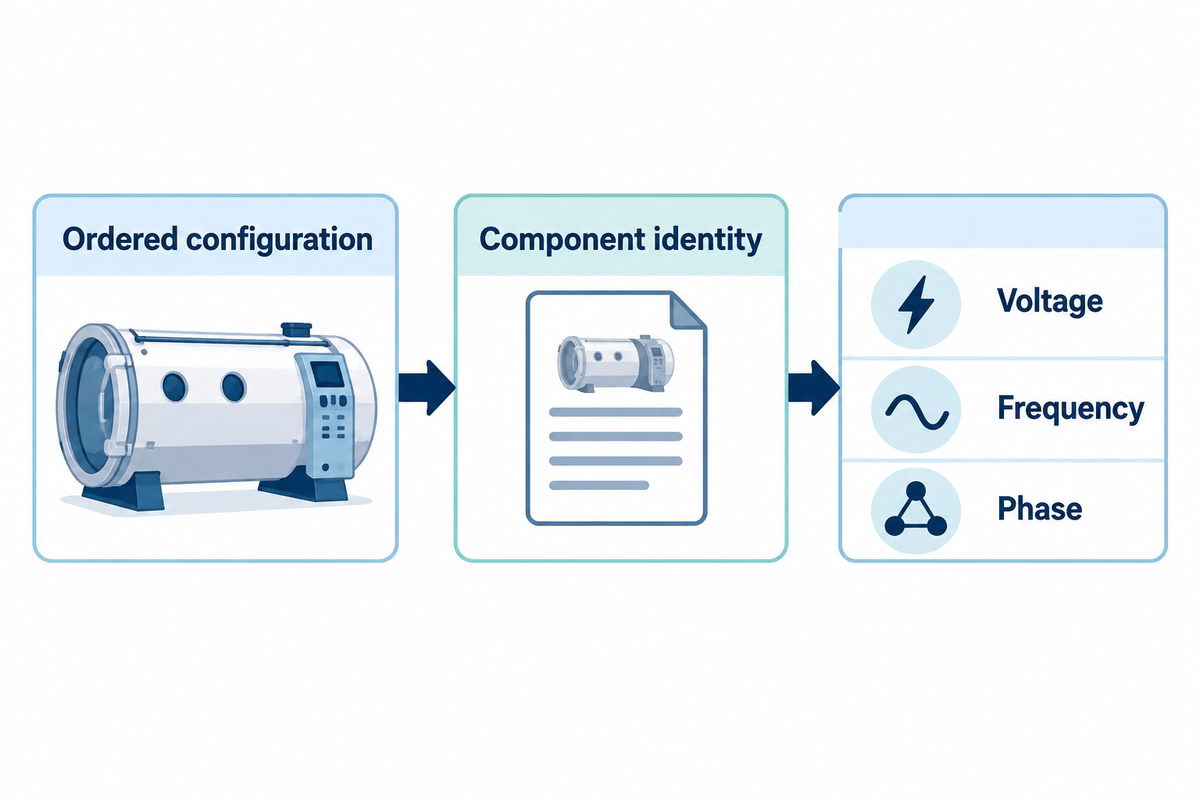
For every powered item in the order, specify the voltage, frequency and phase and ensure the supply matches the requirements. Keep each component’s identity beside its electrical data so a support-machine rating cannot accidentally become a specification for the whole installation.
Does a catalogue voltage option identify the supplied unit?
No. Use the ordered-unit documents and nameplate to identify the supplied configuration. A catalog may show alternatives available to a buyer and the equipment purchased may have a different input configuration. Ask the supplier to confirm the selected input and connection in writing before the electrician prepares the outlet or hardwired connection.
For example, OxyHealth’s Vitaeris 320 page places its 110–120V entry under CleanAir Compressor technical details. That number belongs to the named component. A buyer comparing chamber models should collect the same component-level information for each proposed package.
Provide plug and terminal details, supply tolerance and any manufacturer restriction on conversion equipment. If the room supply differs from the selected input, have the supplier and designer resolve the mismatch before delivery. A plug adapter doesn’t resolve electrical compatibility.
A chamber’s pressure level, stated in ATA or other pressure unit, describes a different property from the electrical input. Soft-shell and hard-shell chambers both require configuration-specific electrical data. Pressure relief valves and pressure figures relative to normal atmospheric pressure are to be included in the pressure-system documents and are to be separated from the electrical ratings. The configuration list should be attached to the purchase order, so that a later accessory substitution triggers an electrical review.
Circuits and Startup Current: Match the Complete Equipment Load
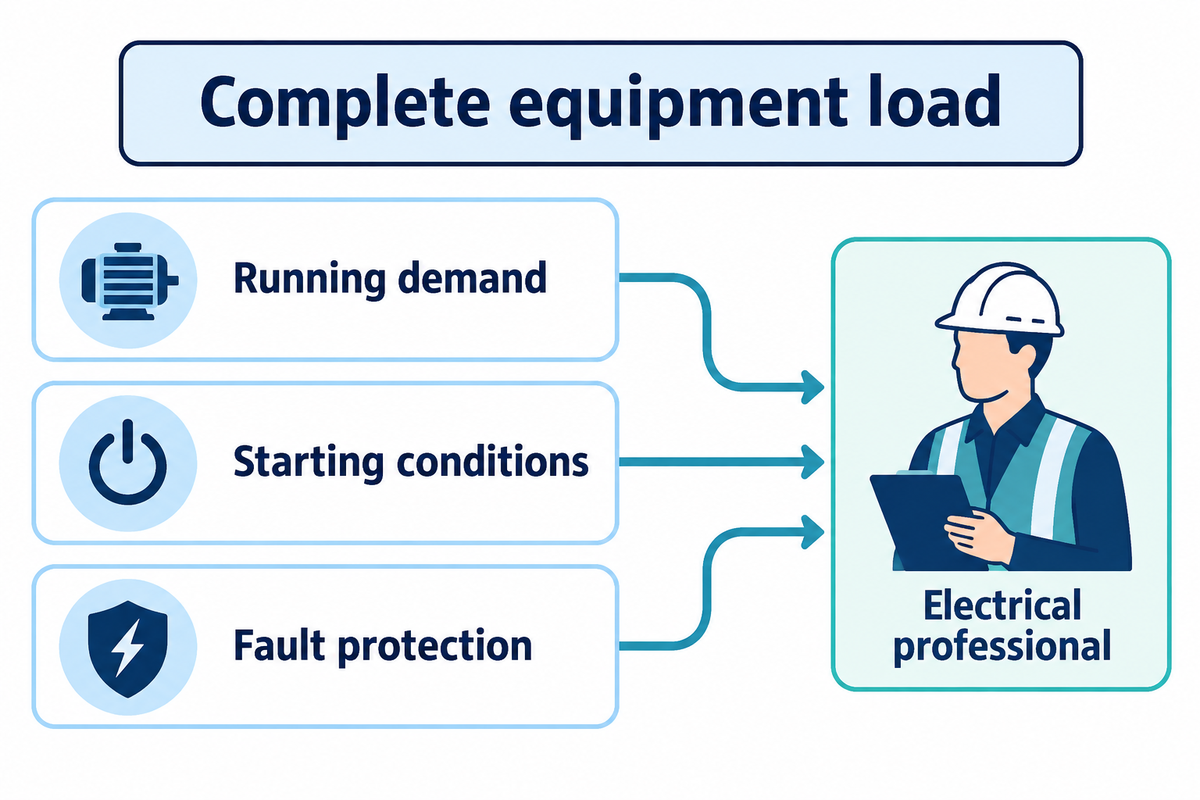
Have the electrical professional review the hyperbaric chamber’s complete connected load, manufacturer circuit instructions and starting conditions before specifying the branch circuit. Support equipment and options also need to be specified. Normal running demand and fault protection satisfy different design requirements. A single wattage entry can’t address the requirements of the design review.
How does startup current affect a dedicated circuit?
How the circuit and protective devices are selected may be impacted by the starting requirements. Give the designer the manufacturer’s starting-current or starting-duty information alongside normal ratings and the intended operating combinations. Whether the equipment needs an individual circuit must follow its installation instructions and the applicable design requirements, rather than a generic chamber rule.
In applicable US workplaces, OSHA 1910.303(b)(4) and (5) address interrupting ratings and protection coordination. Include available fault current, equipment short-circuit ratings and the proposed protective devices in the designer’s scope. These checks concern fault conditions, not the ordinary operating current.
Consider the example of a clinic purchasing a separate cooling option after the first package was priced by the electrician. Procurement should send the revised equipment list back for review before accepting the change.
Include in the electrical review
- All powered components and operating combinations
- Running, starting and fault-protection information
- Manufacturer-approved connection arrangement
Avoid procurement shortcuts
- Choosing a breaker from catalogue watts alone
- Copying a different model’s circuit
- Adding accessories after the circuit is approved
Grounding, Bonding and Static Electricity: Check Separate Safety Functions
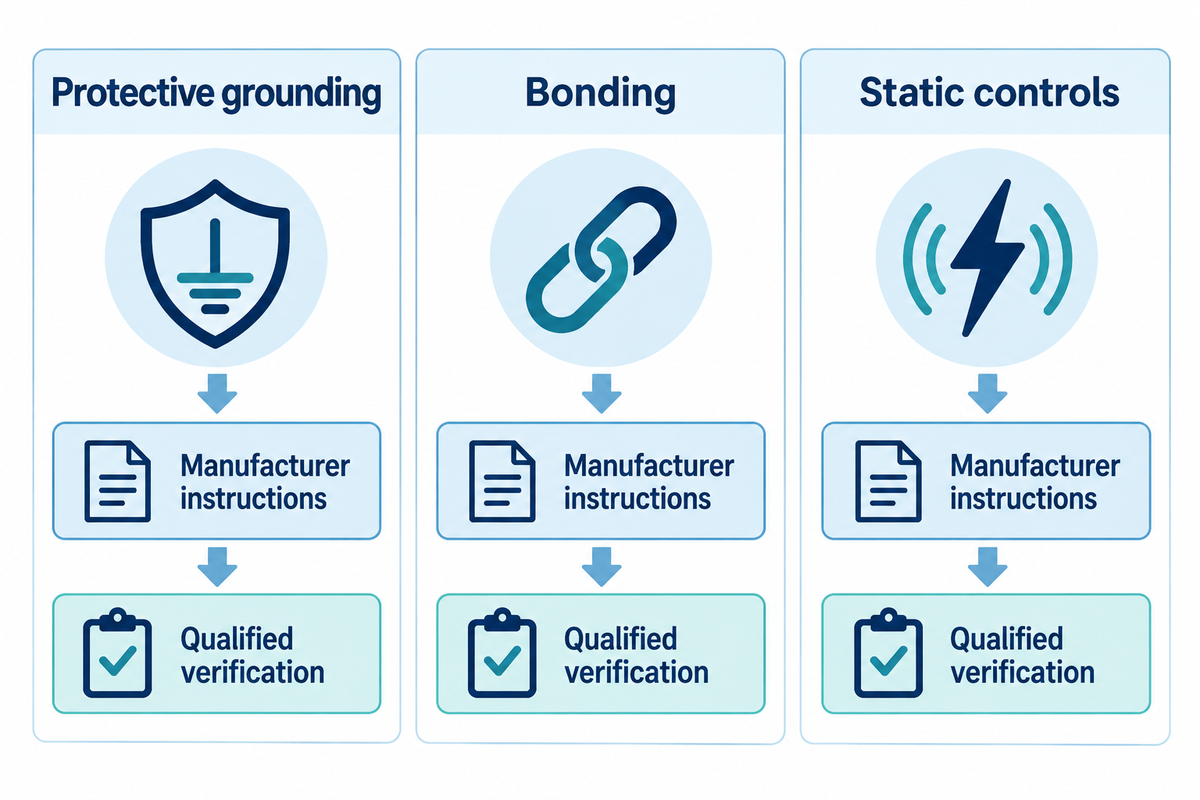
Protective grounding, bonding and manufacturer-specified static controls should be treated as separate components of the installation. Obtain the required connections, verification methods and acceptance criteria for the exact system. The electrical personnel and hyperbaric safety personnel for the facility should determine who will install, verify and maintain the safety measures.
Is grounding the same as controlling static electricity?
No, keep the protective electrical arrangements for the equipment and the chamber’s static-control instructions separate when handing over records. A grounding connection does not answer every question about clothing, permitted items or patient-contact arrangements. Follow the manufacturer’s requirements for chamber environment and have qualified personnel verify the connections and tests.
The FDA’s August 2025 safety letter recommends proper grounding and following device instructions for electrical or static items, some of which may need additional grounding measures. It also states that the root cause of the reported fires was not known. Do not use those reports to diagnose an installation remotely.
A facility safety lead reviewing a proposed grounding strap should request the chamber-specific instructions before approving its use. Keep patient arrangements, conductive connections, and protective earth clearly documented in the records. Improvised straps, earth connections or test thresholds should not enter the installation scope.
Coordinate the electrical work with the facility’s fire protection review. The safety lead should consider an ignition source separately from combustible materials or flammable products in the approved-item process. FDA also identifies clothing concerns involving wool and synthetic materials. Include the occupant’s applicable static-control instructions in staff handover. Account for the selected oxygen-enriched atmosphere in the facility risk review; oxygen enrichment and electrical supply are separate inputs to that review.
Backup Power: Define What Must Work During an Outage
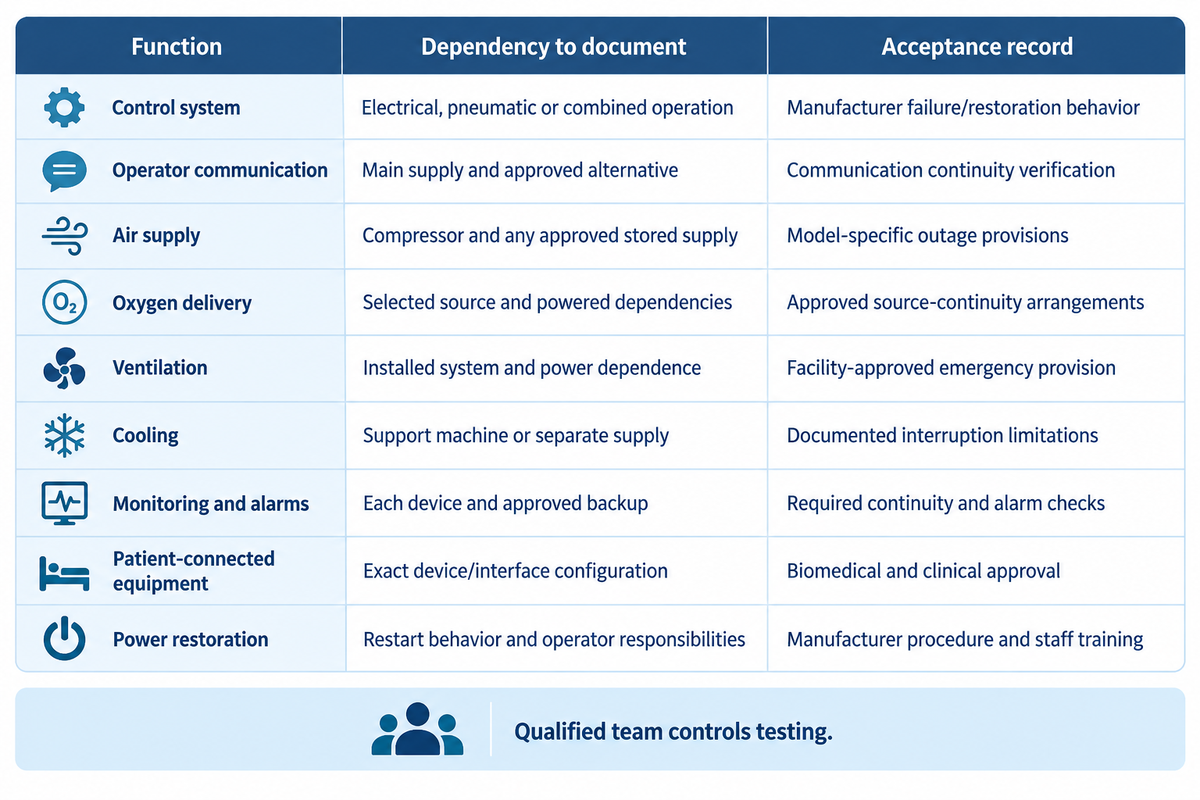
Define the required behavior of the hyperbaric chamber for each function prior to procuring a UPS or generator. Separate controls, communication, gas supply, cooling and connected patient equipment. Obtain the manufacturer’s power-failure instructions and have the facility team determine the approved continuity arrangements, including any transfer, runtime and restoration requirements for that installation.
Does a UPS or generator make the system ready for an outage?
Outage readiness is established only with an agreed, compatible and tested arrangement. Approval of emergency equipment and procedures should be in accordance with the national regulations and requirements. This guidance provides supplemental information to national regulations.
The European Code of Good Practice for Hyperbaric Oxygen Therapy, review 2022 lists power and backup supplies separately from primary and secondary communications. Its emergency-procedure section recognizes differences between facilities, chambers and patient needs. This professional guidance doesn’t replace national regulations.
A good model-specific example is found on HPO’s ZEUGMA page: pneumatic controls use compressed gas, while a discrete power source supports continued communications during an outage. This example doesn’t describe MACY-PAN equipment, or establish a general response to power failures.
| Function | Dependency to document | Acceptance record |
|---|---|---|
| Control system | Electrical, pneumatic or combined operation | Manufacturer failure/restoration behavior |
| Operator communication | Main supply and approved alternative | Communication continuity verification |
| Air supply | Compressor and any approved stored supply | Model-specific outage provisions |
| Oxygen delivery | Selected source and powered dependencies | Approved source-continuity arrangements |
| Ventilation | Installed system and power dependence | Facility-approved emergency provision |
| Cooling | Support machine or separate supply | Documented interruption limitations |
| Monitoring and alarms | Each device and approved backup | Required continuity and alarm checks |
| Patient-connected equipment | Exact device/interface configuration | Biomedical and clinical approval |
| Power restoration | Restart behavior and operator responsibilities | Manufacturer procedure and staff training |
Direct your qualified team to stipulate UPS or generator compatibility, starting loads and allowable interruption. Include the manufacturer’s provisions for pressurization and depressurization in its review of required functions. Record which safety features depend on electrical power and which have other dependencies. Keep the qualified team in control of the outage test procedure. This map assigns review tasks; emergency operation belongs to the approved facility procedures.
Electrical Accessories Inside and Around the Chamber
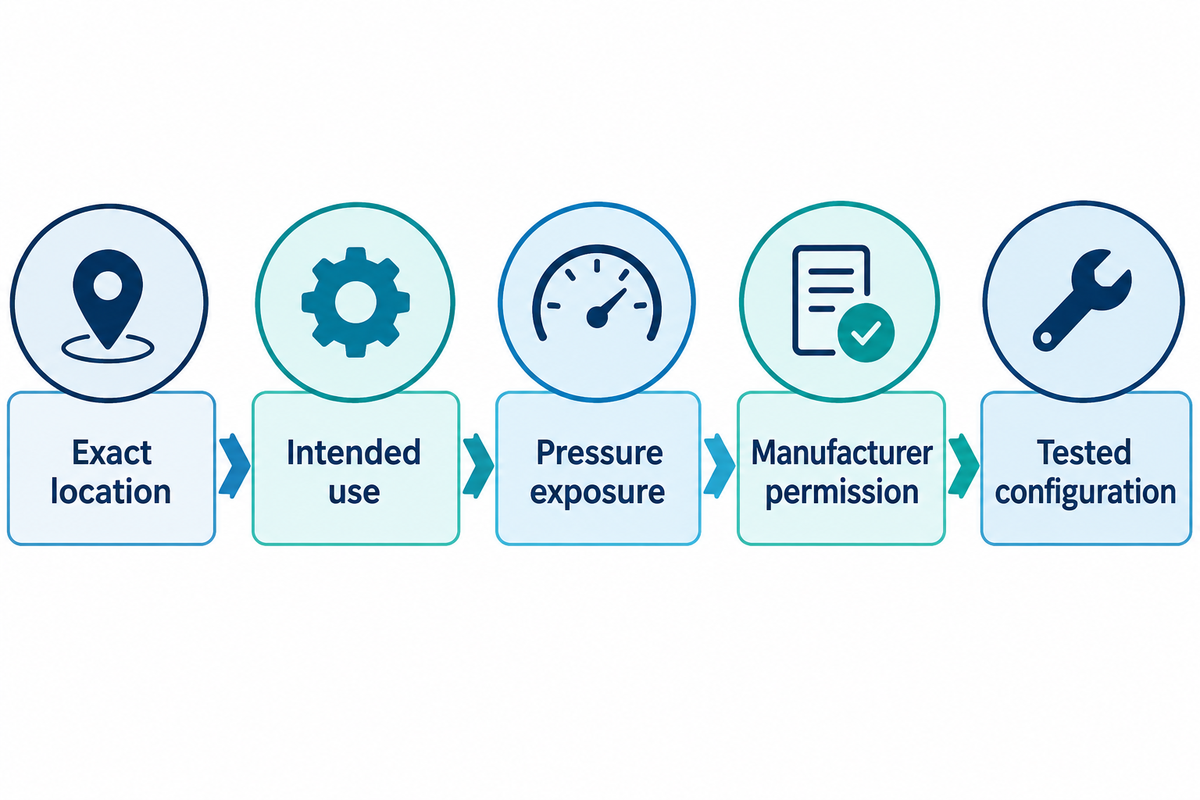
Approve accessories in the exact location and intended use, especially if they’re outside the pressurized enclosure and are connected to the system through an interface. Keep the identity of the equipment, the pressure it’s exposed to, and the permission of the manufacturer, together. Electrical supply continuity and suitability for the oxygen environment are separate matters; both need review before the accessory enters service.
Which accessory approvals apply inside the pressure boundary?
Use the instructions for the selected chamber and the facility’s approved item process to decide what may be placed in the interior. Be sure to include the exact arrangement of the device, battery, cables and connectors, in your decision. Permission for a component outside the pressure vessel does not automatically authorize placing it inside or changing its approved interface.
The FDA letter directs users to follow the manufacturer’s prohibited-item instructions for items inside the chamber. In a separate 2025 infusion-pump experiment published in Diving and Hyperbaric Medicine, specified modified pumps showed delivery differences with pressure changes, including compression and decompression. Those findings apply to the tested configurations, but they illustrate why a powered accessory requires functional assessment as well as a power connection.
For a hypothetical clinical case of installation with a patient-connected device outside of a monoplace chamber, biomedical personnel and the clinical lead should review the complete interface. Hyperbaric chambers are designed for specified internal pressure conditions; include these conditions in the accessory assessment. Procurement shouldn’t approve it solely because the plug fits and/or it has its own battery. It should be noted that ordinary chargers and extension leads, and/or power converters shouldn’t be assumed to be safe for the proposed arrangement.
Use the Electrical Readiness Checklist Before Installation
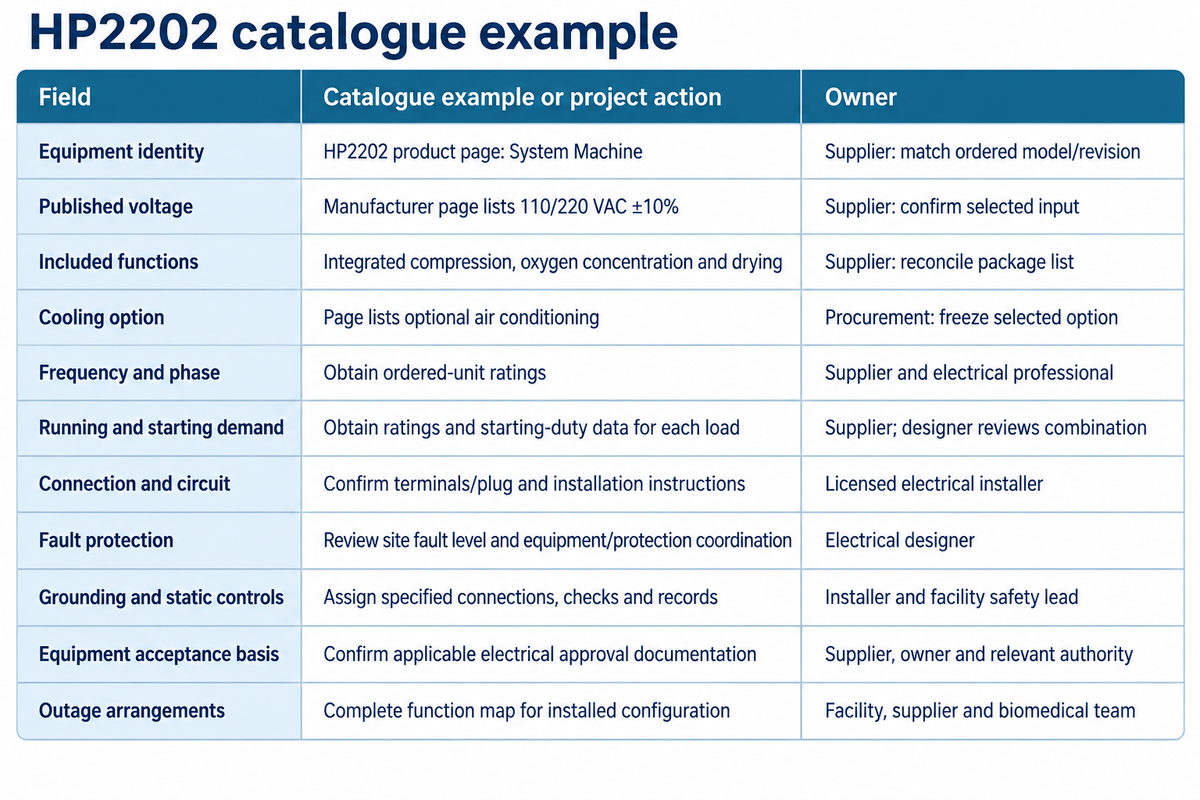
One component-by-component schedule should be used to reconcile the ordered equipment with the site design. Unresolved field elements should be assigned an owner and required document. Procurement can then differentiate a missing supplier specification from unfinished building work, and instead of asking the electrician to speculate which accessory the chamber package contains, make an informed decision.
Which electrical fields remain unconfirmed in the sample schedule?
The ordered input, frequency, phase, running and starting requirements, connection details, and site protection still need project-specific verification. The sample below identifies a published component and catalog entry of a real product. Replace the remaining review tasks with the selected unit’s documents and the electrical professional’s accepted design before installation proceeds.
The Connected-Load Boundary Schedule links powered components to source documents, site decisions and reviewers. Start with the supplier’s complete bill of equipment.
| Field | Catalogue example or project action | Owner |
|---|---|---|
| Equipment identity | HP2202 product page: System Machine | Supplier: match ordered model/revision |
| Published voltage | Manufacturer page lists 110/220 VAC ±10% | Supplier: confirm selected input |
| Included functions | Integrated compression, oxygen concentration and drying | Supplier: reconcile package list |
| Cooling option | Page lists optional air conditioning | Procurement: freeze selected option |
| Frequency and phase | Obtain ordered-unit ratings | Supplier and electrical professional |
| Running and starting demand | Obtain ratings and starting-duty data for each load | Supplier; designer reviews combination |
| Connection and circuit | Confirm terminals/plug and installation instructions | Licensed electrical installer |
| Fault protection | Review site fault level and equipment/protection coordination | Electrical designer |
| Grounding and static controls | Assign specified connections, checks and records | Installer and facility safety lead |
| Equipment acceptance basis | Confirm applicable electrical approval documentation | Supplier, owner and relevant authority |
| Outage arrangements | Complete function map for installed configuration | Facility, supplier and biomedical team |
The catalogue entries above come from MACY-PAN’s HP2202 product page. Use the order-specific model documentation package for installation decisions. A revised support machine or optional component should carry a revised schedule before its electrical work is released.
Electrical Site-Work Cost and Lead Time: Separate the Scope
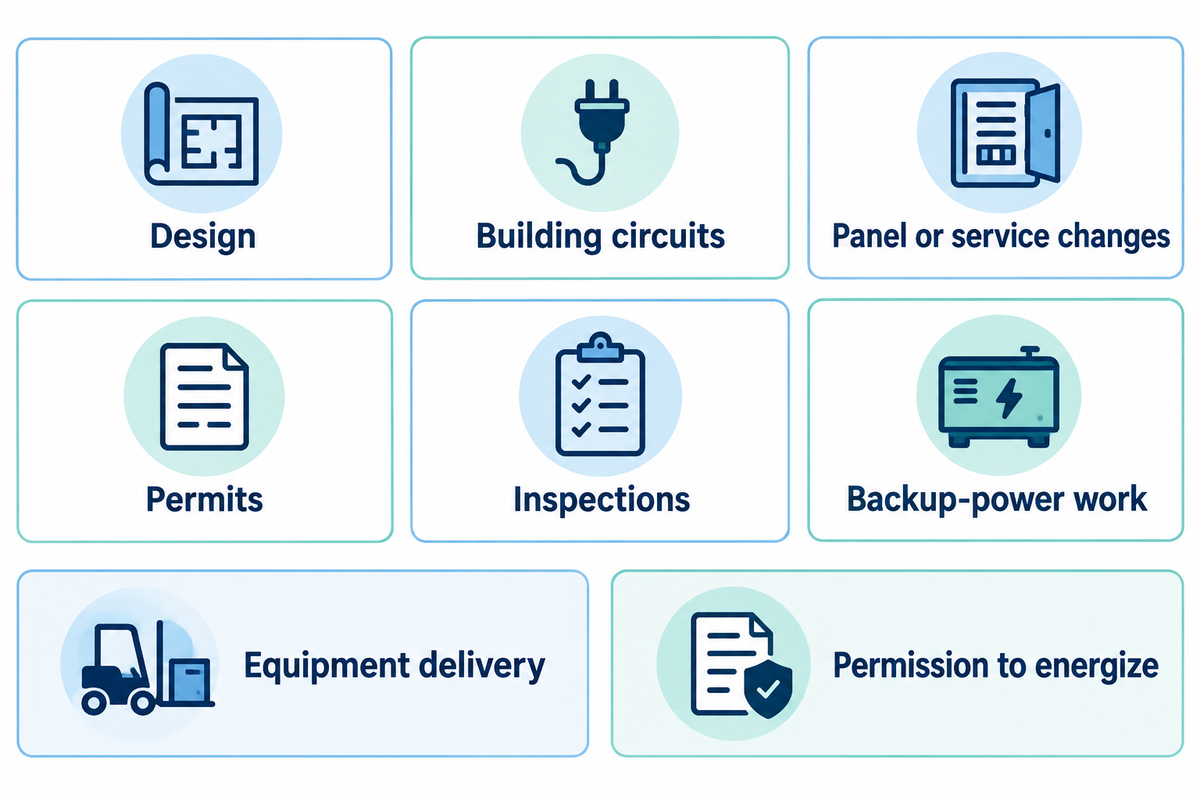
Obtain an itemized electrical site-work quotation after the equipment list and proposed location are fixed. Separate design, building circuits, panel or service changes, permits, inspections and backup-power work. Ask each responsible party for its own milestone dates so equipment delivery is not confused with permission to energize or begin service.
Do I need to modify my building before installation?
Modify only where the site assessment and approved equipment identify necessary changes. An existing suitable supply and a project requiring service upgrades are different in scope. Before authorizing the work, have an electrical professional examine the location, assess available capacity and review the options for connection. This may identify permit or utility company dependencies.
Arlington County’s electrical permit process, for example, separates completeness checks, review and revisions, final processing and inspections. It also identifies scope-dependent exceptions. This local example explains why one permit-review window can’t be used as a universal chamber installation timetable.
For example, in a leased clinic, the owner could grant approval for a room, but the landlord controls the distribution panel and the route the cables take. In this instance, the landlord’s permission and any shutdown coordination should be obtained before an opening date is set. Use the room requirements guide to coordinate the electrical scope with the rest of the space.
Request a Model-Specific Review and Record Installation Acceptance
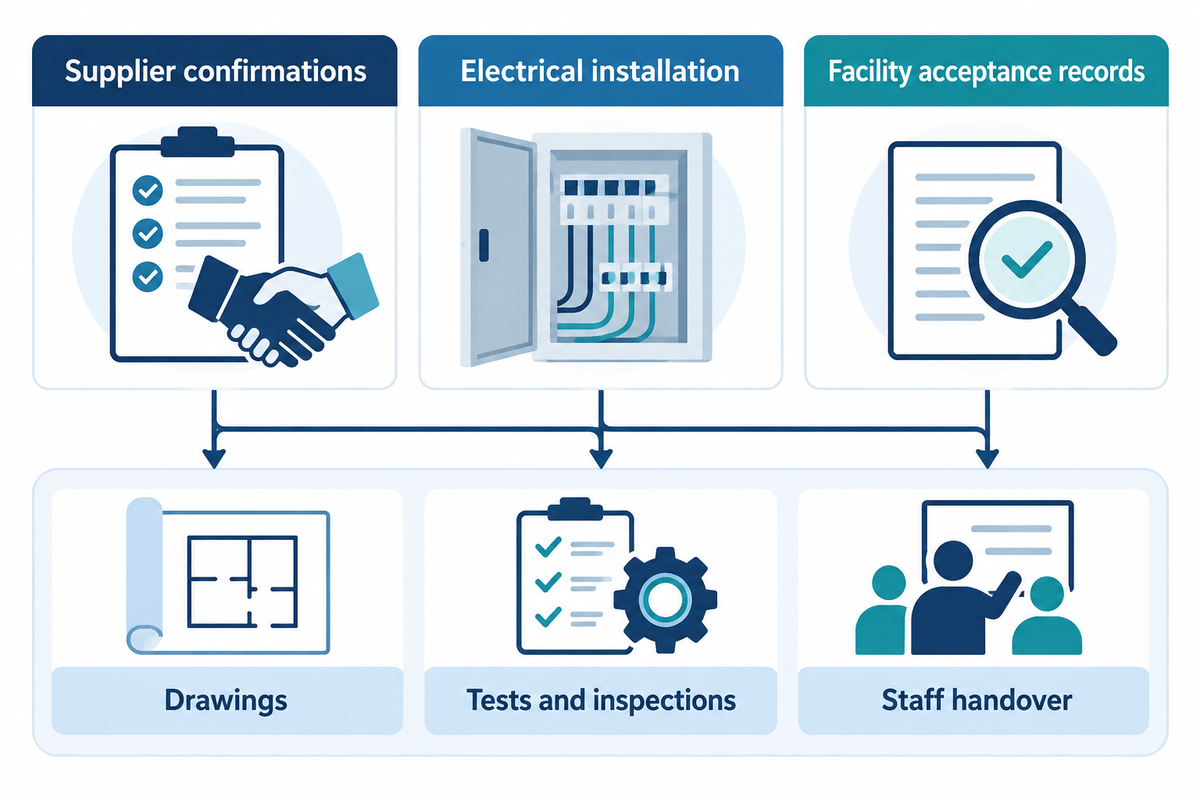
Obtain supplier confirmations, and electrical installation and facility acceptance records as separate end-items. Identify the applicable code edition and route for approval with the local jurisdiction professionals responsible. Drawings, completed tests and inspections, outstanding conditions and staff handover should be kept together so a delivered chamber isn’t assumed to be accepted for clinical installation.
Which records show that electrical work has been accepted?
Retain the installed equipment lists, appropriate approvals, completed electrical tests, inspections, releases, agreed-to grounding checks, and outage arrangements. Facility owners should indicate who accepts each record, and close all outstanding conditions, through the responsible professional, before releasing installation for its intended use.
NFPA’s explanation of NFPA 99 and the NEC distinguishes risk-based performance requirements from installation methods. For hyperbaric facilities, confirm the locally applicable requirements rather than treating the newest publication as automatic local adoption. NFPA 99 is the Health Care Facilities Code.
“Listed or labeled equipment shall be installed and used in accordance with any instructions included in the listing or labeling.”
- Freeze the order. Identify the exact chamber, support equipment and options.
- Reconcile the site. Resolve supply, installation and approval questions before releasing work.
- Complete acceptance. Retain the required inspections, test results and handover documents.
Factory checks and site acceptance cover different aspects. Use the factory acceptance test guide to agree what is checked before dispatch, then assign the remaining site checks. Document the actual chamber uses and approved operating context with the facility team; electrical readiness of the site doesn’t authorize hyperbaric treatment. A hyperbaric technologist’s equipment handover and the electrical acceptance by the licensed installer should have defined scopes.
Review MACY-PAN’s clinic installation and buying process and request an electrical configuration review. Send the model, destination, available supply and complete accessory list so the supplier and your electrical professional can resolve the outstanding fields.
Frequently Asked Questions
What are the electrical requirements before installation?
Confirm the ordered system’s supply, load, grounding and outage arrangements before installation.
Begin with the exact model and its powered-component list. Obtain voltage, frequency, phase, connection details and running and starting requirements from the supplier. The licensed electrical professional then reviews the building supply, protection and applicable installation rules. Keep equipment approval, accessory restrictions and required acceptance records in the same project file, with an owner for every unresolved item.
Does a hyperbaric chamber need a dedicated circuit?
Follow the selected equipment’s instructions and the site’s electrical design.
A dedicated circuit decision requires more than the chamber’s marketing description. The reviewer needs the actual powered-equipment ratings, operating combinations, startup conditions and proposed connection. Support devices may have separate supplies. Ask the supplier to identify its circuit requirements, and have the licensed electrical professional confirm the design against the local installation rules and site conditions before work begins.
What should I prepare before installation?
Prepare the equipment documents and a reviewed site plan before the installation team arrives.
Collect the order configuration, component manuals, nameplate data and accessory approvals. Identify the room location, proposed supply connection and any landlord or utility dependencies. Arrange the required electrical review, permits and inspection responsibilities early. Keep the accepted design and manufacturer’s instructions available to the installer, and agree how grounding checks, outage provisions and handover records will be completed.
Can you take a phone in a hyperbaric chamber?
Bring a phone in only if the manufacturer’s instructions and facility process permit that exact arrangement.
Ordinary consumer-device suitability should not be assumed. The FDA specifically reminds users to follow instructions concerning potentially prohibited electrical or static items. Ask the operator before bringing a phone, battery or charger into the chamber.
How long does installation usually take?
Obtain a project schedule after the site scope and equipment configuration are reviewed.
Electrical readiness can involve design, equipment documentation, construction, permission for a shutdown and inspection releases. Some projects use suitable existing infrastructure; others need panel or utility work. Ask who owns each dependency and distinguish equipment delivery, installation completion and facility acceptance. A supplier’s delivery date or a local authority’s review window shouldn’t be presented as the total time needed to open a clinic.
Can I calculate the breaker size by dividing watts by volts?
No; that calculation alone is insufficient for selecting a protective device.
The electrical professional must review the equipment ratings, starting characteristics, operating conditions, manufacturer’s instructions and applicable protection rules. Supply arrangement and site fault conditions also matter. Don’t buy a breaker or specify conductors from that arithmetic alone.
What backup power should I buy for the chamber?
Select backup equipment only after the required functions and compatibility have been agreed.
Start with the selected model’s power-failure instructions and the facility’s outage plan. Identify each load that must remain available, its starting requirements and its approved interruption and runtime limits. Have the supplier and qualified facility team review the proposed UPS or generator arrangement, including restoration behavior and verification. A communications backup, a gas reserve and backup electrical power address different dependencies and should be documented separately.
References & Sources
Primary material reviewed in October 2026: FDA hyperbaric oxygen therapy (HBOT) safety letter; OSHA electrical requirements; NFPA electrical systems explanation; European practice review; Arlington electrical permit process. Manufacturer examples and the accessory experiment are linked beside their relevant statements.