
Get in Touch with MACY-PAN Company


A hyperbaric chamber factory acceptance test is a buyer-witnessed verification of one identified medical HBOT chamber against the approved order, test protocol, and evidence requirements before shipment. The witness should observe or participate in the tests and take part in evaluating the actual results, deviations, retests, and rationale for the final disposition.
Direct answer: witness the chamber identity and build baseline, test readiness, pressure and leak sequence, fitted controls and protective functions, oxygen/electrical/grounding evidence, raw records, deviation closure, and final signatures. Don’t accept a general quality stamp in place of serial-bound evidence.
>2 psipublished ASME PVHO scope boundary, not a FAT limit
72 hoursMACY-PAN’s stated aging-test duration
Dec. 26, 2026FDA’s narrowly scoped US premarket transition date
Key takeaway
A buyer signs a FAT result for the identified build and agreed factory scope. The signature does not approve every market, installed room, treatment procedure, or future software state.
Buyer-Witnessed FAT Scope for a Medical HBOT Chamber
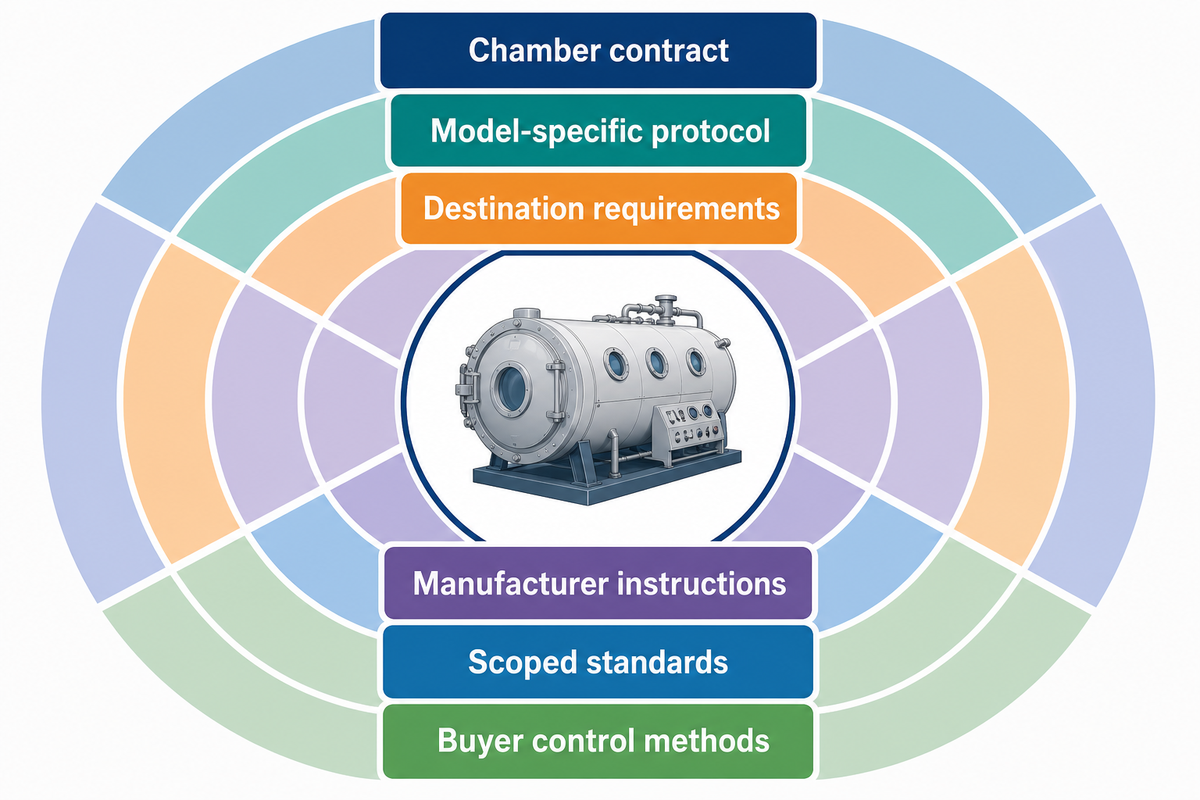
A buyer-witnessed FAT is a controlled acceptance process conducted at the supplier’s site. This process evaluates the ordered chamber against the agreed physical and technical requirements. Here, a hyperbaric medical chamber supports hyperbaric oxygen therapy (HBOT); the FAT doesn’t decide how a patient should breathe oxygen or whether a treatment is appropriate. This FAT also doesn’t replace a factory audit, destination verification, site acceptance testing, commissioning, operator training, or authorization to provide clinical care.
“Design, fabrication, inspection, testing, marking, and stamping.”
The quotation above describes part of ASME PVHO-1’s published scope. It doesn’t provide the acceptance values for this order. The buyer must keep six authority layers separate: the chamber contract, the model-specific protocol, the destination’s binding requirements, the manufacturer’s instructions, standards within their stated scope, and buyer-created control methods such as the register in this guide.
MACY-PAN states that its production sequence includes raw-material inspection, assembly inspection, a 72-hour aging test, full-system testing, final inspection, and packing inspection. That first-party statement is useful process context. It doesn’t prove buyer attendance, the tested serial, or closure of a purchase-order requirement. A separate hyperbaric chamber factory audit checklist belongs to supplier-system review rather than unit FAT sign-off.
Ambiguity in scope is the first type of risk of refusal. The phrases “PVHO,” “hyperbaric chamber,” and “medical hbot chamber” have similar meanings, but aren’t always interchangeable. When using the factory acceptance test (FAT) cover form, the buyer must record the intended medical use, destination, exact model, serial number or build number, purchase specification, governing documents, and all required supporting evidence.
Freeze the Model, Revision, Software, and Acceptance Basis
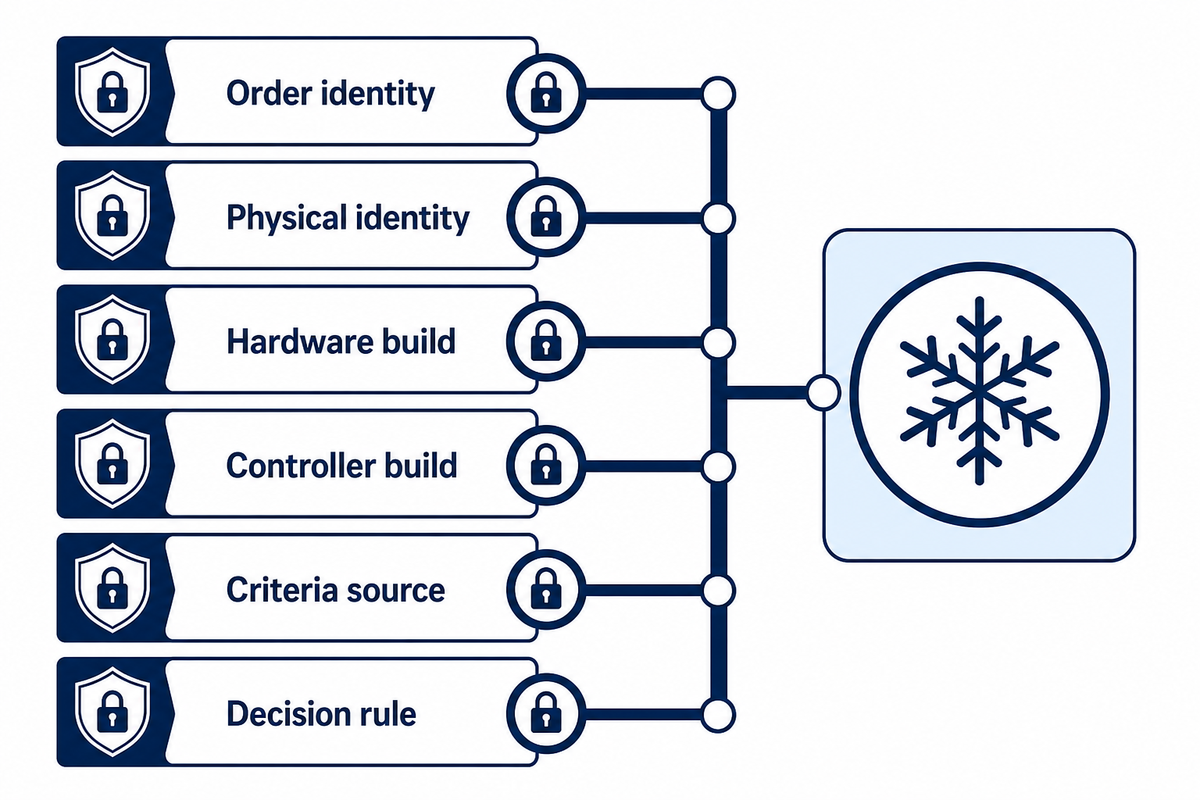
The acceptance basis is the definition of completeness against which witnesses validate individual test cases. That baseline should freeze the ordered hardware, controller and firmware/software build, fitted options, labels, network and interface settings where applicable, user roles, audit-log settings, destination, protocol revision, instruments, criteria sources, and approved deviations before testing starts. Acceptance basis is established at the beginning of a test cycle.
Catalog entries usually don’t provide sufficient detail. For example, a chamber can be manufactured incorrectly if the controller, software, language, permission levels, user interfaces, accessories, and destination labels aren’t installed properly. Therefore, the purchaser must be provided a sheet that describes each acceptance item and the test data that support that item.
| Baseline object | Controlled entry | Buyer check |
|---|---|---|
| Order identity | Purchase order, line, project | Matches the unit and option list |
| Physical identity | Model, serial or build ID, nameplate | Visible identity matches every record |
| Hardware build | Drawing and bill-of-material revisions | No unapproved substitution |
| Controller build | Controller, firmware and software versions | Screens and reports show the frozen build |
| Digital settings | Roles, logs, interfaces, network settings where fitted | Settings match the approved baseline |
| Destination | Country, site, electrical and language interfaces | Evidence is not borrowed from another market |
| Protocol | Document number, revision and approvals | Current signed copy is on the floor |
| Criteria source | Contract, approved specification, method or instruction | Every result points to its source |
| Measurement chain | Instrument IDs, ranges, certificates and due status | Fit for the intended decision, not merely traceable |
| Witness plan | Notice, hold points, attendees and authority | No critical step runs without release |
| Known deviations | Approved deviation IDs and limits | No verbal exception enters the baseline |
| Decision rule | How boundary and uncertain results are called | Witnesses use one agreed rule |
According to NIST’s guidance, a documented calibration trail isn’t equivalent to fitness for purpose. As such, having the most recent calibration doesn’t mean that the instrument’s range, resolution, method and decision rule align with the requirements reflected in the buyer’s acceptance question.
12-Row Witness-to-Waive Register
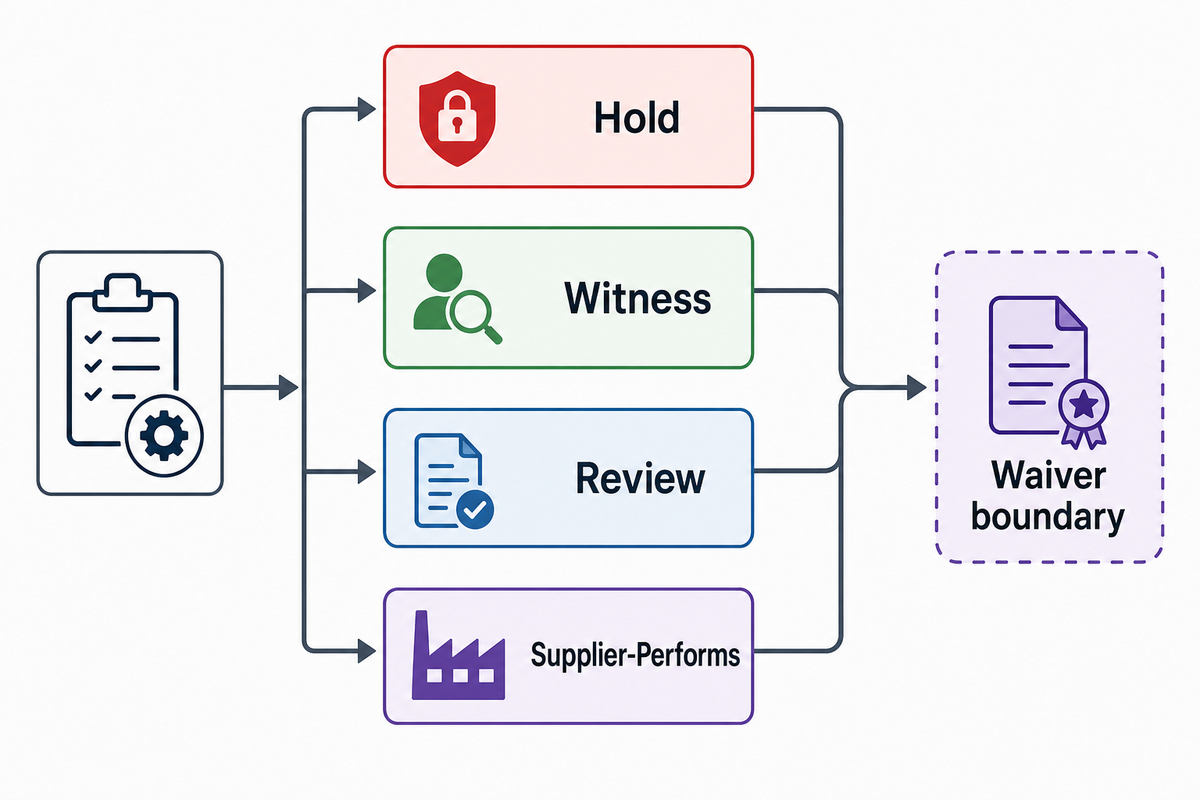
The Witness-to-Waive Register changes “buyer-witnessed” tests to controlled test obligations. Each entry receives a Hold, Witness, Review, or Supplier-Performs classification, along with instructions, evidence, and waiver procedures. The register prevents a supplier from completing a critical test first and asking the buyer to accept a summary later. As a planning analogue, the IEC 62381:2024 public scope describes factory- and site-acceptance checklist planning for process-industry automation; this register borrows only that stage-control logic and is not presented as a hyperbaric compliance requirement.
| FAT line | Class | Required buyer evidence | Waiver boundary |
|---|---|---|---|
| Opening baseline review | Hold | Signed cover sheet | No test before baseline release |
| Unit identity | Witness | Live nameplate and build match | Remote view only if identity stays legible |
| Instrument readiness | Review | IDs and certificate references | Buyer records prior approval |
| Pressure sequence | Witness | Live trace and observations | Recorded substitute defined in advance |
| Leak evaluation | Witness | Method, readings and locations | No summary-only waiver |
| Door and seal response | Witness | Condition before and after test | Safe repeat method required |
| Controls and alarms | Witness | Stimulus-response records | Only approved safe simulations |
| Software and roles | Review | Version and permission evidence | Only where fitted and specified |
| Communication functions | Witness | Initiation, receipt and recovery | Method cannot create unsafe conditions |
| Safety-file review | Review | Scoped records and instructions | Badge images are not enough |
| Deviation retest | Hold | Correction and linked retest | Affected lines remain open |
| Final disposition | Hold | Closed register and signatures | Only named buyer authority releases it |
A waiver doesn’t eliminate a requirement. It documents which witness was waived, who granted the waiver, what evidence is substituted, and whether the test step may proceed. Missing a mandatory witness point creates a process deviation. The buyer then decides whether the test can be repeated safely under the approved method.
Opening Meeting and Chamber Readiness Checks
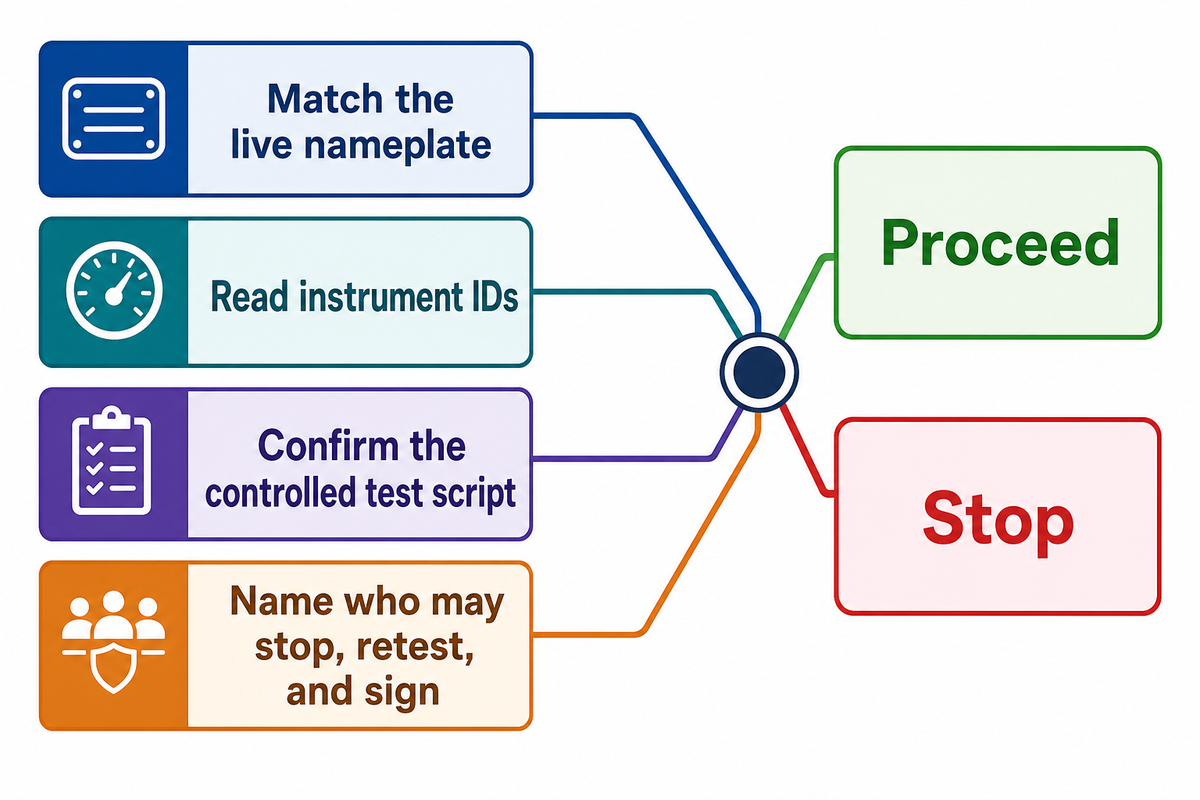
The opening meeting is used to confirm that the right people, unit, records, instruments, utilities, and safe test method are available. For measurement items, NIST’s metrological-traceability guidance supports a documented measurement chain but does not turn a current certificate into proof that an instrument is fit for this FAT decision. The meeting should end with a signed baseline, an attendance list, confirmed witness classes, and a stop-work route. Witness authority and roles are also confirmed. This stop-work authorization route is also confirmed. There should be no urgency to perform the test merely to protect the production schedule when the unit identity or approved method is unresolved.
Do
- Match the live nameplate to the cover sheet.
- Read instrument IDs from the equipment.
- Confirm the controlled test script and restoration steps.
- Name who may stop, retest, and sign.
Don’t
- Rely on a catalogue image for identity.
- Accept a certificate without application review.
- Invent a stimulus for a fitted protective function.
- Let schedule pressure redefine a hold point.
Agree on data format conventions (file names, time stamps, camera frame views, raw data, etc.) and where signed records will be placed prior to performing any test.
Remote witnesses can’t validate the unit or instruments when they’re given only a recorded demonstration. Recorded demonstrations provide no assurance that the test equipment and unit shown are the same equipment and unit under review.
“Blocking objections” from buyers are typically practical. Stopping the line costs time. Instead, take a very short readiness stop to check. If the cover page lists the wrong revision, instrument, or serial, identifying and resolving the problem will take longer. During that time, the affected evidence won’t be available for a valid acceptance decision.
Pressure and Leak Test Evidence the Buyer Should See
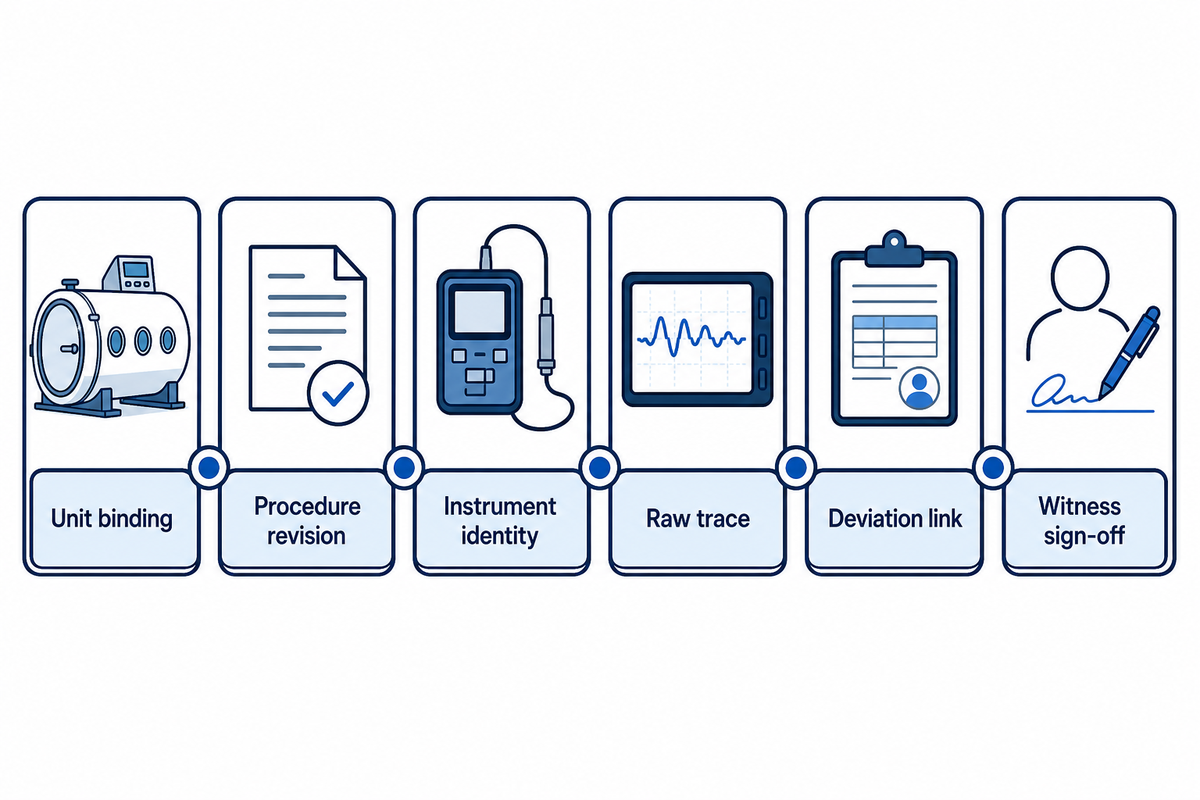
Pressure and leak evidence should show the approved method, calibrated measurement chain, and observed conditions. It should include acceptance criteria, deviations, and signatures. Factory acceptance tests should define the applicable method of leak testing and associated instrumentation. The given supplier’s procedure shouldn’t be presumed to apply more broadly. This publication won’t define allowable limits of pressure, hold times, or leak rates. Such limits, if applicable, should be defined by the approved design, contract, protocol, and/or applicable authority.
The reviewed NOAA/U.S. Navy service record contains fields for discrepancy, repair, retest, and approval, but it does not provide a transferable commercial FAT threshold. Values from these fields may vary from record to record. Here, we’ve noted no values from the record, since the noted values didn’t agree among the fields, and an unreliable value has no use. Service records can’t be relied upon to substantiate threshold requirements for chambers manufactured outside of military service.
| Record field | What the witness verifies | Release risk if absent |
|---|---|---|
| Unit binding | Serial/build ID appears on trace and report | Result may belong to another unit |
| Procedure revision | Approved sequence is current | Method may not match the order |
| Prerequisites | Configuration and initial condition are recorded | Result lacks context |
| Instrument identity | IDs, ranges and certificates link to readings | Measurement chain cannot be reviewed |
| Commanded sequence | Operator follows the approved steps | Uncontrolled method |
| Raw trace | Time and pressure observations are retained | Only a conclusion remains |
| Leak method | Locations, method and observations are stated | Leak verdict cannot be repeated |
| Door and seals | Condition is checked before and after | Physical effects stay hidden |
| Acceptance criterion | Exact source and revision are named | Pass label has no basis |
| Deviation link | Each exception has an ID and owner | Open finding disappears |
| Retest link | Corrected result points to original failure | Repair is mistaken for proof |
| Witness sign-off | Names, roles, dates and scope are clear | No accountable decision owner |
The table is a record template, not a test method. It outlines the evidence the buyer should retain after qualified personnel implement the accepted procedure. Buyers shouldn’t request demonstrations involving the use of improvised overpressure devices, blocked relief paths, safeguards in a disabled condition, and other unsafe means to fill in the blanks on a checklist.
12-Type Functional Test Matrix for Fitted Systems
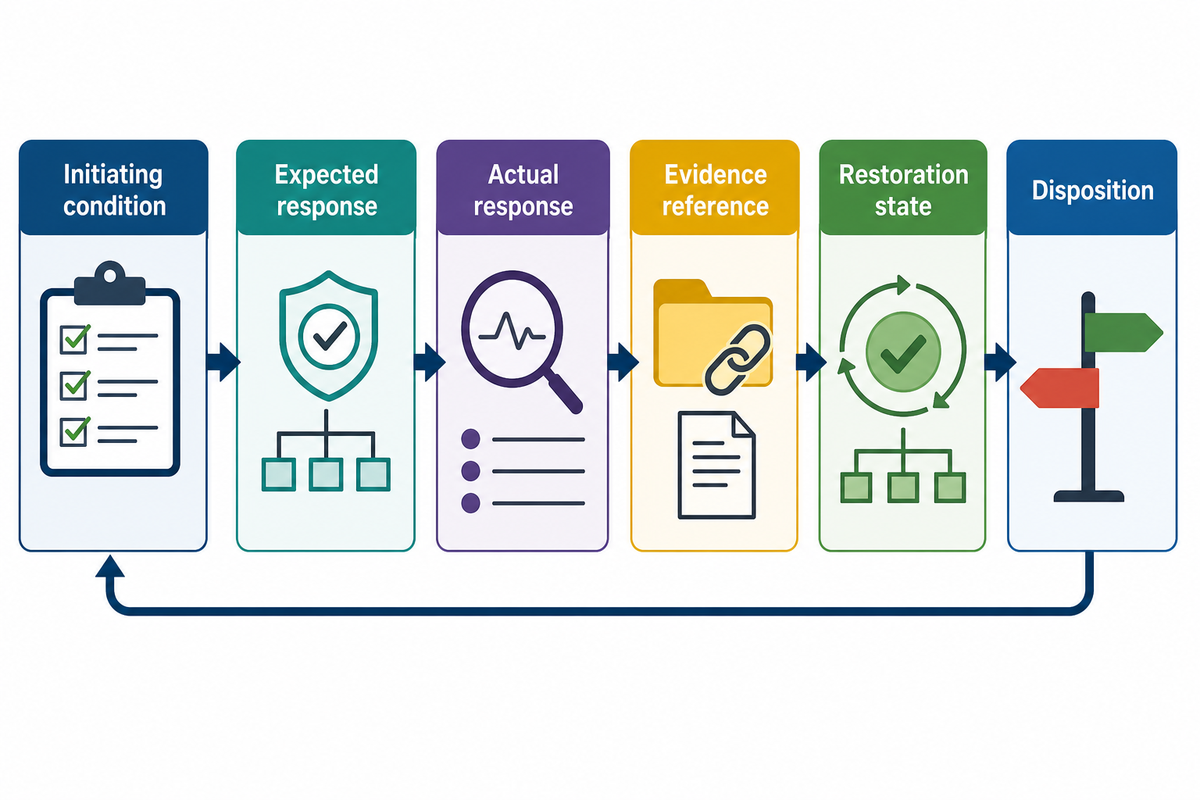
Functional witnessing should challenge only installed, specified functions through approved safe methods. For automation-system planning, the IEC 62381:2024 public scope treats factory and site tests as distinct planned stages; this article uses that distinction only as a test-planning analogue. Approved risk mitigation strategies should be included. Each line needs the initiating condition, expected response, actual response, evidence reference, restoration state, and disposition. State should be restored to the condition prior to the testing. Version-bound evidence, such as configuration and design documentation should be provided if specified functionality of a control is provided through a configuration. Similarly, connections to a control should be addressed if provided.
| Function family | Buyer observes | Record | Boundary |
|---|---|---|---|
| Main controls | Command and indicated state | Input/output result | Only approved operating range |
| Pressure indication | Agreement with reference instrument | Linked readings | Criterion comes from protocol |
| Door state | Indication and permitted action | Stimulus-response entry | No forced unsafe state |
| Alarm family | Trigger, indication and reset | Alarm ID and result | Test only fitted alarms |
| Interlock family | Prevented action and recovery | Safe simulation record | Do not defeat the protection |
| Communication | Call, receipt and clarity | Endpoint result | Ordered channels only |
| Emergency action | Approved response path | Method and restored state | Qualified test lead controls method |
| Relief evidence | Identity and scoped test record | Certificate/report link | No improvised actuation |
| Software build | Displayed installed version | Version capture | No assumption from model family |
| User roles | Permitted and blocked actions | Role test result | Where role control is specified |
| Audit logging | Recorded event and retrieval | Log evidence | Where logging is fitted |
| External interface | Approved exchange and failure behavior | Interface result | No live site dependency at factory |
Screen navigation gives limited insight into challenged responses. The focus should be on the approved initiating condition and the return to a defined state. If the feature isn’t configured in the ordered chamber, mark it not applicable and provide evidence of configuration; don’t perform a demonstration or assume that a patent, brochure, or options list indicates configuration.
Oxygen, Electrical, Grounding, and Fire-Safety Evidence Within Scope
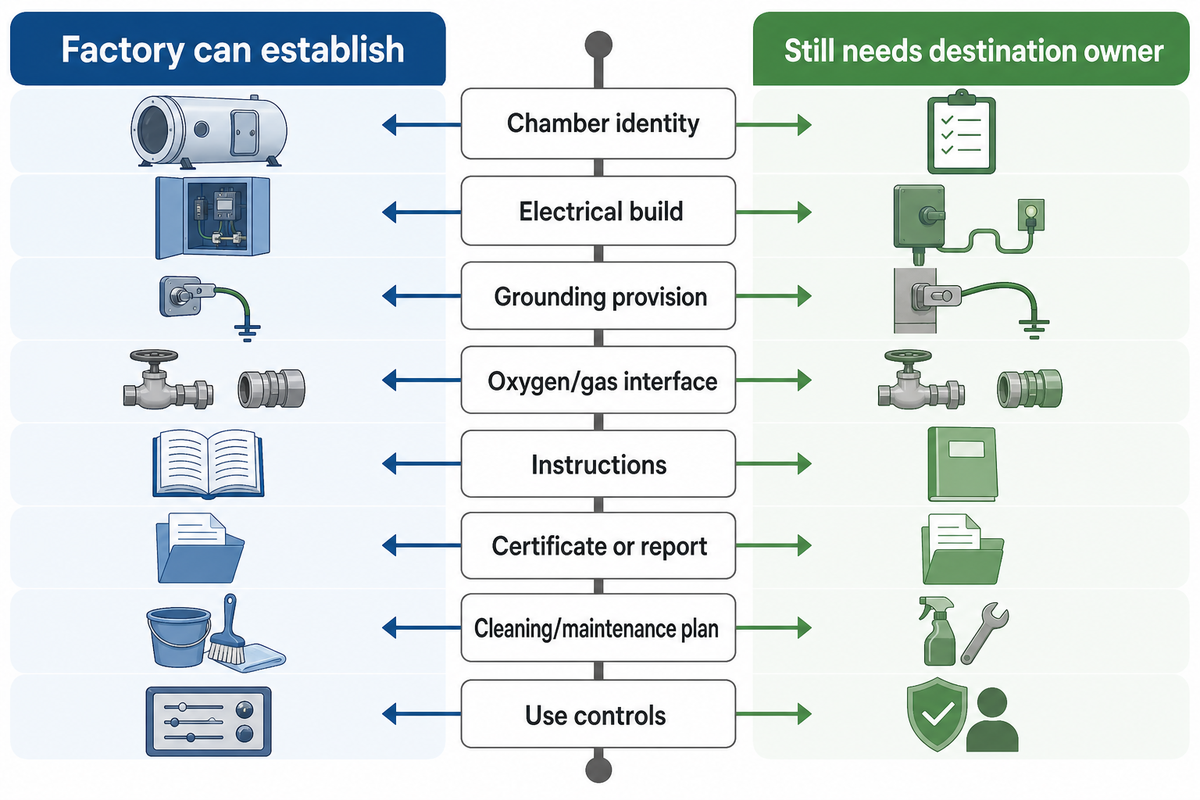
Evidence of safety requires scope. Certain records can show factory production but the remaining aspects including utilities, installation, on-site approvals, operation and protection of the equipment remain to be addressed. The buyer must determine the extent of the applicability of the safety standards and the related contractual provisions to the evidence provided, the scope of coverage of each certificate and instruction, and identifications, if any, of labels and test reports, as well as any inconsistencies that are left unresolved.
The U.S. Food and Drug Administration’s HBOT device safety communication points facilities back to manufacturer instructions, maintenance, cleaning, grounding, routine checks, trained personnel, monitoring, clothing, and prohibited-item controls. Many of those obligations are downstream handoff items rather than factory acceptance values.
The FDA recognized-standards record 1-181 recognizes ASME PVHO-1-2023. It also says declarations to superseded recognition 1-154 may support US premarket submissions through December 26, 2026. That date does not decide a FAT line; it illustrates why edition, destination, and regulatory purpose must be named.
| Evidence object | Factory can establish | Still needs destination owner |
|---|---|---|
| Chamber identity | Built model, serial and fitted options | Market authorization and intended-use review |
| Electrical build | Nameplate and factory test record | Installed supply and local work |
| Grounding provision | Specified factory path and test evidence | Site connection and verification |
| Oxygen/gas interface | Ordered components and connection identity | Source, room system and local controls |
| Instructions | Correct controlled revision supplied | Site adoption and staff use |
| Certificate or report | Named object and test scope | Applicability to installed system |
| Cleaning/maintenance plan | Required instructions and supplied items | Schedule, records and responsible staff |
| Use controls | Required warnings and instructions | Training, clothing, prohibited items and monitoring |
A logo, badge, or certificate by itself doesn’t describe a system in detail. Ask for the issuing body, document number, edition, tested object, named model, exclusions, and the link to the delivered serial where required. If the chain of evidence leads to a component, don’t say chamber approval; instead describe it as component evidence.
3-Part Stimulus, Response, Record Triangle
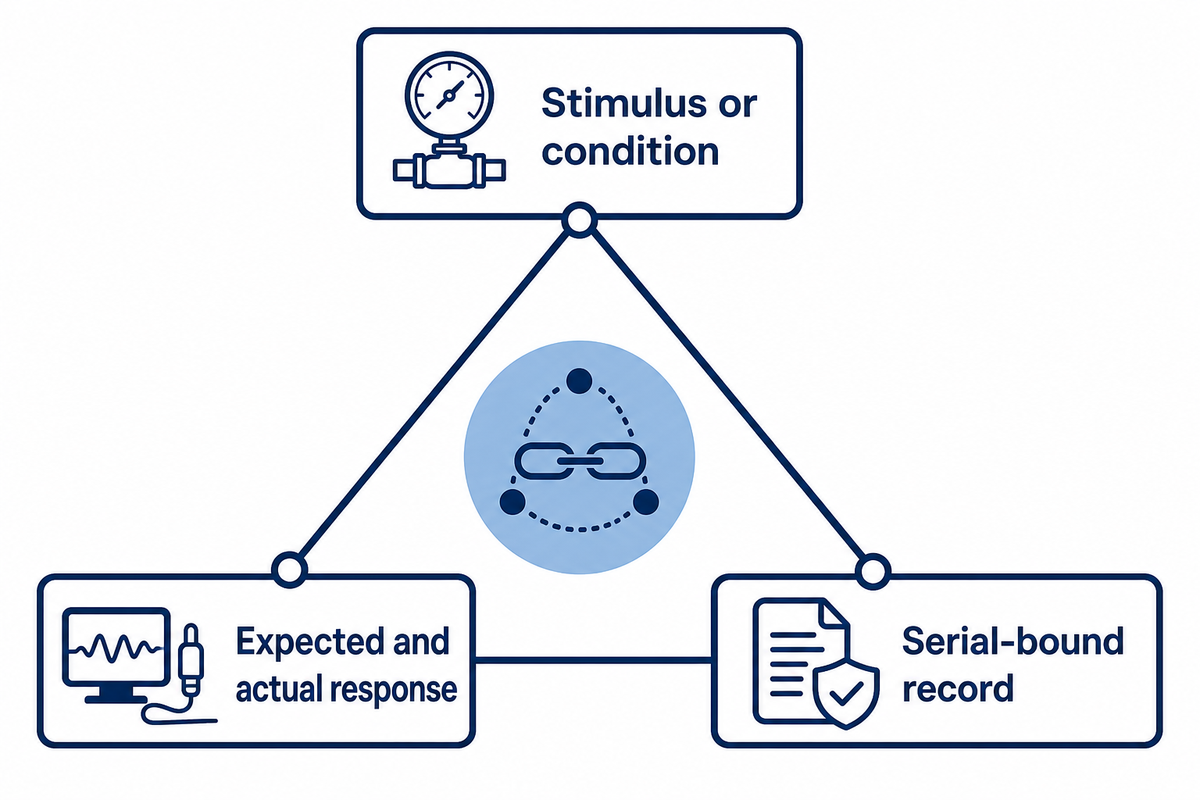
The Stimulus-Response-Record Triangle turns a witnessed demonstration into repeatable evidence. The test line describes a controlled condition and states anticipated and observed (or recorded) behaviors. It also indicates the outcome and ties it to the chamber, if applicable, and the record (or journal) entry. Absent these links, the record is incomplete. An observation doesn’t constitute a validated record. NIST’s traceability framework supports linking a measurement result to a documented chain; the three-part triangle itself is this guide’s buyer-control synthesis, not a standard-defined method.
- Stimulus or condition: identify the approved starting state, action, simulation, or measurement condition.
- Expected and actual response: copy the expected behavior from the controlled basis, then record what happened without rewriting the requirement.
- Serial-bound record: preserve raw readings or observations, unit identity, instrument, evidence file, witness, exception, result, restoration, and retest link.
The triangle quickly brings out poor records. A response without a controlled stimulus is of no use. A stimulus without an expected result is of no significance. A result without a serial, revision, or evidence reference is likely to belong to some other build. The buyer can perform the above three checks while the FAT evaluation is in progress.
Use the same row structure for things like physical measurements, control response reviews, software role checks, and record review checks. The evidence object changes, but the logic does not. The method is a buyer control proposed in this guide, not a named ASME, FDA, IEC, or UHMS requirement.
Deviation Closure and the FAT Sign-Off Decision
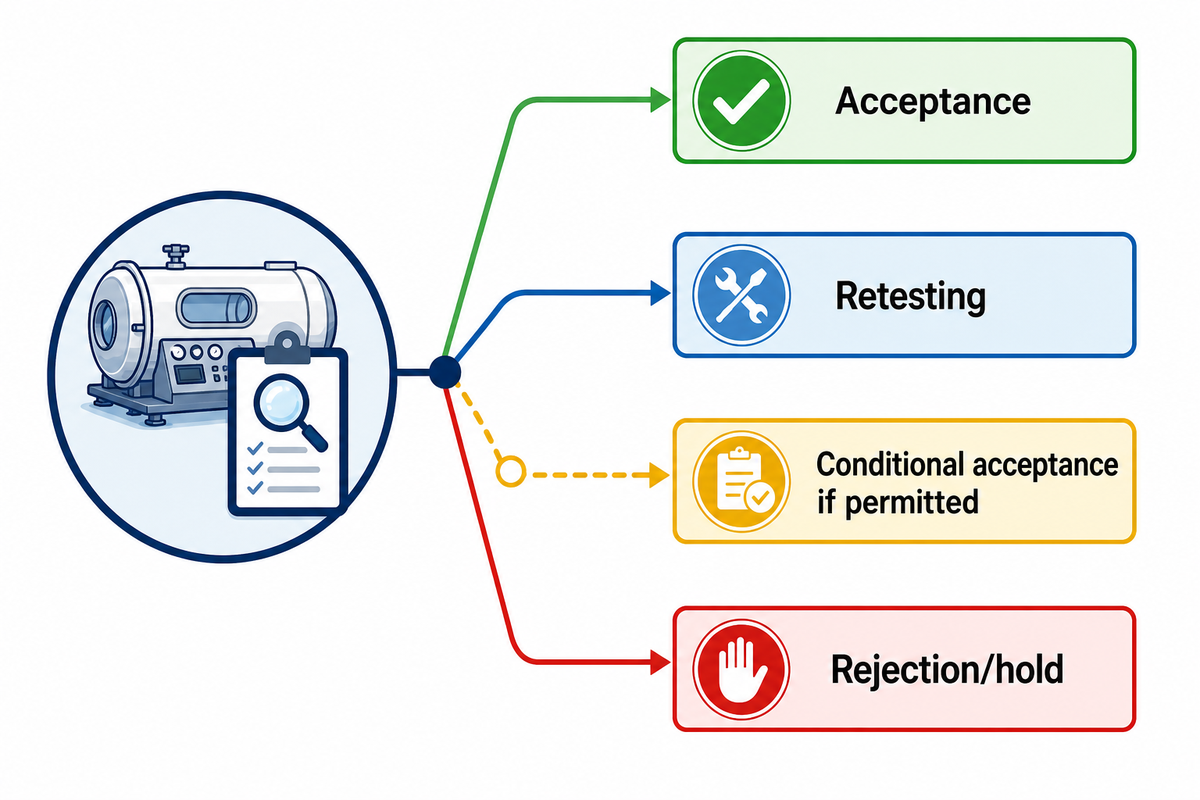
A buyer should be allowed to review and sign off on a disposition basis only after he/she has seen: what met the basis, what failed, what changed, what was retested, and who will authorize the disposition. Making impatient demands about closing the deal won’t make a safety or mandatory integrity gap a minor anomaly. Only within the limits defined by the controlling contract will a condition be accepted. In the reviewed NOAA/U.S. Navy service record, a discrepancy-repair-retest-approval trail is visible; the record does not supply a commercial acceptance threshold or concession authority.
| Observed condition | Immediate decision | Evidence needed to close |
|---|---|---|
| All criteria met and records complete | Accept FAT scope | Signed report and closed register |
| Correct result, missing raw file | Hold evidence line | Recovered authenticated file or safe retest |
| Wrong unit or revision tested | Reject result | Test the approved identified build |
| Instrument unsuitable for decision | Retest | Fit instrument chain and new result |
| Criterion not agreed | Hold | Approved criterion and decision rule |
| Mandatory witness point missed | Open process deviation | Authorized waiver or safe repeat |
| Function fails | Correct and retest | Root cause, correction and linked retest |
| Correction affects other lines | Expand retest scope | Impact review and affected results |
| Unspecified fitted feature | Configuration review | Approved build decision and updated baseline |
| Open mandatory safety evidence | Reject or hold | Required scoped evidence |
| Minor item eligible for concession | Conditional only if permitted | Scope, owner, deadline and approver |
| FAT met but site duties remain | Accept FAT, preserve handoff | Open downstream owner register |
Every deviation should have an ID, requirement, evidence, classification basis, owner, and either containment or correction. There should be an affected test review and retest result. There should be a closure authority and a closure date. The FAT report should be clear regarding whether the final signature on the protocol documents covers all of the protocols or only individual lines.
There are four possible outcomes for the buyer. These are acceptance, retesting, conditional acceptance if permitted, and rejection/hold. A concession won’t remove the effect of failing to satisfy a mandatory requirement. It will state the remaining requirement, the party responsible for meeting the requirement, the time within which it must be performed, and whether shipment or site work can be performed.
FAT-to-Operation Handoff After the Factory Signature
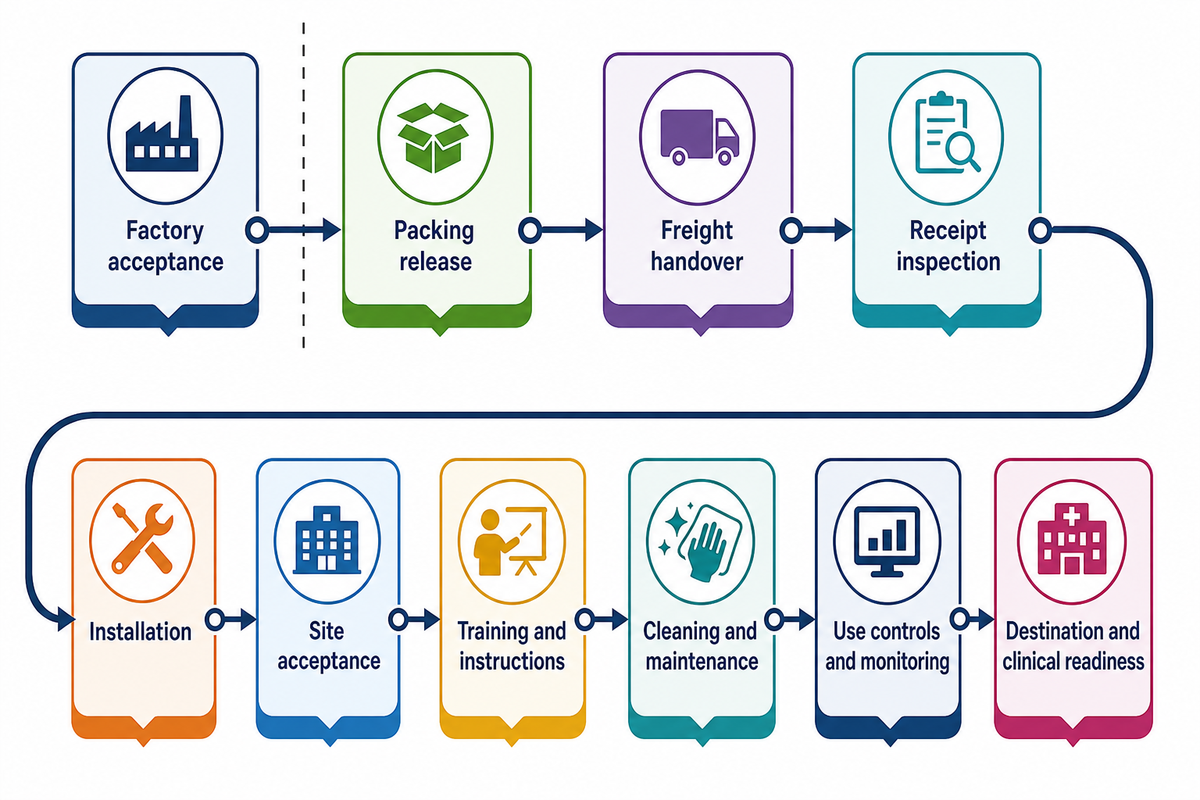
A FAT signature only closes the defined factory scope. There are separate processes for packing release, freight handover and receipt, installation, utilities, on-site acceptance, oxygen-delivery readiness, training, cleaning and preventative maintenance, routine checks, control of prohibited items, monitoring, destination verification, and clinical readiness. Each of these is initiated by a separate decision.
IEC 62381:2024’s public description separates factory acceptance, optional factory integration, site acceptance, and site integration for process-industry automation. It is not a hyperbaric mandate. Its value here is the planning lesson: test stages and responsibilities should be named instead of collapsed into one approval.
| Gate | Evidence owner | Decision | Part of FAT? |
|---|---|---|---|
| Factory acceptance | Supplier and named buyer witnesses | Does the identified build meet the agreed factory basis? | Yes |
| Packing release | Supplier release authority | Is the accepted unit protected and complete? | Only if contract includes it |
| Freight handover | Shipper and carrier | Did custody transfer in recorded condition? | No |
| Receipt inspection | Consignee | Did transit change condition or completeness? | No |
| Installation | Qualified installer | Is the system installed to controlled instructions? | No |
| Site acceptance | Buyer and site team | Does the installed system meet the site basis? | No |
| Training and instructions | Employer and qualified trainer | Are assigned people prepared for their roles? | Handoff evidence only |
| Cleaning and maintenance | Facility maintenance owner | Are schedules, parts and records controlled? | Handoff evidence only |
| Use controls and monitoring | Facility leadership | Are prohibited items, clothing and monitoring controlled? | No |
| Destination and clinical readiness | Regulatory and clinical authorities | May the chamber be placed into its intended service? | No |
While FAT acceptance closes the factory gate, a buyer can keep downstream gates open as long as the handoff is controlled. The FAT report should list any owner-requirements so the accepting signature doesn’t release the shipment, accept the end-item system, or give clinical approval.
Prospective clients can consider options in the product family and review hard medical hyperbaric chamber alternatives. The product site describes the general features of the product line; the FAT report describes how the features of the ordered product are implemented.
Frequently Asked Questions
The answers to the remaining questions usually address waivers and sign offs. These answers, like the answers to the other questions, explain that a FAT is a controlled factory action for a particular chamber and shouldn’t be mistaken for a downstream decision.
What should a buyer witness during a hyperbaric chamber factory acceptance test?
A buyer should witness chamber identity, prerequisite and instrument review, the approved pressure and leak sequence, door and seal behavior, fitted controls, alarms, interlocks, communication and emergency functions, and software/configuration evidence where applicable. The witness should see raw readings and evidence references rather than a pass stamp. Each deviation needs an owner, correction, retest result, and documented closure before final sign-off.
Who should attend and sign a hyperbaric chamber FAT?
The supplier should name the test lead and the people authorized to record results, correct findings, and sign for the manufacturer. The buyer should name a technical or quality witness with authority to accept evidence, open deviations, request a safe retest, and withhold signature. Third-party inspectors may witness agreed lines, but their role and limits belong in the protocol. The signature block should identify each person, organization, role, date, and any unresolved condition.
Is factory acceptance the same as site acceptance?
No. Factory acceptance examines the identified chamber at the supplier’s facility against an approved factory protocol before shipment. Site acceptance examines the delivered and installed system under the destination site’s utilities, interfaces, environment, and local responsibilities. Transport condition, installation work, site services, training, permits, and use readiness can change what still needs verification. A FAT result therefore becomes an input to site acceptance, not a substitute for it.
What records should be attached to the FAT report?
Attach the approved protocol, controlled build baseline, unit identity, instrument and calibration references, raw observations, evidence-file index, witness signatures, deviations, correction evidence, retest results, approved waivers, and final disposition.
Can a buyer waive a live witness point?
A buyer may waive a live witness only when the contract and approved protocol permit it and an authorized buyer representative records the decision before the test. The waiver should identify the exact test line, why attendance is being waived, what substitute evidence is required, how unit identity and timing will be preserved, who may review the evidence, and what happens if the record is incomplete. A waiver isn’t deletion of the requirement or acceptance of a failure. Hold points should remain stopped until the named buyer authority releases them. Safety-critical steps, configuration discrepancies, or unresolved deviations may require attendance or retest rather than remote evidence. If the supplier already completed a mandatory witness step without notice, the buyer should record that process deviation and decide whether the test can be repeated safely under the approved method.
Does a completed FAT prove regulatory approval or clinical readiness?
No. A completed FAT can show that one identified build met the agreed factory protocol and criteria. It doesn’t prove market authorization, every jurisdiction’s requirements, installed-room readiness, operator competence, treatment suitability, or clinical commissioning.
Request a Model-Specific FAT Plan
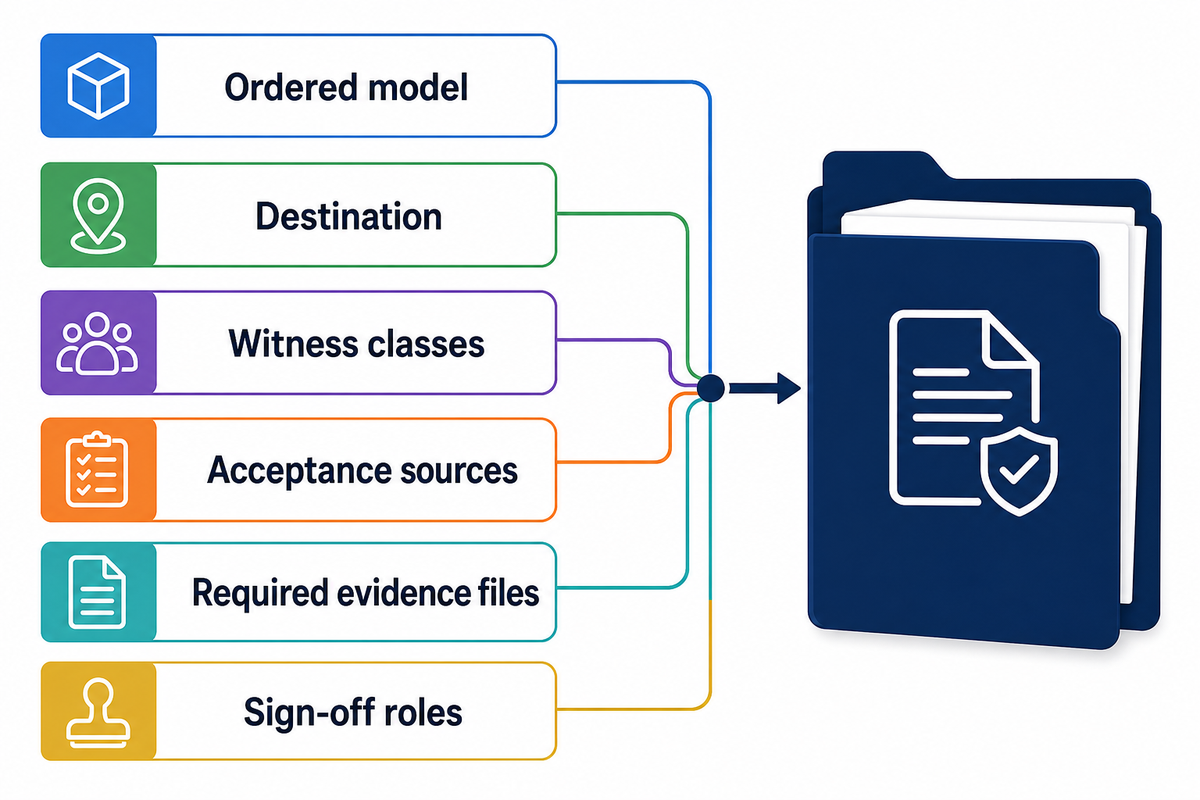
Send MACY-PAN the ordered model, destination, witness classes, acceptance sources, required evidence files, and sign-off roles before the factory test is scheduled. The team can map those requirements to the quoted chamber build.
Scope and transparency
This buyer template doesn’t publish universal pressure, leakage, alarm, interlock, oxygen, electrical, or relief criteria. Apply the purchase contract, approved model protocol, manufacturer instructions, current scoped standards, destination rules, and qualified technical review to the specific chamber.
Related buying resources
- Hyperbaric chamber RFQ checklist for setting requirements before the order
- OEM hyperbaric chamber guide for customization ownership
- Hyperbaric certification decoder for document-scope questions
- Hard medical hyperbaric chambers for configuration review
References & Sources
- ASME, PVHO-1:2023 public scope
- U.S. FDA, Follow Instructions for Safe Use of HBOT Devices
- U.S. FDA, Recognized Consensus Standard record 1-181
- NIST, Metrological Traceability guidance
- ILAC, Guidance series including decision-rule and measurement-uncertainty guidance
- IEC, IEC 62381:2024 public description
- NOAA, Operating Standards for Hyperbaric Chambers
- UHMS, Standards and Codes FAQ
- Element, Test Protocol for Medical Devices