Get in Touch with MACY-PAN Company


This is a hyperbaric chamber OEM project brief used by the buyer to communicate requirements to potential vendors. This hyperbaric chamber OEM project brief is a guide used by the buyer to help potential vendors understand constraints, preferences, options, unresolved requirements, and items open to change-order requests before requests for proposals (RFP) are issued. It also defines the persons (or organizations) that will validate the requirements, the type of (if any) information that’s to be submitted by the prospective vendor, and assumptions to be included in the proposal.
Direct answer: put program identity, intended use, destination, chamber configuration, customization, compliance roles, commercial scenarios, approval gates, logistics, service, and document control into one revision-controlled brief. Mark every field with an owner and status. Leave MOQ, tooling, lead time, price, and certification applicability for written supplier or destination-market confirmation.
Key takeaways
- A project brief is not the supplier’s quotation, contract, quality agreement, or regulatory submission.
- Use 6 field statuses: Fixed, Preferred, Optional, TBD, Supplier Proposal, and Not Applicable.
- Record both the task owner and the legally accountable entity; a commercial agreement cannot override destination law.
- Compare assumptions, exclusions, alternatives, one-time charges, and evidence scope before comparing prices.
10 blocksOne quote-readiness brief
6 statusesNo blank-field assumptions
2 ownersTask and legal responsibility shown separately
What Decision Should a Hyperbaric Chamber OEM Project Brief Produce?
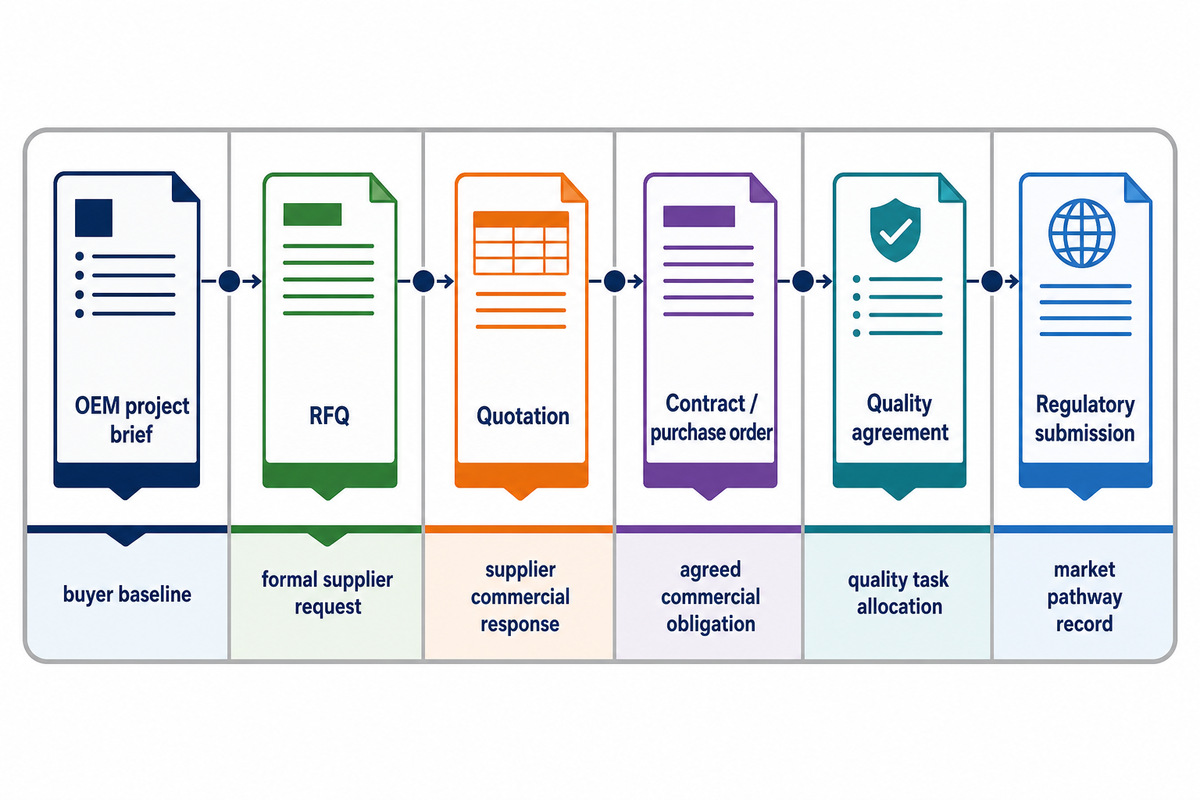
The brief should produce one reviewable baseline: In its technical evaluation, the supplier can confirm a requirement, question it, identify a capability limit or exclusion, or return a documented alternative; it should also flag critical areas, incomplete inputs, and technical requirements that aren’t clearly defined. The buyer can then decide what enters the quoted base scope. The document does not award the order or prove that a proposed configuration is approved for a destination.
That boundary protects adjacent tasks. Use the hyperbaric chamber RFQ checklist to assemble broader supplier questions, and the OEM hyperbaric chamber manufacturing guide for general supplier-selection context. This article owns only the controlled project input that makes later answers and quotations comparable.
Development boundary: the brief supports project management for a new project, but it does not replace medical device development, product development, medical device design, design control, risk management, design validation, usability engineering, or the applicable quality management process. It records the inputs, owners, and handoffs that the responsible teams must carry into those activities.
| Document | Primary job | Issued by | Not a substitute for |
|---|---|---|---|
| OEM project brief | Defines buyer inputs, owners, statuses, and requested evidence | Buyer or brand program team | Supplier feasibility review |
| RFQ | Requests a formal response against the brief | Buyer | Quotation |
| Quotation | Returns price, timing, assumptions, exclusions, and terms | Supplier | Contract |
| Contract / purchase order | Creates the agreed commercial obligation | Both parties | Quality or regulatory duties |
| Quality agreement | Allocates quality-system tasks and records | Named quality entities | Nondelegable legal accountability |
| Regulatory submission | Supports a stated market pathway | Applicable legal sponsor or submitter | Commercial quote acceptance |
Document the activity each party actually performs; do not let the commercial label “OEM” assign legal duties.
Key takeaway: the project brief freezes the question set. The supplier’s written response turns unknowns into proposals; the buyer’s approved revision turns selected proposals into the next baseline.
Lock Program Identity, Intended Use, Destination, and Decision Owners
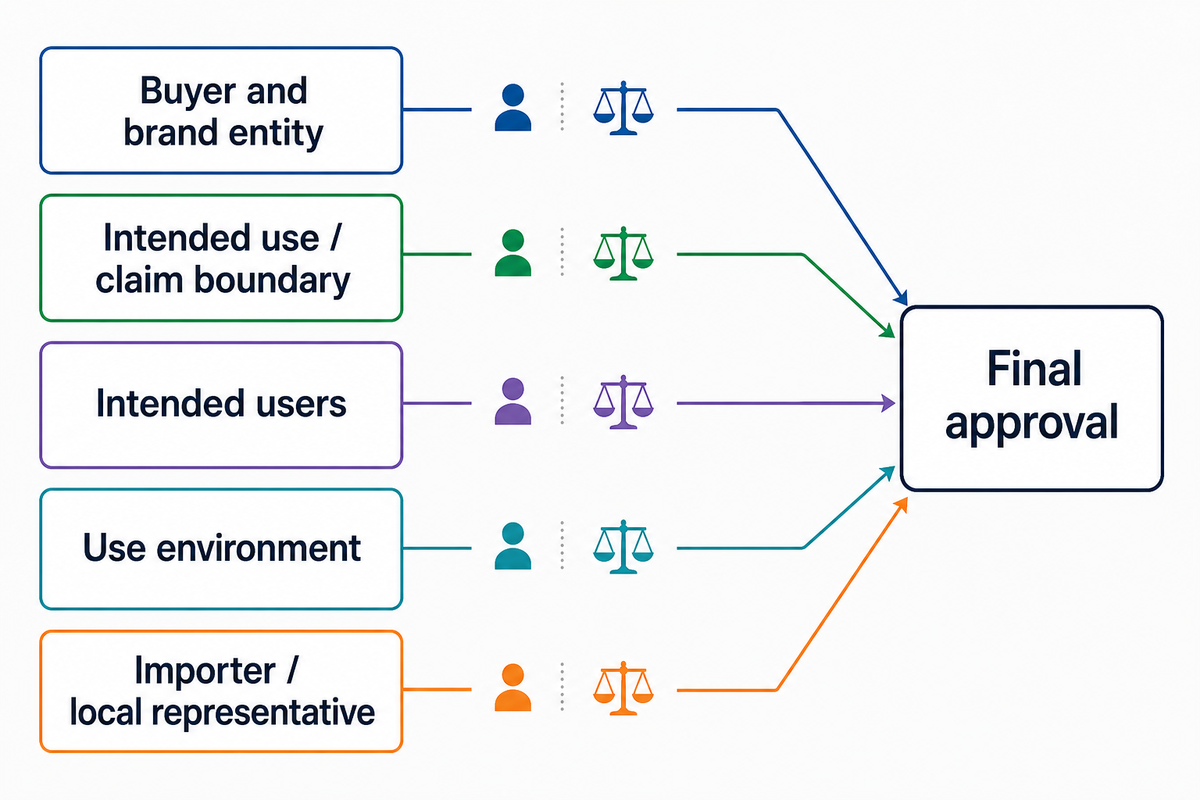
Choose the operating model, decision owners, and customer or distributor team before approving the logo and buyer baseline. You will provide or name the following: buying entity, brand owner, proposed manufacturer, targeted jurisdiction, intended use, intended users, user environment, claims, importer/representative, and decision maker. These fields determine which label, evidence, language, and review questions belong in the quotation.
The FDA activity table distinguishes manufacturers, specification developers, contract manufacturers, relabelers, and initial importers. “OEM” is not one of those operating models. For the European Union, Regulation (EU) 2017/745 also makes own-name or own-trademark placement a material role question under Article 16, subject to the regulation’s stated exception.
Intended use is only one line. FDA’s human-factors material separates users, use environments, and user interfaces. A home user, clinical operator, installer, cleaner, and service technician can each require different instructions, controls, alarms, training, or maintenance information.
| Decision field | Task owner | Legal-accountability check | Required output |
|---|---|---|---|
| Buyer and brand entity | Commercial lead | Destination reviewer | Exact legal names and addresses |
| Intended use / claim boundary | Product lead | Qualified regulatory reviewer | Approved wording or Legal Review status |
| Intended users | Product and training leads | Market-specific review | User groups and competency assumptions |
| Use environment | Site lead | Facility / destination review | Home, clinic, wellness, or other stated setting |
| Importer / local representative | Market-access lead | Destination law controls | Named entity or TBD owner/date |
| Final approval | Named project manager | Cannot waive statutory duties | Signed revision and question log |
Key takeaway: show task ownership and legal accountability in separate columns. If either is unknown, assign the question to a named reviewer and due date instead of guessing.
Describe the Chamber Platform and Configuration Envelope
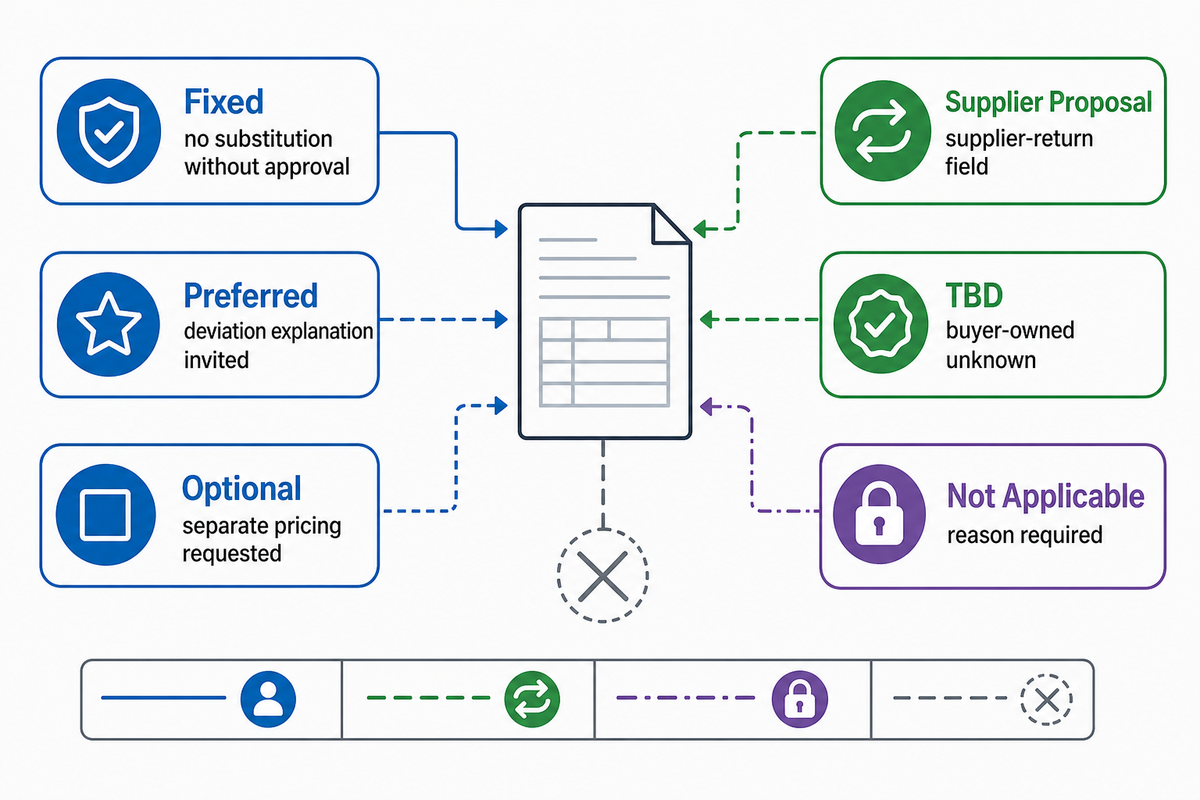
The configuration envelope should state what the buyer requires without inventing supplier performance. At the level of detail needed for evaluation, record the reference platform, capacity, dimensional constraints, relevant technical specifications, controlled drawing references, operating temperature inputs, site interfaces, accessories, controls, user interface, alarms, instructions, training, grounding or fire-control needs, and permitted alternatives. Every technical value must show its source or remain TBD.
Use status labels consistently: Fixed means no substitution without approval; Preferred invites a deviation explanation; Optional requests separate pricing; TBD remains buyer-owned; Supplier Proposal asks the manufacturer to return a value; and Not Applicable needs a reason. Blank cells are prohibited because they let each supplier make a different assumption.
Illustrative Project Echo: The examples below have been provided to illustrate how buyer/site limits are captured and a supplier is requested to respond. These don’t represent MACY-PAN limits, recommended chamber limits, supplier commitments or other specific limits.
| Input category | Illustrative buyer/site record | Required supplier response |
|---|---|---|
| Room envelope | 4,000 mm × 3,000 mm × 2,600 mm | Offered footprint and clearances |
| Delivery opening | 900 mm × 2,050 mm | Handling plan and dismantling assumptions |
| Access / service | 1,100 mm corridor; 500 mm service zone | Required access and maintenance clearance |
| Floor / handling review | 1,000 kg site review; 1,200 kg handling limit | Actual unit and packed mass |
| Electrical interface | 230 V, 50 Hz, 16 A, 2.0 kW available | Required supply and exclusions |
| Operating environment | 10 °C–30 °C; 30%–75% RH | Manufacturer-stated operating range |
| Connection routes | 15 m cable route; 3 m hose route | Included lengths and site work |
| Crate envelope | 2,400 mm × 1,200 mm × 1,400 mm maximum | Proposed packed dimensions |
| Storage envelope | -10 °C–45 °C; 20%–80% RH | Manufacturer-stated storage conditions |
| Commercial clocks | 10 days requested response; 30 days requested validity | Supplier-confirmed response and validity |
It is requested that evidence be provided for limits rather than universal limits for safety-related interfaces. FDA’s August 25, 2025 HBOT communication emphasizes device-specific instructions, training, grounding, cleaning, maintenance, safety checks, and prohibited-item controls. The brief should request the applicable manufacturer instructions and proposed evidence package; it should not create a global pressure, oxygen, electrical, or inspection limit.
| Configuration item | Buyer entry | Status | Supplier return |
|---|---|---|---|
| Reference platform | Model/family or functional reference | Fixed / Preferred | Exact offered configuration and revision |
| Capacity and access | User capacity, room and access constraints | Fixed / TBD | Dimensions, mass, handling assumptions |
| Electrical / gas interfaces | Destination and known site inputs | TBD if unverified | Required utilities and exclusions |
| Controls and alarms | Required functions and user groups | Fixed / Preferred | Function list and verification evidence |
| Accessories | Base, optional, and spare items | Fixed / Optional | Compatibility and separate pricing |
| Safety instructions | Destination/user needs | Supplier Proposal | Applicable instructions, controls, and records |
| Connectivity trigger | Remote monitoring/network/software present? | Yes / No / TBD | Architecture, supported baseline, update path |
If connectivity is present, add a conditional cybersecurity branch. FDA’s cyber-device FAQ describes a United States definition involving software, internet connectivity, and vulnerability characteristics; related evidence can include vulnerability processes, updates or patches, and a software bill of materials. Do not assume every chamber is a cyber device or project one country’s rule worldwide.
Key takeaway: define the envelope, then ask the supplier to fill the engineering gaps. Keeping a clear TBD with an owner is safer than inserting an unsupported exact value.
Define Branding, Localization, and Packaging Customization
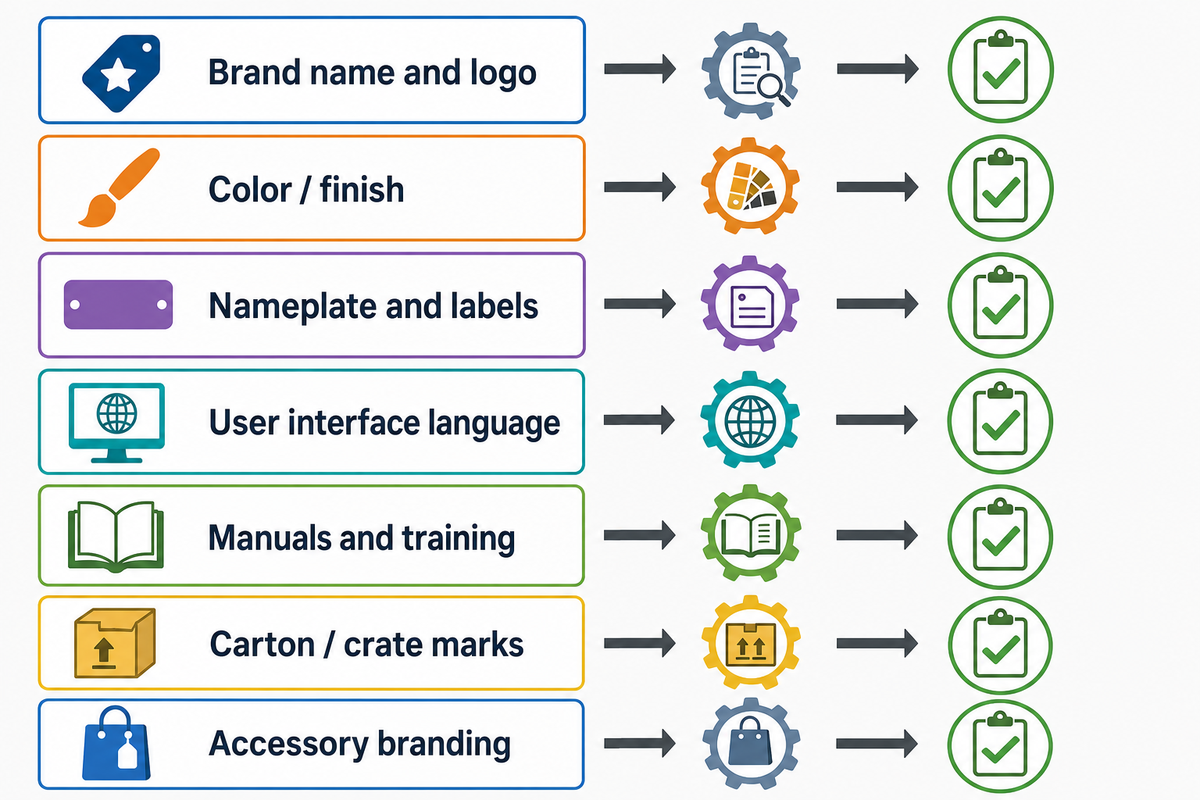
Private label is more than applying a logo. Separate cosmetic elements from controlled labels, nameplates, instructions, interface language, packaging, and source files. For each item, name the buyer input, supplier feasibility check, proof format, approver, and revision. Availability may differ by platform, quantity, and destination.
The live MACY-PAN OEM and wholesale program is the first-party source for its current customization boundary. It supports asking about private-label and custom-design options, but it does not make every requested color, label, interface, package, or evidence set automatically feasible for every configuration.
| Customization item | Buyer must supply | Supplier must confirm | Approval evidence |
|---|---|---|---|
| Brand name and logo | Vector files and usage rules | Placement, process, durability | Dated artwork proof |
| Color / finish | Reference system and tolerance expectation | Material/process feasibility | Approved sample or limit sample |
| Nameplate and labels | Approved legal content and language | Format, material, application | Controlled artwork revision |
| User interface language | Terminology and locale | Available strings and display limits | Screen review record |
| Manuals and training | Required languages and audiences | Translation/source-file workflow | Approved document revision |
| Carton / crate marks | Brand and destination markings | Packing method and printable area | Before-seal proof |
| Accessory branding | Included item list | Compatible branding method | Sample and packing-list match |
The FDA’s labeling page outlines approval, inspection, storage, and release of labeling, along with change control. Its terminology reflects the older quality-system wording, so use it for the concrete control concept, not as a substitute for the current QMSR. A logo proof cannot approve legal label content; those decisions need the named accountable reviewer.
The visuals and legal text should be approved individually, and then both should be frozen to a single version before being translated and typeset for production.
Assign Compliance Evidence and Approval Responsibilities
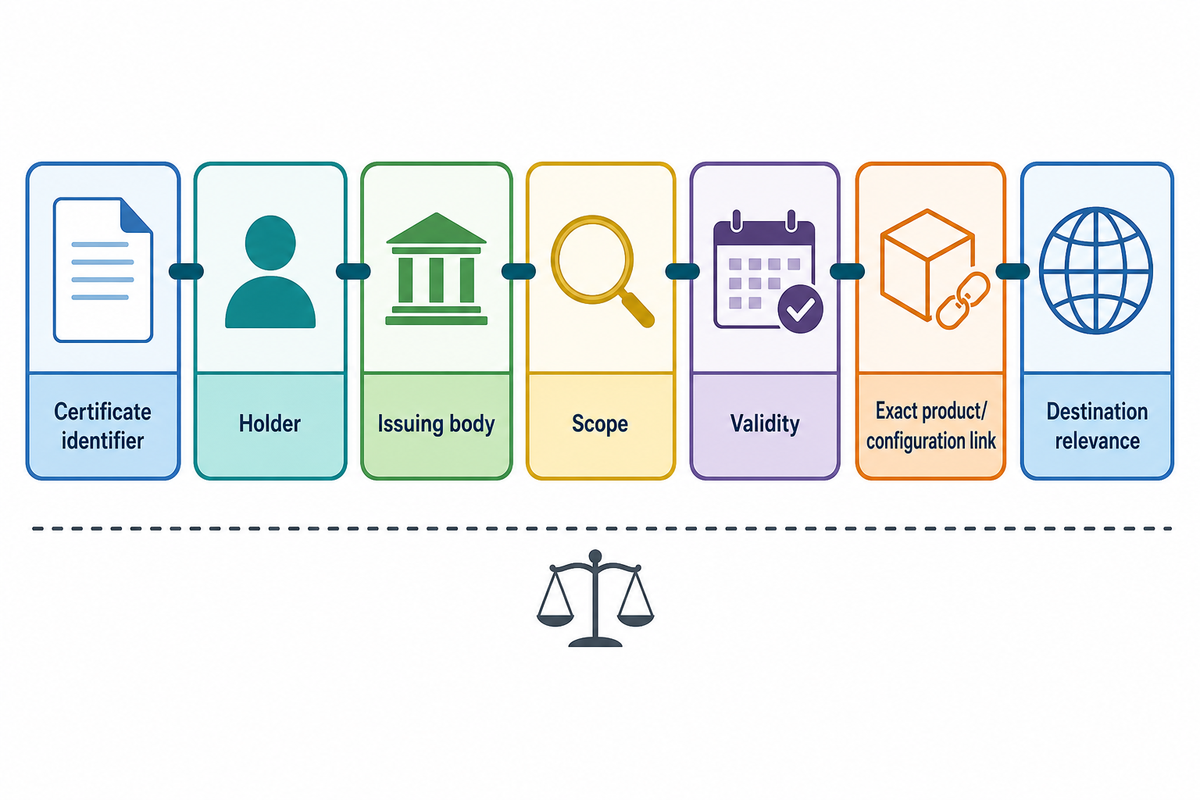
The brief should require the provision of evidence and name the decision owners, where appropriate, without endorsing or providing legal advice. Provide the proposed legal role, the operational task owner, the evidence required, the status of the role, and any outstanding issues for each jurisdiction. A supplier certificate doesn’t by itself confirm that coverage exists for the product, service, configuration, claims, labeling or destination at issue.
FDA states that its Quality Management System Regulation became effective on February 2, 2026 and incorporates ISO 13485:2016 by reference while retaining FDA-specific provisions. ISO’s public catalog identifies ISO 13485:2016, Edition 3. Neither page proves that a named supplier’s certificate is current or covers this private-label chamber.
| Evidence question | Operational task owner | Legal-accountability check | Status / proof |
|---|---|---|---|
| Intended use and claims | Buyer product lead | Destination regulatory owner | Verified / Legal Review |
| Legal manufacturer identity | Joint mapping | Destination law controls | Named entity and label evidence |
| Importer / representative | Buyer market lead | Local qualification | Contract and registration evidence |
| Product classification / pathway | Qualified reviewer | Regulator-specific | Written rationale, not sales copy |
| Quality-system certificate | Supplier quality | Certificate is not product approval | ID, issuer, scope, validity |
| Configuration coverage | Supplier technical lead | Qualified review | Exact model/revision link |
| Label and language approval | Artwork owner | Legal label owner | Controlled approved proof |
| Technical document handoff | Supplier documentation | Retention/access duty checked | Index, format, revision, access |
| Change assessment | Joint change board | Submission impact owner | Approved impact record |
| Release decision | Named project/quality approver | Cannot waive statutory duty | Signature, date, scope |
In the operating model described on FDA’s 510(k) page, the specification developer introducing a device to the United States market submits the 510(k), not the contract manufacturer. This example focuses on the United States and is not a universal rule or conclusion about unnamed entities. It shows why the brief must describe actual activities before allocating responsibilities.
Certificate check: request the certificate identifier, holder, issuing body, scope, validity, exact product/configuration link, and destination relevance. If one item is missing, record Pending or Legal Review, not “certified.”
Contract terms can allocate work and evidence delivery, but destination law determines which legal accountability can or can’t be delegated.
Give the Supplier the Commercial Inputs Needed to Quote
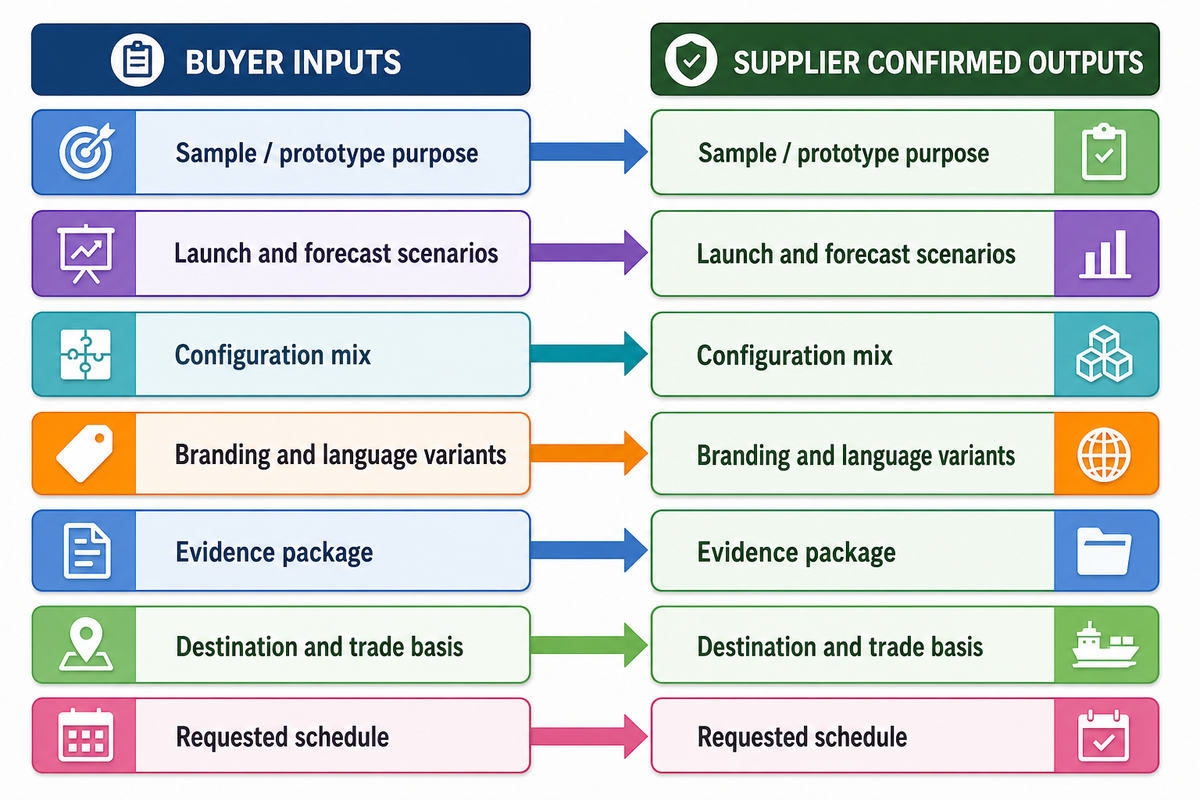
RFQ preparation begins with demand scenarios and scope dependencies from the buyer; the supplier returns commercial outputs. State sample needs, launch quantity, forecast bands, option mix, destinations, packaging variants, requested services, artwork status, evidence package, and desired trade basis. Do not insert an invented minimum order quantity, tooling fee, unit price, or lead time.
Illustrative scenario only: (Scenario description only) Buyers will ask for pricing for 1 sample unit, 10 unit launch, 50 unit and 100 unit (annual/scale) scenarios for 2 locations and 3 language packs. This example represents a format only and shouldn’t be construed to represent a MACY-PAN commitment, minimum or forecast.
| Buyer input | Why it changes the quote | Supplier-confirmed output | Comparison field |
|---|---|---|---|
| Sample / prototype purpose | Determines build and evidence scope | Availability, charge, timing | Separate from production price |
| Launch and forecast scenarios | Sets pricing basis and capacity assumptions | MOQ and price breaks | Scenario-by-scenario |
| Configuration mix | Changes parts, labor, and testing | Base/option pricing | Exact included revision |
| Branding and language variants | Changes artwork and document work | One-time and recurring charges | By variant |
| Evidence package | Adds review, test, and documentation scope | Included records and extra fees | Document-by-document |
| Destination and trade basis | Changes packing, freight, and handoff | Incoterm, freight, exclusions | Same destination/basis |
| Requested schedule | Reveals material, approval, and capacity dependencies | Sample and production lead time | From the same approval milestone |
The live MACY-PAN OEM program page varies minimum order terms by tier and does not publish a universal tooling amount. Keep both as Supplier Proposal until the written quote names the selected configuration, tier, quantity, artwork status, evidence work, destination, and assumptions.
Key takeaway: The main thing to know is that volume is an input; MOQ, tooling, lead time, and price are returned outputs. Compare these only when their scope basis is the same.
Set Sample, Verification, Acceptance, and Change-Control Gates
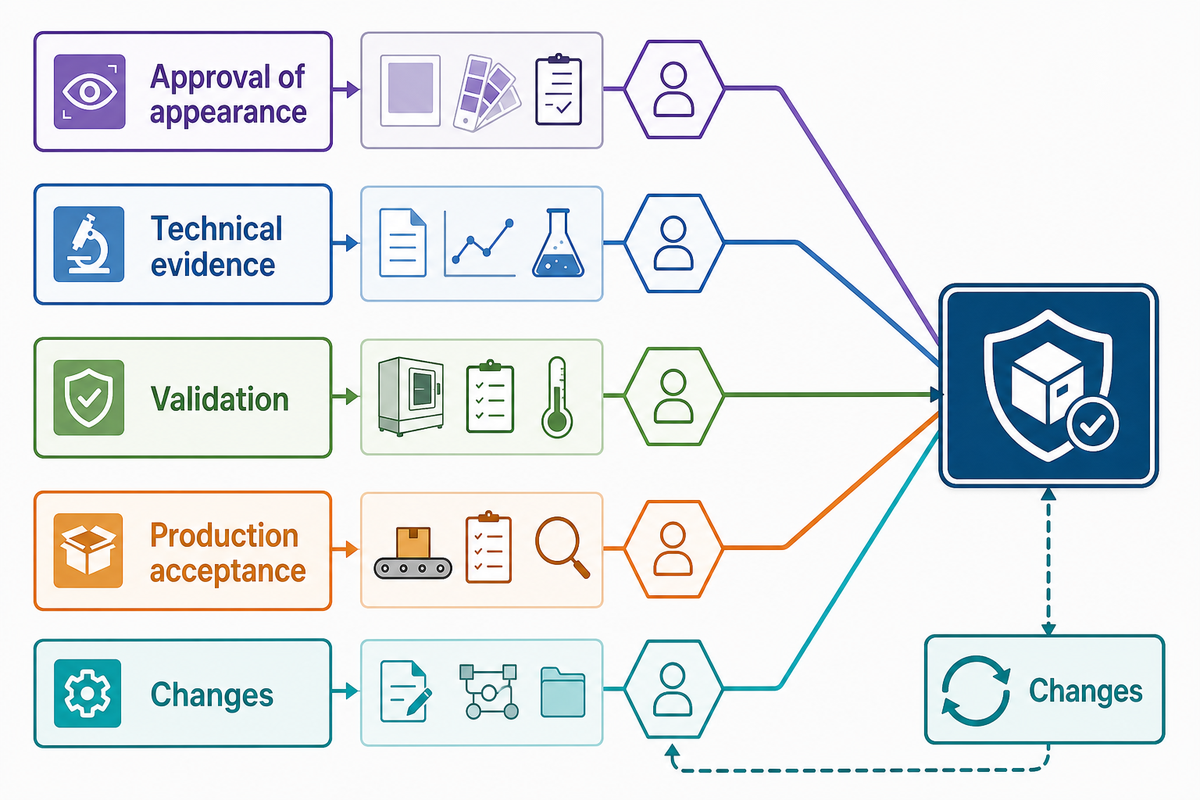
Summarize what each sample demonstrates and what it fails to demonstrate. A visual sample can approve color and logo placement without approving performance, labeling, documents, packaging, or production consistency. The brief should include what evidence was reviewed, the name of the approver, the release decision, and the change rule at each gate from feasibility to production baseline.
| Gate | Evidence expected | Approver | Release decision | Change rule |
|---|---|---|---|---|
| Feasibility | Requirement response and open questions | Buyer + supplier leads | Quote / clarify / decline | Redline before quote |
| Artwork proof | Rendered label/package files | Brand and legal label owners | Approve file revision | New revision for any content change |
| Appearance sample | Color, finish, placement | Product / brand lead | Approve visual baseline | Limit sample retained |
| Engineering sample | Configuration and functional evidence | Technical reviewer | Verify stated requirements | Impact review for changes |
| Validation boundary | Defined use/user/environment evidence | Accountable validation owner | Separate stated decision | Do not infer from sample approval |
| Golden sample | Approved physical/configuration reference | Named joint approvers | Freeze production comparison | Controlled replacement only |
| Pilot / first article | Production-method evidence | Quality and buyer | Release or correct/retest | Record deviations |
| Production acceptance | Agreed unit/lot records | Named release authority | Accept / hold / reject | No silent waiver |
| Post-approval change | Description, reason, impact, verification | Change board + legal owner | Approve before implementation | New baseline and effective date |
Med Tech industry guidance pertaining to change management and design transfer covers the control of impacted documents, traceability, approved changes, verification, and design transfer. Use it as practical guidance, not as a substitute for applicable regulation or the parties’ quality system.
Where the chamber-specific safety communication applies, include manufacturer instructions, grounding, cleaning, maintenance, safety checks, training, and prohibited-item controls in the proposed evidence plan. The supplier should identify what it can verify at factory and what remains site-owned.
Key takeaway: Pull apart the five gates (approval of appearance, technical evidence, validation, production acceptance, and changes). A single signature won’t replace the other four.
Capture Logistics, Service, and Lifecycle Inputs
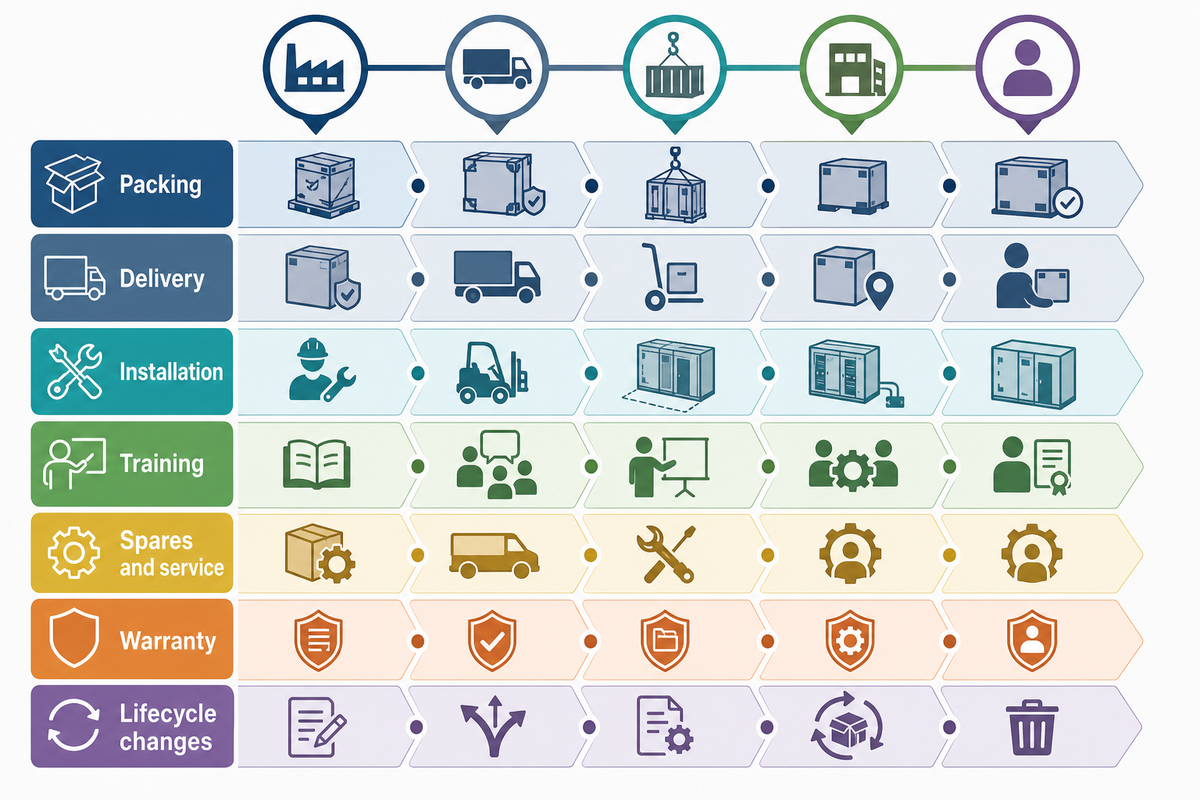
Different factors beyond unit price affect a project’s overall scope. These inputs include packing, delivery points, freight responsibility, on-site installation, training, spare parts, warranty, support routes, document updates, software support when present, and change or end-of-life notifications. Each of these must be defined to indicate if they’re included in the scope of the project, and if so, to what extent. These are captured in supplier-return fields.
- Packing: crate or other method, marks, preservation, included photographs, and destination assumptions.
- Delivery: named place, trade basis, custody point, and import responsibilities.
- Installation: supplied work, buyer/site prerequisites, remote versus on-site support, and excluded building utilities.
- Training: audience, language, format, materials, attendance evidence, and the boundary between attendance and competency.
- Spares and service: initial pack, part identification, ordering route, response channel, and any supplier-confirmed availability terms.
- Warranty: start event, coverage, exclusions, labor/travel/freight treatment, and claim process as written in the quotation.
- Lifecycle changes: manual revisions, component substitutions, software updates, security notices, and discontinuation communication.
When applicable connected controls and remote monitoring are configured, add the software baseline, component inventory, vulnerability report, and update/patch path. Add the support period and change notification owner. Keep the branch conditional: connectivity presence, in and of itself, doesn’t define a regulatory pathway.
For route planning, use the worldwide chamber shipping guide as adjacent logistics context. The project brief should still name the actual delivery point, route constraints, included services, and handoff evidence for this program.
Major points: After factory release, all requirements should be placed in a quoted supplier scope or in a hand-off to the named buyer/site. Requirements shouldn’t be left to be assumed.
Build the 10-Block Quote-Readiness Brief
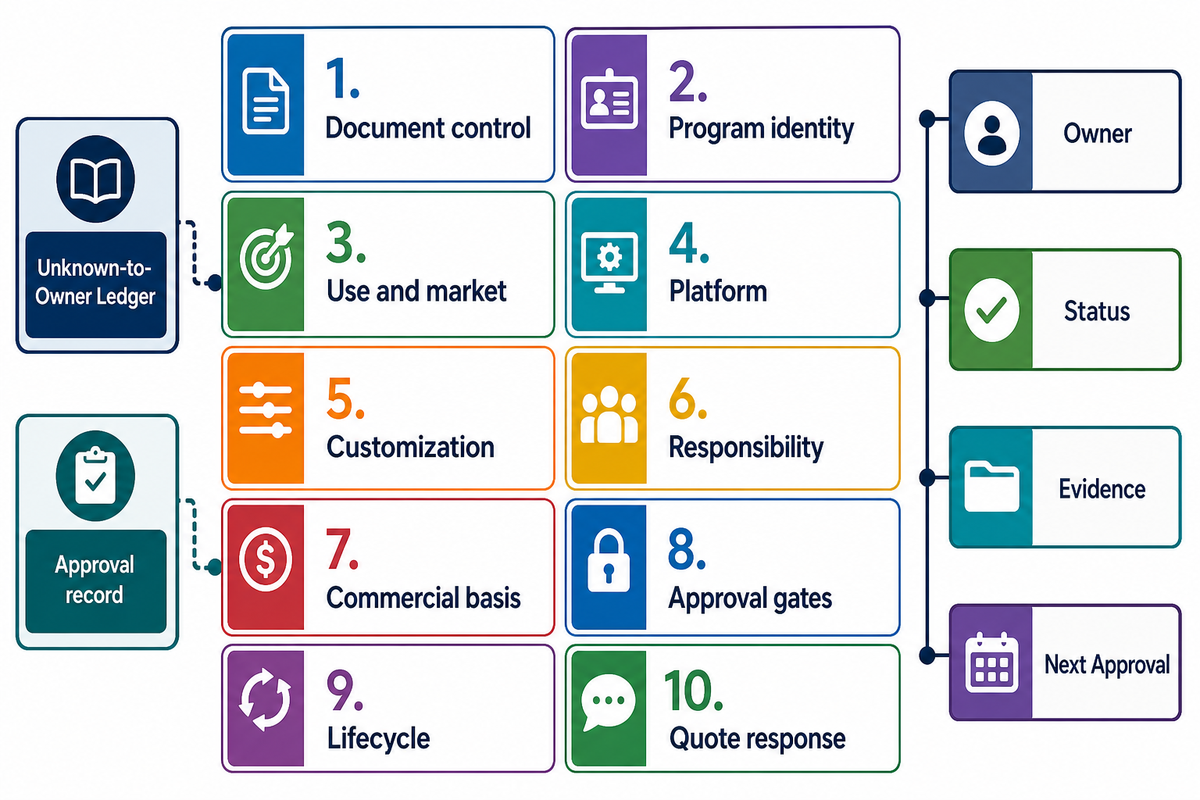
The 10-Block Quote-Readiness Brief turns scattered emails into one controlled buyer document. Every row carries an owner, status, evidence reference, supplier question, and next approval. Use the current MACY-PAN OEM program page only for published customization scope; leave other entries buyer-defined, jointly approved, or supplier-confirmed. Unresolved data stays visible in the embedded Unknown-to-Owner Ledger until a named person closes it.
| # / block | Minimum fields | Owner | Status | Supplier return / evidence |
|---|---|---|---|---|
| 1. Document control | ID, revision, date, issuer, approvers | Project manager | Fixed | Receipt acknowledgment |
| 2. Program identity | Buyer, brand, project, contacts | Buyer | Fixed / TBD | Entity questions |
| 3. Use and market | Intended use, users, environment, destinations | Product + regulatory | Legal Review | Applicability assumptions |
| 4. Platform | Reference model, capacity, constraints, interfaces | Technical lead | Fixed / Preferred | Offered revision and deviations |
| 5. Customization | Logo, color, labels, language, packaging | Brand + legal label owner | Preferred / TBD | Feasibility and proof plan |
| 6. Responsibility | Operational and legal role matrix | Joint | Pending / Legal Review | Evidence and exclusions |
| 7. Commercial basis | Sample, launch, forecast, options, destination | Procurement | Buyer Input | MOQ, tooling, price, lead time |
| 8. Approval gates | Samples, evidence, approvers, change triggers | Quality / technical | Supplier Proposal | Gate plan and records |
| 9. Lifecycle | Packing, freight, install, training, spares, support | Operations | Optional / TBD | Included scope and terms |
| 10. Quote response | Assumptions, exclusions, alternatives, validity | Supplier | Required Return | Completed response matrix |
| Unknown ledger | Field, owner, due date, dependency | Named person | TBD | Question / proposal / evidence |
| Approval record | Decision, signer, date, revision | Authorized approver | Approved / Rejected | Acknowledged baseline |
Worked status example: “Target launch order = TBD” stays in the ledger. The buyer assigns an owner and a 5-working-day internal due date. The supplier returns price breaks and minimum-order constraints as Supplier Proposal. The buyer then approves one scenario as Fixed in Rev 1. The numbers are process examples, not supplier terms.
Key takeaway: A complete brief is one in which an owner has been defined for each unknown. Further, the owner has defined a due date, has identified the knowns (dependencies) required to clarify the unknown, and has defined a route to close the unknown.
Issue a Controlled Brief and Compare Like-for-Like Quotations
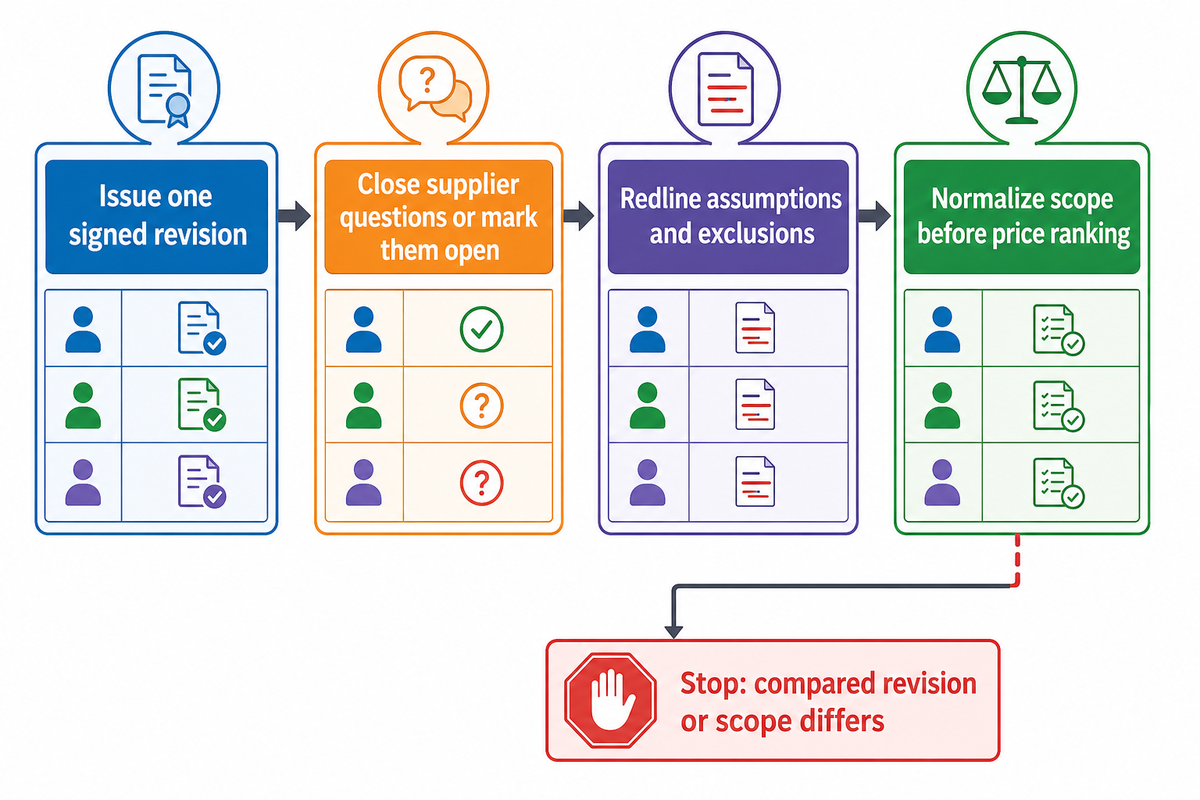
The Redline-Before-Quote Gate requires every supplier to return the same brief revision with questions, deviations, assumptions, exclusions, alternatives, evidence scope, one-time charges, timing basis, and open TBD fields exposed. Only then can procurement normalize the responses before ranking price.
Procurement commentary on distorted supplier quotes makes the practical point: a lower price can reflect different assumptions or transferred risk. Treat that as a procurement comparison method, not medical-device law. The controlled brief supplies the common comparison columns; primary regulatory sources still govern legal-role decisions.
| Normalization line | Supplier A | Supplier B | Buyer decision |
|---|---|---|---|
| Brief revision acknowledged | Rev 1 | Rev 0 | Return B for re-quote |
| Base configuration | Included | Alternative proposed | Technical review |
| Branding / language scope | 3 packs included | 1 pack included | Normalize quantity |
| Evidence package | Listed | Partial / unclear | Clarify before price rank |
| One-time charges | Separated | Bundled | Split for comparison |
| MOQ / price breaks | Supplier confirmed | Not stated | Open item |
| Lead-time start event | Artwork approval | Deposit date | Align milestone |
| Freight / trade basis | Named | Excluded | Normalize destination basis |
| Quote validity | 30 days | Not stated | Request written validity |
| Open legal-role items | Listed as pending | Assumed complete | Qualified review required |
4-step gate: (1) issue one signed revision, (2) close supplier questions or mark them open, (3) redline assumptions and exclusions, and (4) normalize scope before price ranking. If the price refers to a different revision, configuration, evidence package, or timing milestone, the quotation is not yet comparable.
When your brief is ready, send the controlled OEM brief for supplier review. The response to the request for quotation should identify feasibility, alternatives, exclusions, supplier-confirmed commercial terms, and outstanding technical or destination questions while defining technical compliance ownership, evaluation completion, dispute escalation, and the post-award handoff.
Key takeaway: price ranking begins after scope normalization, not before. A cheaper quote against a smaller or different scope is not a saving.
Frequently Asked Questions
What belongs in a hyperbaric chamber OEM project brief?
Include 10 controlled blocks: document control; program identity; intended use, users, environment, and destination; chamber platform; customization; operational and legal responsibilities; commercial scenarios; sample and approval gates; logistics and lifecycle support; and required quotation responses. Give every field an owner, status, evidence reference, supplier question, and next decision. Unknown fields stay visible in the Unknown-to-Owner Ledger.
Is an OEM project brief the same as an RFQ?
No. The project brief is the buyer’s controlled description of the program and its open questions. The RFQ asks suppliers to respond against that brief. A supplier then returns feasibility, assumptions, alternatives, exclusions, commercial terms, and a quotation. The accepted quotation may feed a contract or purchase order, but none of these documents replaces a quality agreement or a required regulatory submission.
Who should define regulatory and certification requirements for a private-label chamber?
The buyer should identify destinations, intended use, claims, brand model, and proposed commercial roles. The supplier should disclose its proposed manufacturing role and provide the requested evidence. A qualified regulatory reviewer should determine the applicable legal roles, pathway, label responsibilities, and evidence for each destination. Record operational ownership separately from legal accountability. A certificate is usable evidence only after its holder, issuer, scope, validity, exact product/configuration link, and destination relevance are checked.
Should the brief state a minimum order quantity, or ask the supplier to confirm it?
State buyer quantity scenarios, then ask the supplier to confirm MOQ, price breaks, one-time charges, and dependencies. Mark them Supplier Proposal unless a current written offer fixes them for this exact program.
How should unknown requirements be shown?
Don’t delete the row or leave the cell blank. Mark it TBD, name the owner, add the due date and dependency, and state what should close it: buyer decision, supplier proposal, joint engineering review, or destination legal review. The Unknown-to-Owner Ledger should also record the exact downstream effect. An unresolved label owner may block artwork approval; an unresolved destination may block document and packing scope; an unresolved configuration may block price, testing, and lead-time confirmation. For example, a launch quantity can move from TBD to Supplier Proposal after the factory returns price breaks and constraints, then to Fixed when the buyer approves one scenario in the next revision. Preserve the old value, decision date, approver, and affected quote line. That history prevents a later email or meeting note from silently changing the commercial baseline.
When does the project brief become a controlled baseline?
It becomes a baseline when it has a document ID, revision, issue date, named approvers, recipient list, and acknowledgment method. Supplier questions and redlines should point to that revision. Later changes need a new revision, an impact note, approval, and an effective date. A revised email attachment without a revision record shouldn’t silently replace the quoted baseline.
Ready to Scope Your Private-Label Program?
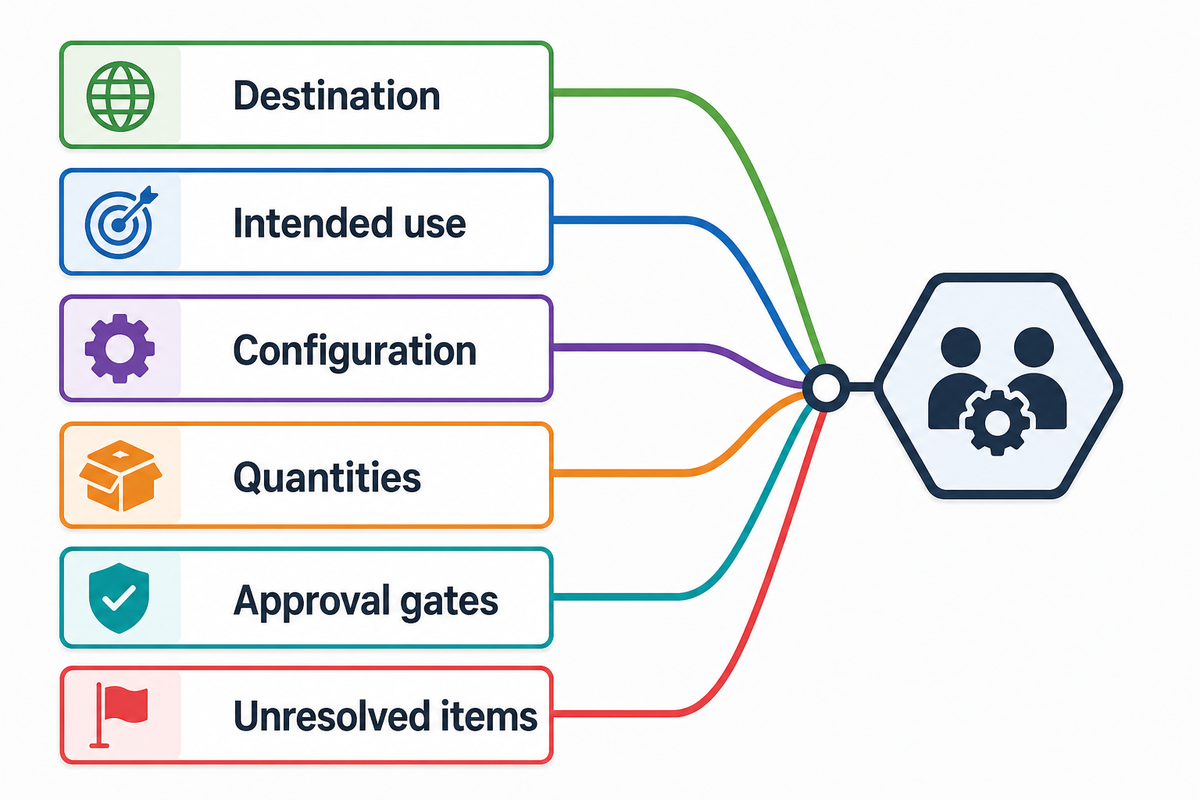
Send MACY-PAN your controlled 10-block brief, including the destination, intended use, configuration, quantities, approval gates, and unresolved items assigned to named owners. The technical and commercial teams can return feasibility questions, configuration options, quotation assumptions, and supplier-confirmed commercial terms against the same revision.
Scope and transparency
This article is a procurement-document method, not legal, regulatory, clinical, or engineering advice. It doesn’t state universal chamber pressure, oxygen, electrical, fire, performance, MOQ, tooling, lead-time, price, warranty, or certification terms. Confirm the exact chamber, operating model, intended use, destination, applicable requirements, supplier evidence, and contract with competent technical, quality, and regulatory reviewers.
Related buying resources
- Hyperbaric chamber RFQ checklist for the broader supplier-question workflow
- OEM hyperbaric chamber manufacturing guide for general supplier selection
- Hyperbaric certification decoder for certificate-scope questions
- Hyperbaric chamber factory audit checklist for supplier-site verification
References & Sources
- Who Must Register, List and Pay the Fee U.S. Food and Drug Administration
- Quality Management System Regulation (QMSR) U.S. Food and Drug Administration
- Premarket Notification 510(k) U.S. Food and Drug Administration
- Human Factors Considerations U.S. Food and Drug Administration
- Follow Instructions for Safe Use of Hyperbaric Oxygen Therapy Devices U.S. Food and Drug Administration
- Cybersecurity in Medical Devices: Frequently Asked Questions U.S. Food and Drug Administration
- Regulation (EU) 2017/745 on Medical Devices EUR-Lex
- Economic Operators Under the Medical Devices Regulations European Commission
- ISO 13485:2016, Medical devices, Quality management systems International Organization for Standardization
- Quality System Regulation Labeling Requirements U.S. Food and Drug Administration